ChatGPT Plus vs API: Is the API Cheaper Than $20 a Month?
Plus is $20 a month; the API bills separately. A 10-turn chat on gpt-6-sol, the model behind GPT-6 in Plus, costs about $0.13. Long threads and Codex suit Plus.
On this page
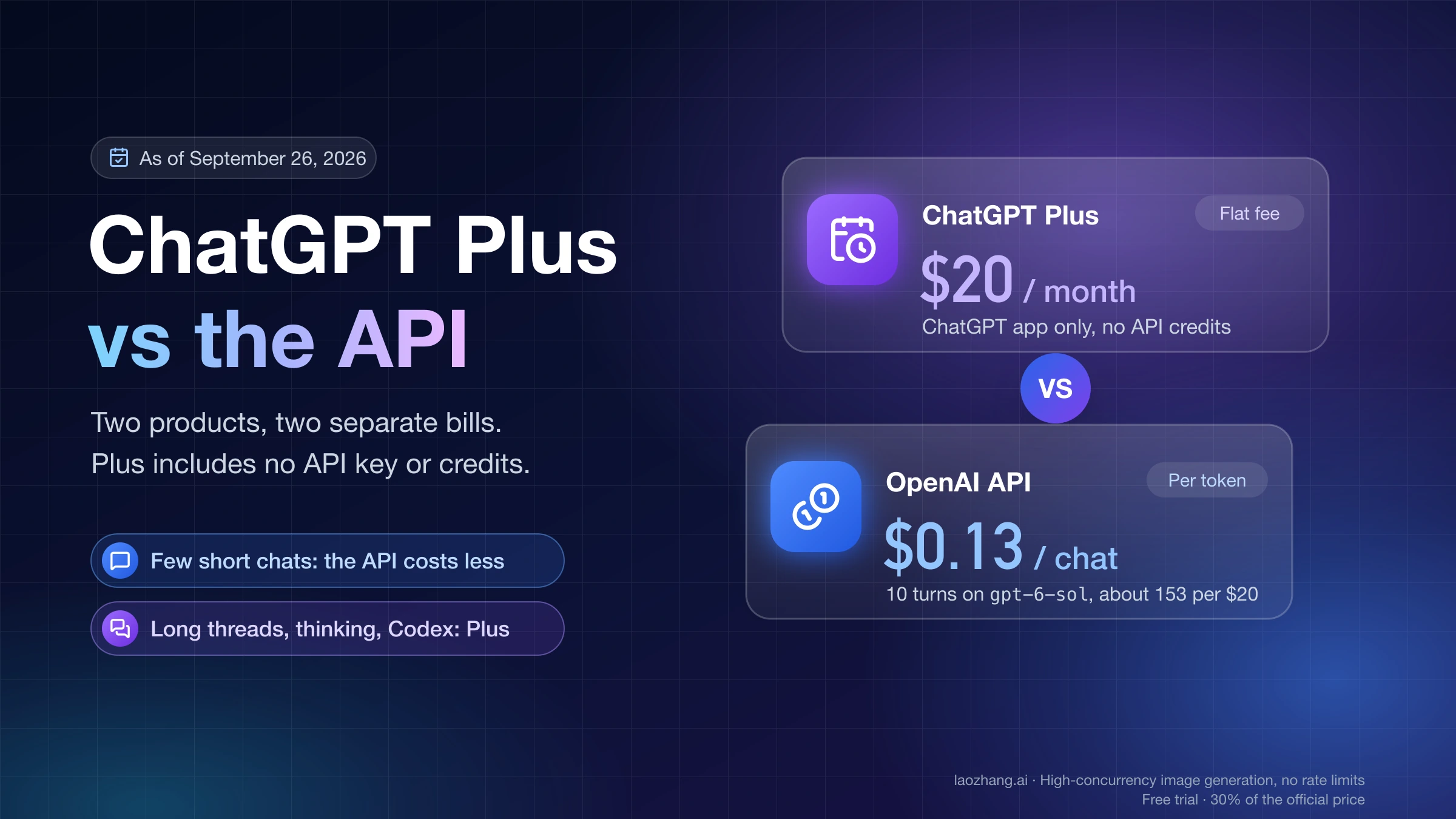
ChatGPT Plus and the OpenAI API are two products with two bills. Plus costs $20 a month for the ChatGPT app. It does not include an API key or API credits, and there is no way to move subscription money into an API account. The API is prepaid, charged per token, and needs your own script or a third-party app to talk to it.
What changed since September 26, 2026: OpenAI is rolling out GPT-6 to Plus chats, so the closest API model is now gpt-6-sol instead of gpt-5.6-sol. OpenAI also replaced its Codex usage estimates and added gpt-6.1-sol to the API price list. Everything below is current as of October 8, 2026.
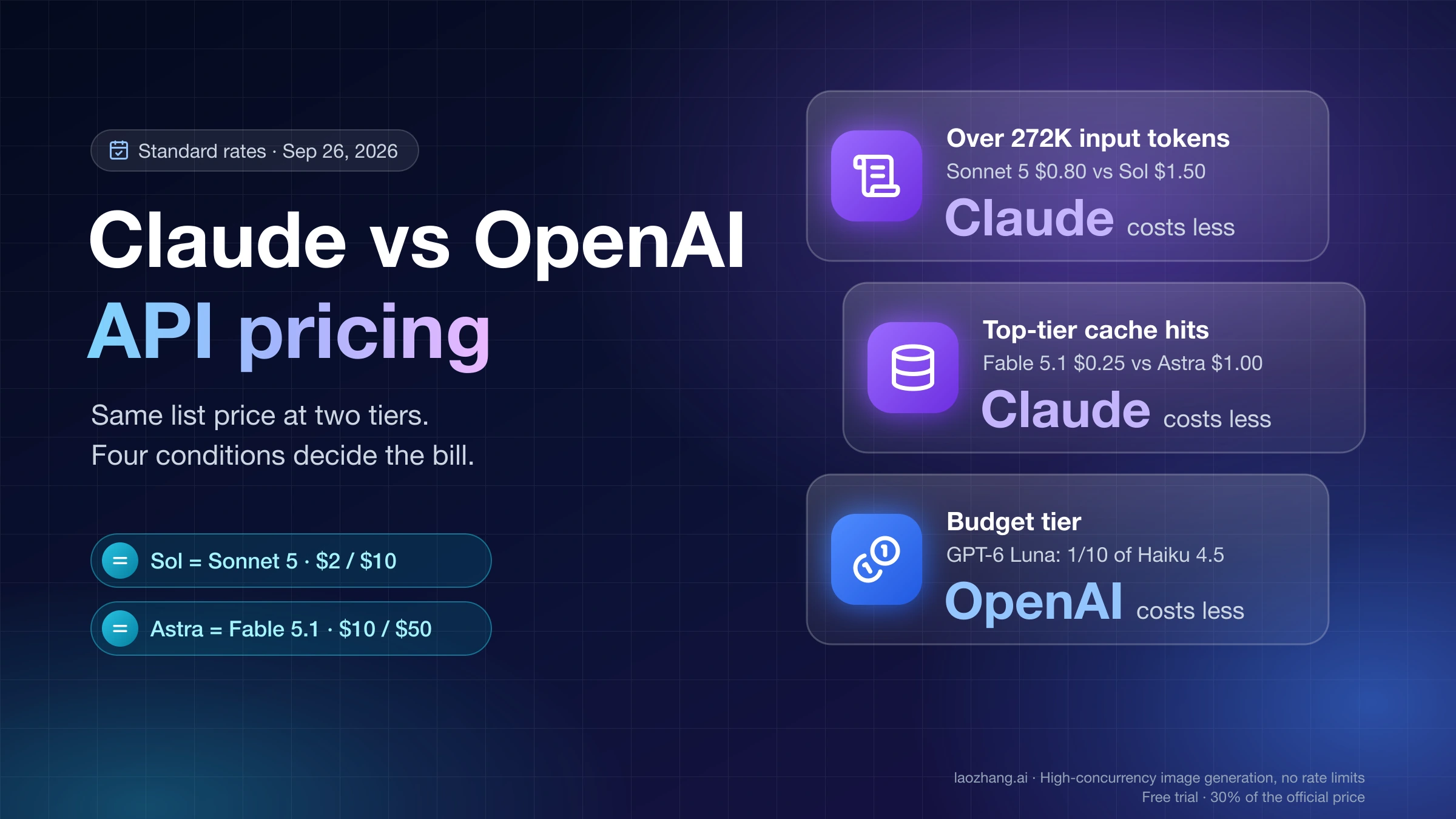
Whether the API is cheaper depends on how you chat. With GPT-6 selected, GPT-6 Sol answers Plus chats at Instant, Medium and High. On the API, gpt-6-sol costs $2 per million input tokens and $10 per million output tokens, half the price of gpt-5.6-sol. Plus accounts the rollout has not reached yet, and anyone who picks GPT-5.6 Sol in the model menu, map to gpt-5.6-sol instead. A 10-turn conversation with short messages costs about $0.13 on gpt-6-sol and about $0.26 on gpt-5.6-sol. That is roughly 153 or 76 such conversations for $20, before any reasoning tokens. If you ask a few short questions a week, or a small model like gpt-6-luna does the job, the API will cost far less than $20. If you keep long threads going every day with thinking turned on, or you use Codex, the Work agent, voice, image generation or Deep Research, Plus is usually the better deal.
Plus does not include an API key or credits
OpenAI's help center puts it plainly: "ChatGPT and the API platform have separate billing systems." The ChatGPT Plus help page lists API usage under "Not included," and ChatGPT Go says the same. In practice that means:
- Your ChatGPT login will not work in an app that asks for an OpenAI API key. Those apps are often called BYOK ("bring your own key") clients, and every request they send is billed to your API account, not to Plus.
- You manage the two charges in two places. The subscription lives in ChatGPT under Settings → Billing. API spending lives in the API billing overview on the OpenAI platform.
- If you subscribed to Plus through the Apple App Store or Google Play, that subscription is billed there. OpenAI notes that subscriptions on more than one platform can create separate charges.
- Codex can run either way. Signed in with ChatGPT, it draws on your plan's allowance. Signed in with an API key, it is billed at API rates. The Codex API Key vs Subscription guide covers how each sign-in behaves.
- Plus can buy ChatGPT credits to extend Codex and Work usage. Those are not API credits and do nothing for an API bill.
Plus and the API side by side
| ChatGPT Plus | OpenAI API | |
|---|---|---|
| How you pay | $20 per month, billed monthly (US price; local price and tax depend on your billing country) | Prepaid credits drawn down per token; $5 minimum purchase |
| Where you use it | ChatGPT website and apps | Your own code, or a third-party app where you paste an API key |
| Models in chat | GPT-6, powered by GPT-6 Sol at Instant, Medium and High (rolling out); GPT-5.6 Sol stays selectable. Extra High and GPT-6 Pro are not part of Plus | Whatever model ID you request, such as gpt-6-sol, gpt-6.1-sol, gpt-6-luna, gpt-6-astra or gpt-5.6-sol |
| Limits | Everyday text chat is unlimited, subject to abuse guardrails. Thinking, tools and image generation have separate limits with no published numbers; at a Thinking limit, ChatGPT may continue with another model | Rate limits set by your usage tier; gpt-6-sol is not available on the Free tier |
| Built-in features | Voice, image generation, file uploads and analysis, Deep Research, memory across chats, projects, existing custom GPTs (personal plans can no longer create new ones) | Tools such as web search and code containers are billed per use; memory and projects depend on the app you build or use |
| Work agent and Codex | One shared allowance included | Codex on an API key is billed per token |
| Training on your data | Conversations may be used to improve models unless you opt out in Data Controls | Not used for training by default; abuse-monitoring logs kept for up to 30 days |
Sources: OpenAI billing help, GPT-6 and other models in ChatGPT, API pricing and API data controls, as of October 8, 2026. Plan-by-plan caps are collected in ChatGPT Usage Limits by Plan: Free, Go, Plus, Pro and Resets.
How to estimate your own API bill
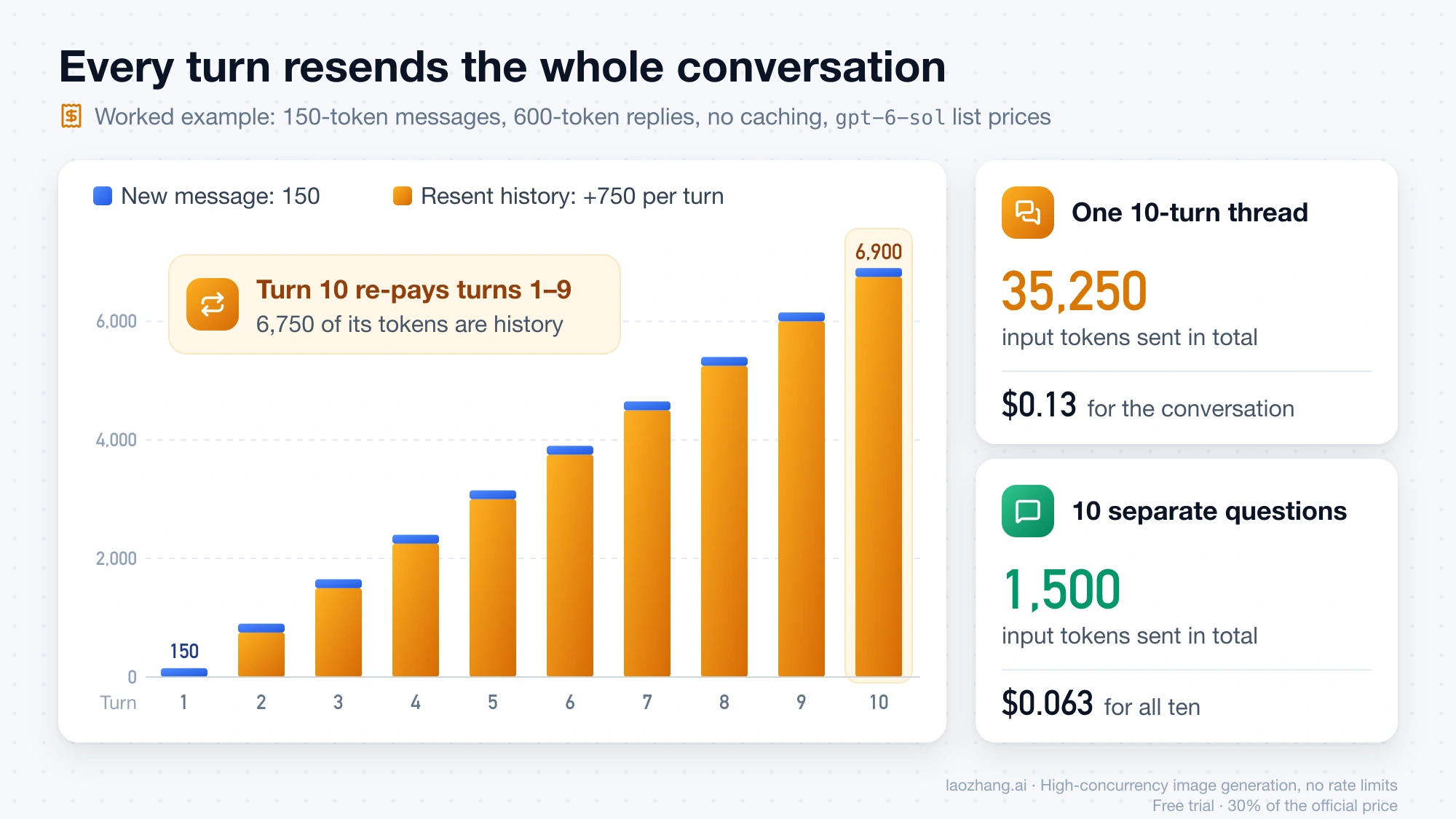
The API charges for every token you send and every token the model writes. The catch in a chat is that the model has no memory between calls. Your app resends the whole conversation each turn, so turn 10 pays again for turns 1 through 9.
cost of one conversation =
  (total input tokens x input price + total output tokens x output price) / 1,000,000

total input tokens  = for every turn: all earlier messages and replies + your new message
total output tokens = for every turn: visible reply + reasoning tokens
A worked example makes the effect visible. Assume a 10-turn conversation where each of your messages is 150 tokens, each visible reply is 600 tokens, the full history is resent every turn, and nothing is cached. Turn k (counting from 0) sends 150 + 750 × k input tokens, so the conversation sends 35,250 input tokens in total and receives 6,000 output tokens. At Standard list prices as of October 8, 2026:
| Model (API ID) | Input / output per 1M tokens | One 10-turn chat | Chats per $20 | Plus 1,000 reasoning tokens per reply | Chats per $20 |
|---|---|---|---|---|---|
gpt-6-luna | $0.10 / $0.50 | $0.0065 | about 3,065 | $0.0115 | about 1,735 |
gpt-6-sol (GPT-6 in Plus chats) | $2 / $10 | $0.13 | about 153 | $0.23 | about 86 |
gpt-6.1-sol | $2 / $10 | $0.13 | about 153 | $0.23 | about 86 |
gpt-5.6-sol (GPT-5.6 Sol in Plus chats) | $4 / $20 | $0.26 | about 76 | $0.46 | about 43 |
gpt-6-astra | $10 / $50 | $0.65 | about 30 | $1.15 | about 17 |
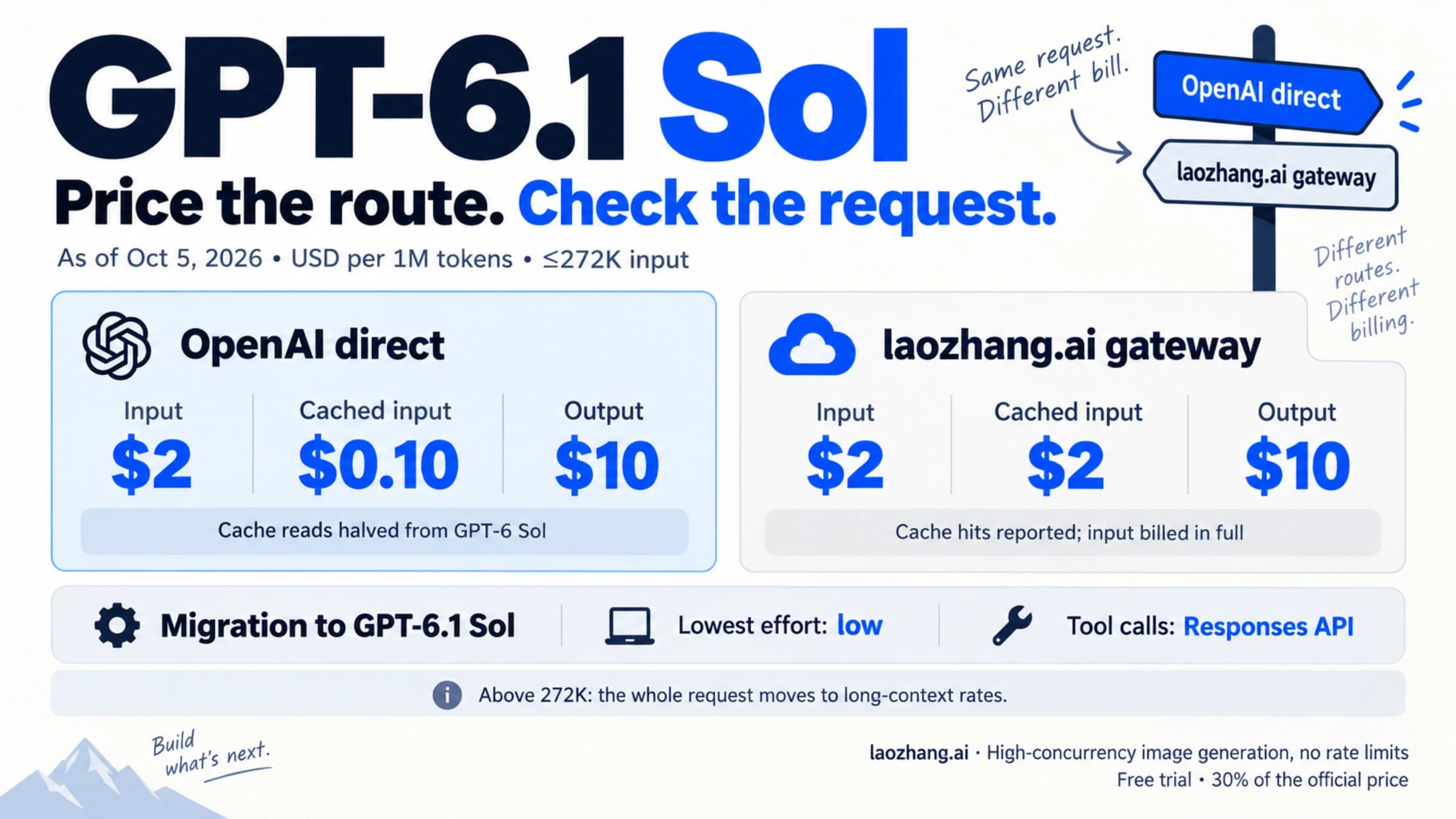
These figures are arithmetic from list prices and assumed message sizes, not a measured bill. For gpt-6-sol the calculation is 35,250 × $2 / 1M + 6,000 × $10 / 1M = $0.0705 + $0.06 = $0.1305. gpt-6.1-sol is new on the price list and costs the same per token; only its cached input is cheaper ($0.10 instead of $0.20 per 1M). In ChatGPT it is a Work and Codex model, not a chat model. The gpt-5.6-sol price is OpenAI's promotional rate, which the pricing page says runs at least through November 21, 2026.
Three things stand out:
- Long threads cost more than the same words asked separately. One question-and-answer of the same size on
gpt-6-solcosts $0.0063, so ten separate questions come to $0.063. Kept in one thread, they cost $0.13 because the thread sends 35,250 input tokens instead of 1,500. That is why "Plus is cheaper if you have long conversations" holds up. - Reasoning roughly doubles the bill here. Plus offers Medium and High thinking on GPT-6 Sol, so a fair API comparison includes reasoning tokens. Adding 1,000 per reply takes
gpt-6-solfrom $0.13 to $0.23 per conversation. - Model choice matters most.
gpt-6-astracosts 100 times as much per token asgpt-6-luna.
To turn this into a monthly figure, multiply by how many conversations you have. At three such conversations a day (90 a month), gpt-6-sol comes to about $11.75 without reasoning and $20.75 with it. If you stay on GPT-5.6 Sol, gpt-5.6-sol comes to $23.49 and $41.49. gpt-6-luna stays under $1.10 either way. On Plus, the same everyday chatting stays inside the $20, because Plus includes unlimited everyday text chat, subject to abuse guardrails.
Your own messages will not match the example, so measure them instead of guessing:
- Pick a typical week in your ChatGPT history. Count the conversations and roughly how many turns each one runs.
- Buy the $5 minimum of API credit (turn off auto-reload while you do, as described below) and replay three to five of those conversations through the model you would actually use.
- Read the
usageobject on each response:input_tokens,output_tokens, andoutput_tokens_details.reasoning_tokens. Reasoning tokens are already included inoutput_tokens. - Put the average per conversation into the formula, multiply by your monthly count, and add any tool charges from the next section.
If the total lands well under $20 and you would not miss the app features listed further down, the API is cheaper for you. If it lands near or above $20, Plus is the better buy.
Why API bills climb faster than expected
When an API bill comes in higher than expected, check these first:
- Growing history. Every turn resends everything before it, as shown above.
- Hidden reasoning. Reasoning tokens never show up in the reply, but OpenAI bills them as output. The reasoning guide says a response can use anywhere from a few hundred to tens of thousands of them. GPT-5.6 models also carry available reasoning from earlier turns into the next one by default, which adds input on later turns;
reasoning.contextcontrols that. A response that stops atmax_output_tokensbefore any visible text still charges for the input and the reasoning. - Tools. Web search costs $10 per 1,000 calls (1 cent each) plus the search content tokens at the model's rate. Code Interpreter and Hosted Shell containers start at $0.03 per 20-minute session. File search storage is $0.10 per GB per day after the first free GB. In Plus, the equivalent features are simply part of the app.
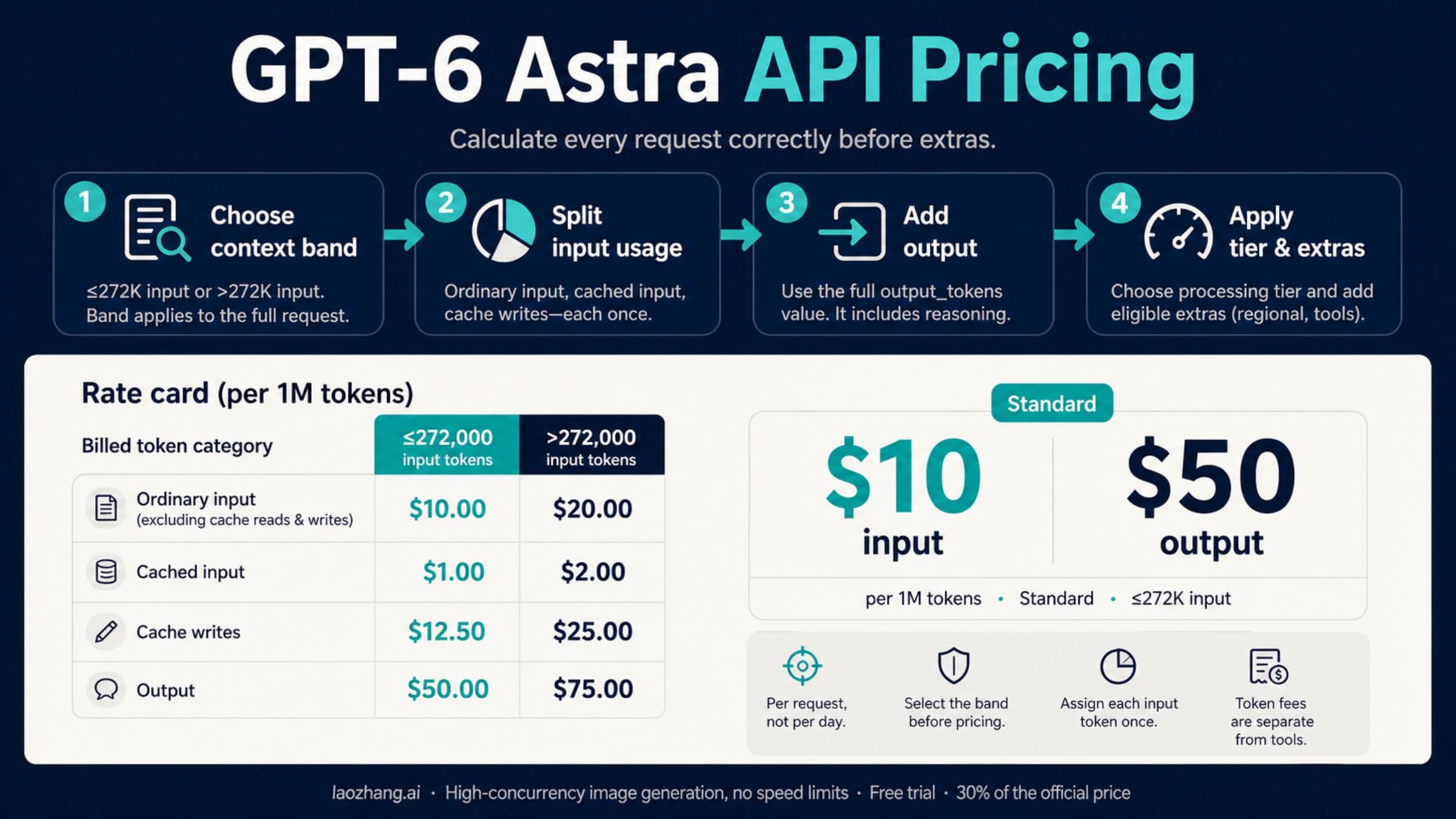
- Very long prompts. A request with more than 272K input tokens is billed at 2x the input and cache rates and 1.5x the output rate for the whole request.
- Fast mode. It doubles the Standard price.
A few settings push the other way. Batch and Flex processing cost half of Standard for work that can wait. Cached input is billed at 10% of the input price on gpt-6-sol (5% on gpt-6.1-sol) when a prompt repeats an earlier prefix, although writing to the cache costs 1.25x the input price. A lower reasoning.effort and a smaller model cut output tokens directly.
What you give up by canceling Plus
Switching to the API means paying only for tokens. It also means dropping everything the $20 bundles in:
- The ChatGPT app itself. Voice conversations, image generation, file uploads and analysis, Deep Research, memory across chats, projects, and your existing custom GPTs. Through the API, some of these become separate per-use charges. Others depend on whatever client you use.
- Unlimited everyday chat on GPT-6. Plus does not meter ordinary text chat, so the flat fee covers heavy days without a per-token bill.
- The Work agent and Codex allowance. Plus includes one shared allowance for both. OpenAI estimates a Plus account gets these local messages per five hours: 5–45 with GPT-6 Astra, 15–160 with GPT-6.1 Sol, 15–150 with GPT-6 Sol, and 350–3,000 with GPT-6 Luna. A weekly limit can also apply. OpenAI says these estimates are not fixed message limits, and cloud tasks can use more of the allowance than local messages.
- GPT-6 Astra inside Work and Codex. Plus includes Astra there, though not GPT-6 Pro in regular chat.
GPT-5.5 retires from ChatGPT, Work and Codex on all plans on October 14, 2026. The API is not affected: gpt-5.5 stays on the price list at $5 per 1M input tokens and $30 per 1M output tokens, so after that date the API is the only way to keep using it.
What the API gives you in return:
- Exact model control. You pick the model ID and the reasoning effort for every request, including models Plus chats do not offer, such as
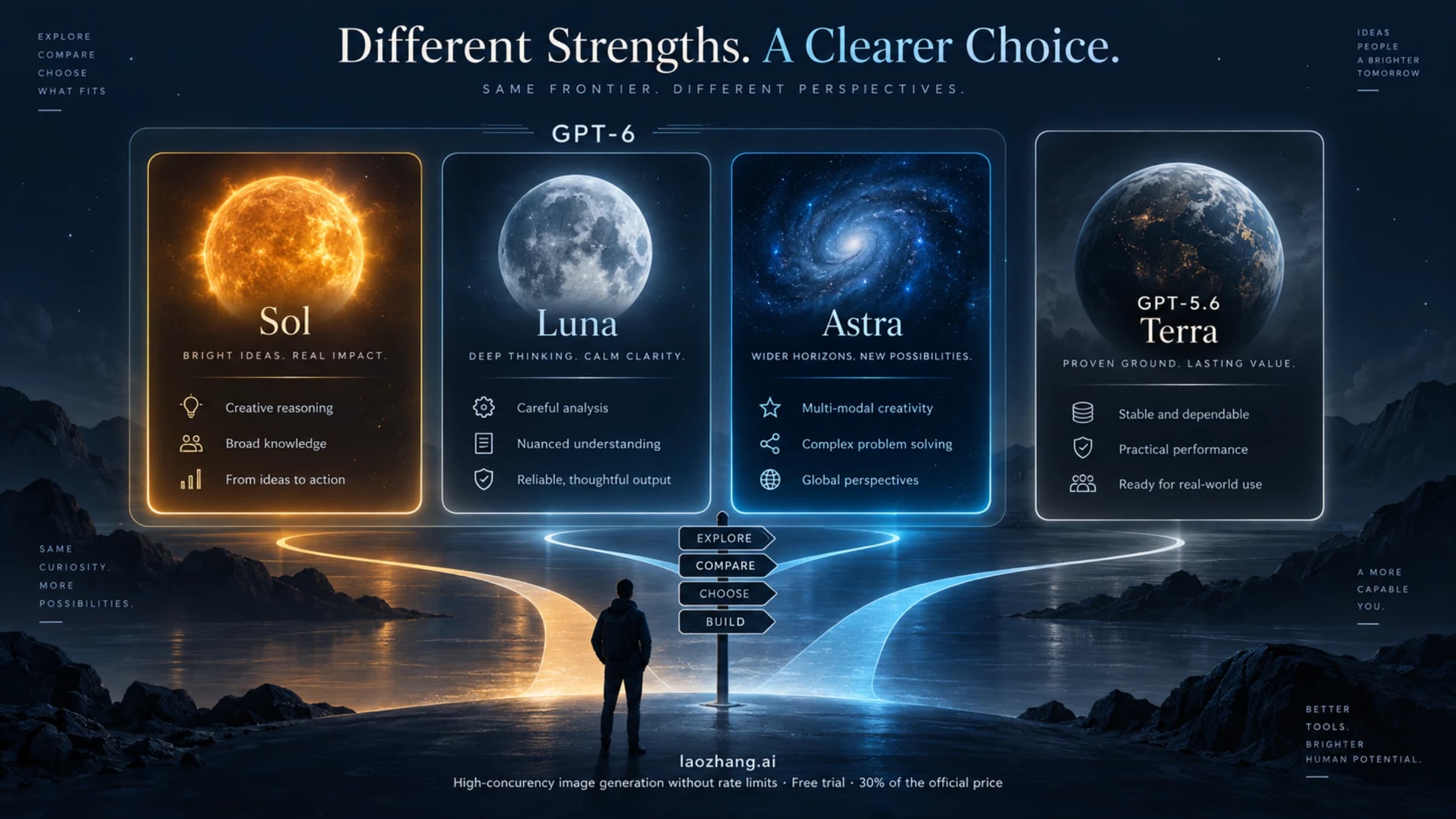
gpt-6-lunaandgpt-6-astra. The GPT-6 Sol vs Terra vs Luna vs Astra comparison helps with picking one. - Programmatic use. Scripts, automations, and your own apps, none of which Plus covers.
- No ChatGPT Thinking or tool caps. You still get rate limits based on your usage tier.
- Different data defaults. Since March 1, 2023, OpenAI does not use API data to train models unless you opt in. That is not the same as not storing it: abuse-monitoring logs are kept for up to 30 days by default. A third-party chat app that uses your key keeps its own copy of your chats under its own policy. Plus users can opt out of training in Data Controls, so privacy alone does not force a switch.
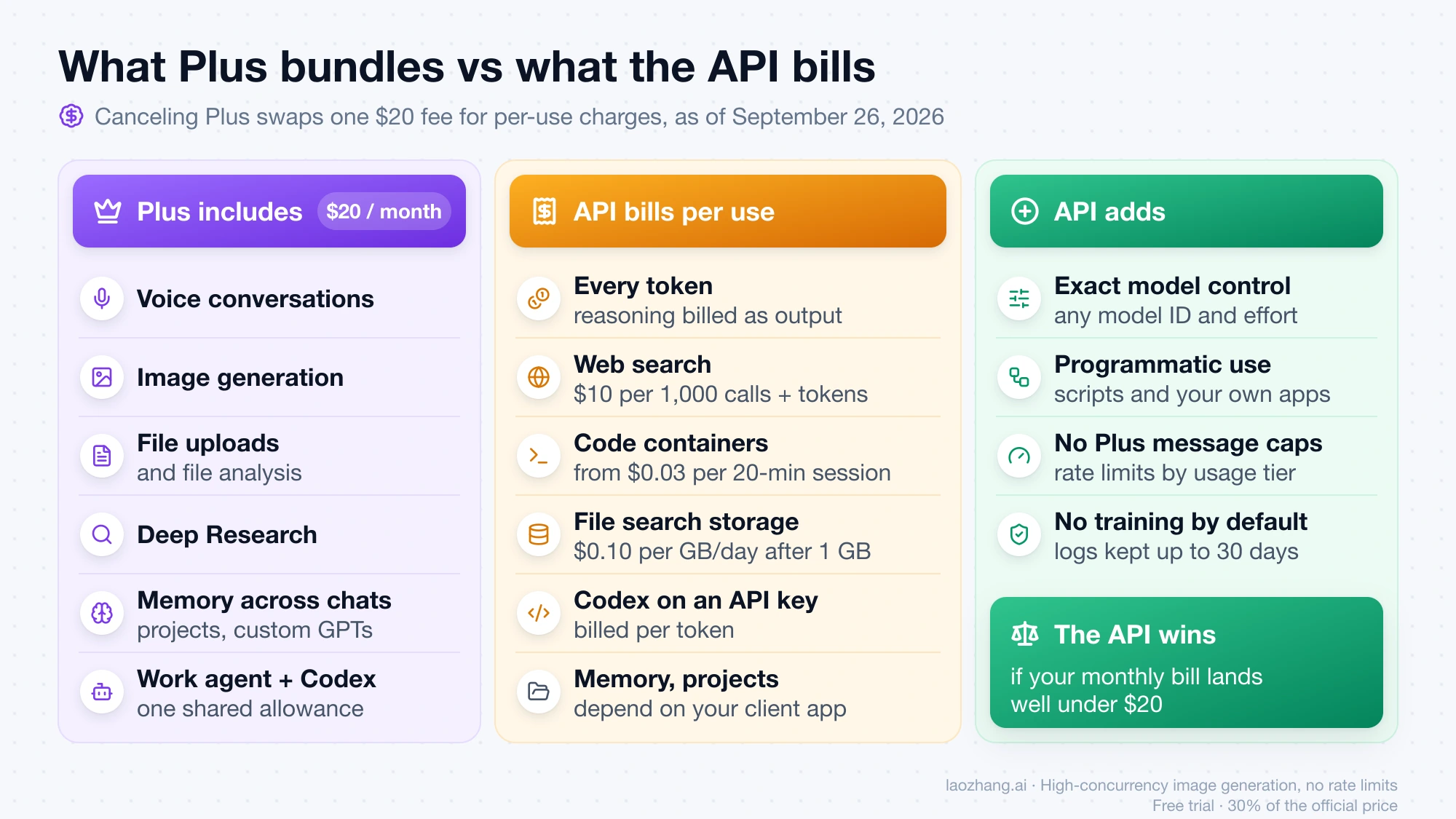
This chart predates the October 8, 2026 update and still lists custom GPTs as a Plus feature; the text above is current: personal plans can use existing GPTs but no longer create new ones.
Codex: Plus allowance or an API key
Codex users face the same decision in a sharper form. Coding tasks read a lot of files, so input tokens add up quickly. On an API key, every 1 million input tokens costs $2 on gpt-6-sol or gpt-6.1-sol and $10 on gpt-6-astra, and every 1 million output tokens costs $10 and $50. On Plus, the same work comes out of the shared Work and Codex allowance, with no per-token charge until you hit the limit. OpenAI's Codex pricing card for Plus lists GPT-6.1 Sol and GPT-6 Luna.
When you hit the limit on Plus, you can wait for the reset time shown in the usage dashboard (or /status in the Codex CLI) or buy ChatGPT credits. Credits are also counted per token, for example 50 credits per 1M input tokens and 250 per 1M output tokens on GPT-6 Sol, but OpenAI does not publish a dollar price per credit on its pricing pages, so a direct comparison with API prices is not possible. Reset options are covered in Codex Weekly Limit Reset: Find Your Time or Reset Now. None of it turns into API credit. OpenAI also lets any Codex user run extra local chats with an API key at standard API rates. If you mainly run Codex in CI or scripts where no one signs in, an API key is the practical choice. If you mostly work interactively and stay under the allowance, Plus is hard to beat on cost.
Switching to the API without surprise charges
Setting up API billing takes a few minutes, but several defaults can cost you money:
- New API accounts are prepaid. The minimum purchase is $5 and the default is $10.
- Turn off auto-reload if you want a hard budget. It is on by default during setup and buys more credit automatically.
- Credits expire after one year and are generally non-refundable. Buy small amounts until you know your usage. The OpenAI API Credits Expired guide explains what happens after that.
- Do not treat the balance as an instant cutoff. Requests processed after your credits run out can leave a negative balance. Your organization's monthly usage limit and any spend limits work separately from the balance, so review them too.
- Expect to pay before using the newer models.
gpt-6-solis not supported on the Free tier, so a brand-new unpaid account cannot call it. OpenAI API Free Tier: What's Actually Free and What Still Bills covers what does work without paying. - Cancel Plus where you bought it. On the web that means ChatGPT → Settings → Billing; for app-store subscriptions, use the Apple or Google subscription settings.
After a month, open the API billing overview and compare your chat-style spending with $20. That one number settles the question better than any estimate.
Plus, API, or both
| Your situation | Best fit | Why |
|---|---|---|
| Long daily conversations with thinking on | Plus | Resent history and reasoning tokens push API cost toward or past $20, while everyday chat on Plus is unmetered |
| You use voice, image generation, file analysis or Deep Research | Plus | These are included in Plus; on the API they are extra charges or missing |
| Regular Codex or Work agent use within the allowance | Plus | The shared allowance has no per-token charge |
| A few short questions a week | API | A short question and answer on gpt-6-sol costs under 2 cents, even with 1,000 reasoning tokens |
Tasks that a small model like gpt-6-luna handles | API | 90 ten-turn conversations cost about $1 a month |
| Scripts, automations, or your own app | API | Plus cannot be used programmatically |
| Daily ChatGPT user who also builds with the API | Both | Two bills, but each covers what the other cannot |
If Plus limits are what push you toward the API, check ChatGPT Plus Message Limit and Credits: What Is Still Capped first. A different plan may fit better than switching products: Pro now comes in $100, $200 and $500 tiers, and the ChatGPT Go vs Plus vs Pro comparison lays them out. For the same decision on the Anthropic side, see Claude Code Heavy Users: API vs Subscription, Keep or Downgrade?
FAQ
Can I use my ChatGPT Plus subscription in apps that ask for an API key?
No. Apps that ask for an OpenAI API key send requests to the API, which is billed to your API account. Plus covers only the ChatGPT website and apps.
Does ChatGPT Plus come with any API credits?
No. Plus and the API have separate billing, and OpenAI describes no way to turn subscription payments into API credit. ChatGPT credits, which Plus users can buy for Codex and the Work agent, are a different currency and cannot pay for API calls.
Can you use the ChatGPT API without a ChatGPT subscription?
Yes. The API needs only an OpenAI platform account with prepaid credit, starting at $5. No Free, Go or Plus plan is required, and having Plus does not reduce the API bill.
Is the model in ChatGPT Plus the same as the one I get through the API?
As of October 8, 2026, Plus chats with GPT-6 selected run on GPT-6 Sol, which the API offers as gpt-6-sol at $2 per 1M input tokens and $10 per 1M output tokens. If your account does not show GPT-6 yet, or you choose GPT-5.6 Sol in the model menu, the API match is gpt-5.6-sol at $4 and $20. The API also offers gpt-6-luna at a fraction of either price and gpt-6.1-sol, which ChatGPT offers only in Work and Codex. What the API cannot give you is the ChatGPT app around the model.
Sources6
External pages this guide links to, in the order they appear. Last updated Oct 8, 2026.
Sources6
External pages this guide links to, in the order they appear. Last updated Oct 8, 2026.
- 1.ChatGPT Plus help pagehelp.openai.com/en/articles/6950777-what-is-chatgpt-plus
- 2.OpenAI billing helphelp.openai.com/en/articles/9039756-managing-billing-for-chatgpt-and-the-api-platform
- 3.GPT-6 and other models in ChatGPThelp.openai.com/en/articles/20001354-gpt-6-and-other-models-in-chatgpt
- 4.API pricingdevelopers.openai.com/api/docs/pricing
- 5.API data controlsdevelopers.openai.com/api/docs/guides/your-data
- 6.reasoning guidedevelopers.openai.com/api/docs/guides/reasoning