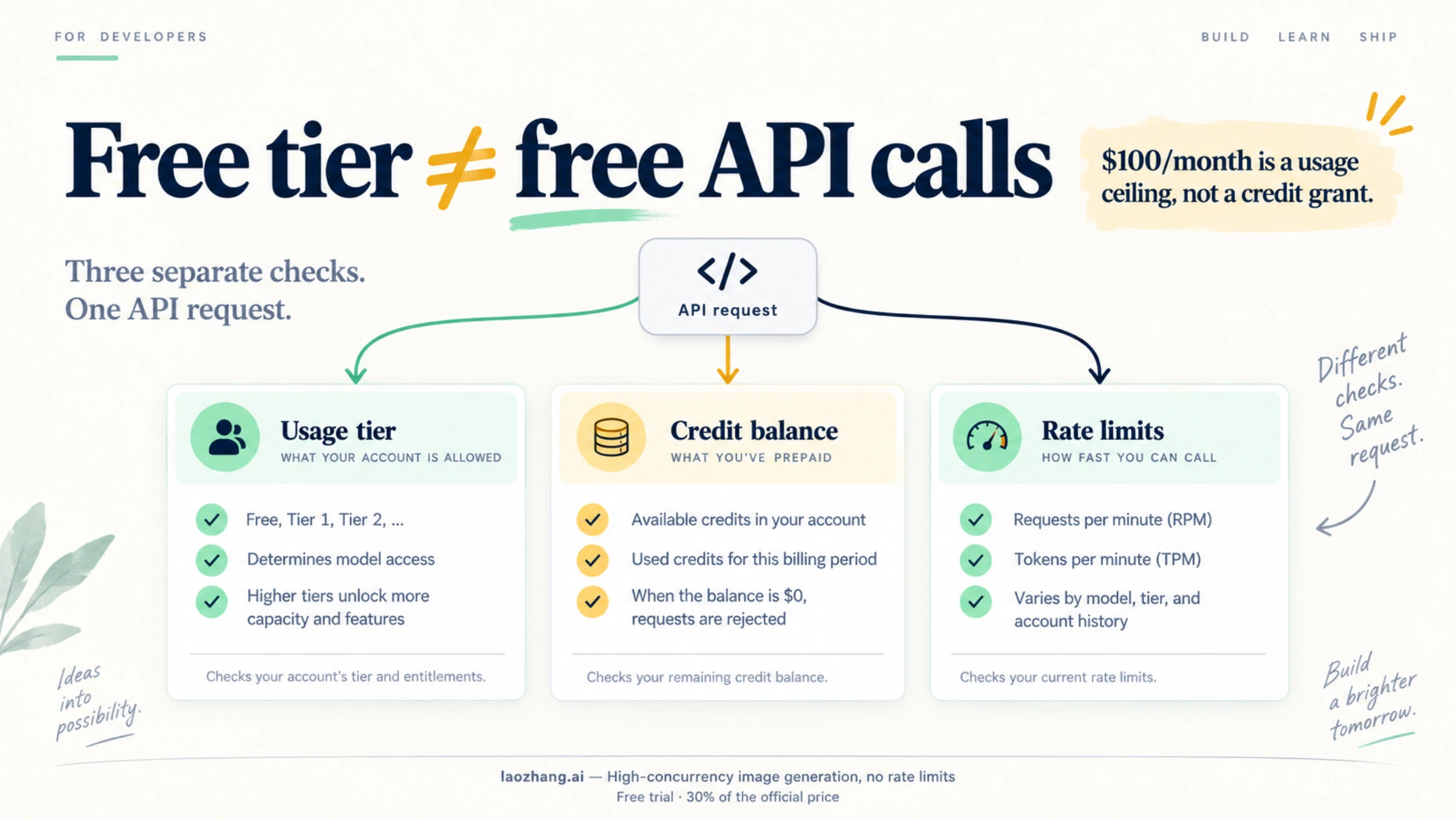
The OpenAI API does not offer every account a recurring, no-charge allowance just because its usage tier says “Free.” As of September 21, 2026, OpenAI’s documentation lists $100 per month as the Free tier’s usage limit. That is a ceiling on approved usage, not $100 deposited into your account. You still need a valid way to cover requests: available credits or an applicable complimentary-token offer. OpenAI’s usage-tier documentation and prepaid billing guide describe those separately.
Start with your account’s billing balance, then check whether it actually displays a free-credit grant or complimentary-token offer. After that, inspect the limits for the model you want to use. An API key, a Free tier label, and access to ChatGPT answer none of those billing questions by themselves.
What “free” can mean in an OpenAI account
Several different account features appear in discussions of the free tier. Only some can pay for—or remove the token charge from—a request.
| What you see | What it means | Does it make API calls free? |
|---|---|---|
| Free usage tier | Your organization’s current usage-tier classification | No. A tier label is not a credit balance. |
| $100/month usage limit | The approved monthly usage ceiling shown for that tier in the documentation | No. It does not fund requests. |
| Free credits in API billing | A grant actually attached to your account, subject to its terms | Potentially, while the credits remain valid and cover the request. |
| Complimentary tokens for data sharing | An offer available to some eligible organizations | Only for qualifying usage under the offer’s conditions. |
| Free or paid ChatGPT access | Access to the ChatGPT product | It does not automatically include API usage. |
The first two rows come from the API usage-tier table. OpenAI documents free credits conditionally—if your account has them, they are used before purchased credits. It does not promise every new signup a $5 or $18 grant. Check the amount and expiration shown for your own grant rather than relying on an old signup tutorial. Prepaid billing details
ChatGPT and the API also have separate billing systems. A ChatGPT subscription does not settle an API invoice, and hitting a ChatGPT message limit does not tell you how much API capacity you have left.
Check whether your own account can run without a usage charge
Use this order before sending a test request. It separates eligibility from funding and avoids mistaking a configured limit for money you can spend.
- Confirm service availability for your actual location. The United States is on OpenAI’s supported-country list, but the language of an account or tutorial does not determine eligibility. Check the list if you are developing elsewhere.
- Open API billing for the organization you intend to use. Look for usable credits and any grant-specific terms. If there is no credit grant, do not assume creating a new key will create one.
- Check Data controls only if you want to investigate the complimentary-token offer. The sharing page must show that your organization is eligible. An absent offer means it is not currently available to that organization; upgrading a tier is not a guarantee.
- Open the organization Limits page. Confirm the intended model’s request and token limits, along with the organization and project spending controls.
- If you choose to test, compare Usage with Costs afterward. Token activity alone is not proof that it was billed. Conversely, a successful response alone is not proof that it was free.
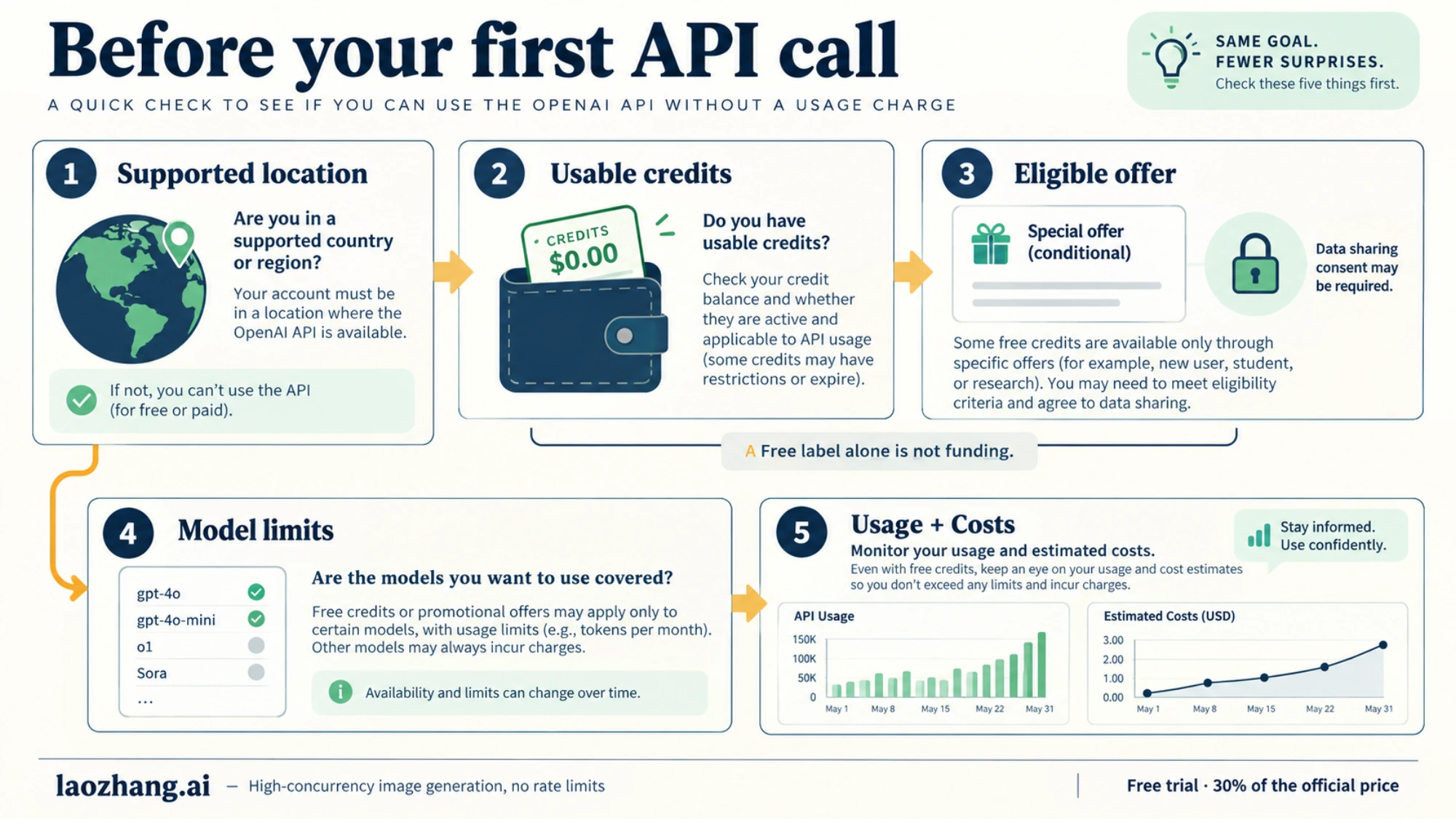
If neither usable free credits nor an applicable offer is present, plan on paid API usage. OpenAI’s prepaid setup has a $5 minimum initial purchase; buying credits is an optional paid test, not activation of a free plan. Purchased credits expire after one year. That purchase-expiration rule should not be substituted for the terms of a promotional grant. Prepaid billing guide
For the mechanics of obtaining a key and making a first request, use the separate API key and trial guide. The checks here determine what can cover that request.
Complimentary tokens have their own eligibility and daily limits
OpenAI offers complimentary daily tokens to some organizations that opt in to sharing API inputs and outputs. The offer must be visible in the organization’s Data controls, requires a positive account balance, and applies only to enabled projects and eligible models. Sharing is off by default; review whether you are permitted to share the data before enabling it. It can be used to improve OpenAI’s models. Offer and data-sharing terms
For eligible organizations, the published daily allowances are:
| Usage tier | Larger-model group | Smaller-model group |
|---|---|---|
| Tiers 1–2 | 250,000 tokens/day | 2,500,000 tokens/day |
| Tiers 3–5 | 1,000,000 tokens/day | 10,000,000 tokens/day |
These are combined input and output tokens, shared within each model group, not separate allowances for every model, project, or API key. They reset at midnight UTC. Check the live eligibility and model list rather than assuming any model you can call qualifies. Tool use, evaluations, and fine-tuning are excluded from these complimentary tokens.
Do not count on only the excess tokens being charged when a request crosses the daily allowance. The help article contains conflicting overage examples, but its explicit crossing-request rule says the entire request is billed. Budget conservatively on that basis and confirm the actual charge in Costs. A daily allowance is therefore not a reliable stop switch for paid usage.
Rate limits control speed, not your credit balance
A funded account can still be throttled. OpenAI measures throughput in several ways, including requests per minute or day and tokens per minute or day; some models also have image limits. The first applicable limit you reach can constrain a request. Limits vary by model and apply at the organization and project levels, so rotating API keys does not create an independent pool. Rate-limit guide
There is no single Free-tier RPM or TPM number that you should copy into every application. Use the model-specific values in your Limits dashboard. Numbers shown in documentation examples are not a reading of your account.
For a hypothetical workload, imagine sending a few requests that each contain a long document. You might exhaust the token allowance for a minute while remaining far below the request-count limit. Slowing the batch or reducing its token demand addresses that constraint; adding credit alone does not change the model’s current throughput allowance.
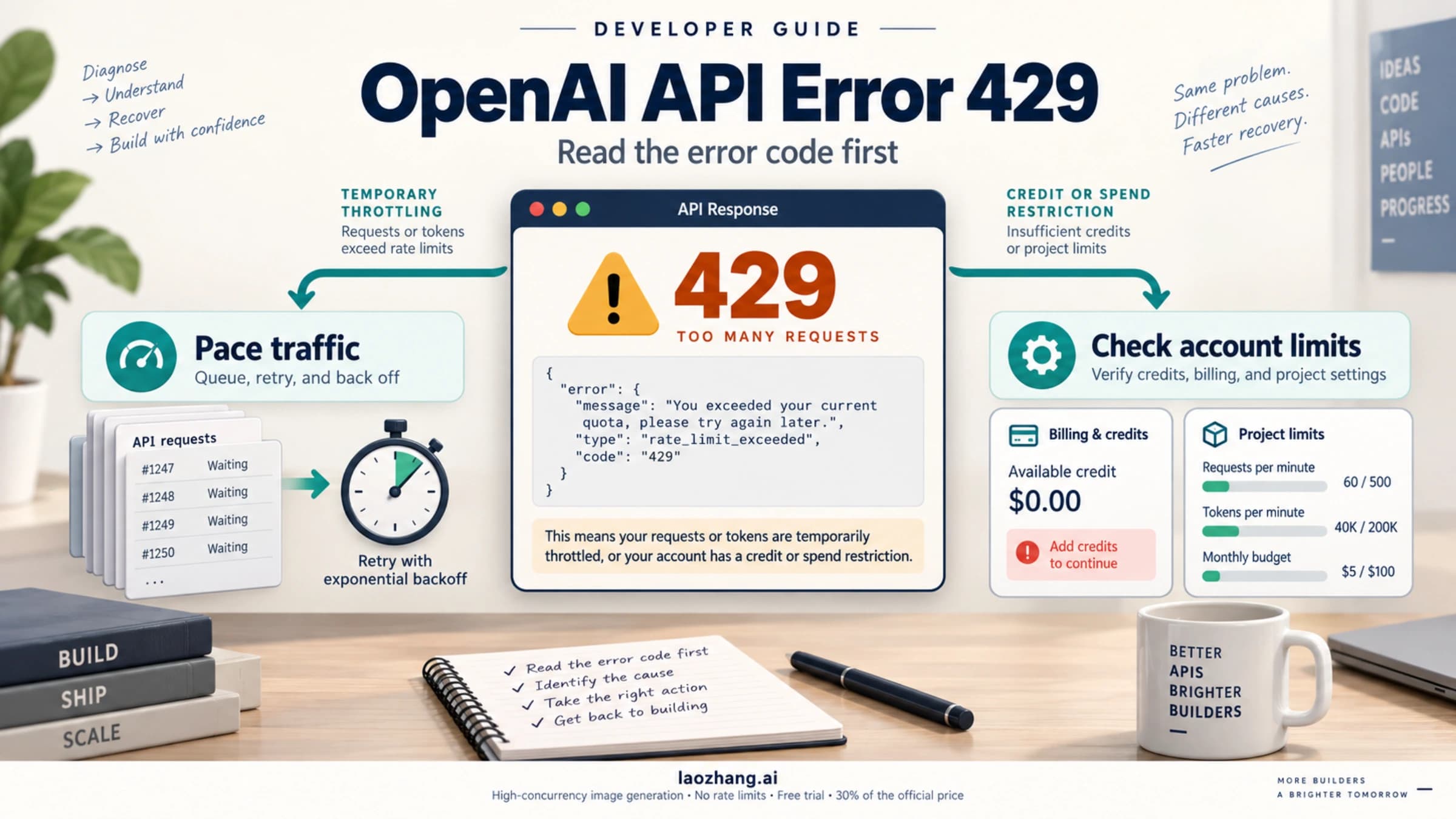
A temporary rate-limit response can justify waiting and retrying with bounded backoff, respecting Retry-After when present. A depleted balance or enforced spending limit needs a different fix. See the OpenAI API rate-limit guide for detailed recovery, or the quota-exceeded guide for account and billing checks.
Set a hard spending limit if paid overage is unacceptable
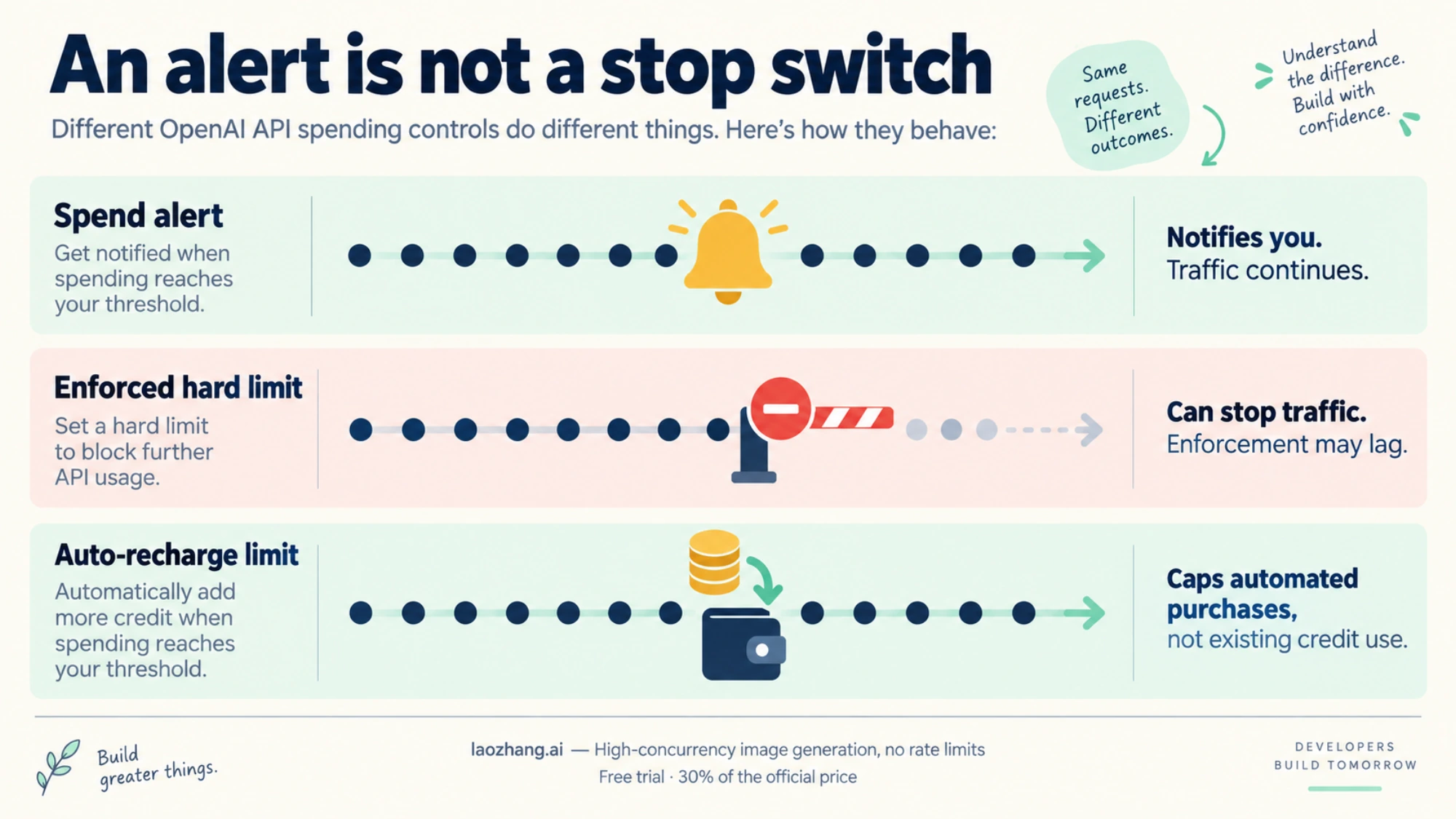
An alert and a hard cap have different effects. In OpenAI’s current spending controls, a spend alert notifies you while traffic continues. An enforced hard limit can stop organization or project traffic with organization_spend_limit_exceeded or project_spend_limit_exceeded. Check that “Enforce a hard limit” is enabled where you intend it to apply; entering a monthly amount alone does not establish that requests will stop. Enforcement can lag, so a small overshoot remains possible. Spend-limit documentation
Also distinguish those controls from prepaid auto-recharge. A monthly auto-recharge limit restricts automated purchases; it does not prevent manual purchases or stop consumption of credits already in the account. Exhausting prepaid credit is not an exact spending guard either, because cutoff can be delayed and leave a negative balance. Prepaid billing controls
For a first experiment, review the intended project and organization together: what covers the calls, how much paid usage you permit, and whether that amount is enforced. If your requirement is strictly zero paid usage, an unclear grant or an invisible offer is a reason to stop before testing. Neither the word “Free” nor the $100 usage ceiling is enough evidence to proceed at no charge.