ChatGPT Plus at $20 per month is worth it for users who rely on AI daily for professional work — writing, coding, research, or creative projects. But it is not the only option, and for many users it is not the best one either. OpenAI now offers five consumer tiers ranging from completely free to $200 per month, plus a pay-per-use API that can cost as little as $2 per month for light users. This guide breaks down every option with real cost calculations based on verified February 2026 pricing, so you can pick the plan that genuinely fits your usage pattern and budget.
TL;DR — Quick Recommendations by User Type
Choosing the right ChatGPT plan comes down to how often you use it, what features you need, and how much you are willing to spend. If you are a casual user who chats with AI a few times per week for simple questions, recipe ideas, or occasional help with emails, the Free plan is perfectly sufficient. You get basic access to GPT-5.2 Instant with a cap of roughly 10 messages every 5 hours, which is more than enough for light exploration. The biggest limitation is the absence of GPT-5.2 Thinking, which means you will not get the deeper reasoning capabilities that power users rely on for complex analysis and multi-step problem solving.
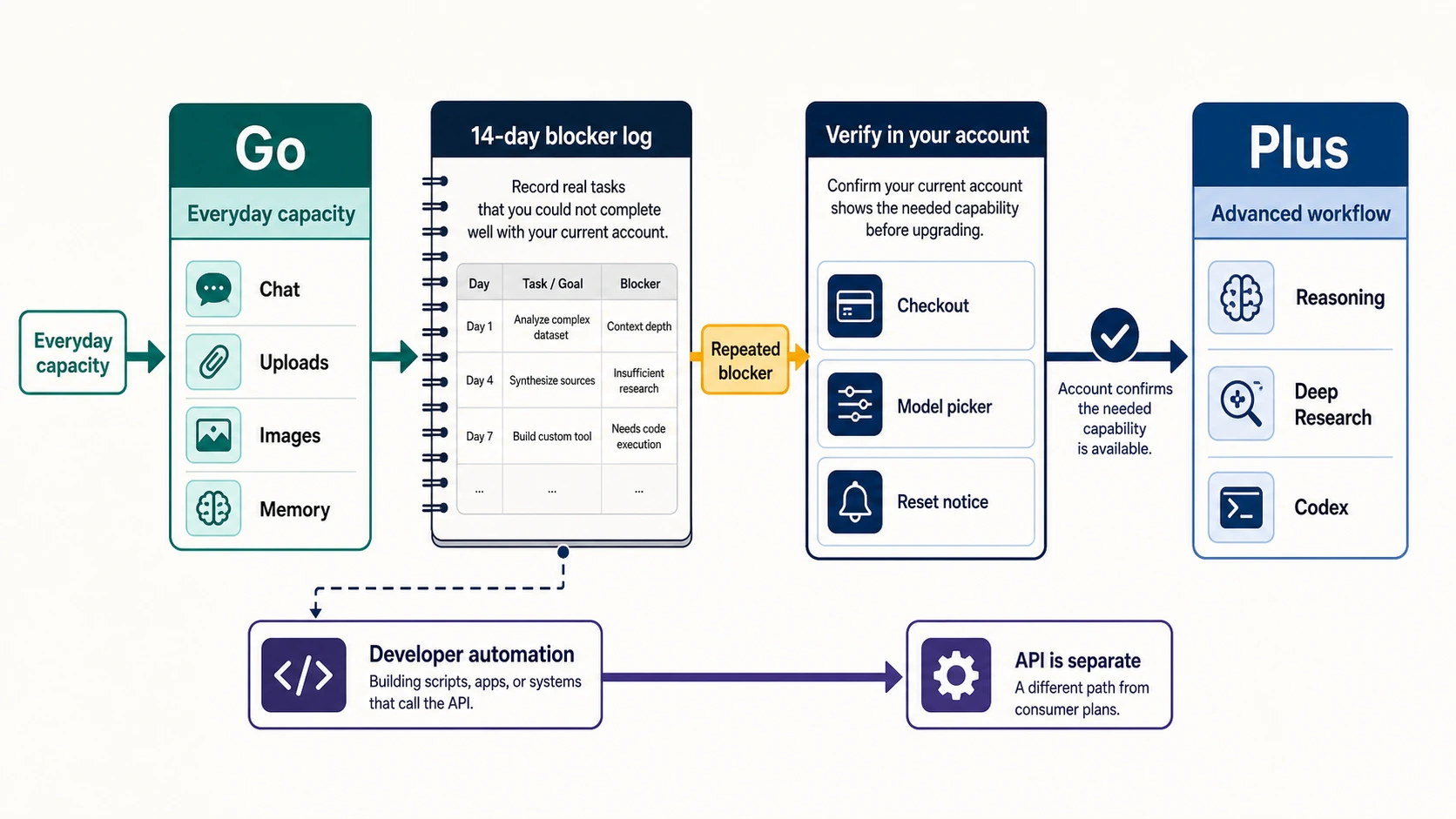
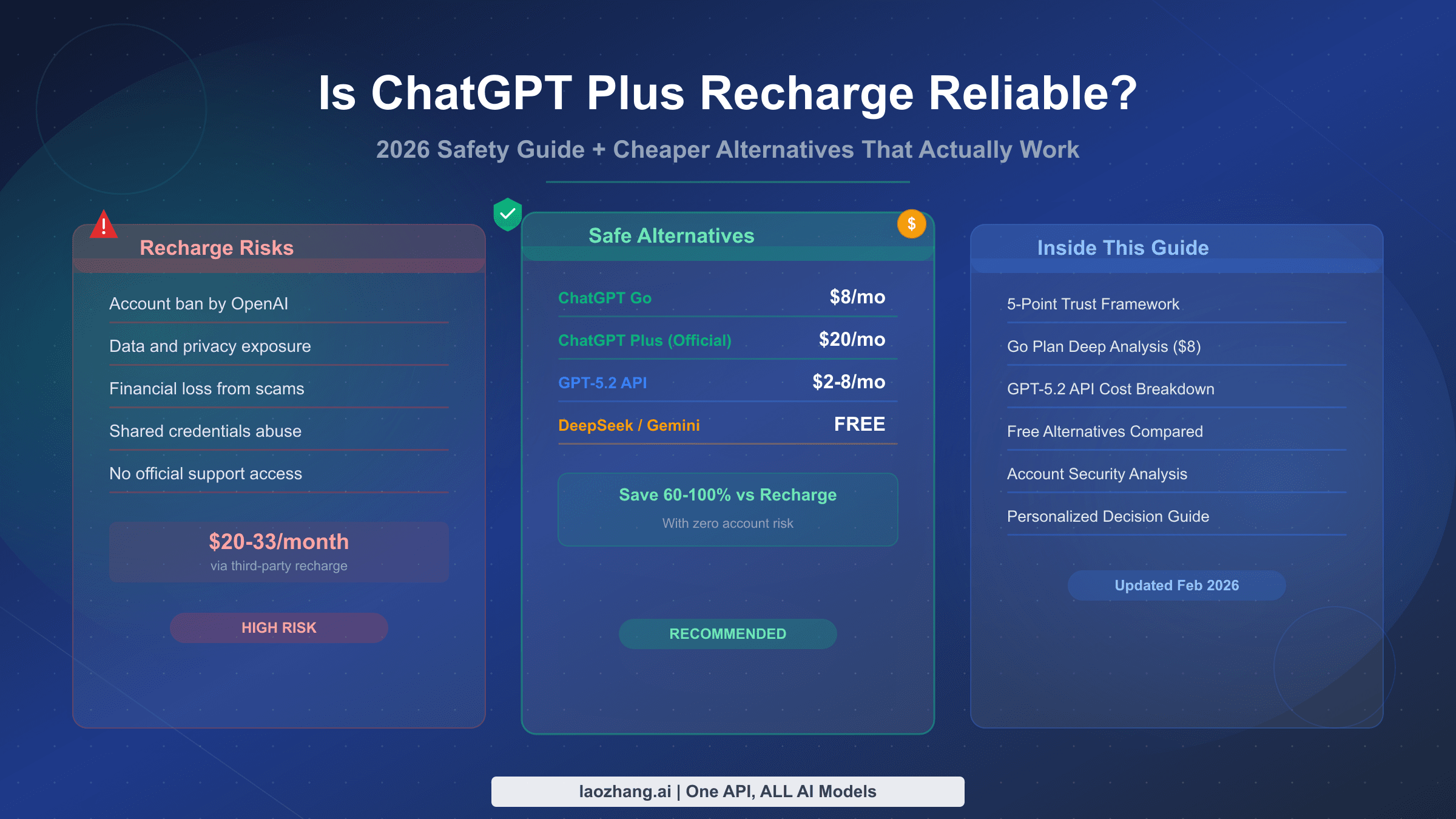
For users who need a bit more room to breathe, the Go plan at $8 per month offers extended message limits, the ability to create Custom GPTs, and voice conversations with video input. It is a solid middle ground for people who use ChatGPT regularly but do not need the full suite of professional features. However, Go still lacks GPT-5.2 Thinking, Agent Mode, Codex, and the ad-free experience that Plus subscribers enjoy. If you find yourself bumping up against limits on Go or wishing you could use Deep Research and Agent Mode, the Plus plan at $20 per month is the sweet spot for power users — it unlocks nearly everything OpenAI offers for individual consumers. For enterprise-level needs or research requiring maximum context windows and the exclusive GPT-5.2 Pro model, the Pro plan at $200 per month delivers unlimited usage and 128K token context. And for technically savvy users, the API offers GPT-5.2 access at roughly $0.008 per message, meaning light users who send around 10 messages per day would pay only about $2.49 per month — an 88% savings compared to Plus.
Every ChatGPT Plan Explained (February 2026)
OpenAI has expanded significantly beyond the original "free vs paid" structure that existed just a year ago. As of February 2026, there are five consumer-facing tiers, plus the API for developers and power users. Understanding what each tier actually includes — and more importantly, what it leaves out — is essential for making an informed decision. All pricing data below comes from chatgpt.com/pricing, verified on February 22, 2026.
The Free Plan ($0/month) gives you access to GPT-5.2 Instant, which is the faster but less capable version of OpenAI's flagship model. You get limited usage — community reports suggest approximately 10 messages every 5 hours, though OpenAI does not publish exact caps. The Free plan includes access to Sora 2 for video generation (with limited credits), Limited Deep Research capabilities, and basic DALL-E image generation with 2-3 images per day. What you do not get is significant: no GPT-5.2 Thinking mode for advanced reasoning, no Agent Mode for autonomous task completion, no Codex for code execution, and a smaller 16K context window that limits how much information the model can consider in a single conversation. Free users may also encounter ads, which OpenAI began testing in the United States in February 2026. Despite these limitations, the Free plan remains genuinely useful for casual exploration and light tasks like brainstorming, quick translations, or simple content drafting.
The Go Plan ($8/month) represents OpenAI's new entry-level subscription, launched in January 2026. Go delivers extended limits on GPT-5.2 Instant — roughly 10x the Free tier's message allowance — along with a 32K context window, the ability to create and use Custom GPTs, and voice conversations with video input capability. For many users, Go represents a significant upgrade from Free without the $20 commitment of Plus. However, the critical gap is the absence of GPT-5.2 Thinking, which is the model's advanced reasoning mode. Go also excludes Agent Mode, Codex, Tasks, Apps, and Interactive Tables. Like the Free tier, Go may include ads. The $8 price point (or $5 per month outside the United States) makes it accessible, but users should understand exactly what they are trading away — which we explore in detail in the detailed breakdown of ChatGPT Plus usage limits and the Go vs Plus section below.
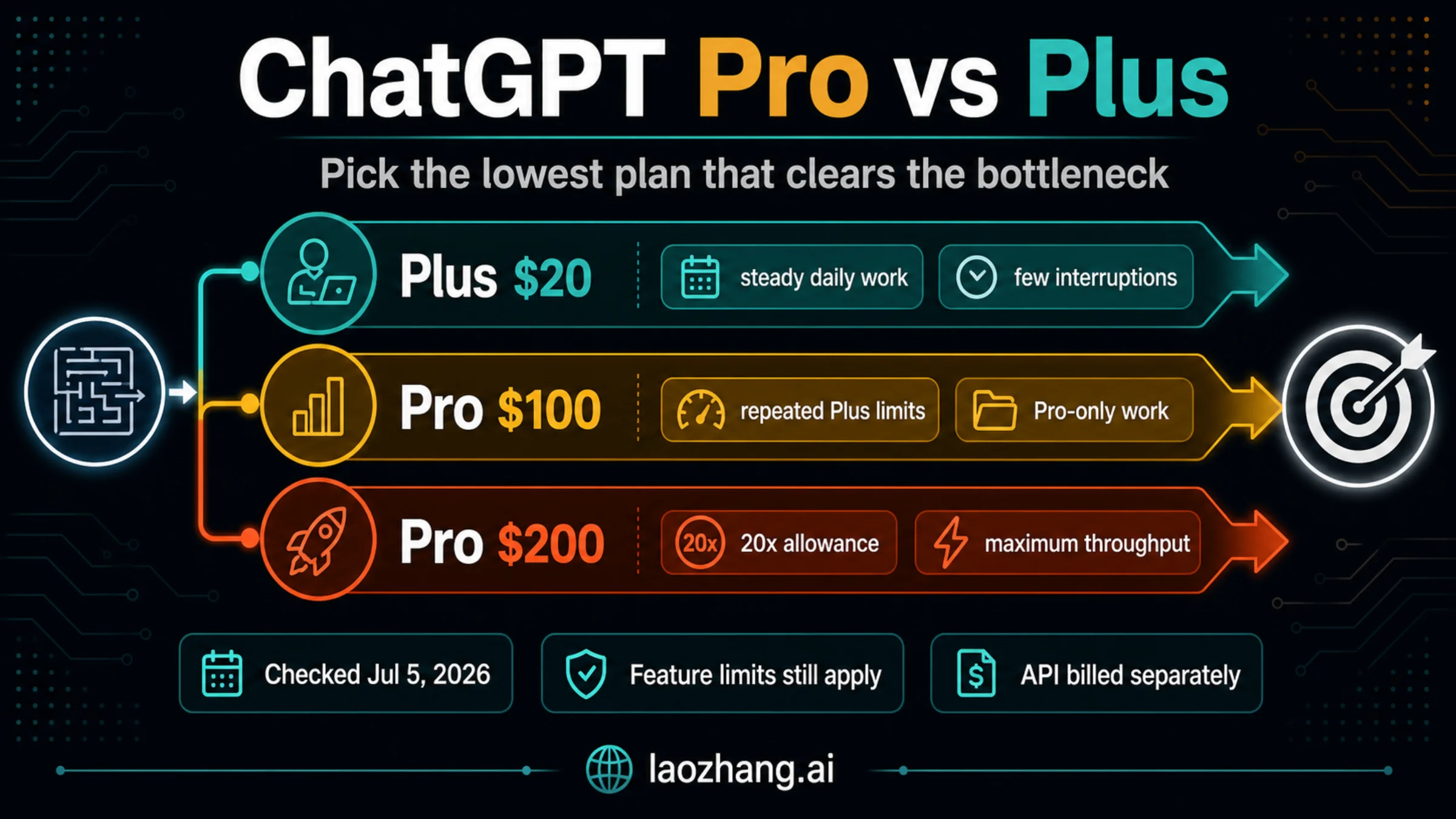
The Plus Plan ($20/month) has been OpenAI's flagship consumer subscription since early 2023, and in 2026 it remains the most popular choice for users who depend on AI daily. Plus unlocks GPT-5.2 Thinking with extended access, which provides dramatically better results for complex reasoning, coding, mathematical analysis, and nuanced writing tasks. You also get Deep Research for in-depth information gathering, Agent Mode for autonomous multi-step task execution, Codex for running and debugging code in a sandboxed environment, Tasks for scheduling automated actions, and the ability to build Apps and Interactive Tables. Plus subscribers enjoy an ad-free experience, a 32K context window, and access to Sora 2 with limited credits. The "extended" qualifier on GPT-5.2 Thinking means you get generous but not unlimited usage — community reports suggest approximately 160 messages per 3-hour window, though this fluctuates based on server load. For most professionals, this limit is rarely a practical concern during normal workflow.
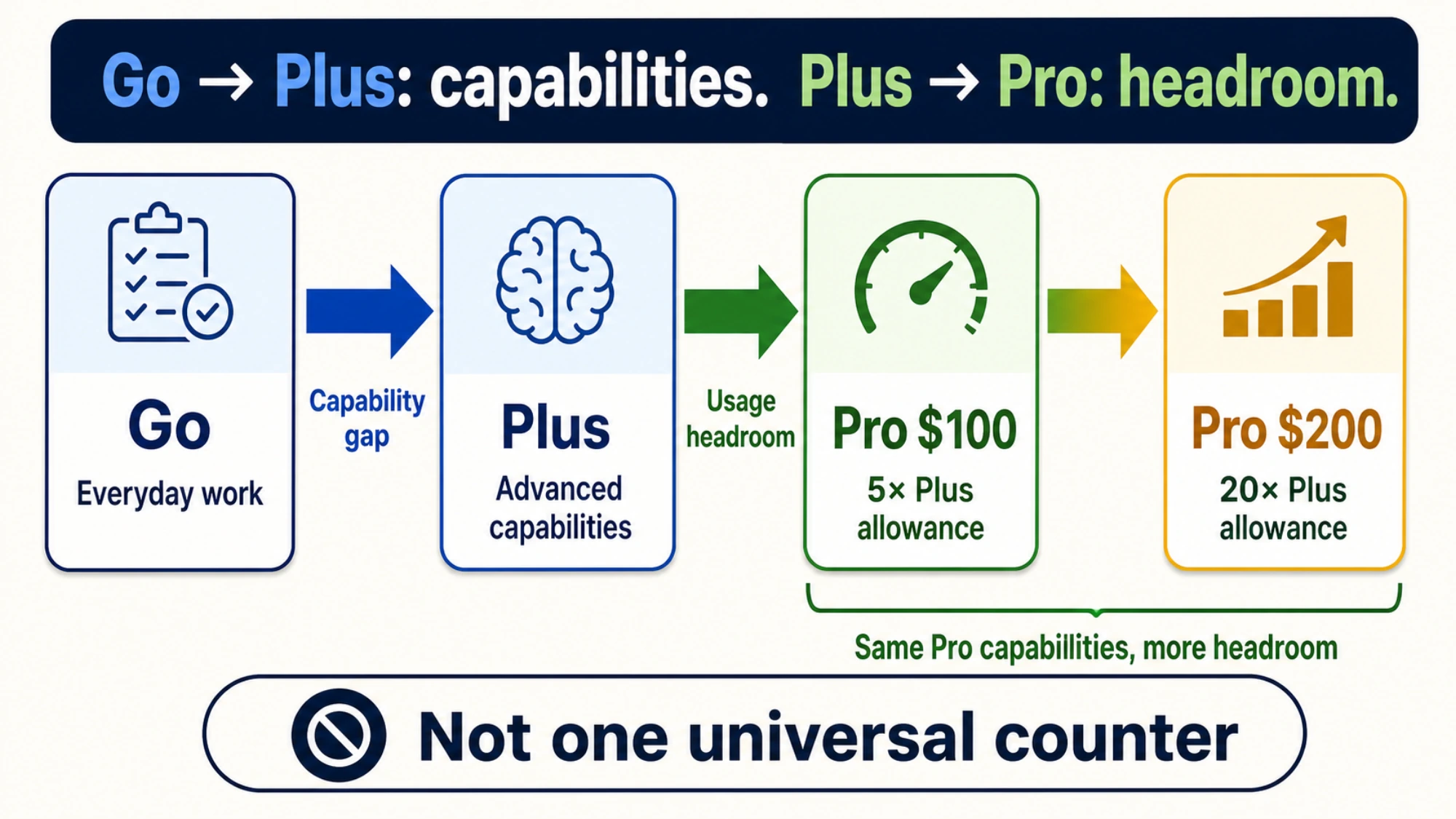
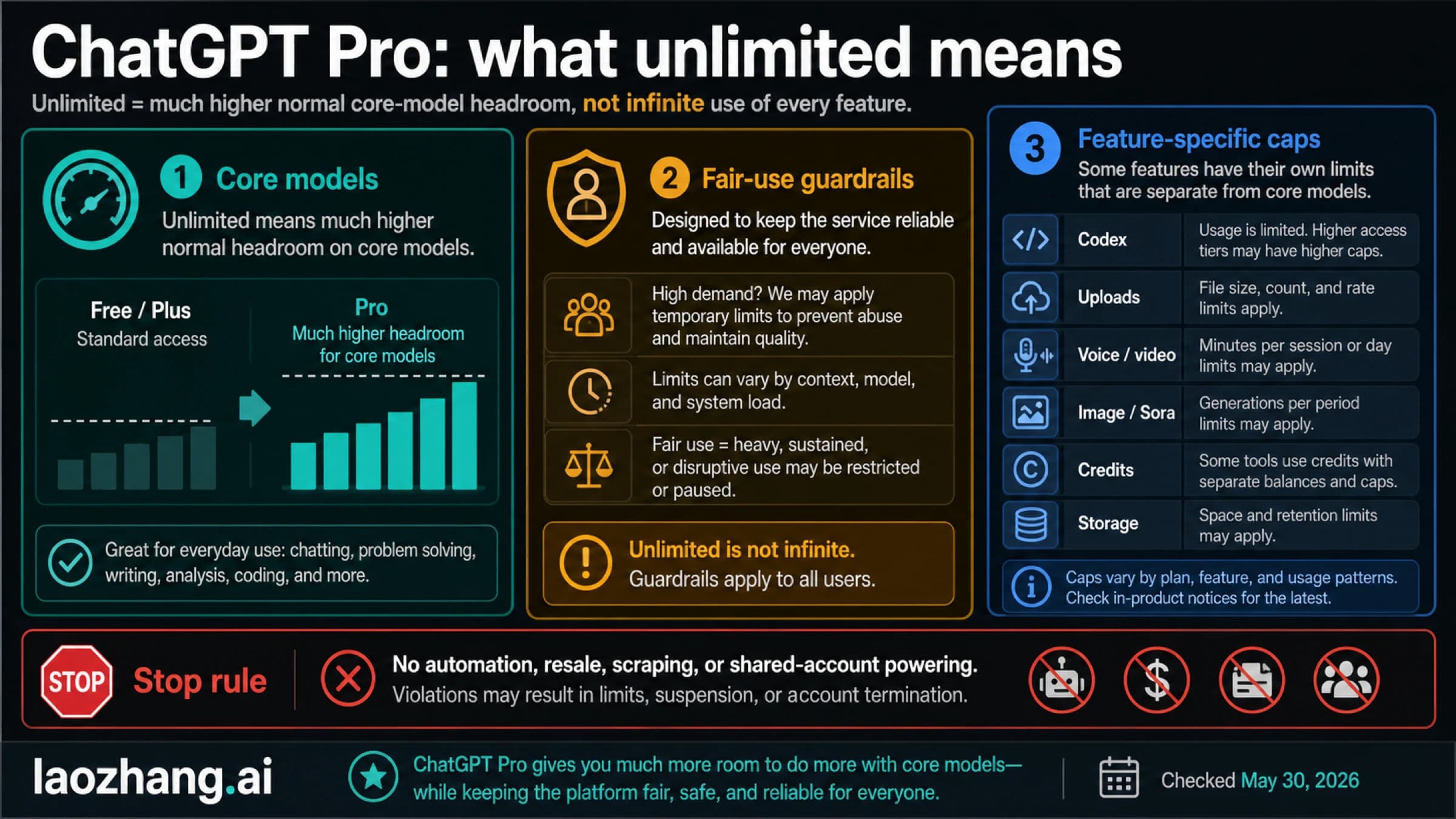
The Pro Plan ($200/month) is designed for power users and researchers who need maximum capability. Pro includes the exclusive GPT-5.2 Pro model, which delivers higher-quality outputs for the most demanding tasks. You get effectively unlimited messaging, a massive 128K context window (4x the Plus tier), extended Sora 2 credits, and access to ChatGPT Pulse — a feature exclusive to Pro subscribers. Everything available in Plus is included, with higher limits across the board. The Pro plan also provides early access to new features as OpenAI rolls them out. At $200 per month ($2,400 per year), Pro is difficult to justify for most individual users, but it can be a worthwhile investment for researchers, professional writers handling long documents, and developers who need the largest context window for complex codebases.
Side-by-Side Feature Comparison
The table below captures every major feature difference across the four consumer tiers, compiled directly from OpenAI's official pricing page (chatgpt.com/pricing, verified February 22, 2026). This is the most complete comparison available because it includes features that many guides overlook, such as context window sizes, Sora 2 access levels, and the new ad policy.
| Feature | Free ($0) | Go ($8) | Plus ($20) | Pro ($200) |
|---|---|---|---|---|
| GPT-5.2 Instant | Limited | Extended | Extended | Unlimited |
| GPT-5.2 Thinking | No | No | Extended | Unlimited |
| GPT-5.2 Pro | No | No | No | Yes |
| Context Window | 16K | 32K | 32K | 128K |
| Deep Research | Limited | Limited | Yes | Yes |
| Agent Mode | No | No | Yes | Yes |
| Codex | No | No | Yes | Extended |
| Sora 2 | Yes (Limited) | Yes | Limited | Extended |
| Custom GPTs (Create) | No | Yes | Yes | Yes |
| Voice (Video) | No | Yes | Yes | Yes |
| Tasks | No | No | Yes | Yes |
| Apps / Interactive Tables | No | No | Yes | Yes |
| ChatGPT Pulse | No | No | No | Yes |
| Legacy Models | No | No | Yes | Yes |
| Ads | May include | May include | No | No |
| Data Training Opt-out | Yes | Yes | Yes | Yes |
Looking at this table, the most striking pattern is the clear dividing line between Go and Plus. The gap is not just about message limits — it is about an entirely different category of capabilities. GPT-5.2 Thinking, Agent Mode, Codex, Tasks, and Apps are all absent from both Free and Go tiers. These are not minor convenience features; they represent fundamentally different ways of interacting with AI. GPT-5.2 Thinking produces dramatically better results for complex reasoning tasks, and Agent Mode enables the model to autonomously execute multi-step workflows like researching a topic, summarizing findings, and drafting a report. If your work involves anything more sophisticated than straightforward question-and-answer exchanges, the Plus tier's feature set makes a meaningful difference in output quality and workflow efficiency.
Another detail worth noting is the ad situation. OpenAI began testing advertisements on Free and Go tiers in the United States in February 2026, while Plus and Pro remain completely ad-free. For users who spend significant time in the ChatGPT interface, the ad-free experience alone may justify the upgrade, particularly for professional use where interruptions affect productivity. The data training opt-out is available across all tiers, so privacy-conscious users can prevent their conversations from being used to improve future models regardless of which plan they choose.
Go vs Plus — Is the $12/Month Upgrade Worth It?
The Go plan creates a genuine dilemma for users who want more than Free but balk at the $20 price tag of Plus. At $8 per month, Go offers a 60% discount compared to Plus, but the savings come with substantial feature trade-offs that are easy to underestimate. Understanding exactly what you lose by choosing Go over Plus is essential for making a decision you will not regret.
The single most important difference is the absence of GPT-5.2 Thinking in the Go plan. This is not just a slightly better version of the same model — it is a fundamentally different capability. GPT-5.2 Thinking uses an extended reasoning process that produces significantly more accurate, nuanced, and logically sound outputs for complex tasks. When you ask GPT-5.2 Thinking to analyze a legal contract, debug a complex algorithm, write a persuasive essay with specific evidence, or solve a multi-step math problem, the quality difference compared to GPT-5.2 Instant is immediately noticeable. Users who regularly tackle tasks requiring careful reasoning, structured analysis, or creative depth will find the Thinking model indispensable once they have experienced it. Going back to Instant-only access feels like a genuine downgrade.
Beyond the model quality difference, Go users miss out on Agent Mode, which enables ChatGPT to autonomously perform multi-step tasks by browsing the web, running code, analyzing files, and synthesizing results without constant user prompting. They also lose access to Codex (a built-in code execution environment), Tasks (for scheduling automated actions), Apps (for building internal tools), and Interactive Tables (for data manipulation). These features collectively transform ChatGPT from a simple chatbot into a productivity platform. If you currently use ChatGPT primarily as a conversational assistant for quick answers and basic writing help, Go may genuinely be sufficient and save you $144 per year. But if you rely on ChatGPT as a core work tool for research, coding, content creation, or data analysis, the $12 monthly difference between Go and Plus is almost certainly worth it — you are not just paying for more messages, you are paying for access to a qualitatively superior model and an entirely different tier of functionality.
To make this concrete, consider three common work scenarios and how Go and Plus handle them differently. For a marketing professional drafting email campaigns, Go's GPT-5.2 Instant produces decent copy for straightforward promotions, but Plus's Thinking model writes significantly more persuasive content with better audience targeting, stronger calls to action, and nuanced tone matching — the kind of quality difference that directly affects conversion rates. For a software developer debugging a complex application, Go provides basic error identification and code suggestions, while Plus's Codex can actually execute code in a sandbox, test solutions, and iterate until the bug is fixed — turning a 30-minute debugging session into a 5-minute one. For a researcher summarizing recent developments in their field, Go handles simple summaries adequately, but Plus's Deep Research and Agent Mode can autonomously browse multiple sources, cross-reference findings, identify contradictions, and produce a structured literature review with citations — work that would take hours manually.
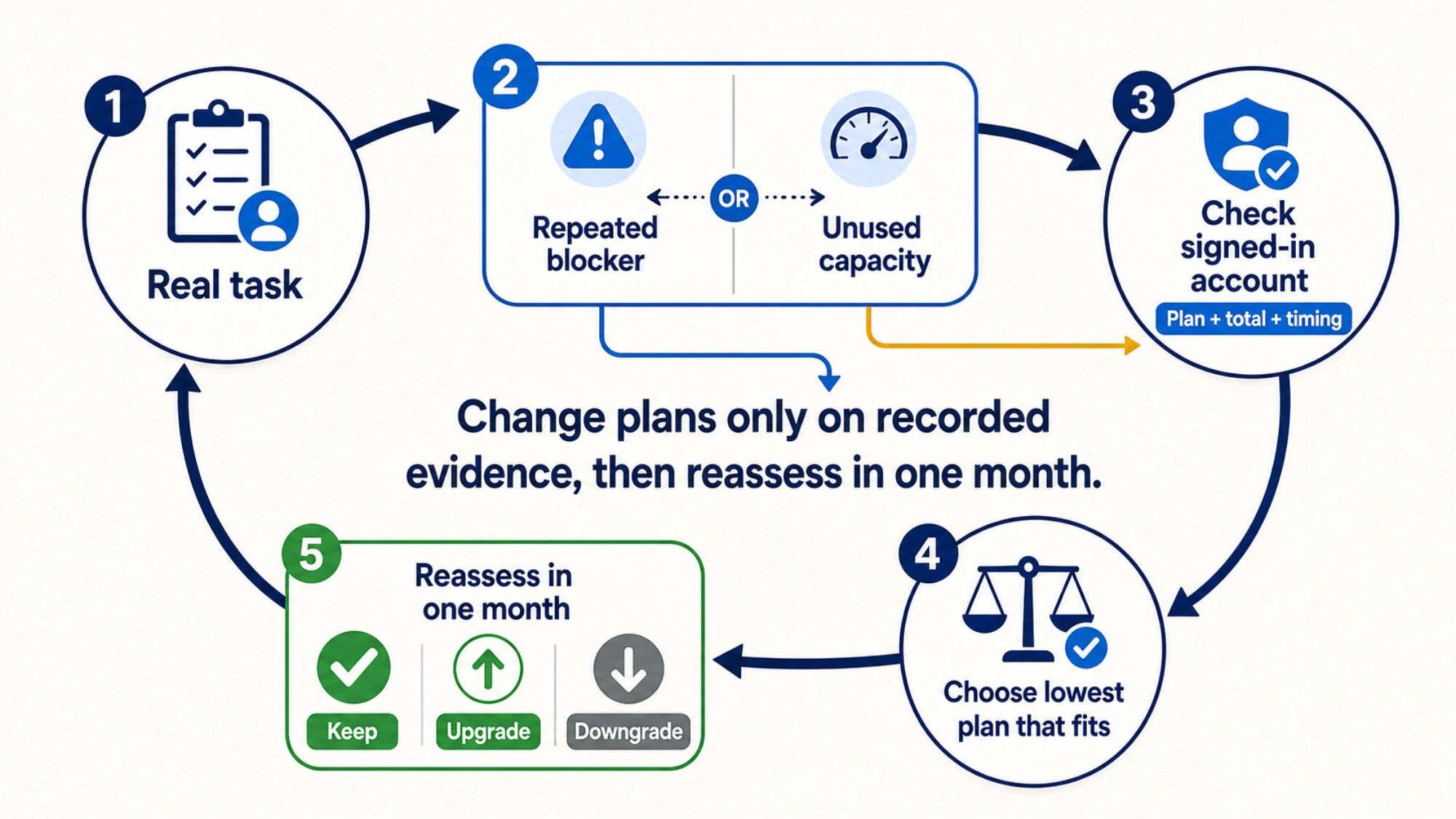
One practical way to decide: try the Free plan first and pay attention to which limitations frustrate you. If you mainly wish you had more messages and Custom GPTs, Go is your answer. If you find yourself wishing for deeper reasoning, better code output, or the ability to delegate complex research tasks, save the $8 and go straight to Plus — the partial upgrade to Go will leave you wanting more within weeks.
The Real Cost Per Message (These Numbers Will Surprise You)

Most "is ChatGPT Plus worth it" articles give you vague advice like "it is worth it if you use it every day." That is not particularly helpful when you are trying to decide whether $20 per month makes financial sense for your specific usage pattern. Let us do the actual math, because the numbers reveal something most users never consider: your cost per message varies dramatically depending on how much you actually use the service, and there is a hidden option that could save you up to 88 percent.
Subscription Cost Per Message
The cost per message for subscription plans is straightforward to calculate: divide your monthly fee by the number of messages you send. For Plus at $20 per month, if you send 10 messages per day (300 per month), each message costs you about $0.067 — roughly 7 cents. At 30 messages per day (900 per month), the cost drops to $0.022 per message, or about 2 cents. Heavy users sending 100 messages per day (3,000 per month) bring the cost down to just $0.007, well under a penny per message. The Go plan at $8 per month follows the same logic: 10 messages per day works out to about $0.027 per message, while 30 messages per day brings it to $0.009. The key insight here is that subscription plans reward heavy usage — the more you use them, the cheaper each individual interaction becomes, just like a gym membership.
API Cost Per Message
The API flips this dynamic entirely. Instead of paying a flat monthly fee regardless of usage, you pay per token — the fundamental unit of text that language models process. Based on OpenAI's API pricing page (openai.com/api/pricing, verified February 22, 2026), GPT-5.2 costs $1.75 per million input tokens and $14.00 per million output tokens. A typical conversational message involves roughly 750 input tokens (your prompt plus conversation context) and 500 output tokens (the model's response). This means each message costs approximately $0.0013 for input and $0.0070 for output, totaling about $0.0083 per message — less than one cent. At 10 messages per day, your monthly API bill would be approximately $2.49. At 30 messages per day, it rises to about $7.47. The breakeven point where API costs match the Plus subscription is approximately 80 messages per day, or about 2,400 messages per month. Below that threshold, the API is cheaper — often dramatically so.
What These Numbers Mean for You
These calculations reveal that most casual-to-moderate ChatGPT users are significantly overpaying with a Plus subscription. If you send fewer than 30 messages per day — which describes the majority of users based on community surveys — the API could save you $12–17 per month, or $150–200 per year. Even at 50 messages per day, the API costs only about $12.45 per month compared to Plus's fixed $20. The subscription only becomes the better deal for heavy users who consistently exceed 80 messages per day and need the convenience features that come with the ChatGPT interface.
It is also worth noting that these calculations assume GPT-5.2, the flagship model. If you are comfortable using GPT-5 Mini for less complex tasks — and for many everyday questions, translations, and summaries it performs remarkably well — the per-message cost drops to roughly $0.0013, bringing a 30-message-per-day usage pattern down to about $1.17 per month. Mixing models based on task complexity is a strategy that API users can leverage but subscription users cannot, since subscription plans always default to the model tier you are paying for. This flexibility alone represents a significant advantage for cost-conscious users who do not need the highest-tier model for every single interaction.
The Hidden Option Most People Miss — Using the API

Here is the option that almost every "ChatGPT Plus review" article fails to mention: you can access the exact same GPT-5.2 model through OpenAI's API on a pure pay-per-use basis, with no monthly subscription, no message limits, and a data policy that guarantees your conversations are never used for model training. This is not some obscure workaround — it is OpenAI's official developer platform, used by millions of applications worldwide, and it is available to anyone willing to set up an account.
How API Pricing Works
The API charges per token rather than per month. OpenAI offers multiple models at different price points, giving you flexibility that subscriptions cannot match. GPT-5.2, the same model that powers the Plus and Pro subscriptions, costs $1.75 per million input tokens and $14.00 per million output tokens. For lighter tasks, GPT-5 Mini offers excellent quality at just $0.25 per million input tokens and $2.00 per million output tokens — making it roughly 7x cheaper than the flagship model. There is even GPT-4.1 Nano at $0.20 per million input tokens and $0.80 per million output tokens for high-volume, lower-complexity tasks. All pricing is verified from openai.com/api/pricing as of February 22, 2026. The API also offers a 50% discount on batch processing, meaning you can run large jobs at half the standard rate if you do not need real-time responses.
Who Should Consider the API
The API is ideal for three types of users. First, light-to-moderate users who send fewer than 80 messages per day and want to minimize costs — paying $2–8 per month instead of $20. Second, developers and technical professionals who want to integrate GPT-5.2 into their own applications, scripts, or workflows. Third, privacy-conscious users who need a guarantee that their data will not be used for training — the API's data policy explicitly states that inputs and outputs are not used to improve models, with a default 30-day retention period that can be reduced to zero. The main downside is that the API does not include the ChatGPT web interface with its conversation history, file uploads, browsing, and visual features. You need a third-party client or your own application to interact with the model, which creates a barrier for non-technical users.
Making API Access Simpler
For users who want API-level pricing without the complexity of managing OpenAI accounts and API keys directly, platforms like laozhang.ai aggregate multiple AI model APIs into a single endpoint with simplified billing. These services handle the technical setup, provide unified documentation, and often offer competitive pricing by optimizing token routing across different models. This can be particularly useful for users who want to experiment with multiple models — GPT-5.2, Claude, Gemini — through a single API key rather than maintaining separate accounts with each provider. The cost savings compared to individual subscriptions can be substantial for users who work across multiple AI platforms.
Whether you access the API directly through OpenAI or through an aggregation platform, the fundamental economics remain the same: pay-per-use pricing is dramatically cheaper for light-to-moderate usage. The decision between API and subscription ultimately comes down to whether the convenience of ChatGPT's polished web interface and built-in features like Agent Mode and Deep Research is worth the premium you pay through a monthly subscription. For many users, the honest answer is that they are paying for features they rarely use.
Privacy, Data Training, and the Ad Question
Privacy has become an increasingly important factor in choosing a ChatGPT plan, especially for business users who handle sensitive information. OpenAI's data policies vary by tier in ways that are not immediately obvious, and the introduction of advertisements on lower tiers adds a new dimension to the privacy conversation that deserves careful examination.
All four consumer tiers — Free, Go, Plus, and Pro — allow you to opt out of having your conversations used for model training. This opt-out is available in Settings and applies retroactively once enabled. However, the default behavior is worth understanding: if you do not explicitly opt out, your conversations may be used to improve future models. The API operates under a different and more privacy-friendly default — conversations are never used for training regardless of settings, and data retention defaults to 30 days with the option to reduce it to zero. For users handling confidential business information, legal documents, medical records, or proprietary code, this distinction between subscription and API data handling can be decisive.
The advertising question introduces a different kind of privacy concern. OpenAI began testing ads on Free and Go tiers in the United States in February 2026. While the company has stated that ad targeting does not use conversation content, the presence of advertising infrastructure within the platform means that usage patterns, session data, and general behavioral signals may be collected for ad delivery purposes. Plus and Pro subscribers enjoy a completely ad-free experience, which means no advertising infrastructure operating within their sessions. For professionals who use ChatGPT for client work or sensitive business tasks, the ad-free guarantee of Plus and Pro provides both a cleaner user experience and greater confidence in data handling practices.
Business and Enterprise tiers ($25 per user per month for Business, with annual billing) offer additional privacy controls including admin-managed data policies, SSO authentication, and compliance features suited for organizational deployment. If your use case involves team access, centralized billing, or regulatory compliance requirements, these tiers are worth evaluating separately from the consumer plans discussed in this guide.
From a practical standpoint, here is how to think about privacy when choosing your tier. If you are using ChatGPT for personal creative projects, casual conversations, or general knowledge questions, the Free or Go tier with the training opt-out enabled provides perfectly adequate privacy — there is nothing sensitive at stake even if data were inadvertently collected. If you are a freelancer or professional who occasionally inputs client information, project details, or proprietary strategies, Plus offers a meaningful privacy upgrade through its ad-free environment and cleaner data handling — the absence of advertising infrastructure means fewer third-party systems touching your session data. If you handle regulated data (healthcare, legal, financial) or work with truly confidential information, the API is the safest consumer-accessible option because it offers the strongest data guarantees: no training usage by default, configurable retention periods down to zero days, and no web-based session management that could create additional data exposure vectors. Understanding these distinctions helps you match your privacy requirements to the appropriate tier rather than either overpaying for unnecessary protection or underinvesting in necessary safeguards.
Which Plan Should You Choose? (3-Question Decision Framework)

After analyzing every tier's features, calculating real costs, and examining privacy implications, the decision comes down to three simple questions. Answer them honestly and you will have your recommendation in under a minute, without second-guessing yourself or falling into analysis paralysis.
Question 1: How Often Do You Use ChatGPT?
If you use ChatGPT a few times per week or less, the Free plan is genuinely sufficient. You get GPT-5.2 Instant for basic tasks, and the 10-message-per-5-hours cap is unlikely to be a practical limitation at this usage level. Do not pay for a subscription "just in case" — you can always upgrade later. The most common mistake people make is subscribing to Plus after reading an impressive review, using it enthusiastically for the first week, and then realizing they only actually need it two or three times per week — which the Free plan handles perfectly. If you use ChatGPT multiple times per day — meaning it is part of your regular workflow rather than an occasional tool — continue to Question 2 to determine which paid tier makes sense for your needs and budget.
Question 2: What Do You Need It For?
For straightforward conversational tasks — asking questions, getting summaries, brainstorming ideas, drafting basic emails — the Go plan at $8 per month provides excellent value with extended limits and Custom GPTs. However, if you need advanced reasoning (complex analysis, detailed coding, mathematical problem-solving), autonomous task execution (Agent Mode), code execution (Codex), or deep research capabilities, these features are exclusively available on Plus and above. If you are technically savvy and your primary use is through code or scripts, the API is worth serious consideration — you get the same model quality at potentially 60-88% lower cost depending on your usage volume.
Question 3: What Is Your Budget?
If $20 per month fits comfortably in your budget and you use ChatGPT daily, Plus is the recommended choice for most users. It offers the best balance of features, model quality, and value. If you are ready to subscribe, our step-by-step guide to subscribing to ChatGPT Plus walks you through the process, and if you encounter any issues during payment, the fix common payment issues guide covers the most frequent problems and solutions. For those considering alternatives in the AI assistant space, it is worth comparing with Claude's pricing and subscription options to ensure you are choosing the best platform for your specific workflow.
If $200 per month is justified by your professional output — and your work regularly requires the largest context window, unlimited GPT-5.2 Pro access, or Pulse — then Pro delivers capabilities that simply are not available at any other price point. The 128K context window alone is worth the premium for users who regularly work with long documents, complex codebases, or extensive research material that exceeds the 32K limit on Plus. However, for the vast majority of individual users, Pro is overkill. If budget is tight, consider the API route for significant savings, or start with Go at $8 per month and evaluate whether the limitations push you toward Plus within the first month. The Go-to-Plus upgrade path is clean — OpenAI prorates the billing, so you do not lose money by starting on a lower tier and upgrading when your needs grow.
Frequently Asked Questions
Is ChatGPT Plus worth $20 a month?
For daily users who leverage advanced features like GPT-5.2 Thinking, Deep Research, and Agent Mode, Plus delivers strong value at approximately $0.02 per message (assuming 30 messages per day). However, if you send fewer than 15 messages per day and only use basic conversational features, the API offers the same GPT-5.2 model for roughly $3-4 per month. Plus is worth it when you regularly use features that are exclusive to the subscription — Thinking mode, Agent Mode, Codex, and the ad-free web interface. If you mainly need a better chatbot with more capacity, Go at $8 per month may be the smarter choice.
What does ChatGPT Plus give you that Free doesn't?
The most significant upgrade is GPT-5.2 Thinking, which provides dramatically better reasoning for complex tasks. Plus also unlocks Deep Research for in-depth information gathering, Agent Mode for autonomous multi-step task execution, Codex for code execution in a sandbox, the ability to create Tasks and Apps, Interactive Tables, access to legacy models, a 32K context window (double the Free tier's 16K), and an ad-free experience. The quality difference between GPT-5.2 Instant (Free) and GPT-5.2 Thinking (Plus) is substantial for any task requiring structured analysis, creative nuance, or logical precision.
Does ChatGPT Plus include API access?
No. The ChatGPT Plus subscription and the OpenAI API are completely separate products with independent billing. A Plus subscription gives you access to the ChatGPT web and mobile apps, while the API requires a separate account at platform.openai.com with its own credit balance. You can use both simultaneously, but they do not share credits or quotas. Many users are unaware that the API exists as an independent access method, which is why we dedicated an entire section of this guide to explaining how it works and when it makes financial sense.
Is the ChatGPT Go plan good enough?
Go is good enough if your primary needs are extended messaging limits, Custom GPTs, and voice conversations, and you do not require GPT-5.2 Thinking, Agent Mode, or Codex. The $8 price point makes it accessible, and for users who mainly use ChatGPT as an enhanced search engine or writing assistant for straightforward tasks, Go delivers solid value. The key test: if you find yourself frustrated by the quality of Go's responses on complex tasks, that frustration comes from the absence of GPT-5.2 Thinking — and the only way to get it is upgrading to Plus.
Can I save money by using the API instead of Plus?
Yes, potentially significant savings. At GPT-5.2's pricing of $1.75 per million input tokens and $14.00 per million output tokens (openai.com/api/pricing, February 2026), a typical message costs roughly $0.008. For light users (10 messages per day), the monthly API cost is approximately $2.49, compared to $20 for Plus — an 88% savings. The breakeven point is approximately 80 messages per day. Below that threshold, the API is cheaper. The trade-off is losing access to the ChatGPT web interface, Agent Mode, Deep Research, and other subscription-exclusive features, plus the need for technical setup or a third-party client.