GPT Image 2 API Pricing: Cost per Image, Batch, and $0.03 Calls
GPT Image 2 costs about $0.005 to $0.43 per image in output on OpenAI's API, set by size and quality. Batch halves it, and ChatGPT has no per-image price.
On this page
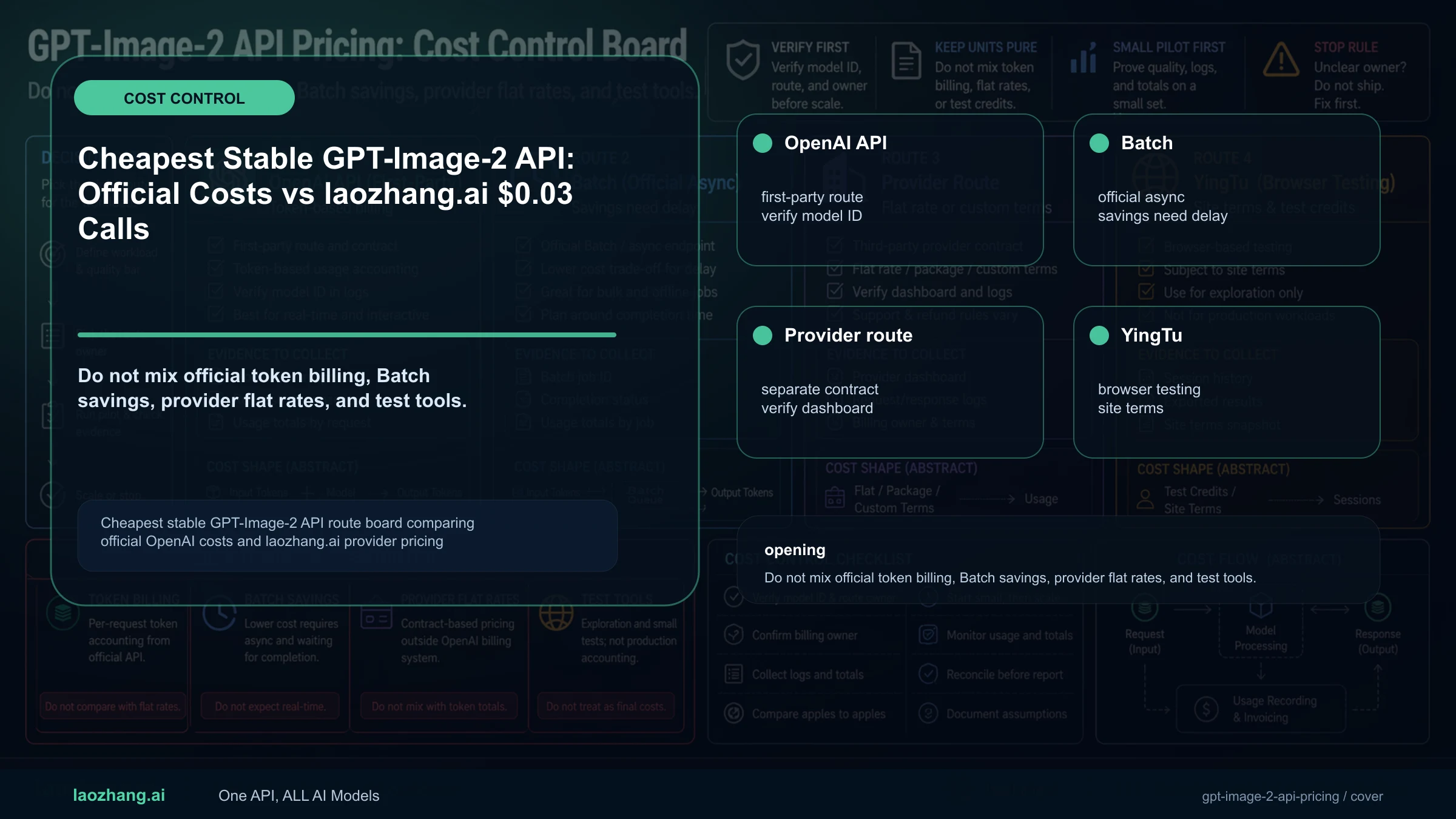
On OpenAI's API, one gpt-image-2 image costs between about $0.005 and $0.43 for the output, and the size and quality you request decide where in that range you land. A 1024x1024 image is estimated at $0.00588 at low, $0.05268 at medium and $0.21072 at high. Those are OpenAI's calculator estimates as of October 3, 2026, and they cover the generated image only: your prompt and any reference images are billed on top.
Three things move the number from there. Batch processing halves every rate if you can wait up to 24 hours. A flat per-call provider price such as $0.03 undercuts OpenAI at medium and high but not at low. And inside ChatGPT there is no per-image price at all, only a subscription with limits OpenAI does not publish.
Every figure below is a published rate, a calculator estimate or arithmetic on the two, with the inputs shown so you can redo it. None of them is a measured bill.
GPT Image 2 cost per image: $0.005 to $0.43 by size and quality
The output of one image costs its output tokens multiplied by $30 per million. OpenAI's calculator gives the token count for each explicit size and quality of gpt-image-2:
| Size | low | medium | high |
|---|---|---|---|
| 1024x1024 | 196 tokens, $0.00588 | 1,756 tokens, $0.05268 | 7,024 tokens, $0.21072 |
| 1536x1024 or 1024x1536 | 158 tokens, $0.00474 | 1,372 tokens, $0.04116 | 5,488 tokens, $0.16464 |
| 2048x2048 | 397 tokens, $0.01191 | 3,568 tokens, $0.10704 | 14,272 tokens, $0.42816 |
| 2560x1440 | 205 tokens, $0.00615 | 1,843 tokens, $0.05529 | 7,370 tokens, $0.22110 |
| 3840x2160 or 2160x3840 | 371 tokens, $0.01113 | 3,336 tokens, $0.10008 | 13,342 tokens, $0.40026 |
Output estimate per image, OpenAI Standard processing, gpt-image-2, as of October 3, 2026. Input tokens are extra.
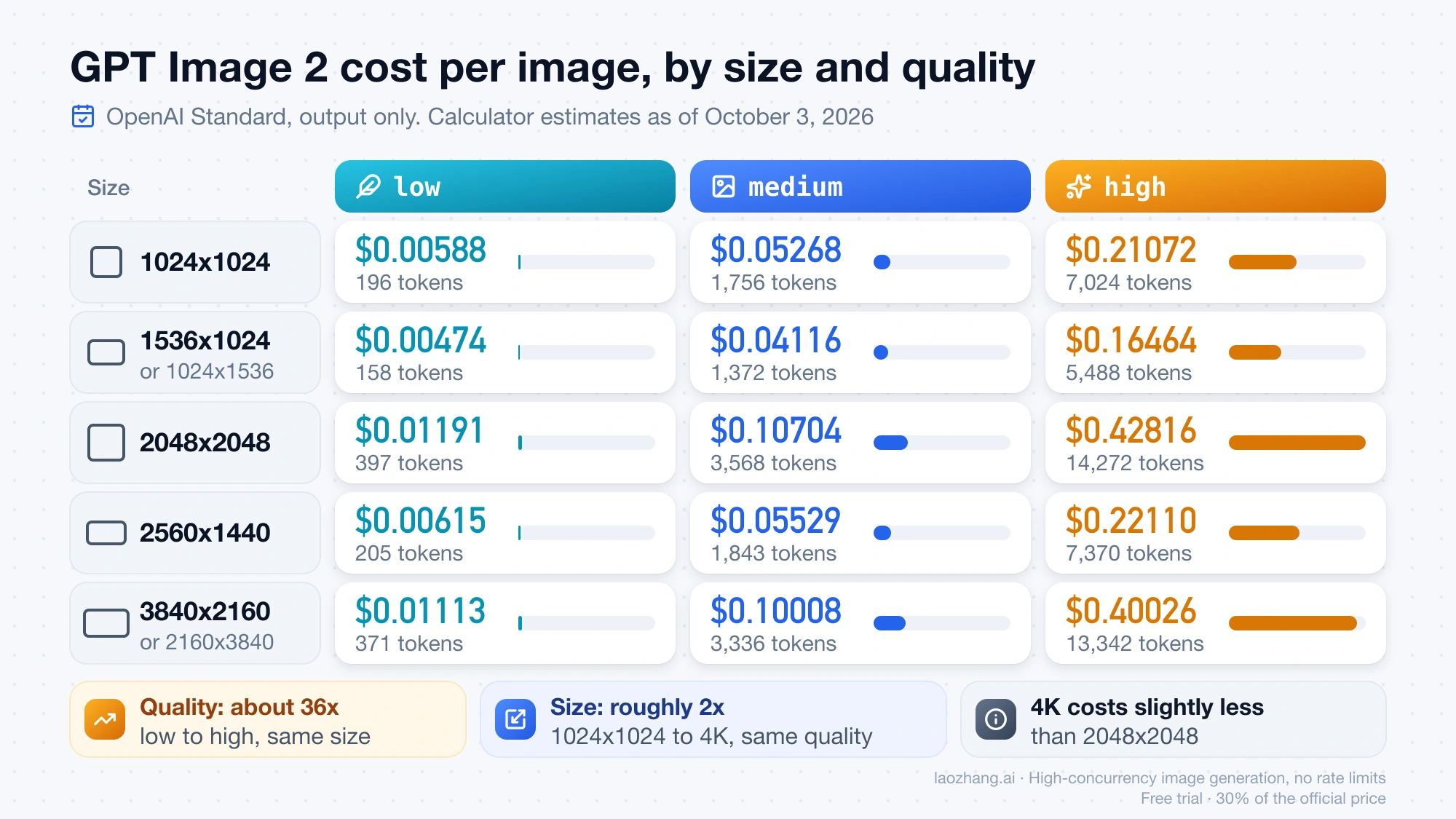
Two patterns in the table matter for a budget. Quality costs far more than size: going from low to high at the same size multiplies the price by about 36, while going from 1024x1024 to 4K at the same quality roughly doubles it. And a 4K image is slightly cheaper than a 2048x2048 one at every quality, so pixel count alone does not predict the bill.
Both size and quality default to auto, and the calculator gives no estimate for auto because the token count then depends on the image the model decides to produce. A request that omits either parameter has no predictable price. Set both explicitly before you forecast anything. The valid sizes and how to confirm you actually received 3840x2160 are covered in the GPT Image 2 4K API guide.
Why "$8 input, $30 output" is not the price of an image
Those two numbers are prices per million tokens, not per image. OpenAI's pricing table bills gpt-image-2 by tokens only, and the model's row appears after you expand "All models" in the image generation section:
| Token type | Standard, per 1M tokens | Batch, per 1M tokens |
|---|---|---|
| Image output | $30.00 | $15.00 |
| Image input | $8.00 | $4.00 |
| Cached image input | $2.00 | $1.00 |
| Text input | $5.00 | $2.50 |
| Cached text input | $1.25 | $0.625 |
There is no text output price for this model. To turn a rate into an image price, multiply by the tokens the image uses. A 1024x1024 medium image uses 1,756 output tokens, so 1,756 × $30 ÷ 1,000,000 = $0.05268. The same sum with 196 tokens gives the low price, and with 7,024 tokens the high price.
What the per-image estimate leaves out
The calculator states its own boundary: "Per image at 30 USD per million image output tokens. Excludes text and image input tokens and streaming partial images." Four charges sit outside it.
| Extra charge | Rate | What it adds |
|---|---|---|
| Prompt text | $5 per 1M text input tokens | A 100-token prompt adds $0.0005; a 1,000-token prompt adds $0.005 |
| Reference images | $8 per 1M image input tokens | Every 1,000 input tokens add $0.008; the count is not published per image |
| Streaming partial images | 100 image output tokens each | $0.003 per partial image |
| Responses API calls | The text model's own token rates | The model that calls the image tool bills its tokens separately |
For plain text-to-image at medium or high, the prompt is a rounding error. At low it is not: a 1,000-token prompt at $0.005 nearly doubles a $0.00588 image. Long system-style prompts therefore matter most on the cheapest setting.
The cached input prices rarely help. They apply only when the image tool is used through the Responses API, not to direct Images API calls, and that includes /v1/images/edits. Cache hits also do not appear in the response's usage, so you cannot confirm them from the API output.
What a GPT Image 2 edit costs: read usage.input_tokens
An edit costs the output estimate for its size and quality plus an input charge that OpenAI does not let you calculate in advance. The image generation guide explains why: "Because gpt-image-2 always processes image inputs at high fidelity, edit requests that include reference images can use more input tokens." The input_fidelity parameter cannot be changed on this model, and OpenAI's separate image input cost calculator covers vision and text models, not gpt-image-2.
No published table tells you how many input tokens a given reference image uses, so any per-edit price printed without a measurement is a guess. The way to get a real number is short:
- Pick three to five edit requests that look like your production work: the same number of reference images, typical dimensions, your real prompt length.
- Send them with explicit
sizeandquality, and recordusage.input_tokensand the output tokens from each response. - Price each one: image input tokens × $8 ÷ 1,000,000, plus text input tokens × $5 ÷ 1,000,000, plus output tokens × $30 ÷ 1,000,000.
- Budget from the highest of the results, not the average, until you have more samples.
Each added reference image adds input tokens, so a workflow that sends four references should be measured with four.
GPT Image 2 Batch API pricing: half the rate, up to 24 hours
Batch cuts every gpt-image-2 token rate by exactly half, to $15 per million image output tokens. The Batch rates are published on the Batch tab of OpenAI's pricing table. A per-image Batch figure is not, so the numbers below are the calculator's token counts multiplied by $15 per million:
| Size | low | medium | high |
|---|---|---|---|
| 1024x1024 | $0.00294 | $0.02634 | $0.10536 |
| 1536x1024 or 1024x1536 | $0.00237 | $0.02058 | $0.08232 |
| 2048x2048 | $0.005955 | $0.05352 | $0.21408 |
| 2560x1440 | $0.003075 | $0.027645 | $0.11055 |
| 3840x2160 | $0.005565 | $0.05004 | $0.20013 |
Calculated Batch output per image, assuming a Batch request uses the same output tokens as a synchronous one. Input tokens are also half price.
The condition is time. OpenAI's Batch guide promises "50% lower costs, a separate pool of significantly higher rate limits, and a clear 24-hour turnaround time", and adds that each batch "completes within 24 hours (and often more quickly)". Both /v1/images/generations and /v1/images/edits are eligible, and one input file can contain requests to a single model only. If a person is waiting on the image, Batch is not an option. For catalog images, backfills and overnight jobs, it is the lowest OpenAI price available.
GPT Image 2 cost per month: 1,000 images run $4.74 to $428
A monthly budget is images per month × price per image, plus inputs. For 1,000 images, output only:
| Setting | OpenAI Standard | OpenAI Batch | $0.03 per call |
|---|---|---|---|
1536x1024 low | $4.74 | $2.37 | $30 |
1024x1024 low | $5.88 | $2.94 | $30 |
1536x1024 medium | $41.16 | $20.58 | $30 |
1024x1024 medium | $52.68 | $26.34 | $30 |
3840x2160 medium | $100.08 | $50.04 | $30 |
1024x1024 high | $210.72 | $105.36 | $30 |
3840x2160 high | $400.26 | $200.13 | $30 |
2048x2048 high | $428.16 | $214.08 | $30 |
Scale the row to your volume: 10,000 images a month at 1024x1024 medium is $526.80 on Standard and $263.40 on Batch.
The number that ends up on your invoice is usually higher than this table, because you pay for every image generated and keep only some of them. The useful figure is total billed ÷ images you accept. If you generate 1,300 images to keep 1,000, the 1,000 kept images cost 1.3 times the table row. Your own rejection rate is the input here; it varies too much by prompt and use case to borrow from someone else.
Volume is also capped by rate limits, not only by money. The gpt-image-2 model page lists 5 images per minute at Tier 1, rising to 20, 50, 150 and 250 at Tiers 2 through 5. The Free tier is marked "Not supported", so there is no free API allowance for this model: you need a funded account to generate the first image. Whether any free way to use it exists outside the API is a separate question, answered in Is the GPT Image 2 API Free?.
Is there a GPT Image 2 subscription or pricing plan?
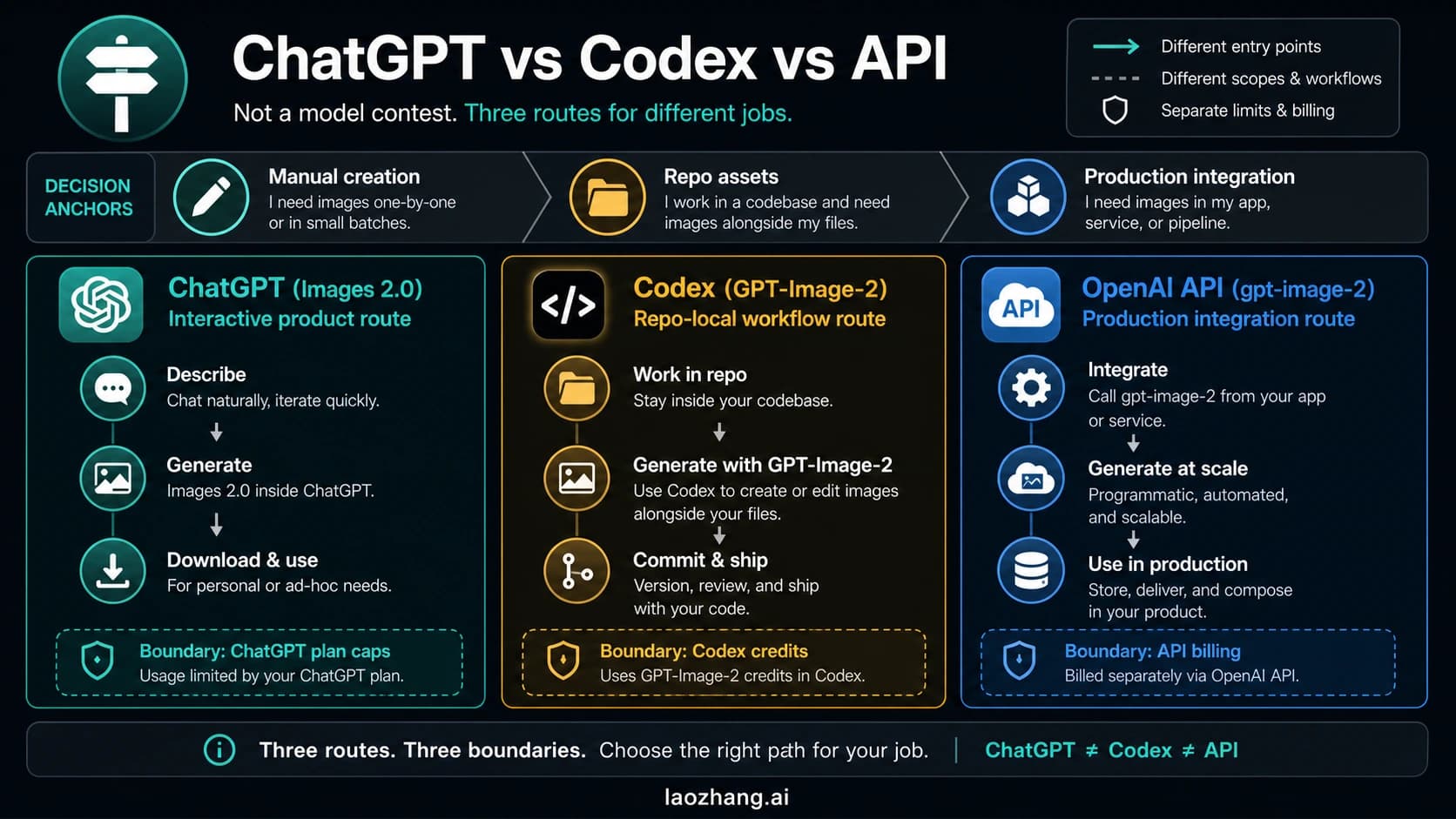
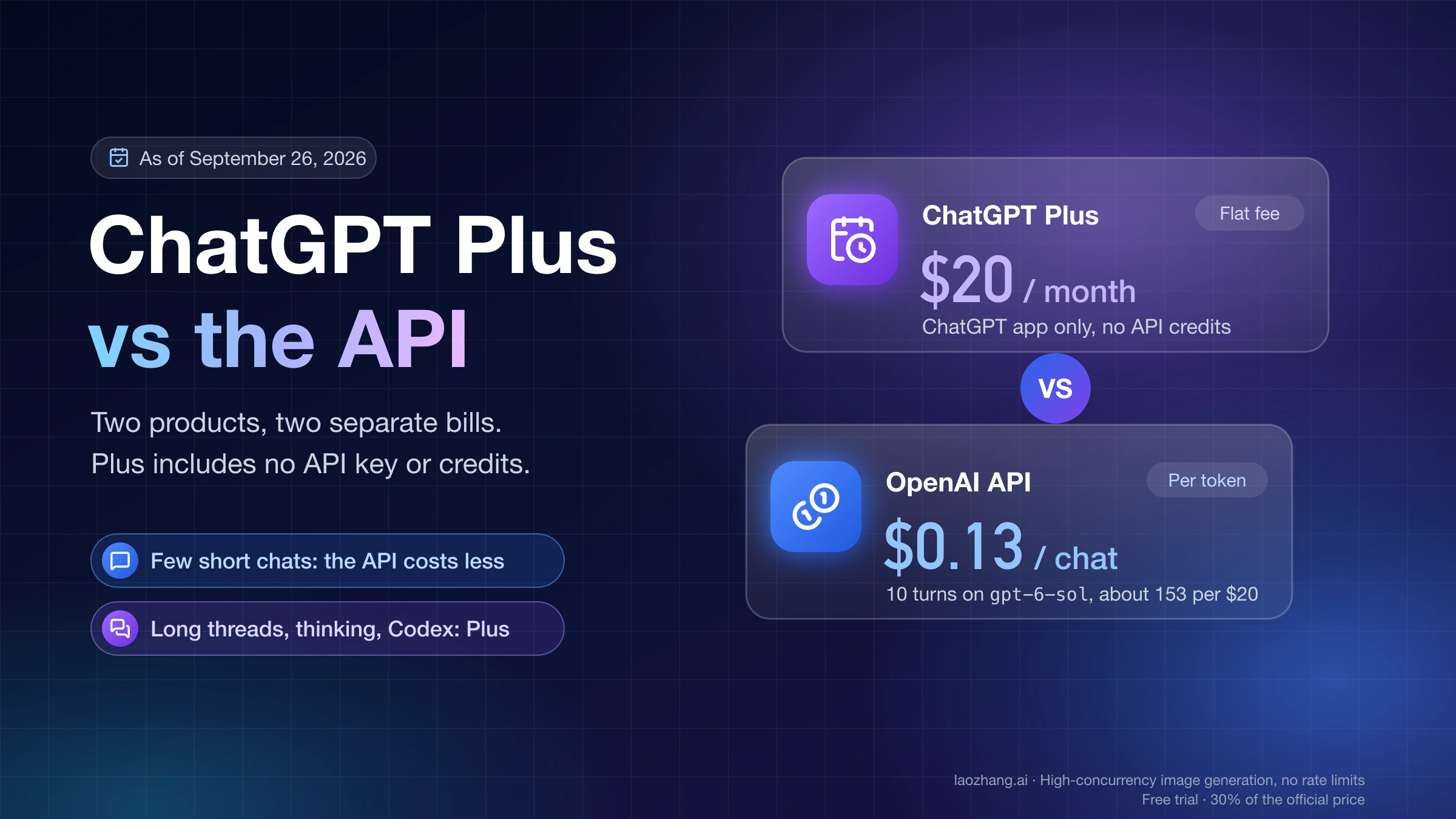
No. OpenAI sells gpt-image-2 only as pay-as-you-go API usage, with no monthly plan and no per-image price in ChatGPT. What exists on the subscription side is ChatGPT itself, and it is a different product from the API model:
- Image generation in ChatGPT is included in the plan rather than priced per image. ChatGPT Plus is "$20/month (billed monthly)" according to OpenAI's Plus help article, and Pro comes in three tiers at $100, $200 and $500 per month.
- Images are available on every tier including Free, with tighter limits on the lower ones. OpenAI publishes no image count for any plan. The details are in ChatGPT Plus and Go Image Generation Limits.
- As of early October 2026, the image feature in the app is named ChatGPT Images 2.5, so a subscription does not buy access to GPT Image 2 specifically.
- A ChatGPT subscription does not include API credit. The same help article says "API usage is separate and billed independently."
For a sense of scale, $20 of API output buys about 3,400 images at 1024x1024 low, about 379 at medium or about 94 at high ($20 divided by each per-image estimate). That is a comparison of what $20 is worth on the API, not a statement of how many images Plus allows.
Websites with "GPT Image 2" in their domain name that sell monthly credit plans are independent resellers, not OpenAI. Their plans are priced in their own credits, and resellers' per-image prices differ several-fold from one another. Before comparing any of them with the tables above, check which size and quality a credit buys and whether the image comes from OpenAI's API at all.
Cheapest GPT Image 2 API: direct, Batch, or $0.03 per call
The cheapest way to pay depends on quality first and urgency second. At low, OpenAI is cheapest at every size. At medium and high, a $0.03 flat price is below OpenAI Standard at every size, and Batch medium beats $0.03 only at the smaller sizes.
| Your workload | Lowest listed price | Why |
|---|---|---|
low quality, any size | OpenAI direct, or Batch if you can wait | Standard low tops out at $0.01191 for 2048x2048, well under $0.03 |
medium at 1024x1024, 1536x1024 or 2560x1440, not urgent | OpenAI Batch | $0.02634, $0.02058 and $0.027645, all under $0.03 before inputs |
medium at 2048x2048 or 4K | $0.03 per call | Batch is $0.05352 and $0.05004; Standard is about double that |
medium, user waiting | $0.03 per call | The lowest Standard medium is $0.04116 |
high, any size | $0.03 per call | Standard runs $0.16464 to $0.42816; Batch runs $0.08232 to $0.21408 |
| Edits with reference images | Measure first; a flat price has no input surcharge | Input tokens are billed on OpenAI and unknown until measured |
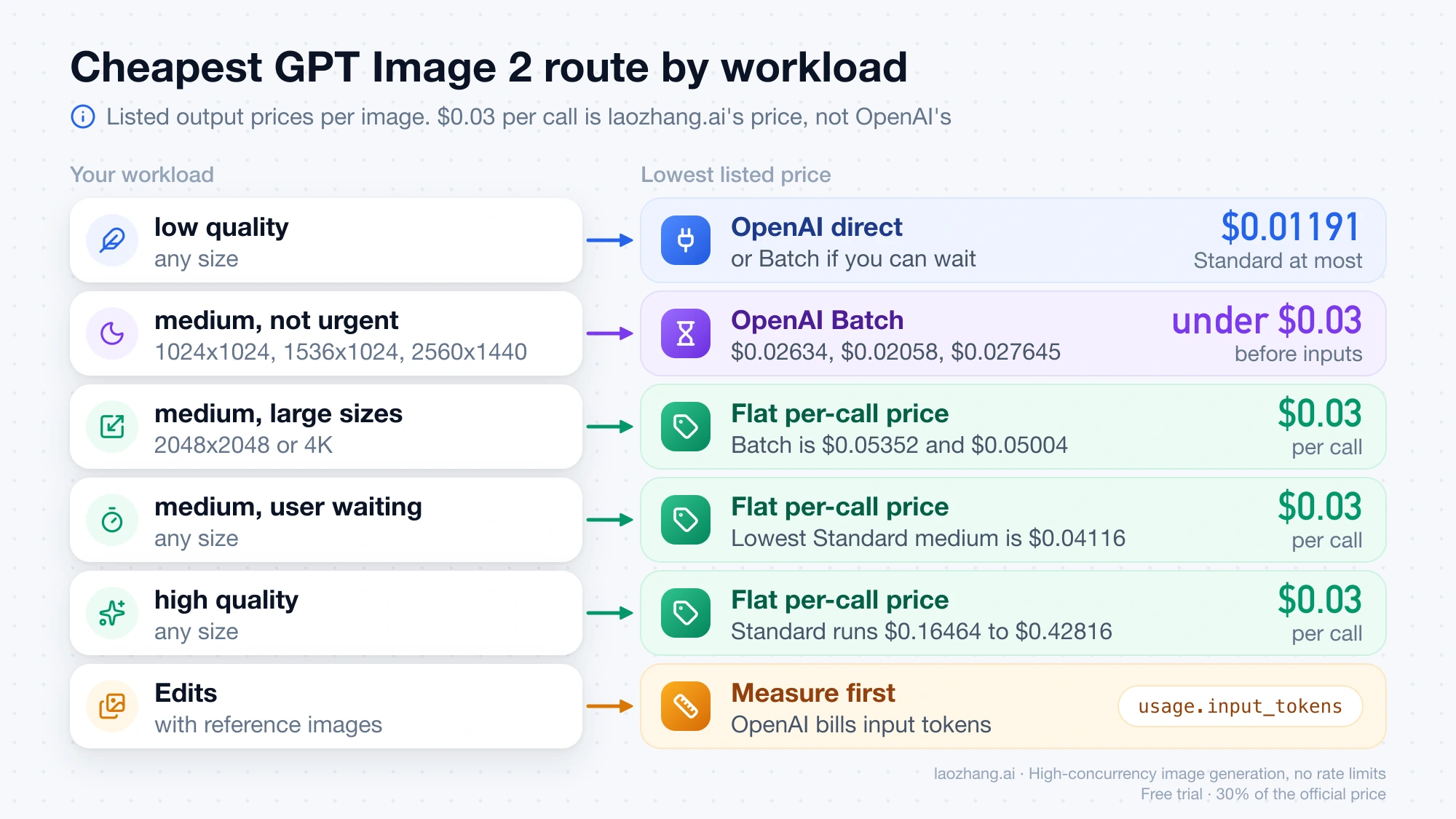
The $0.03 figure is laozhang.ai's listed price, not OpenAI's. Its GPT Image 2 documentation lists two model IDs in the default group with per-call billing, with prices stated as of September 24, 2026:
Disclosure: laozhang.ai is our own service. Its prices are platform pricing, not an independent comparison.
gpt-image-2at $0.03 per call. It does not acceptsizeorquality, so omit both.gpt-image-2-vipat $0.03 per call, with 1024x1024, 2048x2048 and 3840x2160 sizes andlow,mediumorhighquality. For portrait 4K, the documentation says to test 2160x3840 with your production prompt.
Against OpenAI Standard output, $0.03 is about 43% below 1024x1024 medium, about 86% below 1024x1024 high and about 93% below 3840x2160 high. The documentation also states that per-call billing keeps its price when you send reference images, which is where the gap to token billing can grow.
That comparison is of listed prices only. It assumes each paid call yields an image you keep, and it says nothing about whether the output matches what OpenAI returns directly. The provider's page publishes no rule for how failed calls are billed, no uptime commitment and no concurrency figure, so run a small paid batch at your real size and quality and compare the charge with your call log before committing a budget.
If you need OpenAI's own token billing through the same provider, it offers two usage-based groups: Sora2Official at OpenAI's official token rates, and GPTImage2 Sora2 Enterprise, which uses official keys only and costs the official price plus 20%. Endpoint and request details are in the GPT-Image-2 API guide.
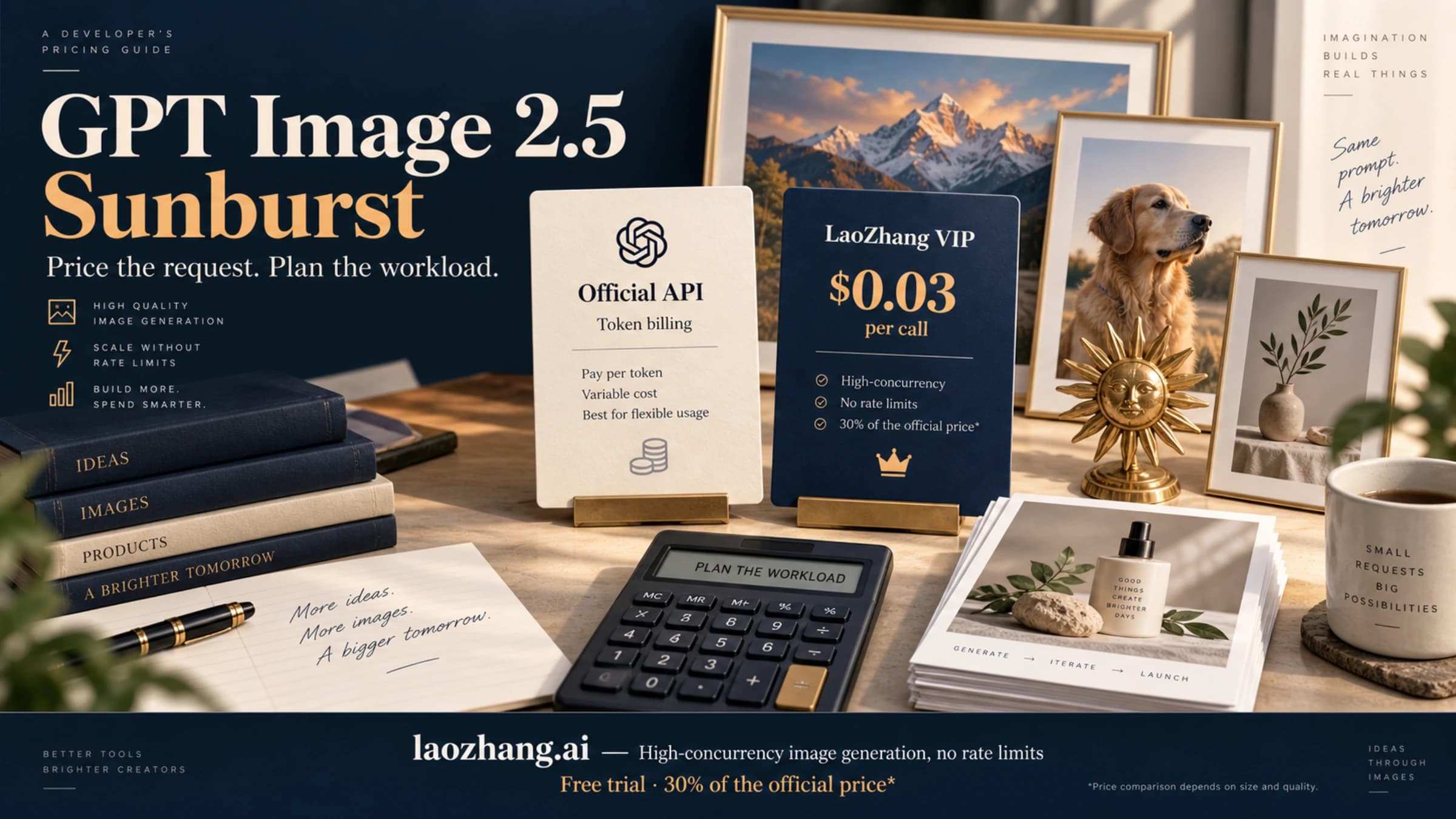
GPT Image 2.5 has the same token rates and a different per-image cost
For new projects, the price question usually belongs to GPT Image 2.5. gpt-image-2 is still a live model with snapshot gpt-image-2-2026-04-21 and no deprecation notice, but OpenAI's guide now files it under "Earlier GPT Image models" and says: "For new integrations, use one of the GPT Image 2.5 models described above."
The token rates are identical, yet the same quality word buys a different number of tokens. At 1024x1024:
| Output tokens, 1024x1024 | Price | gpt-image-2 | GPT Image 2.5 |
|---|---|---|---|
| 196 | $0.00588 | low | low |
| 439 | $0.01317 | none | medium |
| 1,756 | $0.05268 | medium | high |
| 7,024 | $0.21072 | high | max |
So medium on GPT Image 2.5 costs a quarter of medium on gpt-image-2, and you pay the old medium price only when you ask 2.5 for high. Equal cost does not show equal image quality, and the table says nothing about which model produces the better picture. The 2.5 figures are laid out in full in GPT Image 2.5 Sunburst Pricing, and whether an existing integration should move is the subject of GPT Image 2.5 Flare vs Sunburst vs GPT Image 2: Which to Run.
FAQ
How much does GPT Image 2 cost per image?
On OpenAI's API, the output of one 1024x1024 image is estimated at $0.00588 at low, $0.05268 at medium and $0.21072 at high. Across the sizes in OpenAI's calculator the range is $0.00474 to $0.42816. Prompt text and reference images are billed in addition, and Batch processing halves every figure.
How much does GPT Image 2 cost per month?
There is no monthly fee. You pay for the images you generate, so 1,000 images at 1024x1024 cost $5.88 at low, $52.68 at medium or $210.72 at high in output on OpenAI Standard, and half that on Batch. The only monthly prices nearby are ChatGPT subscriptions, which do not include API usage.
Is $0.03 the official OpenAI price for GPT Image 2?
No. OpenAI has no flat per-image price; it bills tokens. $0.03 per call is laozhang.ai's listed price for its gpt-image-2 and gpt-image-2-vip model IDs as of September 24, 2026.
Does a 4K GPT Image 2 image cost more than a 2K one?
Not on OpenAI's API. A 3840x2160 image is estimated at $0.01113, $0.10008 and $0.40026 for low, medium and high, slightly below the $0.01191, $0.10704 and $0.42816 for 2048x2048. Both cost about twice the 1024x1024 price at the same quality.
Sources5
External pages this guide links to, in the order they appear. Last updated Oct 3, 2026.
Sources5
External pages this guide links to, in the order they appear. Last updated Oct 3, 2026.
- 1.OpenAI's calculator estimatesdevelopers.openai.com/api/docs/guides/image-generation
- 2.OpenAI's pricing tabledevelopers.openai.com/api/docs/pricing
- 3.OpenAI's Batch guidedevelopers.openai.com/api/docs/guides/batch
- 4.gpt-image-2 model pagedevelopers.openai.com/api/docs/models/gpt-image-2
- 5.OpenAI's Plus help articlehelp.openai.com/en/articles/6950777-what-is-chatgpt-plus