
Claude Opus 5.5 costs $4 per million input tokens and $20 per million output tokens on Anthropic's standard API, down from Opus 5's $5 and $25. The newly announced limit reset is for eligible Claude subscriptions, not a credit or rate-limit reset for the API. Open Settings → Usage in Claude to see whether your own reset card restores a five-hour session limit or a weekly limit, and when it expires. These are separate decisions with separate billing. Claude API pricing · Claude's reset instructions · Subscription and API billing explained
Prices and reset rules below were checked on September 23, 2026. Use the API rates to budget an application; use the reset card when deciding whether to continue a Claude chat or Claude Code session now.
Opus 5.5 API price versus Opus 5
Anthropic lists these first-party, standard-mode USD rates per million tokens. Cache rates apply only when prompt caching is used; they are different token categories, not extra fees on top of the same input tokens. Anthropic's pricing table
| Billable token category | Opus 5.5 | Opus 5 | Difference at the listed rate |
|---|---|---|---|
| Base input | $4.00 | $5.00 | 20% lower |
| Output | $20.00 | $25.00 | 20% lower |
| Five-minute cache write | $5.00 | $6.25 | 20% lower |
| One-hour cache write | $8.00 | $10.00 | 20% lower |
| Cache read | $0.20 | $0.50 | 60% lower |
The model ID is claude-opus-5-5. A cache read on this model is priced at 5% of its base input rate, rather than the usual 10% multiplier. For the listed input and output categories, the arithmetic is straightforward: ($5 − $4) ÷ $5 = 20%, and ($25 − $20) ÷ $25 = 20%. A lower rate per token does not guarantee the same percentage reduction in a completed task's bill. Different models can consume different numbers of tokens, and Anthropic notes that its newer tokenizer may produce more tokens for the same text. Model pricing and tokenizer note
A bill you can reproduce
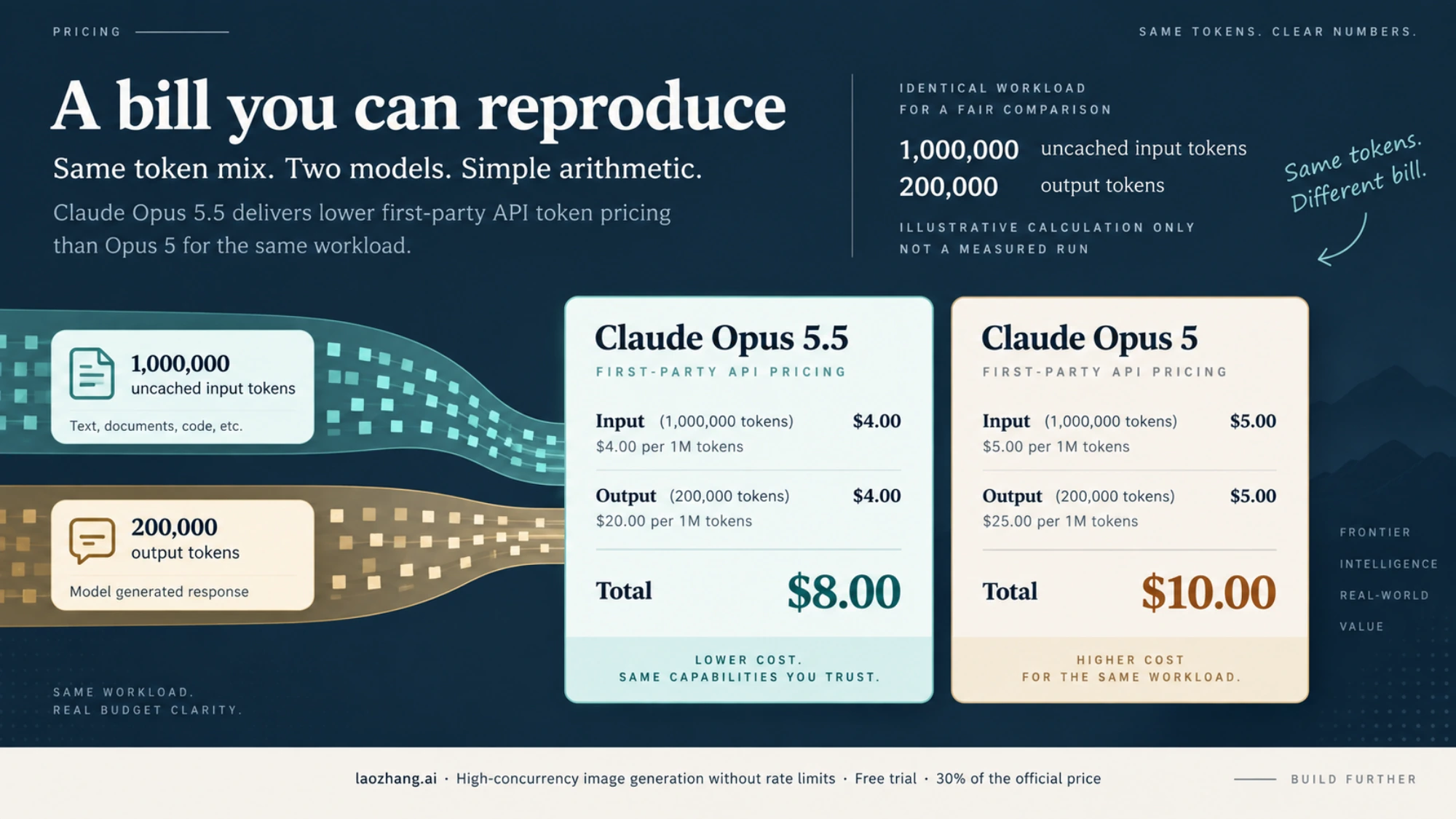
Suppose a workload uses one million uncached input tokens and 200,000 output tokens, with standard global routing, no other priced features, and the same measured token totals on each model. Opus 5.5 would cost $4 + (0.2 × $20) = $8. Opus 5 would cost $5 + (0.2 × $25) = $10. This example shows a $2, or 20%, difference in the listed token charges; it is a calculation, not a test run or a prediction of identical token usage in production. Official rates
To estimate your own bill, separate the usage counters for base input, output, cache writes, and cache reads. Multiply each count in millions by its matching rate, then add the results. For example, 500,000 cache-read tokens on Opus 5.5 cost 0.5 × $0.20 = $0.10 for that category. Do not charge those same tokens again as base input. Check any additional tool charges and price modifiers before treating the sum as a full invoice. Prompt-caching and tool pricing
Anthropic says its own tests at default settings found about 40% lower cost per task on typical workloads with Opus 5.5 than with Opus 5, partly because the model used fewer tokens. That is a vendor workload result, not a published 40% discount on every API token or a guaranteed saving on yours. Compare real usage and task quality on your workload before changing a production budget. Opus 5.5 announcement
Which price changes if you use fast mode, Batch, or a cloud provider?
The $4/$20 pair is the standard first-party API rate. Anthropic lists fast mode for Opus 5.5 at $8 input / $40 output per million tokens in research preview; it is available on the first-party API and cannot be combined with the Batch API. For jobs that can wait, Batch lists $2 input / $10 output per million tokens for Opus 5.5. These are different operating modes, so choose the one the request actually uses before multiplying tokens. Fast mode and Batch pricing
On the first-party API, requesting US-only inference adds a 1.1× multiplier to input, output, cache writes, and cache reads; global routing uses the standard rate. Anthropic-operated Claude Platform on AWS has its own marketplace billing presentation, while partner-operated Amazon Bedrock and Google Cloud set independent prices. Do not transfer the table above unchanged to a partner invoice. Data residency and cloud pricing
Does the Opus 5.5 limit reset apply to API usage?
No. Anthropic describes the reset as a benefit for Claude subscription users, while its Help Center says a paid Claude plan and the developer Console/API are separately billed products. Paying for Pro, Max, Team, or Enterprise does not include API access, and redeeming a subscription reset does not add API credits or reset API organization rate limits. If your problem is an API charge or API 429, inspect the Console billing and API limit information instead of looking for a subscription reset button. Opus 5.5 announcement · Subscription versus Console · What a limit reset changes
The announcement also says five-hour usage limits are increasing on Pro, Max, Team, and seat-based Enterprise plans. It gives no numerical increase to turn into a promised number of messages or hours. Your available usage still depends on your plan and activity; the Usage page is the relevant place to inspect your own account. Anthropic announcement
What does your Claude limit reset actually restore?
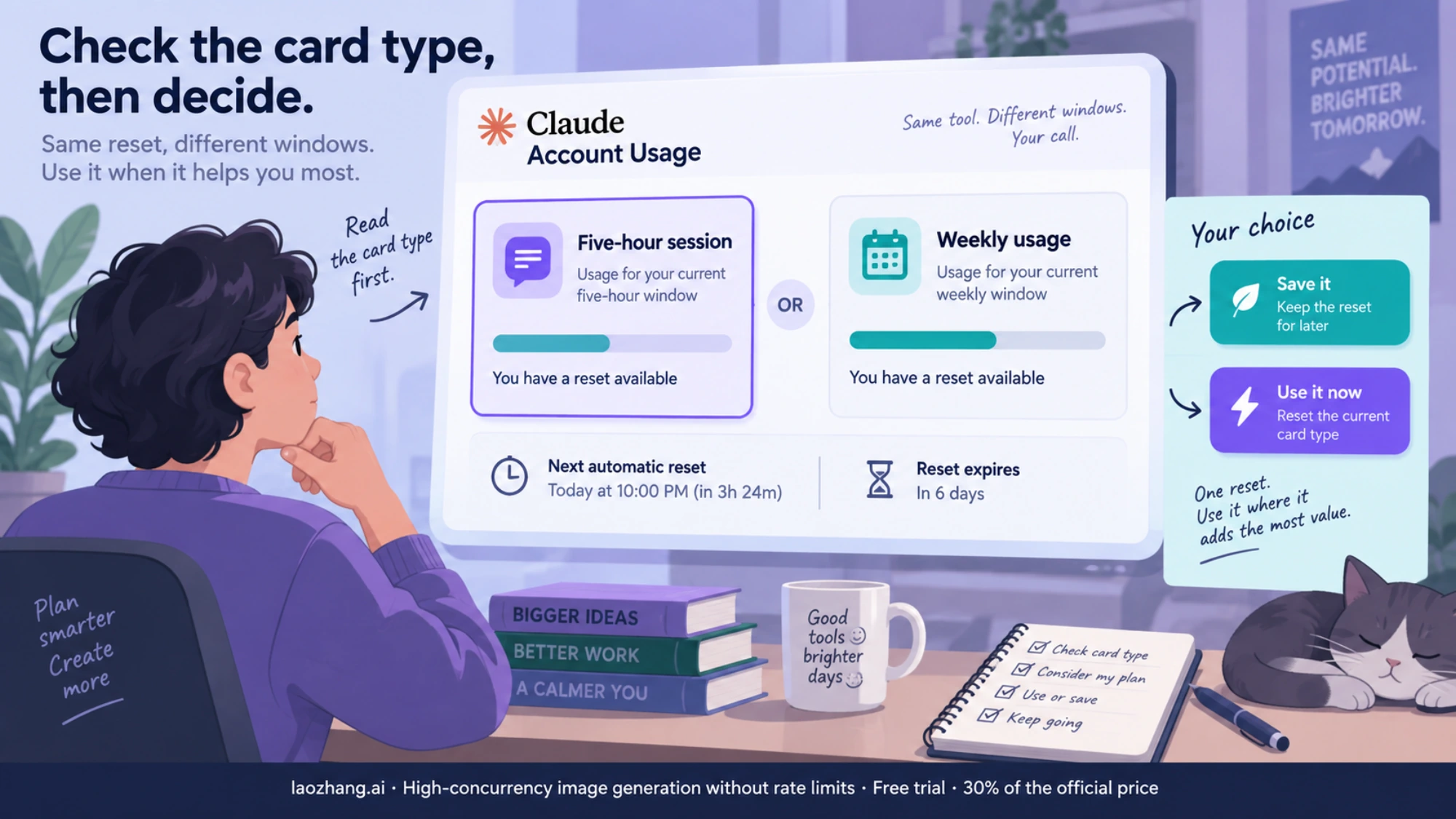
Read the type printed on your card. According to Claude's Help Center, a reset immediately refills either the five-hour session limit or the weekly usage limit, depending on the particular reset shown. It does not automatically refill both. The normal day and time of the weekly reset remain the same. An expiration, if one applies, appears in Settings → Usage; there is no safe universal expiration date to borrow from someone else's screenshot. Claude Help Center: limit reset
| Your situation | Practical decision |
|---|---|
| A five-hour card is shown, and the five-hour limit is blocking work you need to finish now | Using the card restores that five-hour limit immediately. Check its expiration and how soon your ordinary session reset would arrive first. |
| A weekly card is shown, and your weekly limit is blocking work before its scheduled reset | Using the card restores the weekly limit now; the next automatic weekly reset still happens at its usual time. |
| You still have enough usage for the work at hand | You can save the reset, subject to the expiration shown on your card. It can be used before you hit a limit, but using it early may leave less value for later. |
| No reset card appears in your account | There is no reset to activate from these instructions. Eligibility and live offer state must be checked in your own account. |
This is a timing judgment, not a way to extend the underlying billing period. A used reset cannot be undone; it also does not refund billed extra usage or replenish a usage-credit balance. Claude says a reset is lost if you downgrade or cancel before using it. Reset rules
How to activate a reset when you decide to use it
- Open Claude in a web browser or Claude Desktop and go to Settings → Usage.
- Find Resets, read the card's limit type and expiration, and select Reset for free.
- Confirm Reset for free. Your displayed limit should return to full for the window named on the card. Claude also offers the button on the message shown when you reach a limit. Claude's activation steps
You cannot currently press that button inside Claude Mobile or Claude Code in a terminal or IDE. If you use Claude Code, activate the offer in the web app or Claude Desktop under the same Claude account; the restored subscription limit is shared with Claude Code and Mobile. Do not confuse that shared subscription usage with a separately billed Console API key. Claude Help Center
Quick answers before you decide
Is Opus 5.5 always 40% cheaper than Opus 5?
No. The standard first-party API lists 20% lower input and output rates per token, and 60% lower cache-read rates. Anthropic's roughly 40% lower cost per task is its result for typical workloads at default settings, including token-efficiency differences. Your bill depends on your actual token mix, model behavior, mode, and routing. Pricing table · Anthropic's test claim
Will using a weekly reset delay my next weekly reset?
No. Claude says the automatic weekly reset keeps its usual day and time, even when you use an available reset. Check whether your card is for the weekly or five-hour limit before confirming. Reset rules