Gemini 4 Argon vs 3.8 Flash: Cost per Task and When to Switch
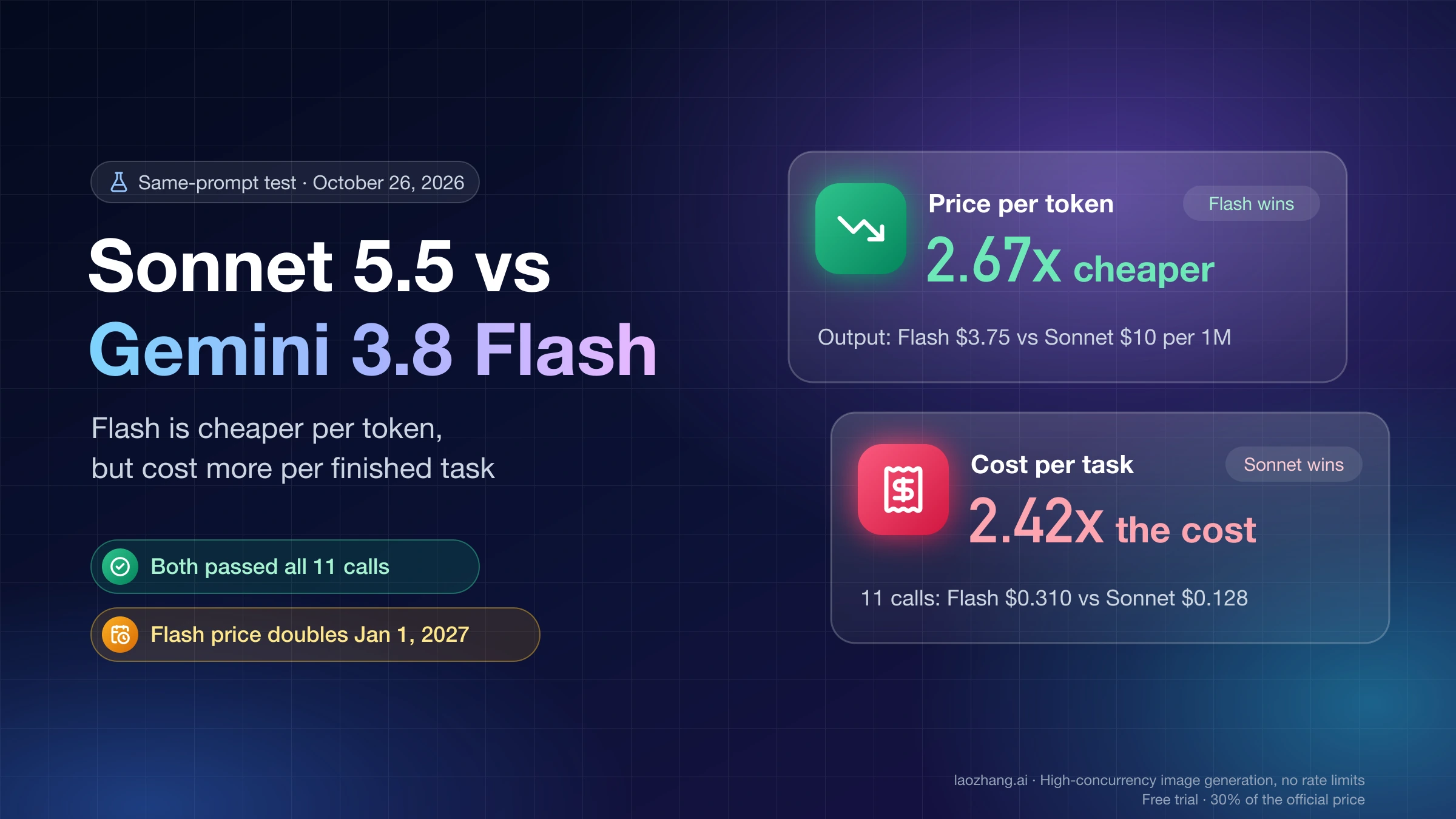
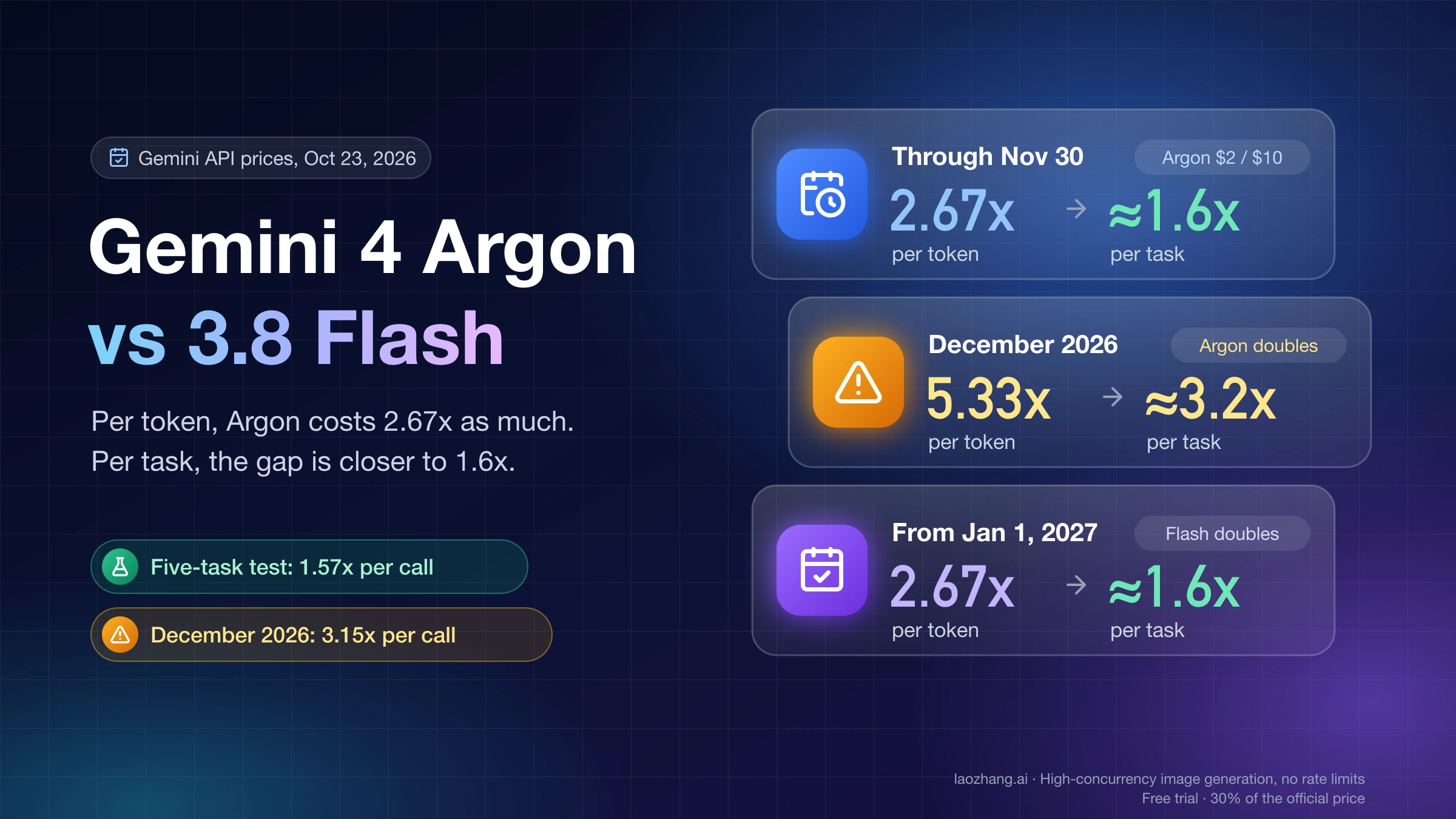
Gemini 4 Argon lists at 2.67x 3.8 Flash per token, but on five same-prompt calls it cost 1.57x as much through Nov 30, 2026, and 3.15x in December.
On this page
Keep most of your gemini-3.8-flash traffic where it is and move only the work Flash keeps failing at to gemini-4-argon: terminal and agentic coding, multi-step tool use and hard math. On those tasks Argon solves far more. On reading long documents and on simple calls the two models score about the same, so paying more there buys nothing. For most teams the cheapest setup is a split by task type.
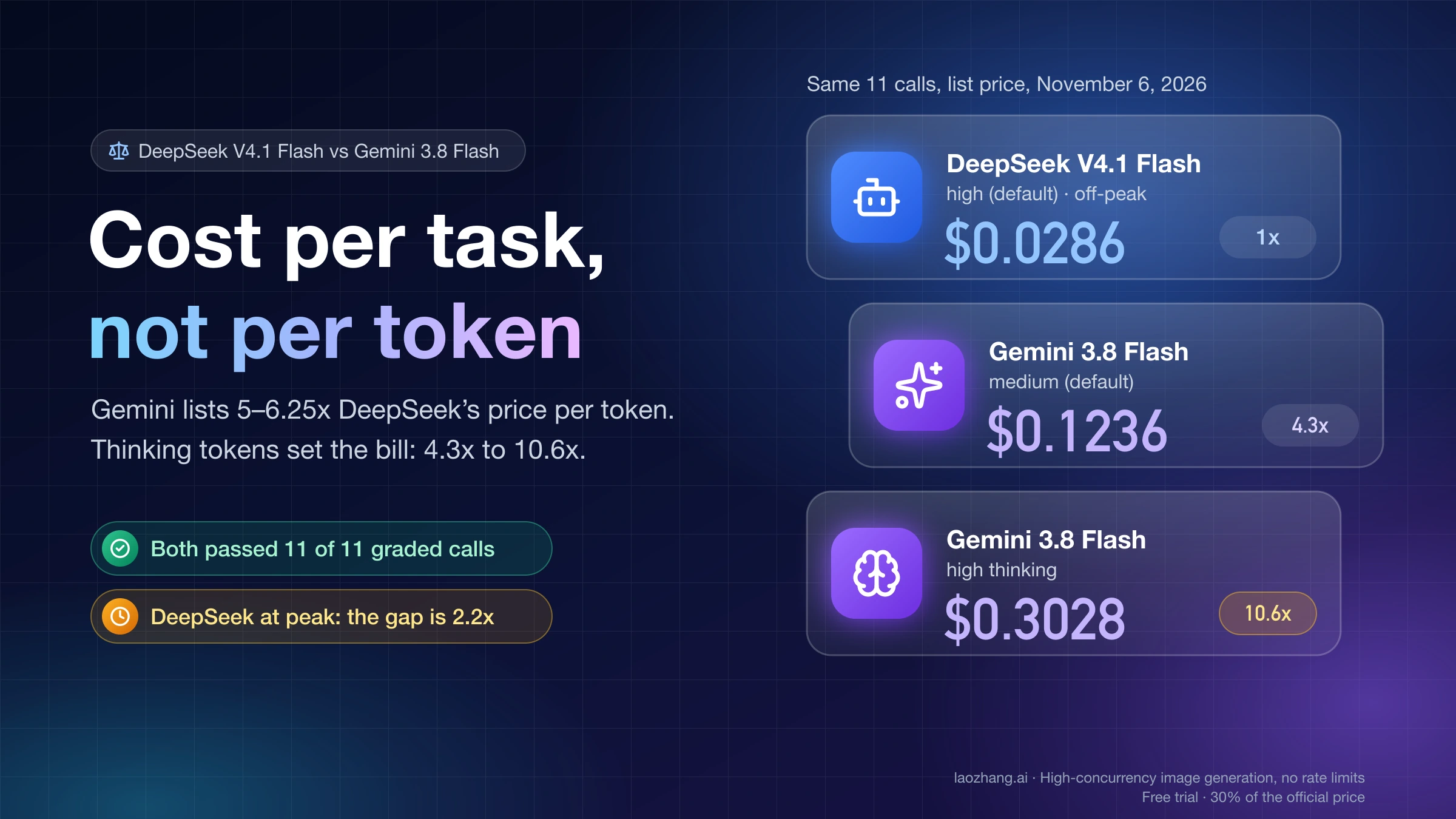
Argon's list price is 2.67 times Flash's per token through November 30, 2026, but the gap per job is smaller because on everyday prompts Flash spends more thinking tokens on the same work. In a same-prompt test on October 23, 2026, with each model at its default thinking level, Argon cost 1.57 times as much as Flash over five everyday tasks. A rerun on November 11 at mixed levels put Argon at low at 1.18 times the cost of Flash at high. Artificial Analysis's hard benchmark set, on its Intelligence Index (nine evaluations; v5.0 replaced v4.3.2 on October 27–28, 2026, and the current version is v5.0.1), puts Argon at about two-thirds of Flash's cost per task at the introductory price, and about 1.3 times Flash at the December price it now uses for Argon, but that comes from how rarely Flash's input hit the cache in its harness, not from the price lists, as explained below. From December 1 to December 31, 2026, Argon's price doubles while Flash's doesn't, and the same everyday jobs cost about 3.15 times as much on Argon. On January 1, 2027, Flash's price doubles too and the ratio falls back to about 1.6.
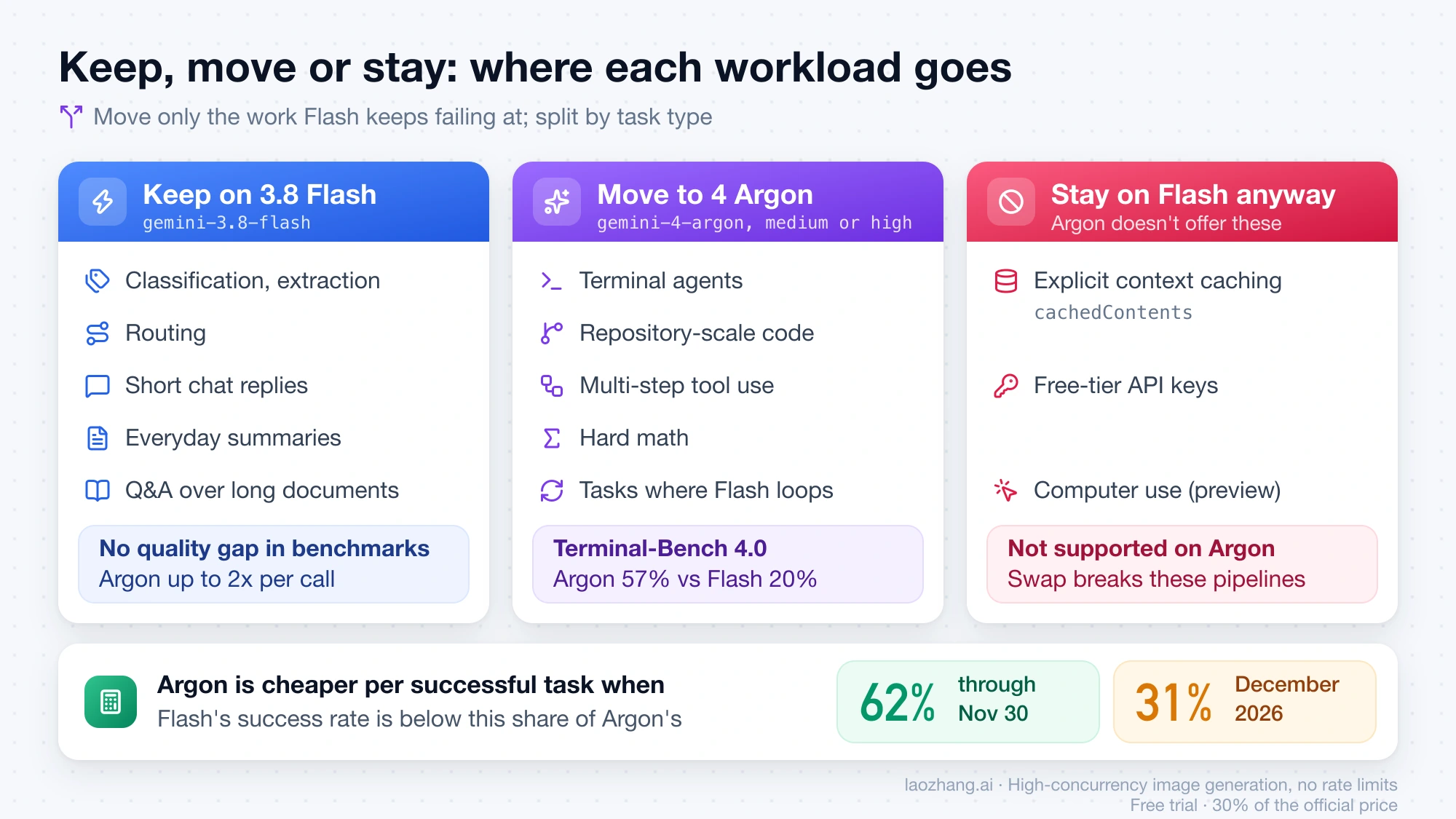
Two things don't come with the swap. Argon has no free tier on the Gemini API, and it doesn't support explicit context caching, so a pipeline that depends on either should stay on Flash.
Gemini 4 Argon vs 3.8 Flash API prices: 2.67x per token, 5.33x in December
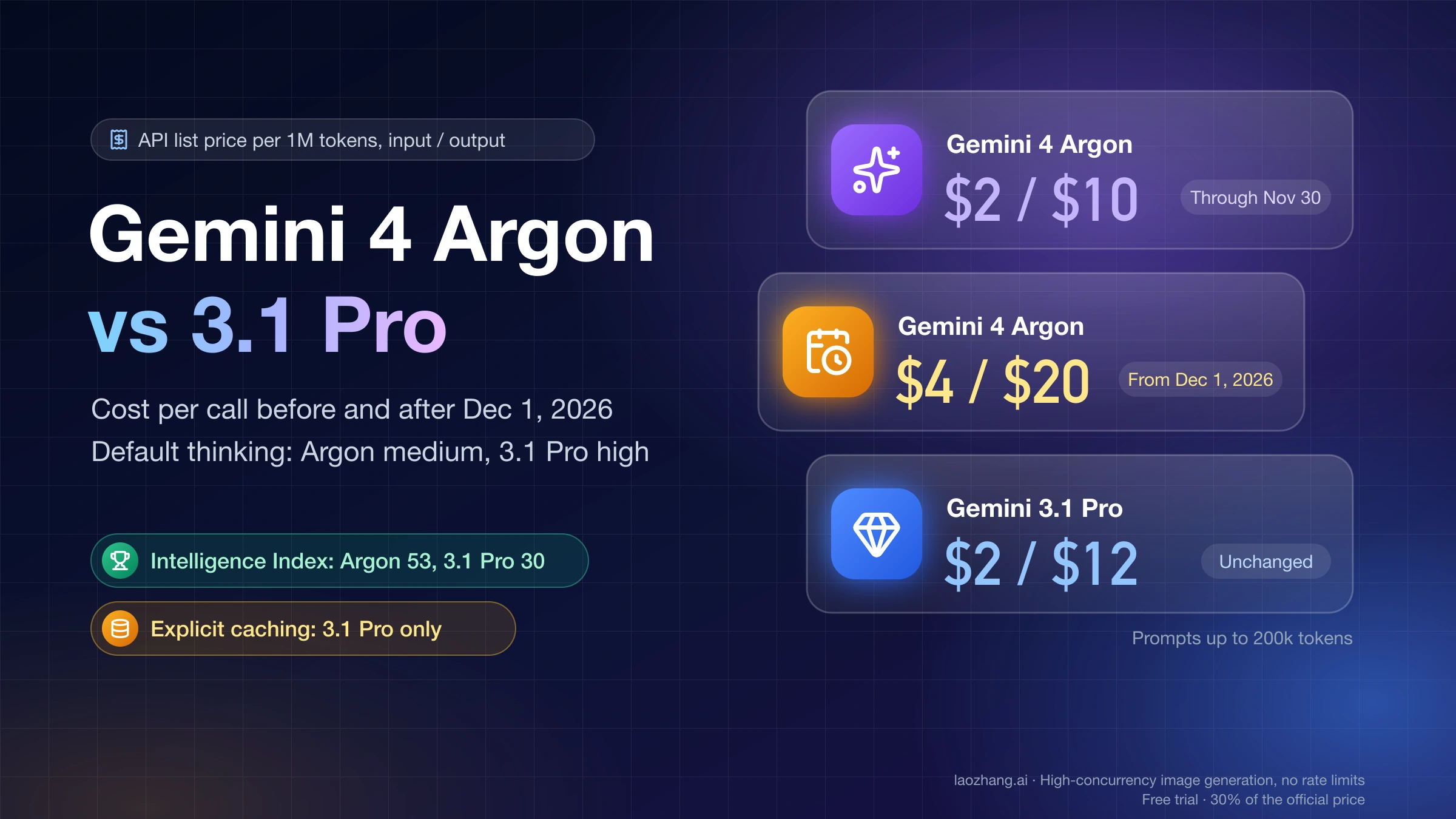
Per token, Argon costs 2.67 times as much as 3.8 Flash on input and on output from now through November 30, 2026, then 5.33 times as much from December 1 to December 31, 2026, then 2.67 times again from January 1, 2027. The two prices change on different dates: Argon's introductory price ends on November 30, and Flash's price doubles a month later. These are the paid Standard rates on Google's Gemini API pricing page as of October 23, 2026. Neither model has a separate price band for prompts over 200k tokens.
| Per 1M tokens, paid tier | Argon through Nov 30, 2026 | Argon from Dec 1, 2026 | 3.8 Flash through Dec 31, 2026 | 3.8 Flash from Jan 1, 2027 |
|---|---|---|---|---|
| Input | $2.00 | $4.00 | $0.75 | $1.50 |
| Output, thinking tokens included | $10.00 | $20.00 | $3.75 | $7.50 |
| Cached input | $0.10, implicit caching only | $0.20, implicit caching only | $0.075, plus $0.50 per 1M tokens per hour of storage | $0.15, plus $1.00 per 1M tokens per hour of storage |
| Batch and Flex, input / output | $1 / $5 | $2 / $10 | $0.375 / $1.875 | $0.75 / $3.75 |
| Priority, input / output | $3.60 / $18 | $7.20 / $36 | $1.35 / $6.75 | $2.70 / $13.50 |
| Free tier | Not available | Not available | Free of charge, data used to improve Google's products | Free of charge |
Batch, Flex and Priority keep the same 2.67x gap, and 5.33x in December. Cached input is the exception: Argon's cache price is only 1.33 times Flash's, but Argon offers implicit caching only. Search grounding is the same on both, 5,000 free requests a month shared across Gemini 3 and newer models, then $14 per 1,000. For every other Gemini model's rates, see Gemini API Pricing 2026: Token Rates, Free Tier, and Key Cost.
Same prompts on both models, October 23, 2026: Argon 1.57x per call
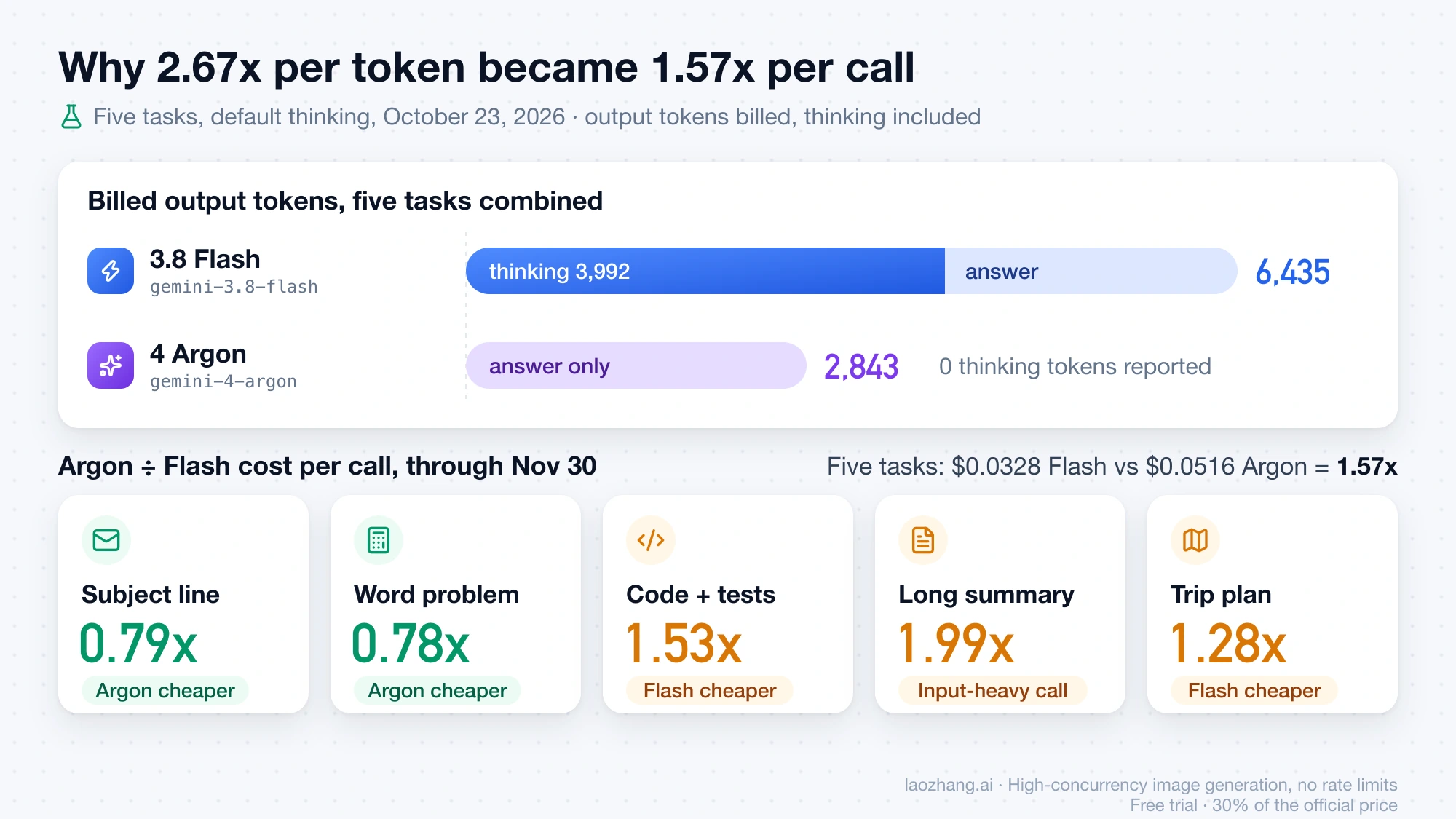
Over five everyday tasks with each model at its default thinking level, Argon cost $0.0516 and Flash $0.0328, so Argon was 1.57 times as expensive per call, not 2.67 times. Both models default to medium thinking, according to Google's thinking guide, so the default rows compare like with like. On the two shortest tasks Argon was actually cheaper per call.
The test ran on the evening of October 23, 2026, through LaoZhang API (laozhang.ai), both models on the same day with identical prompts, one sample per prompt and thinking level and no reruns. The tasks were a one-line email subject, a pen-pack word problem, a Python merge_intervals function with six pytest tests, a summary of a 6,723-word article (about 11,100 input tokens) with three claims to check, and the last turn of a four-turn trip-planning chat that ends in a budget table in euros. The prompts were the same ones used for the earlier Gemini 4 Argon vs 3.1 Pro cost test.
Disclosure: laozhang.ai is our own service. Its prices are platform pricing, not an independent comparison.
The two models went through different endpoints, and that is a limit of this test. Flash's Gemini-native endpoint timed out on four attempts that evening, so Flash went through the OpenAI-compatible /v1/chat/completions endpoint with reasoning_effort. Argon went through the Gemini-native generateContent endpoint with thinkingConfig.thinkingLevel, because on the OpenAI-compatible endpoint its reasoning_effort had no visible effect. Every response returned the requested model ID, gemini-3.8-flash or gemini-4-argon. Costs below are computed from the token counts each response reported, at Google's list prices, and are not billing statements.
| Task, default thinking | Flash tokens in / thinking / out | Argon tokens in / thinking / out | Flash cost | Argon cost through Nov 30 | Argon ÷ Flash through Nov 30 | Argon ÷ Flash Dec 2026 |
|---|---|---|---|---|---|---|
| Email subject line | 23 / 402 / 67 | 53 / 0 / 129 | $0.0018 | $0.0014 | 0.79x | 1.57x |
| Word problem | 61 / 778 / 456 | 92 / 0 / 347 | $0.0047 | $0.0037 | 0.78x | 1.56x |
| Coding with tests | 61 / 522 / 503 | 91 / 0 / 577 | $0.0039 | $0.0060 | 1.53x | 3.06x |
| Long-document summary | 11,191 / 1,456 / 741 | 11,102 / 0 / 1,097 | $0.0166 | $0.0332 | 1.99x | 3.99x |
| Multi-turn trip plan | 218 / 834 / 676 | 267 / 0 / 693 | $0.0058 | $0.0075 | 1.28x | 2.56x |
| Five tasks | $0.0328 | $0.0516 | 1.57x | 3.15x |
Flash at $0.75/$3.75 per 1M tokens, Argon at $2/$10 through November 30 and $4/$20 in December 2026. From January 1, 2027 both prices double and the ratios return to the "through Nov 30" column. One sample per row, October 23, 2026.
Thinking tokens explain the gap. At its default, Flash reported 402 to 1,456 thinking tokens on every call, 3,992 in total, and billed 6,435 output tokens including thinking across the five tasks. Argon reported no thinking tokens at default and billed 2,843 output tokens. Whether Argon skipped thinking at medium or the endpoint left the count out isn't visible in the usage data, but the counts shown are the ones that get billed. The same pattern showed up in the October 14 Argon test. If your own Argon calls at medium do report thinking tokens, expect costs between the default rows and the high rows below.
Turning Argon up to high changes the picture. Argon then reported 445 to 2,439 thinking tokens per call, and the five tasks cost $0.1110, about 2.15 times its own default. Flash's thinking level, on the other hand, didn't visibly change its token counts on the OpenAI-compatible endpoint: the coding task used 522 thinking tokens at default, 516 at low, 588 at medium and 512 at high. So this test has no clean high-versus-high ratio for single calls. The Artificial Analysis numbers in the next section are high against high, on hard tasks and with a caching caveat. A rerun on November 11, 2026, with both models on the Gemini-native endpoint, where Flash's level did apply, is in the section on Argon low versus Flash high below: there Argon at high cost 2.76 times as much as Flash at high.
The long-document summary is the one task where Argon's premium is largest, 1.99x now and 3.99x in December. Input tokens dominate that call, and Argon's input price is 2.67 times Flash's with no thinking discount to offset it.
Did the cheaper calls answer correctly?
Yes on both models, on the two tasks with a checkable answer. All four word-problem answers, Flash and Argon at default and at high, chose four 10-packs and three 6-packs for 58 pens at $41.50, which is correct. The code from all eight coding answers, four thinking settings on each model, passed all six of its pytest tests under pytest 9.1.1. The subject line, summary and trip plan weren't graded.
These are easy tasks, so the result shows what each model costs on everyday work, not which one is smarter. The test also didn't cover Google's own endpoint, Vertex AI, Batch or Flex, long agent sessions with tool loops, the Gemini app or Antigravity.
Latency from single samples doesn't work as a speed benchmark here. During the run, Flash returned 429 and 503 "This model is currently experiencing high demand" errors for several minutes plus some read timeouts, and its subject-line call took 98.6 seconds on the fourth attempt. Argon's calls all succeeded on the first try in 6.8 to 59.7 seconds. That was one evening on one route, so don't read it as a reliability ranking.
Why Argon's cost per task is smaller than its price per token
The cost of a job is price per token times the tokens the model spends, and on everyday prompts Flash spends more: in the test above it billed 6,435 output tokens against Argon's 2,843, which is why Argon came out at 1.57x rather than 2.67x. On Artificial Analysis's hard benchmark tasks at high thinking the token count runs the other way. Read on November 11, 2026 (index v5.0.1), the Artificial Analysis Argon vs 3.8 Flash comparison puts Argon at $9.95 per task and Flash at $7.77, with Argon using about 116,000 output tokens per task against Flash's 99,000. On November 4 the same page showed Argon at $7.68; Artificial Analysis has since raised its published Argon figure without a note, with the same index score and the same output tokens per task. Artificial Analysis prices Argon at its December rate of $4 / $20. Every Argon price is exactly half of that through November 30, so at today's rate the same tokens cost about $4.98, about 0.64 times Flash; that $4.98 is our halving of Artificial Analysis's figure, not a number Artificial Analysis publishes.
Flash's higher figure is almost all input. Of its $7.77, about $7.03 is input billed at the full $0.75 per 1M tokens, because only 34% of Flash's 10.16 billion input tokens hit the cache in Artificial Analysis's harness, against about 87% of Argon's 7.55 billion (92% in the November 4 figures); Flash's output comes to $0.37. At Argon's hit rate, Flash would cost about $2.73 per task, 0.55 times Argon's introductory-rate $4.98, the same direction as the everyday test. So the two sources now disagree on which model is cheaper per task, and the reason is caching behavior in one harness, not the price lists. If your own Flash traffic rarely hits the implicit cache, check your cached-token counts before relying on either ratio.
December changes both ratios. On the everyday test, Argon goes from 1.57x to 3.15x Flash's cost on December 1 and back to 1.57x on January 1, 2027, when Flash's price doubles too. On Artificial Analysis's figures, Argon's hard-task cost doubles to $9.95 in December, about 1.28 times Flash's $7.77; Artificial Analysis already shows that December figure. From January 1, with the same token use and cache hits, Flash's doubles to about $15.54, putting Argon at about 0.64 times Flash. The January figure is our calculation, not a new measurement.
Per-call costs are fractions of a cent, so the decision only shows up at volume. As a calculation from the per-call costs above, not a measurement:
| Monthly workload, calculated | 3.8 Flash through Dec 31, 2026 | Argon through Nov 30, 2026 | Argon in Dec 2026 | 3.8 Flash from Jan 1, 2027 | Argon from Jan 1, 2027 |
|---|---|---|---|---|---|
| 100,000 calls split evenly across the five test tasks, default thinking | $656 | $1,033 | $2,066 | $1,312 | $2,066 |
| 100,000 summaries like the long-document task, default thinking | $1,663 | $3,317 | $6,635 | $3,326 | $6,635 |
| 1,000 hard tasks at Artificial Analysis's per-task cost, high thinking, at its harness's cache-hit rates | $7,770 | $4,980 | $9,950 | $15,540 | $9,950 |
If you're planning a migration, December 2026 is the month when moving traffic to Argon costs the most relative to staying on Flash, on both sources. A job that only marginally needs Argon can wait until January, when the everyday-test gap returns to roughly 1.6x.
Gemini 4 Argon low vs 3.8 Flash high: cost per call and which to pick
On five everyday prompts run on November 11, 2026, Argon at low cost 1.18 times as much as 3.8 Flash at high, and Argon at medium cost 1.22 times as much. At low, Argon was the cheaper of the two on every task except the long-document summary, so through November 30 the gap between these settings is small and comes almost entirely from long input. In December 2026 the same comparison is 2.35 times and 2.43 times, and from January 1, 2027 it returns to 1.18 and 1.22.
This rerun used the five prompts from the October 23 test, one sample per model, level and task, through LaoZhang API (laozhang.ai). This time both models went through the Gemini-native generateContent endpoint with thinkingConfig.thinkingLevel, and all 30 responses returned the requested model ID on the first attempt. On this endpoint Flash's level did change its thinking: across the five tasks it reported no thinking tokens at low, 4,500 at medium and 6,326 at high. Argon reported none at low or medium and 6,229 at high. Costs are computed from the reported token counts at Google's list prices through November 30, 2026.
Disclosure: laozhang.ai is our own service. Its prices are platform pricing, not an independent comparison.
| Task | 3.8 Flash high, tokens in / thinking / out | Flash high cost | Argon low, tokens in / thinking / out | Argon low cost | Argon low ÷ Flash high | Argon medium cost | Argon medium ÷ Flash high |
|---|---|---|---|---|---|---|---|
| Email subject line | 22 / 494 / 69 | $0.0021 | 53 / 0 / 113 | $0.0012 | 0.58x | $0.0011 | 0.51x |
| Word problem | 61 / 1,552 / 328 | $0.0071 | 92 / 0 / 264 | $0.0028 | 0.40x | $0.0034 | 0.48x |
| Coding with tests | 61 / 1,146 / 558 | $0.0064 | 91 / 0 / 546 | $0.0056 | 0.88x | $0.0055 | 0.86x |
| Long-document summary | 11,191 / 1,749 / 808 | $0.0180 | 11,102 / 0 / 944 | $0.0316 | 1.76x | $0.0323 | 1.80x |
| Multi-turn trip plan | 218 / 1,385 / 572 | $0.0075 | 267 / 0 / 653 | $0.0071 | 0.94x | $0.0077 | 1.02x |
| Five tasks | $0.0411 | $0.0484 | 1.18x | $0.0500 | 1.22x |
One sample per cell, November 11, 2026. Flash at $0.75/$3.75 per 1M tokens, Argon at $2/$10. In December 2026 Argon's costs double and the two ratios become 2.35x and 2.43x.
All three levels of both models, five-task totals from the same run:
| Five tasks, through Nov 30, 2026 | Low | Medium (default) | High |
|---|---|---|---|
| 3.8 Flash | $0.0187, no thinking tokens | $0.0344, 4,500 thinking tokens | $0.0411, 6,326 thinking tokens |
| Argon | $0.0484, no thinking tokens | $0.0500, no thinking tokens | $0.1137, 6,229 thinking tokens |
On these prompts Argon's low and medium cost almost the same. Neither reported thinking tokens and the totals differ by 3%, which is why "Argon low vs Flash high" and "Argon medium vs Flash high" get nearly the same answer. The expensive step on Argon is high, about 2.3 times its medium. Flash works the other way round: most of its increase comes between low and medium (1.84 times), and high adds another 20%. With each model at its default, Argon cost 1.45 times as much as Flash in this run, against 1.57 times on October 23, and with both at high Argon cost 2.76 times as much.
Quality didn't separate the settings on the two tasks that can be checked. All six word-problem answers, three levels on each model, gave four 10-packs and three 6-packs for $41.50, and the code from all six coding answers passed its six tests under pytest 9.2.0. These are easy tasks, so the result tells you what each setting costs, not which one solves more hard problems. Timing is from single calls on one route: the five Argon low calls took 74 seconds in total and the five Flash high calls 108 seconds.
No public benchmark covers this exact pairing. As of November 11, 2026, Artificial Analysis lists Argon at high only, with no low or medium row, so there is no published index score for Argon at low. For Flash it lists three levels: high scores 31 at $7.77 per task, medium 30 at $6.26, and low 23 with no cost figure. Argon at high scores 50. Dropping Flash from high to medium loses one index point and saves about 19% per task; dropping it to low loses eight points.
You make this choice in Antigravity, where you pick a model and a thinking level (Low, Medium or High) together. Daniel Strebel's effort-level test in Google Cloud's Medium publication, published October 15, 2026, ran four coding scenarios on one open-source repository through the Antigravity CLI at all three levels of both models. Every configuration passed his validation. He reports that Argon cost roughly half as much as Flash at every level on his most ambiguous scenario, that Argon finished faster on three of the four tasks, and that Flash at medium and high used many more tokens than Argon. His advice is low for narrow, well-scoped changes, medium when you don't know how far a change reaches, and high for ambiguous work or tasks that failed at a lower level. That is one author and one code base, and his charts don't give the values as numbers.
On a Google AI plan you spend usage, not tokens. Google's limits page says more advanced models and higher thinking levels take more of your usage, and publishes no weights per model or level, so there is no official figure for how Argon at low compares with Flash at high against a plan's limit.
Which to pick, from this test and the published data:
- Short and mid-length calls where you've been using Flash at high for more careful answers: try Argon at low or medium. In this test it cost less per call on four of five tasks at low and answered both checkable tasks correctly.
- Long inputs, around 10,000 tokens and up: keep Flash at high. Argon at low cost 1.76 times as much on the long-document summary, because input price dominates that call.
- Simple tasks: Flash at low is cheaper than either. It cost $0.0187 for the five tasks, 39% of Argon at low, and its checkable answers were also right.
- December 2026: Argon at low costs 2.35 times Flash at high on the same calls, so for that month move only the work Flash keeps failing at.
- Hard agentic work: the published comparison is high against high, 50 to 31 on Artificial Analysis's index. Test your own tasks before assuming Argon at low keeps that lead.
Is Gemini 4 Argon better than 3.8 Flash? Agents yes, long reading no
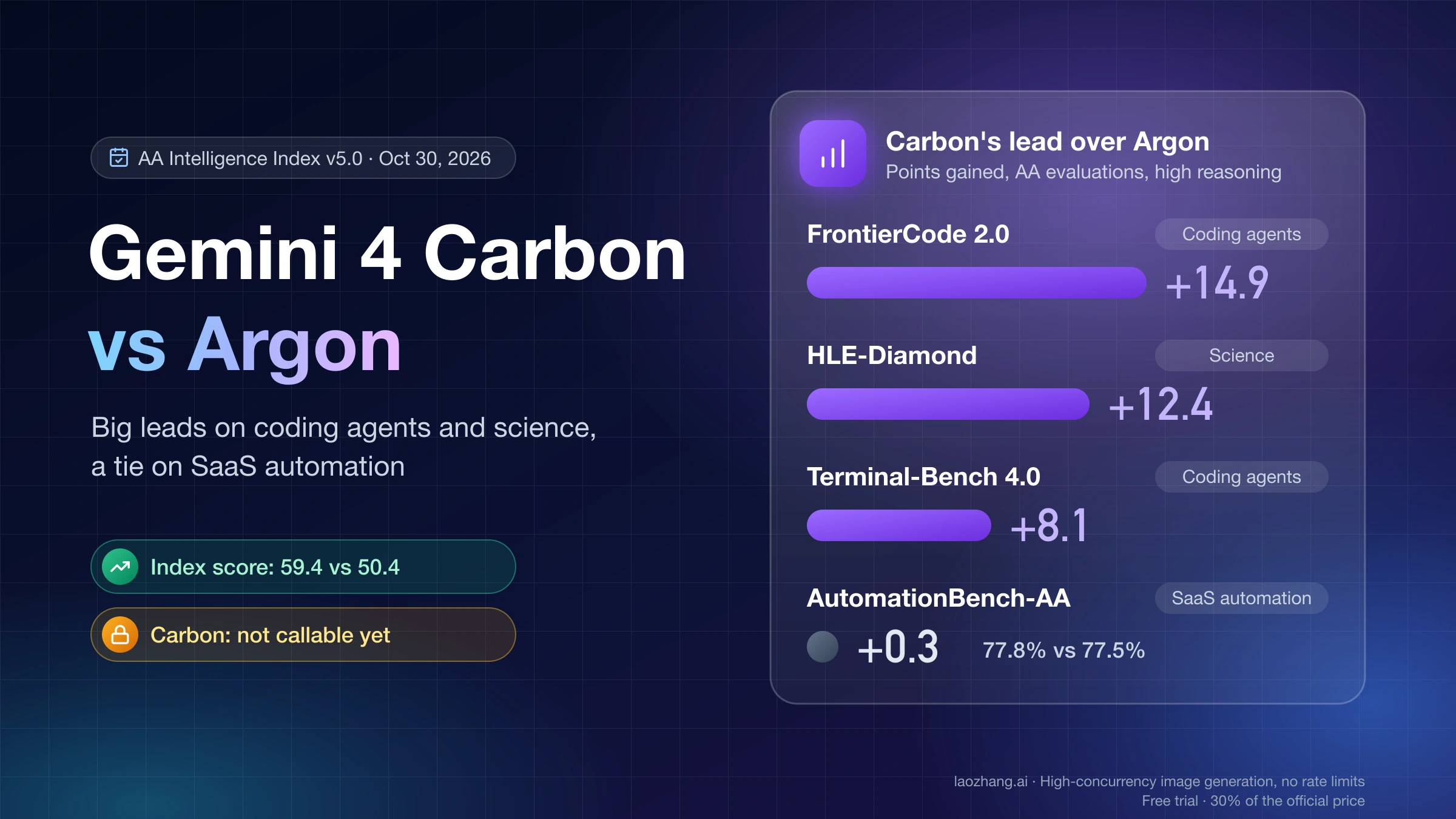
Argon is clearly better at terminal work, agentic coding, frontier math and abstract reasoning, and about level with Flash on document extraction and, on Artificial Analysis's previous v4.3.2 index, long-context reading. Artificial Analysis's Intelligence Index v5.0.1 puts Argon at 50 and Flash at 31, both at high thinking, but the gap is concentrated in a few kinds of work.
| Benchmark | Gemini 4 Argon | Gemini 3.8 Flash | Source |
|---|---|---|---|
| Terminal-Bench 4.0 | 57% | 20% | Artificial Analysis, high |
| FrontierSWE v2 | 55.0% | 19.6% | BenchLM |
| ARC-AGI-3 | 46.3% | 10.4% | BenchLM |
| FrontierMath v2 Tier 4 | 78.0% | 22.0% | BenchLM |
| AutomationBench-AA | 78% | 60% | Artificial Analysis, high |
| HLE-Diamond | 57% | 33% | Artificial Analysis, high |
| OSWorld 2.0 | 69.2% | 59.0% | BenchLM |
| DeepSWE | 77.9% | 73.8% | BenchLM |
| ARC-AGI-2 | 91.3% | 89.2% | BenchLM |
| AA-LCR v1.1, long-context reasoning | 80% | 81% | Artificial Analysis v4.3.2 index, high; no longer in the index |
| GDP.pdf | 22% | 21% | Artificial Analysis, high |
| Gray Swan prompt-injection success, lower is better | 0.7% | 5.5% | BenchLM |
Artificial Analysis figures from its comparison page as of October 28, 2026, except the AA-LCR row, which is as of October 23, 2026; BenchLM rows from the BenchLM Gemini 3.8 Flash vs Gemini 4 Argon page (last updated October 20, 2026), as of October 23, 2026. BenchLM's overall score moves between reads, about 69 for Flash against 81–83 for Argon.
The rows to read for your own workload are the top and the bottom. If your calls are terminal sessions, repository-scale coding or multi-step agents, Flash solves roughly a third as many Terminal-Bench and FrontierSWE tasks as Argon. If your calls read a long document and answer questions about it, the PDF extraction score is a tie, and so was long-context reasoning on the previous index, which no longer includes that eval, so check a sample of your own documents on both. Argon's lower prompt-injection success rate matters if your agents read untrusted web pages or emails.
Flash is the faster model. On November 11, 2026, Artificial Analysis showed 115 output tokens per second for Flash against 67 for Argon, a time to first answer token of 17.09 seconds against 40.12 seconds, and 14.4 minutes per benchmark task against 29.0 minutes for Argon (its earlier reading was 133 against 82 tokens per second; these speed figures move as it re-runs its tests). If your users wait on each response, that difference counts alongside cost.
Reports from agent users point the same way as the everyday test's token counts, though they are single accounts seen only as search snippets. One r/singularity post says Argon became Pokémon Champion "using less than half the tokens Gemini 3.8 Flash spent earning 3 badges", and an X user wrote that 3.8 Flash "needed an insane amount of steps and tool calls to get something done." Daniel Strebel, writing in Google Cloud's Medium publication about effort budgets in Antigravity, reports that although Argon's price is "much higher than for Gemini 3.8 Flash, the cost per task is comparable." None of these is a controlled measurement.
Which calls to keep on 3.8 Flash and which to move to Argon
Move a workload to Argon when Flash's failures cost you more than Argon's premium, and keep it on Flash otherwise. The simplest version of that rule compares cost per successful task. Divide each model's cost per attempt by its success rate on your own test set. With the 1.57x per-task ratio from the everyday test, Argon is cheaper per success when Flash's success rate is below about 64% of Argon's, which is 1 divided by 1.57, through November 30, 2026. In December, at 3.15x, the threshold drops to about 32%. Artificial Analysis's hard-task figures, which put Argon at about half Flash's cost at the introductory price, would make Argon cheaper per success outright through November 30, but only at the cache-hit rates of its harness. Swap in the per-task ratio you measure on your own prompts, and run a few dozen real examples from your traffic through both models before you trust either number.
That arithmetic assumes a failed attempt costs only its tokens. In practice a wrong answer that someone has to notice and fix, or an agent run that breaks a build, costs far more than the cents in the tables above. When failures are expensive to catch, the switch to Argon pays off even at the December price.
In practice the split usually looks like this. Classification, extraction, routing, short chat replies, everyday summaries and questions over long documents stay on Flash, because the benchmarks show little or no quality gap there and the test shows Argon costing up to 2x more per call on long input. Terminal agents, repository-scale code changes, multi-step tool use, hard math and anything where Flash loops through many tool calls go to Argon at medium or high, where the Terminal-Bench and FrontierSWE gaps are. Pipelines built on explicit caching or the free tier stay on Flash regardless, because Argon supports neither.
The Rundown's model guide reaches a similar split, using 3.8 Flash for "substantial everyday work" and comparing Argon on hard multi-step problems current models keep missing. Google's own launch posts describe 3.8 Flash as "a daily workhorse" and Argon as built for "your hardest problems."
Switching from gemini-3.8-flash to gemini-4-argon: what to change
Changing the model string is enough to get a response, but Google's Gemini 4 Argon migration checklist lists several other changes, and two of them remove things a Flash integration may rely on. The two models share most of the basics: a 1,048,576-token context window, a 65,536-token output limit on normal requests, low, medium and high thinking levels with medium as default, function calling, structured output, code execution and grounding. One difference in how the window is counted: on Argon, input, thinking and output all share the 1,048,576 tokens.
- Move the project to the paid tier. Argon isn't available on the free tier. A free-tier key that works for
gemini-3.8-flashwon't work forgemini-4-argon. - Remove explicit context caching. Argon doesn't support
cachedContentsorcaches.create. Implicit caching is on by default for prompts of at least 4,096 tokens and bills cache hits at 95% off, $0.10 per 1M tokens through November 30. If your Flash pipeline caches a large shared prefix explicitly, either rely on implicit caching or keep that pipeline on Flash. - Raise
max_output_tokensto at least 32,768. Google recommends this because Argon can spend more of the limit on thinking, and the limit counts thinking and answer together. - Set the thinking level yourself and test all three. Both models default to medium, but medium doesn't cost the same on each, as the test above shows. Google's advice is to pick the lowest level that clears your quality bar.
- Drop
temperature,top_pandtop_k. Argon ignores them. - Raise client timeouts to at least 15 minutes for hard prompts, or use background execution. Background execution is also how Argon produces more than 65,536 output tokens, up to 1,048,576, which Flash can't do.
- Use
previous_interaction_idfor multi-turn and function-calling conversations if you're on the Interactions API, so conversation state stays on the server.
Here is an Argon request body for generateContent, the same shape the test sent, with the output limit raised as the checklist recommends. Only the model name in the URL changes between the two models:
{
  "contents": [
    {"role": "user", "parts": [{"text": "Write a Python function merge_intervals ..."}]}
  ],
  "generationConfig": {
    "maxOutputTokens": 32768,
    "thinkingConfig": {"thinkingLevel": "medium"}
  }
}
Flash has a few capabilities Argon doesn't list: explicit caching, computer use in preview and the free tier. If none of your code touches those, the swap is mostly a configuration change plus an evaluation run.
Where you can use Argon and 3.8 Flash: API, Gemini app, Antigravity
3.8 Flash is available nearly everywhere, including free accounts. Argon needs a paid API project or a paid Google AI Pro or Ultra plan. As of October 23, 2026:
| Where | Gemini 4 Argon | Gemini 3.8 Flash |
|---|---|---|
| Gemini API, free tier | No | Yes |
| Gemini API, paid tier | Yes | Yes |
| Gemini app, no plan | Shown in the picker but locked | Gemini Auto and Flash-Lite only |
| Gemini app, Google AI Plus | No | Flash, version not stated by Google |
| Gemini app, Google AI Pro and Ultra | Yes | Yes |
| Antigravity, Free and Google AI Plus | No | Yes |
| Antigravity, paid Google AI Pro, Ultra, Enterprise | Yes, in the Antigravity app, CLI and IDE extensions, not the Antigravity IDE | Yes |
| Gemini CLI | Not optimized for Argon; Google points Argon users to Antigravity | Yes, gemini-3.8-flash |
The Gemini app rows come from Google's About Gemini models help article, the Antigravity rows from the Antigravity models documentation, which also lists Argon for Google AI Pro trials on eligible premium devices, and the CLI row from the Gemini CLI README. For the plan choice itself, see Google AI Plus vs Pro: Pro Gets Argon, Plus Loses Pro Models. For what each API tier allows, see Gemini API Free Tier 2026: Limits, Free Models, and Free API Keys.
In the Gemini app, Argon draws down the same five-hour and weekly limit as every other model, faster, because Google's Gemini app limits page says "more advanced models and higher thinking levels require more of your usage." That is why some Google AI Pro users report running out of Argon after about 10 messages, though Google publishes no message counts per model. In Antigravity, a Google employee has said paid Google AI Pro gets a separate weekly Argon quota, which the docs don't yet show. Quotas per plan and reset times are covered in Gemini 4 Argon Usage Limits: Pro vs Ultra, Resets, API Credits.
If you call the API without a Google billing account, LaoZhang API lists both models at the same rates as Google's current list price, $2/$10 for Argon and $0.75/$3.75 for 3.8 Flash per 1M tokens, and hasn't published what it will charge for Argon from December 1.
Disclosure: laozhang.ai is our own service. Its prices are platform pricing, not an independent comparison.
Gemini 4 Argon vs 3.8 Flash: other questions
Is there a Gemini 4 Flash, and is 3.8 Flash being rerouted to Argon? No on both, as of October 23, 2026. Google's Gemini API models list and changelog have no Gemini 4 Flash model ID, and the Argon launch post only says Google is "looking forward to bringing you the rest of the Gemini 4 family", with no date. The automatic routing that did happen on October 8, 2026 was gemini-3.7-flash to gemini-3.8-flash, not Flash to Argon.
Which Gemini Flash model is best right now? On the Gemini API, gemini-3.8-flash is Google's newest and most capable Flash model, generally available since September 2, 2026, with no announced shutdown date.
How does Argon compare with Claude Opus 5.5 and GPT-6.1 Sol? That comparison, with prices and access for each, is in Gemini 4 Argon vs Claude Opus 5.5 vs GPT-6.1 Sol: Cost and Access.
Is 3.8 Flash slow in Antigravity, or is something else waiting? A slow first answer, a running tool, server capacity, a repeated command and the app itself each need a different fix; Gemini 3.8 Flash Slow in Antigravity? Find the Delay Before Retrying shows how to tell which one you're seeing.
Sources12
External pages this guide links to, in the order they appear. Last updated Nov 11, 2026.
Sources12
External pages this guide links to, in the order they appear. Last updated Nov 11, 2026.
- 1.Google's Gemini API pricing pageai.google.dev/gemini-api/docs/pricing
- 2.Google's thinking guideai.google.dev/gemini-api/docs/thinking
- 3.Artificial Analysis Argon vs 3.8 Flash comparisonartificialanalysis.ai/models/comparisons/gemini-4-argon-vs-gemini-3-8-flash
- 4.effort-level test in Google Cloud's Medium publicationmedium.com/google-cloud/stop-defaulting-to-medium-optimizing-gemini-4-argon-and-3-8-flash-effort-budgets-in-antigravity-df55442d7560
- 5.BenchLM Gemini 3.8 Flash vs Gemini 4 Argon pagebenchlm.ai/compare/gemini-3-8-flash-vs-gemini-4-argon
- 6.The Rundown's model guideapp.therundown.ai/guides/gemini-4-argon-vs-flash-vs-pro
- 7.Gemini 4 Argon migration checklistai.google.dev/gemini-api/docs/latest-model
- 8.About Gemini models help articlesupport.google.com/gemini/answer/18648722
- 9.Antigravity models documentationantigravity.google/docs/models
- 10.Gemini CLI READMEgithub.com/google-gemini/gemini-cli
- 11.Gemini app limits pagesupport.google.com/gemini/answer/16275805
- 12.Gemini API models listai.google.dev/gemini-api/docs/models