Gemini 4 Neon vs Carbon: Costlier Until Dec 1, Then 43% Cheaper
At default settings, Gemini 4 Neon costs 14% more per task than Carbon through November 30 and 43% less from December 1. Hydrogen costs half as much as Neon.
On this page
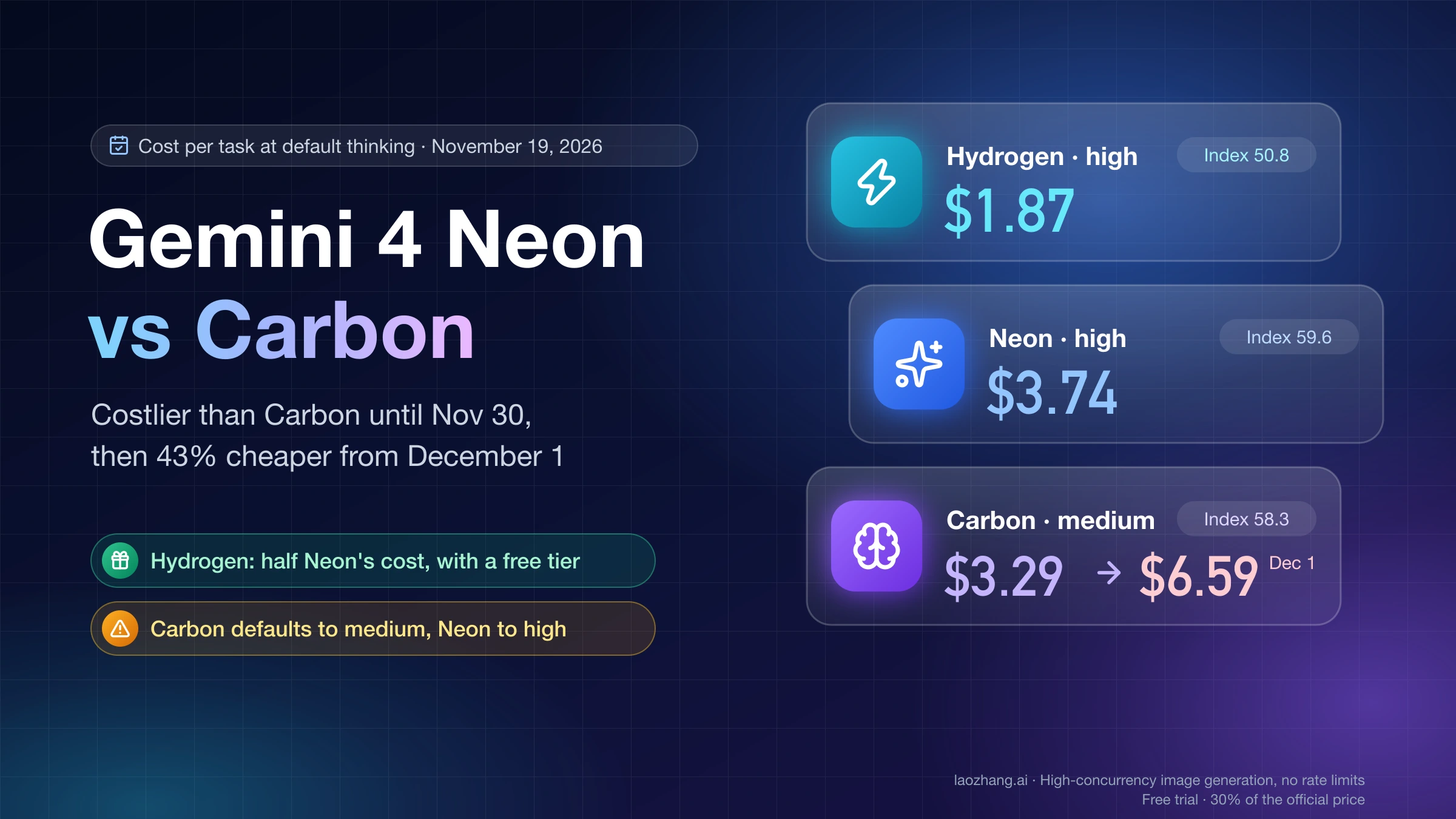
Gemini 4 Neon (gemini-4-neon), which Google released on November 18, 2026, costs $3 per million input tokens and $15 per million output tokens on the Gemini API, with no free tier and no introductory price. That is 1.5 times Gemini 4 Carbon's per-token price through November 30, 2026, when Carbon is still on its introductory $2/$10, and 0.75 times Carbon's price from December 1, when Carbon moves to $4/$20, according to the Gemini API pricing page. Per finished task the gap is smaller but flips on the same date. At each model's default thinking level, Neon (high) costs $3.74 per Artificial Analysis Intelligence Index task against $3.29 for Carbon (medium) this month and $6.59 for Carbon from December 1, so Neon is 14% more expensive now and 43% cheaper afterwards, while scoring 59.6 to Carbon's 58.3 and finishing in half the time. Those costs are Artificial Analysis token counts repriced at Google's list prices on November 19, 2026.
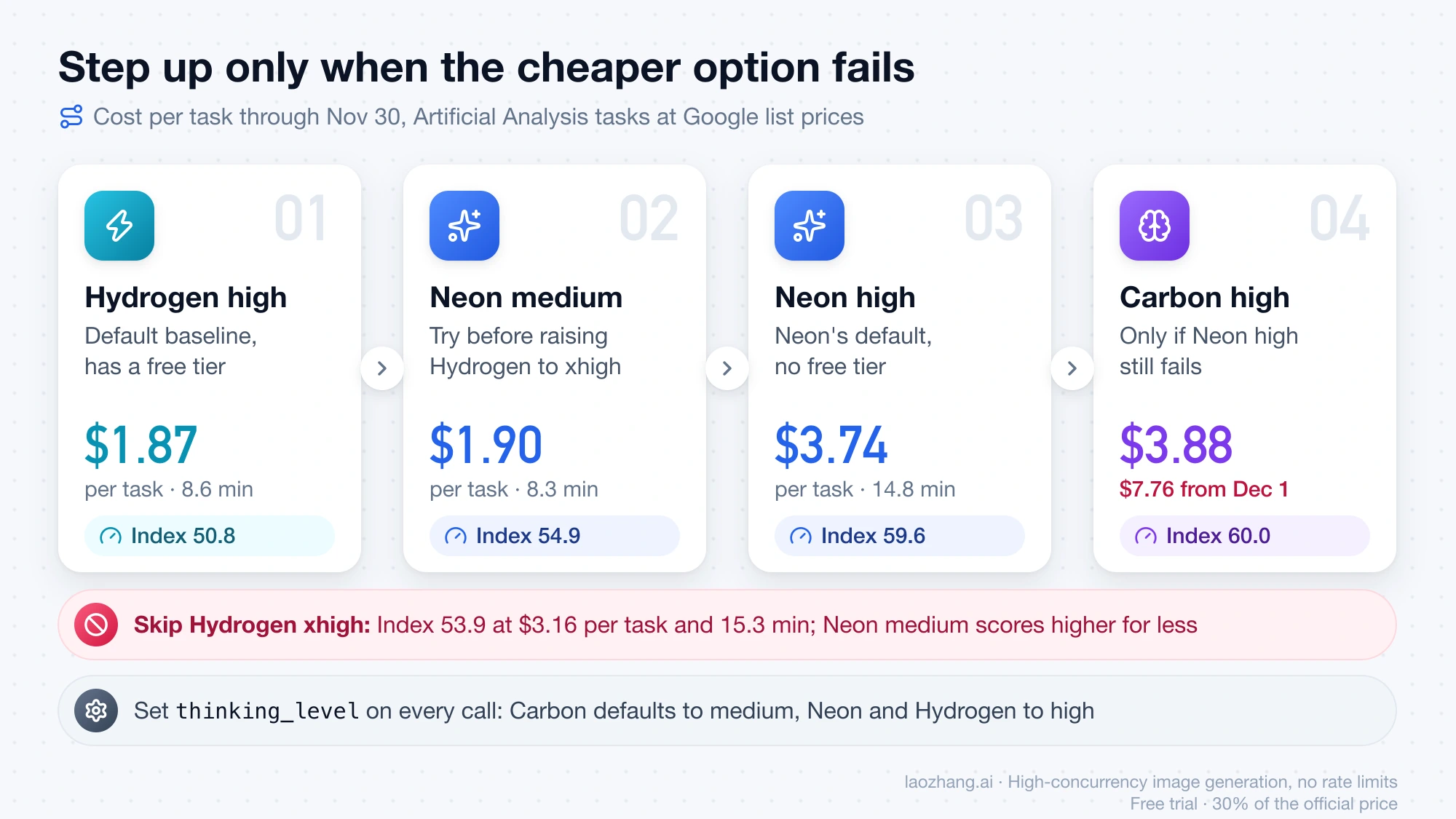
For a new API workload, start with gemini-4-hydrogen, Google's default pick at $1.50/$7.50 with a free tier, and move to gemini-4-neon at medium once Hydrogen only clears your quality bar at xhigh: on the same benchmark tasks, Neon at medium scored a point higher than Hydrogen at xhigh for 0.60 times the cost. If you already run Carbon, it stays competitive per task until November 30; before December 1, rerun your workload on Neon at high and keep Carbon only for the problems Neon can't solve. In the Gemini app the plan decides for you: as of November 19, 2026, Neon needs Google AI Pro, Carbon needs Google AI Ultra, and Google AI Plus gets Hydrogen only.
Two settings change these numbers more than the model choice does. Carbon defaults to medium thinking while Neon and Hydrogen default to high, so swapping a Carbon model ID for Neon without setting thinking_level also raises the reasoning depth. And Google's launch claim of a "32% lower cost per task than Carbon" can't be matched to either price period on public data, so plan with the per-period figures below.
Is Gemini 4 Neon cheaper than Carbon? Not per token until December 1
Gemini 4 Neon is not cheaper than Carbon per token before December 1, 2026: its token prices are 50% above Carbon's introductory ones. Per task, it depends on which Carbon level you compare and in which month. Neon spends fewer output tokens than Carbon at a similar score, which is what Google means by "finishes faster with fewer output tokens than Carbon" on its choosing-a-model page. This month that saving outweighs Carbon's lower token price when Neon is matched against Carbon high or low, but not against Carbon's default medium or when Neon runs at xhigh; from December 1, Neon is cheaper in every pairing.
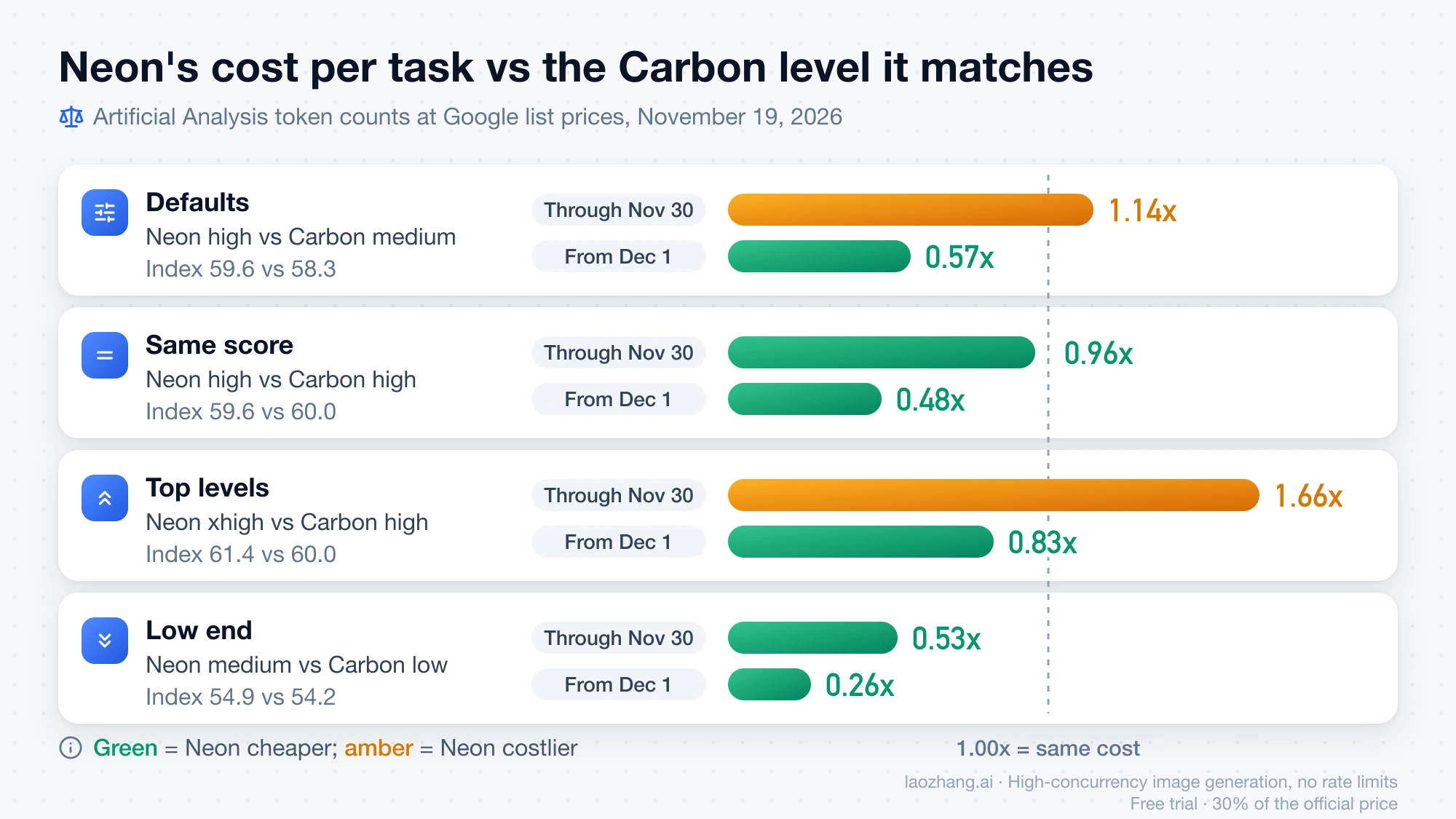
The pairs below put each Neon level next to the Carbon level with the closest Artificial Analysis Intelligence Index v5.0.1 score, using the per-task costs recomputed at Google's list prices on November 19, 2026. A ratio below 1.00x means Neon is cheaper or faster.
| Pairing | Index score (Neon vs Carbon) | Neon's cost per task, through Nov 30 | Neon's cost per task, from Dec 1 | Neon's time per task |
|---|---|---|---|---|
| Defaults: Neon high vs Carbon medium | 59.6 vs 58.3 | 1.14x | 0.57x | 0.50x |
| Same score: Neon high vs Carbon high | 59.6 vs 60.0 | 0.96x | 0.48x | 0.41x |
| Top levels: Neon xhigh vs Carbon high | 61.4 vs 60.0 | 1.66x | 0.83x | 0.60x |
| Low end: Neon medium vs Carbon low | 54.9 vs 54.2 | 0.53x | 0.26x | 0.27x |
Read the rows as decisions. Through November 30, Carbon at its default medium is the cheaper way to get a score near 58–60 if you can wait twice as long; Neon at high matches Carbon high at about the same cost in less than half the time. From December 1, every Neon level is cheaper than the Carbon level it matches, by 17% at the top and 74% at the low end. On output tokens per task, Neon high used 0.88 times Carbon medium's and 0.73 times Carbon high's.
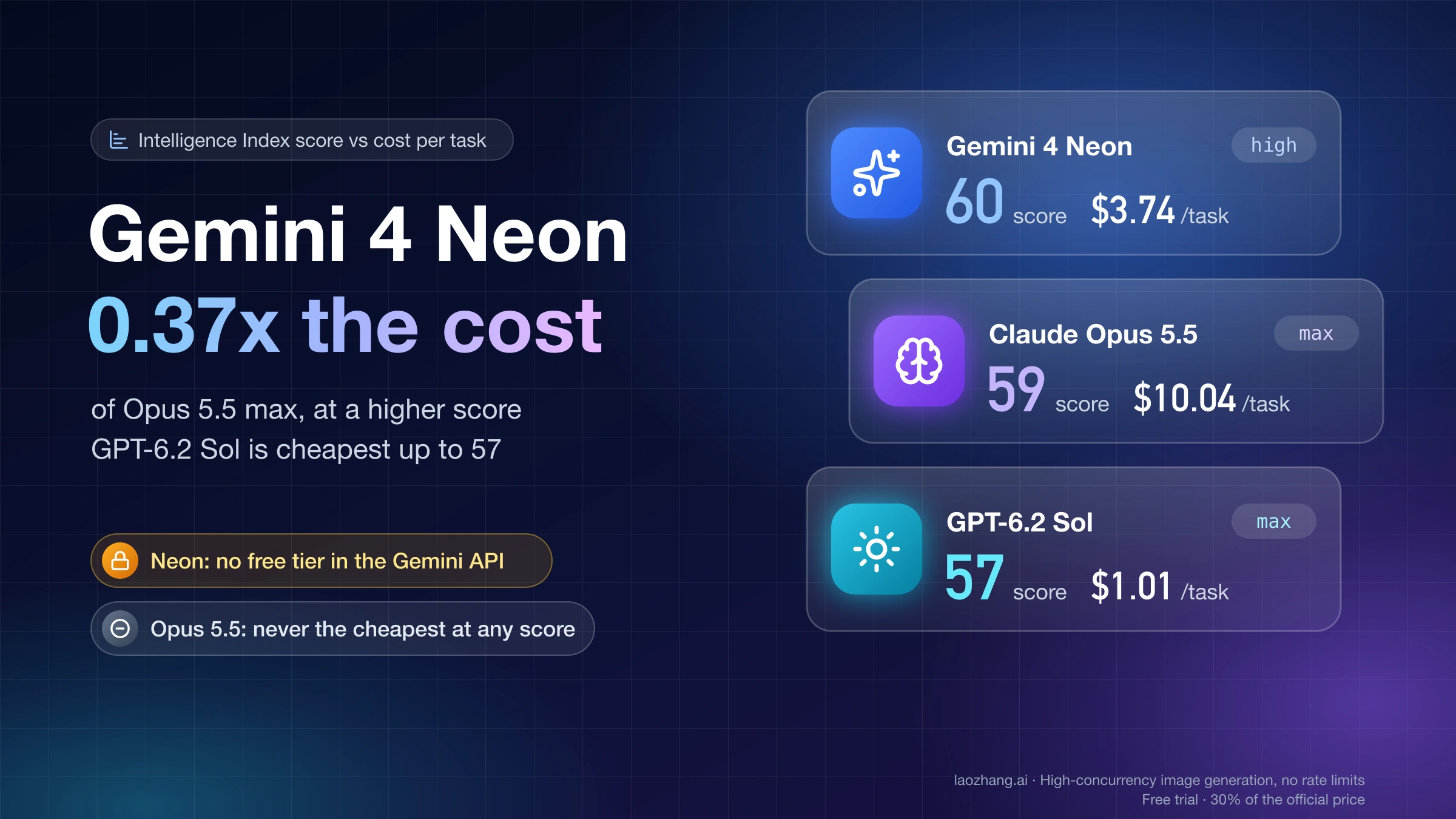
Google's Gemini 4 Neon launch post says that at its default high level Neon pairs a high Artificial Analysis score "with a 32% lower cost per task than Carbon". The public Artificial Analysis numbers don't produce 32% under any combination. Against Carbon high, Neon high is 24% cheaper at Artificial Analysis's own prices, 4% cheaper at Google's list prices through November 30 and 52% cheaper from December 1. Against Carbon's default medium, it is 10% cheaper at Artificial Analysis's prices, 14% more expensive now and 43% cheaper from December 1. Google doesn't say which Carbon level or price it compared with, so the 32% is Google's figure, not one you can plan a budget on. For how Neon compares with Claude Opus 5.5 and GPT-6.2 Sol at the same score, see Gemini 4 Neon vs Opus 5.5 vs GPT-6.2 Sol: Cost at Equal Score.
Cost per task at every thinking level, now and from December 1
The table gives the cost of one Artificial Analysis Intelligence Index task for every thinking level of the three models, at Gemini API Standard list prices for both Carbon price periods. Neon and Hydrogen prices don't change on December 1, so only Carbon's column moves, and it doubles.
| Model and thinking level | Index score | Cost per task, through Nov 30 | Cost per task, from Dec 1 | Minutes per task |
|---|---|---|---|---|
| Hydrogen low | 26.9 | $0.29 | $0.29 | 1.5 |
| Hydrogen medium | 41.2 | $0.80 | $0.80 | 4.1 |
| Hydrogen high (default) | 50.8 | $1.87 | $1.87 | 8.6 |
| Hydrogen xhigh | 53.9 | $3.16 | $3.16 | 15.3 |
| Neon low | 44.1 | $0.75 | $0.75 | 3.7 |
| Neon medium | 54.9 | $1.90 | $1.90 | 8.3 |
| Neon high (default) | 59.6 | $3.74 | $3.74 | 14.8 |
| Neon xhigh | 61.4 | $6.44 | $6.44 | 21.5 |
| Carbon low | 54.2 | $3.59 | $7.19 | 30.3 |
| Carbon medium (default) | 58.3 | $3.29 | $6.59 | 29.6 |
| Carbon high | 60.0 | $3.88 | $7.76 | 36.1 |
Neon itself was not called for this comparison. It has no free tier, and the API gateway used for the earlier Carbon and Hydrogen tests had no Neon channel the night it launched, so every Neon score, token count and time here comes from Artificial Analysis or Google. What was done on November 19, 2026 is a recomputation: the Artificial Analysis Neon vs Carbon comparison and Neon vs Hydrogen comparison split each configuration's cost into uncached input, cache reads, cache writes and output (thinking included). Dividing each part by Artificial Analysis's unit price gives the token counts per task, and multiplying those by Google's list prices gives the columns above. Cache writes are counted as ordinary input, because Gemini's implicit caching has no write fee.
You can redo any row. Carbon high uses 0.8153 million input tokens, 10.1957 million cached input tokens and 0.1228 million output tokens per task, so through November 30 it costs 0.8153 × $2 + 10.1957 × $0.10 + 0.1228 × $10 = $3.88, and from December 1 every term doubles to $7.76. The same split shows why these tasks favor models with cheap cache reads: they are agentic and re-read long contexts, so at the default levels cached input outweighs fresh input more than ten to one. A chat or extraction workload with little caching will weigh output, and therefore thinking tokens, more heavily, so treat the table as a ranking under one task mix rather than your bill.
Artificial Analysis's own Carbon costs ($4.16 at medium, $4.90 at high) sit in neither price period. Its page lists Carbon's input and output at the November $2/$10 but cached input at $0.20, Carbon's December price, and because cache reads are such a large share of these tasks, Google's list price this month comes out about 21% below Artificial Analysis's Carbon figures, and December's comes out well above them.
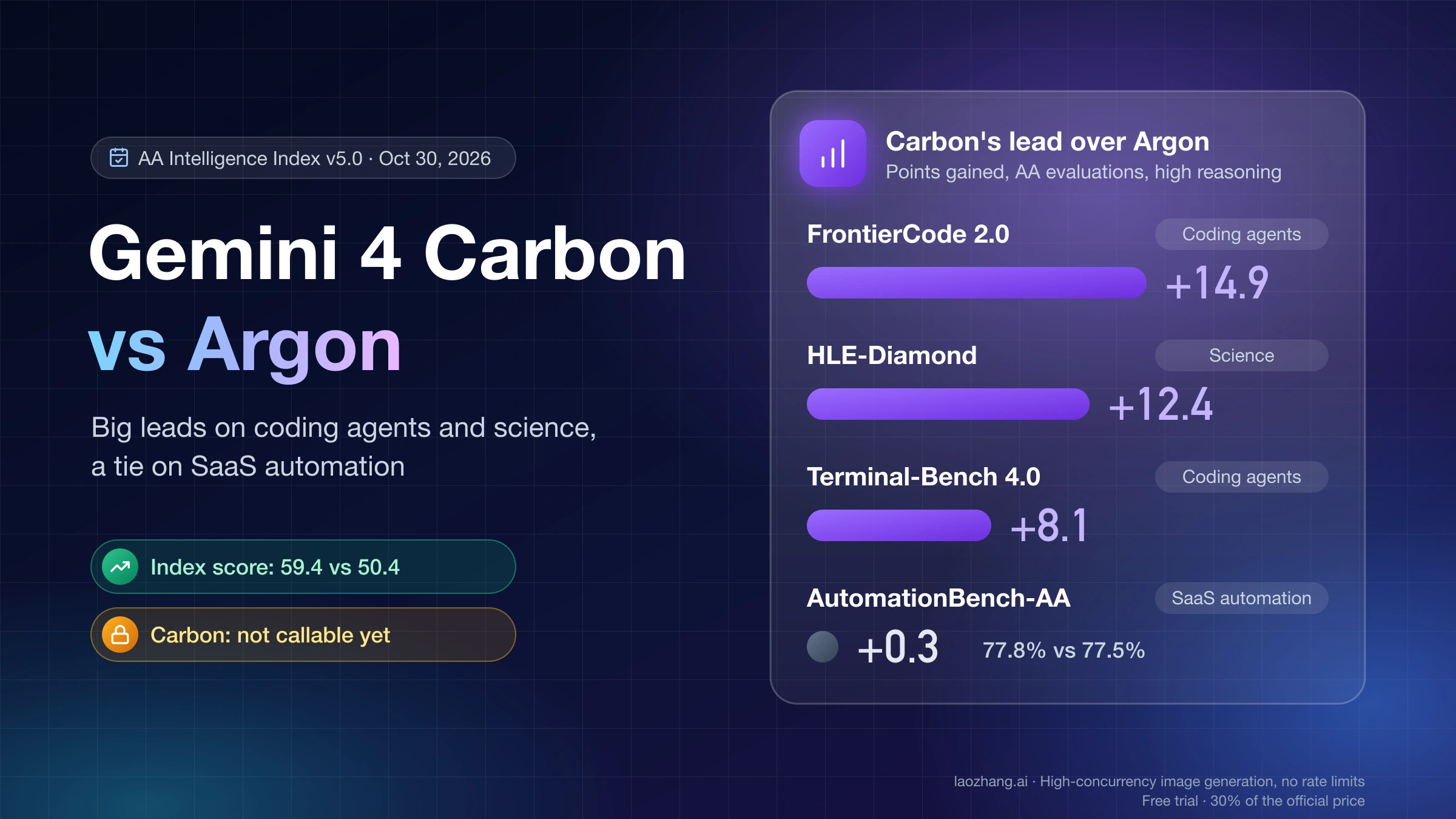
If you're still on Gemini 4 Argon, Neon at medium beats it in both periods: Argon high scored 50.4 for $4.97 per task through November 30 and $9.95 from December 1, since Argon follows Carbon's price schedule. Argon is no longer named on Google's choosing-a-model page or in the Gemini app's model table as of November 19, 2026, but the Gemini API deprecations page lists no shutdown date for gemini-4-argon.
Gemini 4 Neon vs Hydrogen: Hydrogen is enough until it needs xhigh
Hydrogen is enough for any task it passes at high or below, and at that point Neon is a 2x cost for a better score you may not need. On Artificial Analysis's tasks, Neon high scored 59.6 to Hydrogen high's 50.8, but it cost 2.00 times as much per task and took 1.72 times as long. Both used almost the same number of output tokens (Neon 1.06 times Hydrogen's), so the cost gap is simply Neon's token price, which is exactly double Hydrogen's.
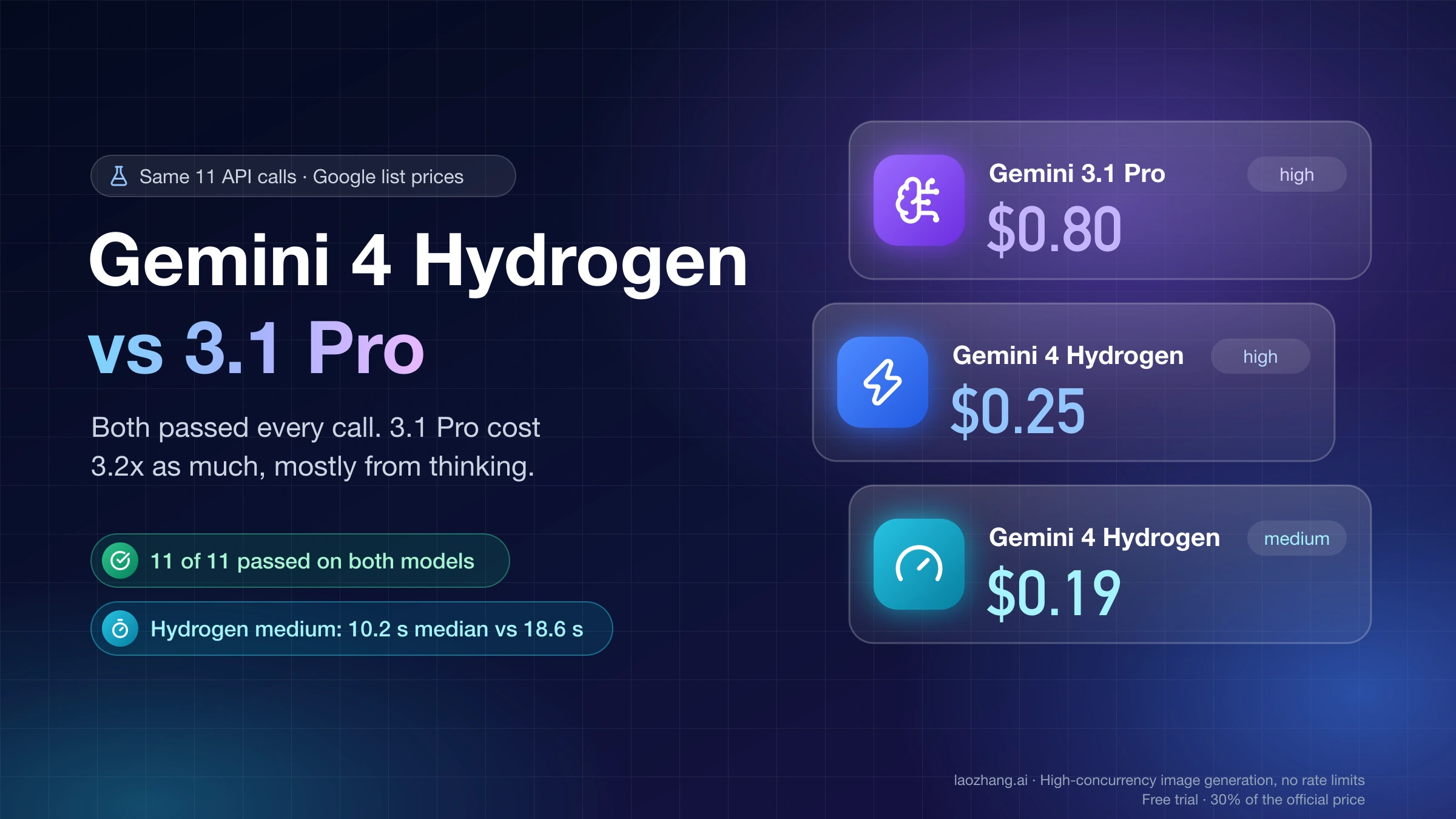
The switch point is xhigh. Hydrogen at xhigh scored 53.9, and Neon at medium scored 54.9 for 0.60 times the cost and 0.54 times the time, using about a third of the output tokens because Hydrogen at xhigh thinks for roughly 97,000 tokens per task. So use Hydrogen high as the baseline; if it fails your checks, try Neon medium before you raise Hydrogen to xhigh, then Neon high, and reach for Carbon only when Neon high still fails. Google's own advice runs the same way: tune thinking_level before switching to a bigger model, and pick the lowest level that meets your quality bar.
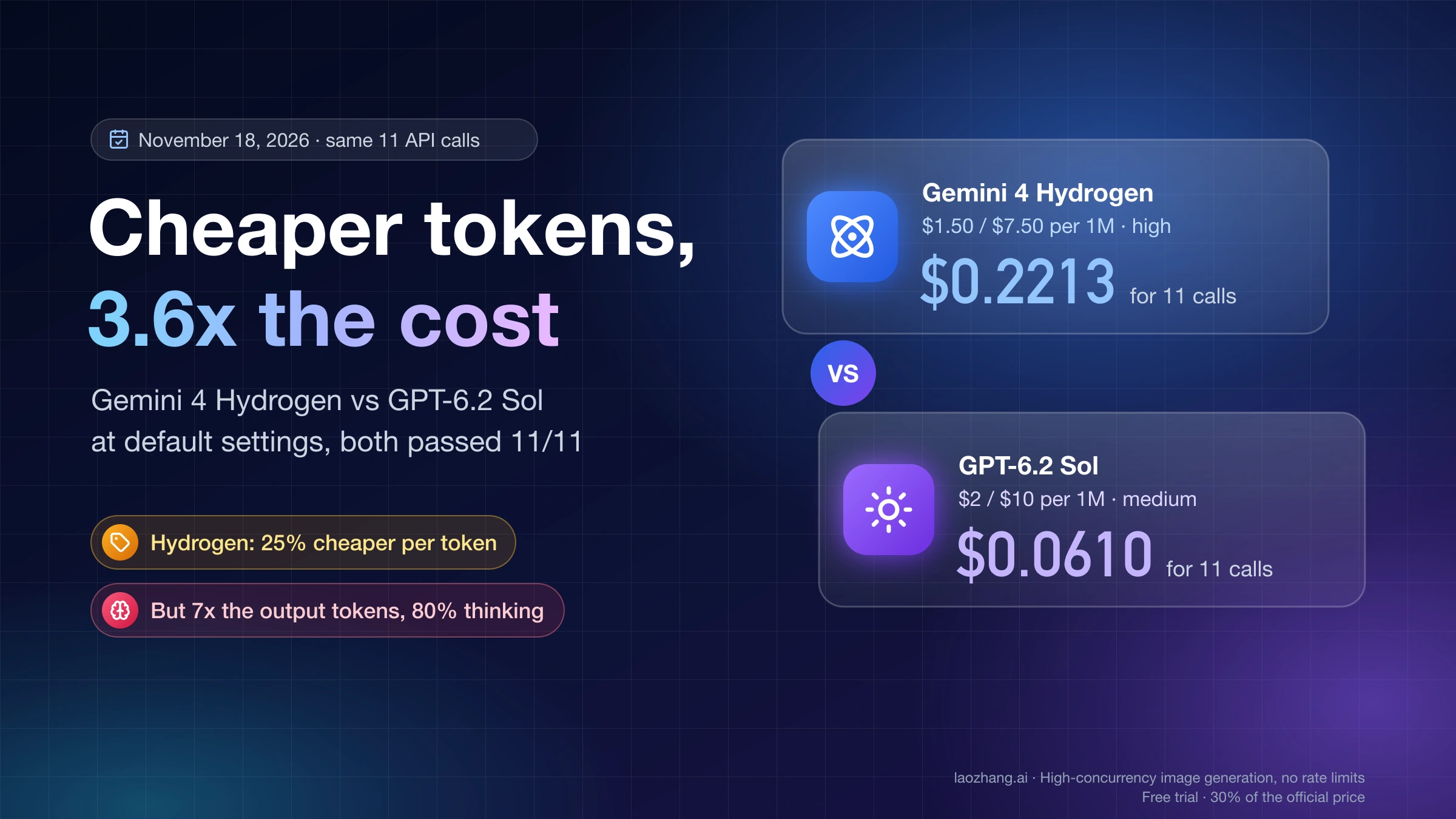
Three things still favor Hydrogen beyond price. It has a Gemini API free tier, though free-tier data is used to improve Google's products. It answers sooner, with a time to first answer token of 19.1 seconds at high against Neon's 40.6 seconds on Artificial Analysis's runs, and streams 155–168 tokens per second to Neon's 97–110. And Neon's Batch and Flex price equals Hydrogen's real-time Standard price, so an overnight job on Neon costs per token what Hydrogen costs live. For a per-call breakdown of Hydrogen at each thinking level, see Gemini 4 Hydrogen Pricing: API Cost per Call by Thinking Level; for Hydrogen against OpenAI's model on the same calls, see Gemini 4 Hydrogen vs GPT-6.2 Sol: Cheaper Tokens, 3.6x the Cost.
When Gemini 4 Carbon is still worth it
Carbon is worth keeping for the hardest problems where Neon gets stuck, and, through November 30, 2026, for anyone who already runs it at medium and doesn't mind the wait. Google calls Carbon "our strongest reasoning model" and points it at system architecture, multi-file debugging, formal proofs and security audits, "or when a faster model gets stuck", because it spends more thinking tokens per turn checking its work. Neon, in Google's words, is for work "where Hydrogen isn't enough and you don't need Carbon's extra verification".
Artificial Analysis has two places where that extra verification shows. On Terminal-Bench 4.0, Carbon high scored 65.2% against 63.6% for Neon at xhigh, and on the CritPt v2 hard subset Carbon high scored 69.0% against Neon xhigh's 60.5%, a gap no Neon level closes. On GDP.pdf the two are within half a point (28.0% for Neon xhigh, 28.4% for Carbon high), and on the other six evaluations in the index Neon xhigh scores higher. Benchmarks Google reports for Neon, such as first place on the Artificial Analysis Coding Agent Index at 58.6, are Google's figures from the launch post.
The calendar matters as much as the benchmarks. Until November 30, Carbon medium costs less per task than Neon high and scores within 1.3 points, so a batch job that isn't waiting on a person has no reason to switch this month. From December 1, Carbon high costs about twice what Neon high does per task, and Carbon's Batch price doubles as well, to what real-time Carbon costs today. If you're weighing Carbon against Anthropic's model rather than Neon, Claude Fable 5.2 vs Gemini 4 Carbon: Cost per Task Flips Dec 1 runs the same two-period comparison.
Carbon vs Hydrogen on the same tasks: tests from November 11 and 18, 2026
On two real workloads run through the Gemini native API, Carbon at its default medium and Hydrogen at its default high both got everything right, and Hydrogen was cheaper in both price periods. The first workload was 11 API calls over 8 coding tasks graded by hidden pytest suites (5 tasks run once, 3 run twice); the second was counting 7 things in a 146 KB, 1,500-line application log. Carbon ran on November 11, 2026 and Hydrogen on November 18, each through the laozhang.ai API gateway. Costs are computed from billed tokens at Google's list prices, so they compare directly, but wall times don't, because the gateway's route to Google changed between the two dates.
Disclosure: laozhang.ai is our own service. Its prices are platform pricing, not an independent comparison.
| Workload | Model and thinking level | Result | Cost through Nov 30 | Cost from Dec 1 |
|---|---|---|---|---|
| 11 coding calls with hidden tests | Carbon, medium (default) | 11/11 passed | $0.2937 | $0.5874 |
| 11 coding calls with hidden tests | Hydrogen, high (default) | 11/11 passed | $0.2213 | $0.2213 |
| 146 KB log, 7 counts | Carbon, medium (default) | All 7 correct | $0.4281 | $0.8562 |
| 146 KB log, 7 counts | Hydrogen, high (default) | All 7 correct | $0.3667 | $0.3667 |
| 146 KB log, 7 counts | Carbon, high | No answer, twice | Not comparable | Not comparable |
Carbon cost 1.33 times Hydrogen on the coding calls and 1.17 times on the log task this month, and will cost 2.65 and 2.33 times from December 1. Neither workload was hard enough to separate the two on quality, which is why Google's advice to start with Hydrogen holds for this kind of work. The Carbon high failure is the warning in the table: on the log task it spent its whole output budget on thinking and stopped with MAX_TOKENS before writing an answer. Because max_output_tokens caps thinking and answer together on all three models, raise it to 65,536 or lower the thinking level rather than leaving a small cap in place; on Carbon, a non-streaming call stops at 32,768 tokens anyway, so stream or use background execution when it needs more room.
Neon has no row because it couldn't be called the same way. At 23:56 UTC on November 18, 2026, the laozhang.ai gateway listed gemini-4-argon, gemini-4-carbon and gemini-4-hydrogen, and a request for gemini-4-neon came back with "no available channels for model gemini-4-neon" without being billed. Third-party gateways add new models on their own schedule, so check the model list on the day rather than assuming Neon is there.
Gemini 4 Neon, Carbon and Hydrogen side by side: price, free tier, defaults
All three models share the same request format and limits: a unified 1,048,576-token context window that input, thinking and output draw from, long decode up to 1 million tokens with background execution, and text, image, video, audio and PDF input with text output. The per-request output limit is the one exception: according to the Gemini 4 limits in Google's Gemini API thinking guide, Neon and Hydrogen return up to 65,536 tokens per request whether or not you stream, while Carbon returns up to 32,768 on non-streaming calls and 65,536 only when streaming. What separates them is price, the free tier, the default thinking level and speed. Prices below are per million tokens on the Gemini API, from Google's pricing page and choosing-a-model page as of November 19, 2026.
| Gemini 4 Hydrogen | Gemini 4 Neon | Gemini 4 Carbon | |
|---|---|---|---|
| Model ID | gemini-4-hydrogen | gemini-4-neon | gemini-4-carbon |
| Released | November 12, 2026 | November 18, 2026 | November 10, 2026 |
| Standard input / output, through Nov 30 | $1.50 / $7.50 | $3.00 / $15.00 | $2.00 / $10.00 |
| Standard input / output, from Dec 1 | $1.50 / $7.50 | $3.00 / $15.00 | $4.00 / $20.00 |
| Cached input | $0.075 | $0.15 | $0.10, then $0.20 from Dec 1 |
| Batch input / output | $0.75 / $3.75 | $1.50 / $7.50 | $1.00 / $5.00, then $2.00 / $10.00 |
| Gemini API free tier | Yes | No | No |
| Thinking levels | low, medium, high (default), xhigh | low, medium, high (default), xhigh | low, medium (default), high |
| Google's speed label | Fast | Moderate | Deliberate |
| Output speed (Artificial Analysis) | 155–168 tokens/s | 97–110 tokens/s | 47–58 tokens/s |
Neon's Priority tier costs $5.40/$27, and its Flex price matches Batch. Output prices include thinking tokens on all three. Neon supports implicit caching only, so requests that use explicit cachedContents need changing before they run on it. Grounding with Google Search gives 5,000 free requests a month shared across Gemini 3 and newer models, then $14 per 1,000. Google lists no shutdown date for any of the three.
Which Google AI plan gets Neon, Carbon and Hydrogen in the Gemini app
In the Gemini app, Neon needs Google AI Pro and Carbon needs Google AI Ultra, while every plan, including no plan, gets Hydrogen in some form. The table follows Google's Gemini Apps Help article on Gemini models for personal Google Accounts as of November 19, 2026; Google notes availability is "subject to change without notice", and Workspace accounts follow different rules.
| Google AI plan | Hydrogen | Neon | Carbon |
|---|---|---|---|
| No plan | Tasks only; Chats use Auto | No | No |
| Google AI Plus | Yes | No | No |
| Google AI Pro | Yes | Yes | No |
| Google AI Ultra | Yes | Yes | Yes |
Auto picks between Hydrogen and a faster, lighter model for each prompt. When you pick a model yourself, the app sets thinking to Low unless you choose Medium or High, so a manual switch to Neon without touching the level doesn't give you the high setting the API defaults to. Bigger models and higher levels use more of your plan's allowance, and on a paid plan, once you reach the limit, chats continue on the lightweight model; Google doesn't publish how many prompts each model gets. Gemini 4 Argon, which the same page listed for Pro and Ultra on November 16, is no longer named there.
So is Gemini 4 Hydrogen free? Yes, in two places: the Gemini API free tier, where your data may be used to improve Google's products, and the Gemini app without a plan, in Tasks and through Auto in Chats, which may route a prompt to Hydrogen. Neon and Carbon have no Gemini API free tier, and in the Gemini app neither is available without a plan or on Google AI Plus: Neon starts at Google AI Pro and Carbon at Google AI Ultra.
Outside the app, Google says Neon is available "with Google AI Pro and Ultra plans in Google AI Studio", in Google Antigravity for paid Google AI Pro and Ultra subscribers, and in Gemini for business through the API and the model dropdown. A free Google account opening Neon in AI Studio on November 19, 2026 got an "Unlock Gemini 4 Neon" screen reading "Gemini 4 Neon is only available with a Google AI plan, or pay per request with an API key", with the thinking level preset to High, and a matching unlock card for Carbon. For how Carbon reached the API and Ultra on its launch day, see Gemini 4 Carbon Release Date: Out Nov 10 on Paid API and Ultra.
How to switch to gemini-4-neon in the Gemini API
Moving from Carbon or Hydrogen to Neon needs no change to the request schema: you change the model ID, set the thinking level on purpose, and make sure the project is on the paid tier, since Neon isn't on the free tier. This Python example uses the Interactions API, following Google's What's new in Gemini 4 Neon guide; generateContent takes the same model ID.
from google import genai

client = genai.Client()  # reads GEMINI_API_KEY from a paid-tier project

interaction = client.interactions.create(
    model="gemini-4-neon",            # was "gemini-4-carbon" or "gemini-4-hydrogen"
    input="Find the race condition in this retry queue and propose a fix.",
    generation_config={
        "thinking_level": "medium",   # Neon defaults to "high"; Carbon defaulted to "medium"
        "max_output_tokens": 65536,   # caps thinking + answer together
    },
)

print(interaction.output_text)
Set thinking_level explicitly in every request you compare. Coming from Carbon, leaving it out moves you from Carbon's medium to Neon's high, which raises cost and wait per task; coming from Hydrogen, the default stays high. Google recommends running your evaluation at all four levels with a high max_output_tokens and keeping the lowest level that passes, and it advises removing hard-coded caps such as 8,192 in favor of 65,536. If your Carbon code made non-streaming calls, note that Neon can return up to 65,536 tokens on them instead of Carbon's 32,768, so check any code that assumed the smaller ceiling. Hard prompts on Neon can run for several minutes, so give your HTTP client at least a 15-minute timeout or use background=True. The same request runs on any of the three models, so you can also keep Carbon for one planning turn and hand the follow-up to Neon or Hydrogen with previous_interaction_id.
Before December 1, 2026, the one number to rerun is Carbon's cost on your own traffic. Take a day of Carbon usage, double it, and compare that with the same requests sent to gemini-4-neon at medium and high; on the Artificial Analysis task mix every Neon level is cheaper than its matching Carbon level from that date, and your own traffic is the check that this holds for your workload.
Sources9
External pages this guide links to, in the order they appear. Last updated Nov 19, 2026.
Sources9
External pages this guide links to, in the order they appear. Last updated Nov 19, 2026.
- 1.Gemini API pricing pageaistudio.google.com/docs/pricing
- 2.choosing-a-model pageaistudio.google.com/docs/choosing-a-model
- 3.Gemini 4 Neon launch postblog.google/innovation-and-ai/models-and-research/gemini-models/introducing-gemini-4-neon
- 4.Artificial Analysis Neon vs Carbon comparisonartificialanalysis.ai/models/releases/comparisons/gemini-4-neon-vs-gemini-4-carbon
- 5.Neon vs Hydrogen comparisonartificialanalysis.ai/models/releases/comparisons/gemini-4-neon-vs-gemini-4-hydrogen
- 6.Gemini API deprecations pageaistudio.google.com/docs/deprecations
- 7.Gemini API thinking guideaistudio.google.com/docs/thinking
- 8.Gemini Apps Help article on Gemini modelssupport.google.com/gemini/answer/18648722
- 9.What's new in Gemini 4 Neon guideaistudio.google.com/docs/whats-new-gemini-4-neon