Claude Sonnet 5.5 vs Gemini 3.8 Flash, 4 Hydrogen: Cost per Task
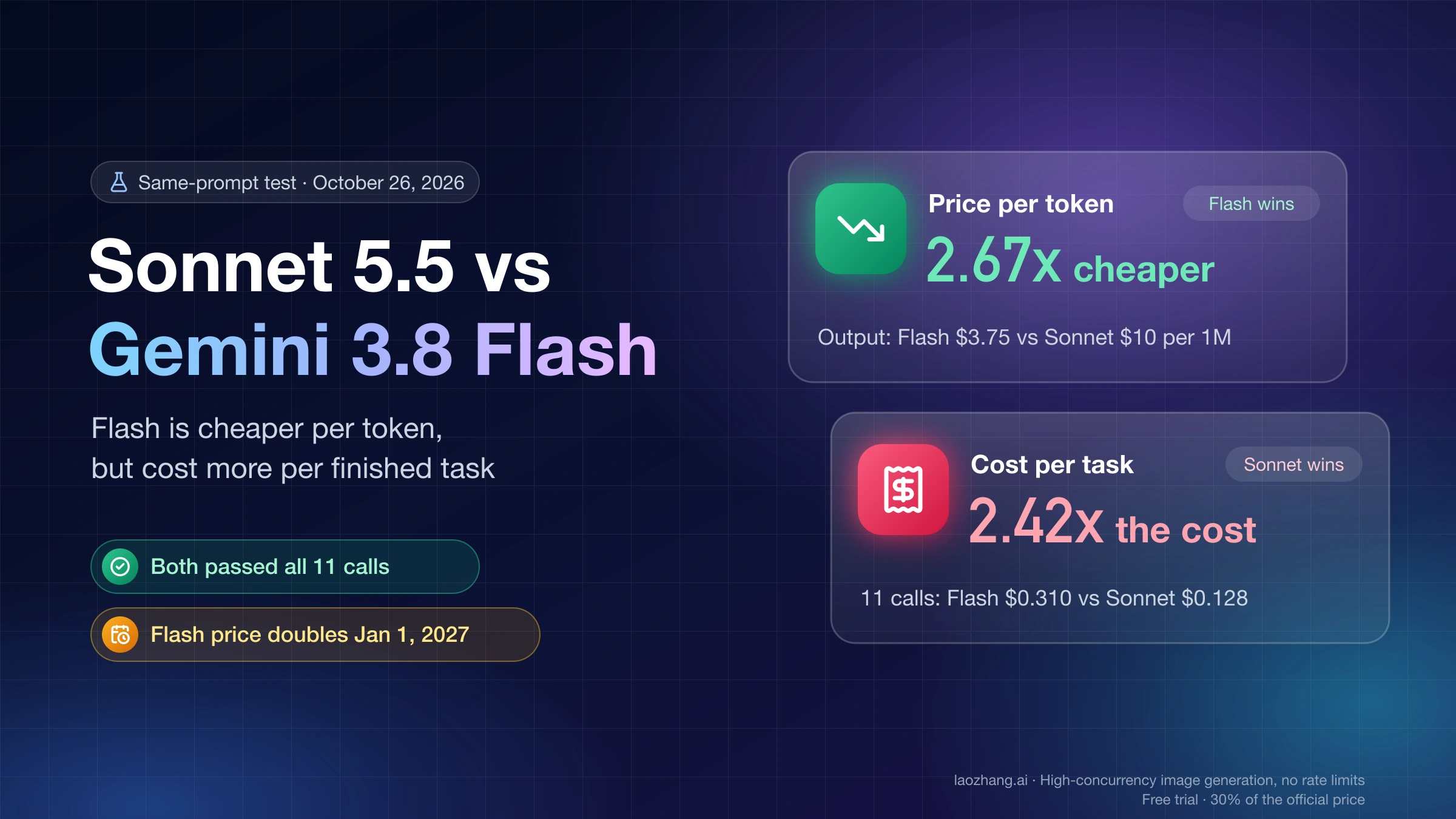
Gemini 4 Hydrogen lists 25% below Claude Sonnet 5.5 per token, yet on the same 11 calls at high it cost 1.96x as much. 3.8 Flash cost 2.42x.
On this page
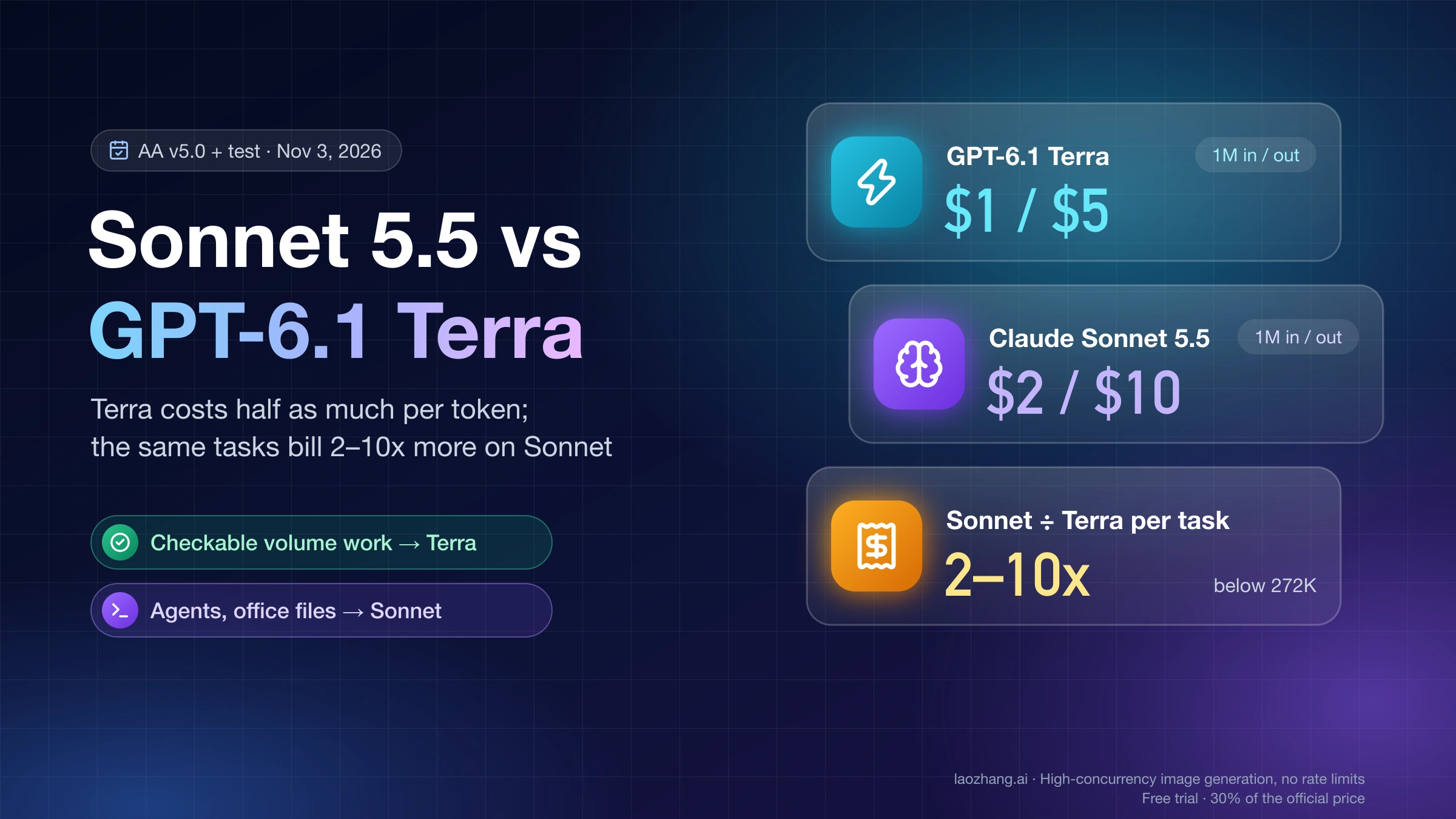
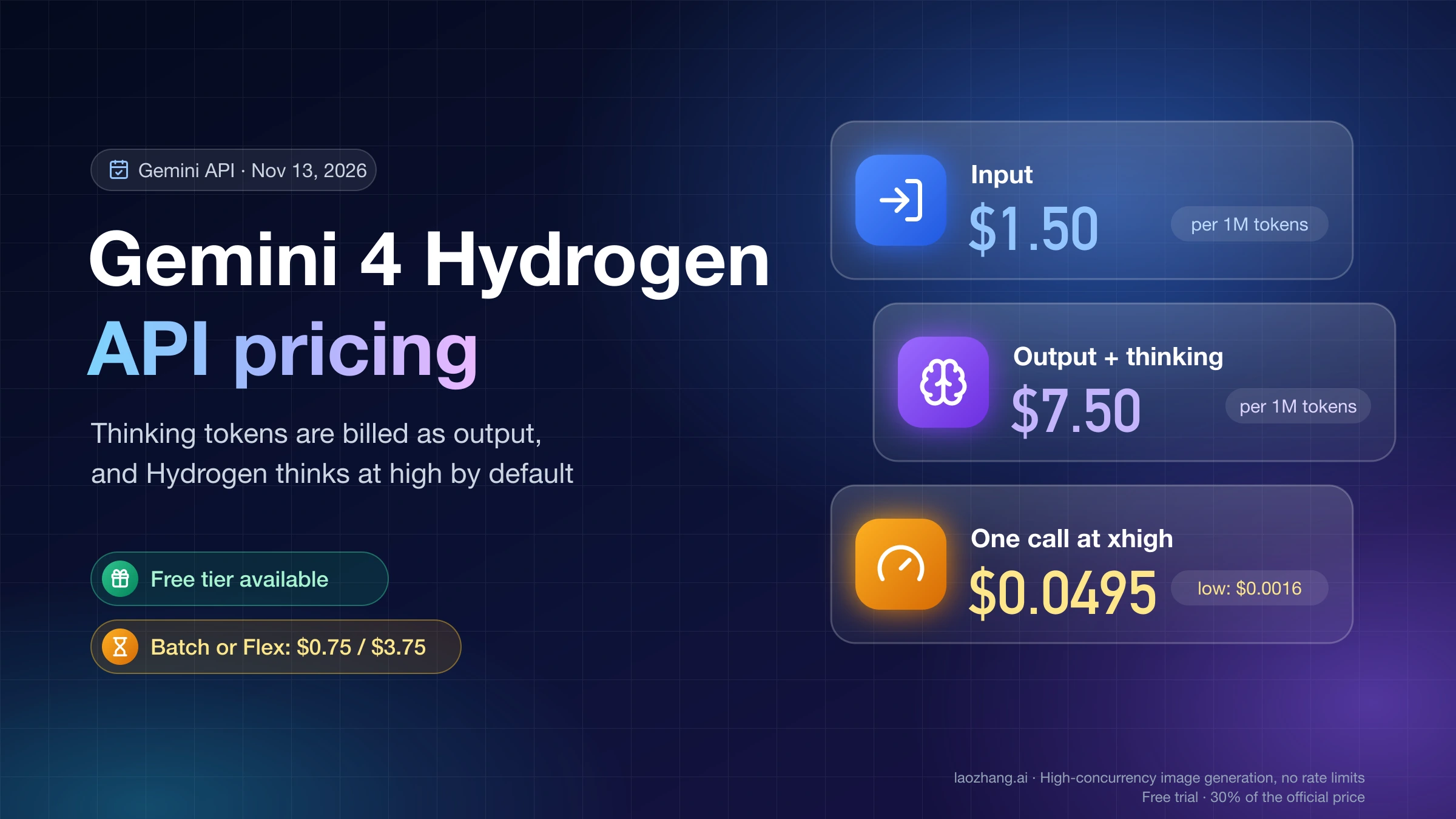
Gemini 4 Hydrogen (gemini-4-hydrogen), which Google made generally available on November 12, 2026, lists at $1.50 input and $7.50 output per million tokens, 25% below Claude Sonnet 5.5's $2 and $10. Per finished task it was not cheaper. On the same 11 API calls at each model's default high setting, Hydrogen cost $0.251 on November 14, 2026, against $0.128 for Sonnet 5.5 on October 26, or 1.96 times as much, because it wrote 3.29 times as many output tokens, 84% of them thinking. Both models passed all 11 calls. So for short, well-specified API work such as parsing, small functions and math, keep Claude Sonnet 5.5 (claude-sonnet-5-5) as your default.
Hydrogen earns its place on harder work and as the replacement for Gemini 3.8 Flash (gemini-3.8-flash). On the Artificial Analysis Intelligence Index v5.0.1, with both at high, Hydrogen scores 51 to Sonnet's 42 for $1.87 against $1.64 per task, and it leads on terminal coding, tool-driven automation and factual recall. The widely shared line that Hydrogen matches Sonnet "at a third of the cost" pairs Hydrogen at xhigh (54, $3.16) with Sonnet at max (55, $10.02), not the defaults. Against 3.8 Flash, which cost $0.310 on the same calls and would cost $0.621 once its price doubles to Hydrogen's level on January 1, 2027, Hydrogen came to 40% of the 2027 bill, so plan to move Flash workloads to it before that date.
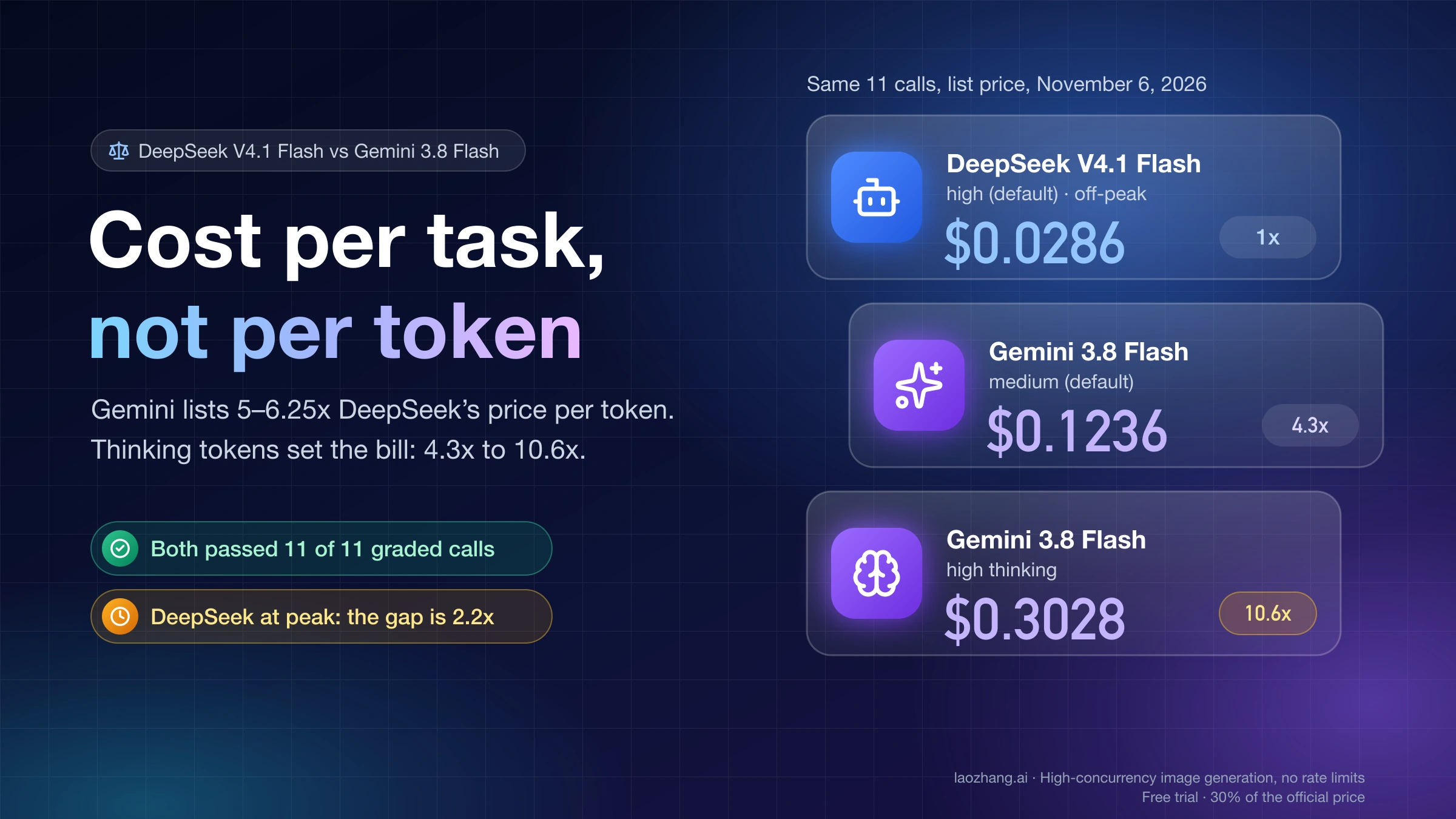
The exception is a long document in and a short answer out. Summarizing a 6,723-word article cost $0.016 on 3.8 Flash, $0.033 on Sonnet and $0.041 on Hydrogen, and Flash stays the cheapest of the three there even at its 2027 price. Over all 11 calls, though, Flash is 2.67 times cheaper per token than Sonnet and still cost 2.42 times as much, which is the same lesson for all three models: you pay per finished task, and thinking tokens are billed as output.
Same prompts, three models: Hydrogen cost 1.96x Sonnet, Flash 2.42x
On eight small tasks, all three models got every answer right, and the cheapest per-token model was never the cheapest overall. Sonnet 5.5 and Gemini 3.8 Flash ran on October 26, 2026, between 11:41 and 11:55 China time. Gemini 4 Hydrogen ran 19 days later, on November 14, 2026, between 11:23 and 11:26 UTC, with the same prompts and the same graders. All three went through the laozhang.ai API gateway with one key, so the route was the same, and Sonnet was not re-run. Sonnet 5.5 went through the Anthropic Messages endpoint with output_config.effort: "high", which is the Claude API default, and no thinking field, so it used adaptive thinking with the thinking text left out of the response. Flash and Hydrogen went through Gemini's native generateContent endpoint with thinkingConfig.thinkingLevel: "high". Every call had a 32,000-token output cap, no system prompt and no tools.
Disclosure: laozhang.ai is our own service. Its prices are platform pricing, not an independent comparison.
"High" is the closest like-for-like setting, not an identical one. It is Hydrogen's default and 3.8 Flash's top level, while Hydrogen has xhigh above it and Sonnet has xhigh and max. Five easier tasks ran once each: a word problem, three small Python functions graded against hidden tests, and a five-bullet summary of a 6,723-word article. Three harder tasks ran twice each: an arithmetic expression evaluator written without eval, a CSV line parser written without the csv module, and a count of the numbers below 1,000,000 whose digits sum to 27. All 33 answers passed. Every function passed all of its hidden tests, every model found 55,252 on both runs, and every summary had exactly five bullets under 25 words. Quality tied on these tasks, so the table shows what each correct answer cost.
Costs are the returned token counts times the Standard list prices. The Gemini models report output as thinking plus answer, while Sonnet reports a single output count that already includes its hidden thinking. For the three harder tasks the token counts are per run and the cost is the mean of two runs. The total row sums all 11 calls.
| Task (hidden tests) | Sonnet 5.5 in / out | Sonnet cost | 3.8 Flash in / thinking + answer | Flash cost | Hydrogen in / thinking + answer | Hydrogen cost |
|---|---|---|---|---|---|---|
| Word problem | 86 / 704 | $0.0072 | 61 / 1,716 + 355 | $0.0078 | 92 / 809 + 431 | $0.0094 |
merge_intervals (8) | 105 / 1,217 | $0.0124 | 61 / 974 + 522 | $0.0057 | 91 / 1,763 + 523 | $0.0173 |
parse_duration (18) | 248 / 723 | $0.0077 | 207 / 4,463 + 318 | $0.0181 | 239 / 1,000 + 299 | $0.0101 |
top_words (10) | 174 / 160 | $0.0019 | 115 / 1,115 + 130 | $0.0047 | 144 / 501 + 128 | $0.0049 |
| 5-bullet summary of a 6,723-word article | 15,335 / 277 | $0.0334 | 11,198 / 1,733 + 154 | $0.0155 | 11,110 / 3,094 + 189 | $0.0413 |
eval_expr without eval (25), 2 runs | 314 / 1,816 and 1,849 | $0.0190 | 212 / 14,876 + 730 and 30,721 + 809 | $0.0885 | 243 / 2,870 + 741 and 5,123 + 764 | $0.0360 |
parse_csv_line without csv (16), 2 runs | 244 / 880 and 432 | $0.0070 | 159 / 4,175 + 371 and 6,167 + 371 | $0.0209 | 193 / 1,509 + 331 and 1,574 + 357 | $0.0144 |
| Digit-sum count (answer 55,252), 2 runs | 69 / 678 and 647 | $0.0068 | 51–52 / 4,831 + 847 and 4,034 + 865 | $0.0199 | 82 / 3,664 + 610 and 4,037 + 594 | $0.0335 |
| Total, 11 calls, all passed | 17,202 / 9,383 | $0.128 | 12,487 / 74,805 + 5,472 | $0.310 | 12,712 / 25,944 + 4,967 | $0.251 |
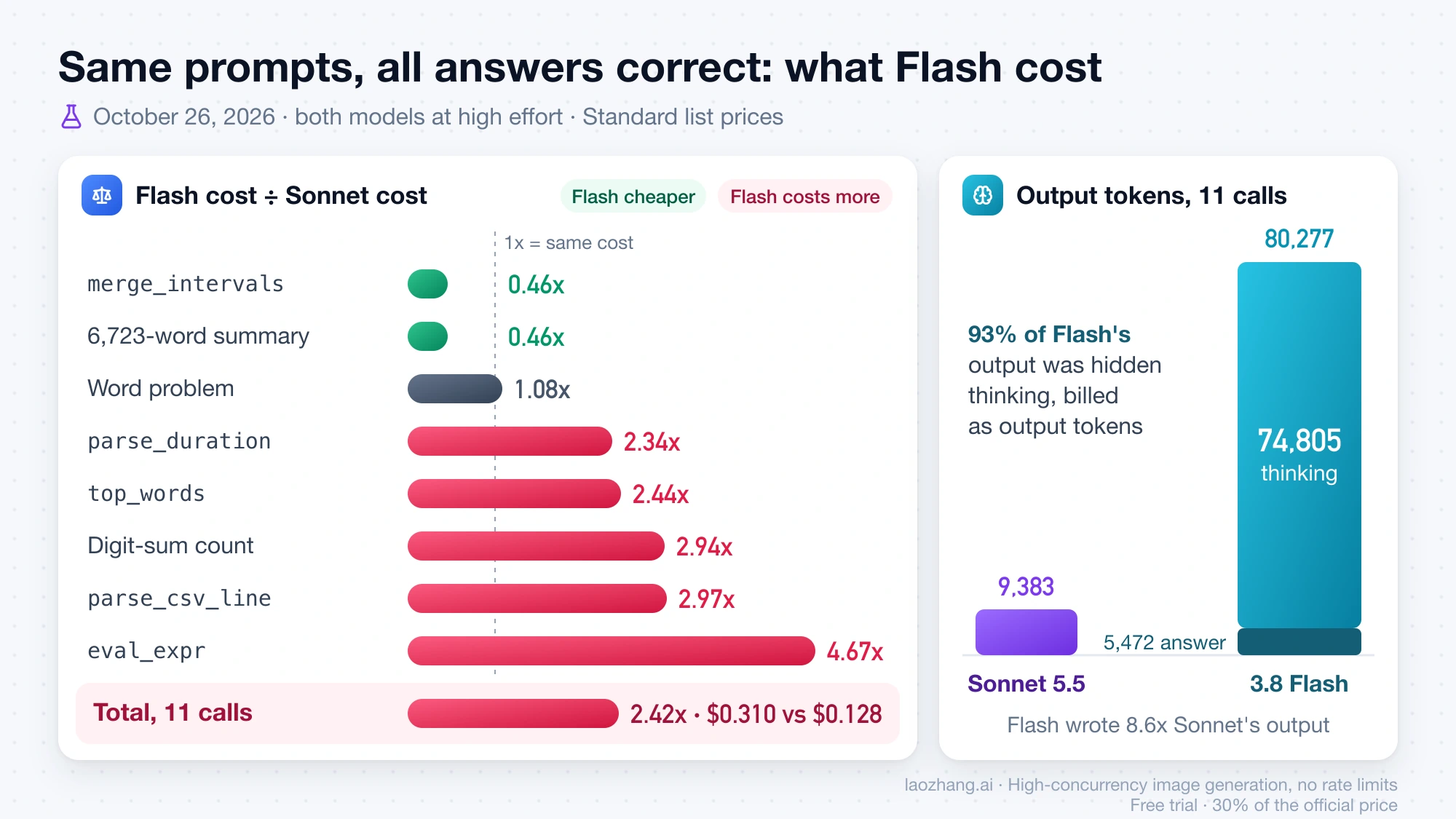
Hydrogen cost more than Sonnet on every one of the eight tasks, from 1.23 times on the long summary to 4.95 times on the digit-sum count, with the word problem and parse_duration both at 1.31 times. Split by difficulty, the five easier tasks cost $0.0627 on Sonnet and $0.0830 on Hydrogen, and the three harder ones $0.0655 and $0.1679, so the gap widened from 1.3 to 2.6 times as the problems got harder. Hydrogen thought far less than 3.8 Flash on the hard tasks: on eval_expr it used 2,870 and 5,123 thinking tokens where Flash used 14,876 and 30,721. That is why it landed between the two on total cost.
Flash was cheaper than Sonnet on only two tasks, merge_intervals and the long summary, at 0.46 times each, and about even on the word problem. On the other five it cost 2.3 to 4.7 times as much. The five easier tasks cost $0.0518 on Flash, 17% less than on Sonnet, while the three harder ones cost $0.2586, 3.95 times Sonnet's bill. Flash's second eval_expr run used 31,530 of the 32,000-token cap, twice its first run, so a lower cap could have cut that answer off. Hydrogen's two eval_expr runs also differed, 3,611 against 5,887 output tokens. Per-task figures this noisy are a reason to trust the totals more than any single row.
What wasn't tested matters as much. This is one gateway, one or two runs per task, all at high, with Hydrogen on a different day from the other two. There are no medium or low runs, no agent loops, tool calls, multi-turn chats, caching or Batch jobs, no direct Anthropic or Google endpoints, and no text other than English. The same 11 prompts on Hydrogen in Google AI Studio's free playground the same day gave the same picture: 11 of 11 passed, $0.245 at list price, 1.91 times Sonnet. All three models solved every one of these small, well-specified tasks, so the test says nothing about where a model fails. For that, use the benchmark scores further down, and re-run a sample of your own prompts before you switch a production default.
Why a model 2.67x cheaper per token costs more per task
Per-token price only decides the bill if the models write about the same number of tokens, and at high they don't. Anthropic and Google both bill thinking tokens as output. Across the 11 calls, 3.8 Flash spent 74,805 tokens thinking, 93% of its output and eight times Sonnet's entire output, thinking included. Its output was 8.56 times Sonnet's at a 2.67 times lower output price, so its output bill alone came out about 3.2 times higher. Hydrogen's output was 3.29 times Sonnet's at a price only 25% lower, so its output bill was 2.47 times Sonnet's, and output made up 92% of its total.
You can recompute any row of the table with one formula, using Standard prices per million tokens. Sonnet 5.5 charges $2 input and $10 output. Gemini 3.8 Flash charges $0.75 and $3.75 through December 31, 2026, and Gemini 4 Hydrogen charges $1.50 and $7.50. Cost is input tokens × input price + output tokens × output price, divided by 1,000,000, with thinking counted inside output. For the long summary that gives 15,335 × $2 + 277 × $10 = $0.0334 on Sonnet, 11,198 × $0.75 + 1,887 × $3.75 = $0.0155 on Flash, and 11,110 × $1.50 + 3,283 × $7.50 = $0.0413 on Hydrogen. Flash wins this row because the bill is mostly input and its answer is short. Hydrogen loses it because it thought for 3,094 tokens before writing five bullets in 189.
The models also count the same text differently. Sonnet 5.5 reported 15,335 input tokens for the 6,723-word article, while 3.8 Flash reported 11,198 and Hydrogen 11,110 for the identical prompt. Anthropic's count was 37% higher, though it includes Anthropic's message wrapper. On this English text the real input-price gap between Sonnet and Flash was about 2.67 × 1.37 ≈ 3.65 times rather than 2.67, which is the other reason long-input jobs lean toward the Gemini models. Across all 11 calls Hydrogen's input count was 0.74 times Sonnet's. That's one text set in one language, and code or other languages may tokenize differently.
Lower thinking settings and Batch change the totals but not this logic. Batch halves both vendors' prices, to $1 and $5 for Sonnet and $0.75 and $3.75 for Hydrogen, so the ratio between them stays where it was. A lower thinking level cuts the tokens themselves. What each Hydrogen level costs per call is worked out in Gemini 4 Hydrogen Pricing: API Cost per Call by Thinking Level.
Is Gemini Flash better than Claude Sonnet? AA: 31 vs 42, Hydrogen 51
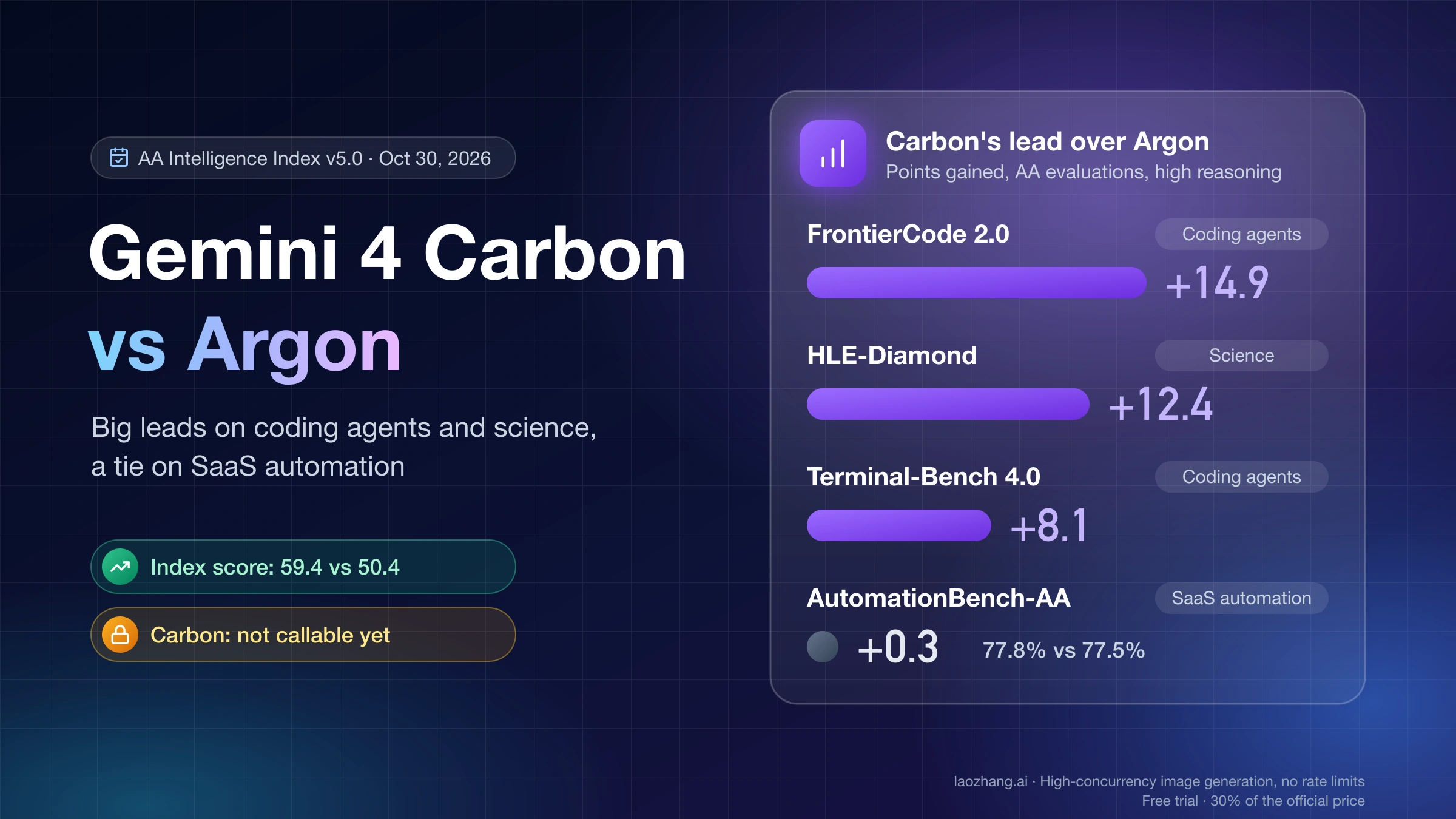
Gemini 3.8 Flash is not, and Gemini 4 Hydrogen is, on Artificial Analysis's harder, multi-domain benchmark. With all three at high on the Intelligence Index v5.0.1, as of November 14, 2026, Flash scores 31, Sonnet 5.5 42 and Hydrogen 51. At their top settings Sonnet max reaches 55 and Hydrogen xhigh 54. Cost per index task at high is $1.64 for Sonnet, $1.87 for Hydrogen and $7.77 for Flash, so in AA's harness Flash costs 4.7 times Sonnet for a lower score. Figures are from the Artificial Analysis Gemini 4 Hydrogen vs Claude Sonnet 5.5 comparison and the Artificial Analysis Gemini 3.8 Flash vs Claude Sonnet 5.5 comparison. On the older index v4.3.2, in October 2026, Sonnet led Flash 47 to 41; v5.0.1 uses a different and harder set of nine evaluations, so the two versions' scores can't be mixed.
| AA evaluation (all at high) | Sonnet 5.5 | Gemini 3.8 Flash | Gemini 4 Hydrogen | What it suggests |
|---|---|---|---|---|
| Terminal-Bench 4.0 (agentic terminal coding) | 43.9% | 19.7% | 54.0% | Coding agents: Hydrogen, then Sonnet; Flash far behind |
| FrontierCode-AA 2.0 | 25.7% | 18.7% | 36.3% | Hard coding problems: Hydrogen |
| AA-Briefcase v1.1 | 1634 | 1204 | 1497 | Business documents and deliverables: Sonnet |
| AutomationBench-AA | 59.4% | 59.9% | 74.4% | Tool-driven automation: Hydrogen; Sonnet and Flash tie |
| AA-Omniscience v1.1 | 19 | 23 | 44 | Factual recall with fewer confident errors: Hydrogen |
| HLE-Diamond | 33.8% | 33.1% | 54.9% | Expert Q&A: Hydrogen |
| CritPt v2 (hard subset) | 51.5% | 46.5% | 61.5% | Hard physics reasoning: Hydrogen |
| Terminal-Bench-Science 0.1 | 34.3% | 10.0% | 41.4% | Scientific terminal work: Hydrogen |
Effort pairing changes the answer, so compare at an equal score as well. Sonnet 5.5 at medium and Gemini 3.8 Flash at high both score 31, and Sonnet gets there for $0.78 and 4.0 minutes per task against Flash's $7.77 and 14.4 minutes, about 10 times the cost. Flash at its default medium scores 30 for $6.26. Even at that matched score Sonnet keeps its coding lead, 29.8% to 19.7% on Terminal-Bench 4.0, while Flash stays slightly ahead on AutomationBench (59.9% vs 54.9%) and Omniscience (23 vs 19). For Hydrogen the equal-score pairs run the other way. Hydrogen at medium scores 41 for $0.80, close to Sonnet high at 42 for $1.64, and Hydrogen high scores 51 for $1.87 against Sonnet xhigh at 50 for $4.09. The "third of the cost" comparison is the top pair: Hydrogen xhigh at $3.16 against Sonnet max at $10.02.
AA's harness and the test above measure different things. AA's tasks are hard enough that models fail and thinking pays off, so there Hydrogen's extra tokens buy a higher score. On short tasks every model already solved, the same extra tokens only raise the bill. Single-user reports also cut both ways. In a Reddit r/google_antigravity thread from November 13, 2026, one user said that on one code review Hydrogen at extra-high found about a dozen issues where Sonnet 5.5 at high found over twenty. A user on X reported the same prompt at extra-high costing about $2.60 and 32 minutes on Sonnet in Claude Code against about $1.20 and 15 minutes on Hydrogen in Cursor, with Hydrogen needing a second pass. In an October 11, 2026 linux.do thread, one user said 3.8 Flash at high stopped about 60% of the way through a dynamic-chart task after three or four retries, while Sonnet 5.5 on the Claude Free plan finished it. Keep vendor-reported numbers apart from AA's: Anthropic's own table lists Sonnet 5.5 at 70.6% on Terminal-Bench 4.0, from a different harness and settings.
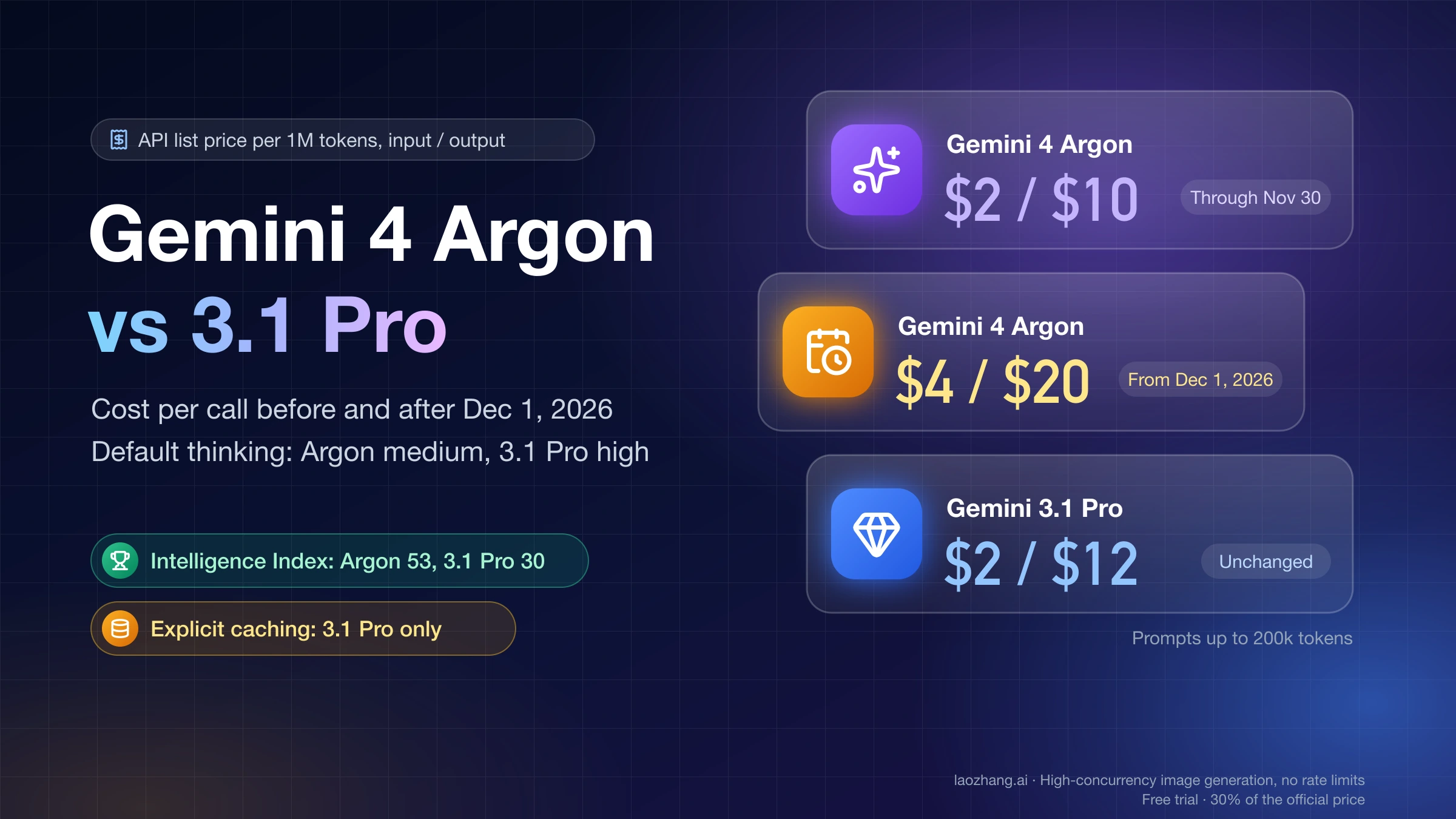
Google now positions Hydrogen as the upgrade from 3.8 Flash. If you want to move further up within Google instead, Gemini 4 Argon vs 3.8 Flash: Cost per Task and When to Switch covers that step.
Which is faster? Sonnet 5.5 returns answers sooner at high effort
If "faster" means how soon you have a finished answer, Sonnet 5.5 at high was the fastest of the three. In the October 26 test it beat 3.8 Flash on every one of the 11 calls, 86 seconds in total against 702, and AA's time per task at high agrees: 6.7 minutes for Sonnet, 8.4 for Hydrogen and 14.4 for 3.8 Flash. Hydrogen's November 14 calls added up to 574 seconds, but they ran four at a time through the gateway, so that sum isn't a fair speed figure, and AA's measurement is the one to compare.
Streaming speed tells a different story, because it only counts tokens once text is flowing. AA measures Hydrogen at 168 output tokens per second at high, Sonnet at 144 and 3.8 Flash at 114. Before that stream starts, though, AA records 17.60 seconds to the first answer token for Hydrogen and 17.34 for Flash against 10.48 for Sonnet, and the Gemini models then write more tokens in total. A model can stream faster and still finish later. Google's launch post says Hydrogen finishes tasks 2.5 times faster than 3.8 Flash at the default high. AA's time per task puts the gap at about 1.7 times, and OpenRouter's Sonnet 5.5 vs Gemini 3.8 Flash comparison, from real traffic as of October 5, 2026, showed Sonnet streaming at 108 tokens per second to Flash's 52.
Lower thinking levels are much quicker. AA times Hydrogen at medium at 3.8 minutes per task and at low at 1.4, against Sonnet's 4.0 and 2.6 at the same levels, and 3.8 Flash at medium at 12.3. None of the lower levels were part of the test. If Flash feels slow inside Antigravity specifically, Gemini 3.8 Flash Slow in Antigravity? Find the Delay Before Retrying separates the model's thinking time from other delays.
What changes on January 1, 2027, when Flash's price doubles
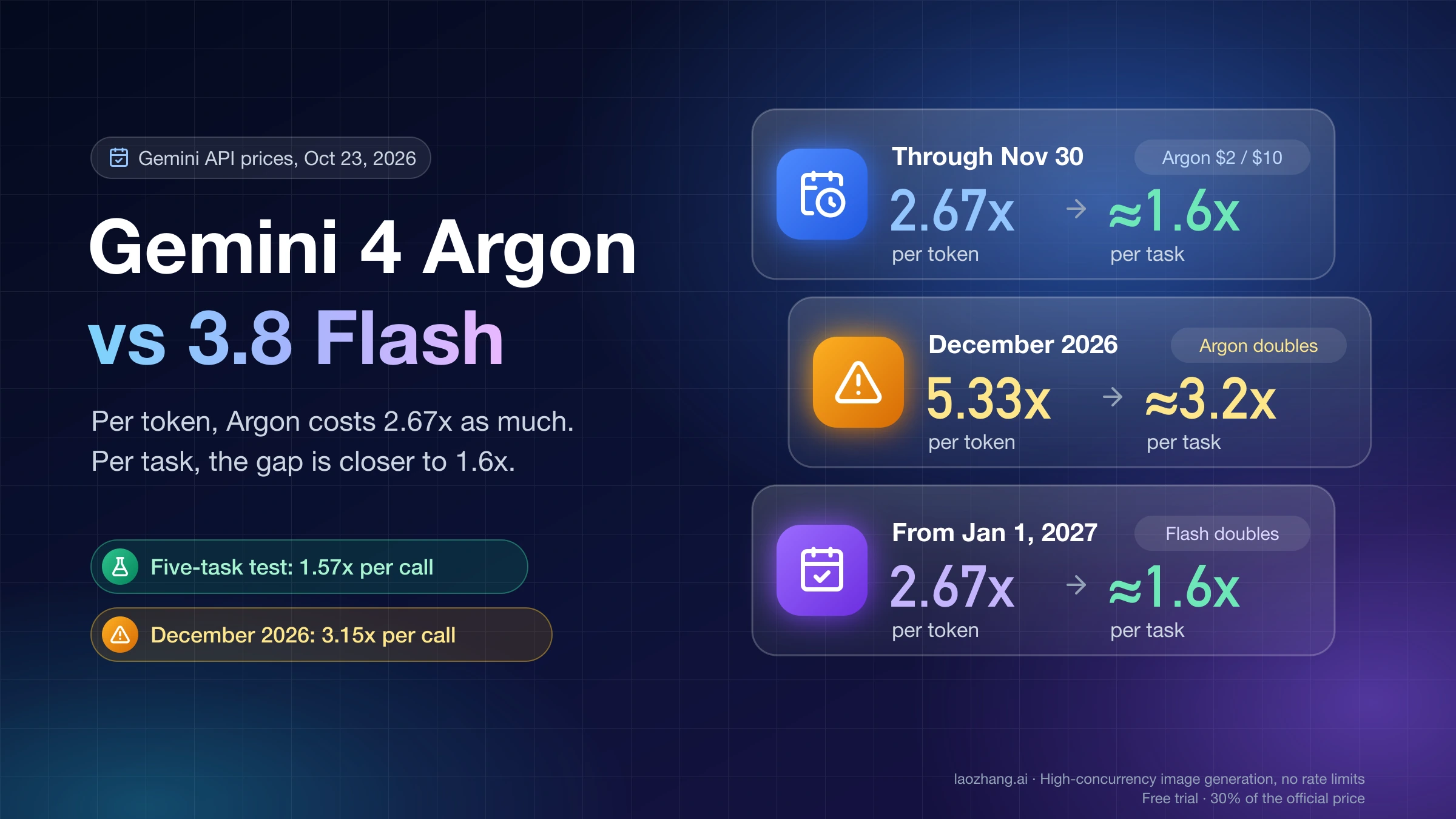
From January 1, 2027, every Gemini 3.8 Flash rate doubles, to exactly Hydrogen's $1.50 and $7.50, so most of the jobs where Flash still beats Sonnet stop being cheaper and Hydrogen becomes the cheaper Google model on most of the test. Google's Gemini API pricing page shows every 3.8 Flash rate doubling on that date: Standard input and output, Batch, Flex, Priority and context caching. As of October 26, 2026, Anthropic's Claude API pricing page lists no change for Sonnet 5.5. The table recomputes the test and AA's figures, assuming each model would use the same tokens after the change.
| Same work, same token counts | Sonnet 5.5 | Flash through Dec 31, 2026 | Flash from Jan 1, 2027 | Gemini 4 Hydrogen |
|---|---|---|---|---|
| Standard price per 1M tokens, input / output | $2 / $10 | $0.75 / $3.75 | $1.50 / $7.50 | $1.50 / $7.50 |
| All 11 test calls | $0.128 | $0.310 | $0.621 | $0.251 |
| Five easier test tasks | $0.0627 | $0.0518 | $0.1036 | $0.0830 |
| Three harder test tasks, both runs | $0.0655 | $0.2586 | $0.5172 | $0.1679 |
| 10,000 summary calls shaped like the 6,723-word task | $334 | $155 | $309 | $413 |
10,000 calls shaped like the eval_expr task | $190 | $885 | about $1,770 | $360 |
| AA cost per task, all at high | $1.64 | $7.77 | about $15.54 | $1.87 |
The 10,000-call rows multiply the measured per-call costs and are an illustration, not a measurement. Your token counts will differ, and Flash's eval_expr runs alone varied by a factor of two. The pattern is still clear. After the change, all 11 Flash calls cost 4.84 times Sonnet's bill, and the two tasks where Flash won, the long summary and merge_intervals, fall to 0.93 and 0.91 times Sonnet's cost. Flash at its 2027 price is then still the cheapest of the three on the long summary, and still cheaper than Hydrogen on merge_intervals, where Hydrogen thought nearly twice as long. If you picked Flash for a pipeline on price alone, re-run a sample in December before the new rates apply.
Move 3.8 Flash workloads to Gemini 4 Hydrogen? Mostly yes, by 2027
Move most 3.8 Flash workloads to Hydrogen before January 1, 2027, and keep long-input, short-answer jobs on Flash until you have re-tested them. At the 2027 price, Hydrogen cost 40% of Flash's bill on the 11 calls and less than Flash on six of the eight tasks, and on AA it scores 51 to Flash's 31 at high. The two tasks where Flash stayed cheaper even at its 2027 price were the long summary ($0.0309 against $0.0413) and merge_intervals ($0.0113 against $0.0173), one run each.
Timing matters. Through December 31, 2026, Flash is half Hydrogen's per-token price, and on the five easier tasks it cost $0.0518 to Hydrogen's $0.0830. Moving short, simple calls now raises their cost until the new year. Hard calls are the opposite: on the three harder tasks Hydrogen already cost $0.1679 to Flash's $0.2586 at today's price.
Two settings decide whether a migration saves what the test suggests. First, 3.8 Flash defaults to medium thinking and Hydrogen to high, so code that never set thinkingLevel will start thinking harder after the switch. Set the level explicitly, and remember that on AA Hydrogen at medium already scores 41, ten points above Flash at its best. Hydrogen at medium wasn't part of the test above, so check it on your prompts. Second, Hydrogen doesn't support explicit context caching. Google's migration notes say to remove cached_content when you switch, and only implicit caching applies, on prompts of at least 4,096 tokens.
Which jobs to send to Sonnet 5.5, Gemini 3.8 Flash or Hydrogen
Send short reasoning calls and business documents to Sonnet 5.5, send agentic coding, automation and factual Q&A to Hydrogen for a head-to-head run against Sonnet, and keep 3.8 Flash for long-input reading until you have re-tested it on Hydrogen. If your choice is only between Sonnet 5.5 and 3.8 Flash, the October map below still holds; the table adds Hydrogen, with the evidence for each row and the condition that would flip it.
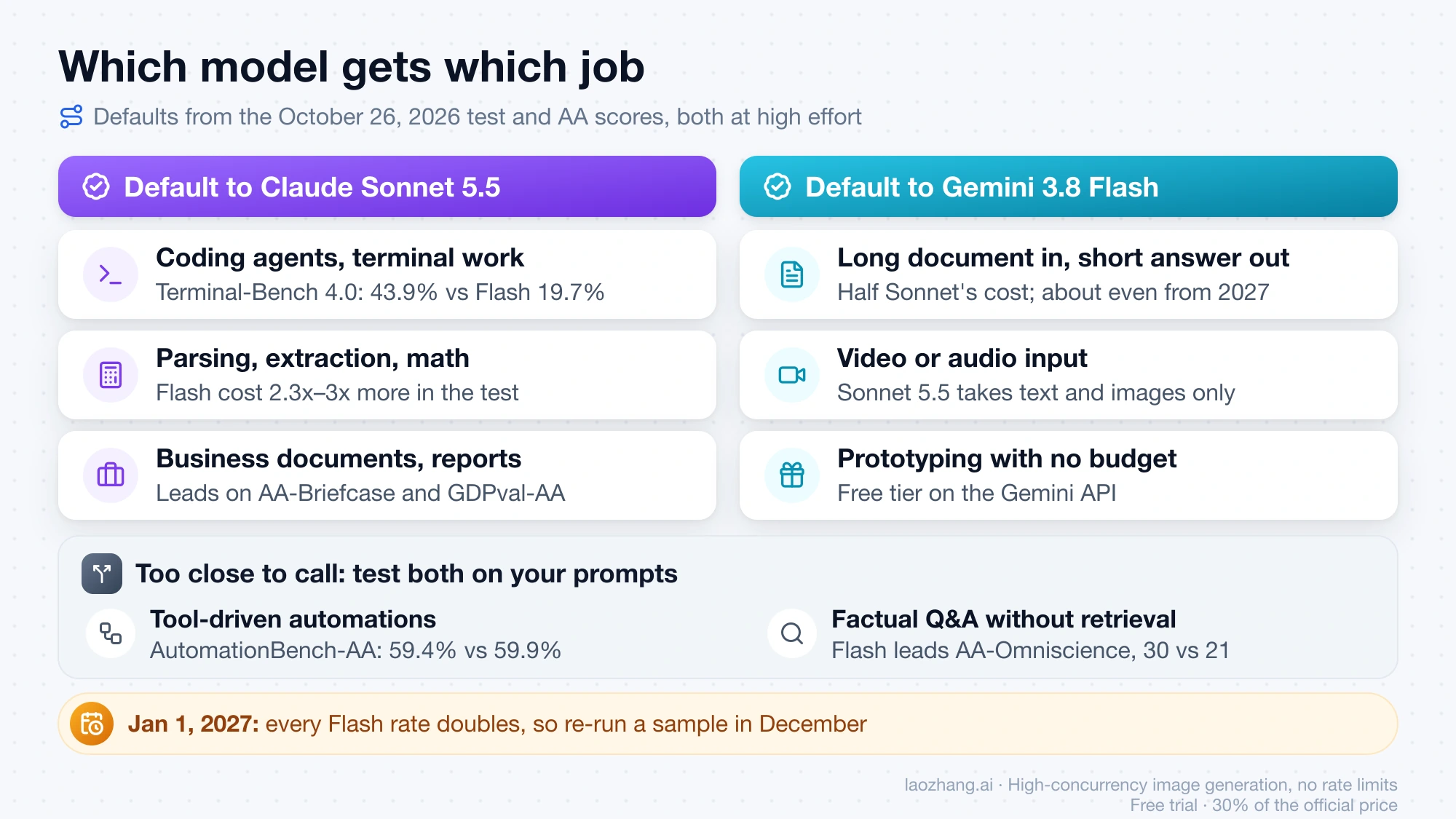
| Job | Default | Why | Route elsewhere when |
|---|---|---|---|
| Coding agents, terminal work, multi-file bug fixing | Gemini 4 Hydrogen at high, tested against Sonnet 5.5 | Highest AA Terminal-Bench 4.0 at high: 54.0% vs Sonnet 43.9% and Flash 19.7%, at $1.87 vs $1.64 per AA task | Your own reviews show Sonnet catching more, as one Reddit user reported, or you work in Claude Code; Sonnet xhigh scores 57.1% for $4.09 |
| Short reasoning calls: parsing, extraction with edge cases, math | Sonnet 5.5 | All three passed; Hydrogen cost 1.31x–4.95x Sonnet and Flash up to 4.7x on these tasks | The call is simple enough for Hydrogen at low ($0.29 per AA task vs Sonnet low $0.51), which wasn't tested here |
| Long document in, short answer out | Gemini 3.8 Flash | Cheapest of the three on the summary, at today's and the 2027 price | Re-test on your documents in December; one run is thin evidence, and repeated documents may suit Sonnet's $0.10 cache reads |
| Video or audio input | Gemini 4 Hydrogen, or 3.8 Flash through 2026 | Sonnet 5.5 takes text, images and PDF only | Only the text and images matter |
| Factual Q&A without retrieval | Gemini 4 Hydrogen | AA-Omniscience 44 vs Flash 23 and Sonnet 19 | You add retrieval and the gap closes on your own checks |
| Business documents, reports, office deliverables | Sonnet 5.5 | AA-Briefcase 1634 vs Hydrogen 1497 and Flash 1204, the one AA test where Sonnet leads | Volume is huge and every draft gets human review anyway |
| Tool-driven automations | Gemini 4 Hydrogen | AutomationBench-AA 74.4% vs Sonnet 59.4% and Flash 59.9% | Your own runs show Sonnet finishing the same flow in far fewer tokens |
| Prototyping with no budget | Gemini 4 Hydrogen on the Gemini API free tier | Free input and output; 3.8 Flash is free there too | Your prompts must not be used to improve Google's products |
For Sonnet, set effort deliberately. Anthropic's effort guidance suggests high as the starting point for most API work, medium for well-specified agentic coding, and medium or low for chat. Claude Code already defaults Sonnet 5.5 to medium, which costs $0.78 per AA task and scores 31, against Hydrogen medium at 41 for $0.80.
If none of the three fits, the next step is usually a different tier rather than another of these models. To cut cost on simple calls, see Claude Haiku 5.5 vs Sonnet 5.5: When the 20x Price Gap Pays Off. For harder agent work, see Claude Sonnet 5.5 vs Opus 5.5: When Half the Price Really Saves. OpenAI's mid-tier is compared in Claude Sonnet 5.5 vs GPT-6 Astra: When the Cheaper Model Wins, and a cross-vendor price table by input and output mix is in AI API Price Comparison: Cheapest Model by Input and Output Mix.
Specs side by side: context, output limit, inputs, caching, batch
The three models share the same 1M-token context class but differ in output length, input types, caching and how you control reasoning, and those differences decide some jobs before price does. Figures are from Anthropic's model overview and pricing pages as of October 26, 2026, Google's Gemini 3.8 Flash model and pricing pages as of October 26, 2026, and Google's Gemini 4 Hydrogen model, pricing and migration pages as of November 13, 2026.
| Spec | Claude Sonnet 5.5 | Gemini 3.8 Flash | Gemini 4 Hydrogen |
|---|---|---|---|
| API model ID | claude-sonnet-5-5 | gemini-3.8-flash | gemini-4-hydrogen |
| Released | September 28, 2026 | Generally available September 2, 2026 | Generally available November 12, 2026 |
| Context window | 1M tokens, same per-token rate across the whole window | 1,048,576 tokens, no long-prompt surcharge | 1,048,576 tokens, flat price across the window |
| Max output | 128K tokens (300K on Batches with a beta header) | 65,536 tokens | 65,536 tokens per synchronous call |
| Input types | Text, images, PDF (document blocks, up to 600 pages / 32 MB per request) | Text, images, video, audio, PDF | Text, images, video, audio, PDF |
| Reasoning control | effort: low, medium, high, xhigh, max; adaptive thinking can't be disabled | thinkingLevel: low, medium, high; minimal returns an error | thinkingLevel: low, medium, high, xhigh; minimal unsupported |
| Default reasoning setting | high on the API | medium | high |
| Batch price per 1M tokens, input / output | $1 / $5 | $0.375 / $1.875, then $0.75 / $3.75 from 2027 | $0.75 / $3.75 (Batch and Flex) |
| Cache reads per 1M tokens | $0.10 | $0.075, then $0.15 from 2027 | $0.075, implicit caching only, prompts of 4,096 tokens or more |
| Cache writes and storage per 1M tokens | $2.50 (5-minute) or $4 (1-hour) to write | $0.50 per hour of storage, then $1.00 from 2027 | None; explicit caching isn't supported |
| Free API use | A small amount of free credits for new users | Free tier: input, output and caching free of charge | Free tier: input, output and caching free of charge |
| Prompts used to improve products | Not covered on the pricing page | Yes on the free tier, no on paid | Yes on the free tier, no on paid |
Caching changes the math for repeated long prompts, and it works differently on each model. Sonnet 5.5's cache reads fell to $0.10 on October 7, 2026, and from 2027 that is cheaper than 3.8 Flash's $0.15, though Flash charges storage by the hour instead of a write fee. Hydrogen's $0.075 applies only when Google's implicit cache happens to hit, so you can't pin a document in cache as you can on the other two. Caching wasn't part of the test. Claude Sonnet 5.5 Cache Read Price Cut to $0.10: What You Save works through the savings, and the full Gemini rate card is in Gemini API Pricing 2026: Token Rates, Free Tier, and Key Cost. Google publishes no request-per-day table for the free tier, and Gemini API Free Tier 2026: Limits, Free Models, and Free API Keys covers what is known.
Sonnet 5.5, 3.8 Flash and Hydrogen in Claude.ai, Gemini and Antigravity
Outside the API, Sonnet 5.5 and Hydrogen are both easy to reach for free in their own chat apps, while a free Antigravity user still gets only 3.8 Flash. Anthropic says anyone can chat with Sonnet 5.5 on Claude.ai, and as of October 26, 2026 the Claude apps offer an effort selector from Low to Max for it, with thinking that can't be turned off. Anthropic's help center doesn't say which effort level the Free plan gets. Claude Code runs Sonnet 5.5 at medium effort by default. Whether a Claude plan or an API key is the better way to pay for it is covered in Claude Pro vs Max vs Ultra: Usage Limits and When Max Is Worth It.
On Google's side, the launch post of November 12, 2026 says Hydrogen is in the Gemini app's model picker for everyone and in Google AI Studio on every plan, including Free. As of October 23, 2026, the Gemini app's help page listed a model called "Flash", with no version number, on Google AI Plus, Pro and Ultra. In Antigravity, Google offers Hydrogen only on paid Google AI Pro and Ultra. Antigravity's model table, as of October 23, 2026, offered 3.8 Flash on every plan from Free & Plus up to Enterprise, and Sonnet 5.5 (thinking) only on paid Google AI Pro (not trials), Ultra and Enterprise, so on Free & Plus 3.8 Flash is the only one of the three you can run there.
Claude Sonnet 5.5 vs Gemini 3.8 Flash and Hydrogen: other questions
Is Claude Sonnet 5 the same as Sonnet 5.5?
No. Claude Sonnet 5 is the older model, and Sonnet 5.5, released September 28, 2026, is its successor. They share base token prices, but Sonnet 5's cache reads still cost $0.20 per million tokens. Some comparison sites, BenchLM and Requesty among them in October 2026, list claude-sonnet-5 against Gemini 3.8 Flash, so check the version before you trust a score or a cost figure.
Can I turn thinking off to make any of these models cheaper?
Not fully on any of them. On the Claude API, Sonnet 5.5 rejects thinking: {"type": "disabled"} and fixed budget_tokens with a 400 error. You can lower effort, or send thinking: {"type": "between_tools"} to skip up-front thinking at high or below, according to Anthropic's extended thinking documentation as of October 26, 2026. The lowest setting on both Gemini 3.8 Flash and Gemini 4 Hydrogen is thinkingLevel: "low", and neither supports minimal. Lower levels weren't part of the October or November tests, so measure your own prompts before you assume the savings.
What happened to Gemini 3.7 Flash?
Google deprecated gemini-3.7-flash on October 8, 2026, and calls to it are now routed automatically to gemini-3.8-flash. If you still send the 3.7 ID, you are already being billed for, and getting answers from, 3.8 Flash.
Sources7
External pages this guide links to, in the order they appear. Last updated Nov 14, 2026.
Sources7
External pages this guide links to, in the order they appear. Last updated Nov 14, 2026.
- 1.Artificial Analysis Gemini 4 Hydrogen vs Claude Sonnet 5.5 comparisonartificialanalysis.ai/models/comparisons/gemini-4-hydrogen-vs-claude-sonnet-5-5
- 2.Artificial Analysis Gemini 3.8 Flash vs Claude Sonnet 5.5 comparisonartificialanalysis.ai/models/comparisons/gemini-3-8-flash-vs-claude-sonnet-5-5
- 3.OpenRouter's Sonnet 5.5 vs Gemini 3.8 Flash comparisonopenrouter.ai/compare/anthropic/claude-sonnet-5.5/google/gemini-3.8-flash
- 4.Gemini API pricing pageai.google.dev/gemini-api/docs/pricing
- 5.Claude API pricing pageplatform.claude.com/docs/en/about-claude/pricing
- 6.document blocksplatform.claude.com/docs/en/build-with-claude/pdf-support
- 7.Anthropic's extended thinking documentationplatform.claude.com/docs/en/build-with-claude/thinking