Kimi K3.1 Pro vs Gemini 4 Argon: Same Price Only Until Dec 1
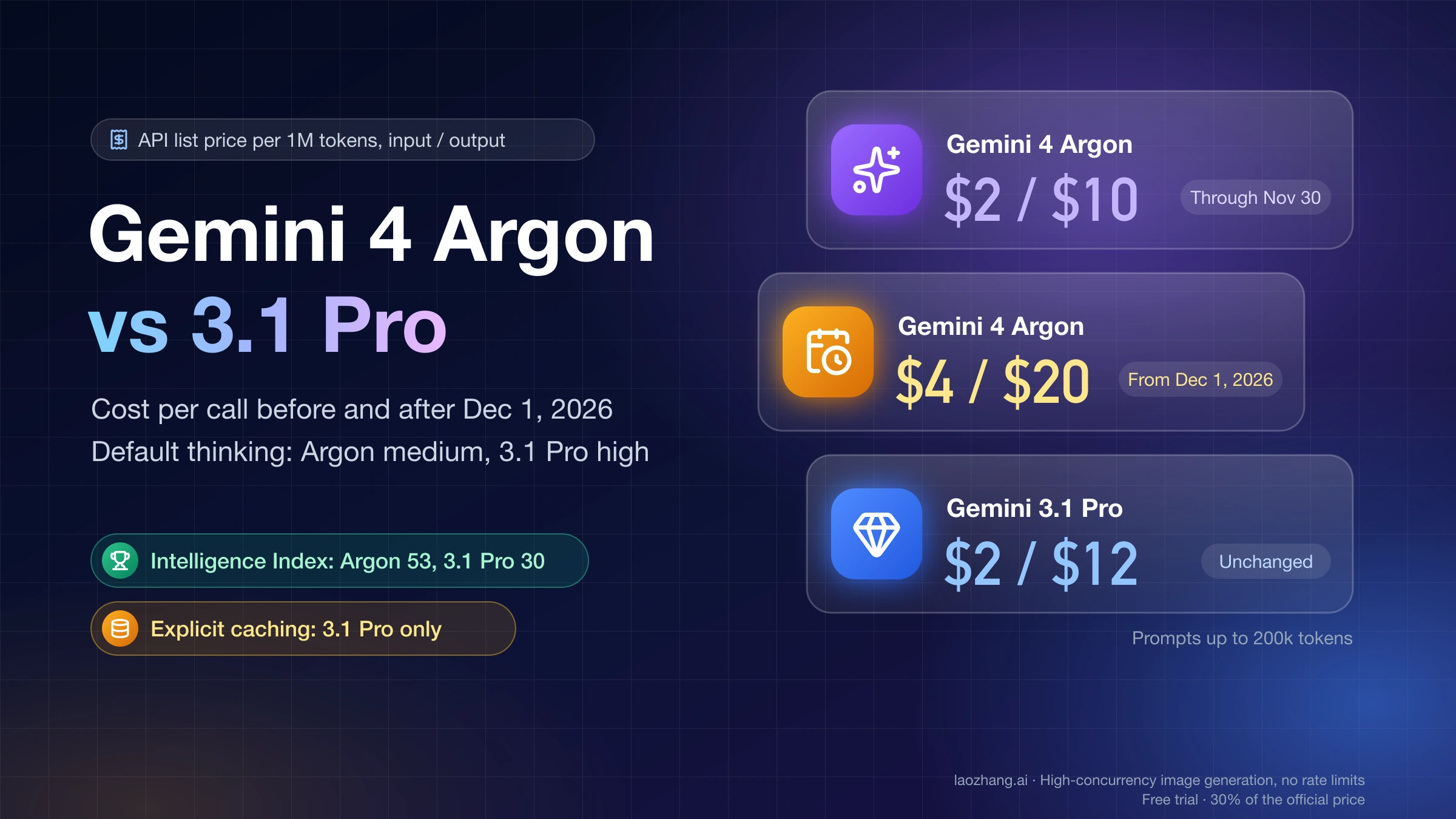
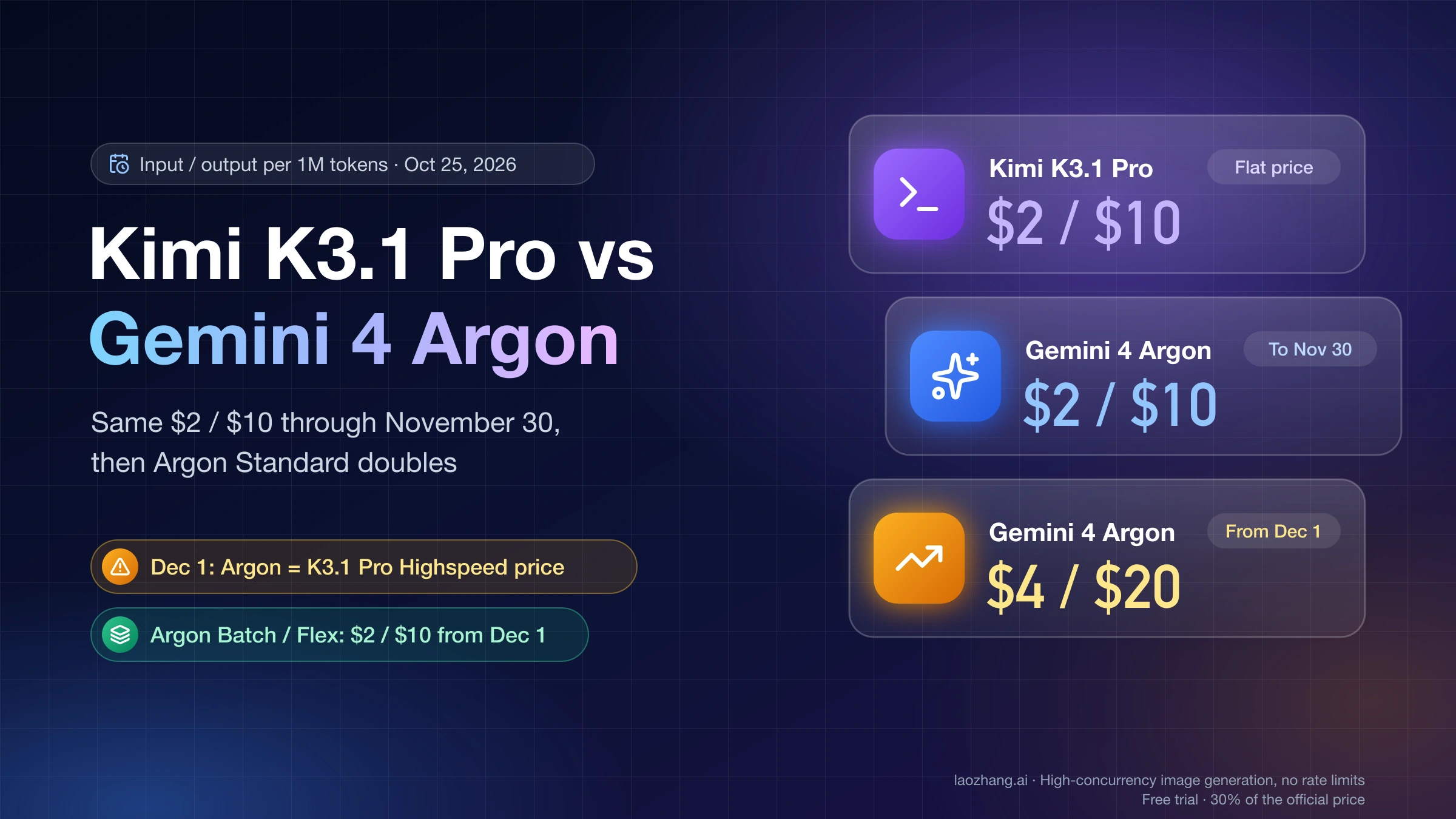
Both list at $2/$10 per 1M tokens through November 30, 2026, then Argon doubles. K3.1 Pro leads terminal coding and long context; Argon leads factual recall.
On this page
Test Kimi K3.1 Pro (kimi-k3.1-pro) first if your workload is a coding agent working in a terminal, question answering over very long documents, or multi-step report and analysis work. Test Gemini 4 Argon (gemini-4-argon) first for factual answers where a wrong fact is expensive, hard science and reasoning questions, SaaS automation through tools, or drawing bounding boxes on images. That split comes from Artificial Analysis's independent evals and Ultralytics' annotation benchmark, both published within two days of K3.1 Pro's October 23, 2026 release. It is not the result of a same-prompt test of the two models.
The price tie has an end date. Both models list at $2 per 1M input tokens and $10 per 1M output tokens through November 30, 2026. From December 1, Google's Standard price for Argon becomes $4 and $20, which is exactly what Moonshot charges for K3.1 Pro Highspeed. In the example coding-agent session worked through below, Argon costs slightly less than K3.1 Pro today and about 1.8 times as much after that date, unless you move the job to Argon's Batch or Flex tier.
Before you judge either model from a first call, set the reasoning level yourself. K3.1 Pro runs at its highest effort (max) by default, while Argon defaults to medium thinking, so two default calls compare a maxed-out model with a mid-level one on cost, latency and quality.
Same price? $2/$10 per 1M tokens only through November 30, 2026
Per token, the two models cost the same today, and Argon is the cheaper one on cached input. The Gemini API pricing page lists two dated prices for Argon as of October 25, 2026, and Kimi's API pricing page lists flat prices for both K3.1 Pro variants, with no context-length tiers, as of October 24, 2026.
| Price per 1M tokens (USD) | K3.1 Pro | K3.1 Pro Highspeed | Argon Standard, through Nov 30 | Argon Standard, from Dec 1 |
|---|---|---|---|---|
| Input | $2.00 | $4.00 | $2.00 | $4.00 |
| Cached input (cache hit) | $0.20 | $0.20 | $0.10 | $0.20 |
| Cache write | $2.00 (5-min TTL), $4.00 (1-hour) | $4.00 (5-min), $8.00 (1-hour) | No write fee | No write fee |
| Output | $10.00 | $20.00 | $10.00 | $20.00 |
Google states that Argon's output price includes thinking tokens. Kimi's pricing page doesn't say so for K3.1 Pro, but OpenRouter and Artificial Analysis count its reasoning as output, and the cost figures below assume the same.
Argon also has two other tiers that change the picture after the switch. Batch and Flex cost $1 input and $5 output through November 30 and $2 and $10 from December 1, which matches K3.1 Pro's standard input and output price. Priority costs $3.60 and $18 now, then $7.20 and $36. If your Argon work can wait for a batch result, the December price increase does not have to put it behind K3.1 Pro on cost. The full Google table, including other Gemini models, is in Gemini API Pricing 2026: Token Rates, Free Tier, and Key Cost.
What a coding agent, a long document and a single call cost
On October 25, 2026, the list prices above were run through three typical request shapes. The token counts are assumptions chosen to represent common jobs, not measured traffic, and output includes thinking tokens on both models. K3.1 Pro pays a 5-minute cache write once for the shared prefix and the cache-hit price afterwards. Argon pays full input price for the prefix on the first turn and its cached price after that, if its implicit cache hits.
| Job (assumed token counts) | K3.1 Pro | K3.1 Pro Highspeed | Argon through Nov 30 | Argon from Dec 1 | Argon if the cache never hits (Nov / Dec) |
|---|---|---|---|---|---|
| Coding-agent session: 60K-token prefix reused for 40 turns, 4K new input and 3K output per turn | $2.11 | $3.75 | $1.87 | $3.75 | $6.32 / $12.64 |
| Long document: 400K tokens, 10 questions within 5 minutes, 300 input and 1,500 output tokens each | $1.68 | $2.63 | $1.32 | $2.63 | $8.16 / $16.31 |
| One cold call: 8K input, 2K output, nothing cached | $0.036 | $0.072 | $0.036 | $0.072 | Same as left |
To check the agent row on K3.1 Pro: one cache write of the 60K prefix (0.06M × $2 = $0.12), 39 cache reads (2.34M × $0.20 = $0.468), 160K fresh input tokens (0.16M × $2 = $0.32) and 120K output tokens (0.12M × $10 = $1.20) add up to $2.108. Argon through November 30 pays the same $0.12 for the first prefix, $0.234 for the 39 cached reads at $0.10, and the same fresh input and output, for $1.874. From December 1 every Argon rate doubles, so the session costs $3.748, about 1.78 times K3.1 Pro and the same as K3.1 Pro Highspeed.
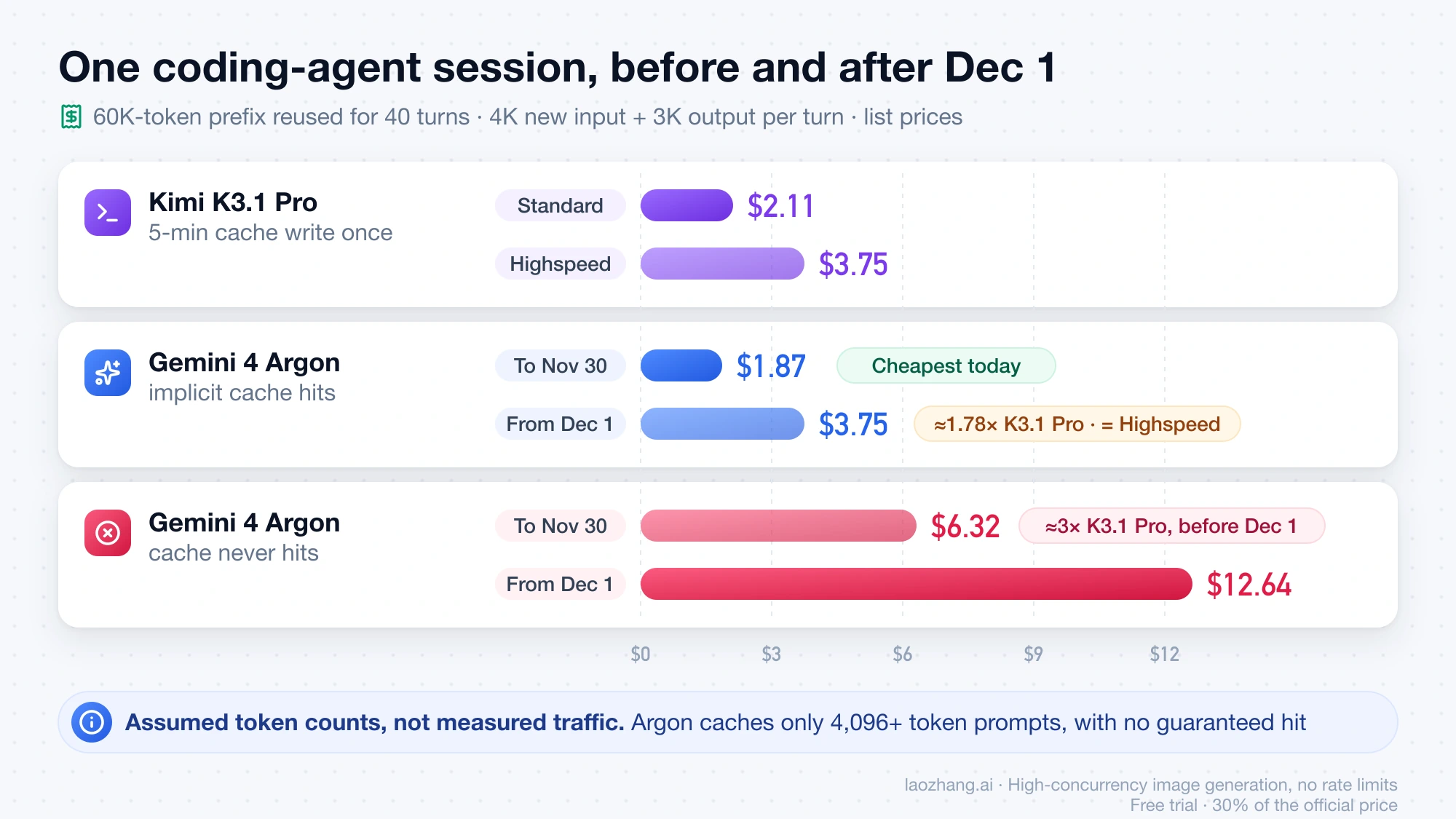
Three things change these numbers in practice. Argon's caching is implicit, applies to prompts of at least 4,096 tokens and is not guaranteed to hit, so the last column shows what happens if every turn pays full input: the agent session costs about three times as much as on K3.1 Pro even before December 1. K3.1 Pro's 1-hour cache costs $4 per 1M tokens to write, so long idle gaps between questions make the document job more expensive than shown. And real thinking length differs by model and effort, which is why the next section's per-task benchmark costs matter more than any assumed shape.
Where each model leads on Artificial Analysis's 10 evals
K3.1 Pro leads on agentic coding in a terminal, long-context reasoning and document-heavy knowledge work, while Argon leads on knowledge reliability, hard reasoning and SaaS automation. The aggregate barely separates them: on Artificial Analysis's K3.1 Pro vs Argon comparison, as of October 25, 2026, K3.1 Pro scores 55 on Intelligence Index v4.3.2 and Argon scores 53. These are third-party results, and no same-prompt quality or latency test of the two models was run for this page. Artificial Analysis ran Argon at High thinking, which is not the API default.
| Artificial Analysis eval (what it measures, per AA) | K3.1 Pro | Argon (High) | Ahead |
|---|---|---|---|
| Terminal-Bench 4.0 (agentic coding and terminal use) | 67% | 57% | K3.1 Pro |
| AA-LCR v1.1 (long-context reasoning) | 86% | 80% | K3.1 Pro |
| GDP.pdf (professional document reasoning) | 31% | 22% | K3.1 Pro |
| AA-Briefcase v1.1 (agentic knowledge work, Elo) | 1678 | 1486 | K3.1 Pro |
| GDPval-AA v2.1 (agentic real-world work tasks, Elo) | 1846 | 1624 | K3.1 Pro |
| AA-Omniscience (knowledge reliability, penalizes hallucinations) | 30 | 42 | Argon |
| Humanity's Last Exam (reasoning and knowledge) | 52% | 57% | Argon |
| AutomationBench-AA (agentic SaaS workflows) | 73% | 78% | Argon |
| CritPt (physics reasoning) | 25% | 27% | Argon, narrowly |
| SciCode (coding, marked under review by AA) | 61% | 62% | Even |
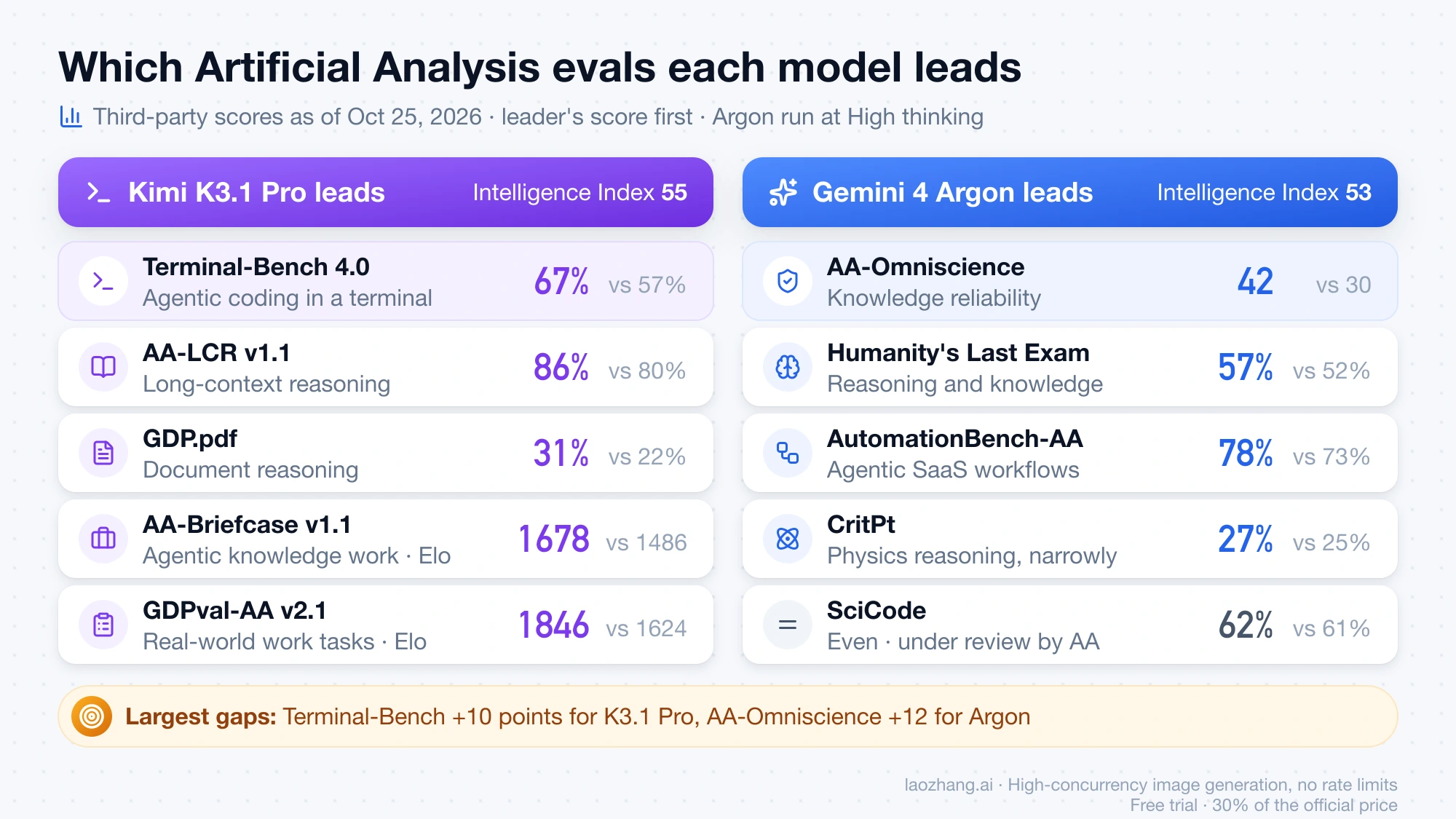
The 10-point Terminal-Bench gap and the 12-point AA-Omniscience gap are the two numbers most likely to decide a first test. A coding agent that spends its time running commands is where K3.1 Pro has the clearest lead. A support bot or research assistant that must not invent facts is where Argon has it, even though Moonshot reports in its K3.1 Pro quickstart that K3.1 Pro's claim-level hallucination rate in its own stress test fell from 23.35% for K3 to 6.85%. Moonshot's Chinese launch page also claims 65.7% on Terminal-Bench 4.0, close to the 67% Artificial Analysis measured, but it doesn't describe the harness, and the English page still shows a placeholder for that number as of October 25, 2026.
Speed depends on what you measure. Artificial Analysis records K3.1 Pro's first token at 2.97 seconds and Argon's at 57.01 seconds, because K3.1 Pro streams its reasoning while Argon's first visible token arrives after it finishes thinking. The first answer token arrives at 30.19 seconds versus 57.01, a full response takes 37.00 seconds versus 63.33, and an average index task takes 618 seconds versus 723. Raw output speed is close: 73 tokens per second for K3.1 Pro and 79 for Argon.
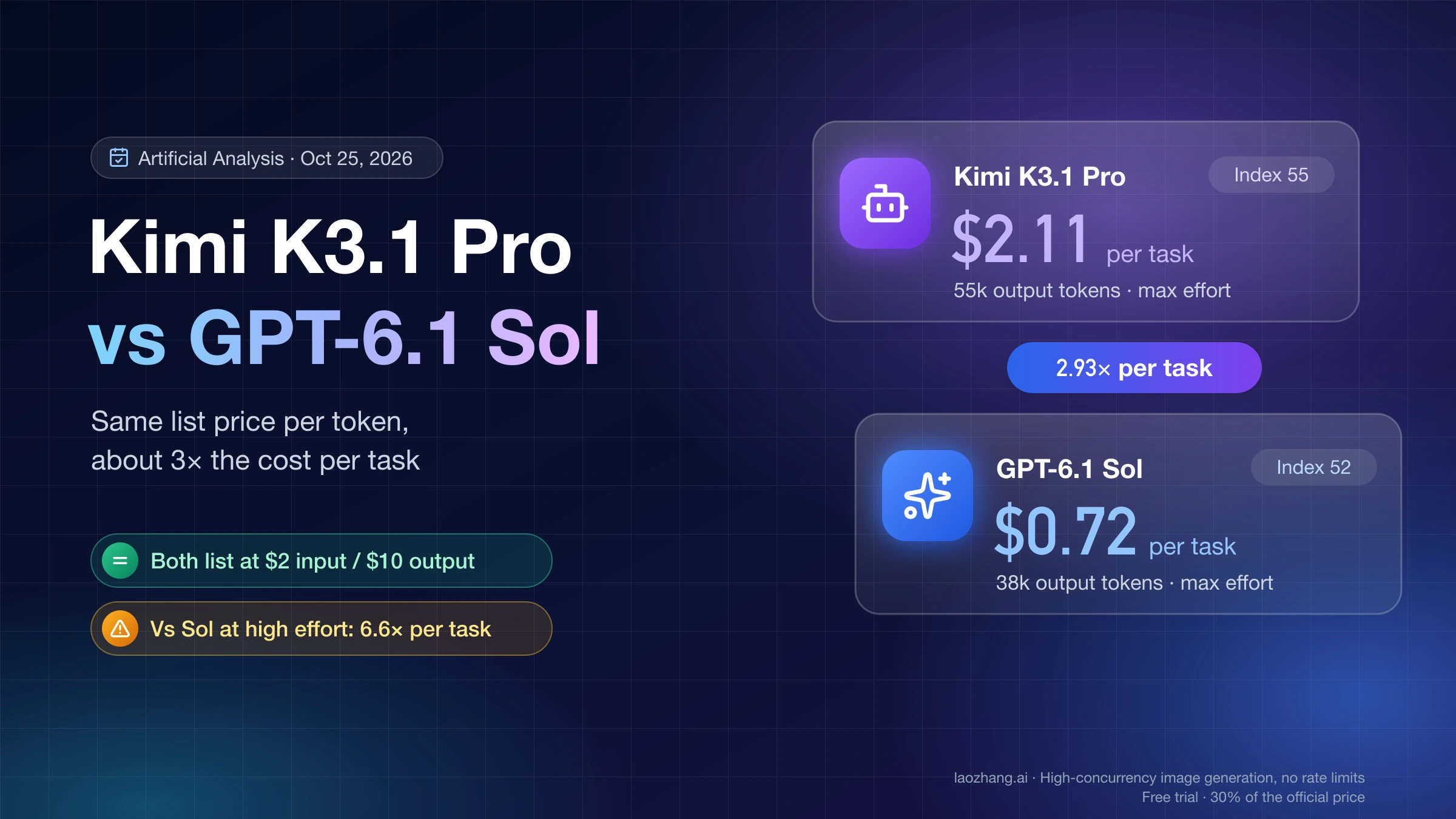
Cost per task follows the price period. Artificial Analysis puts the cost of an Intelligence Index task at $2.11 for K3.1 Pro and $1.99 for Argon at Argon's current price, with Argon using 62K output tokens per task against K3.1 Pro's 55K. Doubling Argon's figure for the December 1 price, on the assumption that token use stays the same, gives about $3.98 per task, 1.89 times K3.1 Pro.
Bounding boxes on images: Argon wins Ultralytics' 360-image test
For drawing object-detection boxes, Argon is more accurate, cheaper and faster than K3.1 Pro overall, even though K3.1 Pro wins some datasets. Ultralytics' Kimi K3.1 Pro auto-annotation benchmark, published October 24, 2026, scored 29 models on 360 images drawn from 36 real detection datasets, with boxes tightened by SAM 3.1 in its production pipeline. Argon scored 0.537 mAP50 and K3.1 Pro 0.444, placing K3.1 Pro seventh.
K3.1 Pro was ahead on six datasets, including tennis, football, wheat heads and thyroid ultrasound, and on the sports domain overall (0.68 versus 0.60). If your images look like those, test both. Everywhere else the cost and speed gap is large: about $7.60 per 1,000 images on Argon against about $22.50 on K3.1 Pro, and a median of 4.6 seconds per image against about 22 seconds. Ultralytics ran K3.1 Pro at high effort, not max, because at max many Kimi K3 images had exceeded its 115-second limit. From December 1, Argon's per-1,000-image cost would be about $15.20 at the same token use, still below K3.1 Pro.
Which model to test first for your workload
Start with the model that leads on the evals closest to your work, then check whether the December 1 price change or latency reverses that choice. K3.1 Pro is the first test for coding agents that edit a repository and run shell commands, for questions over contracts, transcripts or large codebases, and for multi-step analyst-style work such as turning spreadsheets into a memo, because those map to its Terminal-Bench, AA-LCR, GDP.pdf, AA-Briefcase and GDPval-AA leads. It is also the first test for a chat interface where users watch for the first token, since it streams reasoning within about 3 seconds while Argon showed nothing for about 57 seconds in Artificial Analysis's runs.
Argon is the first test when an invented fact causes real damage, as in support answers or research lookups, because its AA-Omniscience lead is the largest gap in its favor. The same goes for exam-style reasoning and science questions, agents that drive SaaS tools through AutomationBench-style workflows, and image annotation with bounding boxes. For large offline jobs that can wait, Argon's Batch or Flex tier is worth a test on any workload, since after December 1 it charges the same input and output price as K3.1 Pro's standard API.
The price period can override all of this. If you plan to finish a heavy run before December 1, Argon's half-price cache reads make it slightly cheaper on cache-heavy work, which can justify trying it first even for a K3.1 Pro workload. After that date, Argon on Standard pricing has to win on quality to justify roughly double the cost. When the evidence is close, as on SciCode and CritPt, run your own task set on both with the reasoning level fixed on each side.
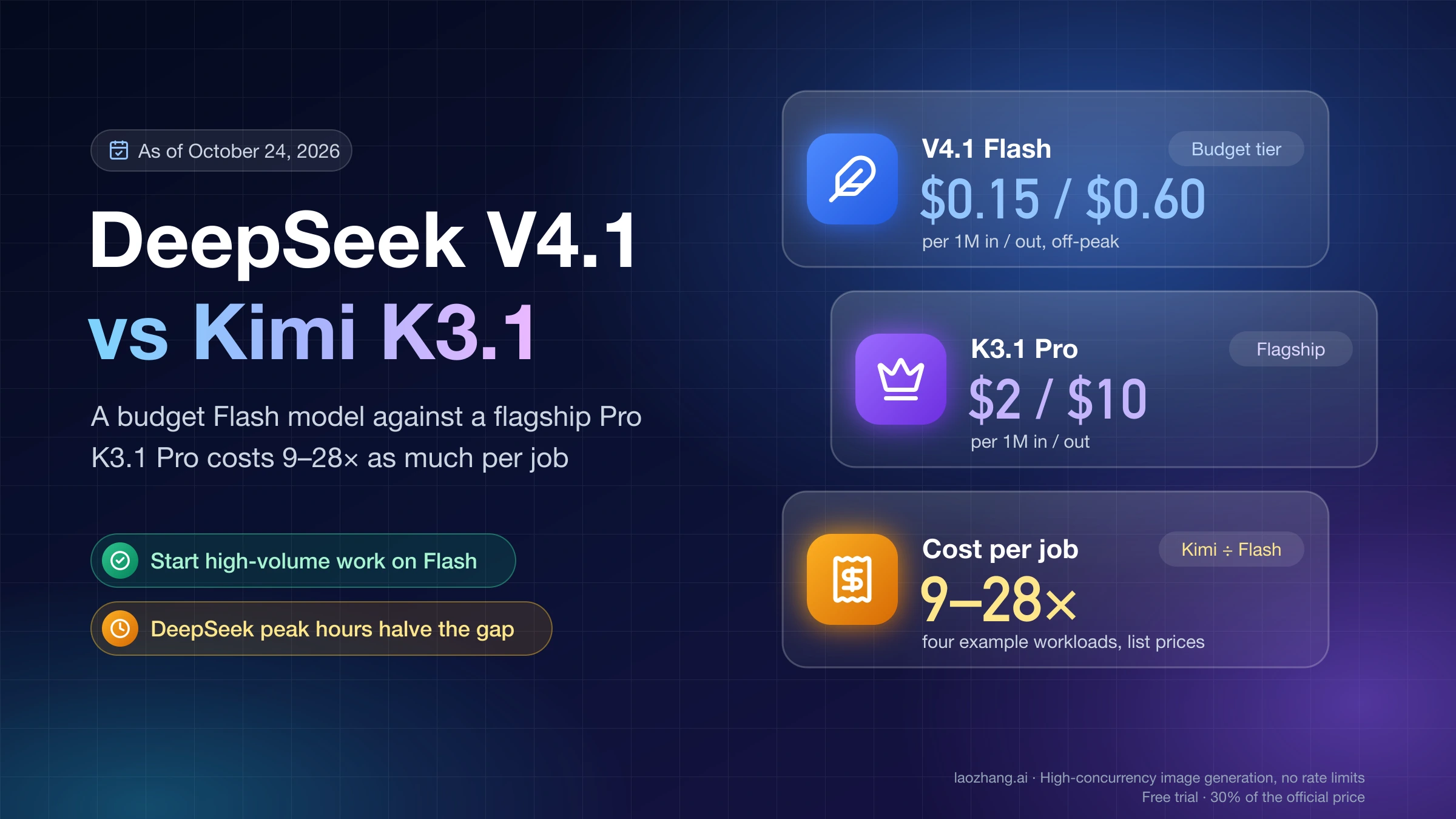
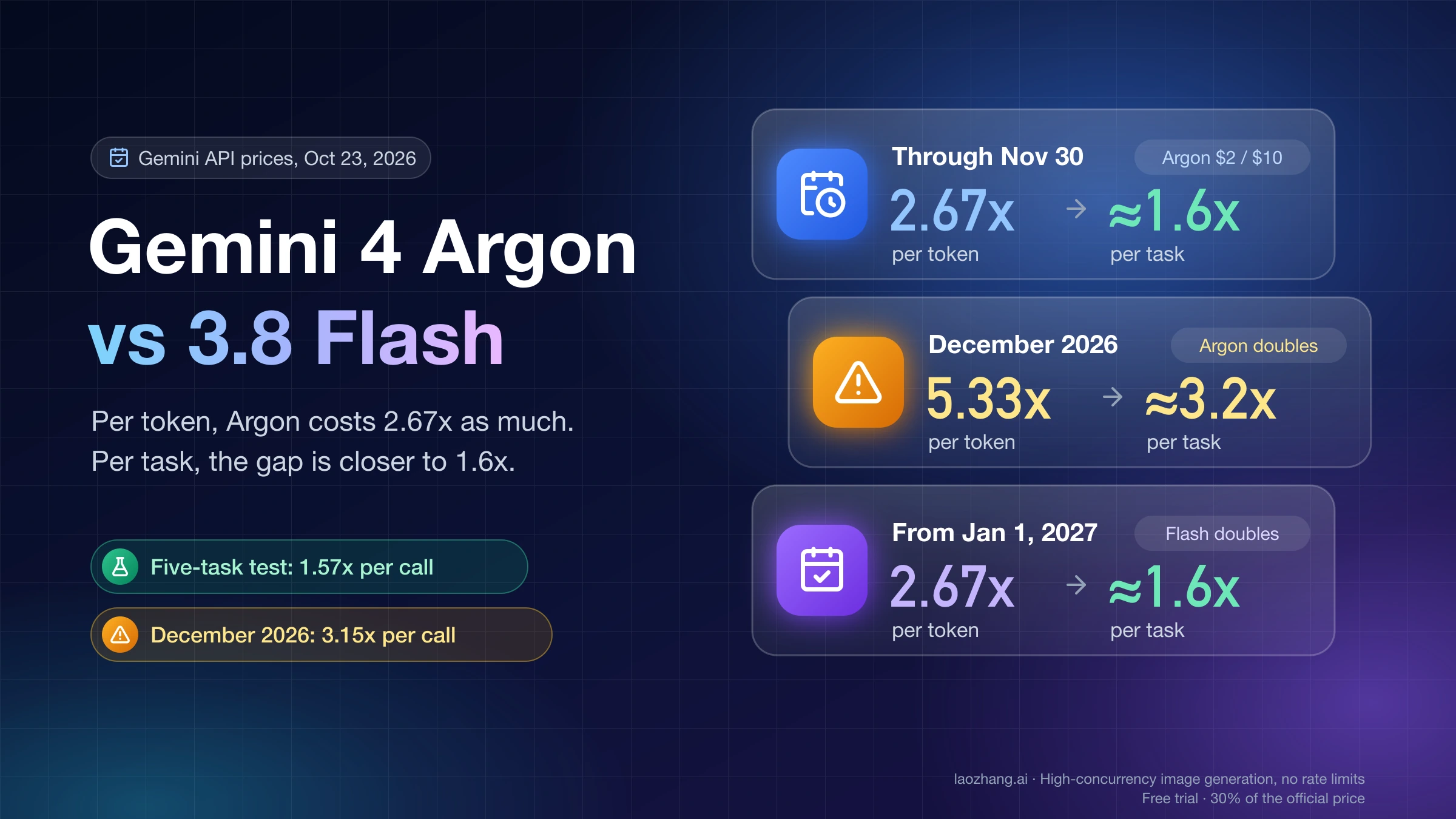
Some neighboring choices have their own comparisons. If K3.1 Pro's price is the issue, see DeepSeek V4.1 vs Kimi K3.1: Flash vs Pro and a 9–28× Cost Gap. If you want to stay on Google but pay less, see Gemini 4 Argon vs 3.8 Flash: Cost per Task and When to Switch, and for Argon against the closed flagships, Gemini 4 Argon vs Claude Opus 5.5 vs GPT-6.1 Sol: Cost and Access.
What changes in your code when you try the other model
Reasoning defaults, sampling parameters, caching and output limits differ enough that a request written for one model can fail or mislead on the other. The table below comes from Moonshot's K3.1 Pro quickstart as of October 25, 2026, and Google's Gemini 4 Argon model page and Gemini thinking guide as of October 23, 2026.
| Setting | Kimi K3.1 Pro | Gemini 4 Argon |
|---|---|---|
| Model ID | kimi-k3.1-pro, kimi-k3.1-pro-highspeed | gemini-4-argon (Stable, GA October 13, 2026) |
| Client | OpenAI SDK with base URL https://api.moonshot.ai/v1 (https://api.moonshot.cn/v1 for the China platform) | Gemini API with an AI Studio key, or Vertex AI |
| Reasoning | Always on; reasoning_effort low, high or max, default max | On by default at medium; levels low, medium and high, no minimal |
| Sampling | temperature 1.0, top_p 0.95, n 1 and both penalties at 0 are fixed; omit them | temperature, top_p and top_k are ignored (deprecated) |
| Caching | Automatic for repeated prefixes; 5-minute TTL by default, 1 hour via prompt_cache_options.ttl; writes are billed | Implicit only, for prompts of 4,096+ tokens; 95% off on hits; explicit cachedContents not supported |
| Context window | 1,048,576 tokens | 1,048,576 tokens shared by input, thinking and output |
| Output limit | max_completion_tokens defaults to 131,072, up to 1,048,576 | 65,536 per synchronous request; up to 1,048,576 only in background long-decode mode |
| Inputs | Text, image, video; images as base64 or ms://<file-id>, not public URLs | Text, image, video, audio, PDF |
| Access | Unlocks after a top-up of at least $1; cumulative top-up sets your rate-limit tier | Paid tier only, no Free tier |
Two rows cause most first-test surprises. Kimi's high default effort makes early K3.1 Pro calls slower and more expensive than they need to be, so set reasoning_effort to the level you would run in production, and set Argon's thinking level to match. On Argon, a large max_output_tokens above 65,536 on a normal request returns a 400 error; Google's migration notes instead suggest a limit of at least 32,768 tokens and client timeouts of 15 minutes or more for hard prompts.
Multi-turn code also needs care when moving to K3.1 Pro. Moonshot asks you to send back the complete assistant message unchanged in multi-turn conversations and tool calls, and to parse only content, not reasoning_content, when you use json_schema with strict: true. If your pipeline sends images by public URL, convert them to base64 before switching to K3.1 Pro.
Can you self-host K3.1 Pro, and who serves each model today?
Not yet. Moonshot says the full K3.1 Pro weights "will be released by Nov 4", and until then only Moonshot serves the model, while Argon will stay a Google-only model. On October 25, 2026, the public OpenRouter catalog (/api/v1/models and each model's /endpoints, read without a key) listed two endpoints for moonshotai/kimi-k3.1-pro, both run by Moonshot AI: a standard one at $2/$10 and a highspeed one at $4/$20. It listed six for google/gemini-4-argon, all run by Google across AI Studio, AI Studio Flex, AI Studio Priority, Vertex global, Vertex US and Vertex Priority, plus a batch variant at $1/$5. The Vertex US endpoint was priced at $2.20/$11 with a 65,536-token completion cap.
That catalog read also showed the sampling difference in practice. K3.1 Pro's endpoints list no temperature, top_p or seed among their supported parameters, while Argon's endpoints list temperature and top_p even though Google says the model ignores them. Once K3.1 Pro weights are public, other hosts may list it at different prices; until then, an outage or queue at Moonshot has no fallback provider.
Where you are can decide the question for you. As of October 25, 2026, Google's Gemini API available regions list does not include Russia, mainland China or Hong Kong. Moonshot publishes no country list for platform.kimi.ai, so whether you can pay for the top-up is the practical test. laozhang.ai lists gemini-4-argon at $2/$10 per 1M tokens without a Google billing account, and from October 25, 2026 also kimi-k3.1-pro ($2/$10, cache hit $0.20) and kimi-k3.1-pro-highspeed ($4/$20) through its OpenAI-compatible endpoint. If you mean Argon in the Gemini app or Antigravity rather than the API, it needs a Google AI Pro or Ultra plan, covered in Gemini 4 Argon Usage Limits: Pro vs Ultra, Resets, API Credits.
Disclosure: laozhang.ai is our own service. Its prices are platform pricing, not an independent comparison.
Kimi K3.1 Pro vs Gemini 4 Argon: other questions
Is Kimi K3.1 Pro the same model as Kimi K3?
No. Moonshot describes K3.1 Pro, released October 23, 2026, as a post-trained version of Kimi K3 and the first model in its K3.1 series. K3 is the earlier model and lists at $3 input and $15 output per 1M tokens on Kimi's pricing page as of October 24, 2026, so benchmark scores and prices labeled "Kimi K3" don't describe K3.1 Pro. The 2.8 trillion total and 104 billion active parameter figures you may see belong to K3; Moonshot's K3.1 Pro page doesn't restate them.
Is Gemini 4 Argon free to use?
Not through the API. As of October 25, 2026, Google's pricing page says Argon is not available on the Gemini API Free tier, so every call is billed at the paid rates. In the Gemini app it requires Google AI Pro or Ultra, not the free plan or Google AI Plus.
Is K3.1 Pro Highspeed worth testing against Argon?
Only if speed is the reason you would pick K3.1 Pro. Moonshot says kimi-k3.1-pro-highspeed delivers 2–3 times the speed of K3.1 Pro at double its token price, which from December 1, 2026 is also Argon's Standard price. The Artificial Analysis and Ultralytics results cover the standard K3.1 Pro, not Highspeed, so time Highspeed on your own prompts before paying the higher rate.
Sources8
External pages this guide links to, in the order they appear. Last updated Oct 25, 2026.
Sources8
External pages this guide links to, in the order they appear. Last updated Oct 25, 2026.
- 1.Gemini API pricing pageai.google.dev/gemini-api/docs/pricing
- 2.Kimi's API pricing pageplatform.kimi.ai/docs/pricing/chat
- 3.Artificial Analysis's K3.1 Pro vs Argon comparisonartificialanalysis.ai/models/comparisons/gemini-4-argon-vs-kimi-k3-1-pro
- 4.K3.1 Pro quickstartplatform.kimi.ai/docs/guide/kimi-k3-1-pro-quickstart
- 5.Ultralytics' Kimi K3.1 Pro auto-annotation benchmarkultralytics.com/zh/blog/kimi-k3-1-pro-auto-annotation
- 6.Gemini 4 Argon model pageai.google.dev/gemini-api/docs/models/gemini-4-argon
- 7.Gemini thinking guideai.google.dev/gemini-api/docs/thinking
- 8.Gemini API available regions listai.google.dev/gemini-api/docs/available-regions