Gemini 4 Carbon vs Gemini 4 Argon: Slower Start, Faster Agents
Gemini 4 Carbon beats Argon 59.4 to 50.4 on AA's index but ties on SaaS automation. It's twice as slow to start a reply, yet finishes coding-agent tasks faster.
On this page
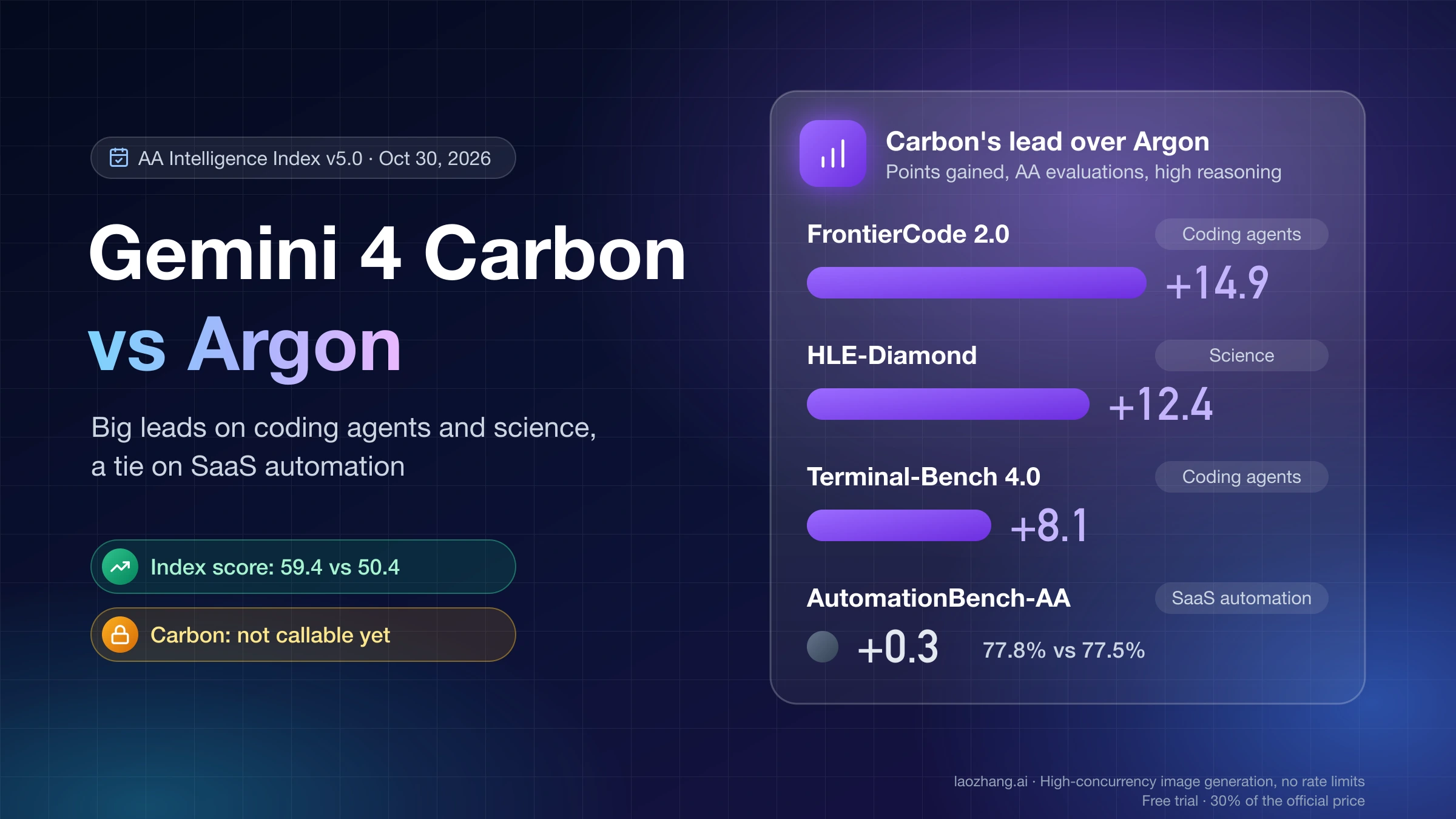
Gemini 4 Carbon is a real step up from Gemini 4 Argon, but the gain is uneven. On the Intelligence Index v5.0 from Artificial Analysis (AA), Carbon (high) scores 59.4 against 50.4 for Argon (high), and the gap is widest on agentic coding and science reasoning: FrontierCode 2.0 rises from 25.7% to 40.6%. On SaaS workflow automation the two are tied at 77.8% and 77.5%. Speed splits the same way. As of October 30, 2026, AA measures Carbon at 97.94 seconds to first token against 47.20 seconds for Argon, so a single reply starts about twice as late, yet in AA's coding-agent runs Carbon finishes a whole task in 29.8 minutes against Argon's 34.7, at $7.74 a task against $11.73 (AA's Gemini 4 Argon vs Carbon comparison, AA Coding Agent Index).
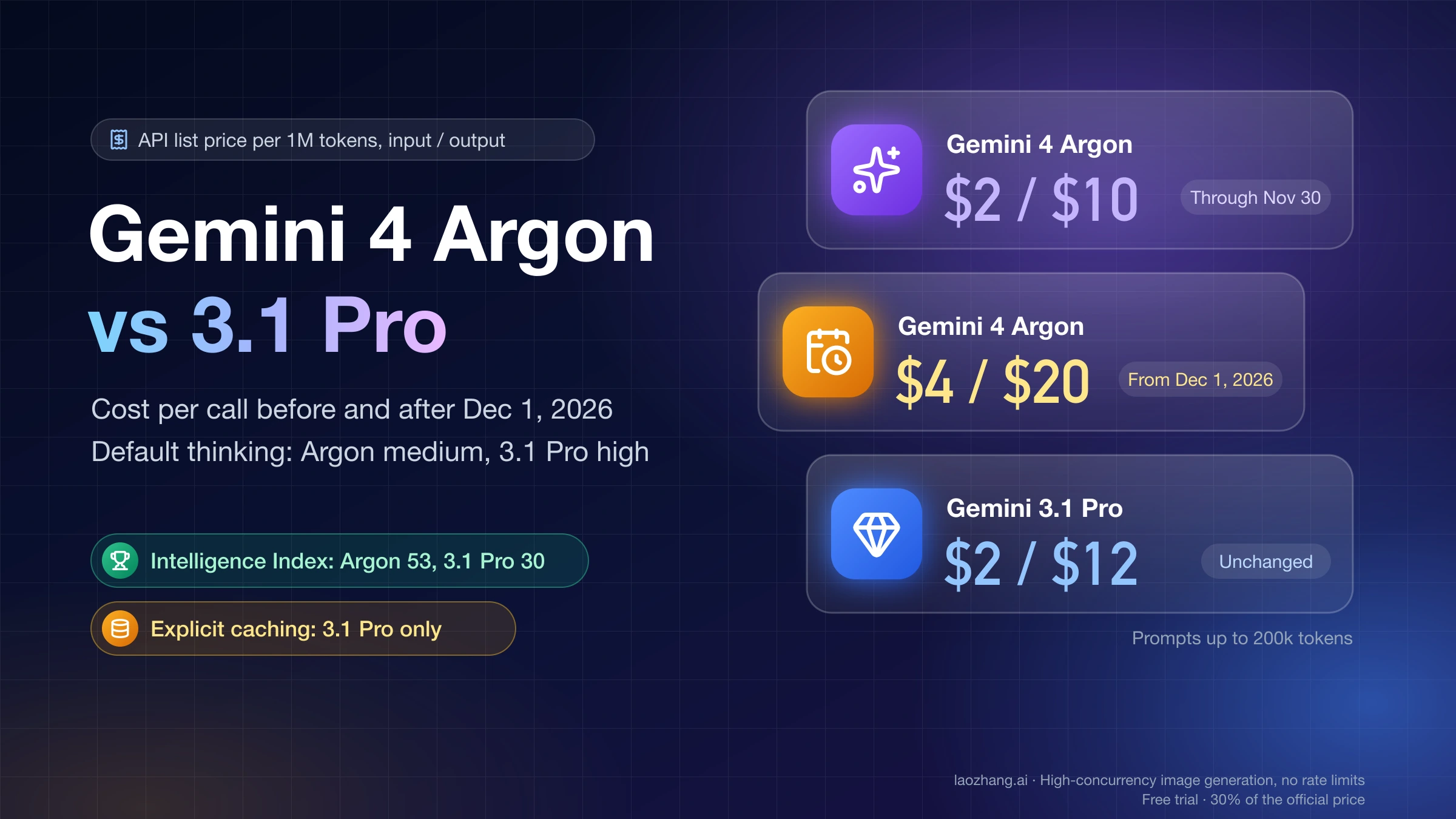
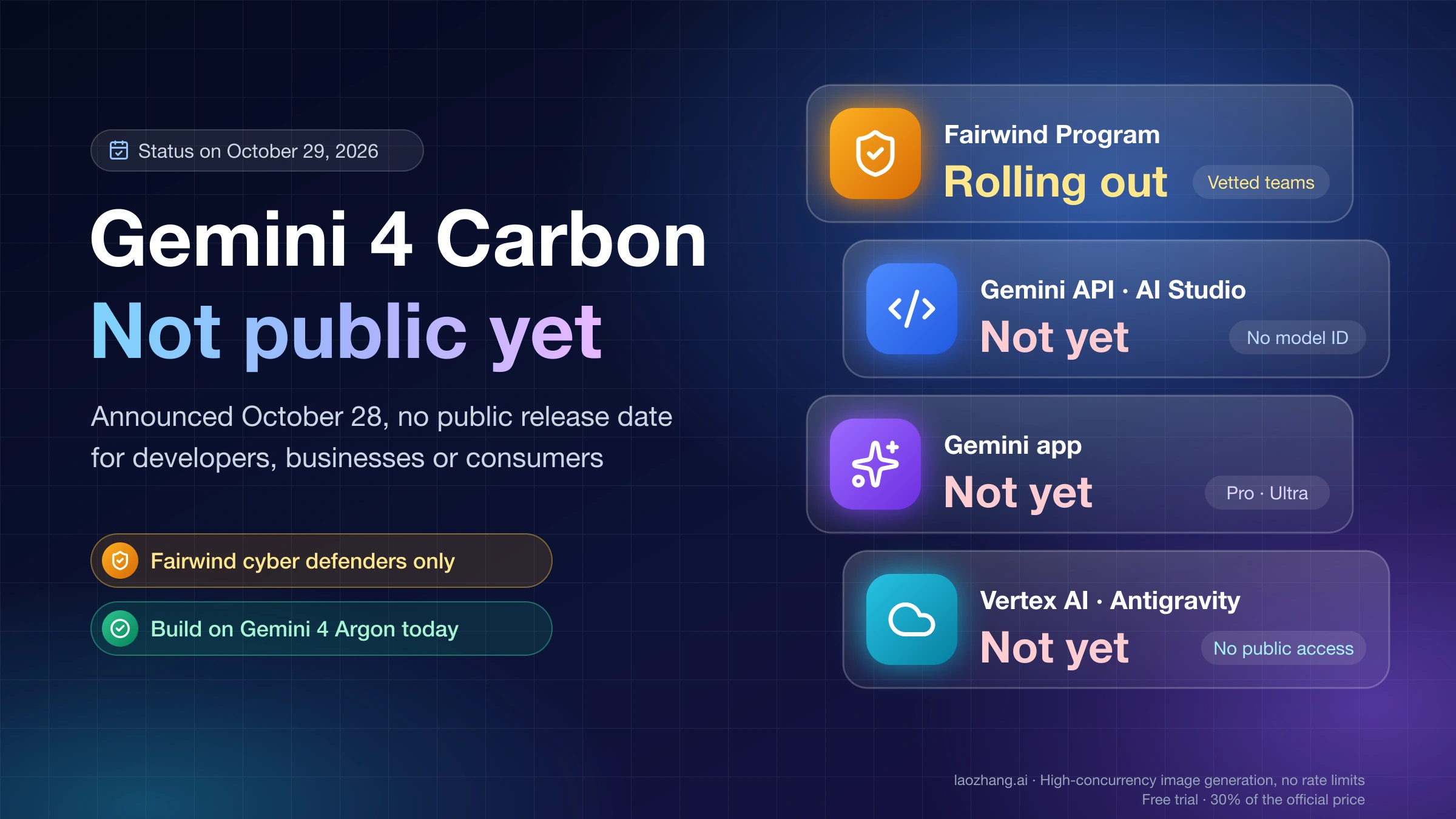
None of that changes what you ship this month, because Carbon can't be called yet. Google announced it on October 28, 2026 for a subset of cyber defenders, and a request for gemini-4-carbon on October 30 returned HTTP 503. Keep building on gemini-4-argon, keep the model ID in one config value so a switch is a one-line change, and budget for Argon's price doubling from $2/$10 to $4/$20 per million input/output tokens on December 1, 2026.
Whether to plan that switch depends on your work. Coding agents, long reasoning and document-heavy analysis are where Carbon earns it. SaaS automation gains almost nothing, interactive features would wait twice as long for the first token, and factual Q&A needs a test first because Carbon answers more questions it should decline.
Where Carbon beats Argon: nine AA evaluations by kind of work
Carbon scores higher than Argon on all nine evaluations in AA's Intelligence Index v5.0, but the margins run from 14.9 points down to 0.3, as of October 30, 2026. Google's Logan Kilpatrick called Carbon "a big jump over Argon", and that holds for agentic coding and science; on SaaS automation the two score the same. All of these results are at high reasoning, the only setting AA lists for either model, and AA ran Carbon on pre-release access.
| Kind of work | AA evaluation (what it tests) | Carbon (high) | Argon (high) | Gap |
|---|---|---|---|---|
| Coding agents | FrontierCode 2.0 (agentic software engineering in open-source repos) | 40.6% | 25.7% | +14.9 |
| Coding agents | Terminal-Bench 4.0 (terminal tasks) | 65.2% | 57.1% | +8.1 |
| Reasoning and science | HLE-Diamond (hard expert questions) | 69.1% | 56.7% | +12.4 |
| Reasoning and science | Terminal-Bench-Science | 64.8% | 52.9% | +11.9 |
| Reasoning and science | CritPt v2 Hard (physics) | 63.0% | 52.5% | +10.5 |
| Knowledge work | AA-Briefcase (agentic knowledge work, Elo) | 1,609 | 1,483 | +126 |
| Knowledge work | GDP.pdf (professional documents, all checks passed) | 28.4% | 21.8% | +6.6 |
| Factual knowledge | AA-Omniscience v1.1 (index) | 53.5 | 46.1 | +7.4 |
| SaaS automation | AutomationBench-AA (agentic SaaS workflows) | 77.8% | 77.5% | +0.3 |
| All nine | Intelligence Index v5.0 | 59.4 | 50.4 | +9.0 |
AA's capability indexes, which regroup the same results by profession, tell the same story more gently. Carbon gains 6.7 to 7.4 points in finance (62.6 vs 55.9), legal (62.0 vs 54.6), engineering (64.7 vs 57.3) and economics (61.0 vs 54.0), but only 3.7 in strategy and operations (60.9 vs 57.2); AA reports no healthcare score for Carbon yet. These are v5.0 numbers, so don't compare them with Index scores quoted before October 27, 2026, which come from the older v4.3.2.
Which Gemini 4 model to use for coding, research, documents and automation
Plan a Carbon trial first if you run coding agents or long reasoning jobs, test it on document work, and leave SaaS automation and latency-sensitive features on Argon. That rule rests on AA's high-reasoning results as of October 30, 2026, and your own task mix can move a case from one side to the other.
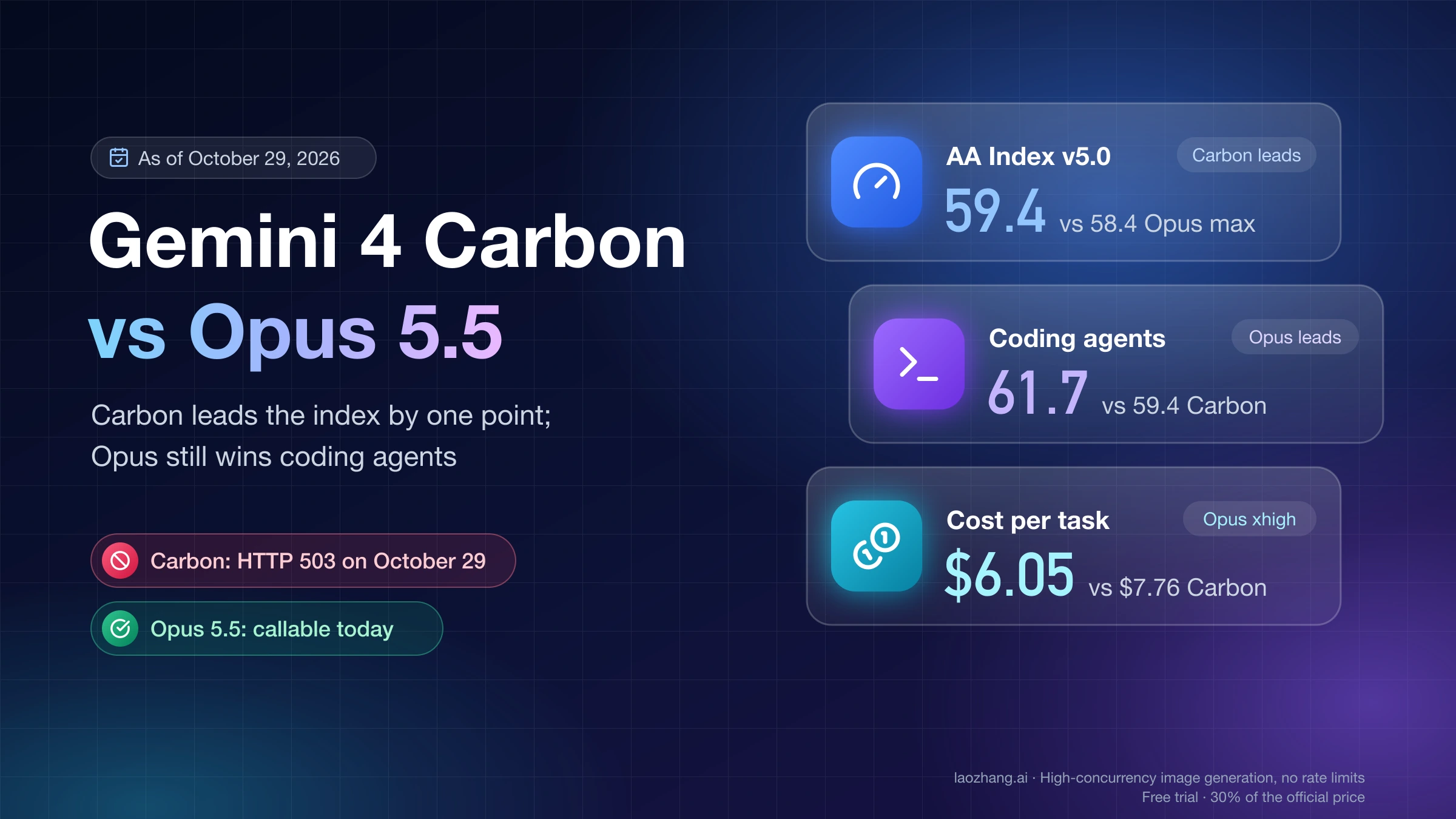
Coding agents are the strongest case for Carbon. Beyond the FrontierCode 2.0 and Terminal-Bench 4.0 gains, AA's Coding Agent Index, run in Google's Antigravity CLI, scores Carbon 59.4 against 53.2 for Argon, with SWE-Atlas QnA up from 55.1 to 63.7. Carbon also finished those tasks sooner and for less money, as the cost and speed sections below show. If you are weighing Carbon against Claude rather than against Argon, Claude Code with Opus 5.5 at max effort scores 61.7 on the same index, covered in Gemini 4 Carbon vs Opus 5.5: Opus Still Wins Coding Agents.
Reasoning and science work gains 10.5 to 12.4 points on HLE-Diamond, CritPt v2 Hard and Terminal-Bench-Science, so research assistants, analysis pipelines and anything that runs in the background are good candidates, because a longer wait for the first token rarely matters there. Document-heavy knowledge work sits in the middle. Carbon's AA-Briefcase lead of 126 Elo points is large, but on GDP.pdf neither model gets even a third of professional documents through every check, so a switch would reduce review work rather than remove it.
SaaS automation is where staying put costs you nothing. AutomationBench-AA moves by 0.3 points and strategy and operations shows the smallest capability gain, so for CRM updates, ticket routing or workflow glue the only reason to move would be price, which depends on Google's December dates. Interactive, low-latency features also belong on Argon, because Carbon starts each reply about twice as late; AA measured only the high setting, so whether lower thinking levels close that gap is unknown until Carbon opens. If even Argon is more model than such a feature needs, Gemini 4 Argon vs 3.8 Flash: Cost per Task and When to Switch covers the cheaper option. For factual Q&A, read the hallucination section before deciding.
If you need a flagship you can call today and Argon isn't it, Gemini 4 Argon vs Claude Opus 5.5 vs GPT-6.1 Sol: Cost and Access compares the three that are open.
Is Gemini 4 Carbon more expensive than Argon? It flips on December 1
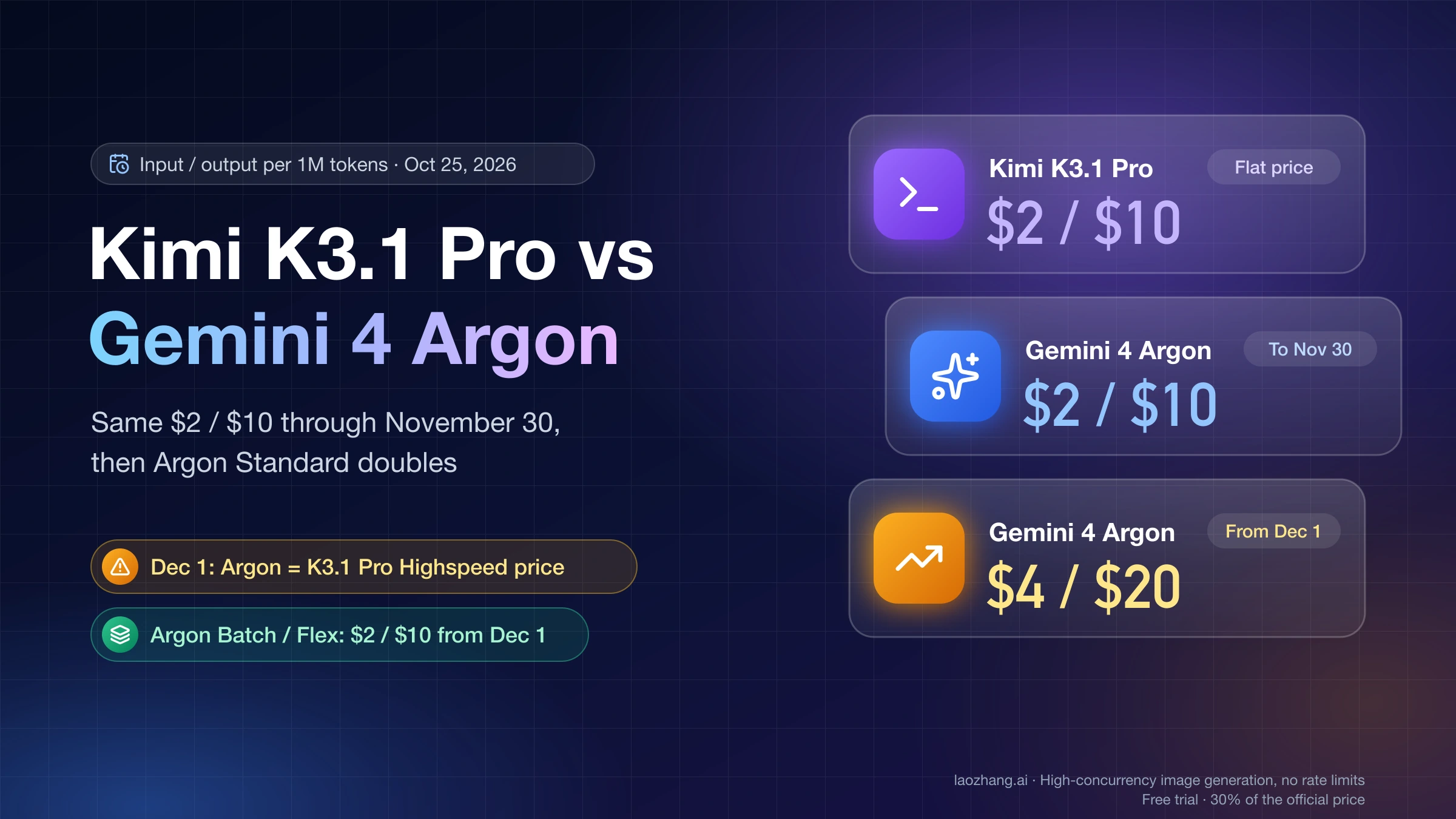
Per token, no. Google says Carbon will launch at Argon's introductory price of $2 per million input tokens and $10 per million output tokens, with cached input 95% off, and move to $4/$20 once its introductory period ends (Google's Gemini 4 Carbon announcement). What differs is the calendar. The Gemini API pricing page lists Argon's introductory rate through November 30, 2026 and the standard rate from December 1, while Google has published no end date for Carbon's introductory price; AA notes "no confirmed end date" as of October 30, 2026.
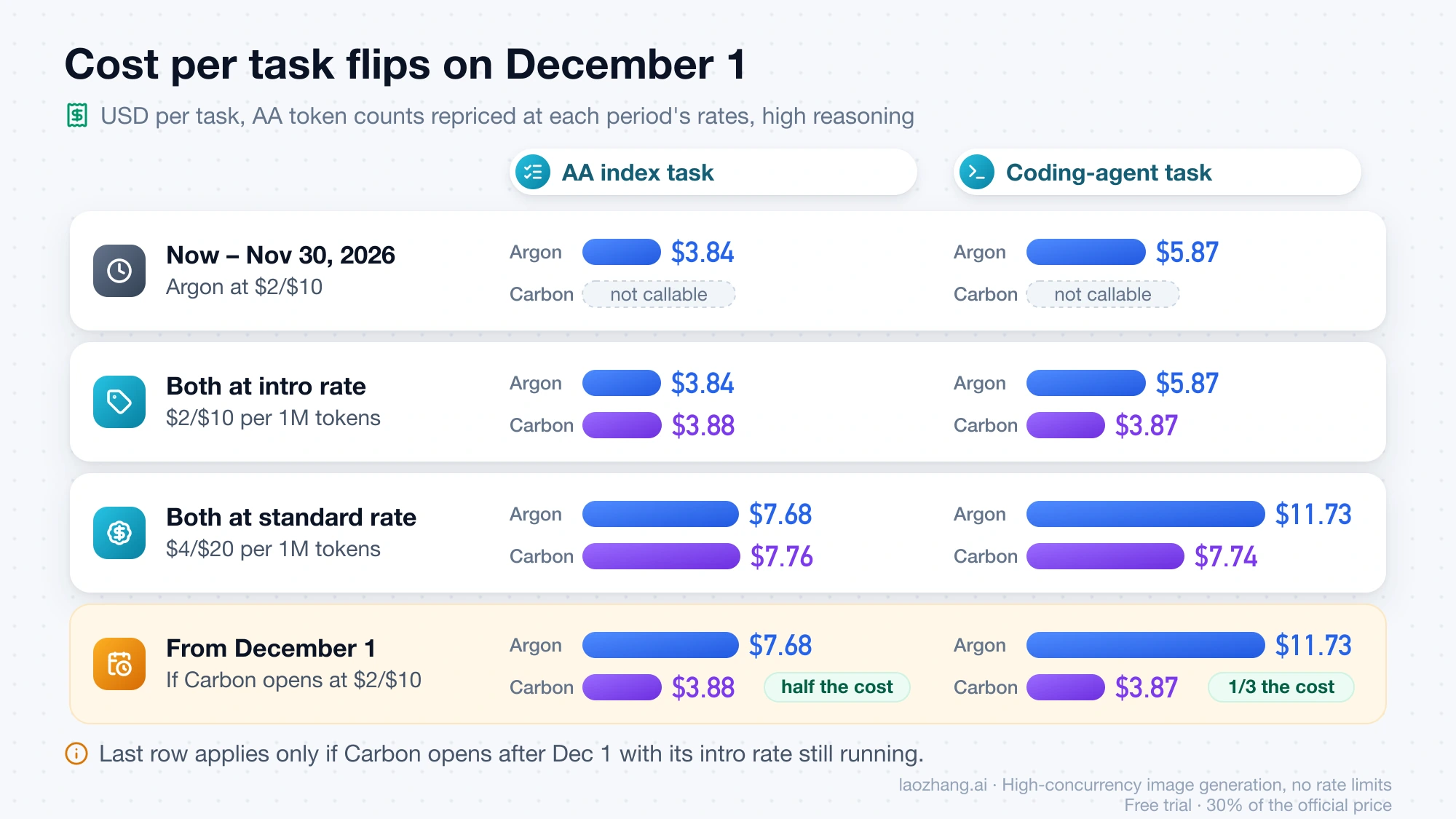
Per task, the result depends on which period you compare. The table below reprices the tokens each model used on AA's tasks at the high setting.
| Price period | Argon, AA index task | Carbon, AA index task | Argon, coding-agent task | Carbon, coding-agent task |
|---|---|---|---|---|
| Now through November 30, 2026 (Argon at $2/$10, Carbon not callable) | $3.84 | not callable | $5.87 | not callable |
| Both at the $2/$10 introductory rate | $3.84 | $3.88 | $5.87 | $3.87 |
| Both at the $4/$20 standard rate | $7.68 | $7.76 | $11.73 | $7.74 |
| From December 1, if Carbon opens while its introductory rate still runs | $7.68 | $3.88 | $11.73 | $3.87 |
At the same price, an AA index task costs about 1% more on Carbon, because Carbon writes slightly more output (122,768 tokens against 116,368). It also scores 9 points higher, so the cost per index point at standard rates is $0.131 for Carbon against $0.152 for Argon. On coding-agent tasks Carbon is a third cheaper at any matching price. The last row is conditional: if Carbon is open to developers after December 1 and still at its introductory rate, the same index task costs half as much on Carbon and a coding-agent task about a third as much. If Carbon's introductory period ends before it opens to developers, that row never happens and the standard row applies.
These per-task figures were recalculated on October 30, 2026 from AA's published cost components, which give the token counts per index task: Argon used 116,368 output tokens, 10.36 million cached input tokens and 0.82 million input tokens billed at the full rate; Carbon used 122,768, 10.20 million and 0.82 million. Cost per task is output tokens × output rate + cached tokens × cached rate + full-rate input × input rate. At standard rates that gives Argon $2.33 + $2.07 + $3.28 = $7.68 and Carbon $2.46 + $2.04 + $3.26 = $7.76, matching AA's own totals; halving every rate gives the introductory figures. The coding-agent column halves AA's standard-price cost per task for the introductory rows.
Carbon's lower coding-agent cost does not come from cheaper tokens. Both models wrote about 109,000 output tokens per task, but Carbon read 12.44 million input tokens against 13.76 million and hit the cache 95.2% of the time against 87.0%, which most likely explains most of the gap. Argon's Batch and Flex modes cost half the standard rate, which helps any job that can wait; Google has published no Batch, Flex or Priority prices for Carbon. How Gemini API billing works across those modes is covered in Gemini API Pricing 2026: Token Rates, Free Tier, and Key Cost.
Is Gemini 4 Carbon slower? 2x to first token, not 2–4x
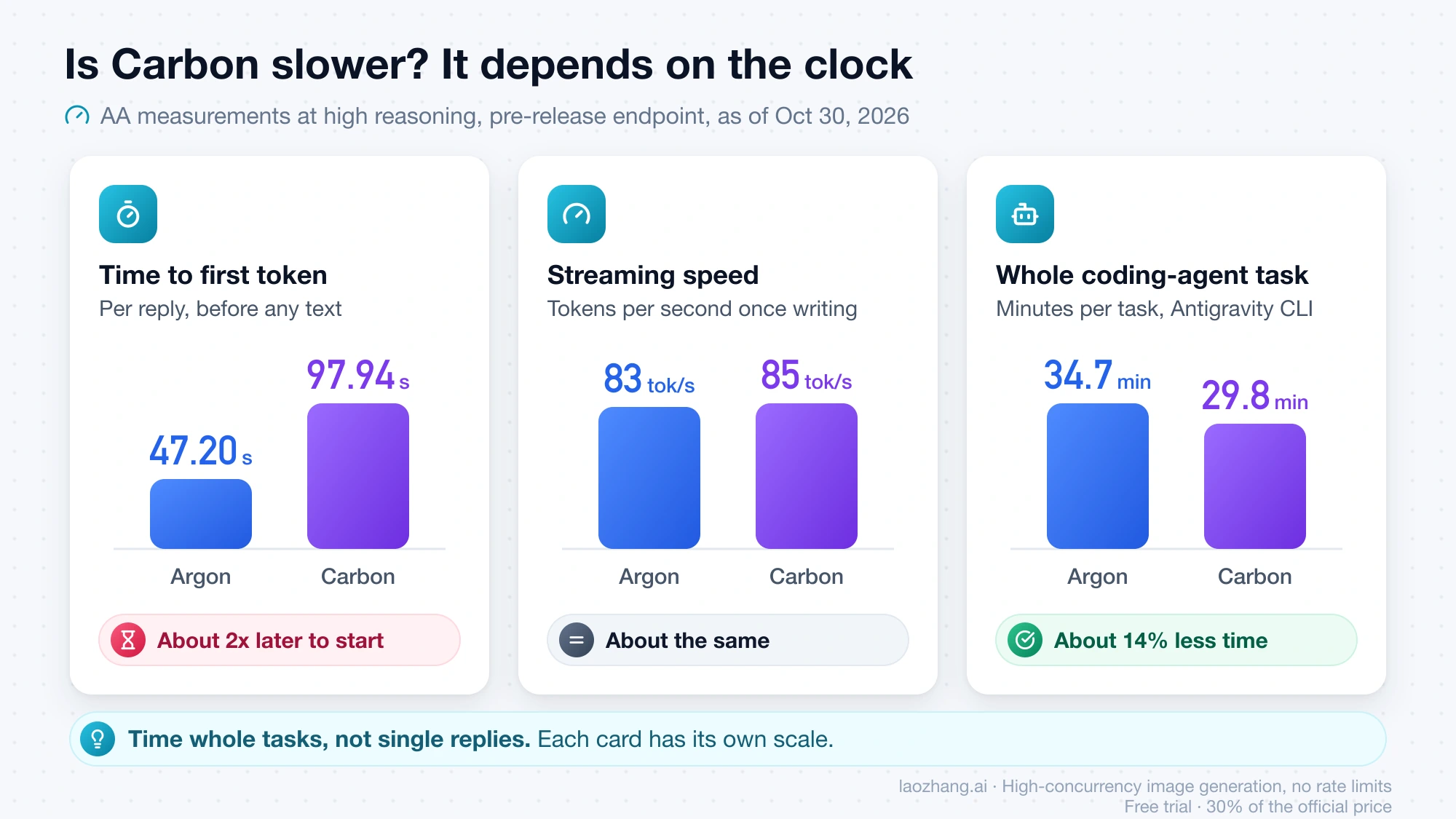
Carbon is slower to start, about as fast once it is writing, and faster over a whole coding-agent task. Those are three different clocks, and as of October 30, 2026 AA's measurements give three different answers.
To the first token, Carbon takes about twice as long: 97.94 seconds against 47.20 seconds for Argon at high reasoning, and 103.82 seconds against 53.23 seconds to finish a 500-token answer including thinking. Once it is writing, Carbon decodes at 85 tokens per second against 83 for Argon, so streaming speed is about the same. AA's speed figures move day to day; on October 29 the same page showed Carbon at 99.8 tokens per second. AA also reports a "time per task" of 1,452.93 seconds for Carbon against 1,364.94 for Argon, but that counts decode time only, excludes time to first token, and mostly reflects Carbon writing 123,000 output tokens per task against 116,000. It is not how long a task takes on the wall clock.
Over a whole coding-agent task, Carbon is faster. In AA's Coding Agent Index runs in Antigravity CLI, Carbon took 29.8 minutes per task against 34.7 for Argon, about 14% less, even though it took 178 steps against 166. Each call waits longer for its first token, so the per-reply numbers above can't predict how long an agent run takes; time whole tasks, not single replies.
The "2 to 4 times slower" figure comes from an October 28 article on letslearngenai, which cites reports from blind Arena testing of pre-release checkpoints and says complex jobs "approached 30 minutes"; the authors themselves call it early access and blind testing "rather than a standardized latency study" (letslearngenai's Gemini 4 Carbon vs Argon article). AA's measurements support about 2x to the first token, not 2–4x. All of these numbers come from AA's pre-release endpoint, so measure again when the public API opens.
Does Carbon hallucinate more? AA says 11.4% vs 4.3%, Google says less
On AA's knowledge test, yes, and in Google's internal tests of work products, no. Both can be true because they count different things. On AA-Omniscience v1.1, Carbon's accuracy rises from 48.3% to 58.3% and its hallucination rate from 4.3% to 11.4%, which still makes it the second-lowest of any model AA has measured, behind only Argon; Claude Opus 5.5 and GPT-6 Astra at max effort both sit around 50% (AA's Gemini 4 Carbon analysis, as of October 30, 2026).
AA's test asks factual questions and lets a model decline. Its index rewards correct answers, penalizes wrong ones, and doesn't penalize declining, so a model that attempts more questions gets more right and more wrong at the same time. That is what Carbon does compared with Argon. Google's claim is about something else: in its internal testing, Carbon "cuts unsupported claims by approximately 2x over Argon" and puts caveats into the deliverable or withholds a blocked action "rather than fabricating". That measures claims without support inside agent output, it is self-reported, and Google has not published the method.
So what to test depends on what you build. For a support bot, a compliance lookup or any feature where a wrong answer costs more than "I don't know", build a question set that includes questions your documents can't answer, and count correct, wrong and declined answers separately on both models; Argon's caution may be worth more than Carbon's extra correct answers. For agent deliverables such as reports or code reviews, check each factual claim against the source material, which is closer to what Google measured.
Google's own Carbon vs Argon numbers, including security tests
Google's announcement table shows Carbon ahead of Argon on every row, with its largest leads on security work. These are Google's own runs; Google says its cyber evaluations used the highest thinking level and were run "without guardrails", which mainly matters to security teams deciding whether to apply for early access.
| Google-reported test | Carbon | Argon |
|---|---|---|
| SEC-bench Pro (finding vulnerabilities) | 88.2% | 83.4% |
| ExploitGym (exploitation) | 54.8% | 42.0% |
| CWE-bench (patching) | 71.0% | 68.0% |
| Gray Swan indirect prompt injection, attack success (lower is better) | 0.0% | 0.7% |
| GraphWalks (long context) | 96.2% | 84.2% |
| OSWorld-2.1 offline (computer use) | 81.5% | 74.7% |
| Vals Index v2.2 | 70.4% | 69.2% |
The smallest gains in Google's table are Vals Index (+1.2) and CWE-bench (+3.0), and Google also describes a "strong uplift" in generating secure code on internal benchmarks, without publishing the numbers. Google's Terminal-Bench 4.0 result of 65.2% against 57.1% matches AA's own model run exactly; the 63.6% that appears in AA's Coding Agent Index comes from a different setup, with the model working inside Antigravity CLI.
Can you call gemini-4-carbon today? A dated API test
No, not through the gateway tested and not through any model ID Google has published. On October 30, 2026 at 00:12 UTC, a usage-billed key on api.laozhang.ai listed 192 models in GET /v1/models, and the only Gemini 4 ID among them was gemini-4-argon. Requests for gemini-4-carbon and gemini-4-carbon-preview through /v1/chat/completions, and for gemini-4-carbon through the native /v1beta/models/gemini-4-carbon:generateContent path, each came back HTTP 503 "no available channels" in about 1.1 seconds, and none was billed. The same requests on October 29 at 01:36 and 03:00 UTC gave the same result. laozhang.ai lists gemini-4-argon on both its Gemini-native and OpenAI-compatible endpoints.
Disclosure: laozhang.ai is our own service. Its prices are platform pricing, not an independent comparison.
That proves Carbon isn't routable through this gateway today. It does not test Google's own API with a Google key, but as of October 30, 2026 the Gemini API models page, pricing page and changelog list no Carbon model ID at all. Who can get Carbon, through which program and when it might open is tracked in Gemini 4 Carbon Release Date: Cyber Defenders Only for Now; if you work in security, the early-access route is explained in Gemini 3.8 Flash Cyber Access: A Fairwind Eligibility Guide.
How to set up Argon now so switching to Carbon is one change
Build on gemini-4-argon as if the switch will happen, so that the day Carbon opens costs you an afternoon of testing rather than a refactor. In order:
- Put the model ID in one config value or environment variable that every service reads, and log it with each request, so a switch and its rollback are both a one-line change.
- Budget for December 1, 2026, when Argon's standard rate takes effect and every Argon task costs twice as much. Move jobs that can wait to Batch or Flex, which stay at half the standard rate.
- Build a small evaluation set on Argon now: a handful of your own coding or document tasks with a pass check, factual questions that include ones the model should decline, and timings for both first token and full task.
- On Carbon's first public day, read its model ID, its introductory end date and its Batch and Flex prices, then run the same set and compare cost per accepted task, time to first token, full-task time, and wrong versus declined answers before moving any traffic.
Long Argon outputs in the API have their own quirks, covered in Gemini 4 Argon API finish_reason: CONTINUATION and Empty Replies, and the same handling is worth keeping in place for Carbon.
Gemini 4 Carbon and Argon: other questions
Does Gemini 4 Carbon have a bigger context window than Argon?
Google hasn't said. As of October 30, 2026, the Gemini API models page gives Argon a 1M-token context window with long outputs up to 1M tokens, and lists no specifications for Carbon. AA's listing shows a 1M context window for both and more input types for Carbon (text, image, speech and video against text and image for Argon), but that is AA's listing, not a Google specification, so treat any context or modality difference as unconfirmed until Carbon's model page exists.
Is Gemini 4 Carbon replacing Gemini 4 Argon?
Google hasn't announced retiring or replacing Argon. Its October 28, 2026 announcement describes Carbon as "building on Gemini 4 Argon, which was launched two weeks ago", and forum descriptions of Carbon as a quick checkpoint of Argon are opinion, not something Google has said. Plan for both to exist until Google publishes a deprecation date.
Can I use Gemini 4 Argon in the Gemini app instead of the API?
Yes, on Google AI Pro or Ultra. As of October 30, 2026, Google's AI Studio subscription plans page says Argon is not available on the Free plan, Pro gives a higher quota with Argon included and Ultra the highest, and that subscription is separate from Gemini API usage, so API calls are never covered by the plan. Argon has also been in the Gemini app on Pro and Ultra since it became generally available on October 13, 2026, and Google publishes no prompt counts for either surface. Plan-by-plan reset times and API credits are covered in Gemini 4 Argon Usage Limits: Pro vs Ultra, Resets, API Credits. Carbon is in none of these surfaces as of October 30, 2026.
Sources8
External pages this guide links to, in the order they appear. Last updated Oct 30, 2026.
Sources8
External pages this guide links to, in the order they appear. Last updated Oct 30, 2026.
- 1.AA's Gemini 4 Argon vs Carbon comparisonartificialanalysis.ai/models/comparisons/gemini-4-argon-vs-gemini-4-carbon
- 2.AA Coding Agent Indexartificialanalysis.ai/agents/coding-agents
- 3.Google's Gemini 4 Carbon announcementblog.google/innovation-and-ai/models-and-research/gemini-models/introducing-gemini-4-carbon
- 4.Gemini API pricing pageai.google.dev/gemini-api/docs/pricing
- 5.letslearngenai's Gemini 4 Carbon vs Argon articleletslearngenai.com/articles/gemini-4-carbon-vs-gemini-4-argon-a-faster-flagship-becomes-a-harder-working-one-2026-10-28
- 6.AA's Gemini 4 Carbon analysisartificialanalysis.ai/articles/gemini-4-carbon-new-number-1
- 7.Gemini API models pageai.google.dev/gemini-api/docs/models
- 8.AI Studio subscription plans pageai.google.dev/gemini-api/docs/google-ai-plans