Gemini 4 Argon vs 3.1 Pro: Cost Test Before and After Dec 1
Each at its default thinking, Gemini 4 Argon cost 57% less than 3.1 Pro on five test calls through Nov 30, 2026, and 14% less from Dec 1. Hard tasks cost more.
On this page
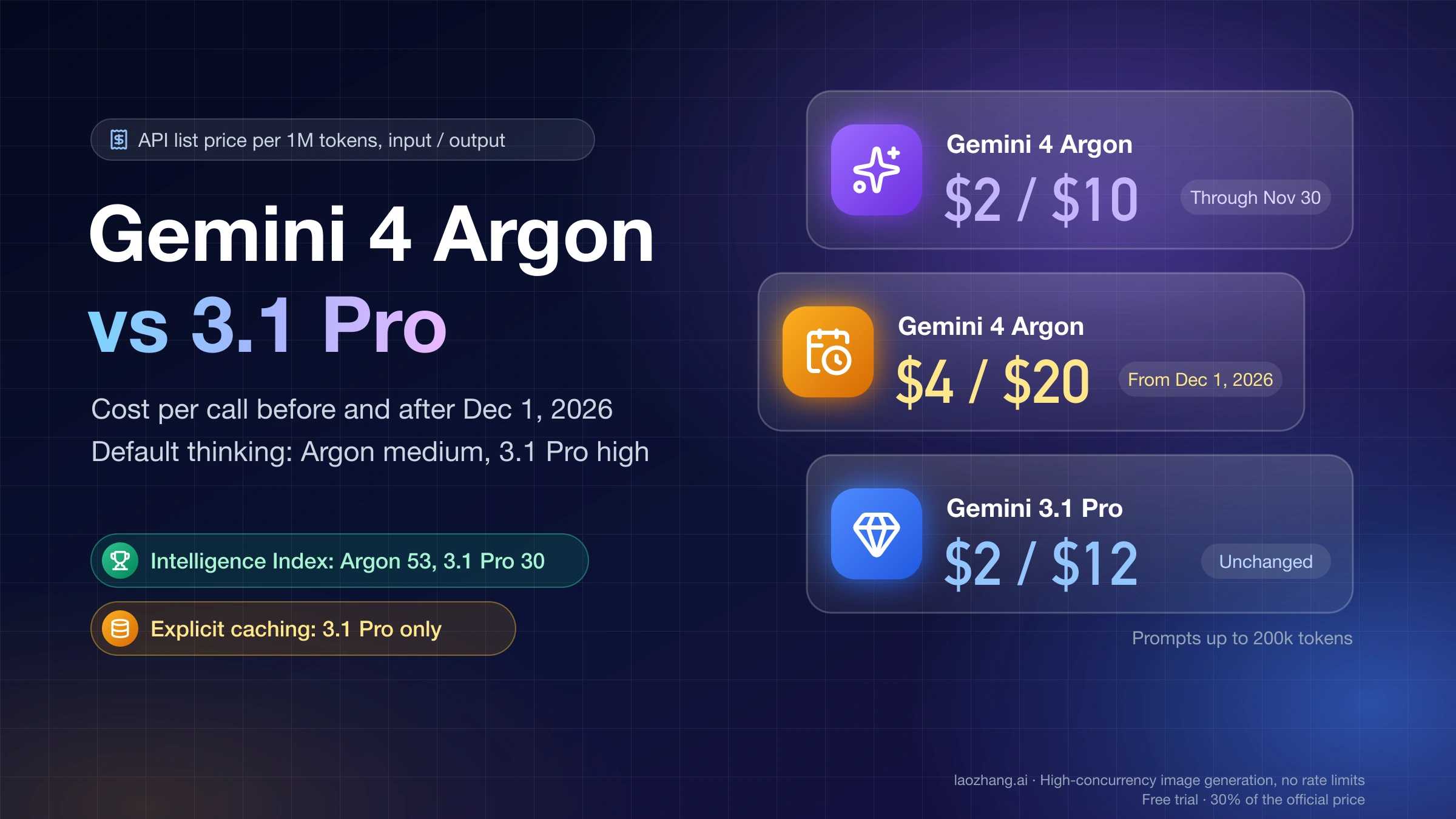
Gemini 4 Argon is the stronger model, and through November 30, 2026 it also costs less per output token than Gemini 3.1 Pro: $2 per million input tokens and $10 per million output tokens, against $2 and $12 for 3.1 Pro on prompts up to 200k tokens. On December 1, 2026, Argon's list price doubles to $4 and $20, and 3.1 Pro's stays the same. After that date, whether Argon costs you more or less depends mostly on how many thinking tokens each model spends on your calls.
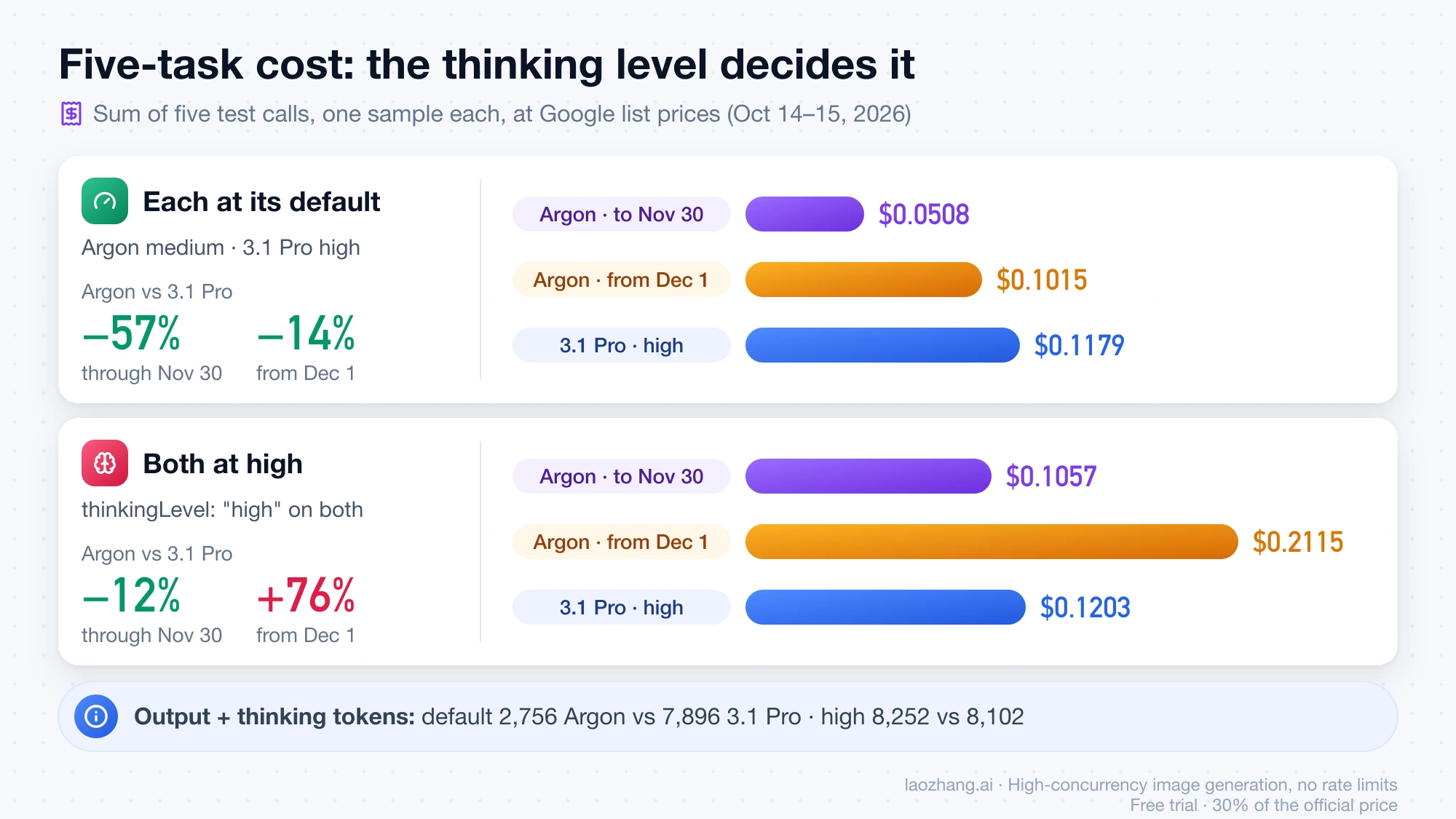
The two models don't think the same amount by default. 3.1 Pro defaults to high thinking and Argon to medium. In a same-prompt test of five everyday tasks, with each model left at its default, Argon cost $0.0508 at the price through November 30 and $0.1015 at the December 1 price, against $0.1179 for 3.1 Pro: 57% less now, 14% less from December 1. With both set to high thinking, Argon cost 12% less now and 76% more from December 1. On hard multi-step work the balance tips earlier. Artificial Analysis reports a cost of $1.99 per Intelligence Index task for Argon at high thinking and $1.30 for 3.1 Pro, at Argon's introductory price, and Argon scored 53 to 3.1 Pro's 30.
The short version:
- Hard reasoning, agentic coding, document work where mistakes are costly: switch to Argon and set the thinking level yourself. Going by those Artificial Analysis figures for Argon at high, budget about 1.5x what 3.1 Pro costs per hard task through November 30, and about 3x from December 1 if Argon's token use stays the same.
- High-volume easy calls: Argon at its default is cheaper through November 30. At December 1 prices it still came out cheaper on the short test prompts, but dearer on the long document, because its input price becomes $4 against 3.1 Pro's $2.
- Keep 3.1 Pro for long-input, short-output calls after December 1, and for anything built on explicit context caching, which Argon doesn't support.
- In the Gemini app: Google AI Pro and Ultra subscribers can pick Argon. Google AI Plus and free accounts can't.
Gemini 4 Argon vs 3.1 Pro API prices: $2/$10 now, $4/$20 from Dec 1
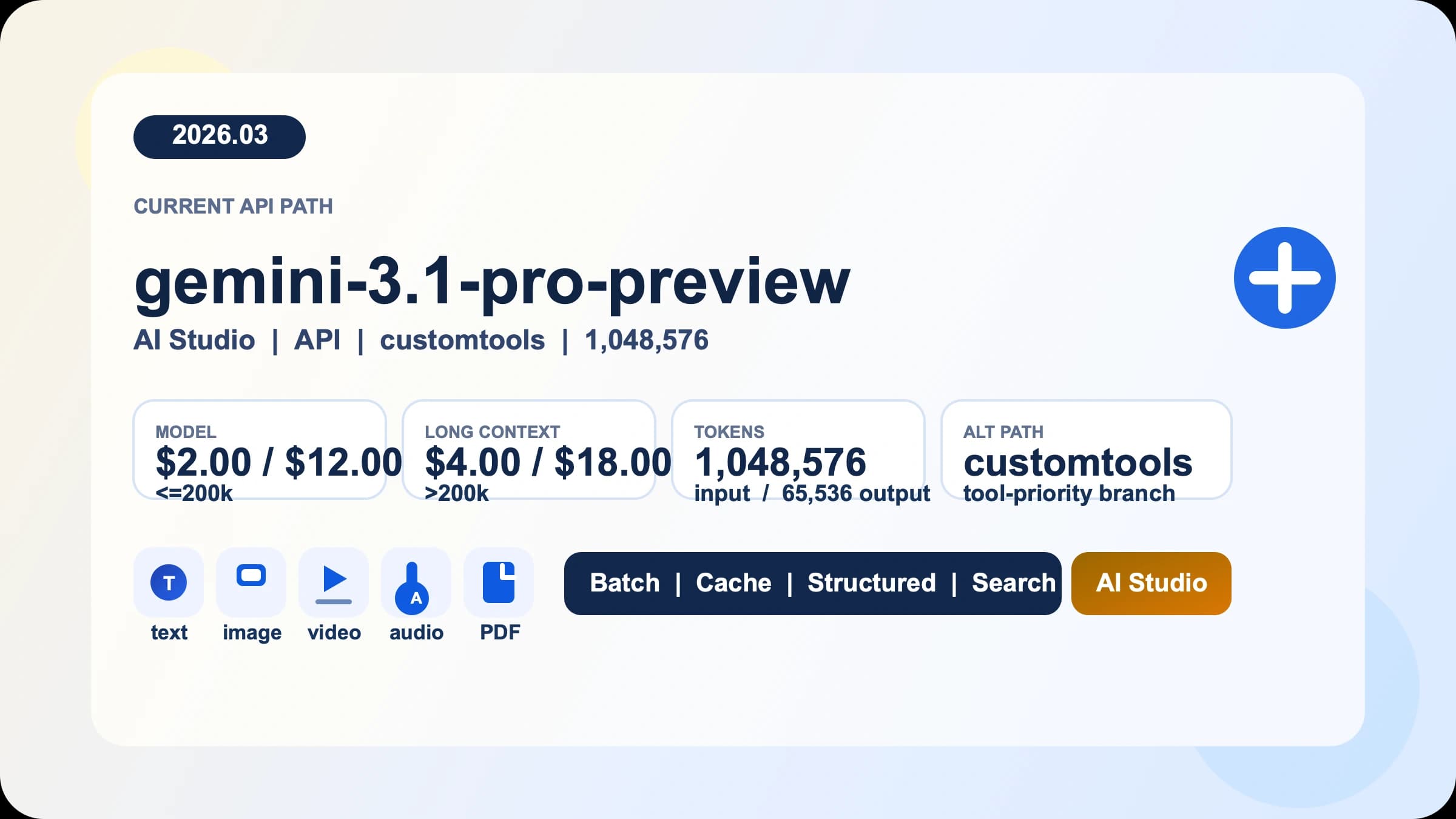
Argon is cheaper per output token than 3.1 Pro until November 30, 2026, and dearer per token on both input and output from December 1, for prompts up to 200k tokens. Above 200k tokens, 3.1 Pro moves to a higher price tier and Argon doesn't, so the comparison changes. These are the paid-tier rates on Google's Gemini API pricing page, last updated October 14, 2026. Neither model has a free API tier.
| Per 1M tokens, Standard | Gemini 4 Argon through Nov 30, 2026 | Gemini 4 Argon from Dec 1, 2026 | Gemini 3.1 Pro |
|---|---|---|---|
| Input, prompts ≤200k tokens | $2.00 | $4.00 | $2.00 |
| Input, prompts >200k tokens | $2.00 | $4.00 | $4.00 |
| Output incl. thinking, prompts ≤200k | $10.00 | $20.00 | $12.00 |
| Output incl. thinking, prompts >200k | $10.00 | $20.00 | $18.00 |
| Cached input | $0.10 (implicit only) | $0.20 (implicit only) | $0.20 / $0.40, plus $4.50 per 1M tokens per hour of storage |
| Batch and Flex, input / output | $1 / $5 | $2 / $10 | $1 / $6 (≤200k), $2 / $9 (>200k) |
| Priority, input / output | $3.60 / $18 | $7.20 / $36 | $3.60 / $21.60 (≤200k), $7.20 / $32.40 (>200k) |
Thinking tokens are billed as output on both models. Grounding with Google Search gives 5,000 free requests a month shared across Gemini 3 and newer models, then $14 per 1,000 requests, the same for both.
Because the input price is the same through November 30, a simple rule falls out of these rates for prompts up to 200k tokens. Argon costs $2 × input + $10 × output, and 3.1 Pro costs $2 × input + $12 × output, so Argon is cheaper on any call where it produces no more than 1.2 times the output and thinking tokens 3.1 Pro produces for the same request.
From December 1 the rule gets tighter. Argon costs $4 × input + $20 × output, so it is cheaper only when its output and thinking tokens stay below 0.6 × 3.1 Pro's output and thinking tokens − 0.1 × input tokens. Long inputs eat into that margin quickly. On an 11,100-token document, the input term alone removes about 1,110 tokens of headroom.
Above 200k-token prompts, Argon is cheaper on both input and output through November 30. From December 1 both charge $4 for input, and Argon's $20 output price is $2 above 3.1 Pro's $18, so Argon needs to produce under 0.9 times 3.1 Pro's output tokens to come out ahead.
The model-by-model rates for the rest of Google's lineup, Argon included, are in Gemini API Pricing 2026: Token Rates, Free Tier, and Key Cost.
Same-prompt test of Gemini 4 Argon and 3.1 Pro: 12 calls each, one sample
Twelve identical requests went to each model through LaoZhang API's Gemini-native generateContent endpoint (laozhang.ai): gemini-4-argon on October 14, 2026 and gemini-3.1-pro-preview on October 15, 2026. Every 3.1 Pro response reported modelVersion: "gemini-3.1-pro-preview". The prompts, chat history and long document were byte-for-byte the same.
Disclosure: laozhang.ai is our own service. Its prices are platform pricing, not an independent comparison.
The five tasks:
- A one-line email subject telling a team that Thursday's meeting moves to Friday at 10am.
- A word problem: pens come in 6-packs for $4.50 and 10-packs for $7.00, and you need at least 58 pens at the lowest cost.
- A Python
merge_intervalsfunction with type hints, a docstring and six pytest tests. - An 8-bullet summary of a 6,723-word article, plus three claims worth checking.
- The third turn of a Lisbon trip-planning chat, turning the plan into a table with a daily budget in euros.
Each task ran at the model's default thinking level and again at thinkingLevel: "high". The coding task also ran at low and medium.
What the test does not cover:
- One sample per prompt and level, no reruns. A second run could produce different token counts.
- Different days. The Argon calls ran a day before the 3.1 Pro calls.
- One endpoint. Google's own endpoint wasn't tested, so thinking-token reporting and speed there may differ.
- Short single calls only. No agentic sessions, tool loops or long outputs.
- Partial grading. Correctness is known only for the word problem and the code. The subject line, summary and trip plan have no grade.
Costs below are calculated from the token counts each response reported, at Google's list prices: Argon $2/$10 through November 30 and $4/$20 from December 1, 3.1 Pro $2/$12. They are not billing statements.
| Task and thinking setting | Argon tokens in / thinking / out | 3.1 Pro tokens in / thinking / out | Argon cost through Nov 30 | Argon cost from Dec 1 | 3.1 Pro cost |
|---|---|---|---|---|---|
| Subject line, default | 53 / 0 / 98 | 22 / 410 / 75 | $0.0011 | $0.0022 | $0.0059 |
| Subject line, high | 53 / 646 / 126 | 22 / 459 / 90 | $0.0078 | $0.0157 | $0.0066 |
| Word problem, default | 92 / 0 / 337 | 61 / 1,620 / 289 | $0.0036 | $0.0071 | $0.0230 |
| Word problem, high | 92 / 1,057 / 279 | 61 / 1,499 / 295 | $0.0135 | $0.0271 | $0.0217 |
| Coding, default | 91 / 0 / 498 | 61 / 919 / 521 | $0.0052 | $0.0103 | $0.0174 |
| Coding, low | 91 / 0 / 542 | 61 / 606 / 482 | $0.0056 | $0.0112 | $0.0132 |
| Coding, medium | 91 / 0 / 541 | 61 / 799 / 513 | $0.0056 | $0.0112 | $0.0159 |
| Coding, high | 91 / 1,343 / 567 | 61 / 1,141 / 584 | $0.0193 | $0.0386 | $0.0208 |
| Document summary, default | 11,102 / 0 / 1,082 | 11,191 / 1,421 / 712 | $0.0330 | $0.0660 | $0.0480 |
| Document summary, high | 11,102 / 1,461 / 1,199 | 11,191 / 1,450 / 710 | $0.0488 | $0.0976 | $0.0483 |
| Trip-plan chat, default | 267 / 0 / 741 | 218 / 1,172 / 757 | $0.0079 | $0.0159 | $0.0236 |
| Trip-plan chat, high | 267 / 808 / 766 | 218 / 1,047 / 827 | $0.0163 | $0.0325 | $0.0229 |
| All 12 calls | $0.1677 | $0.3354 | $0.2672 |
"Default" means each model's own default: medium for Argon, high for 3.1 Pro. One sample per row, October 14 for Argon and October 15, 2026 for 3.1 Pro.
The two models count the same text slightly differently. Short prompts came out about 30 tokens longer on Argon, and the long document 89 tokens shorter. At these prices that difference changes the cost by a fraction of a cent.
Which is cheaper per call? The default thinking level decides it
Over the five tasks, the default thinking level drives more of the cost difference than the per-token price. Left at their defaults, 3.1 Pro produced 7,896 output and thinking tokens and Argon 2,756, about a third as many. At high thinking the totals were almost equal: 8,102 for 3.1 Pro and 8,252 for Argon.
| Sum of the five tasks | Argon through Nov 30 | Argon from Dec 1 | 3.1 Pro | Argon vs 3.1 Pro |
|---|---|---|---|---|
| Each model at its default (Argon medium, 3.1 Pro high) | $0.0508 | $0.1015 | $0.1179 | −57% through Nov 30, −14% from Dec 1 |
Both at thinkingLevel: "high" | $0.1057 | $0.2115 | $0.1203 | −12% through Nov 30, +76% from Dec 1 |
The thinking counts explain the split. 3.1 Pro reported between 410 and 1,620 thinking tokens on every call, including at low. Argon reported no thinking tokens at default, low or medium, and between 646 and 1,461 at high. Whether Argon really skipped thinking at medium or the endpoint left the count out isn't something the usage data can show. In every Argon response, the reported total equaled the prompt tokens plus output tokens exactly, so no unreported tokens appear in the usage totals. If your own Argon calls at medium do report thinking tokens, expect your costs to land between the default row and the high row.
Turning 3.1 Pro down to low doesn't close the gap on this sample. The coding task at low still used 606 thinking tokens and cost $0.0132 on 3.1 Pro, against $0.0056 for Argon at low through November 30 and $0.0112 from December 1.
Per task, at high thinking and through November 30, Argon was cheaper on the word problem ($0.0135 vs $0.0217), the coding task ($0.0193 vs $0.0208) and the trip-plan chat ($0.0163 vs $0.0229). It was dearer on the subject line ($0.0078 vs $0.0066) and about even on the document summary ($0.0488 vs $0.0483). From December 1, Argon at high was dearer on all five.
At each model's default and from December 1, Argon was cheaper on four tasks and dearer on one: the document summary, $0.0660 against $0.0480. That is the long-input case from the pricing rule above. The input alone is about 11,100 tokens, which costs about $0.044 on Argon at $4 per million and about $0.022 on 3.1 Pro at $2.
Per-call amounts this small only matter at volume. As a calculation, not a measurement, 100,000 calls a month split evenly across the five test tasks at each model's default would cost about $1,015 on Argon through November 30, $2,031 on Argon from December 1, and $2,357 on 3.1 Pro.
Did the cheaper calls give worse answers?
Not on the two tasks with a right answer to compare against. Both models solved the word problem correctly at every thinking level: four 10-packs and three 6-packs for $41.50. The code from all eight coding responses, four thinking levels on each model, passed all six of its own pytest tests when run.
These were easy tasks, so they show that Argon's lower default spend didn't break simple work. They don't show which model is smarter. The hard-task evidence is in the next section.
Speed, from single samples on one endpoint: Argon at its default took 5.5–14.2 seconds per task and 3.1 Pro at its default 9.5–27.6 seconds. At high thinking the ranges overlapped, 9.5–31.0 seconds for Argon and 10.9–28.3 seconds for 3.1 Pro. Speed depends on the day and the endpoint, so treat this as a rough indication only.
Is Gemini 4 Argon better than 3.1 Pro? Intelligence Index 53 vs 30
On hard tasks, yes. All three third-party comparisons below put Argon well ahead as of October 15, 2026. It also spends more per hard task, because it writes many more tokens.
- Artificial Analysis Intelligence Index: Gemini 4 Argon (High) scores 53 and ranks 8th of 216 models. Gemini 3.1 Pro Preview scores 30 and ranks 96th. Argon at high produced 110 million output tokens across the index, against 67 million for 3.1 Pro.
- Box AI Complex Work eval: Box CEO Aaron Levie wrote on X on October 13, 2026 that Argon jumped "14 percentage points across all our tests" over 3.1 Pro. His examples: +18 points in financial services, +25 in healthcare and +37 in technology. In the financial case, 3.1 Pro "folded the interest into a single figure." In the healthcare case, only Argon removed the interacting drugs from its final regimen. Box hasn't published the eval method.
- BenchLM shared benchmarks: the BenchLM comparison of Gemini 3.1 Pro and Gemini 4 Argon lists Vibe Code Bench at 91.90% vs 32.03%, PostTrainBench v1.1 at 45.3% vs 22.0%, FrontierMath v2 tiers 1–3 at 86.0% vs 59.6%, and tier 4 at 78.0% vs 26.8%, Argon first.
Google itself hasn't published a head-to-head benchmark table. The Gemini 4 Argon model card compares Argon's benchmarks with GPT-6 Astra, Claude Fable 5.1 and Claude Opus 5.5, and compares it with 3.1 Pro only on safety. There Argon makes 9.60 percentage points fewer unjustified refusals and does better on image-to-text and multilingual safety, and scores 1.57 points worse on text-to-text safety, within confidence intervals.
What a hard task costs on Argon vs 3.1 Pro
Artificial Analysis reports a cost of $1.99 per Intelligence Index task for Argon at high thinking and $1.30 for 3.1 Pro Preview, which it lists without a separate thinking label. The Argon figure uses the introductory $2/$10 price. That is about 53% more for Argon through November 30. If Argon's token use stays the same and its price doubles on December 1, the same task works out to about $3.98, roughly three times 3.1 Pro. That is a calculation; Artificial Analysis may re-measure.
This doesn't contradict the same-prompt test. On short tasks Argon at its default wrote few tokens. On hard benchmark tasks at high thinking it wrote about 1.6 times as many tokens as 3.1 Pro, and the per-token saving disappears.
Not everyone is convinced. A Reddit thread in r/GeminiAI titled "Argon vs 3.1 Pro" from October 14, 2026 includes the comment "Gemini 4 Argon isn't a good model and isn't leading." Opinions like that aren't measurements, so run your own hard prompts before you move a production workload.
For Argon against other vendors' flagships, see Gemini 4 Argon vs Claude Opus 5.5 vs GPT-6.1 Sol: Cost and Access.
Keep 3.1 Pro, switch to Argon, or split calls: a decision rule
Choose per workload, not per account. The model ID is a per-request setting, so you can send different calls to different models.
| Your calls | Through Nov 30, 2026 | From Dec 1, 2026 |
|---|---|---|
| Hard reasoning, multi-step coding, high-stakes document analysis | Argon at high. Expect about 1.5x 3.1 Pro's cost per hard task | Argon at high if the quality gain is worth about 3x the cost. Otherwise keep 3.1 Pro |
| Short, easy, high-volume calls (classification, short replies, simple code) | Argon at its default. It was 57% cheaper over the five test tasks | Argon at its default was still 14% cheaper over the five tasks. Recheck with your own prompts |
| Long input, short output (summaries, extraction over large documents) | Argon. Same $2 input, cheaper output | 3.1 Pro. Argon's input becomes $4 against $2 |
| Prompts over 200k tokens | Argon. Cheaper on both input and output | Close. Both charge $4 input, and Argon's output is $20 against $18 |
| Pipelines built on explicit context caching | 3.1 Pro, or move to implicit caching on Argon | Same |
| Anything that must not change behavior before you have evaluated it | Stay on 3.1 Pro. No shutdown date is announced | Same |
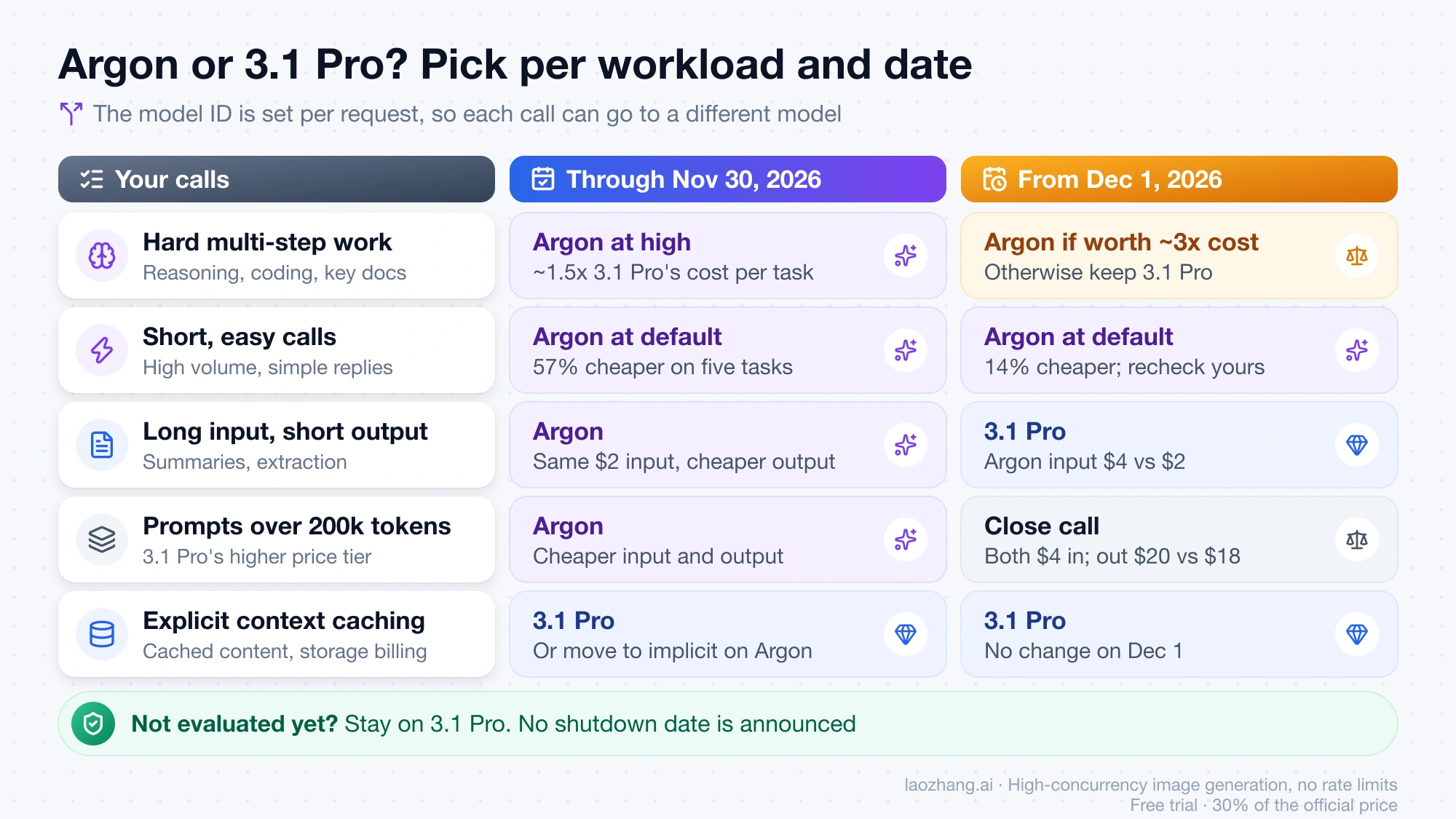
One workable split: hard calls on Argon at an explicit thinking level, cheap bulk calls on whichever model your own token counts favor, and long-document calls on 3.1 Pro from December 1. Re-measure the bulk calls after December 1, because the margin for Argon at its default becomes thin.
Gemini 4 Argon vs 3.1 Pro specs: same 1M context, different defaults
On paper the two models accept the same inputs and the same 1,048,576-token context. The differences that affect your code are the thinking default, caching and how the output limit works. These come from Google's Gemini 4 Argon model page, Gemini 3.1 Pro Preview model page, thinking guide and deprecations page.
| Gemini 4 Argon | Gemini 3.1 Pro | |
|---|---|---|
| Model ID | gemini-4-argon | gemini-3.1-pro-preview |
| Status | Stable | Preview, released February 19, 2026. No shutdown date announced |
| Context window | 1,048,576 tokens, unified input and output | 1,048,576 input tokens |
| Output limit | 65,536 tokens by default; up to 1,048,576 with long decode | 65,536 tokens |
| Input types | Text, image, video, audio, PDF | Text, image, video, audio, PDF |
| Thinking levels and default | Low, medium, high. Default: medium | Low, medium, high. Default: high |
| Context caching | Implicit only. Explicit caching not supported | Supported, including explicit caching with storage billing |
| Computer use | Supported (Preview) | Not listed |
| Live API, audio or image generation | No | No |
The "1M output" figure quoted for Argon refers to long decode. In a default synchronous call, both models stop at 65,536 output tokens. On Argon, a long output also counts against the same 1,048,576-token window as the input.
Gemini 3.1 Pro is not labeled "legacy" by Google. As of the deprecations page's October 12, 2026 update, it is still a Preview model with "No shutdown date announced", and it is still listed as the replacement for the retired gemini-3-pro-preview. Preview models can be given a shutdown date later, so watch that page if you stay on it.
Switching to gemini-4-argon: thinking, caching and output limits
Changing the model ID is enough to get a response, but four other things change with it.
- Set the thinking level explicitly. Code that never sets it gets high thinking on 3.1 Pro and medium on Argon. For hard calls, ask for high. For cheap calls, leave it at medium or set low, and check the cost on your own prompts.
- Remove explicit caching from Argon calls. Argon supports implicit caching only. If your 3.1 Pro pipeline creates cached content for a large shared prefix, keep that path on 3.1 Pro or rely on implicit caching. Implicit cache hits on Argon cost $0.10 per million tokens through November 30 and $0.20 from December 1, with no storage charge listed.
- Use long decode for outputs above 65,536 tokens. Without it, Argon's output limit is the same as 3.1 Pro's.
- Re-budget for December 1. Argon has one price for all prompt lengths, with no 200k step, and that price doubles on December 1, 2026. Batch and Flex follow the same pattern: $1/$5 through November 30, then $2/$10.
This is the request body the test sent, with the thinking level set. Only the model name in the endpoint path changes between the two models.
{
  "contents": [
    {"role": "user", "parts": [{"text": "Write a Python function merge_intervals ..."}]}
  ],
  "generationConfig": {
    "thinkingConfig": {"thinkingLevel": "high"}
  }
}
Argon's knowledge cutoff is March 2026, according to its model card. Rerun your own evaluation set before you switch production traffic, because behavior, length and refusals all moved between the two models. For 3.1 Pro setup, billing and the Batch and Flex options, see Gemini 3.1 Pro API: Setup, Pricing, Limits, and Migration Guide. For per-project request limits on either model, see Gemini API Rate Limits 2026: Free vs Paid Tiers and How to Raise.
Where you can use Argon and 3.1 Pro: API, Gemini app, Antigravity
Argon is more restricted by plan than 3.1 Pro. As of October 15, 2026:
| Where | Gemini 4 Argon | Gemini 3.1 Pro |
|---|---|---|
| Gemini API, paid tier | Yes, by the token | Yes, by the token |
| Gemini API, free tier | No | No |
| Gemini app and AI Mode in Search | Google AI Pro and Ultra, since October 13, 2026 | Google AI Pro and Ultra. Google AI Plus until a date Google emails each subscriber (November 13, 2026 in the reported email) |
| No subscription | No | Not selectable. Free accounts use Auto since October 9, 2026, mostly Flash-Lite, sometimes Flash or Pro |
Google's Gemini release notes say Argon began "rolling out globally for Google AI Pro & Ultra subscribers in the Gemini app" on October 13, 2026. The US Google AI Pro plan card lists both "Access to Gemini 4 Argon" and "Access to our Pro model", so both models are part of that plan.
In Google Antigravity and in AI Studio's plan quota, Argon is limited to Ultra, so a Google AI Pro subscriber gets Argon in the Gemini app and Search but not in those two developer tools.
In the app you can choose low, medium or high effort for each model, and higher effort uses more of your limit. Google doesn't publish an Argon prompt count. Google AI Pro subscribers on Reddit report that one Argon prompt takes about 10% of a five-hour window. The quotas, reset windows and the $10 monthly Google Cloud credit that comes with Google AI Pro are covered in Gemini 4 Argon Usage Limits: Pro vs Ultra, Resets, API Credits. If you are deciding between plans, see Google AI Plus vs Pro: Pro Gets Argon, Plus Loses Pro Models.
Gemini 4 Argon vs 3.1 Pro FAQ
What is Gemini 4 Argon?
Gemini 4 Argon is Google's Gemini 4 model, released as a Stable API model under the ID gemini-4-argon and rolled out to Google AI Pro and Ultra subscribers in the Gemini app on October 13, 2026. Gemini 3.1 Pro stays available alongside it as a Preview model.
Is there a Gemini 4 Pro?
No. Google has no model called "Gemini 4 Pro". Some Reddit threads use that name and argue Argon is a renamed "Gemini 4 Pro", mainly because Argon in Antigravity is limited to Ultra. Google's name for the model is Gemini 4 Argon.
Is Gemini 3.1 Pro still the best Gemini model?
Not on hard tasks. Artificial Analysis scores it 30 on its Intelligence Index, against 53 for Argon at high thinking. It is still a reasonable choice for long-document calls after December 1, 2026, when it has the lower input price, and for pipelines that use explicit caching.
Will Gemini 3.1 Pro be shut down?
Google hasn't announced a date. As of October 12, 2026, the Gemini API deprecations page lists gemini-3.1-pro-preview with "No shutdown date announced". As a Preview model it can receive one later.
Can I use Gemini 4 Argon in Antigravity with Google AI Pro?
No. In Google Antigravity and in AI Studio's plan quota, Argon is available to Ultra subscribers only. Google AI Pro subscribers get Argon in the Gemini app and AI Mode, and can call it through the paid Gemini API.
Is Argon cheaper than 3.1 Pro after December 1, 2026?
Per token, no: $4/$20 against $2/$12 for prompts up to 200k tokens. Per call, it depends on thinking. With each model at its default, Argon was still 14% cheaper over five short test tasks. With both at high it was 76% more, and it was dearer on a long document even at its default.
Sources11
External pages this guide links to, in the order they appear. Last updated Oct 15, 2026.
Sources11
External pages this guide links to, in the order they appear. Last updated Oct 15, 2026.
- 1.Google's Gemini API pricing pageai.google.dev/gemini-api/docs/pricing
- 2.Gemini 4 Argon (High)artificialanalysis.ai/models/gemini-4-argon
- 3.Gemini 3.1 Pro Previewartificialanalysis.ai/models/gemini-3-1-pro-preview
- 4.Box CEO Aaron Levie wrote on X on October 13, 2026x.com/levie/status/2110046686198550539
- 5.BenchLM comparison of Gemini 3.1 Pro and Gemini 4 Argonbenchlm.ai/compare/gemini-3-1-pro-vs-gemini-4-argon
- 6.Gemini 4 Argon model carddeepmind.google/models/model-cards/gemini-4-argon
- 7.Gemini 4 Argon model pageai.google.dev/gemini-api/docs/models/gemini-4-argon
- 8.Gemini 3.1 Pro Preview model pageai.google.dev/gemini-api/docs/models/gemini-3.1-pro-preview
- 9.thinking guideai.google.dev/gemini-api/docs/thinking
- 10.deprecations pageai.google.dev/gemini-api/docs/deprecations
- 11.Google's Gemini release notesgemini.google/release-notes