Gemini 4 Hydrogen vs 3.1 Pro: 3x Cheaper on the Same Tasks
On 11 identical API calls, Gemini 4 Hydrogen and 3.1 Pro both passed every task, but 3.1 Pro cost 3.2x as much. In the Gemini app, only AI Pro offers both.
On this page
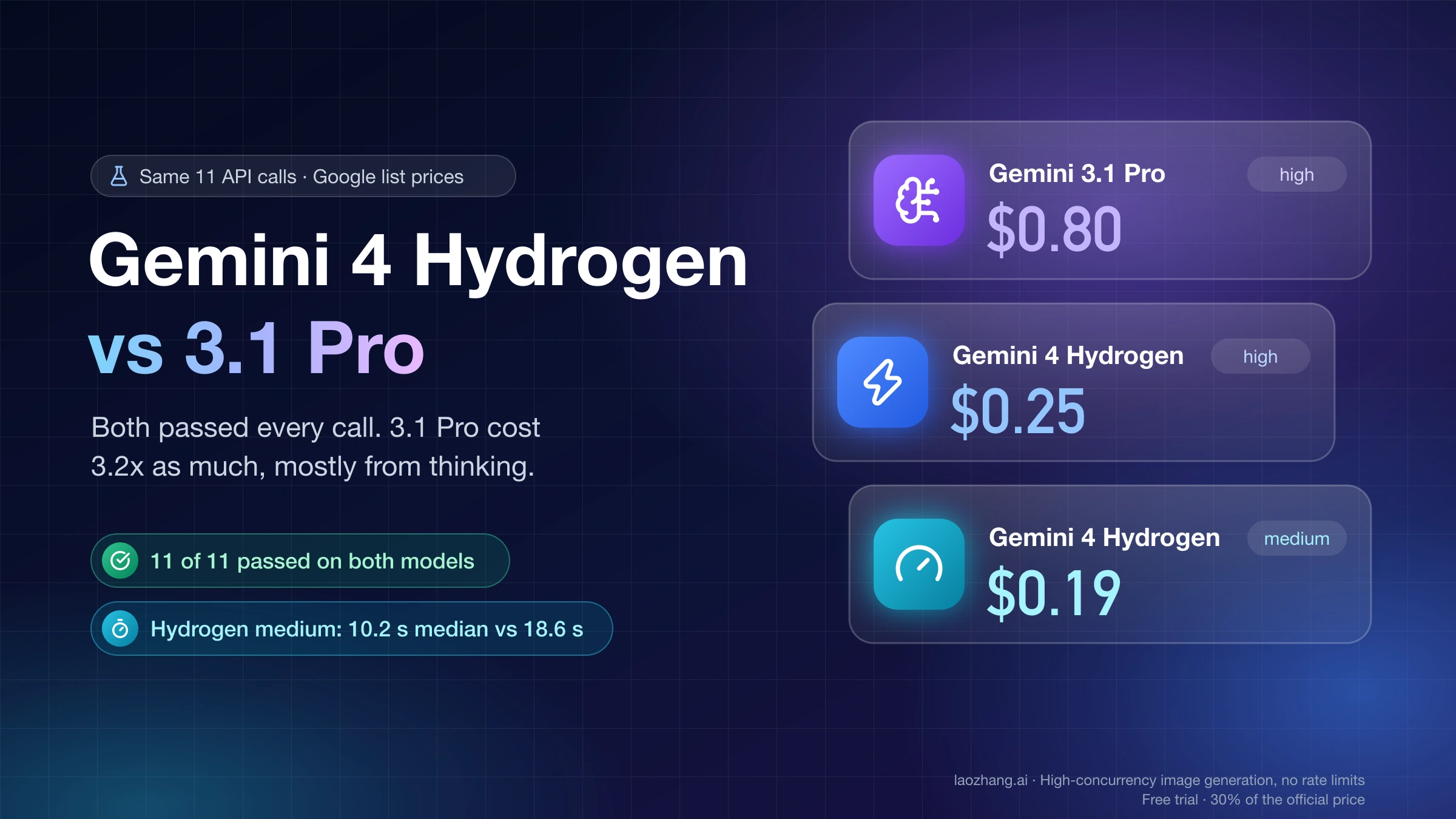
For everyday text and coding work, Gemini 4 Hydrogen (gemini-4-hydrogen) does the same job as Gemini 3.1 Pro (gemini-3.1-pro-preview) for about a third of the money. Both models passed all 11 calls of the same API test, eight short coding, math, and summarizing tasks checked by automatic graders, sent through the laozhang.ai gateway at each model's default high thinking level. At Google's list prices, 3.1 Pro's calls came to $0.80 on November 16, 2026 and Hydrogen's to $0.25 on November 14, because 3.1 Pro spent more than twice as many tokens thinking. Hydrogen at medium cost $0.19 and was faster as well, with a median of 10.2 seconds per call against 18.6 seconds for 3.1 Pro on the same day.
Disclosure: laozhang.ai is our own service. Its prices are platform pricing, not an independent comparison.
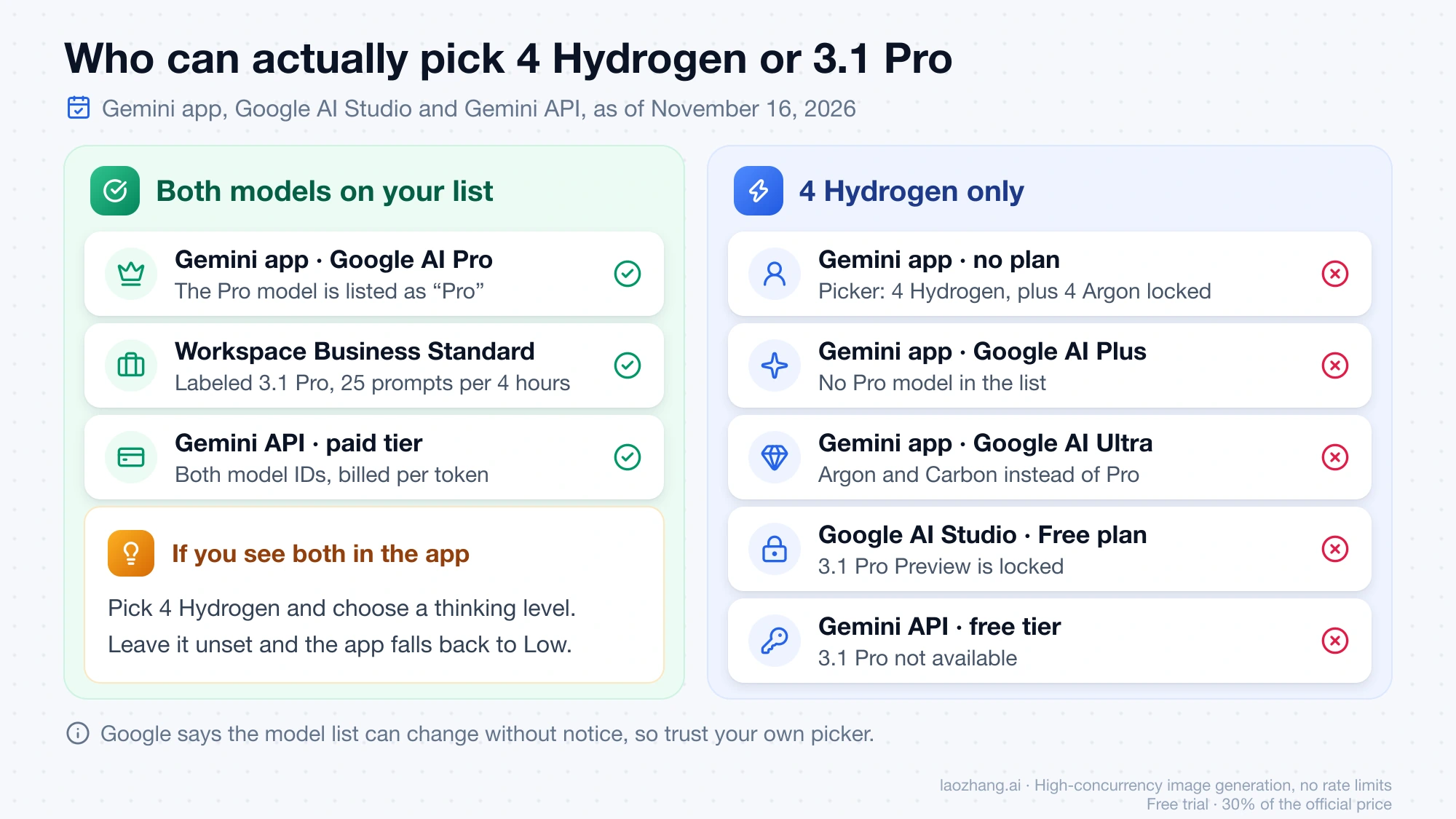
So in the API, change the model ID to gemini-4-hydrogen and set the thinking level yourself: medium for short, well-specified calls, the default high for coding and agent work. In the Gemini app, first check whether you have a choice at all. Google's help page lists both 4 Hydrogen and the Pro model only on Google AI Pro, and on a free account on November 16, 2026 the picker offered just 4 Hydrogen and a locked 4 Argon. If you do see both, pick 4 Hydrogen and choose a thinking level, because the app falls back to Low when you don't.
The test measures cost and time, not intelligence, since every configuration passed every task. For harder work, Artificial Analysis scores Hydrogen above 3.1 Pro on all five evaluations where both have a result, even at Hydrogen's lowest thinking level. Keep 3.1 Pro only where your own tests show it ahead, as one company found when reading handwritten figures on invoices, and for long, difficult work step up to Gemini 4 Argon or Carbon rather than back to 3.1 Pro. Google has announced no shutdown date for 3.1 Pro, so nothing forces the move on a deadline.
Gemini 4 Hydrogen vs 3.1 Pro cost: same 11 API calls, 3.2x apart
On identical requests, Gemini 3.1 Pro at its default high thinking level cost 3.19 times as much as Gemini 4 Hydrogen at its default high, and 4.15 times as much as Hydrogen at medium, with every call passing in all three configurations. Each configuration received the same 11 calls through the laozhang.ai gateway, using Gemini's native generateContent endpoint with no system prompt, no tools, and maxOutputTokens set to 32,000. 3.1 Pro at high and Hydrogen at medium ran on November 16, 2026; the Hydrogen high calls ran on November 14, 2026 with the same gateway, prompts, and settings.
Disclosure: laozhang.ai is our own service. Its prices are platform pricing, not an independent comparison.
The eight tasks were short and fully specified. Five ran once: a word problem about the cheapest mix of 6-pen and 10-pen packs for 58 pens, a Python merge_intervals function with six pytest tests, a parse_duration function with strict rules for units and invalid input, a top_words frequency function, and a five-bullet summary of an article of about 11,100 tokens. Three harder tasks ran twice each: an arithmetic expression evaluator written without eval, a CSV line splitter written without the csv module, and counting the positive integers below 1,000,000 whose digits sum to 27. Every answer was graded automatically, the code against hidden pytest suites.
| Configuration (test date) | Passed | Input tokens | Output tokens (thinking) | Cost at list price | Median time per call |
|---|---|---|---|---|---|
gemini-3.1-pro-preview, high (Nov 16) | 11 of 11 | 12,497 | 64,585 (58,672) | $0.8000 | 18.6 s (7.7–52.2) |
gemini-4-hydrogen, high (Nov 14) | 11 of 11 | 12,712 | 30,911 (25,944) | $0.2509 | Run on another day, not compared |
gemini-4-hydrogen, medium (Nov 16) | 11 of 11 | 12,714 | 23,144 (18,096) | $0.1927 | 10.2 s (4.4–24.7) |
The cost is each response's own token counts multiplied by Google's paid Standard prices for prompts up to 200,000 tokens, with thinking billed as output: $2.00 per million input tokens and $12.00 per million output tokens for 3.1 Pro, $1.50 and $7.50 for Hydrogen. For 3.1 Pro that is (12,497 × $2.00 + 64,585 × $12.00) ÷ 1,000,000 = $0.8000. It is list-price arithmetic, not an invoice. Spread over the 11 calls, it works out to about $0.073 per call for 3.1 Pro, $0.023 for Hydrogen at high, and $0.018 at medium.
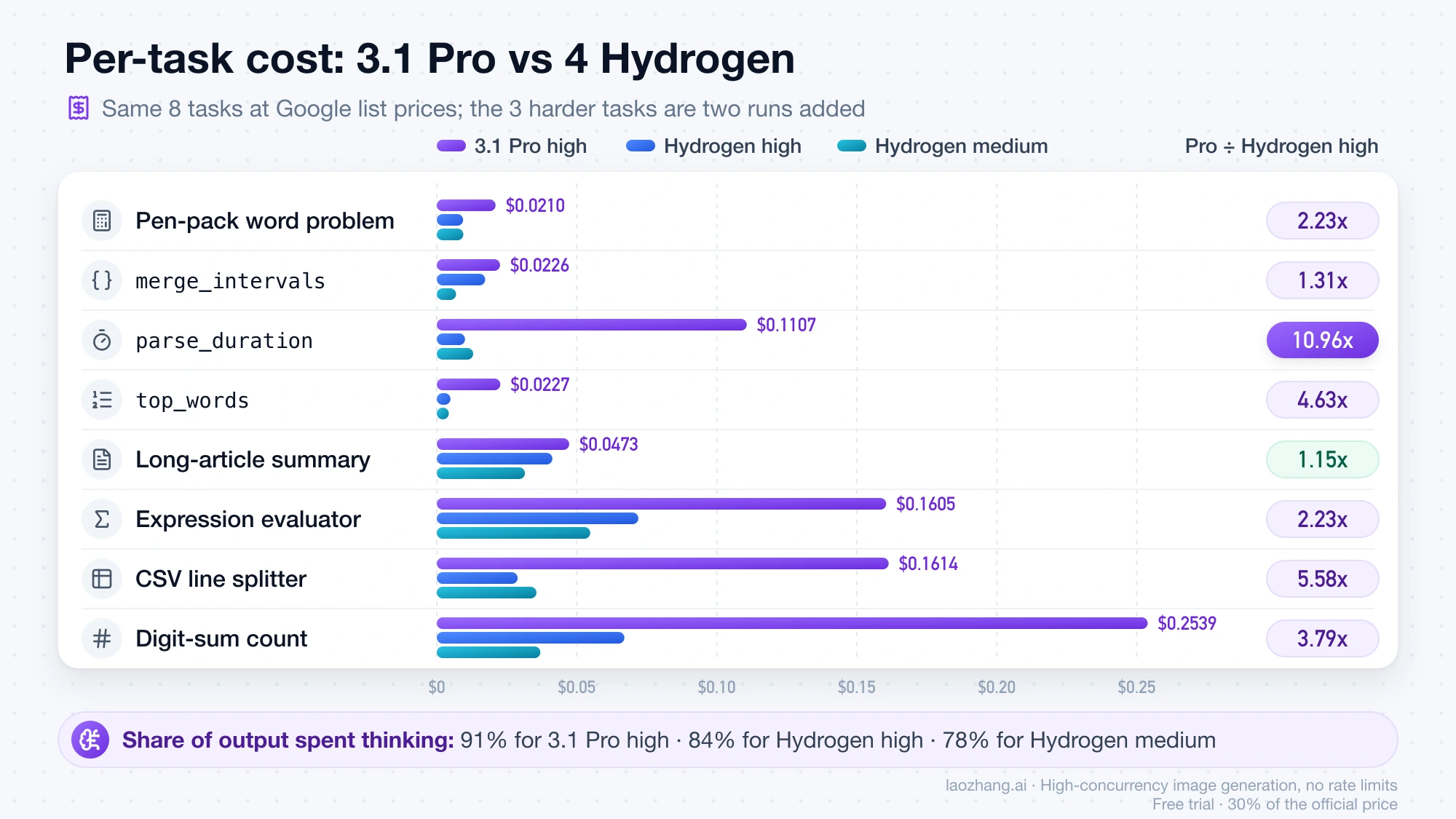
The price list explains only part of the gap. 3.1 Pro's output tokens cost 1.6 times Hydrogen's, but it also produced 2.09 times as many of them, and 91% of its output was thinking that never shows up in the answer, against 84% for Hydrogen at high and 78% at medium. That is why 3.1 Pro was the most expensive of the three on all eight tasks, as the per-task totals below show (two runs added together on the three harder tasks).
| Task | 3.1 Pro high | Hydrogen high | Hydrogen medium | 3.1 Pro ÷ Hydrogen high |
|---|---|---|---|---|
| Pen-pack word problem | $0.0210 | $0.0094 | $0.0095 | 2.23x |
merge_intervals with tests | $0.0226 | $0.0173 | $0.0069 | 1.31x |
parse_duration | $0.1107 | $0.0101 | $0.0130 | 10.96x |
top_words | $0.0227 | $0.0049 | $0.0043 | 4.63x |
| Summary of an 11,100-token article | $0.0473 | $0.0413 | $0.0315 | 1.15x |
| Expression evaluator (2 runs) | $0.1605 | $0.0720 | $0.0548 | 2.23x |
| CSV line splitter (2 runs) | $0.1614 | $0.0289 | $0.0356 | 5.58x |
| Digit-sum count (2 runs) | $0.2539 | $0.0670 | $0.0370 | 3.79x |
The gap was narrowest on the long summary, where input tokens make up a bigger share of the bill, and widest on parse_duration, where 3.1 Pro spent 8,803 thinking tokens on a 386-token answer. If your traffic is mostly short prompts that need careful reasoning, expect gaps like the larger multiples here; if it is mostly long documents with short outputs, expect something closer to the summary's 1.15x.
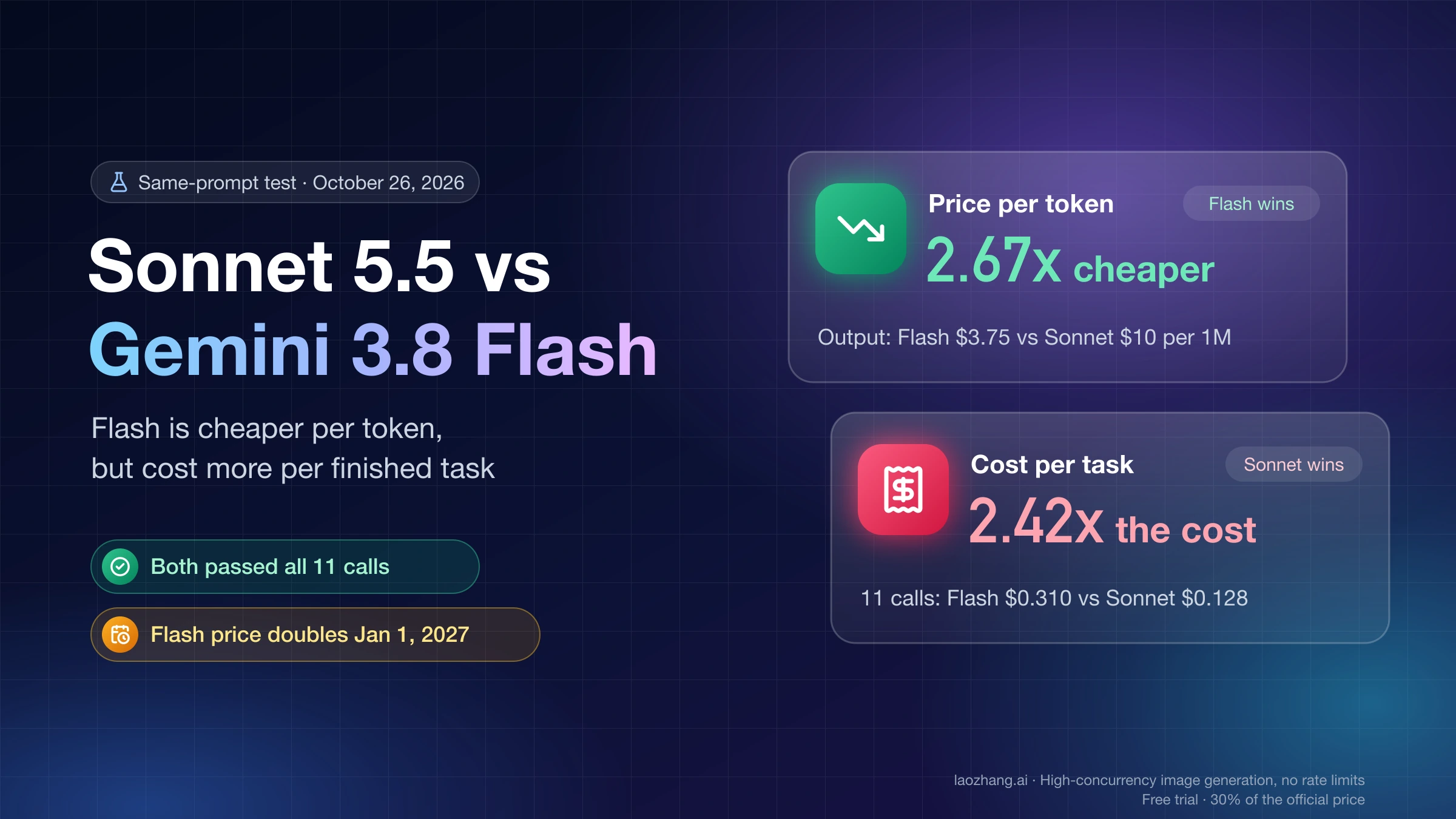
Dropping Hydrogen to medium is not a guaranteed discount. Across all 11 calls it cost 23% less than high, but it cost more on the CSV splitter and on parse_duration and the same on the word problem. Thinking volume also swings between runs of one prompt: Hydrogen at medium used 4,775 thinking tokens on the first expression-evaluator run and 1,008 on the second. Compare levels on a batch of your own requests rather than on single calls. What one call costs at each of Hydrogen's four levels is worked through in Gemini 4 Hydrogen Pricing: API Cost per Call by Thinking Level, and the same 11 calls on two other models are in Claude Sonnet 5.5 vs Gemini 3.8 Flash, 4 Hydrogen: Cost per Task.
One oddity: on the CSV splitter and the digit-sum count, 3.1 Pro's two runs came back with identical text and identical token counts under different response IDs, while Hydrogen's two runs always differed. Either 3.1 Pro answered those prompts deterministically or something upstream reused a result. The cause is unknown, and both runs are counted in the totals.
On time, only the same-day pair is a fair comparison. Hydrogen at medium had a median of 10.2 seconds per call against 18.6 for 3.1 Pro at high, and its slowest call, at 24.7 seconds, took less than half as long as 3.1 Pro's slowest at 52.2. For Hydrogen at high, the Artificial Analysis comparison of Gemini 4 Hydrogen and Gemini 3.1 Pro Preview gives a mixed picture as of November 16, 2026: Hydrogen streams faster, 170 tokens per second against 111, yet its average single request took 58.68 seconds against 38.55 for 3.1 Pro, while Hydrogen at medium took 28.49 seconds. Across both measurements, Hydrogen at medium is the setting that is reliably faster than 3.1 Pro.
Is Gemini 4 Hydrogen better than 3.1 Pro? Ahead on all five shared benchmarks
On harder work than those short tasks, the best public measurement says yes. Artificial Analysis, which runs both models through their APIs, has five evaluations with a result for both, and Hydrogen leads on all five at high, at medium, and even at low, as of November 16, 2026. The margins are widest on agent and terminal work: on Terminal-Bench 4.0, Hydrogen at high scored 54.0% against 4.0% for 3.1 Pro. The narrowest gap is on HLE-Diamond, where Hydrogen at low edges 3.1 Pro by 32.2% to 31.4%.
| Artificial Analysis evaluation | Hydrogen xhigh | Hydrogen high | Hydrogen medium | Hydrogen low | 3.1 Pro Preview |
|---|---|---|---|---|---|
| AA-Briefcase v1.1 | 1568 | 1497 | 1296 | 947 | 457 |
| AutomationBench-AA | 76.1% | 74.4% | 72.0% | 60.5% | 35.4% |
| Terminal-Bench 4.0 | 53.5% | 54.0% | 29.3% | 6.6% | 4.0% |
| GDP.pdf | 27.6% | 30.0% | 32.8% | 28.2% | 17.8% |
| HLE-Diamond | 58.8% | 54.9% | 47.7% | 32.2% | 31.4% |
Read these with two limits in mind. Artificial Analysis publishes no Intelligence Index v5.0.1 score for 3.1 Pro, so Hydrogen's headline figures (51 at high, 54 at xhigh) have no 3.1 Pro number to compare against, and four newer evaluations, FrontierCode, Omniscience, CritPt, and Terminal-Bench-Science, have no 3.1 Pro result either. And these are long, hard, mostly agentic tasks, so they say little about creative writing, image reading, or the tone of chat answers. Google's own Gemini 4 Hydrogen launch post doesn't fill the gap: it compares Hydrogen with Gemini 3.8 Flash and Argon and never with 3.1 Pro, and for the Gemini app it claims Hydrogen is "better at following your guidance, calling the right tools" and stays on track across multi-turn conversations.
Which Gemini plans let you choose 4 Hydrogen or 3.1 Pro
In the Gemini app on a personal account, only Google AI Pro lists both models, according to Google's About Gemini models help page as of November 16, 2026. That page never writes "3.1 Pro": it calls the model "Gemini Pro" or "our Pro model", while the work-account picker shown in Relymate's test labels it "3.1 Pro". Outside the app the dividing line is payment, because Hydrogen has a free tier in the Gemini API and 3.1 Pro doesn't.
| Where you use Gemini | 4 Hydrogen | 3.1 Pro (the "Pro" model) | Based on |
|---|---|---|---|
| Gemini app, no Google AI plan | Help page: Auto (mostly Flash-Lite, some Hydrogen) or Flash-Lite. Picker on a free account: 4 Hydrogen, selected by default | No | Google help page; free account, Nov 16, 2026 |
| Gemini app, Google AI Plus | Yes | No | Google help page |
| Gemini app, Google AI Pro | Yes | Yes, listed as Pro | Google help page |
| Gemini app, Google AI Ultra | Yes | No Pro entry; Argon and Carbon instead | Google help page |
| Gemini app, Workspace Business Standard | Yes, plus a Thinking mode | Yes, labeled 3.1 Pro, 25 prompts per 4 hours | Relymate report, Nov 13–14, 2026 |
| Google AI Studio, Free plan | Yes | Locked | Free account, Nov 16, 2026 |
| Gemini API, free tier | Yes | Not available | Gemini API pricing page |
| Gemini API, paid tier | Yes | Yes | Gemini API pricing page |
The row for accounts without a plan comes with a conflict. Google's help page says those accounts get Auto, which sends most prompts to Flash-Lite and some to Hydrogen, or Flash-Lite alone. Yet on a personal account without a plan, on November 16, 2026, the Gemini web app's picker showed exactly two entries: 4 Hydrogen, selected and marked new, and 4 Argon with a lock icon, with no Flash-Lite or Pro entry. Google says the model list can change without notice, so trust your own picker over either description.
In Google AI Studio, the same free account couldn't open 3.1 Pro at all. Choosing gemini-3.1-pro-preview in the Playground showed a lock panel instead of a chat: "Gemini 3.1 Pro Preview is only available in the Playground via a Google AI Plan or an API key." Hydrogen ran on the same Free plan on November 13 and 14, 2026. So if you're on a free account, the practical answer to "which one should I use" is that 4 Hydrogen is the one you have.
Where both are listed, the app still doesn't say how many messages each model gets. According to Google's Gemini Apps limits page, limits are compute-based, refresh every five hours up to a weekly cap, and AI Pro gets four times the no-plan allowance; Google's model page adds that "more advanced models and higher thinking levels require more of your usage." The context window in the app depends on the plan as well: 32k tokens without a plan, 128k on AI Plus, and 1 million on AI Pro and Ultra.
Gemini 4 Hydrogen vs 3.1 Pro specs: price, free tier, thinking levels
On paper, Hydrogen is cheaper per token at every prompt size, and the gap widens above 200,000 input tokens, where 3.1 Pro's price steps up and Hydrogen's doesn't: per million tokens, 3.1 Pro's extra cost grows from $0.50 to $2.50 on input and from $4.50 to $10.50 on output. The prices are Google's paid Standard rates per million tokens from the Gemini API pricing page, and the thinking levels come from the Gemini API thinking guide, both as of November 16, 2026.
| Gemini 4 Hydrogen | Gemini 3.1 Pro Preview | |
|---|---|---|
| Model ID | gemini-4-hydrogen | gemini-3.1-pro-preview |
| Status | Generally available since November 12, 2026 | Preview since February 19, 2026 |
| Input, prompts up to / above 200k tokens | $1.50 / $1.50 | $2.00 / $4.00 |
| Output including thinking, up to / above 200k | $7.50 / $7.50 | $12.00 / $18.00 |
| Caching | Implicit only; cached reads $0.075 | Context caching $0.20 / $0.40 (up to / above 200k), plus $4.50 per 1M tokens per hour of storage |
| Free tier in the Gemini API | Yes; free-tier data is used to improve Google products | Not available |
| Thinking levels | low, medium, high (default), xhigh | low, medium, high (default) |
| Context window | 1,048,576 tokens; default output cap 65,536 | 1M tokens |
Per token, 3.1 Pro costs 1.33 times Hydrogen on input and 1.6 times on output for prompts up to 200,000 tokens, and 2.67 and 2.4 times above that. That is the condition under which the test's 3x gap would grow: a large codebase or a long document sent in one prompt over 200k tokens pays 3.1 Pro's upper rates and Hydrogen's usual ones. Neither model accepts minimal as a thinking level. Google's guidance for Hydrogen is to start at high, keep xhigh for hard multi-step problems, and use the lowest level that meets your quality bar.
Is Gemini 3.1 Pro being retired? No shutdown date as of November 16, 2026
No. Google's Gemini API deprecations page lists gemini-3.1-pro-preview with "No shutdown date announced" and no recommended replacement as of November 16, 2026, and the API changelog has no November entry about it. Posts saying 3.1 Pro is retiring are their authors' reading of Hydrogen's launch, not a Google announcement.
That is not a promise it stays forever. It is still a preview model, and its predecessor gemini-3-pro-preview was shut down on March 9, 2026 and replaced by 3.1 Pro Preview. Google says the dates it lists are the earliest possible and that it gives advance notice, so the deprecations page is the place to watch. A separate change on the same page affects an older model: from December 1, 2026, requests to gemini-2.5-pro route to gemini-3.8-flash, which has nothing to do with 3.1 Pro.
When to stay on 3.1 Pro, and when to move up to Argon or Carbon
Stay on 3.1 Pro where your own tests show it ahead on work you care about. The clearest public example is narrow. Relymate, a Japanese company, tested the Gemini app on Google Workspace Business Standard accounts on November 13–14, 2026, and in its write-up on choosing between the Gemini 4 Hydrogen modes and 3.1 Pro 3.1 Pro got slightly more of the handwritten figures on 49 real invoices right: 41 and 40 correct in two passes against 39 and 39 for 4 Hydrogen in Thinking mode. On 16 kinds of office tasks the two were about even, Thinking mode answered in about a minute against about 1 minute 20 seconds for 3.1 Pro, and plain 4 Hydrogen got the first figure of an overtime calculation wrong three times out of three before correcting itself. That is one company's test on work accounts, and image reading is outside the API test above.
Forum opinions point in different directions, so treat them as reasons to test rather than as findings. The student who started an r/GeminiAI discussion on November 15, 2026 wrote that 3.1 Pro "easily forgets stuff and makes lots of mistakes"; in another r/GeminiAI thread a day earlier, one user found "the guardrails on gemini 3.1pro are much lighter compared to 4 hydrogen and argon"; and on r/GoogleAIStudio around November 12, a writer said Hydrogen's creative prose "feels a little better than 3.1 Pro to me. But it's not quite up to par with 4 Argon." If refusals or prose style decide it for you, run your own prompts through both. If you stay on 3.1 Pro in the API, Gemini 3.1 Pro Thinking Levels: Low vs High, Defaults, Gemini 4 covers how to set its levels.
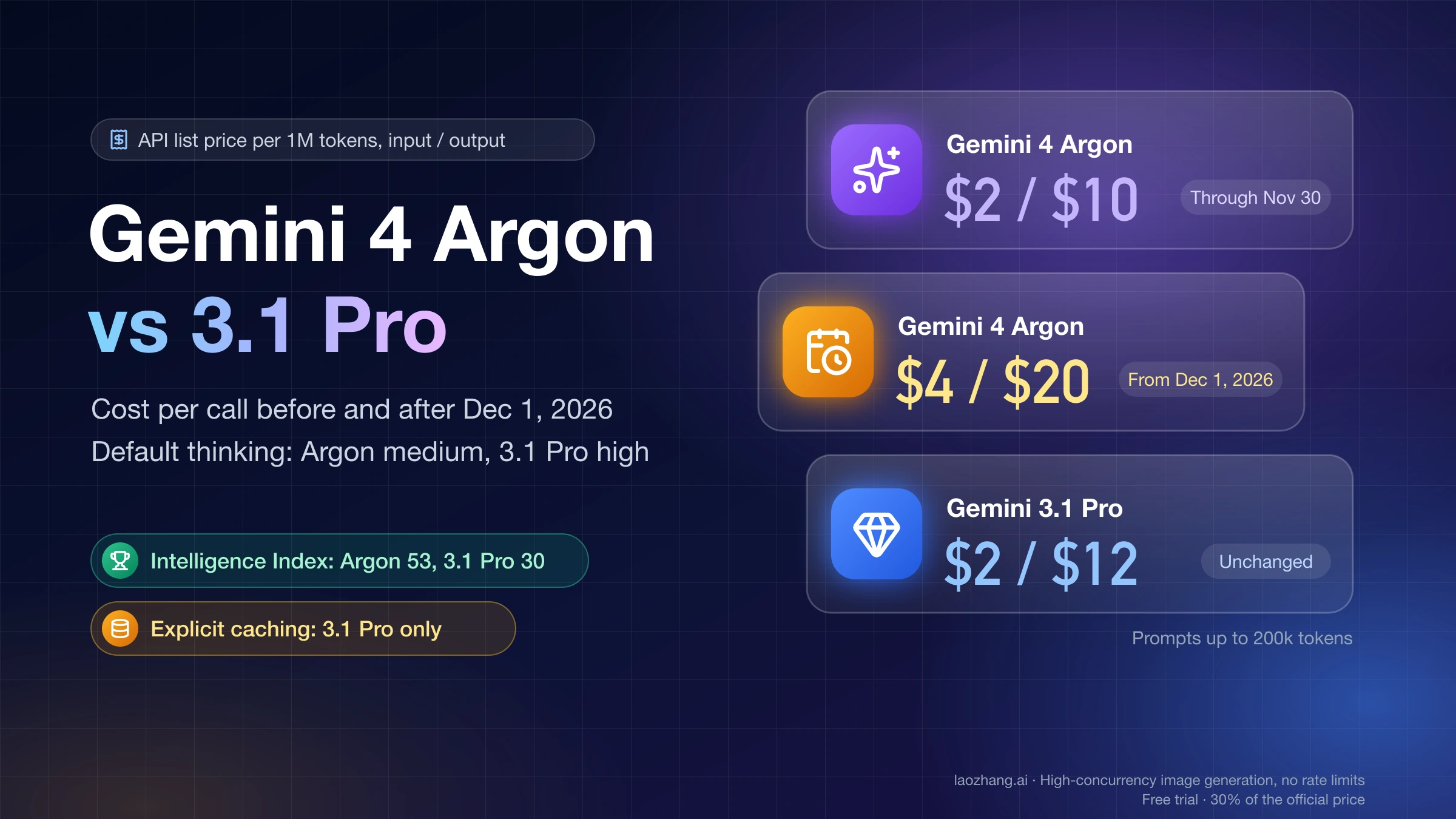
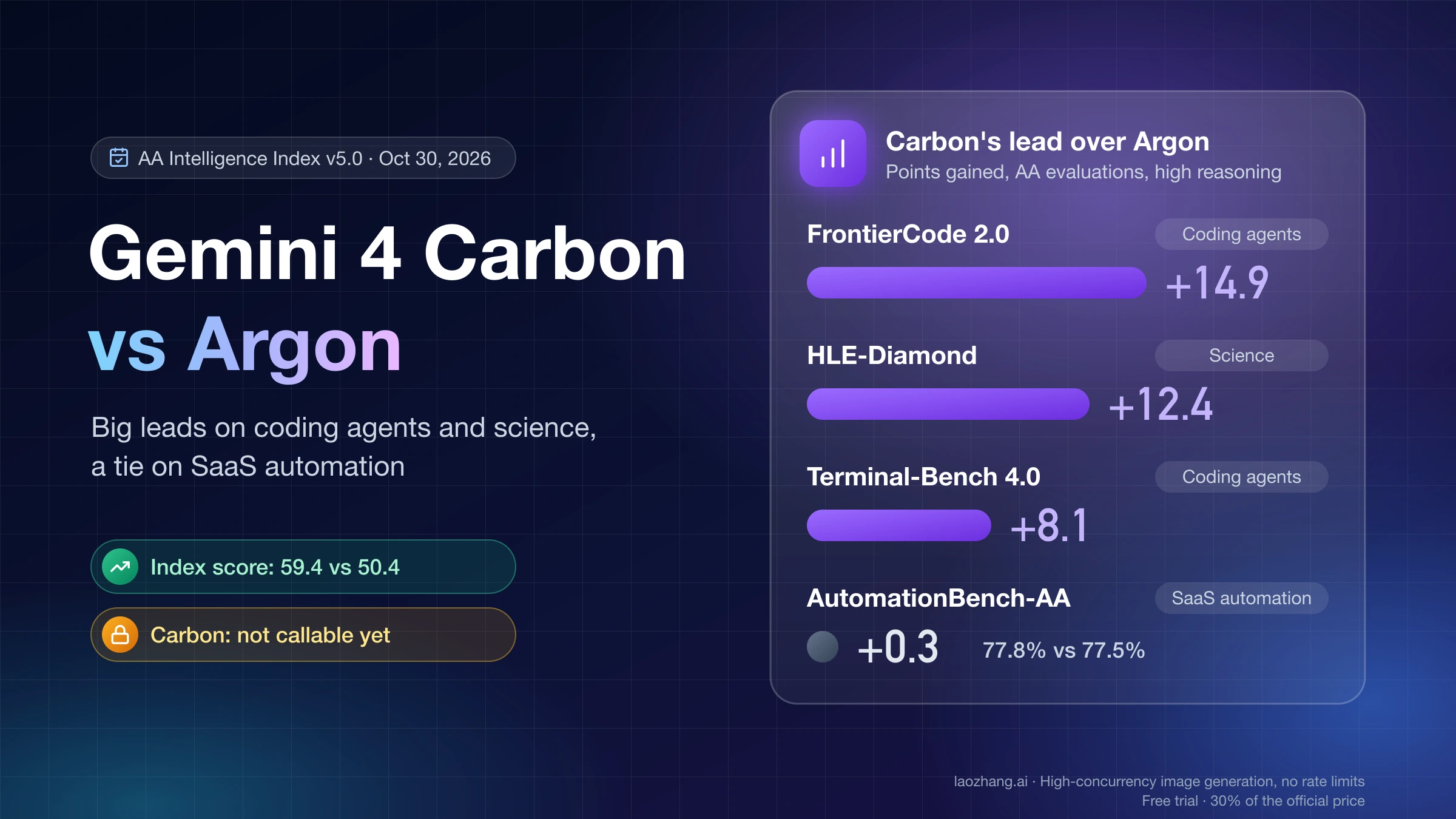
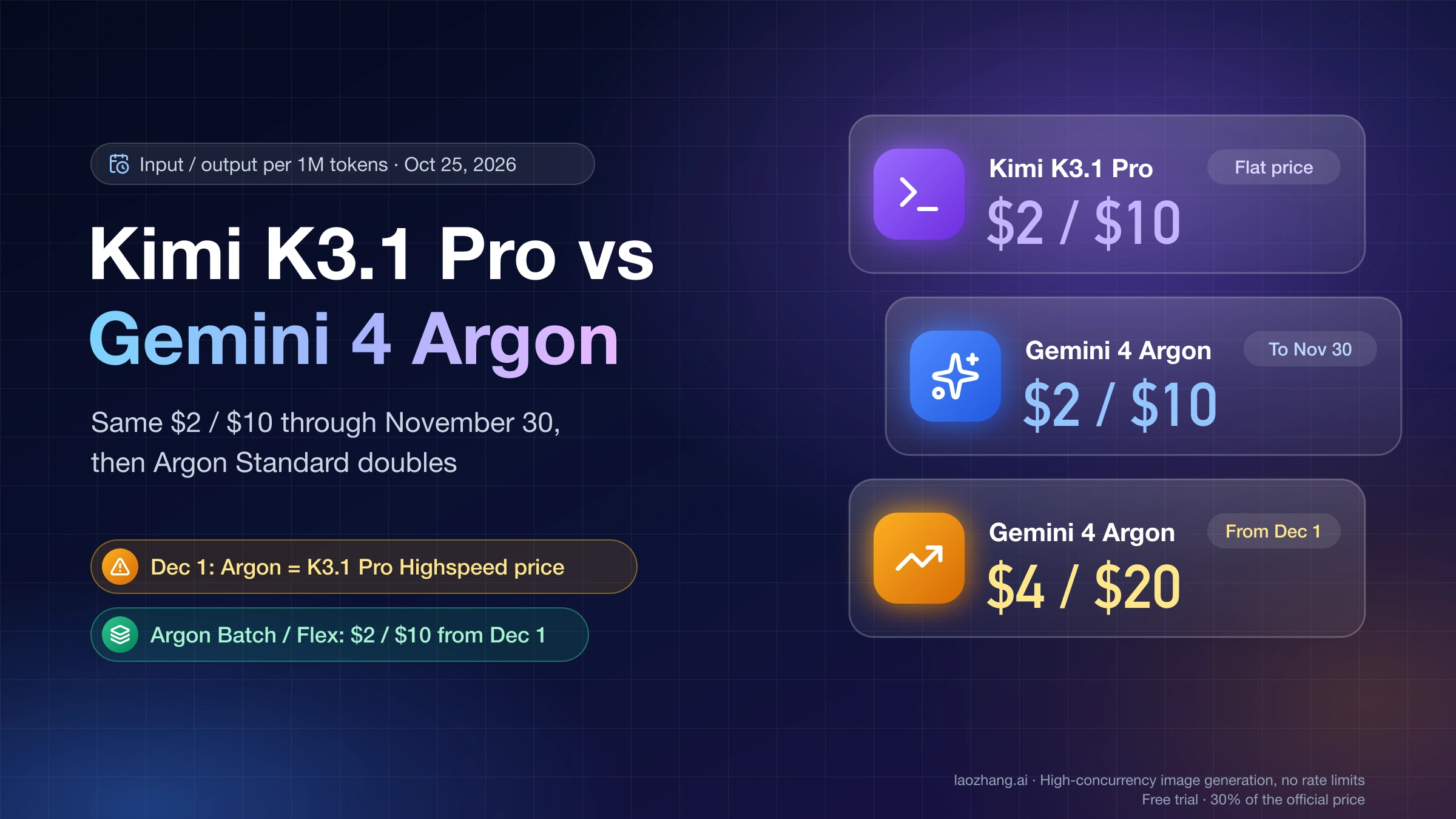
If Hydrogen falls short on long, hard work, the next step is Gemini 4 Argon or Carbon, which Google positions for deep, long-horizon reasoning, not 3.1 Pro, which scores below even Hydrogen at low on the five shared Artificial Analysis evaluations. Neither has a free tier. Both cost $2 input and $10 output per million tokens through November 30, 2026, then $4 and $20 from December 1, and in the Gemini app Argon needs AI Pro or Ultra while Carbon needs Ultra. Since Hydrogen at high already slightly outscores Argon at high on the Artificial Analysis index (51 vs 50), try Hydrogen at xhigh before paying for either. Picking between the two is covered in Gemini 4 Carbon vs Gemini 4 Argon: When Slower Carbon Pays Off.
How to switch from gemini-3.1-pro-preview to gemini-4-hydrogen
Switching takes a model ID change and a deliberate thinking level in the API, or a picker choice and a thinking level in the app. In both places, check which model actually answered, because a silent fallback would undo the cost and speed difference.
In the Gemini API
-
Replace the model ID. In REST calls it sits in the path, as in
v1beta/models/gemini-4-hydrogen:generateContent; in an SDK, passgemini-4-hydrogenas the model name. -
Set the thinking level explicitly, because both models default to
high. Start withmediumfor short, well-specified calls and keephighfor coding and agent work:{ "contents": [{ "role": "user", "parts": [{ "text": "Your prompt" }] }], "generationConfig": { "thinkingConfig": { "thinkingLevel": "medium" }, "maxOutputTokens": 32000 } } -
If your code creates explicit context caches for 3.1 Pro, plan to rework that part. Google's pricing page lists implicit caching only for Hydrogen, so repeated prefixes are discounted automatically rather than through a cache you create and pay to store.
-
Check
modelVersionin each response; it should readgemini-4-hydrogen. In the test above, every response'smodelVersionmatched the model requested. LogusageMetadata.thoughtsTokenCounttoo, because thinking tokens are where most of the cost difference comes from. -
Run your own evaluation set on both models and compare cost per accepted answer before moving all traffic.
In the Gemini app
- Open the model picker and choose 4 Hydrogen. On Google AI Pro, the entry named Pro is the other model.
- Choose a thinking level. If you don't, it defaults to Low, and the app keeps that model and level for the rest of the conversation.
- To see which model wrote a reply, open More, then Show thinking steps; the model name is at the bottom of the steps. Paid plans that reach their usage limit continue the chat on Flash-Lite, so this is how you'd notice the switch.
Sources8
External pages this guide links to, in the order they appear. Last updated Nov 16, 2026.
Sources8
External pages this guide links to, in the order they appear. Last updated Nov 16, 2026.
- 1.Artificial Analysis comparison of Gemini 4 Hydrogen and Gemini 3.1 Pro Previewartificialanalysis.ai/models/comparisons/gemini-4-hydrogen-vs-gemini-3-1-pro-preview
- 2.Gemini 4 Hydrogen launch postblog.google/innovation-and-ai/models-and-research/gemini-models/introducing-gemini-4-hydrogen
- 3.About Gemini models help pagesupport.google.com/gemini/answer/18648722
- 4.Gemini Apps limits pagesupport.google.com/gemini/answer/16275805
- 5.Gemini API pricing pageai.google.dev/gemini-api/docs/pricing
- 6.Gemini API thinking guideai.google.dev/gemini-api/docs/thinking
- 7.Gemini API deprecations pageai.google.dev/gemini-api/docs/deprecations
- 8.its write-up on choosing between the Gemini 4 Hydrogen modes and 3.1 Prorelymate.com/blog/gemini-4-hydrogen-model-choice