Claude Pro vs ChatGPT Plus Limits: Plus for Chat, Claude for Code
Claude Pro vs ChatGPT Plus usage limits as of October 15, 2026: Plus doesn't cap everyday text chat; Claude Pro fits more agent coding in one shared pool.
On this page
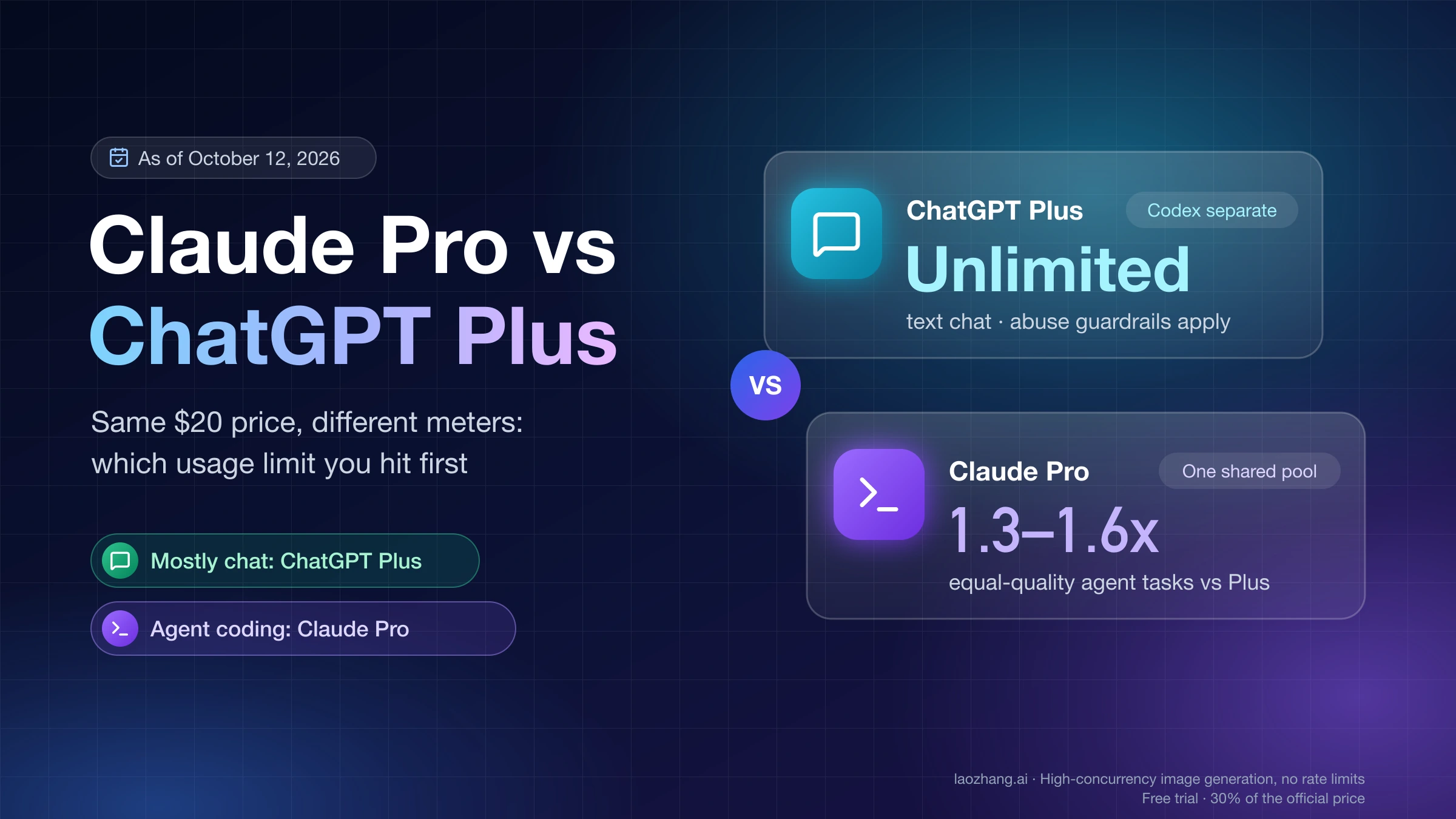
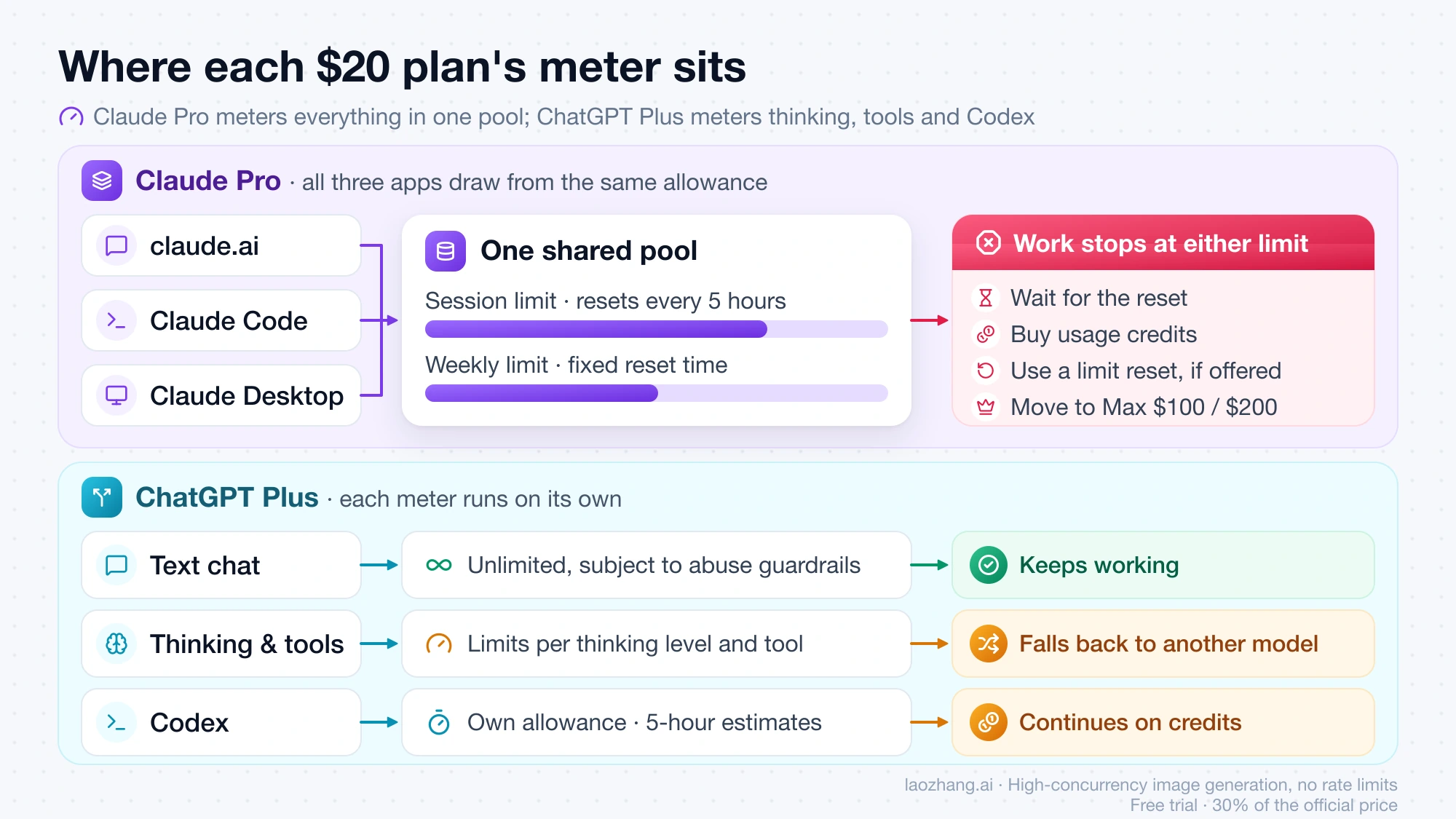
Claude Pro and ChatGPT Plus both cost $20 a month, but they meter different things, so the plan that runs out first depends on how you split your week between chat and a coding agent. ChatGPT Plus doesn't cap everyday text chat (the Plus pricing card read "subject to abuse guardrails" as of October 8, 2026), and as of October 15, it limits thinking levels and tools separately and gives Codex its own allowance. Claude Pro counts everything you do in claude.ai, Claude Code and Claude Desktop against one five-hour session limit and one weekly limit, and stops you when either runs out.
For mostly chat, Plus runs out less. For agent and coding work, Claude Pro's allowance is larger: SemiAnalysis estimated it at roughly 5.6 times Plus in API-list value, a gap that shrinks to about 1.3–1.6 times when you count tasks of equal quality. Neither company publishes a message count for either plan, so the number that settles it for you is the one on your own usage screen. The one-week test near the end shows where to find it.
Claude Pro vs ChatGPT Plus usage limits side by side (October 2026)
The table compares what each $20 plan meters, what happens when you hit a limit, and where you can watch your usage. Facts are as of October 15, 2026, from Anthropic's Claude Pro plan help page, OpenAI's GPT-6 models in ChatGPT help page and OpenAI's ChatGPT Work and Codex pricing page.
| Claude Pro | ChatGPT Plus | |
|---|---|---|
| Price | $20/month (US), or $200 billed once a year | $20/month, no annual billing |
| What is metered | Everything: chat, Claude Code and Claude Desktop share one allowance | Thinking levels and tools; everyday text chat is unlimited, subject to abuse guardrails |
| Time windows | A session limit that resets every five hours, plus a weekly limit across all models | Separate limits per thinking level and tool in Chat; Work and Codex have five-hour estimates, and weekly limits may also apply |
| Coding agent | Claude Code draws from the same pool as your chats | Codex runs on an allowance separate from Chat |
| When you hit the limit | Work stops until the reset, unless you buy usage credits or upgrade | Chat may continue with another available model; Codex can continue on credits |
| Newest models | Fable 5 and 5.1 are outside Pro's limits and bill usage credits from the first request | GPT-6 Sol at Medium and High (rolling out); Extra High and GPT-6 Pro are not included; GPT-6 Astra only in Work and Codex |
| Where to check usage | Settings > Usage on claude.ai; /usage in Claude Code | Reset time shown when you reach a limit; Codex usage dashboard and /status in Codex CLI |
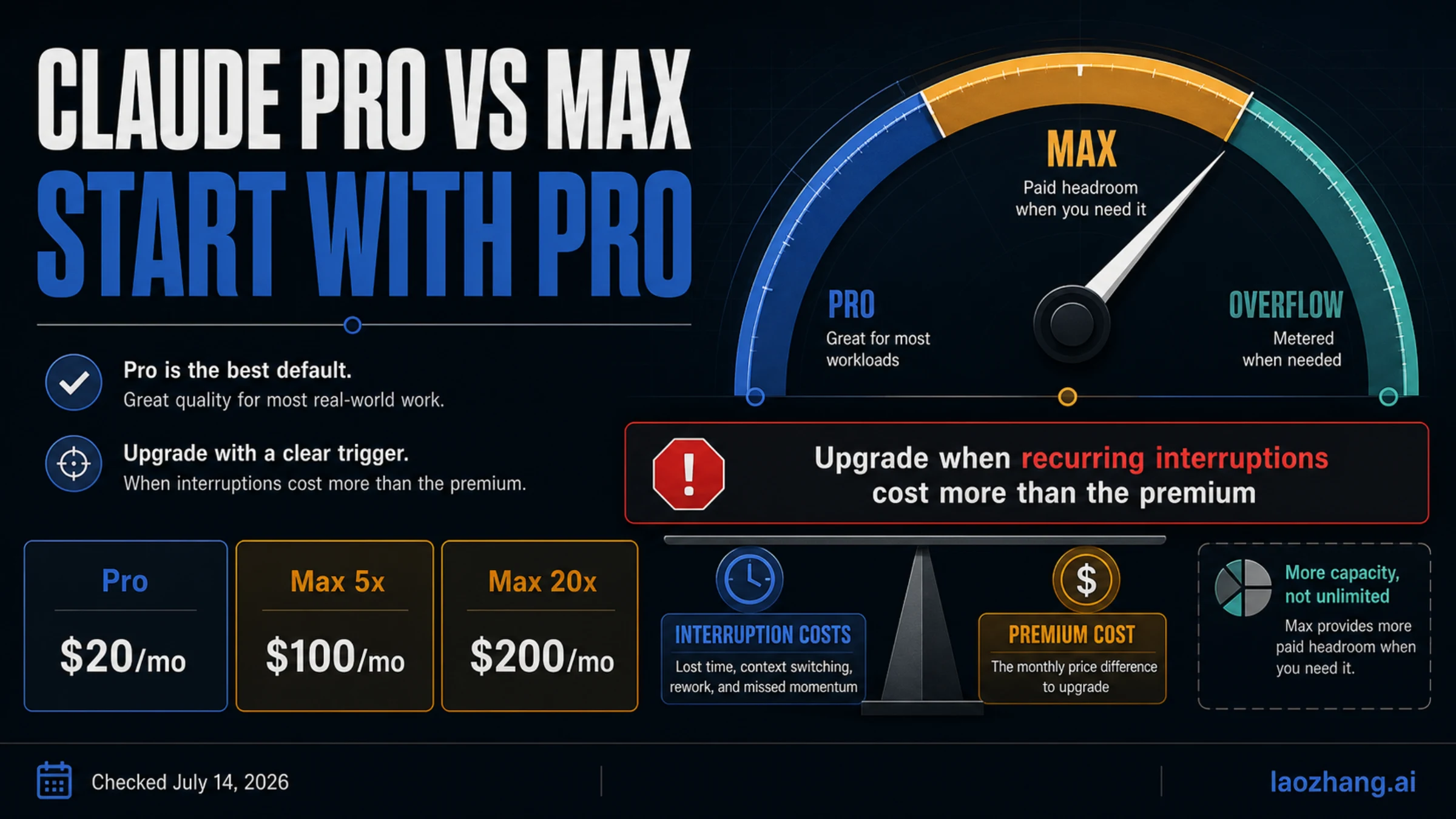
| Next tier up | Max at $100 (5x Pro per session) or $200 (20x) | Pro at $100, $200 or $500 |
The annual Claude Pro price works out to $17 a month on claude.com/pricing as of September 3, 2026. The "5x" and "20x" in Max are per-session multiples of Pro, not weekly ones; the Claude usage limits by plan guide covers what each Claude tier actually multiplies, and ChatGPT usage limits by plan lists every ChatGPT plan's caps and reset rules.
Why does Claude have a limit but ChatGPT doesn't? Plus caps thinking, not text
ChatGPT Plus does have limits, just not on plain text replies, which is where most chat time goes. As of October 8, 2026, the ChatGPT pricing page listed "Unlimited text chats subject to abuse guardrails" on the Plus card. The limits sit on thinking levels and on tools such as file uploads, image generation and deep research.
With GPT-6 selected, GPT-6 Sol powers Instant, Medium, High and Extra High. Plus includes Medium and High, and on Plus, Instant doesn't switch itself up to a higher thinking level. In practice, everyday questions and drafting stay unmetered until you pick a thinking level for harder work. GPT-6 is still rolling out in Chat, and OpenAI notes it "may not be available for your account yet."
Claude Pro meters every message. Anthropic's help page says the number you can send "will vary based on message length, including the length of files you attach, the length of your current conversation, and the model or feature you use." Long threads cost more than short ones: chats that trigger automatic context management "consume more of your usage limit," according to the Claude usage and length limits help page. Someone who drafts long documents in one running conversation can therefore hit Claude's limit with relatively few messages.
There are two Claude ceilings, and either one can stop you. The session limit resets every five hours. The weekly limit resets at a fixed time assigned to your account, which you can see in Settings > Usage. Anthropic raised Pro's five-hour limits when Claude Opus 5.5 launched on September 22, 2026, without publishing a number. On X, one user paying for both plans wrote on September 28, 2026 that Claude Pro "hit Limit multiple times in one week" while Plus showed "zero limits." That is a single report, but it is what the two meters predict for chat-heavy use.
What happens at the limit: Claude stops, ChatGPT switches models
When Claude Pro runs out, you stop until a reset. Claude Code shows messages such as "You've hit your session limit · resets 3:45pm" or "You've hit your weekly limit · resets Mon 12:00am." Claude does not drop you to a smaller model. You have four ways forward:
- Wait for the five-hour or weekly reset.
- Turn on usage credits in Settings > Usage. They are prepaid, bill at standard API rates, and support optional auto-reload and a monthly spend limit.
- Use a limit reset if your account has one. These occasional resets restore the five-hour or weekly limit, but not every account gets them.
- Move to Max at $100 or $200.
When ChatGPT Plus runs out of a thinking level, OpenAI says "ChatGPT may continue with another available model," and it shows when the allowance resets if that information is available. Everyday text chat keeps working throughout. OpenAI Support does not reset ChatGPT or Codex limits; contact it only if usage was counted wrong or access didn't come back after the stated reset. In Codex, credits let you continue after the included limits.
The difference matters most on a deadline. On Claude, hitting the limit mid-task means waiting or paying. On ChatGPT, you keep getting answers, but possibly from a different model than the one you were relying on for hard reasoning.
Claude Pro vs ChatGPT Plus for coding: shared pool vs Codex allowance
On Claude, a long Claude Code session uses the same allowance as your chats, so a heavy coding afternoon leaves less room for writing that evening. On ChatGPT, "usage and credit rules in Work and Codex are separate from Chat," so Codex can't eat into your everyday chat.
OpenAI's Codex pricing page gives these estimates for Plus local messages per five-hour period, and says they "are not fixed message limits":
| Model in Codex (Plus) | Local messages per five hours |
|---|---|
| GPT-6 Astra | 5–45 |
| GPT-6.1 Sol | 15–160 |
| GPT-6 Sol | 15–150 |
| GPT-6 Luna | 350–3,000 |
Local messages and cloud chats share the same allowance, weekly limits may also apply, and Fast mode uses included limits at 2.5 times the normal rate. Tools you connect with Sign in with ChatGPT don't add capacity either: "Usage in connected tools draws from the applicable allowance," according to the What is ChatGPT Plus help page.
Anthropic publishes no comparable Claude Code numbers, so the only cross-vendor figure is a third-party estimate. SemiAnalysis maxed out each plan on an agent workload (Claude Opus 5.5 against GPT-6.1 Sol), converted the result to tokens per month, and priced those tokens at each company's API list rates. The original report is paywalled; the figures below are as reported by Dataconomy's article on the SemiAnalysis subscription estimate and two posts on X that match it.
| Plan pair | Claude, API-list value per month | ChatGPT, API-list value per month |
|---|---|---|
| $20: Claude Pro vs ChatGPT Plus | ≈ $1,178 | ≈ $211 |
| $100: Max 5x vs Pro $100 | ≈ $5,725 | ≈ $1,055 |
| $200: Max 20x vs Pro $200 | ≈ $11,726 | ≈ $2,084 |
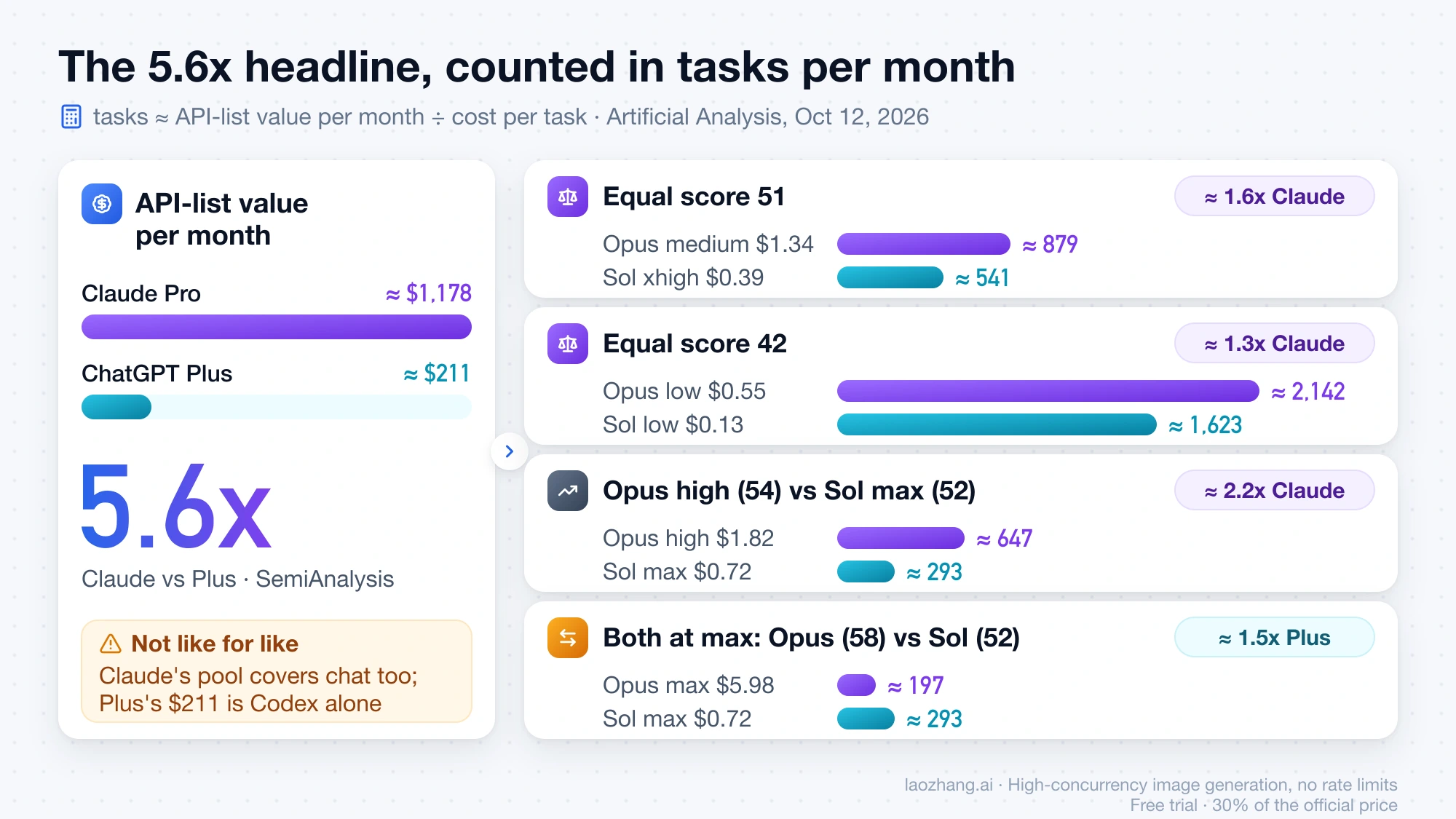
That is 5.4 to 5.6 times at every tier. In raw tokens the gap is smaller: about 2.9 billion a month on Claude Pro against about 1 billion on Plus, because Opus 5.5 tokens list at twice the price of GPT-6.1 Sol tokens. Three caveats apply. This is allowance priced at list, not finished work. SemiAnalysis also said that most subscribers never come close to exhausting their limits. And Claude's $1,178 has to cover your chatting as well, while Plus's $211 is Codex alone.
Turning the 5.6x estimate into tasks per month: about 1.3x to 1.6x
Dollar value doesn't tell you how many jobs get done, because Opus 5.5 and GPT-6.1 Sol spend different amounts per task. Artificial Analysis publishes a cost per task for both models at each effort level, priced at the same API list rates ($4/$20 per million input/output tokens for Opus 5.5, $2/$10 for GPT-6.1 Sol). Dividing one figure by the other gives a rough task count:
tasks per month ≈ plan's API-list value per month ÷ cost per task at your effort levelUsing the SemiAnalysis values and the Artificial Analysis comparison of GPT-6.1 Sol and Claude Opus 5.5 as of October 15, 2026:
| Comparison (Intelligence Index score) | Claude Pro | ChatGPT Plus | Ratio |
|---|---|---|---|
| Equal score 51: Opus medium $1.34 vs Sol xhigh $0.39 | $1,178 ÷ 1.34 ≈ 879 | $211 ÷ 0.39 ≈ 541 | ≈ 1.6x Claude |
| Equal score 42: Opus low $0.55 vs Sol low $0.13 | ≈ 2,142 | ≈ 1,623 | ≈ 1.3x Claude |
| Opus high (54) $1.82 vs Sol max (52) $0.72 | ≈ 647 | ≈ 293 | ≈ 2.2x Claude |
| Both at max: Opus (58) $5.98 vs Sol (52) $0.72 | ≈ 197 | ≈ 293 | ≈ 1.5x Plus |
At equal benchmark scores, Claude Pro still comes out ahead, but by 1.3–1.6 times rather than 5.6. If you run Opus 5.5 at max effort, Plus gets through more tasks per month, though at a lower score (52 against 58).
Treat these as an illustration, not a measurement. The calculation assumes you max out the allowance every window all month, that Artificial Analysis's task mix resembles your work, and that SemiAnalysis's workload maps onto those tasks. To rerun it for yourself, swap in the cost per task at the effort level you actually use, and subtract whatever share of Claude's pool your chatting takes.
Which $20 plan is better for your week: Plus, Claude Pro, both, or a $100 tier
Start from where your hours go, then check the exceptions.
- Mostly chat (writing, questions, analysis), little or no coding agent: ChatGPT Plus. Everyday text never stops, and on heavy thinking days a limit moves you to another model instead of blocking you.
- Mostly coding agent, light chat: Claude Pro. By the estimate above, it holds 1.3–1.6 times as many equal-quality agent tasks as Plus, unless you habitually run Opus at max effort.
- Heavy on both: Claude Pro for coding plus ChatGPT Plus for chat comes to $40 a month. That takes your chatting off Claude's shared pool and still costs less than either $100 tier.
- Hitting limits on both every week: move up a tier. Max 5x gives five times Pro's per-session allowance; ChatGPT Pro plans "currently have no five-hour limit" in Work and Codex. ChatGPT Pro vs Plus covers when each Pro price pays off.
- You need Fable: on Claude Pro, Fable 5 and 5.1 bill usage credits from the first request; Max includes them up to 50% of your weekly limits.
- You need Extra High thinking or GPT-6 Pro in Chat: Plus doesn't include either. GPT-6 Pro in Chat starts at the $100 Pro plan.
- You rarely hit anything on the free plans: you may not need either. Is Claude Pro worth it has a one-month test for Pro against Free.
Two things can shift the answer. GPT-5.5 retired from Codex with ChatGPT sign-in on October 14, 2026, so if your Codex setup still points to it, switch to a current model before you measure your limits. And GPT-6 is still rolling out in Chat, so it may not have reached your ChatGPT account yet.
Test both plans for one week on your own account
Message counts quoted online can't tell you how your own week will go. The usage screens can. Run your normal mix for seven days and record what each meter does.
- Record your starting point. On claude.ai, open Settings > Usage and note your weekly reset time and the current session and weekly bars. In ChatGPT, note which models you can select; in Codex, open the usage dashboard or run
/statusin the CLI. - Work normally. Don't save your hard tasks for one plan; the point is to measure your real split.
- Check Claude after heavy sessions. Use Settings > Usage or
/usagein Claude Code. Count each "You've hit your session limit" message, and note where the weekly bar is at the midpoint of your week. - Log ChatGPT's notices. Write down each Thinking limit notice, which model ChatGPT continued with, and the reset time it showed. After Codex sessions, check the dashboard or
/status. - Run one identical task on both. Give the same coding task to Claude Code and Codex, then compare how much of each five-hour window it used. That single comparison says more about your work than any published ratio.
After seven days, compare what you logged with this table:
| What you saw | What it means | What to do |
|---|---|---|
| Claude's weekly bar past half at the midpoint of your week | At that pace you hit the weekly limit before it resets | Move chat to Plus, or go to Max 5x if Claude Code is the drain |
| Claude session limit hit on more than one or two workdays | The five-hour window is too small for your sessions | Usage credits for occasional overflow; Max if it happens every week |
| ChatGPT fell back to another model on tasks that mattered | Plus's thinking allowance is too small for you | Use Claude for those tasks, or a ChatGPT Pro plan |
| Codex five-hour limit hit regularly | Plus's agent allowance is the bottleneck | Claude Pro for agent work, or ChatGPT Pro without a five-hour limit |
| Neither meter moved much | You're well inside both plans | Keep the one you prefer; don't upgrade |
If Claude Code is the main drain, Claude Code usage limits: check, audit, and reduce token usage shows how to cut what each session spends. For finding your Codex window and reset time, see Codex weekly limit reset.
Claude Pro and ChatGPT Plus usage limits: FAQ
Who has more usage, Claude Pro or ChatGPT Plus?
For everyday text chat, ChatGPT Plus, because that part is unlimited subject to abuse guardrails. For coding agents, Claude Pro: SemiAnalysis estimated its allowance at about 5.6 times Plus in API-list value, roughly 1.3–1.6 times at equal benchmark quality. That Claude allowance is shared with your chats, while Codex on Plus is separate from Chat.
Is Claude Pro better than ChatGPT Plus for coding?
On allowance, usually yes, if you code with an agent and don't also chat heavily on Claude. Claude Code and Claude chat drain one pool, so heavy use of both can hit the weekly limit. If you run Opus 5.5 at max effort, Plus with Codex may complete more tasks per month, at a lower benchmark score.
How many messages do Claude Pro and ChatGPT Plus allow?
Neither company publishes a number. Anthropic says Claude Pro's count varies with message length, attachments, conversation length and model. OpenAI gives no thinking-message count for Plus, and its Codex figures are ranges it calls "not fixed message limits." Counts such as "150–160 messages every three hours" for Plus or "about 45 messages per five hours" for Claude Pro don't appear on either company's current help pages.
Does Claude Code use the same limit as Claude chat?
Yes. On Claude Pro, claude.ai, Claude Code and Claude Desktop all count toward the same five-hour and weekly limits. A long coding session reduces what's left for chat, and the reverse is also true. /usage in Claude Code and Settings > Usage on claude.ai show the same bars.
Can I pay for ChatGPT Plus yearly like Claude Pro?
No. ChatGPT Plus is $20 billed monthly, and OpenAI doesn't offer annual billing or prepaying several months. Claude Pro offers an annual subscription billed once a year: $200, or $17 a month, as of September 3, 2026.
Sources8
External pages this guide links to, in the order they appear. Last updated Oct 15, 2026.
Sources8
External pages this guide links to, in the order they appear. Last updated Oct 15, 2026.
- 1.Claude Pro plan help pagesupport.claude.com/en/articles/8325606-what-is-the-pro-plan
- 2.GPT-6 models in ChatGPT help pagehelp.openai.com/en/articles/20001354-gpt-6-and-other-models-in-chatgpt
- 3.ChatGPT Work and Codex pricing pagelearn.chatgpt.com/docs/pricing
- 4.ChatGPT pricing pagechatgpt.com/pricing
- 5.Claude usage and length limits help pagesupport.claude.com/en/articles/11647753-how-do-usage-and-length-limits-work
- 6.What is ChatGPT Plus help pagehelp.openai.com/en/articles/6950777-what-is-chatgpt-plus
- 7.Dataconomy's article on the SemiAnalysis subscription estimatedataconomy.com/2026/10/07/anthropic-subscriptions-offer-5x-openais-value-semianalysis-says
- 8.Artificial Analysis comparison of GPT-6.1 Sol and Claude Opus 5.5artificialanalysis.ai/models/releases/comparisons/gpt-6-1-sol-vs-claude-opus-5-5