Claude Pro vs Max in 2026: Pricing, Claude Code Limits, and When Max Is Worth It
Start with Claude Pro at $20/month. Max 5x costs $100/month and Max 20x costs $200/month; upgrade only when recurring interruption cost plus overflow spend exceeds the premium. Max buys capacity and priority, not a smarter model or a larger standard paid-plan context window.
On this page
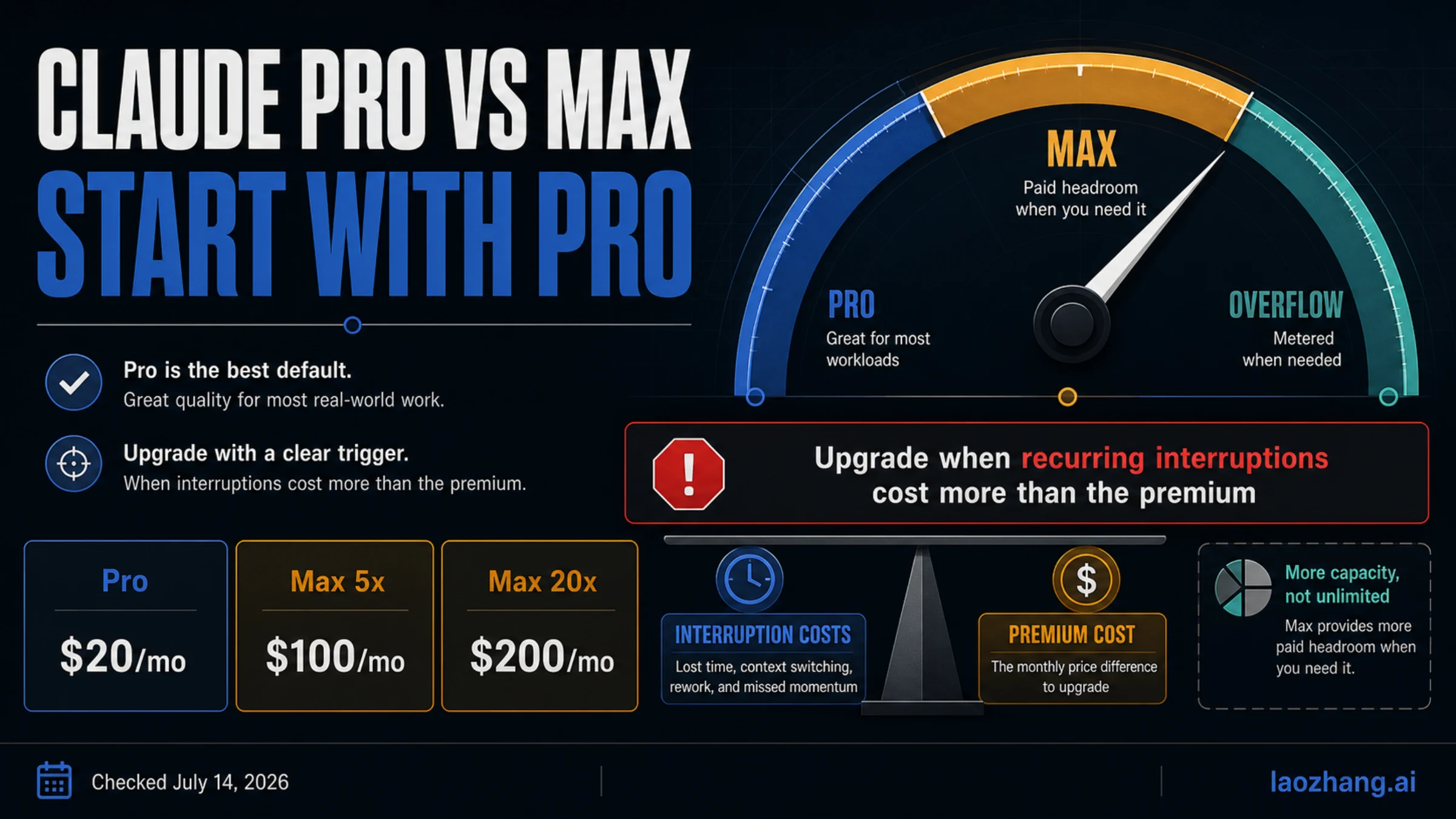
Start with Claude Pro at $20/month. As of July 14, 2026, Max 5x costs $100/month and Max 20x costs $200/month on Anthropic's US consumer surfaces. Pay that premium only when repeated shared-limit interruptions are already costing more than the upgrade. If heavy use arrives in occasional spikes, try Pro plus capped usage credits before committing to Max every month.
Max buys more usage capacity, higher output limits, priority access during high traffic, and earlier access to features. It does not inherently make the same model smarter, make usage unlimited, or expand the current 200K standard paid-plan context window. Claude chat and Claude Code also draw from the same plan allocation, so a plan can feel small even when coding is not the only thing consuming it.
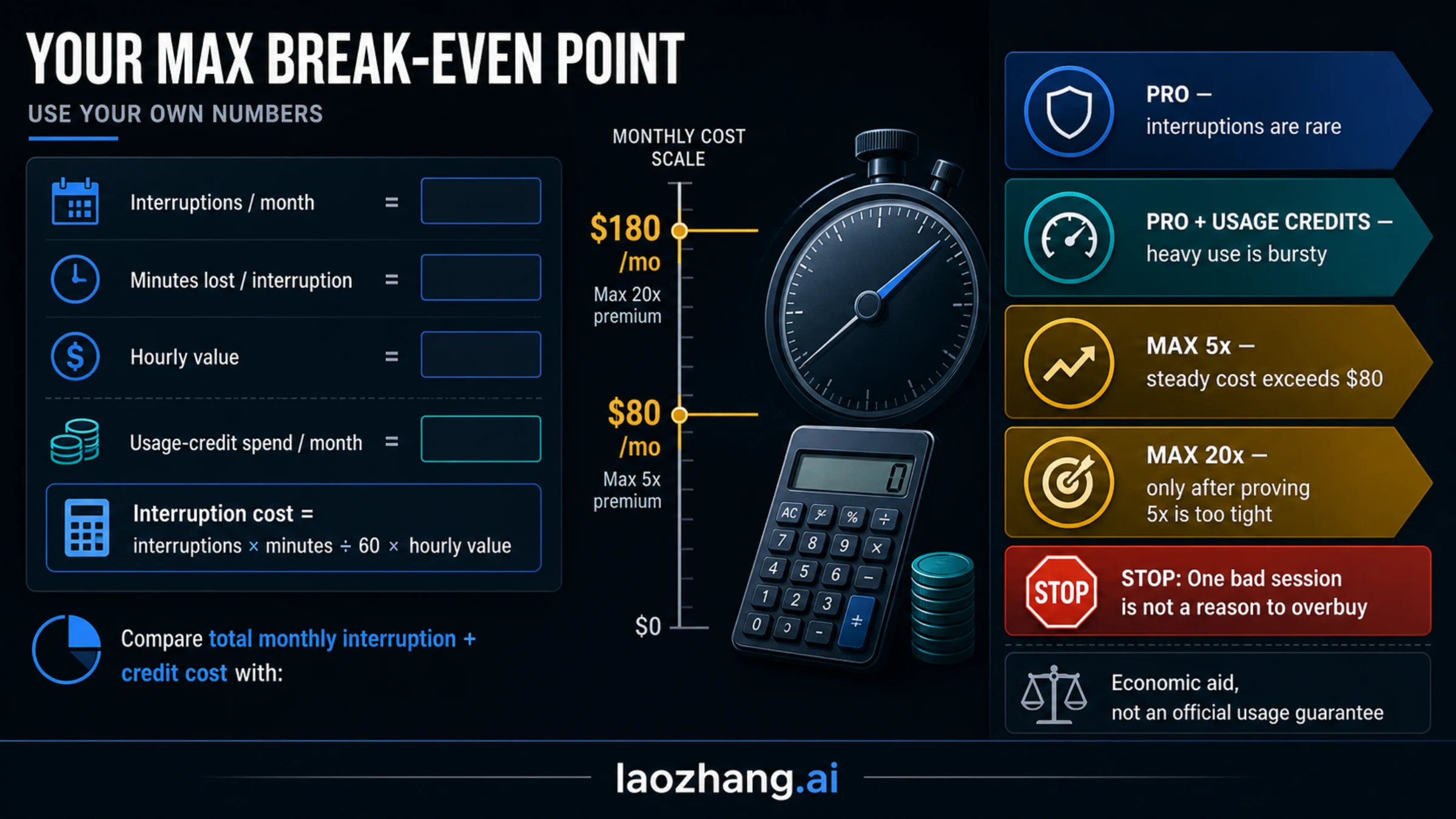
Anthropic does not publish these subscriptions as fixed message, token, or coding-hour entitlements. The useful decision is economic: estimate how often limits interrupt you, how much time each interruption costs, what that time is worth, and how much metered overflow you already buy. Compare that monthly total with the $80 Max 5x premium or the $180 Max 20x premium over monthly Pro pricing.
Evidence note: prices, plan differences, context length, usage credits, prepaid bundles, reset behavior, and Claude Code routing were rechecked against Anthropic's pricing and help-center pages on July 14, 2026. A live Google US result page for
claude pro vs maxwas captured the same day; third-party and community results informed reader questions, not product facts.
TL;DR
- Choose Pro if you code a few focused hours a day, mostly use Sonnet, and only hit limits occasionally.
- Choose Max 5x if Pro limits interrupt you every week, you regularly work in large repos, or you need longer uninterrupted Claude Code sessions.
- Choose Max 20x only if Claude Code is a core part of your all-day workflow and even Max 5x would still feel tight.
- Do not upgrade for “better answers.” With the same model and settings, Max buys capacity and priority, not different model intelligence.
- Do not upgrade for a larger standard context window. Anthropic currently documents 200K for standard paid plans across Pro and Max; context length and usage capacity are separate limits.
- Do not assume Max is unlimited. Max raises your usage band, but it still has session, weekly, and other discretionary caps.
- Do not ignore usage credits. If your heavy usage comes in bursts rather than every day, Pro plus capped usage credits can be cheaper and cleaner than living on Max year-round.
- Do not expect every reset display to change immediately after an upgrade. Check the five-hour session timer, the assigned weekly reset time in Settings > Usage, shared Claude usage, and the active Claude Code login route before escalating.
The Current Claude Pro vs Max Price Ladder
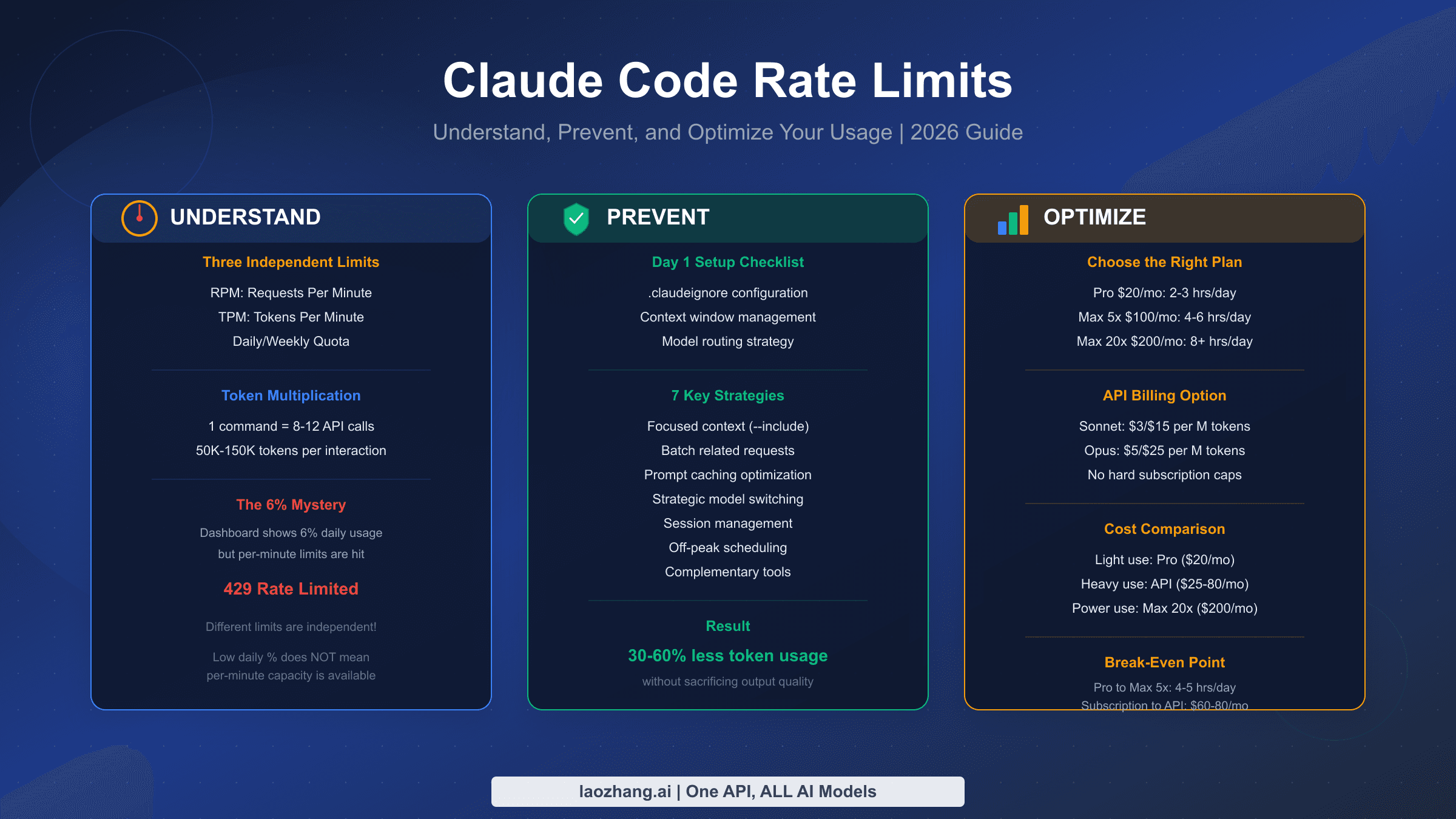
The cleanest way to compare Pro and Max is to separate the fixed part from the fuzzy part. The fixed part is price. The fuzzy part is how much work you can actually get done before you hit a reset window, because Anthropic does not publish a simple public token quota for consumer plans.
Here is the current official consumer ladder:
| Plan | Current price | Claude Code included | Official limit framing | Best fit |
|---|---|---|---|---|
| Pro | $20 monthly, or $200 upfront annually ($17/month equivalent) | Yes | More usage than Free, five-hour session reset, weekly all-model limit | Most individual developers |
| Max 5x | $100 monthly; no annual plan shown | Yes | 5x Pro capacity per session, higher output limits, priority traffic, early access | Steady heavy users |
| Max 20x | $200 monthly; no annual plan shown | Yes | 20x Pro capacity per session, highest consumer headroom, still capped | Sustained edge workloads |
Two details matter more than most pricing guides admit.
First, Claude and Claude Code share the same paid-plan allocation. If you do long research chats, upload large files in Claude, or spend half your day inside the web app, that usage still eats into the same pool you were hoping to save for Claude Code. This is one of the biggest reasons a plan can feel "too small" even when your coding workload alone seems moderate.
Second, compare like with like. The $80 and $180 premiums compare monthly list prices. If you would otherwise prepay Pro annually, Max's effective premium is slightly larger because Max is currently monthly-only.
What Max Changes—and What It Does Not
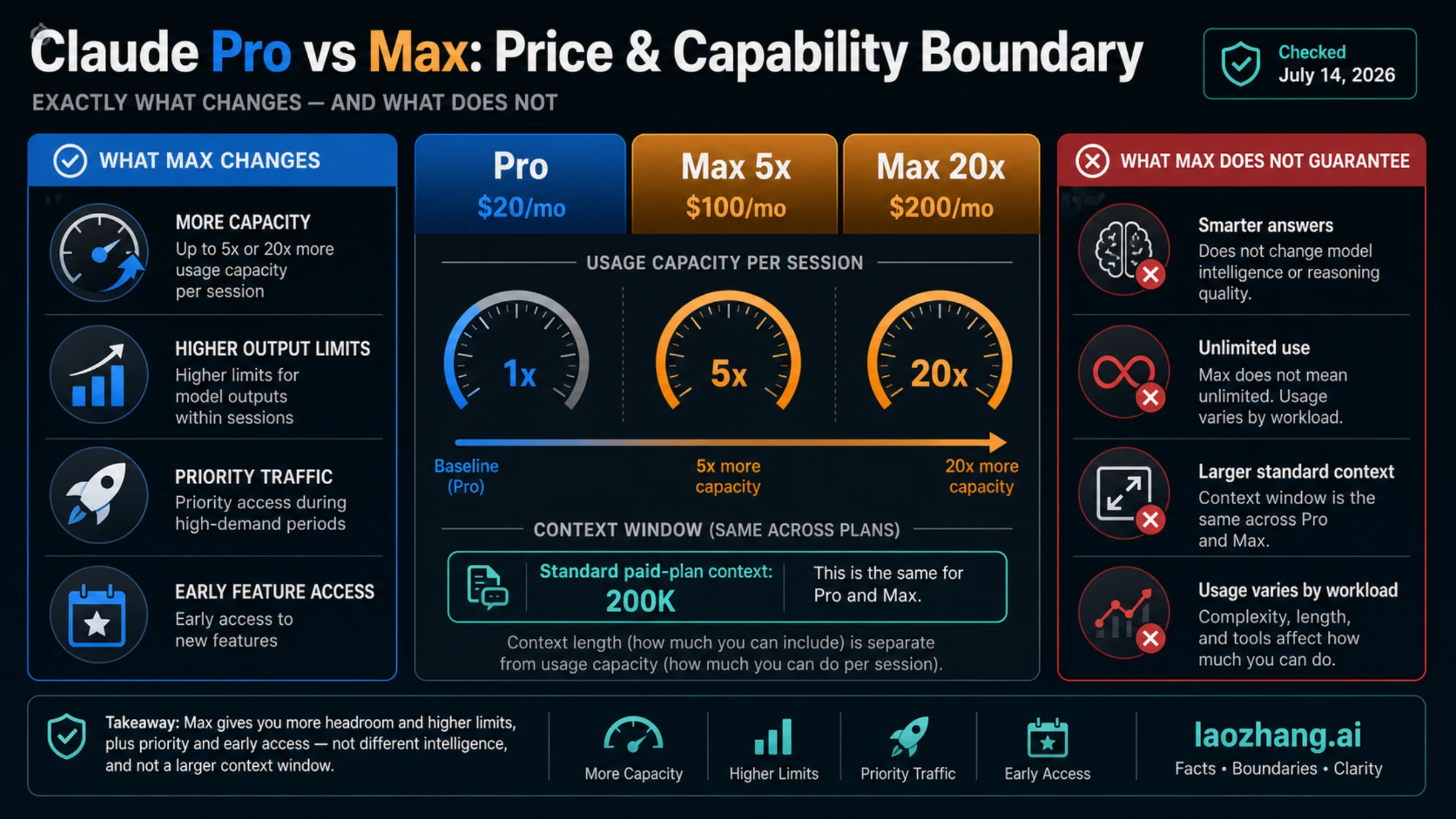
The Max premium has four concrete jobs: it raises usage capacity, raises output limits, gives priority access during high-traffic periods, and gives earlier access to features and models. Those benefits matter when a limit or busy period breaks valuable work.
Three common upgrade reasons do not survive the current official boundaries:
| Question | Current answer | Buying consequence |
|---|---|---|
| Does Max make the model smarter? | Not by itself. If you select the same model and use the same settings, the subscription changes access and headroom, not the model's reasoning ability. | Upgrade for throughput or access, not for a promised quality jump. |
| Is Max unlimited? | No. Session, weekly, and additional discretionary limits still apply. | Size the plan around recurring interruptions, not a fantasy of infinite usage. |
| Does Max have a larger standard context window? | Anthropic currently documents a 200K context window across standard paid plans. | Do not confuse how much one request can hold with how much total work the plan lets you do. |
That last distinction is easy to miss: context length is the maximum information a request can carry; usage capacity is how much work the plan lets you consume across a session or week. Max mainly changes the second.
How Claude Code Limits Actually Work on Pro and Max
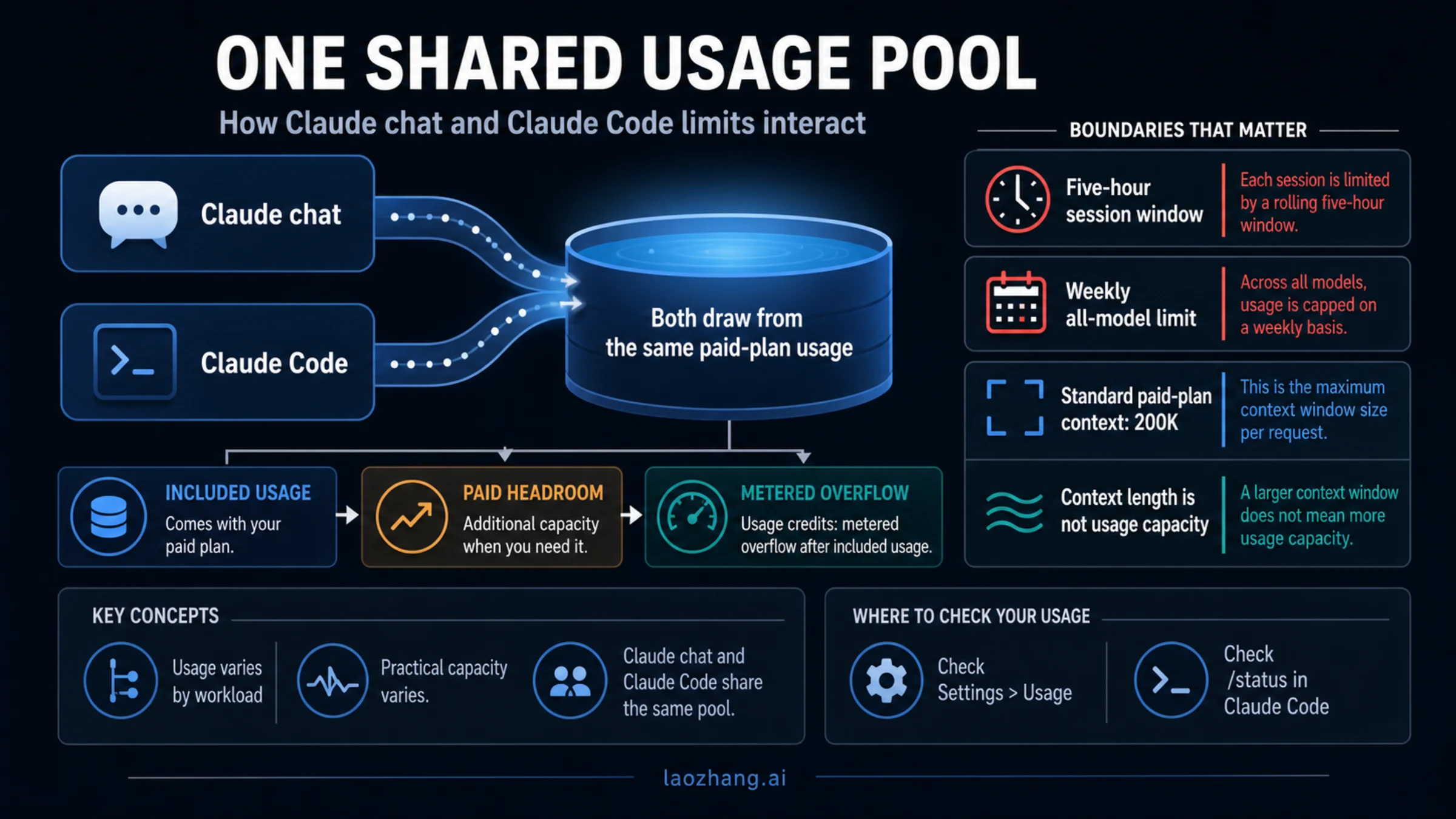
Anthropic's consumer help pages describe Pro and Max limits in terms of sessions, resets, and relative usage bands, not a public "you get exactly X tokens" contract. If you are reading forum posts or older blog guides that quote neat fixed quotas, treat them carefully. The stable facts are simpler than that:
Your included usage is shared across Claude and Claude Code. Anthropic says activity in both tools counts against the same usage limits. For a developer, that means the question is not just "How hard do I push Claude Code?" but also "How much of my paid plan do I burn elsewhere during the same day or week?"
The short reset window is five hours. When you hit your included session limit, Anthropic says your plan allocation resets every five hours. That is the most important operational detail for normal Pro-vs-Max decisions. If your problem is an occasional intense block that runs long, a five-hour reset may be tolerable. If it breaks your work several times a week, that is the clearest sign Pro is no longer the right fit.
There are also weekly limits. Pro has a weekly all-model limit. Max has weekly limits too, including one across all models and another for Sonnet models only. This is why Max does not mean "unlimited." It means a much larger consumer usage band.
Context length is a separate boundary. Anthropic's current usage-and-length guidance lists a 200K context window across standard paid plans. A larger Max usage band lets you do more work, but it does not turn a 200K request into a larger standard request. Some Enterprise cases are documented separately.
Anthropic still reserves the right to impose additional caps. The Pro and Max help pages both say Anthropic may limit usage through weekly or monthly caps, or model and feature usage, at its discretion. That is one more reason not to treat unofficial quota math as a contractual guarantee.
So what do you do with all the message and coding-hour numbers floating around online? Treat them as anecdotes about somebody else's workload, not as your entitlement. Repo size, context growth, model, tools, files, and effort settings all change practical usage.
Calculate Your Max Break-Even Point
You do not need an unofficial message estimate to decide. Use four inputs from your own month:
- How many times included limits interrupt valuable work.
- How many productive minutes each interruption costs, including context switching and restart time.
- What one hour of that time is worth.
- How much you expect to spend on usage-credit overflow.
Your base calculation is:
Monthly interruption cost = interruptions × minutes lost ÷ 60 × hourly value
Then add expected usage-credit spend and compare the total with the plan premium. On monthly list prices, Max 5x is $80 more than Pro, and Max 20x is $180 more than Pro.
Here is an illustrative example, not an Anthropic usage promise. Suppose Pro causes six meaningful interruptions per month, each costs 20 minutes, and your productive time is worth $60/hour. The interruption cost is 6 × 20 ÷ 60 × $60 = $120. Add $15 of expected credits and the monthly pressure cost is $135. That clears the $80 Max 5x premium, but it does not by itself justify the $180 Max 20x premium.
The calculation only works if Max would remove most of that loss. If the real cause is giant contexts, accidental API billing, or unrelated waiting time, the premium will not buy the assumed savings.
Use a typical month, not your worst session. One painful afternoon is evidence to investigate; a recurring pattern is evidence to upgrade.
When Pro Is Still the Right Plan
For most individual developers, Pro remains the best default.
That surprises people because the online conversation is skewed toward power users, not normal users. The people most likely to post about Claude Code limits are the people hitting those limits hard. If you mainly use Claude Code for focused implementation, code review, debugging, or refactoring in one repo at a time, Pro is still the right starting point.
Pro is usually enough if your usage looks like this: you spend a few focused hours a day in Claude Code, you mostly rely on Sonnet rather than Opus, your repos are not enormous, and when you do hit a limit it feels annoying rather than workflow-destroying. In that situation, paying five times more for Max usually buys more headroom than you can convert into real productivity.
There is also a practical cost test here. The difference between monthly Pro and Max 5x is $80/month. If a typical month's Pro interruptions cost less than that, waiting or adjusting your workflow is still cheaper. A single broken afternoon should trigger diagnosis; repeated costly afternoons are what justify a permanent subscription change.
The mistake is upgrading too early because forum math makes Pro sound tiny. Pro is not tiny. Pro just stops being enough once your work pattern becomes consistently heavy enough that the five-hour reset starts showing up inside real deadlines.
When Max 5x Earns Its Price
Max 5x is the tier most people really mean when they ask whether they should upgrade.
It earns its price when your Claude Code usage is no longer "a few intense sessions per week" and has become part of your normal daily workflow. If you are regularly working in larger codebases, asking Claude Code to inspect many files, using longer conversations instead of clearing context often, or leaning on Opus for complex tasks, Pro can start to feel narrow quickly.
Max 5x is the right upgrade when three things are true at once.
The first is that Pro limits are interrupting you regularly, not once in a while. The second is that those interruptions are happening during valuable work, not during optional exploration. The third is that you have already ruled out simpler fixes such as shortening sessions, watching shared Claude usage, or using usage credits only during spikes.
This is also the tier where priority access becomes easier to justify. If Claude Code is part of your core workflow, "higher usage" is only half the story. Reduced friction during busy periods matters too, because the real cost of limits is not just fewer prompts. It is broken momentum.
If you are on the edge, this is the practical question to ask: Would I rather pay $80 more every month, or would I rather keep planning around resets and occasional hard stops? If the second option already feels more expensive in attention and lost flow, Max 5x is doing real work for you.
When Max 20x Is Actually Justified
Max 20x is not the default power-user plan. It is the edge-case power-user plan.
The people who genuinely need it tend to have one or more of these patterns: Claude Code is open for most of the day; they work across especially large codebases; they run multiple demanding sessions; they rely on Opus-heavy workflows; or they treat Claude Code less like an assistant and more like a constant paired operator.
That is a real category of user. It is just a much smaller category than the online discussion makes it sound.
If Max 5x would already eliminate most of your interruptions, Max 20x is overbuying. The 20x tier only makes sense when your current or expected usage stays high enough that even Max 5x would still force you back into planning around resets. If you cannot describe exactly why 5x is still insufficient, you probably do not need 20x.
There is also a behavioral trap here: some people buy the highest tier because it feels safer. In practice, that often turns a workflow problem into a spending problem. If the real issue is oversized sessions, large shared chat usage, or an API key accidentally shifting you onto a different billing path, Max 20x will not solve the underlying mistake. It will just give you a more expensive way to keep making it.
Pro Plus Usage Credits and Bundles vs Max
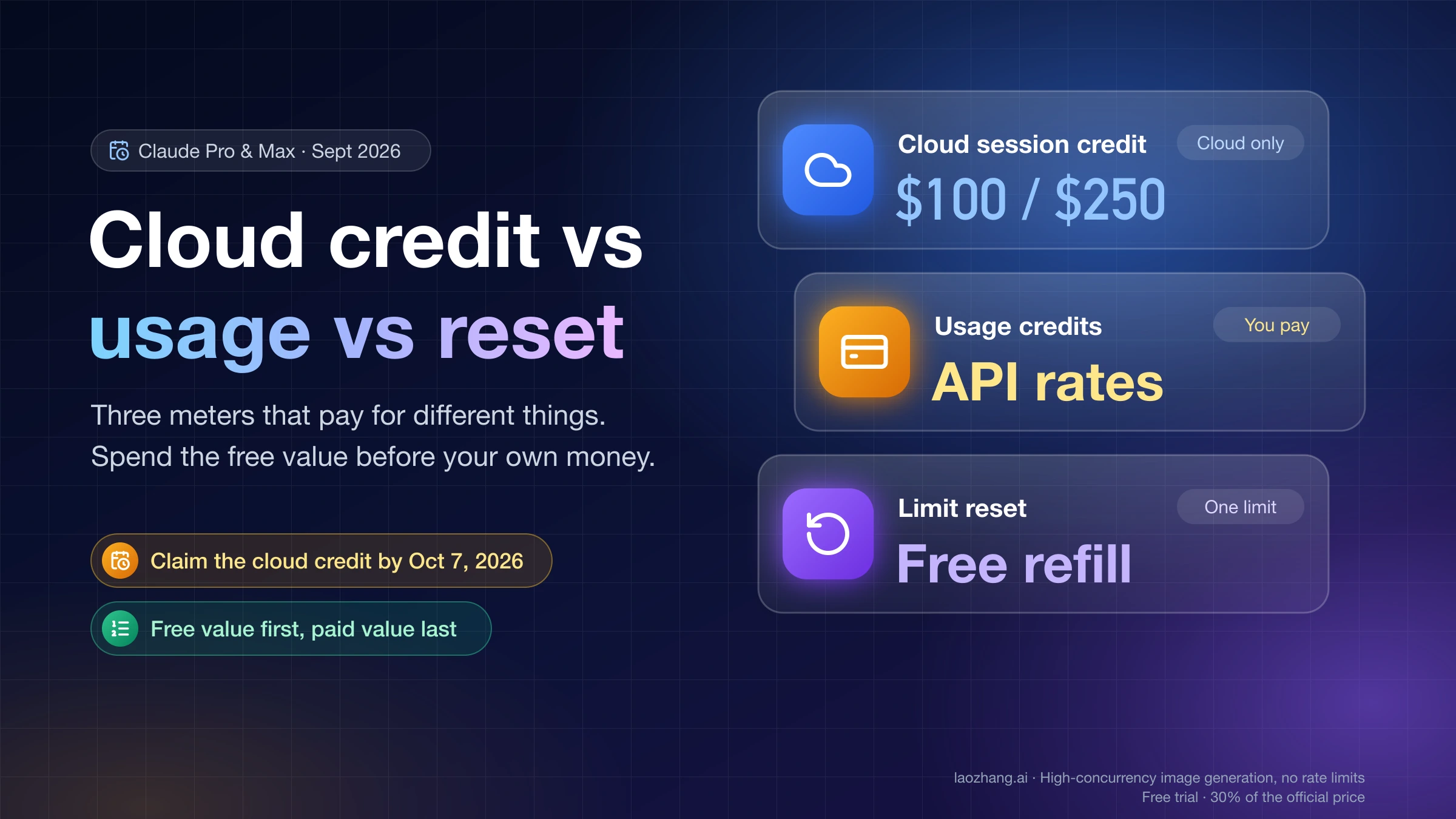
The most underrated 2026 change in Anthropic's consumer plan structure is that usage credits now exist for paid Claude plans, including Pro, Max 5x, and Max 20x.
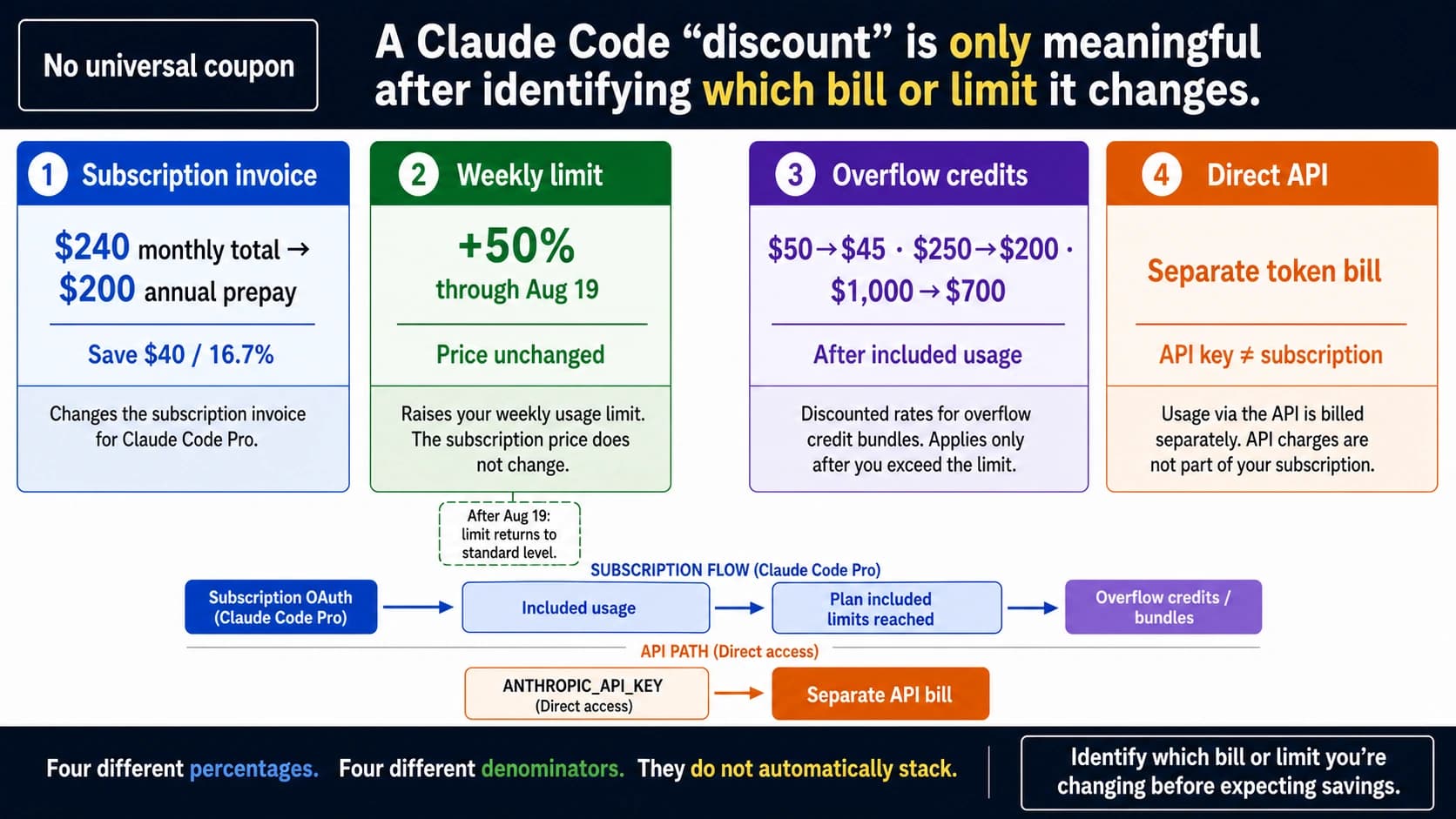
Usage credits matter because they create a third path between "stay on Pro forever" and "upgrade to Max forever." Once enabled, hitting your included plan limit no longer has to mean stopping completely. Anthropic lets you continue through consumption-based pricing at standard API rates, and you can put a monthly cap on how much you are willing to spend. Anthropic also frames that switch as a user-controlled choice, which matters if you want overflow capacity without turning your subscription into an open-ended bill.
Anthropic also currently sells prepaid usage bundles for paid plans. The official support page lists $50 of value for $45, $250 for $200, and $1,000 for $700. Those are 10%, 20%, and 30% purchase discounts, respectively. A bundle still starts only after included usage is exhausted; it is not extra included capacity, a new reset window, or a substitute for choosing the right base plan.
That changes the decision for a lot of developers.
If you are a bursty heavy user rather than a constant heavy user, Pro plus usage credits can be the smartest setup. Maybe most weeks you fit comfortably inside Pro, but one release week, one incident week, or one migration week pushes you hard. In that case, paying for Max every month may be wasteful. Paying Pro pricing most months and using capped overflow only when needed can be the cleaner option.
Max still wins when the heavy usage is steady enough that overflow spending would become the norm, or when you care about the non-price differences like priority access and higher output limits. But if your pain comes in spikes, do not skip straight from Pro to Max without considering usage credits first.
The right mental model is simple:
- Steady heavy usage favors Max.
- Spiky heavy usage often favors Pro plus usage credits.
- Predictable, repeated overflow may justify a discounted bundle, but only if its spend remains below the Max premium and priority/output benefits do not matter.
That is a much more useful distinction than asking which plan has the prettiest multiplier.
Why Pro Can Feel Too Small Even When Pro Should Be Enough
Before you conclude that you need Max, make sure you are not accidentally making Pro feel smaller than it really is.
Shared chat usage is the first culprit. If you spend a lot of time in the Claude web app doing research, long chats, or document work, you are shrinking the same pool Claude Code depends on. Many developers evaluate their Claude Code tier as if coding were the only thing that counts. Anthropic says it is not.
Long sessions are the second culprit. Claude Code work gets more expensive as context grows. If you keep one long-running conversation alive all day, you are making every later prompt heavier than it needs to be.
Large codebases and aggressive settings are the third culprit. Anthropic's own help text says codebase size and settings like auto-accept affect how quickly you hit limits. If your workflow encourages Claude Code to read broadly and act aggressively, your paid plan will feel smaller than it would under tighter, more focused use.
Accidental API billing is the fourth culprit. Anthropic's help center explicitly warns that if ANTHROPIC_API_KEY is set in your environment, Claude Code can authenticate against the API rather than your paid plan. That changes the billing path completely. If your spending or behavior suddenly looks wrong, check your auth path before you blame Pro or Max.
If you are already seeing Rate limit reached errors, the next step is not more theory. It is a diagnostic pass. Our Claude Code rate limit reached guide walks through the practical fixes.
Why the Limit Reset May Not Change Right After You Upgrade
This is the post-upgrade trap: you hit a Pro limit, buy Max 5x or Max 20x, return to Claude Code, and the reset display still looks unchanged. Several legitimate states can produce that symptom.
| What did not change? | Likely reason | What to check first |
|---|---|---|
| The current-session timer still points to the old time | The five-hour session window is already in flight; a bigger plan does not necessarily create a new clock for exhausted usage | Settings > Usage and Claude Code /status |
| Weekly usage still looks depleted | Weekly limits reset at an account-assigned time, not when a subscription begins | Settings > Usage for the next all-model and model-specific reset times |
| Claude Code still shows the old plan | The terminal, IDE extension, or local client may retain old authentication state | Run /logout, update and restart Claude Code, then sign in with the intended account |
| Work continues but charges separately | Usage credits or Console/API billing may be active instead of included plan usage | Settings > Usage, /usage-credits, /status, and ANTHROPIC_API_KEY |
| The web account is updated but the terminal is not | Claude Code may be on another account, an API key, a gateway route, or a cached session | Compare the web account with /status and remove accidental alternate routes |
Upgrade state, reset state, and billing route are separate proof. Confirm the subscription, check reset timers, and confirm Claude Code's active route before deciding whether to wait, re-authenticate, use credits, or contact support.
The Real Upgrade Point
So where is the real line?
It is not "the moment you hit a limit once." It is not "the moment a forum thread says Pro is too small." And it is not "the moment you think a bigger plan would feel safer."
The real upgrade point is when a typical month of interruption cost plus overflow spend exceeds the premium, and Max is likely to remove most of that loss.
If that is not happening yet, stay on Pro.
If it is happening regularly, and especially if it is happening during work that pays your bills, move to Max 5x.
If even Max 5x still looks narrow because Claude Code is an all-day, multi-session part of your workflow, only then should Max 20x enter the picture.
And if your heavy usage comes in bursts, remember that Pro plus usage credits may be the best answer of all.
FAQ
Does Max remove Claude Code rate limits?
No. Max raises your included usage band, but Anthropic still documents session limits, weekly limits, and additional discretionary caps. Max is "much more headroom," not "unlimited."
Does Claude Max give better answers than Pro?
Not automatically. If both plans use the same model, mode, and settings, Max changes access, capacity, output headroom, priority, and feature timing—not the underlying model intelligence.
Does Max have a larger context window than Pro?
Not on Anthropic's current standard paid-plan boundary. The documented standard context window is 200K across Pro and Max. Max raises usage capacity; context length is a separate limit.
Should I upgrade the first time I hit Pro limits?
Usually no. First ask how often it happens, whether shared Claude chat usage is contributing, and whether usage credits would handle your occasional spikes more cheaply.
Why did my Claude Code limit reset not change immediately after upgrading to Pro or Max?
Usually because the visible limit is tied to an already-running five-hour session window, an account-assigned weekly reset, shared Claude usage, usage-credit overflow, or the wrong local auth route. Check Settings > Usage and Claude Code /status before assuming the plan upgrade failed.
Are the message and coding-hour estimates online official entitlements?
No. Anthropic's current public contract is relative and workload-dependent. Model choice, context growth, repo size, tools, files, and effort all change practical usage, so do not buy a plan from somebody else's message count.
Should I use usage credits, a prepaid bundle, or Max?
Use capped credits for unpredictable spikes, consider a bundle for repeat overflow that remains economically below the Max premium, and choose Max when heavy usage is steady or priority and output headroom matter. Bundles and credits start after included usage; they do not reset the included window.
If I only have one subscription, should it be Pro or Max?
For most individuals, Pro. Max becomes worth it when the cost of interruptions is clearly higher than the cost of the upgrade. Recalculate after two representative weeks or whenever Anthropic changes the plan terms.