Muse Wonder vs Opus 5.5: Benchmarks and Cost at the Same $4/$20
At max effort on Artificial Analysis, Claude Opus 5.5 scores 58 to Muse Wonder's 52, but Wonder costs 24% less per task. Wonder Full has no API.
On this page
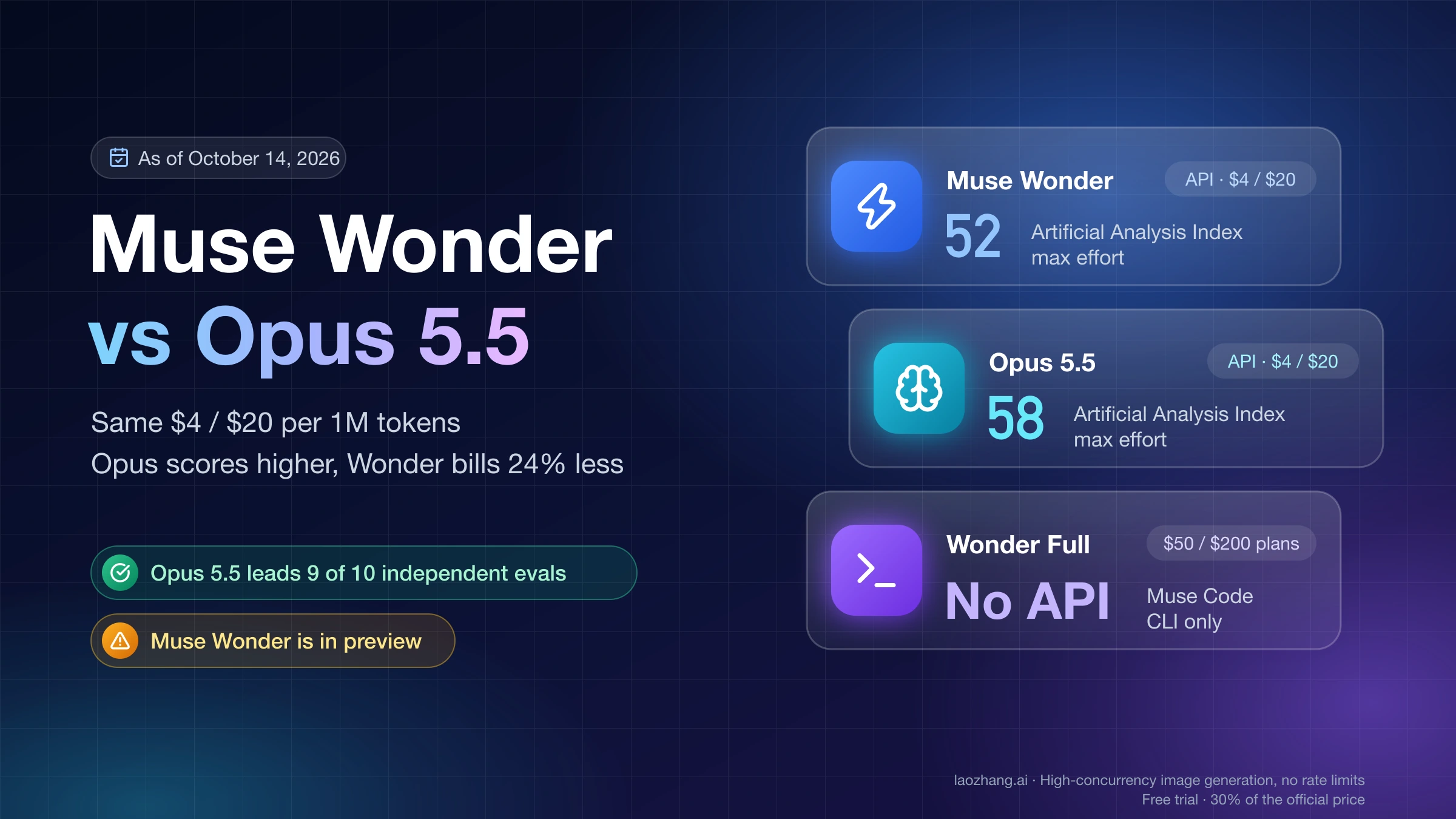
Muse Wonder and Claude Opus 5.5 list the same API price: $4 per million input tokens and $20 per million output tokens. The catch is that "Muse Wonder" is two models. The one you can call by API, muse-wonder-1.0, trails Opus 5.5 on independent tests. Artificial Analysis scores it 52 against Opus 5.5's 58, both at max effort. Most of the rows where Meta's launch table shows a Muse model beating Opus 5.5 belong to the second variant, Muse Wonder Full, and it has no API. You get it only inside Meta's Muse Code CLI, on the $50 Power Usage or $200 Maximum Usage plan.
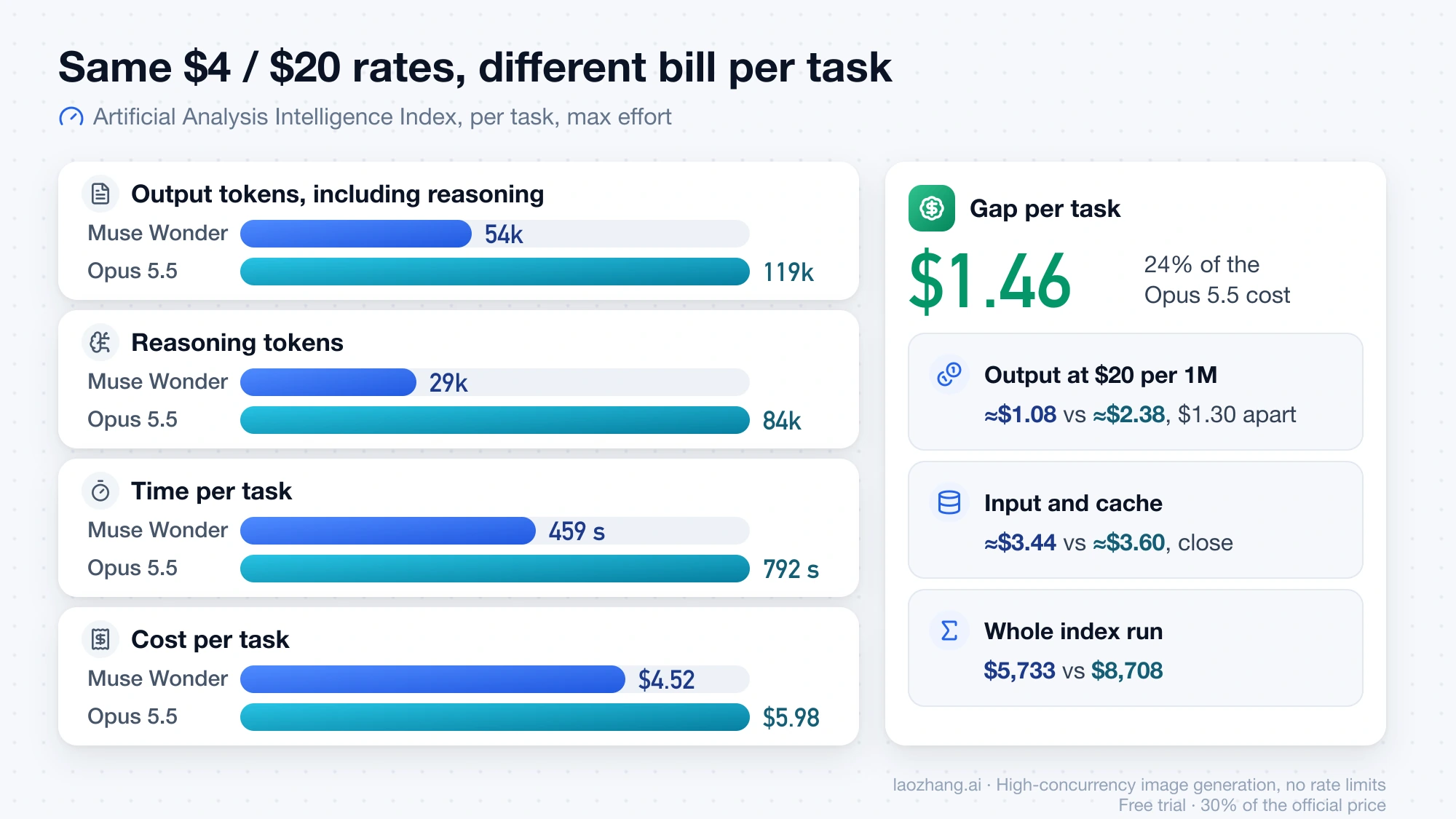
Muse Wonder wins on the bill and the clock instead. In that same Artificial Analysis run it produced 54k output tokens per task against 119k for Opus 5.5. A task cost $4.52 instead of $5.98, and took about 459 seconds instead of 792.
As of October 14, 2026, the short answer:
- Stay on Opus 5.5 if task success matters more than price or speed, or if your work involves 3D, games or other visual and spatial reasoning.
- Add Muse Wonder through the API for long agent runs where a cheaper, faster attempt is worth a lower score, and test it on your own tasks first.
- Pay $50 a month for Muse Code only if you specifically want Wonder Full. It works only in Meta's CLI, and the plan uses your code for training unless you switch that off.
Neither model was run hands-on for this comparison. Every score and cost below comes from Meta, Artificial Analysis or a named user report, and the setup is given next to each one.
Which Muse Wonder beats Opus 5.5? Mostly Full, the one with no API
Meta released Muse Wonder and Muse Wonder Full on October 12, 2026. They share a name and a model card, but you buy them through different doors. Meta's model documentation says Wonder Full is "available only in Muse Code with a subscription, so setting reasoning effort to "max" on Muse Wonder doesn't select it." Turning effort up on the API model gives you more reasoning from Muse Wonder, not a different model.
| Muse Wonder | Muse Wonder Full | |
|---|---|---|
| Model ID | muse-wonder-1.0 | muse-wonder-full-1.0 |
| Meta Model API | Yes, Standard mode only | Not available |
| OpenRouter | Yes, $4 / $20 | No |
| Muse Code | Pay-as-you-go and every plan | Power Usage ($50) and Maximum Usage ($200) plans only |
| Token price | $4 input, $0.20 cached input, $20 output per 1M | None published |
| Context window | 1,048,576 tokens | 1M tokens |
| Rows ahead of Opus 5.5 in Meta's own benchmark table | 5 of 14 | 8 of 14 |
Meta labels Muse Wonder as "in preview," so prices, plans and limits can still move.
A few names around it are easy to mix up. Muse is Meta's consumer assistant app. Meta says Wonder "will soon power experiences in Muse," starting with subscribers, but gives no date; the app itself is covered in ChatGPT Dots vs Meta Muse vs Grok Bot: $100, $0, or $20 to Start. Muse Spark is Meta's cheaper model line, at $1.25 input and $4.25 output per million tokens for Spark 1.3. Muse Code is Meta's coding agent for the terminal, similar in role to Claude Code. One more clash: lowercase "max" in this comparison means the reasoning effort setting, while capital-M Max is Anthropic's $100 and $200 Claude plan.
Where to get Muse Wonder, Wonder Full and Opus 5.5, and at what price
Every route below comes from Meta's pricing and rate limits page, the Muse Code plans page, Anthropic's Claude API pricing documentation and the Claude plans page. Prices are in USD before tax.
| Route | What it gets you | Price |
|---|---|---|
| Meta Model API, pay-as-you-go | Muse Wonder only | $4 input, $0.20 cached input, $20 output per 1M tokens; web search $2.50 per 1,000 queries |
| OpenRouter | Muse Wonder only, served by one provider | $4 / $20, cache $0.20 |
| Muse Code, pay-as-you-go | Muse Wonder | Per token on your Meta API key, same rates |
| Muse Code Everyday Usage / High Usage | Muse Wonder, Muse Spark, Muse Image; Everyday allows 10–50 prompts every 5 hours, High allows 5x that | $5 / $15 per month |
| Muse Code Power Usage / Maximum Usage | Everything above plus Muse Wonder Full; 20x and 80x Everyday usage | $50 / $200 per month |
| Claude API | Opus 5.5 (claude-opus-5-5) | $4 / $20; Batch $2 / $10; fast mode (research preview) $8 / $40; web search $10 per 1,000 searches |
| Claude Free | No Opus | $0 |
| Claude Pro | Opus 5.5 in the Claude apps and Claude Code | $20 a month, or $17 a month billed annually |
| Claude Max 5x / Max 20x | Opus 5.5 with more usage, plus $100 or $200 a month in API credits | $100 / $200 per month |
Some details in that table change real decisions:
- A Muse Code plan only works inside the Muse Code CLI. Meta's subscriptions page says any other API key you create bills pay-as-you-go. You cannot point your own agent at Wonder Full.
- Claude Max API credits cover the Claude API, Managed Agents, the Agent SDK and the playground, but not Claude Code. They expire each billing cycle without rollover, according to Anthropic's API credits for subscribers page. What each plan's 5x and 20x actually multiply is broken down in Claude Usage Limits by Plan: What 5x and 20x Actually Multiply.
- Meta's pricing page lists no batch discount for Muse Wonder. Anthropic halves Opus 5.5 prices for asynchronous Batch jobs.
- Rate limits for
muse-wonder-1.0are 3,000 requests and 4,000,000 tokens per minute per team. They apply across all keys in the team. - Output length: Opus 5.5 returns up to 128K tokens per response, or 300K on Batch with a beta header. Meta does not publish a maximum output figure for Muse Wonder.
- Location: Meta's geographic use policy bars access from territories that include China (with Hong Kong and Macau), Russia, Belarus, Iran, Pakistan and Venezuela, among others. Muse Code subscribers must also be 18 or the age of majority in their country.
The full Opus 5.5 rate card, including cache writes and data residency, is in Claude Opus 5.5 Pricing and Limit Reset: What Each One Changes.
Independent tests: Opus 5.5 beats Muse Wonder on 9 of 10 evaluations
The cleanest head-to-head is Artificial Analysis' Muse Wonder vs Claude Opus 5.5 comparison. It runs both models at max effort through the same ten evaluations behind its Intelligence Index v4.3.2. Wonder Full is not on that public comparison page, so it has no published per-task cost or token counts from Artificial Analysis. Its Artificial Analysis-sourced scores appear only in Meta's own table, covered in the next section.
| Artificial Analysis, max effort | Muse Wonder | Claude Opus 5.5 |
|---|---|---|
| Intelligence Index v4.3.2 | 52 | 58 |
| Terminal-Bench 4.0 (agentic coding) | 52% | 60% |
| SciCode (coding) | 60% | 67% |
| Humanity's Last Exam | 50% | 61% |
| AA-Omniscience (knowledge, penalizes hallucination) | 25 | 46 |
| AA-LCR v1.1 (long-context reasoning) | 81% | 85% |
| AutomationBench-AA (business workflows) | 68% | 70% |
| CritPt (physics) | 28% | 32% |
| AA-Briefcase v1.1 (knowledge work, Elo) | 1659 | 1805 |
| GDPval-AA v2.1 (real-world work, Elo) | 1770 | 1866 |
| GDP.pdf (document reasoning) | 31% | 26% |
| Output speed | 115 tokens/s | 95 tokens/s |
| Time per index task | 459 s | 792 s |
Opus 5.5 leads on nine of the ten evaluations. Some gaps are small, like AutomationBench at 70% against 68%. Others are wide: 21 points on AA-Omniscience and 11 on Humanity's Last Exam. Muse Wonder's clear wins are speed and GDP.pdf.
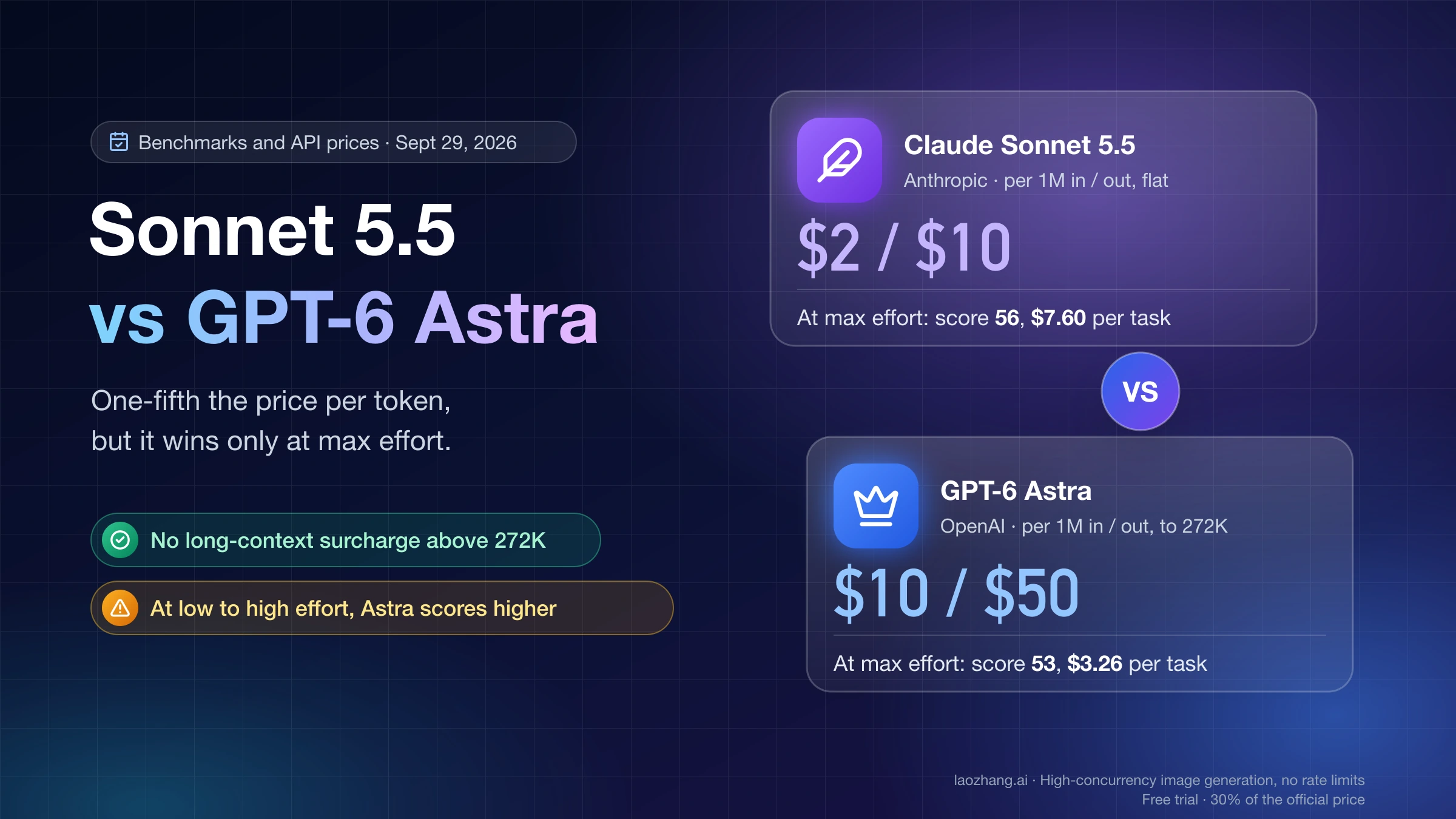
Agent products tell a closer story. Latent.Space's October 13 launch roundup reports Artificial Analysis' Coding Agents Index, which scores a model and its agent harness together. Wonder Full inside Muse Code scored 68. That tied Claude Code with Sonnet 5.5 at 68 and edged out Opus 5.5 at 66. Plain Muse Wonder scored 63. These are product scores, not raw model scores, and a cheaper Claude model sits level with Wonder Full. That makes Claude Sonnet 5.5 vs Opus 5.5: When Half the Price Really Saves worth a look before you buy a second subscription.
Early practitioner reactions collected in the same roundup are mixed. Theo ranks Muse Wonder in his top tier next to Opus 5.5 but does not recommend replacing Opus. QuixiAI places Wonder Full at high effort below Claude Code with Opus 5.5. scaling01, who disclosed Meta-provided access, called Wonder Full's SVG output "too gimmicky" and estimated Meta at three to six months behind Anthropic and OpenAI.
Meta's own table: Wonder Full leads Opus 5.5 on 8 of 14 rows
Meta's Muse Wonder model page publishes a broader table, all at max effort. It is a vendor table, and the sources behind each row differ. Read the last column before you read the scores.
| Benchmark | Wonder Full | Muse Wonder | Opus 5.5 | Where the result comes from |
|---|---|---|---|---|
| Personal Superintelligence Index | 59.1 | 54.3 | 55.2 | Meta internal composite |
| Harvey LAB-AA (legal agent work) | 13.1 | 10.0 | 4.2 | Artificial Analysis |
| Vals Finance Agent V2 | 59.1 | 56.6 | 58.6 | Vals AI |
| HealthBench Pro | 62.3 | 60.5 | 65.6 | Meta's framework; Opus from Anthropic's system card |
| AutomationBench-AA | 45.4 | 39.1 | 41.2 | Artificial Analysis, strict pass@1 |
| GDP.pdf | 33.2 | 30.8 | 30.6 | Surge |
| JobBench | 75.3 | 70.5 | 75.4 | Rubric-scored work products |
| OSWorld V2.1 (computer use, partial) | 78.4 | 72.6 | 81.8 | Meta's framework; Opus is Anthropic's own reported score |
| MemoryBench | 85.5 | 85.6 | 81.5 | Meta internal |
| Terminal-Bench 4.0-AA | 57.1 | 52.0 | 59.6 | Artificial Analysis |
| DeepSWE 1.1 (long-horizon coding) | 79.0 | 78.8 | 74.2 | Datacurve |
| SWE-Marathon | 57.5 (xhigh) | 53.1 | 46.3 | Abundant AI; harnesses differ |
| ProgramBench (from-scratch programs) | 59.0 | 50.0 | 70.5 | Same mini-swe-agent harness for all |
| Artificial Analysis Index | 56 | 52 | 58 | Artificial Analysis |
Bold marks the highest score in each row.
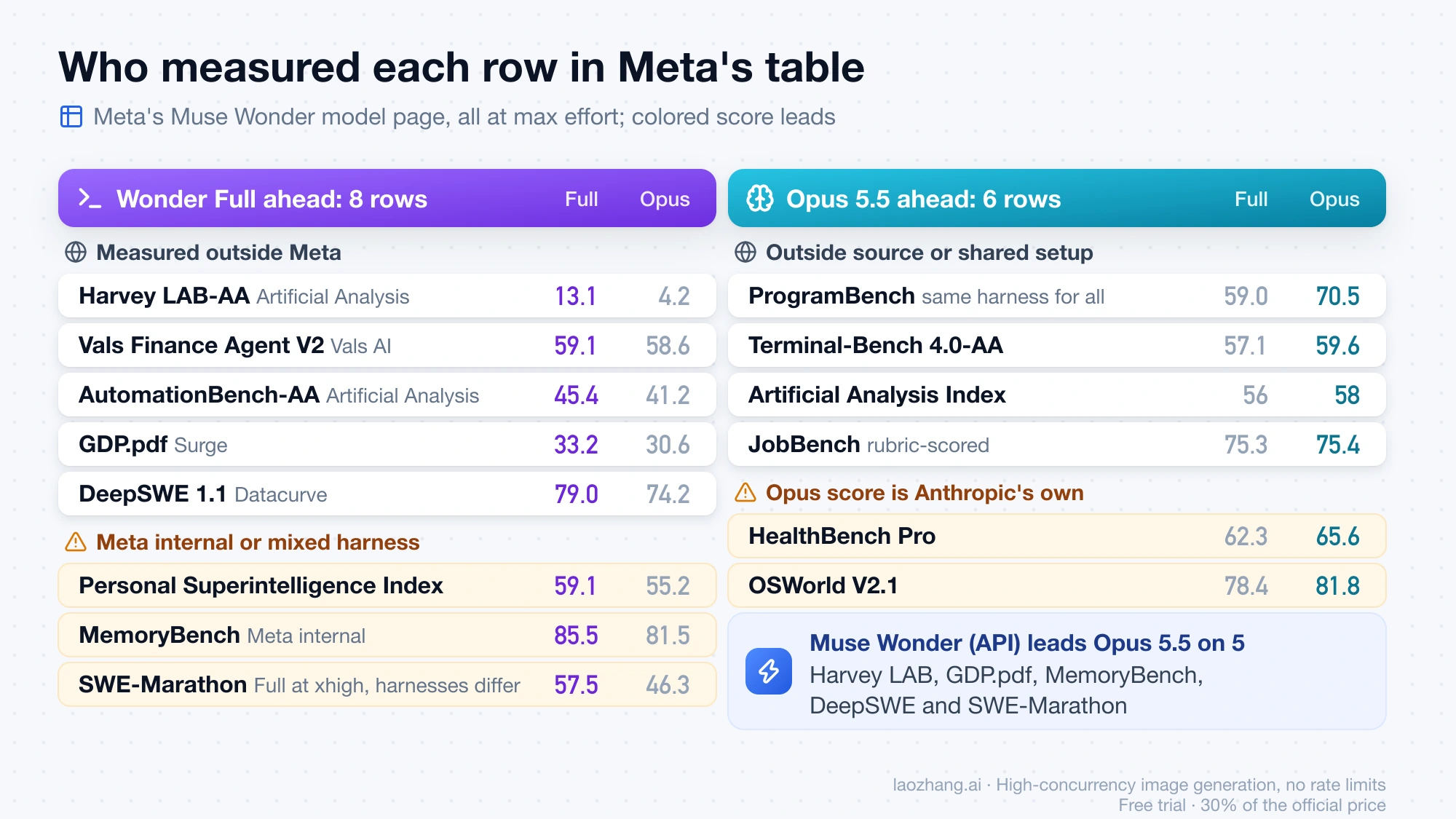
Wonder Full leads Opus 5.5 on eight rows. Plain Muse Wonder, the model you can call by API, leads on five: Harvey LAB, GDP.pdf, MemoryBench, DeepSWE and SWE-Marathon. If you have seen "85.6 against 81.5" in launch coverage, that is MemoryBench, one of Meta's internal benchmarks, and the score belongs to the API model.
Three of Wonder Full's eight wins sit on the least comparable rows. The Personal Superintelligence Index and MemoryBench are Meta's internal benchmarks. The SWE-Marathon row is, in the model card's own words, "not a controlled common-harness comparison," and Full ran at xhigh effort there. The model card also says Meta's competitor runs are "best-effort: prompts, tools, and runtime may not be optimally tuned for proprietary models."
The rows the model card attributes to outside sources split both ways. Wonder Full leads Opus 5.5 on Harvey LAB, Vals Finance Agent, AutomationBench-AA, GDP.pdf and DeepSWE. Its widest margin is Harvey LAB legal work, 13.1 against 4.2, a result from Artificial Analysis. Opus 5.5 leads on Terminal-Bench and the Artificial Analysis Index, both also sourced from Artificial Analysis, including the Wonder Full scores. Opus 5.5's widest margin anywhere in the table is ProgramBench, where every model ran in the same mini-swe-agent harness and Opus scored 70.5 against Wonder Full's 59.0. On HealthBench Pro and OSWorld, the Opus 5.5 figures are Anthropic's own reported scores set beside Meta's runs.
AutomationBench-AA appears in both tables with different numbers: 39.1 against 41.2 in Meta's table, 68% against 70% on Artificial Analysis' page. Meta reports a strict pass@1 metric. The two sets of figures measure the task differently and should not be combined, though both put Opus 5.5 slightly ahead of Muse Wonder.
Same $4/$20 list price, different bill: $4.52 vs $5.98 per task
A token bill on either API works the same way:
cost = input tokens × $4 / 1M + cached input tokens × $0.20 / 1M + output tokens × $20 / 1MIf both models used identical tokens, they would cost the same. A job with 1M uncached input tokens and 200K output tokens costs $4.00 + $4.00 = $8.00 on Muse Wonder or Opus 5.5.
They don't use identical tokens. Artificial Analysis measured this across its index at max effort:
| Per Intelligence Index task, max effort | Muse Wonder | Claude Opus 5.5 |
|---|---|---|
| Output tokens (including reasoning) | 54k | 119k |
| Reasoning tokens | 29k | 84k |
| Cost per task | $4.52 | $5.98 |
| Cost to run the whole index | $5,733 | $8,708 |
The per-task gap is $1.46, or 24% of the Opus 5.5 cost: ($5.98 − $4.52) ÷ $5.98 = 0.244. Most of it is output. At $20 per million, 54k output tokens cost about $1.08 and 119k cost about $2.38, a $1.30 difference. The remaining $3.44 against $3.60 is input and cache, which come out close. Treat that split as approximate, because Artificial Analysis weights each evaluation in its averages. At max effort, Opus 5.5 spends almost three times as many reasoning tokens (84k against 29k), and you pay for each of them at the output rate.
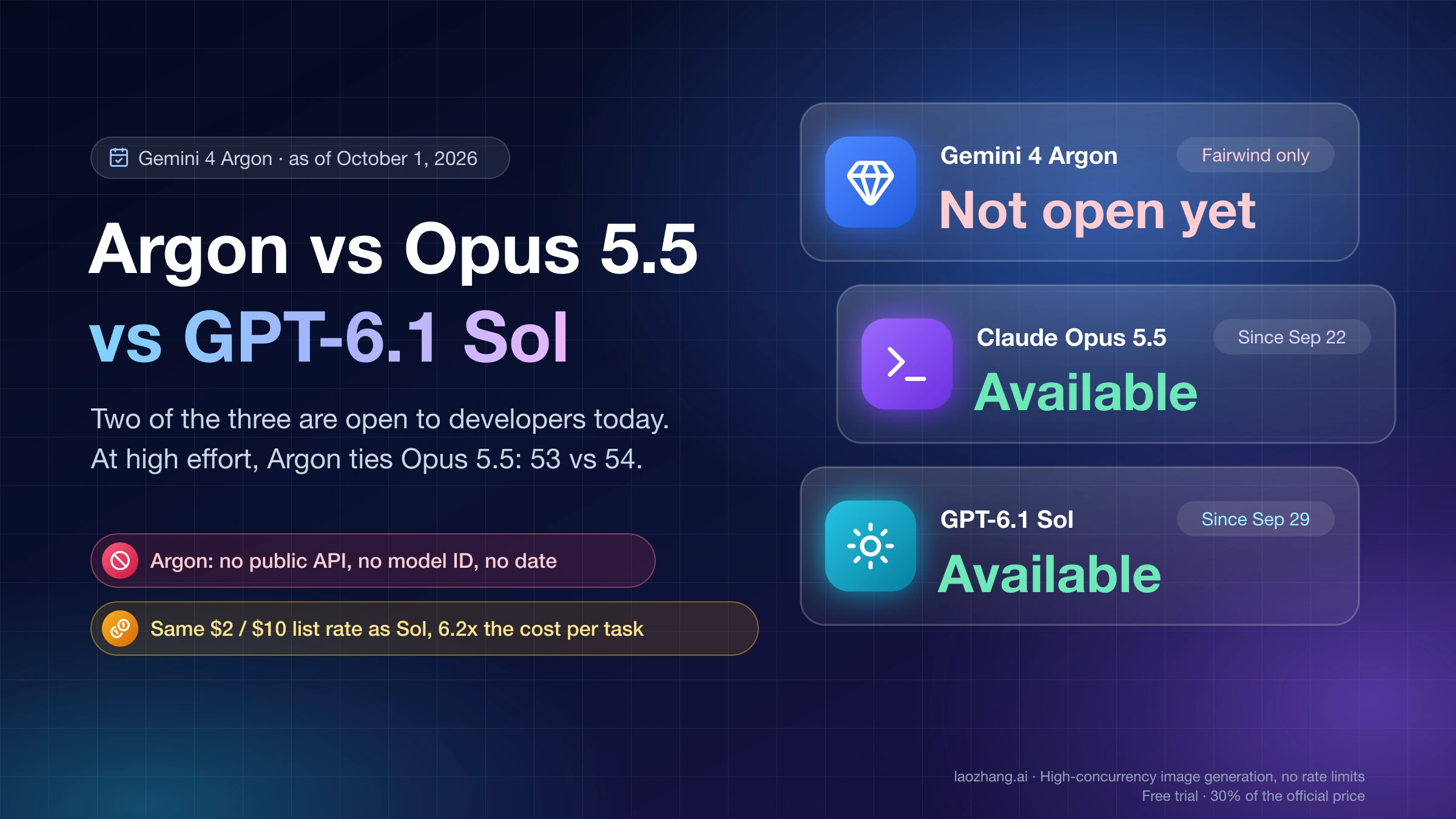
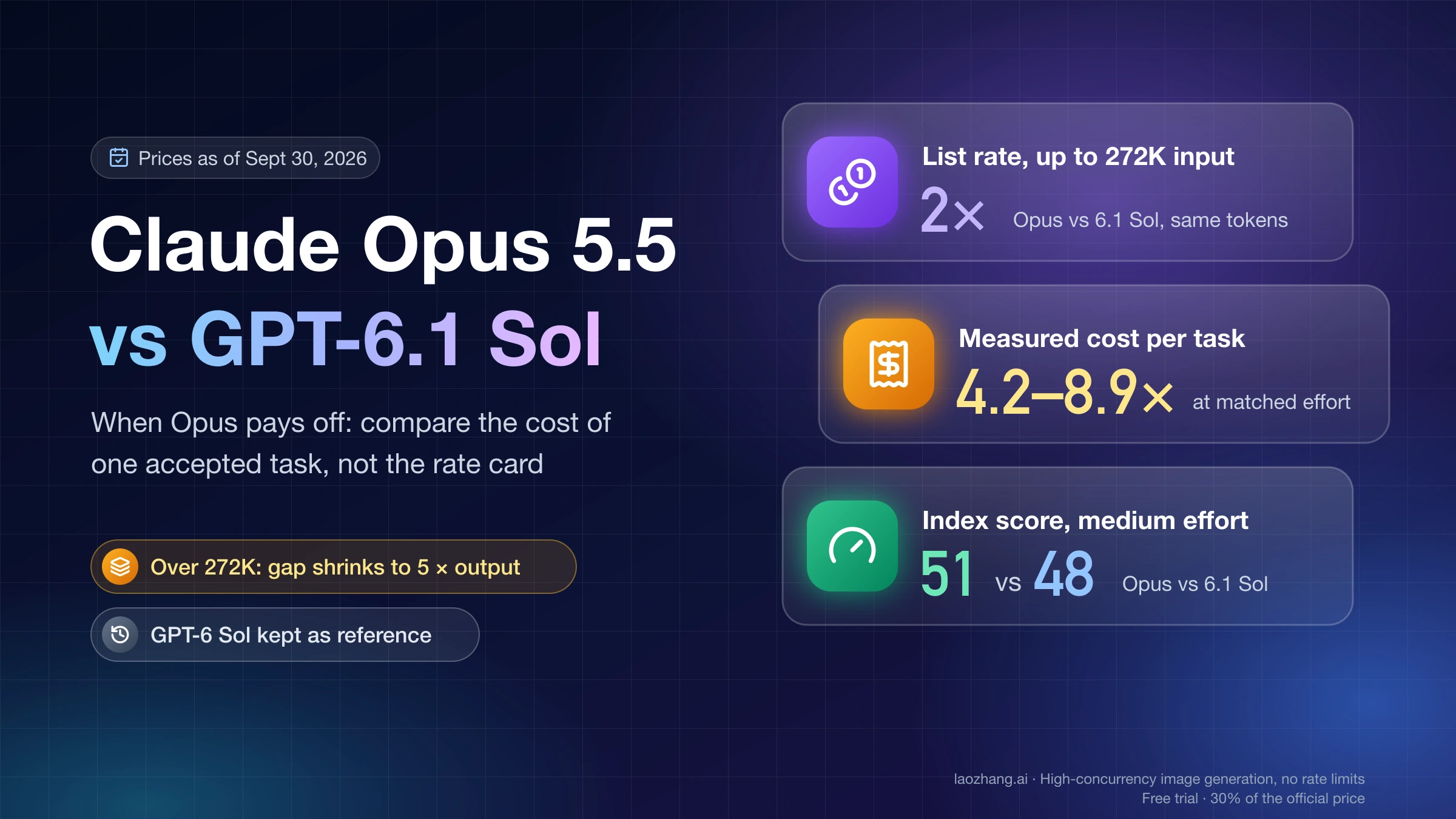
Compare at the same effort. Every figure above is at max effort. At "high" effort, Artificial Analysis lists Opus 5.5 at $1.82 per task with an index score of 54, as covered in Gemini 4 Argon vs Claude Opus 5.5 vs GPT-6.1 Sol: Cost and Access. Artificial Analysis lists Muse Wonder only at max, so there is no matched high-effort pair yet. If your Opus 5.5 bill is the problem, lowering Opus effort may save more than switching models. Set effort explicitly on both sides of any test.
Token counts differ by tokenizer. The same text does not produce the same number of tokens on different models. Anthropic's pricing documentation says Claude 4.7 and later models use a tokenizer that "produces approximately 30% more tokens for the same text" than its earlier one. Meta publishes no comparison against Claude's tokenizer. Meta does note that the steering context it injects into every prompt is not billed. Equal list prices tell you nothing about equal bills until you run your own text through both.
Other line items:
- Web search: $2.50 per 1,000 queries on Meta, $10 per 1,000 searches on Anthropic. A search-heavy agent making 10,000 searches a month pays $25 against $100 before tokens.
- Batch: Opus 5.5 Batch runs at $2 / $10. For overnight or bulk jobs, that alone halves the Opus 5.5 side of the comparison.
- Caching: both charge $0.20 per million for cache hits. Anthropic also charges for cache writes, at $5 per million for 5-minute entries and $8 for 1-hour entries. Meta's pricing page lists only the cached-input rate.
- Long context: neither charges a premium for using the 1M-token window.
3D and game tasks: Meta's own model card flags them as a weak spot
The Muse Wonder model card lists the limitation directly: "Visual and spatial reasoning, especially 3D tasks, remains a known limitation." It adds that performance "can vary with quantization, serving configuration, prompts, tools, and the agent harness." According to Latent.Space's roundup, Alexandr Wang said Meta did not explicitly train on the 3D demo games it showed, adding "we probably should've."
User cost reports on game tasks point in opposite directions. These are single posts, not controlled runs:
- An r/ClaudeAI post titled "Meta's new Muse Wonder cost $96 on Pokémon Red and never got past the first forest. Opus 5.5 cost $8.44 and beat Brock." The post title does not say which Muse variant was used.
- X user _MaxBlade gave Wonder Full and Opus 5.5 the same 3D lawn-mower simulator prompt. The poster put the cost at "muse - $4.11 opus - $99.43" in API-equivalent terms. Because Wonder Full has no published token price, that $4.11 is the poster's own conversion. The same post says the run "burned my $50 plan," forcing an upgrade to the $200 plan.
The lawn-mower post appeared within a day of launch. Latent.Space reports that on launch day a Muse Code bug drained Muse Wonder and Wonder Full quotas abnormally fast. Meta fixed it the same day and reset quotas. Whether the bug affected that run is not known. If your work leans on 3D scenes, games, layout or other spatial judgment, Meta's own advice applies: validate before you depend on it.
Contributor mode: Muse Code can train on your code by default
Contributor mode is Meta's trade of data for usage. With it on, Meta may use your prompts, code, files, context and the model's responses to train future Meta models, and you get more usage from your plan in return. Meta's subscriptions page says "Muse Code subscriptions default to Contributor mode." You can turn it off in Muse Code settings at any time. After that, your future content is not used for training. Meta's wording covers future content only, so content sent while the mode was on is not covered.
The geographic use policy says the same about any "Coding Harness Subscription": you are treated as using Contributor Services by default "regardless of which Meta Model you select." VentureBeat's October 13 report adds that Meta's terms bar confidential, sensitive or personal information in Contributor mode.
The API route works differently. On the Meta Model API, Muse Wonder runs in Standard mode only, and Meta states that Standard mode content is not used to train its models. VentureBeat also reports zero data retention for qualified API organizations, subject to approval. In that mode, server-side conversation state, background requests, file uploads and built-in web search are not supported.
For employer code or client data, the practical rule is simple. Use Muse Wonder through the API. If you subscribe to Muse Code for Wonder Full, turn Contributor mode off before the first session.
Switch, add, or stay: Muse Wonder vs Opus 5.5 by situation
| Your situation | What to do | Why |
|---|---|---|
| You run Opus 5.5 through the API for coding or agents, and success rate matters most | Stay on Opus 5.5 | Leads Muse Wonder 58 to 52 on Artificial Analysis and on 9 of 10 evaluations |
| Long agent runs where speed and cost per task matter and retries are cheap | Add Muse Wonder through the API and test it | 54k vs 119k output tokens and 459 s vs 792 s per task at max effort |
| Search-heavy agents | Test Muse Wonder | Web search is $2.50 vs $10 per 1,000 |
| Large asynchronous jobs | Stay on Opus 5.5 Batch | $2 / $10, and Meta lists no batch price for Wonder |
| Opus 5.5 costs too much, but quality is fine | Try lower Opus effort or Sonnet 5.5 first | Opus 5.5 at high effort: $1.82 per task on Artificial Analysis |
| Legal or document-heavy agent work | Test Wonder Full or Muse Wonder on your own documents | Harvey LAB-AA: 13.1 Full, 10.0 Wonder, 4.2 Opus 5.5 |
| 3D, games, visual or spatial tasks | Stay on Opus 5.5, or validate carefully | Meta's model card names this as a known limitation |
| You want Wonder Full | Muse Code Power Usage at $50 | No API, no OpenRouter, CLI only |
| Confidential code | API, or Muse Code with Contributor mode off | Muse Code plans default to training on your content |
| You are in a Meta restricted territory | Stay on Opus 5.5 | Meta Model API and Muse Code are unavailable there |
| You need production stability now | Stay on Opus 5.5, pilot Muse Wonder | Muse Wonder is in preview |
If Opus 5.5 itself falls short on your hardest tasks, the next step up in Anthropic's lineup is covered in Claude Fable 5.1 vs Opus 5.5: Which Should You Use?.
Test Muse Wonder against Opus 5.5 on your own tasks before switching
Published benchmarks and anecdotes disagree, and Meta's model card says results depend on the harness. A short run on your own work settles more than any table. Keep it small.
- Pick 5–10 real tasks you already know the answer to, such as closed tickets, past bug fixes, or a document set you have reviewed. Include at least one of your hardest.
- Use the same harness and the same effort for both. Run them through the same agent framework or script, so prompts, tools and retry rules match. Set effort explicitly on each side.
- Record billed usage per task, not list price. Log input, cached input and output tokens from each response's usage data. Meta reports cache hits in
cached_tokens. Then compute dollars with the formula above. - Score the result, not the transcript. Did the tests pass, was the document right, how many retries did it take? A cheaper attempt that needs a second run is not cheaper.
- Note wall-clock time if a person is waiting on the agent.
- Decide on cost per successful task, meaning total spend divided by tasks that passed.
Wonder Full cannot join that test, because it only runs inside Muse Code. The closest fair check is Muse Code with Wonder Full against Claude Code with Opus 5.5 on the same repository tasks. Watch how much of each plan's usage a task consumes, since there is no per-token bill to compare. That makes it a product comparison, not a model comparison, the same way the Coding Agents Index is.
Muse Wonder vs Opus 5.5 questions
Is Muse Wonder Full better than Opus 5.5?
On Meta's own table, Wonder Full leads Opus 5.5 on 8 of 14 rows. Three of those rows are Meta-internal or mixed-harness, and Opus 5.5 still leads on ProgramBench, Terminal-Bench, OSWorld and the Artificial Analysis Index (58 against 56). In agent-product form, Artificial Analysis' Coding Agents Index puts Wonder Full in Muse Code at 68 against 66 for Opus 5.5, a narrow edge. Wonder Full's raw-model scores from Artificial Analysis, such as 56 on its index, appear only in Meta's table. Artificial Analysis has no public comparison page or per-task cost for Wonder Full.
Is Muse Wonder actually better than Opus 5.5 and GPT-6 Astra?
The API version, plain Muse Wonder, is not better than Opus 5.5 on independent tests: 52 against 58 on the Artificial Analysis Index at max effort. In Meta's table, GPT-6 Astra sits at 53 on that index, between the two. Muse Wonder is faster than Opus 5.5 and cost 24% less per task in Artificial Analysis' max-effort run.
If Muse Wonder costs the same as Opus 5.5, why not just run Opus 5.5?
For most API users, that is the right default. Muse Wonder makes sense when its fewer output tokens and faster runs matter more to you than its lower scores, or when its $2.50-per-1,000 web search changes your bill. The version that scores higher than Opus 5.5 on most of Meta's rows, Wonder Full, is locked behind a $50 or $200 Muse Code subscription.
Can I get Muse Wonder Full through the API or OpenRouter?
No. Meta's model page lists muse-wonder-full-1.0 with no token price, and its documentation marks it "Not available" on Model API. OpenRouter carries only Muse Wonder. Setting Muse Wonder's reasoning effort to max does not switch you to Full.
Is Muse Wonder the same as Meta's Muse app?
No. Muse is Meta's consumer assistant. Muse Wonder is a model on Meta's developer platform. Meta says Wonder will "soon" power experiences in Muse, starting with subscribers, without a date.
Sources15
External pages this guide links to, in the order they appear. Last updated Oct 14, 2026.
Sources15
External pages this guide links to, in the order they appear. Last updated Oct 14, 2026.
- 1.Muse Wonder and Muse Wonder Full on October 12, 2026research.meta.ai/blog/introducing-muse-wonder
- 2.model documentationdev.meta.ai/docs/models
- 3.pricing and rate limits pagedev.meta.ai/docs/pricing-rate-limits
- 4.Muse Code plans pagedev.meta.ai/products/muse-code
- 5.Claude API pricing documentationplatform.claude.com/docs/en/about-claude/pricing
- 6.Claude plans pageclaude.com/pricing
- 7.OpenRouteropenrouter.ai/meta/muse-wonder
- 8.subscriptions pagedev.meta.ai/docs/muse-code/subscriptions
- 9.API credits for subscribers pageplatform.claude.com/docs/en/about-claude/api-credits-for-subscribers
- 10.geographic use policydev.meta.ai/legal/geographic-use-policy
- 11.Muse Wonder vs Claude Opus 5.5 comparisonartificialanalysis.ai/models/comparisons/muse-wonder-vs-claude-opus-5-5
- 12.October 13 launch rounduplatent.space/p/ainews-meta-muse-wonder-and-wonder
- 13.Muse Wonder model pagedev.meta.ai/models/muse-wonder
- 14.model card'sresearch.meta.ai/static/muse-wonder-model-card
- 15.October 13 reportventurebeat.com/technology/metas-new-muse-wonder-and-muse-wonder-full-models-achieve-frontier-performance-but-only-the-weaker-one-is-available-via-api