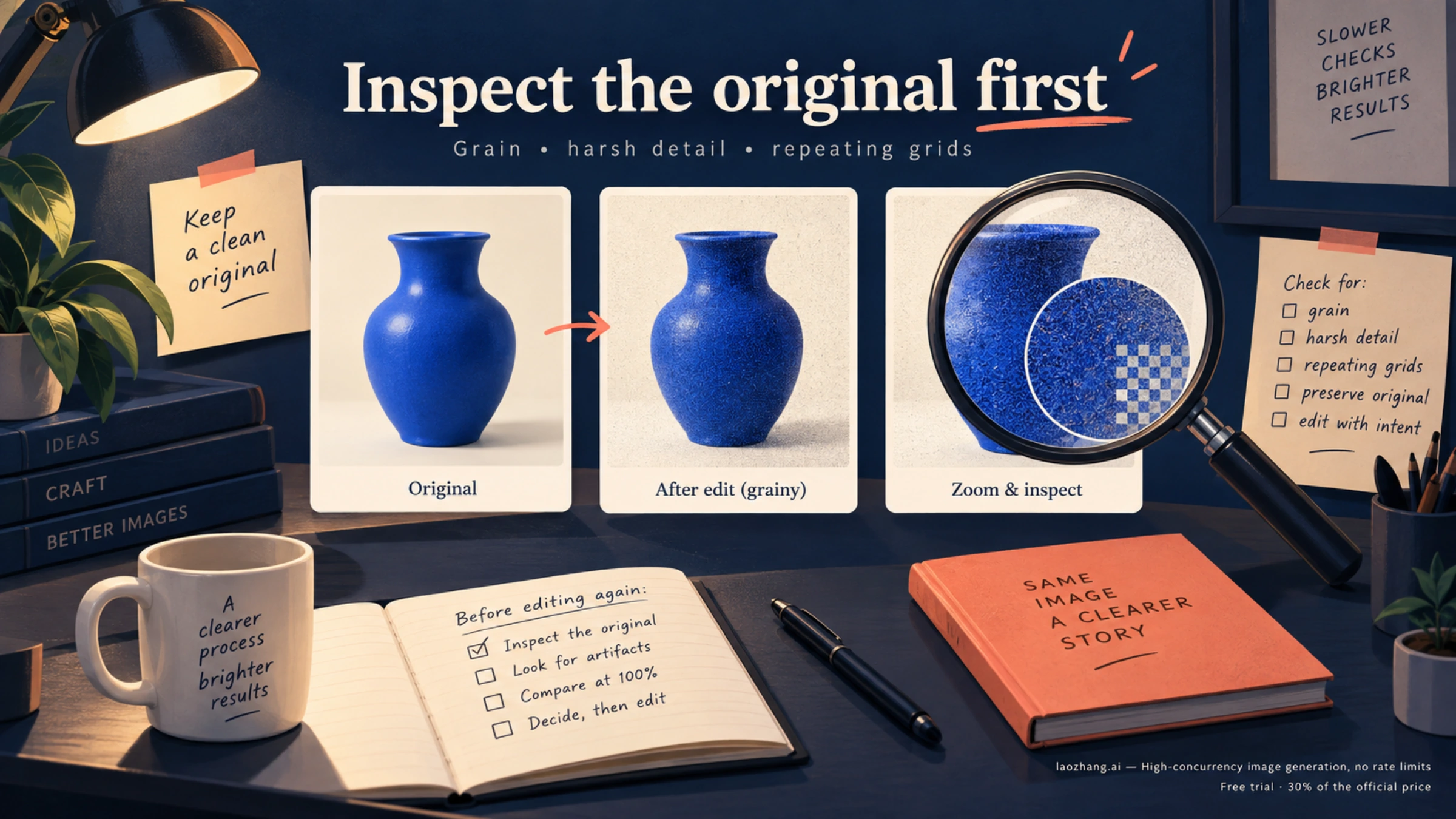
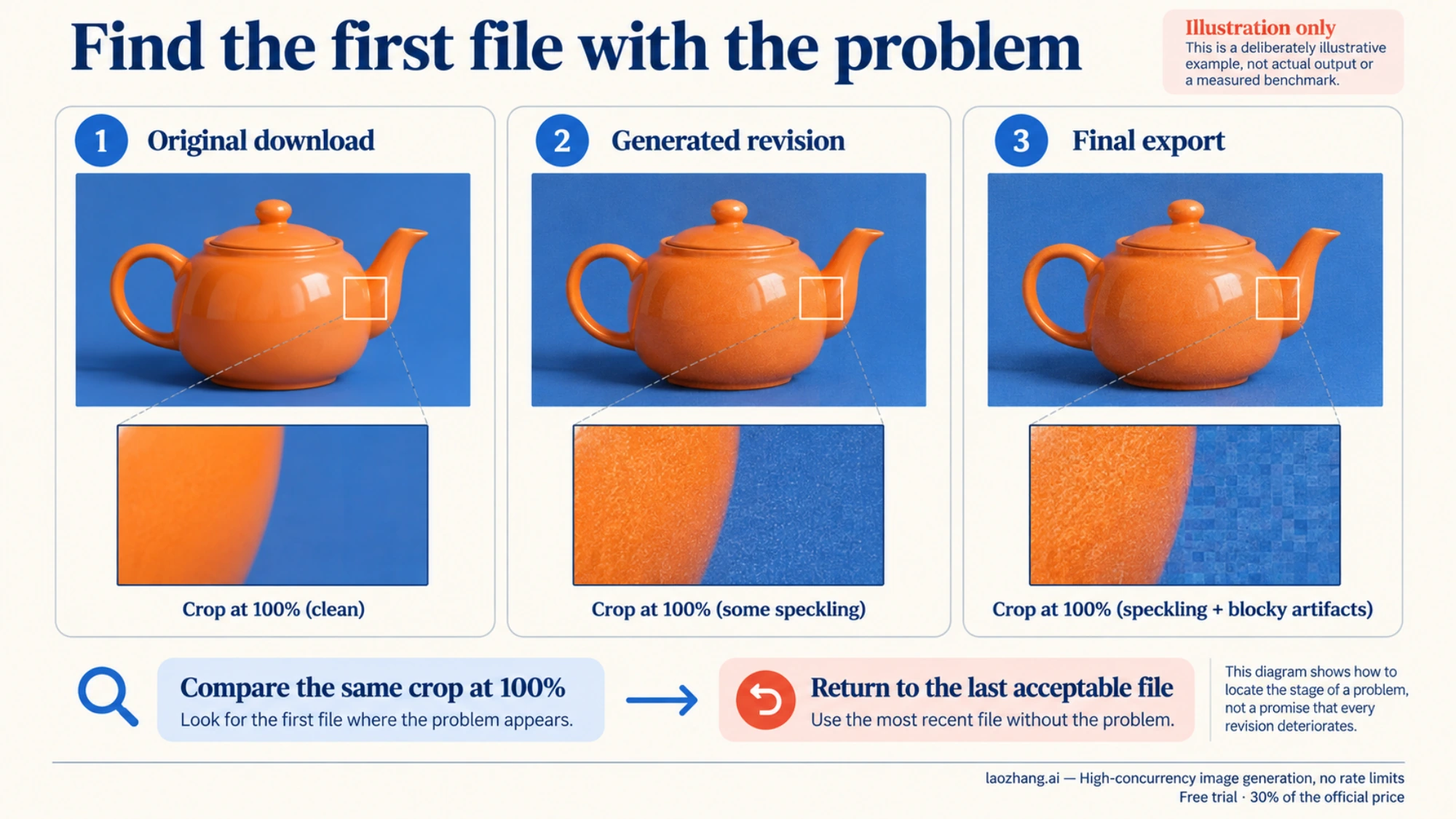
Before asking GPT Image 2.5 to remove noise again, download the original and compare it with your latest edit and final export. If only the export looks bad, return to the clean file and fix the export. If each generated revision looks worse, branch from the last acceptable version. If the first image already contains unwanted texture, try a fresh generation or a narrowly scoped correction, with no guarantee that either will remove it.
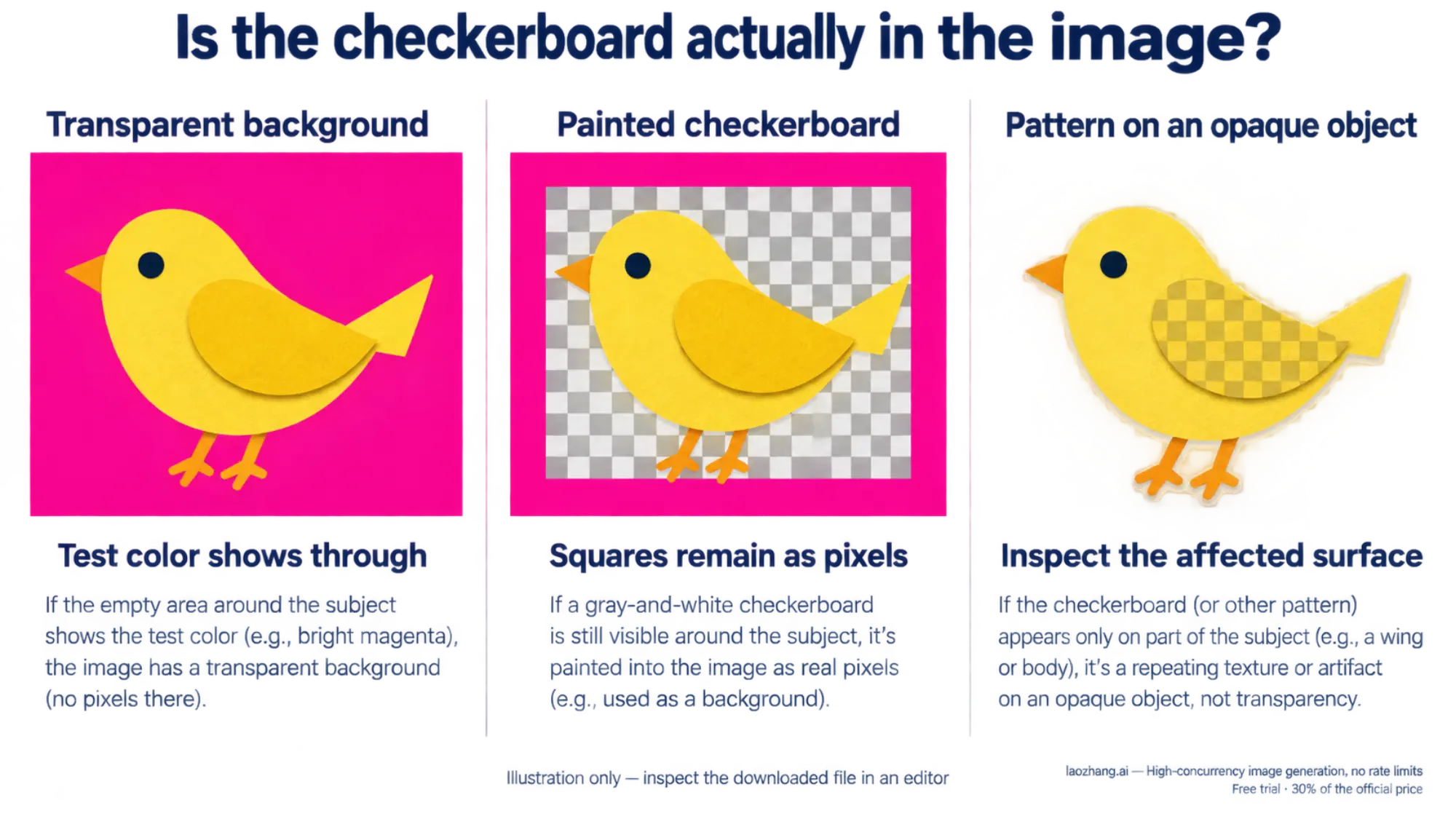
A checkerboard needs a separate check: a viewer's transparency grid, a grid painted into the background, and a repeating pattern inside an opaque object are three different problems. Changing the file extension will not resolve all three.
This guide uses documentation and published reports checked on September 21, 2026. The steps below are diagnostic suggestions, not results from our own GPT Image benchmark. The illustrations explain the checks; they are not model test outputs.
Start with three files and one crop
Keep an untouched copy of the first downloaded image, the latest generated revision, and the exported file you intend to use. Open them in the same image editor or viewer. Compare the same small area at 100% zoom, then compare the complete image at its intended display size. A browser thumbnail or an enlarged chat preview is a poor substitute for checking the downloaded asset.
Choose a crop that includes both the affected surface and something you need to preserve. For a magazine illustration, that might be a flat wall beside a face. For a product image, it might be the packaging color beside small label text. This makes it harder to mistake blurred detail for a successful cleanup.
| What you find | What it tells you | Next step |
|---|---|---|
| The original looks acceptable; the exported copy does not | The unwanted appearance is present in the later file, so regeneration is not your first move | Re-export from the original and inspect any resizing, sharpening, and compression settings |
| The original is usable; later generated edits accumulate texture or change details | The edit sequence has lost quality you wanted to keep | Return to the last acceptable file and start a separate revision |
| Unwanted grain is already in the original download | Export settings cannot restore detail that the generated file never contained | Try a fresh generation or a limited correction, then compare against the original |
| Squares appear only behind the subject | Transparency display or a painted background may be involved | Test the file over a solid color before generating again |
| A repeating grid runs through an opaque surface | The pattern is in image content rather than merely the viewer's empty background | Treat it as an unwanted visual pattern and evaluate a new generation or local correction |
These observations identify where the symptom appears. They do not establish why the model produced it. If you have only a screenshot or a compressed repost, get the original download before drawing conclusions about the generated file.
Also decide whether the texture conflicts with the brief. Grain may be appropriate in a film-inspired portrait and unacceptable in a flat color illustration. A file that looks rough at extreme enlargement may still work at its intended size; a visibly dirty background in the actual deliverable remains a problem even if its dimensions are large.
Grain, crunchy edges, and grids need different decisions
Fine speckles across a smooth area are the usual concern when people call an image “grainy.” Harsh outlines and exaggerated tiny details can instead make it look crunchy or oversharpened. Both can occur together, but “make it sharper” is an unhelpful correction when excessive edge emphasis is already what bothers you.
Published complaints are real, although they do not tell us how often the problem occurs. In a September 10 TechRadar test of four ChatGPT images, Eric Hal Schwartz reported grain in smooth regions and overly harsh detail despite instructions intended to avoid it. A separate Reddit product-image report describes digital noise on colored packaging after attempts with different prompts and quality choices. Those examples do not establish a controlled API comparison or identify the exact variant behind a ChatGPT result.
For a grid, first determine whether it belongs to the file. Place the image over a solid blue or magenta background in an editor that supports transparency. If the supposedly empty region reveals that color, it has transparency there. If the gray and white squares remain visible as colored pixels, they are painted into the image. A file can also contain transparent areas and an unwanted painted pattern elsewhere, so inspect the affected region itself.
OpenAI documents transparent output with background: "transparent" and a format that supports alpha, such as PNG or WebP. A checkerboard drawn by the model is not a substitute for alpha. Our transparent PNG guide covers the complete file and edge checks. Official transparency guidance
If a grid crosses a solid shirt, wall, or package, asking for a transparent background addresses a different problem. Describe the repeating pattern in that surface and the details that must survive its removal.
Give one correction a clear acceptance test
Make a copy or start a new branch from the best available file. Ask for the smallest useful change and specify the material you actually want. “Remove noise” alone leaves considerable room to reinterpret texture, lighting, and detail.
For an opaque flat-color illustration, a suggested correction is:
textKeep the composition, shapes, colors, and lettering unchanged.
Make only the blue background a smooth, uniform field of color.
Remove the unwanted speckled texture from that background.
Preserve the clean boundaries and the exact lettering.
For a portrait, a different instruction is needed: preserving natural skin texture matters more than making every surface uniform. Name the unwanted effect, such as colored speckles in the plain background, and ask to retain facial features, hair, and natural skin detail. Avoid asking for global smoothing if the problem occupies one small region.
OpenAI's image prompting guide recommends making preservation requirements explicit. That improves the instruction; it does not lock the unaffected pixels. After the edit, check the requested area and the face, lettering, outline, and material detail you wanted to retain.
Accept the correction only if it solves enough of the visible problem without breaking those requirements. A cleaner background paired with a misspelled label is not a successful product asset. If the edit misses, do not keep feeding its damaged output into the next attempt. Return to the earlier file, change the approach, or stop.
Stop a revision chain when it loses more than it fixes
Compare every new generated edit with the best previous version, not just the immediately preceding one. Otherwise, small losses can become the new baseline and escape notice.
This is a practical precaution supported by published examples, not a claim that every edit degrades an image. In a Japanese author's first-person tests, a sequence of four edits accumulated visible problems, and an upscale request changed the look of an image. The article does not establish a universal threshold or identify a hidden ChatGPT model variant.
Use a stopping rule tied to the job: if the revision makes the background cleaner but damages protected text or identity, reject it. If another attempt reproduces the same problem without a useful gain, stop that chain and choose among these options:
- Regenerate from the original brief and references when the overall composition can change. You may get a more usable image, but you may also lose the pose, layout, or details you liked.
- Use a local, reversible image-editor adjustment when the composition is fixed and only a small area needs cleanup. Keep it on a separate layer where possible and inspect the effect on edges and material texture.
- Replace or rebuild the affected element when exact text, logos, or flat graphic shapes matter more than preserving generated pixels.
- Keep the earlier version if the remaining texture is acceptable at the intended display size and further edits are damaging more important details.
An enlargement request is not a reliable rescue for this decision. More pixels do not by themselves prove that unwanted texture was removed, and a generative upscale may reinterpret the image. Evaluate the result against the same preservation requirements.
API users: separate generation quality from file compression
The direct OpenAI API exposes controls that a chat interface or third-party product may not expose. As checked on September 21, both GPT Image 2.5 variants accept low, medium, high, xhigh, max, and auto for generation quality. Output formats include PNG, JPEG, and WebP; output_compression applies to JPEG and WebP. These are separate controls in the official image generation reference.
Changing quality changes the generation request. Changing compression changes how output is encoded. Saving or converting an already grainy image as PNG does not remove grain. Requesting PNG can help you avoid a lossy encoding step during a comparison, but it does not guarantee smooth source pixels.
If the original generated file is the problem, try another explicit quality setting while keeping the prompt, references, dimensions, and model constant. Keep the originals and judge the same crop. Treat any improvement as a result for that task, not proof that max always fixes noise. There is no verified universal setting or prompt that guarantees clean output in the sources checked for this guide.
Do not copy denoising strength, CFG, or sampling-step recipes from another image system into a GPT Image API request. The official reference does not document those controls as a noise remedy for GPT Image 2.5.
Sunburst's official emphasis on editing precision is a reason to evaluate preservation on your own assets, not evidence that it always produces less grain. For a comparison with explicit model selection, use our Sunburst vs. Flare guide. You cannot identify a ChatGPT image's underlying API variant from its texture or generation speed.
Keep a usable record if the problem persists
Save the original download, the problematic revision, the exact instruction, and a crop showing the issue at 100% zoom. For an API workflow, also retain the model ID, quality, size, output format, and relevant request identifier. For ChatGPT, describe the interface and sequence of edits without guessing which API variant ran.
That record gives you something concrete to compare on the next attempt or attach to a support report. Until a new result passes the actual job's requirements, keep the last acceptable file as your working master. A cleaner preview is encouraging; an intact downloaded asset is what you can deliver.