AI Image Generation API Comparison 2026: Pricing, Quality, and the Best Value Pick
As of February 2026, the AI image generation API market offers over 12 models from Google, OpenAI, and third-party providers. Prices range from $0.005 to $0.167 per image, with GPT Image 1.5 leading quality benchmarks (Elo 1,264) and Google Imagen 4 Fast offering the best price-to-quality ratio. This guide compares every major API on pricing, quality, and value efficiency to help you make the optimal choice for your project.
On this page
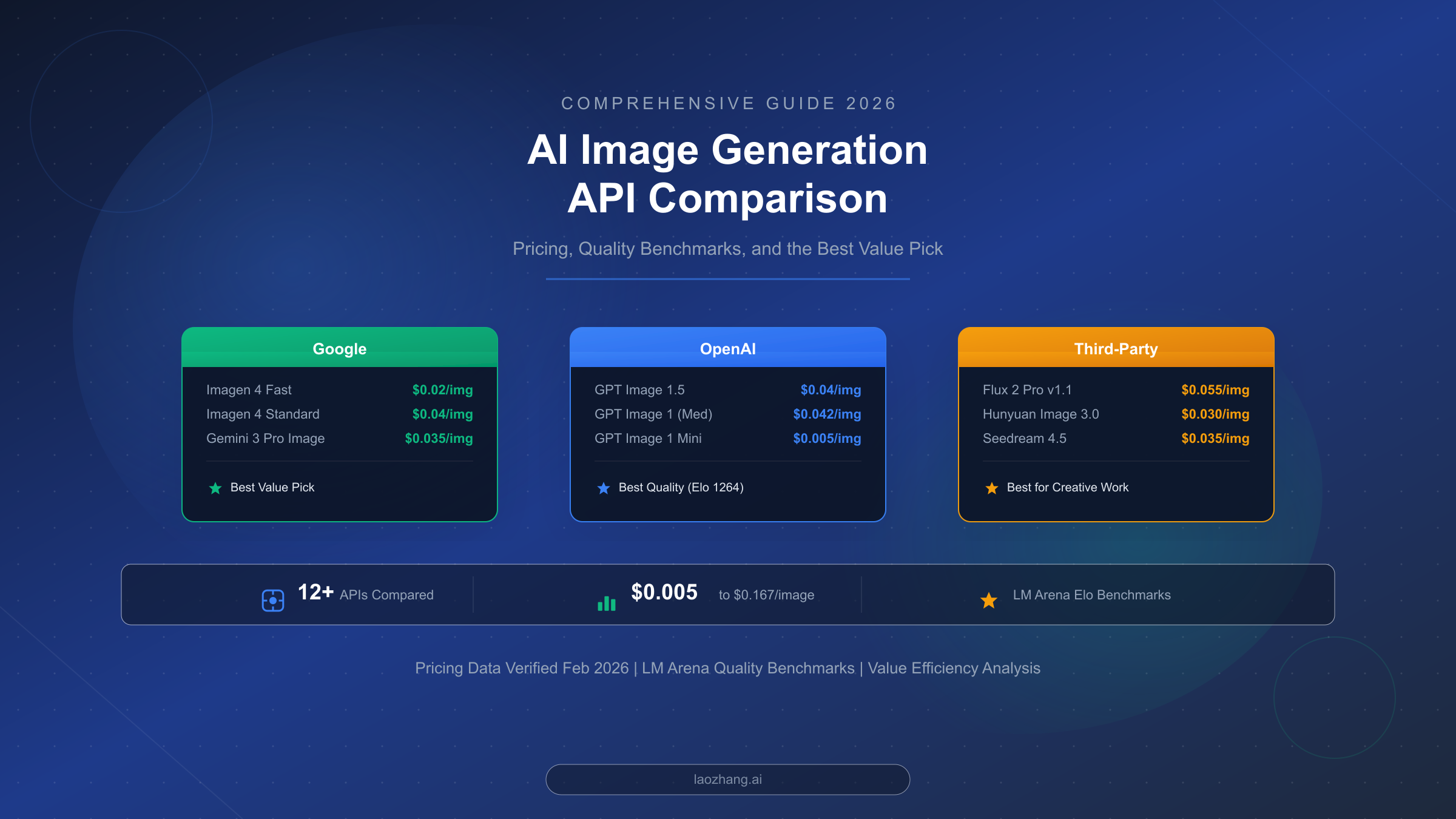
As of February 2026, OpenAI's GPT Image 1.5 leads quality benchmarks with an LM Arena Elo score of 1,264, while Google's Imagen 4 Fast offers the best value at just $0.02 per image. For developers choosing between 12+ AI image generation APIs, the right pick depends on your volume, quality needs, and budget. This guide compares every major API's pricing, quality scores, and value efficiency to help you make the optimal choice.
TL;DR
The AI image generation API landscape in 2026 has split into clear tiers. At the budget end, OpenAI's GPT Image 1 Mini delivers usable images for as little as $0.005 each, making it the cheapest option by a wide margin. For standard quality, Google's Imagen 4 Fast at $0.02 per image and Imagen 4 Standard at $0.04 offer the most competitive pricing from a major provider. OpenAI's GPT Image 1.5, the current quality leader with an LM Arena Elo of 1,264, costs $0.04 per standard image, matching Imagen 4 Standard's price while delivering higher benchmark scores.
Third-party models deserve serious consideration as well. Black Forest Labs' Flux 2 Pro v1.1 scores a strong Elo of 1,265, essentially tying with GPT Image 1.5 for the quality crown, though at a slightly higher price point of $0.055 per image. Tencent's Hunyuan Image 3.0 and ByteDance's Seedream 4.5 offer competitive alternatives in the $0.030-$0.035 range. For developers processing at scale, the pricing gap between cheapest and most expensive options reaches a staggering 33x, which means choosing the right API can save you thousands of dollars monthly. The sections below break down exactly how to make that choice.
Every AI Image API You Need to Know in 2026
The AI image generation market has evolved dramatically from the days when DALL-E was the only serious API option. Today, three major ecosystems dominate the landscape, each offering multiple models optimized for different use cases. Understanding this landscape is essential before diving into pricing or quality comparisons, because the model you choose should align with your specific needs rather than simply being the cheapest or highest-rated option.
Google's Image Generation Ecosystem
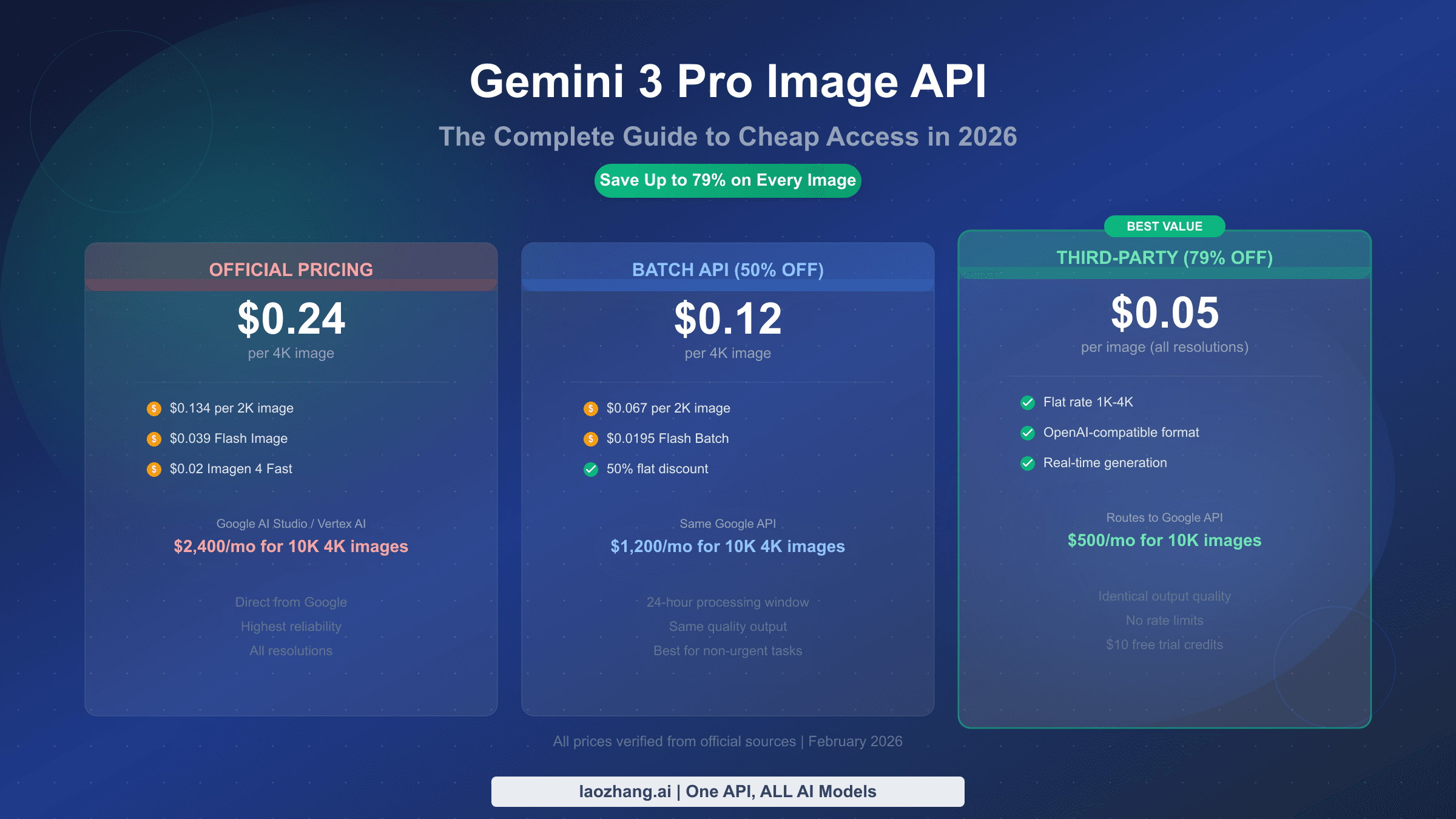
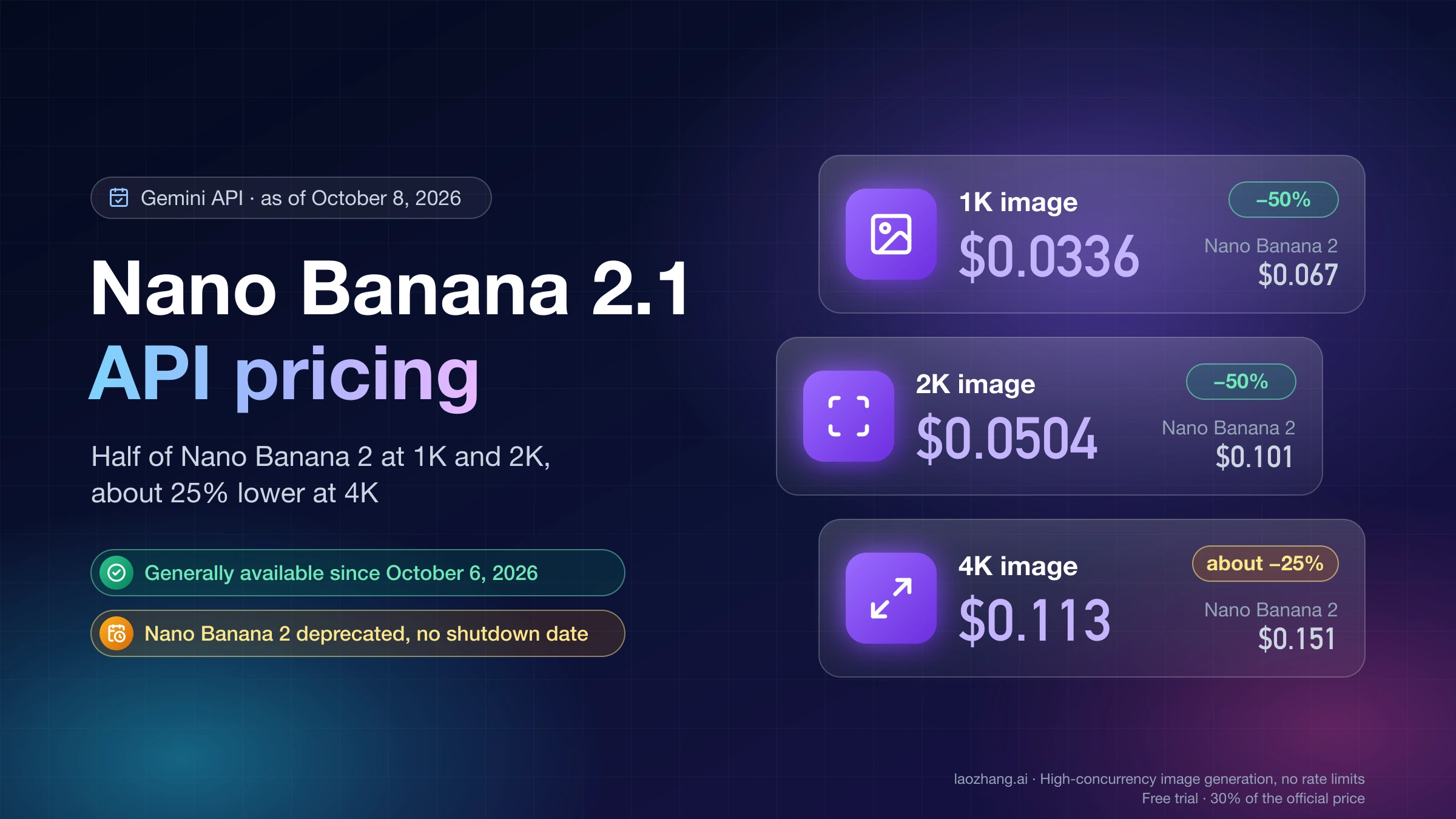
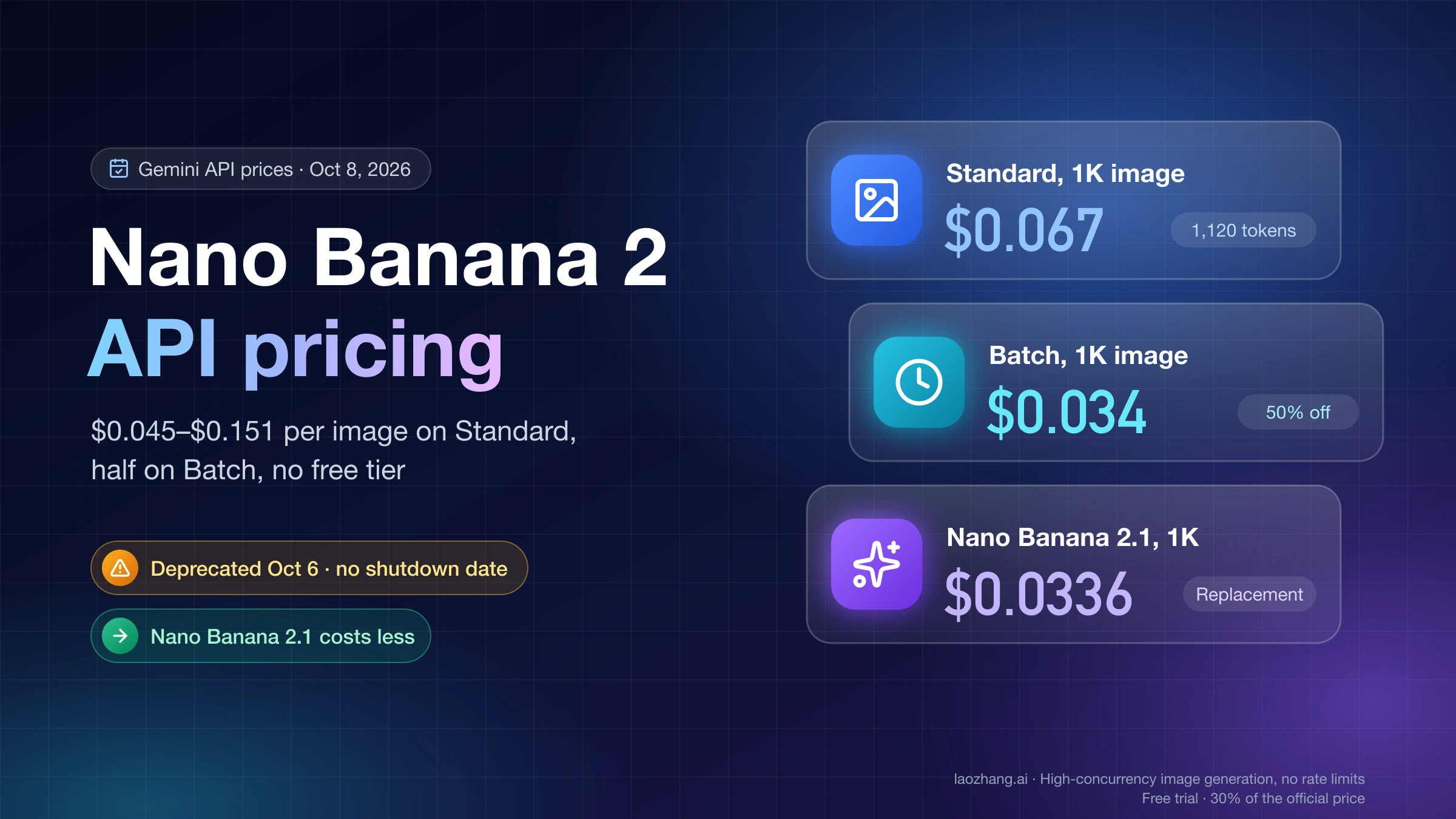
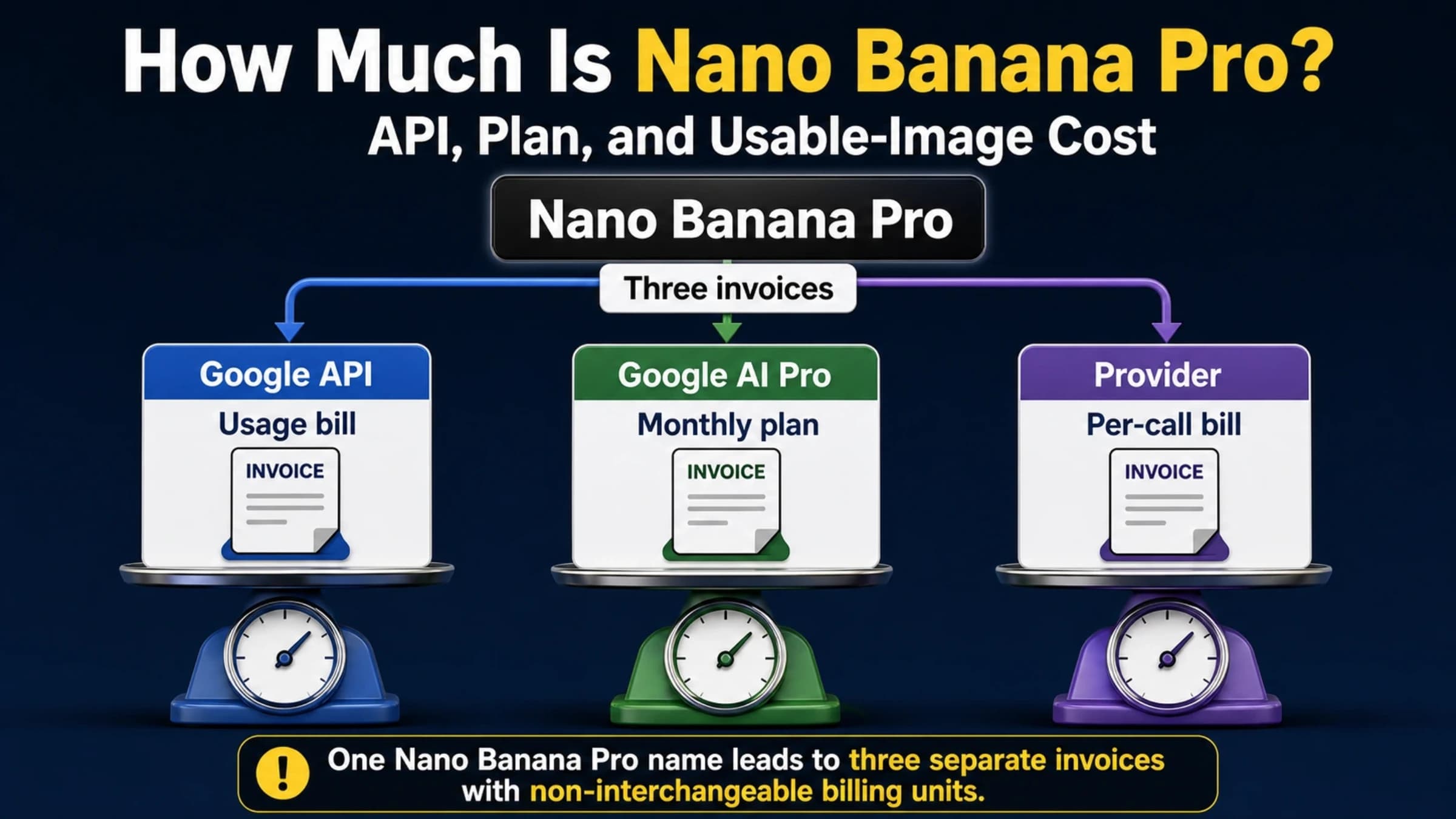
Google offers the most diverse lineup of any provider. Their flagship Imagen 4 family includes three tiers: Imagen 4 Fast (optimized for speed at $0.02/image), Imagen 4 Standard (balanced quality at $0.04/image), and Imagen 4 Ultra (premium quality at $0.06/image), all announced at Google I/O and now generally available through the Vertex AI and Gemini APIs. Beyond Imagen, Google also offers Gemini 3 Pro Image, a specialized model for professional-grade image generation and editing that scores impressively on LM Arena benchmarks with an Elo of 1,235-1,268 at $0.035 per standard image. You can explore our hands-on Gemini 3 Pro Image speed test results for real-world performance data. Rounding out Google's offerings, Nano Banana Pro serves as a conversational image editing model, and Gemini 2.5 Flash Image provides budget-friendly generation at $0.039 per image. For a deeper look at Google's budget options, check our Nano Banana Pro pricing details.
OpenAI's Image Generation Ecosystem
OpenAI has moved beyond DALL-E with their GPT Image family. GPT Image 1.5 sits at the top, delivering the highest LM Arena Elo score of 1,264 among all tested models, and pricing starts at $0.04 for standard quality. The workhorse GPT Image 1 offers three quality tiers (Low at $0.011, Medium at $0.042, and High at $0.167 per 1024x1024 image), providing flexibility between budget and premium needs. For high-volume, cost-sensitive applications, GPT Image 1 Mini starts at just $0.005 per image in low quality mode, making it the cheapest option from any major provider. DALL-E 3 remains available at $0.04 per standard image but is effectively legacy technology at this point, superseded by the GPT Image family in both quality and capability.
Third-Party Contenders
Black Forest Labs' Flux 2 family has emerged as a serious competitor, particularly for creative and artistic applications. Flux 2 Pro v1.1 achieves an LM Arena Elo of 1,265, essentially matching GPT Image 1.5, at $0.055 per image. The more affordable Flux 2 Dev ($0.025) and Flux 2 Schnell ($0.015) offer excellent value for less demanding use cases. Tencent's Hunyuan Image 3.0 ($0.030, Elo 1,238) and ByteDance's Seedream 4.5 ($0.035, Elo 1,225) bring strong competition from Chinese tech giants, while Ideogram 2.0 ($0.040, Elo 1,218) and Midjourney v7 round out the field. For a complete ranking of all models, see our comprehensive AI image model ranking.
The Real Cost: AI Image API Pricing Compared
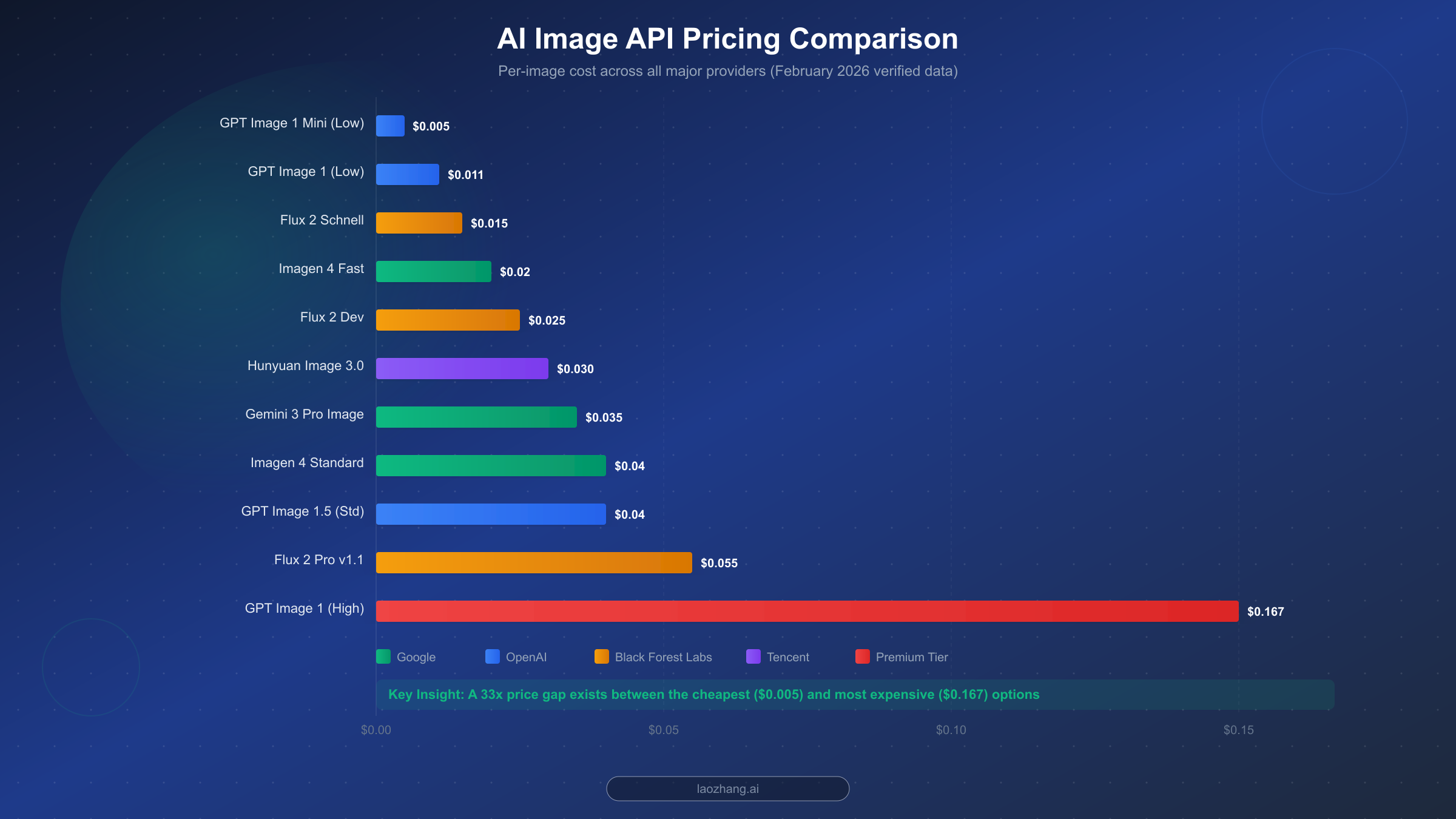
Raw per-image pricing only tells part of the story. What developers really need to know is how much they will actually spend at their expected volume. This section breaks down both the per-image costs and the projected monthly expenditures at different scales, using verified February 2026 pricing data from official documentation and API pricing pages.
Per-Image API Pricing Table
The following table shows the verified per-image pricing for every major AI image generation API, sorted from least to most expensive. All prices reflect standard resolution (typically 1024x1024) unless otherwise noted, and were verified against official pricing pages as of February 2026.
| Model | Provider | Price/Image | LM Arena Elo | Notes |
|---|---|---|---|---|
| GPT Image 1 Mini (Low) | OpenAI | $0.005 | ~1,200 | Budget option, 1024x1024 |
| GPT Image 1 (Low) | OpenAI | $0.011 | ~1,250 | Low quality tier |
| Flux 2 Schnell | Black Forest Labs | $0.015 | 1,232 | Speed-optimized |
| Imagen 4 Fast | $0.02 | ~1,220 | Speed-optimized | |
| Flux 2 Dev | Black Forest Labs | $0.025 | 1,245 | Development model |
| Hunyuan Image 3.0 | Tencent | $0.030 | 1,238 | Chinese market focus |
| Gemini 3 Pro Image | $0.035 | 1,252 | Professional editing | |
| Seedream 4.5 | ByteDance | $0.035 | 1,225 | Chinese market focus |
| Imagen 4 Standard | $0.04 | ~1,230 | Balanced quality | |
| GPT Image 1.5 (Std) | OpenAI | $0.04 | 1,264 | Quality leader |
| DALL-E 3 (Std) | OpenAI | $0.04 | 1,205 | Legacy model |
| Ideogram 2.0 | Ideogram | $0.040 | 1,218 | Text rendering focus |
| GPT Image 1 (Medium) | OpenAI | $0.042 | ~1,250 | Mid quality tier |
| Flux 2 Pro v1.1 | Black Forest Labs | $0.055 | 1,265 | Premium creative |
| Imagen 4 Ultra | $0.06 | ~1,240 | Maximum quality | |
| GPT Image 1 (High) | OpenAI | $0.167 | ~1,260 | Maximum quality tier |
For a deeper analysis of Google's pricing structure specifically, our detailed Gemini image API pricing breakdown covers all the nuances including HD pricing and volume discounts.
Volume Cost Projections
The table below shows what you would actually pay per month at different generation volumes, using the most popular models from each provider. These projections assume consistent usage across the billing period with no volume discounts applied, which means your actual costs could be lower at scale.
| Model | 100 imgs/mo | 1,000 imgs/mo | 10,000 imgs/mo | 100,000 imgs/mo |
|---|---|---|---|---|
| GPT Image 1 Mini (Low) | $0.50 | $5 | $50 | $500 |
| Imagen 4 Fast | $2 | $20 | $200 | $2,000 |
| Flux 2 Schnell | $1.50 | $15 | $150 | $1,500 |
| GPT Image 1.5 (Std) | $4 | $40 | $400 | $4,000 |
| Imagen 4 Standard | $4 | $40 | $400 | $4,000 |
| Flux 2 Pro v1.1 | $5.50 | $55 | $550 | $5,500 |
| GPT Image 1 (High) | $16.70 | $167 | $1,670 | $16,700 |
The difference becomes dramatic at scale. A developer generating 100,000 images per month would pay $500 with GPT Image 1 Mini versus $16,700 with GPT Image 1 at high quality. That is a 33x cost difference for what are essentially comparable base models at different quality settings. Even comparing the standard-quality leaders, Imagen 4 Fast at $2,000 per month costs half as much as GPT Image 1.5 at $4,000 for 100,000 images, though GPT Image 1.5 delivers measurably higher quality scores. Services like laozhang.ai can further reduce these costs by aggregating multiple APIs under a single endpoint, often at 50-80% below official pricing.
Disclosure: laozhang.ai is our own service. Its prices are platform pricing, not an independent comparison.
Consumer Subscription Comparison
For non-API users, both Google and OpenAI offer consumer subscription plans that include image generation capabilities. Google's free Gemini tier allows approximately 3 images per day, scaling up to 100 images per day on the AI Pro plan ($19.99/month) and 1,000 images per day on the AI Ultra plan (~$30/month). OpenAI's ChatGPT free tier provides 2-3 images per day, while the Plus plan ($20/month) and Pro plan ($200/month) both offer unlimited generation. For casual users generating fewer than 100 images per month, a consumer subscription often works out cheaper than direct API access.
Quality vs Price: The Value Efficiency Nobody Shows You
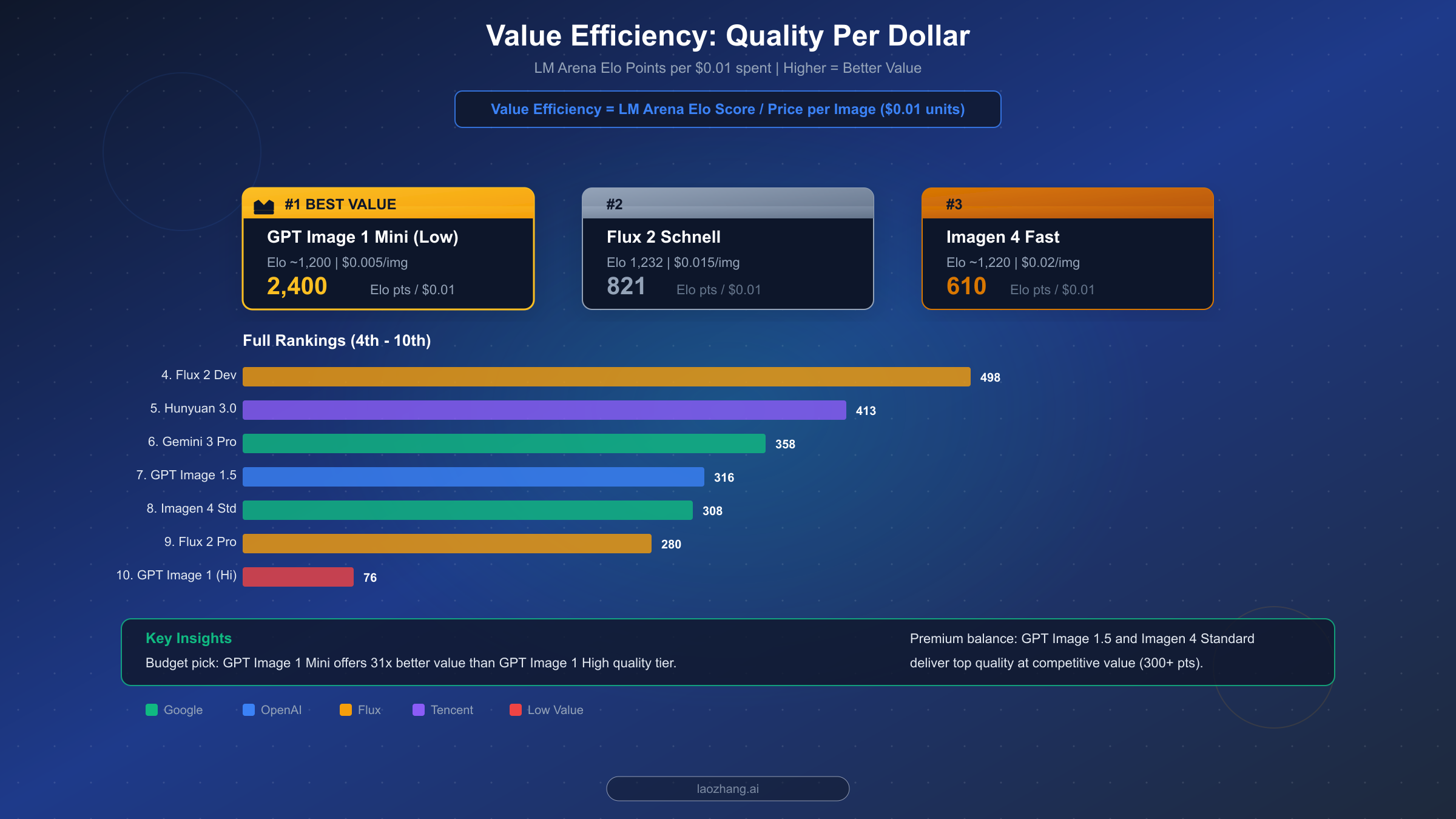
Every comparison article shows you pricing tables and quality benchmarks separately, but nobody combines them into the metric that actually matters for budget-conscious developers: quality per dollar. This section introduces a "Value Efficiency" metric that calculates how many LM Arena Elo points you get for every $0.01 spent, providing the clearest possible picture of which API delivers the best bang for your buck.
Understanding LM Arena Elo Scores
LM Arena (formerly known as Chatbot Arena) uses an Elo rating system where human evaluators compare image outputs side by side and vote for their preferred result. The resulting Elo scores provide an objective, crowd-sourced quality benchmark that accounts for factors like photorealism, text accuracy, prompt adherence, and aesthetic appeal. As of late 2025, scores for the leading image models range from approximately 1,200 to 1,265, with GPT Image 1.5 and Flux 2 Pro v1.1 effectively tied at the top. While the absolute point differences between adjacent models may seem small, they represent statistically significant quality gaps that compound over thousands of generated images, affecting everything from user satisfaction to conversion rates in production applications.
The Value Efficiency Formula
The Value Efficiency metric divides a model's Elo score by its cost per image measured in $0.01 units. A model with an Elo of 1,200 that costs $0.005 per image (0.5 units of $0.01) scores 2,400 on the Value Efficiency scale, while a model with an Elo of 1,264 that costs $0.167 per image (16.7 units) scores only 76. This simple calculation reveals enormous disparities that raw pricing alone does not expose. The top three value picks are GPT Image 1 Mini (Low) at 2,400 points, Flux 2 Schnell at 821 points, and Imagen 4 Fast at 610 points. Notice that the quality leader GPT Image 1.5, despite its excellent Elo of 1,264, lands in the middle of the pack at 316 points because its pricing puts it in a different value bracket than the budget options.
Finding Your Sweet Spot
The right choice depends on where you fall on the quality-versus-budget spectrum. For applications where quality matters most (marketing campaigns, hero images, product launches), GPT Image 1.5 and Flux 2 Pro v1.1 offer the highest absolute quality at $0.04-$0.055 per image, delivering around 280-316 value efficiency points. For production workloads where "good enough" quality at scale matters more (social media thumbnails, placeholder images, bulk content), Imagen 4 Fast at 610 value efficiency points and Flux 2 Schnell at 821 points offer dramatically better economics. And for the most cost-sensitive applications (testing, prototyping, internal tools), GPT Image 1 Mini at 2,400 points delivers adequate quality at a fraction of the cost. The key insight from our analysis is that paying for the highest quality tier (GPT Image 1 High at $0.167) delivers only marginally better results than GPT Image 1.5 at $0.04, resulting in a 4x cost increase for quality gains that most users cannot perceive.
How to Cut Your Image API Costs by 50-80%
Even after choosing the most cost-effective API for your use case, there are several strategies that can further reduce your spending without sacrificing output quality. These approaches work regardless of which provider you use and can stack together for compound savings that significantly impact your bottom line at scale.
Quality Tier Optimization
The single biggest cost reduction comes from matching your quality tier to your actual needs. Most developers default to the highest quality setting out of habit, but the visual difference between quality tiers is often imperceptible for web-sized images. OpenAI's GPT Image 1, for example, jumps from $0.011 (low) to $0.042 (medium) to $0.167 (high), a 15x increase from lowest to highest. For images displayed at 512px or smaller on social media or in thumbnails, low quality output is virtually indistinguishable from high quality to the human eye. Run A/B tests with your specific use case before committing to a quality tier; you might discover that the cheaper option performs just as well in practice, saving you up to 93% on per-image costs with OpenAI's models alone.
Batch Processing and Caching
Implementing an intelligent caching layer can eliminate 30-50% of redundant API calls. When users request similar images (product shots with minor variations, social media templates with different text, seasonal variations of the same design), a content-addressable cache using prompt hashing can serve previously generated results instantly. Beyond caching, batching requests during off-peak hours and pre-generating commonly needed image templates can both reduce costs and improve response times for your end users. Google's Imagen API and OpenAI's GPT Image API both support asynchronous batch processing, which can unlock volume-based pricing discounts that are not available for real-time requests.
API Proxy and Aggregator Services
API aggregators provide a single unified endpoint that routes requests to multiple image generation providers based on your cost, quality, and availability preferences. Services like laozhang.ai aggregate multiple image APIs under one endpoint, often at 50-80% below official pricing, which is particularly valuable for developers who want to use different models for different purposes without managing multiple API keys, billing accounts, and SDK integrations. The aggregator handles automatic failover if a provider experiences downtime, load balances across regions, and provides unified usage analytics. You can explore available image models and test them directly at images.laozhang.ai, or consult the API documentation for integration details. For developers exploring free options before committing to paid APIs, our guide to Gemini API free tier limits covers what you can accomplish without spending anything at all.
Disclosure: laozhang.ai is our own service. Its prices are platform pricing, not an independent comparison.
Resolution and Format Optimization
Generating images at the maximum supported resolution and then downscaling wastes money. If your final output will be displayed at 512x512 on a website, generating at 1024x1024 doubles your cost with no visible benefit. Similarly, choosing PNG output when JPEG would suffice adds unnecessary file size and bandwidth cost. Configure your API requests to match your actual display requirements, and implement server-side image optimization (compression, format conversion, responsive sizing) to get the most value from every generated pixel. Modern CDN services like Cloudflare Images or imgix can automatically serve the optimal format and resolution based on the requesting device, meaning you only need to generate at the highest resolution you will ever display and let the CDN handle the rest. This approach ensures visual quality while minimizing both generation costs and bandwidth expenses across your entire image delivery pipeline.
Best AI Image API by Use Case
Choosing the right AI image API is not a one-size-fits-all decision. The optimal choice depends on your specific use case, volume requirements, and quality expectations. This section maps the major use cases to concrete API recommendations based on the pricing and quality data analyzed above, giving you an actionable "if X then Y" framework instead of generic advice.
E-Commerce Product Images
For product photography, consistency and photorealism matter more than artistic flair. GPT Image 1.5 ($0.04/image, Elo 1,264) delivers the best photorealistic quality, making it ideal for hero product shots where every detail matters. For bulk catalog images where you need hundreds of product variations, Imagen 4 Standard ($0.04/image) provides comparable quality at the same price with slightly faster generation times through Google's infrastructure. At high volume (10,000+ products), consider using Imagen 4 Fast ($0.02/image) for initial drafts and reserving GPT Image 1.5 for final hero shots, cutting your total spend by roughly 40% compared to using the premium model for everything.
Marketing and Social Media Content
Social media content demands fast turnaround and visual variety more than pixel-perfect quality. Flux 2 Schnell ($0.015/image, Elo 1,232) hits the sweet spot for social media teams generating 50-200 images per week. Its speed-optimized architecture returns results faster than most competitors, and its quality score of 1,232 is more than adequate for platforms that display images at compressed, mobile-friendly resolutions. For campaign hero images that anchor a marketing push, step up to Flux 2 Pro v1.1 ($0.055, Elo 1,265) for its superior creative quality, particularly in artistic and stylized compositions where Flux models consistently outperform the competition.
Technical Documentation and Diagrams
When generating illustrations for technical documentation, text rendering accuracy becomes critical. Ideogram 2.0 ($0.040, Elo 1,218) specializes in accurate text rendering within images, making it the strongest choice for diagrams, infographics, and documentation visuals that incorporate labels and descriptions. Its ability to place text cleanly within complex visual layouts sets it apart from competitors that tend to garble or misplace text elements, a frustrating issue that has plagued AI image generation since its early days. For simpler technical illustrations without embedded text, Imagen 4 Fast ($0.02) provides a cost-effective alternative that handles clean, professional-looking diagrams well. Development teams producing developer documentation or API guides should also consider generating base illustrations with AI and then overlaying precise text using standard graphic tools for maximum accuracy.
Creative and Artistic Projects
Creative professionals and agencies need models that can interpret artistic direction with nuance and produce visually distinctive results. The Flux 2 family dominates this category. Flux 2 Pro v1.1 ($0.055, Elo 1,265) produces the most artistically versatile output, excelling at stylistic interpretation, composition, and visual storytelling. Its training on high-quality artistic datasets gives it a distinctive advantage in generating images that feel authored rather than algorithmically assembled, a critical distinction for creative agencies where visual differentiation is the entire point. Gemini 3 Pro Image ($0.035, Elo 1,252) stands out for iterative creative workflows, as its editing capabilities allow you to refine generated images through conversational prompts rather than starting from scratch each time. This conversational approach to image editing can reduce the number of generation attempts needed to reach a final result by 60-70%, saving both time and API costs for creative teams that iterate heavily.
High-Volume Automated Generation
For pipelines generating 50,000+ images per month, cost per image becomes the dominant factor. GPT Image 1 Mini in low quality mode ($0.005/image) offers the lowest cost from any major provider, but if you need moderate quality at volume, Flux 2 Schnell ($0.015) or Imagen 4 Fast ($0.02) deliver much better results for only marginally higher cost. At this scale, the difference between $0.005 and $0.02 per image means $750 versus $1,000 per month for 50,000 images, a modest premium for a significant quality upgrade. Combine these with the caching and batch processing strategies from the previous section to further optimize your spend.
Getting Started: Quick Integration Guide
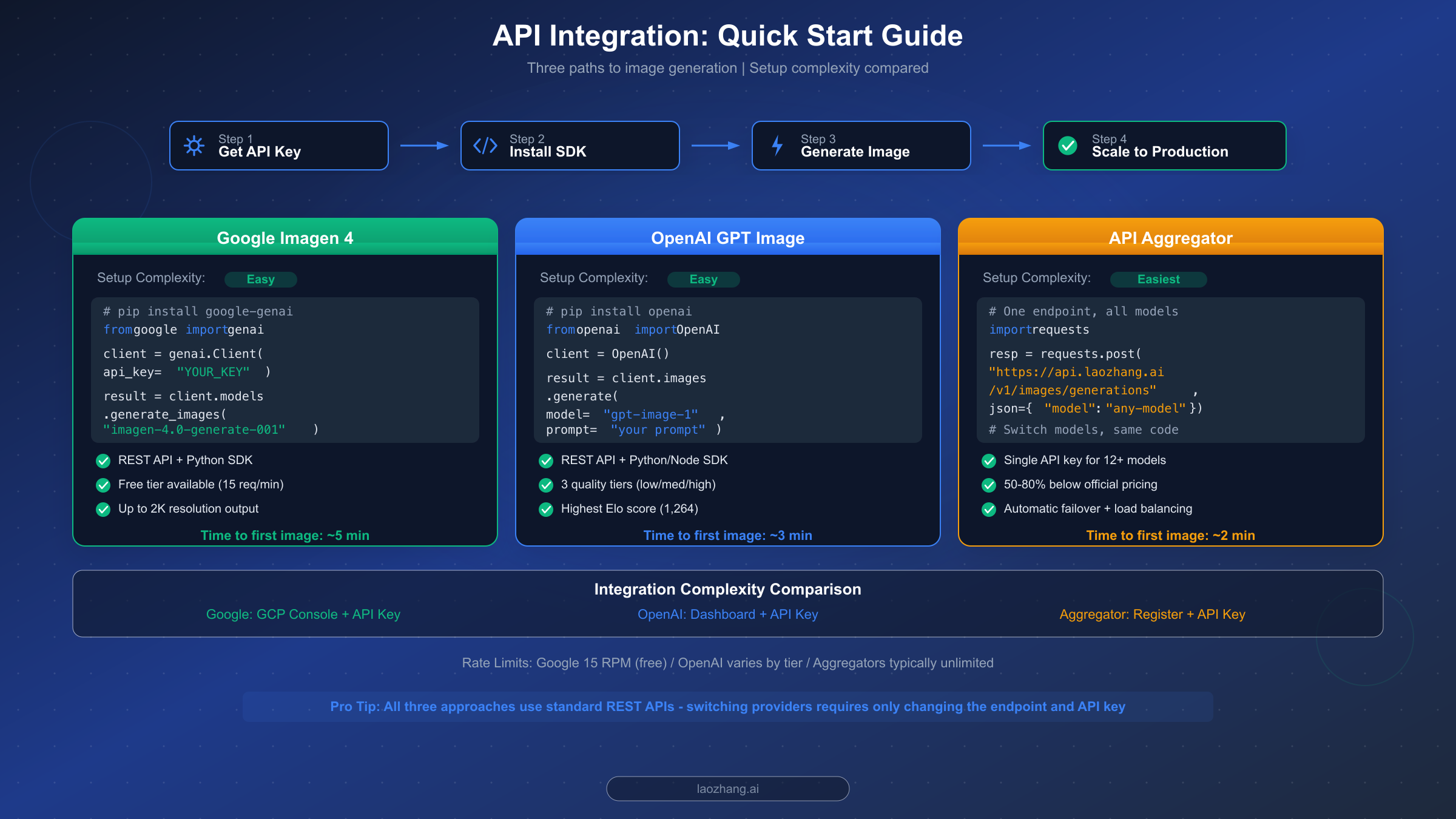
Choosing an API is only half the decision. The other half is integration complexity, which directly affects your time-to-value and ongoing maintenance burden. This section compares the setup experience for the three most popular approaches: Google Imagen via Vertex AI, OpenAI's GPT Image API, and unified access through an API aggregator. All three use standard REST APIs, which means the core integration pattern is similar regardless of provider.
Google Imagen: Setup and Code
Getting started with Google's Imagen 4 requires a Google Cloud account and an API key from the Google AI Studio or Vertex AI console. The Python SDK (google-genai) provides a clean interface for image generation. Authentication uses a standard API key, and the SDK handles retry logic and error handling automatically. Google's free tier allows 15 requests per minute, which is sufficient for development and testing. The main advantage of Google's approach is access to their full ecosystem (Imagen 4, Gemini 3 Pro Image, Nano Banana Pro) through a single SDK.
from google import genai

client = genai.Client(api_key="YOUR_API_KEY")
result = client.models.generate_images(
    model="imagen-4.0-generate-001",
    prompt="A professional product photo of wireless earbuds on marble",
    config={"number_of_images": 1}
)
# result.generated_images[0] contains the image data
OpenAI GPT Image: Setup and Code
OpenAI's setup is the most straightforward of the major providers. Create an account at platform.openai.com, generate an API key, and install the Python SDK. The images API supports GPT Image 1, GPT Image 1.5, GPT Image 1 Mini, and DALL-E 3 through a single endpoint, with quality and model selection controlled by parameters. Rate limits vary by pricing tier, and OpenAI provides clear documentation on usage policies and content filtering. The three quality tiers (low, medium, high) let you balance cost against output quality at the request level.
from openai import OpenAI

client = OpenAI()  # Uses OPENAI_API_KEY environment variable
result = client.images.generate(
    model="gpt-image-1",
    prompt="A professional product photo of wireless earbuds on marble",
    quality="medium",
    size="1024x1024"
)
# result.data[0].url contains the generated image URL
API Aggregator: Unified Access
For teams that want flexibility to switch between providers or use different models for different tasks, an API aggregator offers the lowest-friction approach. A single API key grants access to 12+ models through an OpenAI-compatible endpoint, meaning you can reuse existing OpenAI SDK code by simply changing the base URL. This approach eliminates the need to manage multiple accounts, billing relationships, and SDK versions. The trade-off is a dependency on the aggregator's availability, though reputable services implement automatic failover and maintain 99.9%+ uptime.
from openai import OpenAI

# Same SDK, different endpoint - access any model
client = OpenAI(
    api_key="YOUR_AGGREGATOR_KEY",
    base_url="https://api.laozhang.ai/v1"
)
result = client.images.generate(
    model="imagen-4.0-generate-001",  # Or any supported model
    prompt="A professional product photo of wireless earbuds on marble"
)
The practical difference in setup time is minimal: Google and OpenAI both take about 5 minutes from signup to first generated image, while aggregator services can be even faster since they typically do not require credit card verification for initial testing. The real integration advantage shows up at scale, where managing a single API relationship versus three or four separate ones reduces operational overhead significantly. Beyond the initial setup, consider the ongoing maintenance cost of each approach. Direct provider integrations require you to monitor deprecation notices, update SDK versions, and handle breaking changes independently for each provider. Aggregator services abstract this maintenance away, but introduce a dependency on the aggregator's compatibility layer.
For production deployments, regardless of which approach you choose, implement exponential backoff for rate limit errors, structured logging for API responses (including generation latency and error rates), and a circuit breaker pattern that falls back to a secondary provider if your primary one experiences extended downtime. These resilience patterns add minimal code complexity but dramatically improve the reliability of your image generation pipeline when you are serving thousands of requests per day.
FAQ: AI Image Generation API Questions Answered
Which AI image generation API has the best quality in 2026?
OpenAI's GPT Image 1.5 currently leads the LM Arena Elo rankings with a score of 1,264, closely followed by Black Forest Labs' Flux 2 Pro v1.1 at 1,265. The margin between these two is within the statistical margin of error, so they are effectively tied for the quality crown. Google's Gemini 3 Pro Image (Elo 1,252) rounds out the top three. For most practical applications, the quality difference between any of these top-tier models is subtle enough that price and integration convenience should drive your decision rather than a few Elo points. It is worth noting that LM Arena scores reflect general-purpose quality across many prompt types; for specialized needs like text rendering or photorealistic product shots, individual model strengths may matter more than aggregate scores.
How much does it cost to generate 10,000 AI images per month?
The cost varies dramatically depending on which API and quality tier you choose. At the budget end, GPT Image 1 Mini in low quality mode would cost approximately $50 per month for 10,000 images. Mid-range options like Imagen 4 Fast ($200/month) and Flux 2 Schnell ($150/month) offer significantly better quality. Premium options like GPT Image 1.5 at $400/month and Flux 2 Pro v1.1 at $550/month deliver top-tier quality. The most expensive option, GPT Image 1 at high quality, would cost $1,670 per month for the same volume. Using an API aggregator or implementing quality tier optimization can reduce these costs by 50-80%.
Is Google Imagen 4 API free?
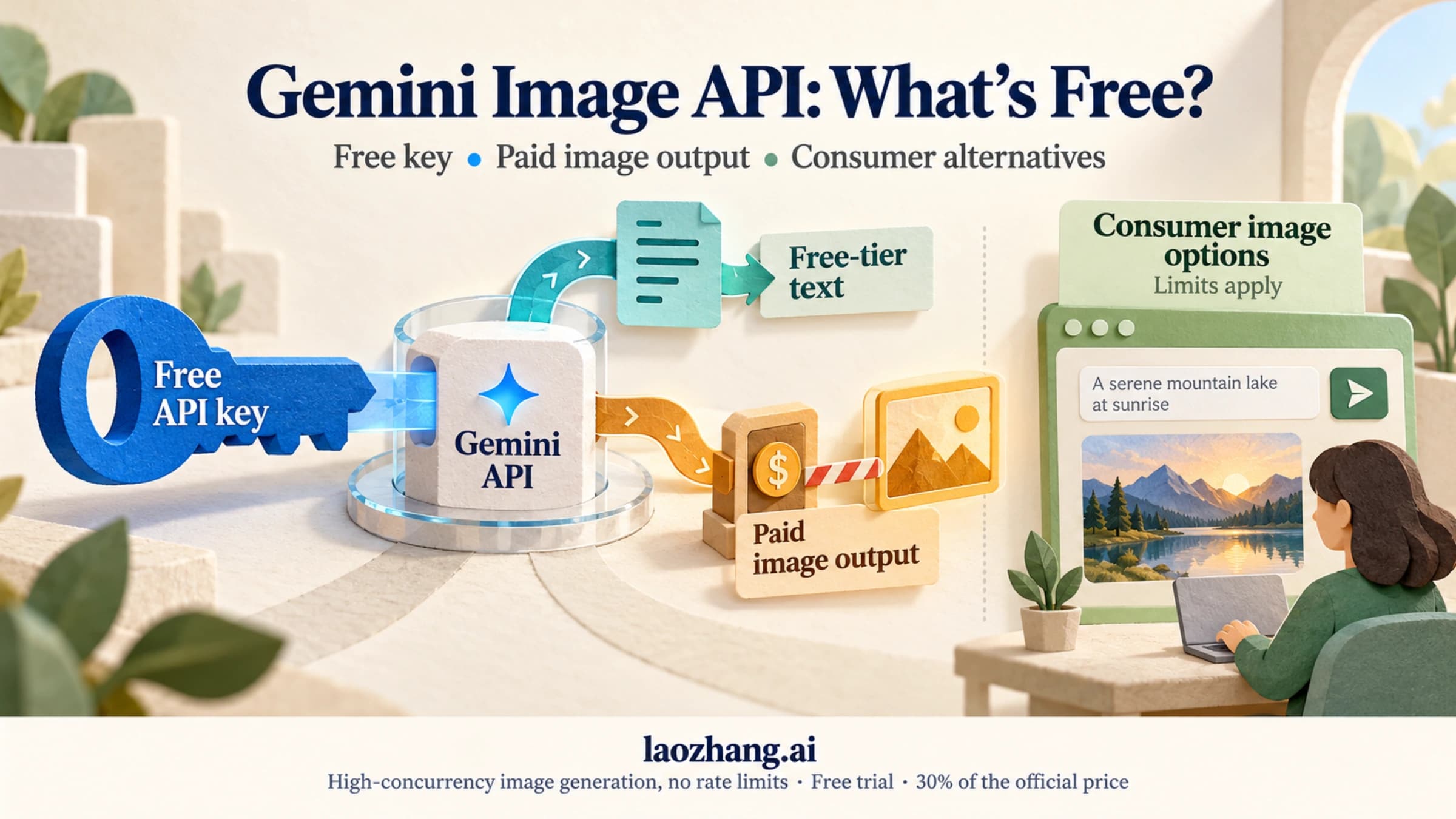
Google offers a free tier for their image generation APIs through Google AI Studio, which includes limited requests per minute (approximately 15 RPM) using the Imagen and Gemini models. This free tier is sufficient for development, testing, and low-volume personal projects but is not designed for production workloads. Paid API access through Vertex AI starts at $0.02 per image for Imagen 4 Fast and $0.04 for Imagen 4 Standard, with no monthly minimum commitment. Google's consumer subscription plans (AI Plus at $7.99/month and AI Pro at $19.99/month) provide another route to image generation without direct API costs.
Can I switch between AI image APIs without rewriting my code?
Switching between providers is straightforward because most AI image APIs follow similar REST conventions. OpenAI's API format has become a de facto standard, and both Google and many third-party providers offer OpenAI-compatible endpoints. API aggregator services take this further by providing a single unified endpoint that supports all major models through the same request format. In practice, switching from one provider to another typically requires changing only the base URL, API key, and model name parameter, leaving your core application logic untouched. The main considerations when switching are differences in supported parameters (some models accept style presets, negative prompts, or seed values that others do not), output format variations (base64 versus URL-based delivery), and content policy differences that may affect which prompts are accepted. Building a thin abstraction layer around your image generation calls from the start makes future provider switches nearly effortless.
What are the rate limits for AI image generation APIs?
Rate limits vary significantly by provider and pricing tier. Google's free tier allows approximately 15 requests per minute, while paid tiers offer higher limits that scale with your usage plan. OpenAI's rate limits depend on your account's usage tier (which increases based on cumulative spending), starting from lower limits for new accounts and scaling up to hundreds of requests per minute for established users. Third-party providers like Black Forest Labs typically offer rate limits based on your subscription plan. API aggregators often provide the most generous rate limits since they can distribute requests across multiple upstream providers, effectively bypassing individual provider limitations.
Making Your Choice: Key Takeaways
The AI image generation API market in 2026 offers more options than ever, but the data points to clear winners in each category. For maximum quality, GPT Image 1.5 and Flux 2 Pro v1.1 are essentially tied at the top of the LM Arena benchmarks. For the best price-to-quality ratio, Imagen 4 Fast and Flux 2 Schnell deliver strong results at $0.02 and $0.015 per image respectively. And for pure cost minimization, GPT Image 1 Mini at $0.005 per image remains unmatched.
The unique "Value Efficiency" metric introduced in this guide reveals that the cheapest option is not always the best value, and the most expensive option is rarely worth the premium. By analyzing Elo points per dollar spent, developers can make informed decisions that optimize both their budget and their output quality for their specific use case.
Your next step depends on your current situation. If you are starting a new project, begin with the use-case recommendations in this guide and test 2-3 models with your actual prompts before committing to a single provider. Most APIs offer free tiers or low-cost trial options that make comparative testing straightforward. If you are already using an image API and spending more than $100 per month, review the cost optimization strategies, particularly quality tier optimization and caching, to identify immediate savings that often exceed 50%. And if you are evaluating at enterprise scale, the volume cost projections above provide the data you need to present a clear business case to your team, including concrete monthly cost comparisons across providers at your expected generation volume.
The AI image generation space continues to evolve rapidly, with new models and pricing changes arriving every few months. The fundamental evaluation framework presented in this guide, comparing pricing, quality benchmarks, and value efficiency rather than relying on marketing claims, will remain useful regardless of which new models emerge. Bookmark this page for updates as we track pricing changes and new model releases throughout 2026.