Seedance 2.0 vs Grok Imagine Video: Pick Control or Access?
Start with Grok Imagine Video if you need the easier public API and simpler pricing today. Start with Seedance 2.0 if you need a richer multimodal video workflow with more image, video, and audio conditioning inside one official surface.
On this page
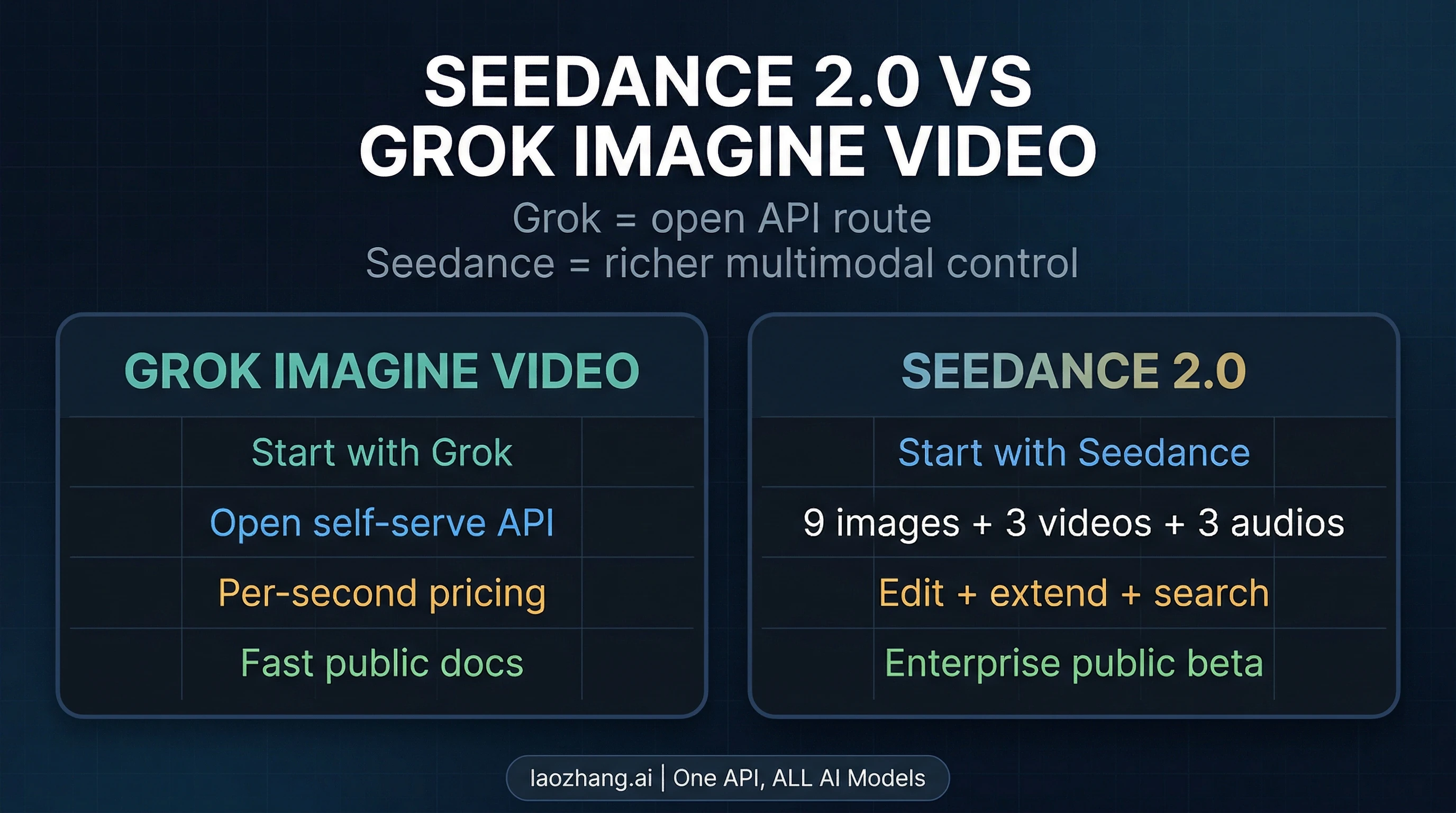
If you need the easier public video API to start using today, start with Grok Imagine Video. If you need richer multimodal control, including multiple image references, video references, audio references, and edit or extend workflows inside one official surface, start with Seedance 2.0.
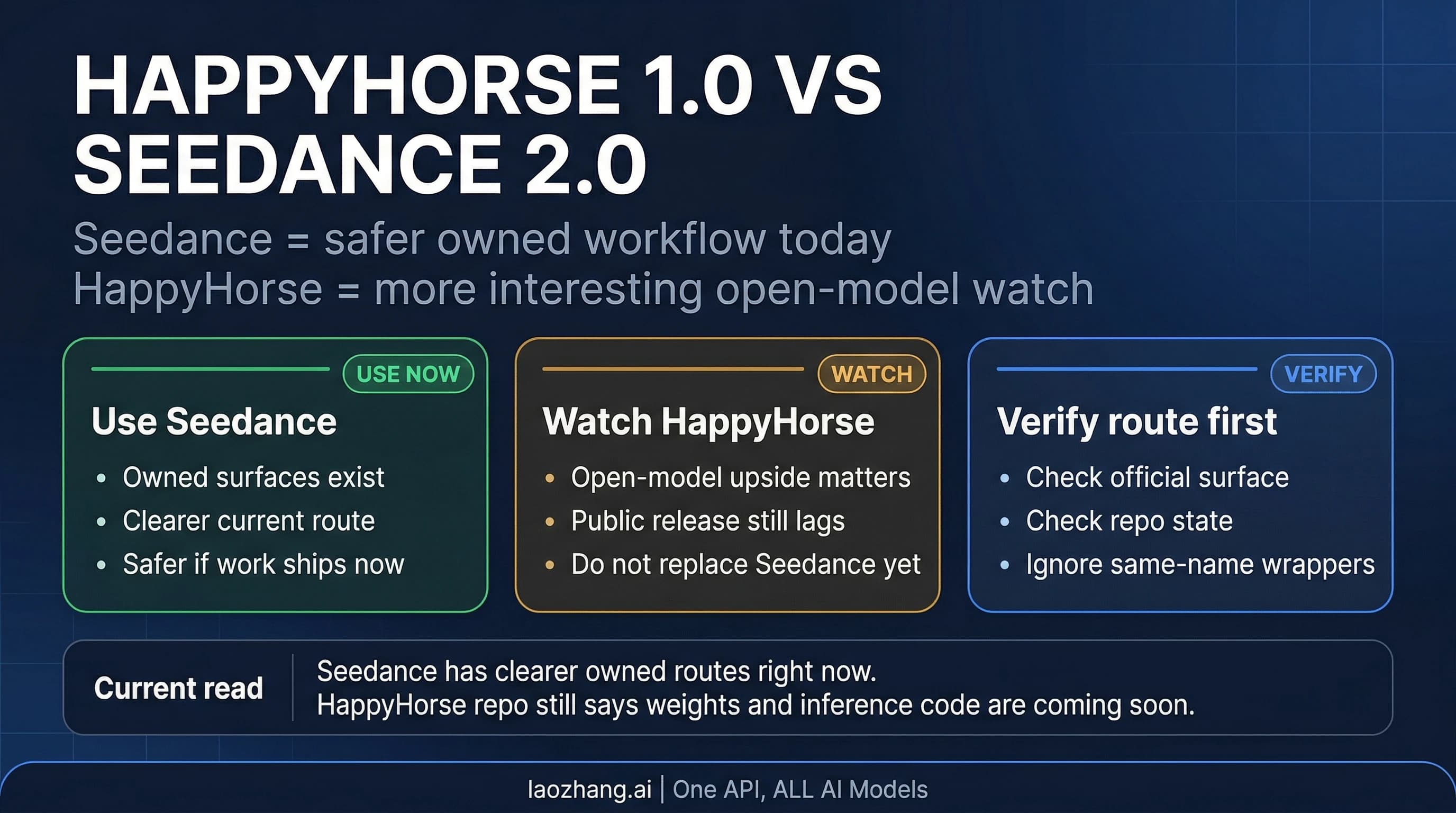
That is the split that actually matters. As of April 3, 2026, this is less a contest for one universal quality winner than a decision between open API access and richer multimodal control. Grok is the cleaner self-serve route. Seedance is the denser video workflow.
Freshness note: all pricing-, limit-, and availability-sensitive facts below were rechecked against official xAI, ByteDance Seed, and Volcengine sources on April 3, 2026.
TL;DR
| If this is your real job | Better default | Why it wins | Main catch |
|---|---|---|---|
| You want the cleanest public video API to prototype with right now | Grok Imagine Video | Public xAI API, simple per-second pricing, clear docs for generation, editing, and extension | Current public docs top out at 720p and expose fewer input types than Seedance |
| You need one video workflow that can combine many reference assets | Seedance 2.0 | Official docs expose 0-9 images, 0-3 videos, 0-3 audios, plus editing and extension | Access is still framed as enterprise public beta |
| You want the fastest budget conversation | Grok Imagine Video | 480p and 720p pricing are readable at a glance, plus separate image and video input charges | Sticker-price clarity does not automatically mean better fit for heavier creative workflows |
| You run an asset-heavy creative or enterprise workflow | Seedance 2.0 | Richer multimodal conditioning is the point of the product, not a side feature | Pricing is harder to flatten into one universal number and onboarding is less frictionless |
The official surfaces that matter
Use the precise product names here. Grok Imagine Video is the current official xAI developer-facing video surface, exposed under the grok-imagine-video model name. On the other side, Volcengine's current tutorial material points to Seedance 2.0 and Seedance 2.0 Fast, with model IDs doubao-seedance-2-0-260128 and doubao-seedance-2-0-fast-260128.
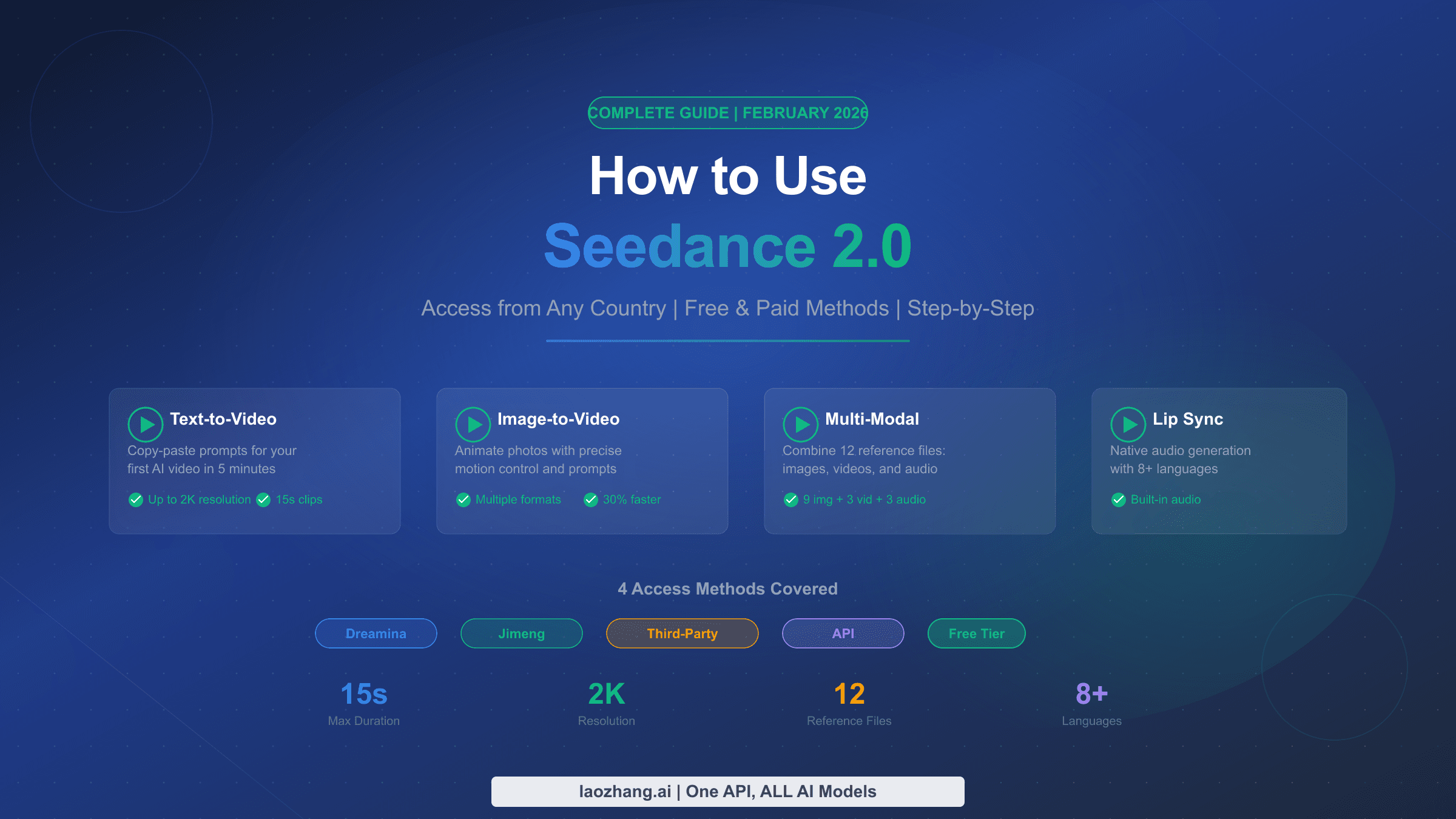
That distinction matters because the two sides are not simply "two text-to-video models with different vibes." Grok's public docs center on a clean developer surface: public model page, public API docs, clear per-second pricing, text-to-video, image-to-video, reference-image guidance, video editing, and video extension. Seedance's current official material describes a more heavily conditioned multimodal system: text plus up to nine images, three videos, and three audios in one request, plus generation, editing, extension, search, and optional audio generation.
Once you compare the official surfaces directly instead of relying on loose shorthand, the decision becomes cleaner. Grok is the easier route to start using. Seedance is the richer route once your workflow needs heavier asset conditioning.
Where Grok Imagine Video is the stronger pick
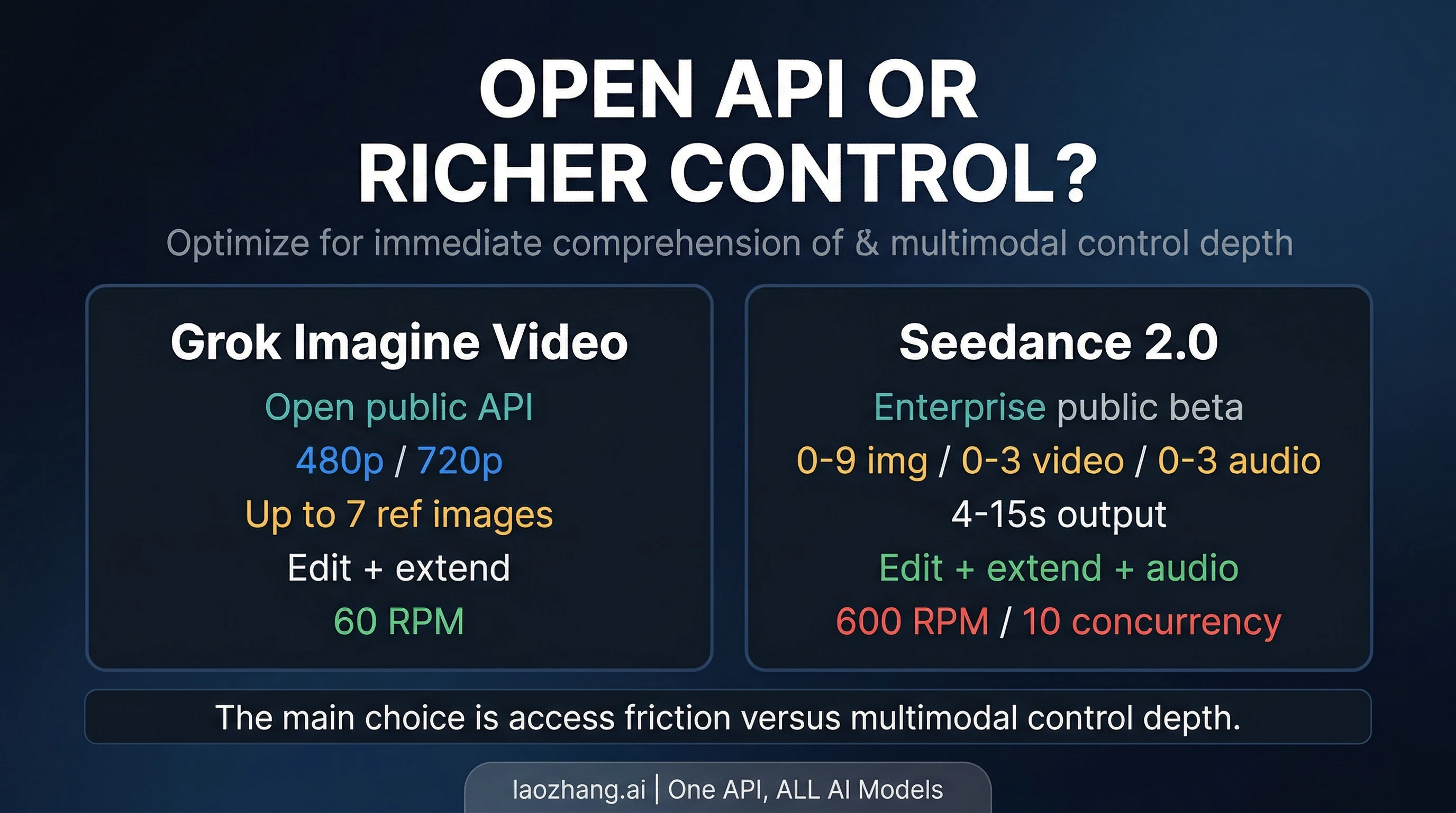
Grok is the stronger pick when your bottleneck is access, not control depth. xAI's current model page gives you the operational picture quickly: grok-imagine-video is available as a public API model, priced at $0.05 per second for 480p and $0.07 per second for 720p, with $0.002 image input pricing, $0.01 per second video input pricing, regions listed as us-east-1 and eu-west-1, and a documented 60 RPM rate limit. That is a much easier first read for a builder than a gated or scenario-shaped pricing surface.
The capability surface is also broader than a bare "prompt to clip" route. xAI's current video-generation docs expose text-to-video, image-to-video, reference-image-guided generation, video editing, and video extension. The reference path supports up to seven images. The edit flow accepts an input .mp4 up to about 8.7 seconds. The extension flow accepts an input clip between 2 and 15 seconds, with extension duration between 2 and 10 seconds. That is enough coverage for a lot of real prototyping jobs: starting from a prompt, steering from stills, repairing a clip, or extending a shot without building around a complex enterprise gate first.
The buyer consequence is straightforward. If you are a solo developer, a small product team, or anyone who needs a callable video API without a lot of access friction, Grok Imagine Video is the easier first move. The catch is equally clear: the public docs top out at 720p and focus on video workflows with text, images, and existing video inputs. They do not expose the same official audio-conditioned, many-reference multimodal stack that Seedance documents. If you are deciding across the wider API market rather than only this pair, our best free AI video API guide is the better shortlist.
Where Seedance 2.0 is the stronger pick
Seedance 2.0 is the stronger pick when your bottleneck is richer conditioning inside the video workflow itself. Volcengine's current Seedance 2.0 tutorial exposes a denser control surface than Grok's public docs. It allows 0-9 images, 0-3 videos, and 0-3 audios as inputs. It documents 4-15 second outputs at 480p or 720p. It explicitly covers generation, editing, extension, search, and a generate_audio=true path. The same current tutorial shows 600 RPM and 10 concurrency for the listed Seedance 2.0 runtime.
That matters because Seedance is not only "another model that accepts references." Its official surface is built around a heavier asset-conditioned workflow. If your team wants to combine multiple keyframes, supporting clips, and audio cues inside one request, or if you care more about a denser control stack than about the easiest self-serve onboarding, Seedance is the more interesting system in this pair. The documented model IDs doubao-seedance-2-0-260128 and doubao-seedance-2-0-fast-260128 make the runtime feel far more explicit than the older "console only" narrative around Seedance did.
But the access boundary has to stay in the sentence, not in the fine print. Current official material still frames Seedance 2.0 as enterprise public beta. So the right recommendation is not "Seedance is better overall." It is: Seedance is the better default when richer multimodal control is the reason you are shopping, and when your organization can accept the current access friction. If you want the broader context on Seedance's current API reality and how the runtime has evolved, our Seedance 2 API guide and how to use Seedance 2 guide are the better companion reads.
Pricing, limits, and access side by side
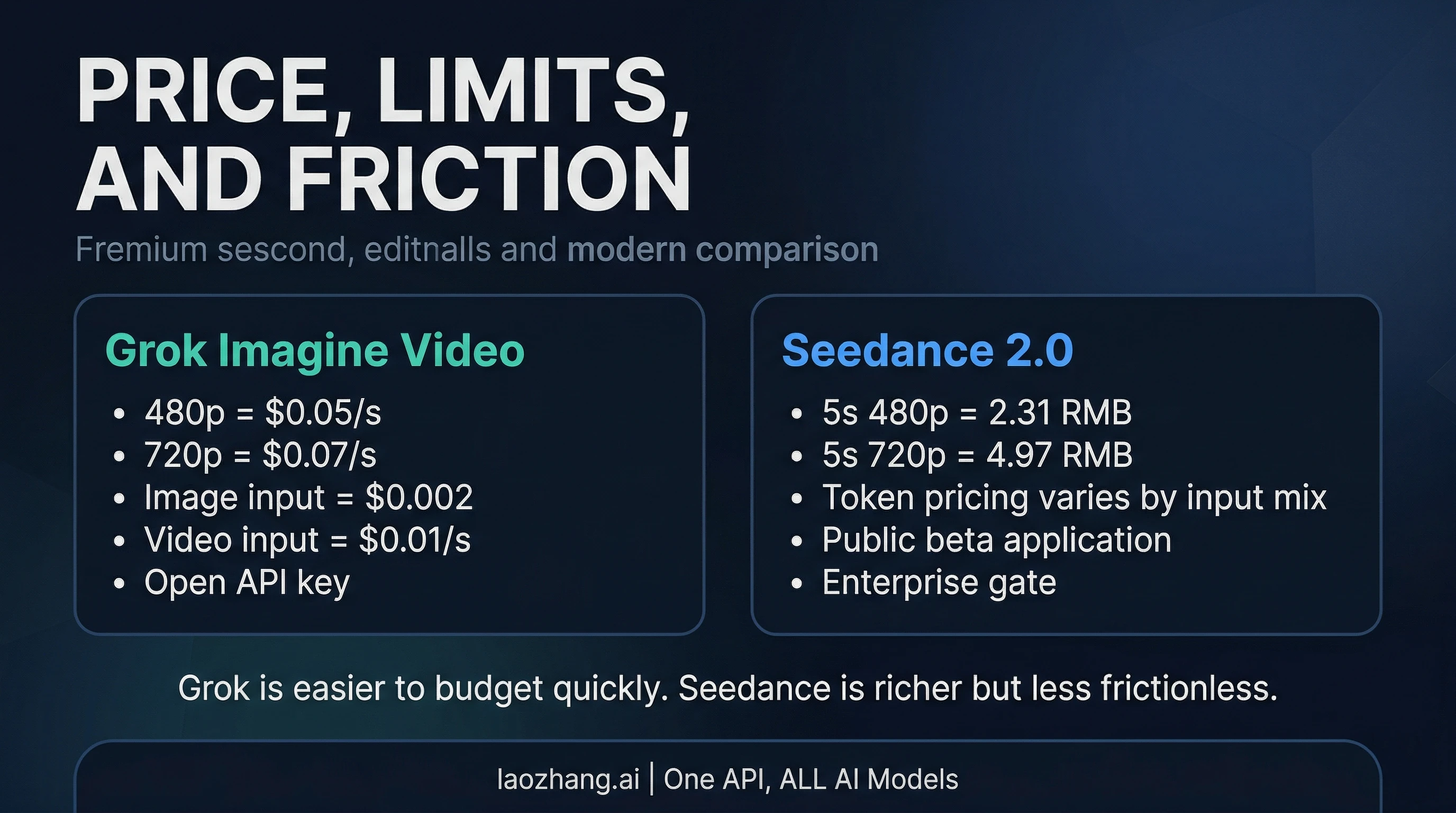
The price question is harder than it looks because the two products do not expose the same pricing shape. Grok uses a cleaner public sticker price. Seedance exposes token pricing plus official scenario examples. That means "which one is cheaper?" depends more heavily on your input mix and workflow shape than most comparison pages admit.
| Area | Grok Imagine Video | Seedance 2.0 |
|---|---|---|
| Access path | Public xAI API | Enterprise public beta via Volcengine |
| Human-readable model surface | grok-imagine-video | Seedance 2.0 / Seedance 2.0 Fast |
| Documented inputs | Text, image input, up to 7 reference images, video edit and extend inputs | Text plus 0-9 images, 0-3 videos, 0-3 audios |
| Output | Public docs center on 480p and 720p video workflows | 4-15 second outputs at 480p or 720p |
| Pricing | 480p = $0.05/s, 720p = $0.07/s, image input = $0.002, video input = $0.01/s | Token pricing plus official 5-second 16:9 examples: 480p = 2.31 RMB standard / 1.86 RMB fast; 720p = 4.97 RMB standard / 4.00 RMB fast |
| Documented rate limit | 60 RPM | 600 RPM, 10 concurrency |
| Main strength | Easier to budget and start | Richer multimodal control surface |
| Main catch | Fewer officially documented input modalities | Access friction and less uniform pricing surface |
The practical interpretation is simple. Grok is easier to price quickly and easier to get started with. You can look at the public page, estimate clip cost by seconds and resolution, and move. Seedance is richer, but its public pricing is harder to flatten into one universal number because the official surface depends on token usage, input mix, and scenario examples. That is not a flaw in the product. It is just a more complex buying conversation.
So do not force a fake apples-to-apples winner. If your org needs the fastest possible budget conversation and the cleanest public API story, Grok wins that round. If your org needs more conditioning power and can tolerate a higher-friction access path, Seedance can still be the better operational fit.
Best picks by workflow and when to switch
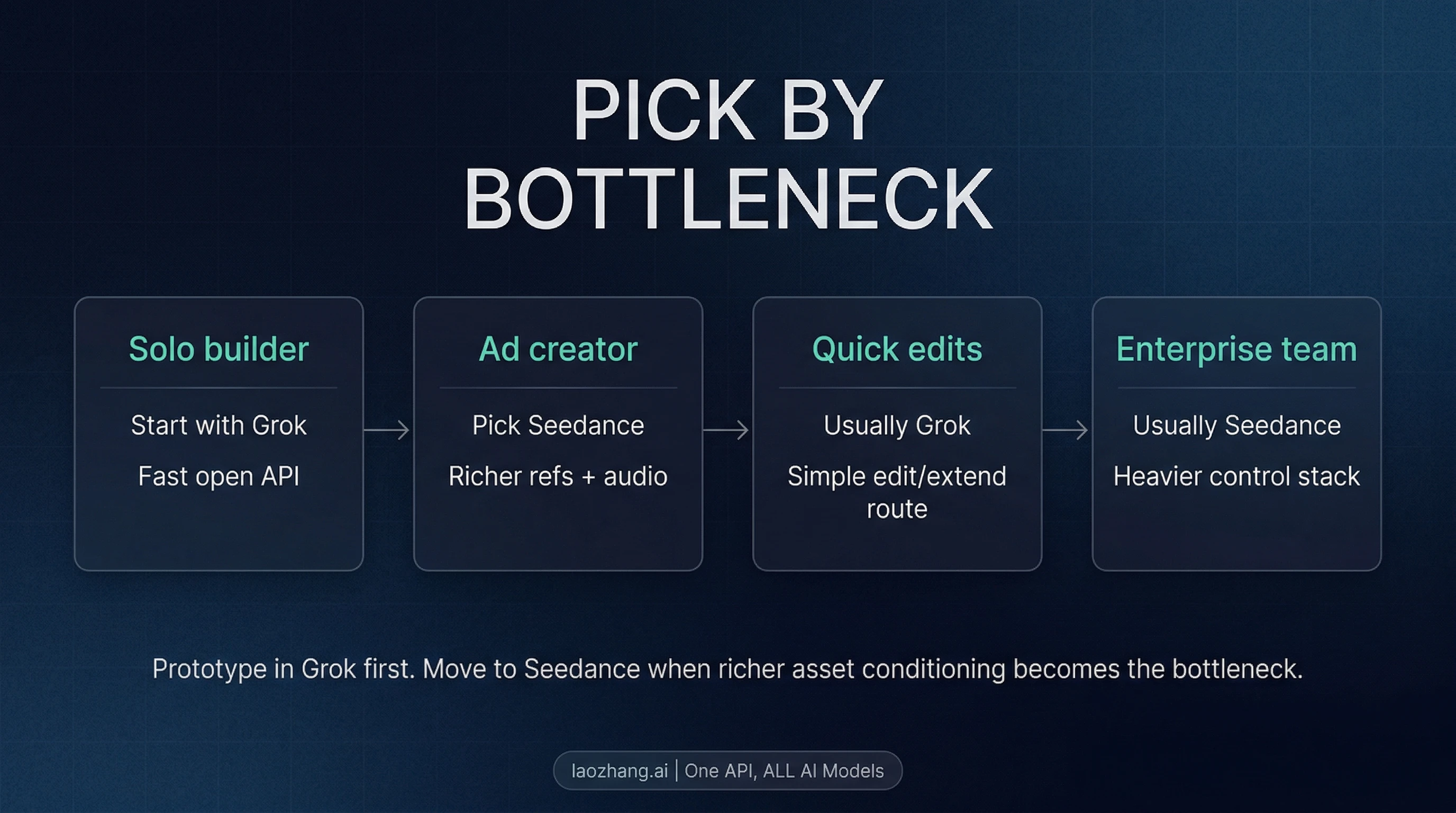
Solo builders and small product teams should usually start with Grok. The public docs are easier to read, the API surface is easier to call, and the pricing surface is easier to explain to a teammate or customer. If the first job is "prove we can generate, edit, or extend clips from an API this week," Grok is the faster route.
Ad creators and asset-heavy short-form teams should usually start with Seedance. The reason is not abstract model hype. It is the documented ability to combine more images, more video references, and audio inputs inside one workflow. If your video process depends on multiple creative assets rather than on one prompt and one quick output, Seedance's current workflow is closer to the job.
Teams doing lighter edit or extend workflows can often stay in Grok longer than they expect. The official xAI docs already cover editing and extension, and that is enough for a lot of practical iteration loops. You do not need to graduate to Seedance only because it is more complex. You move when the missing control becomes the bottleneck.
Enterprise creative ops teams are the clearest Seedance audience. Once you already have multiple approved assets, more formal workflows, and the ability to handle a public-beta access process, the richer conditioning surface becomes more valuable than Grok's easier onboarding.
The clean switch rule is this: start in Grok when access is the bottleneck; move to Seedance when richer asset conditioning becomes the bottleneck. That is a much more useful decision model than asking which side wins in the abstract. If you want the broader public-API landscape around this choice, our best free AI video API guide and best AI image-to-video generator guide are the next useful reads.
FAQ
Is "Grok Video" the same thing as Grok Imagine Video?
Not as a precise product name. "Grok video" is loose shorthand. The current official developer-facing comparator is Grok Imagine Video, exposed under the grok-imagine-video model name.
Which one is easier to use today?
Grok Imagine Video is easier to start with because xAI exposes a public API surface, clearer public pricing, and straightforward current docs for generation, editing, and extension.
Which one has richer multimodal control?
Seedance 2.0. Current official docs expose text plus up to nine images, three videos, and three audios in one request, which is a heavier conditioning stack than Grok's current public docs show.
Which one is cheaper?
There is no honest universal winner. Grok is easier to estimate because the public price is per second plus input charges. Seedance uses token pricing plus official scenario examples, so cost depends more directly on how you build the request.
Should I start in Grok and switch later?
Often yes. That is the cleanest route when you need a public API now and only later discover that multiple reference assets or audio-conditioned workflows matter enough to justify Seedance's richer but more gated surface.