Best Free AI Video API in 2026: Which Ones Are Actually Free?
If you want one free AI video API for real text-to-video or image-to-video prototyping, start with Magic Hour. If you need conversational or avatar video, Tavus is the better free route and HeyGen is the easiest small trial. If you mean official model APIs like Veo, OpenAI's public video API, or Runway's public API, the honest answer is that those routes are mostly paid.
On this page
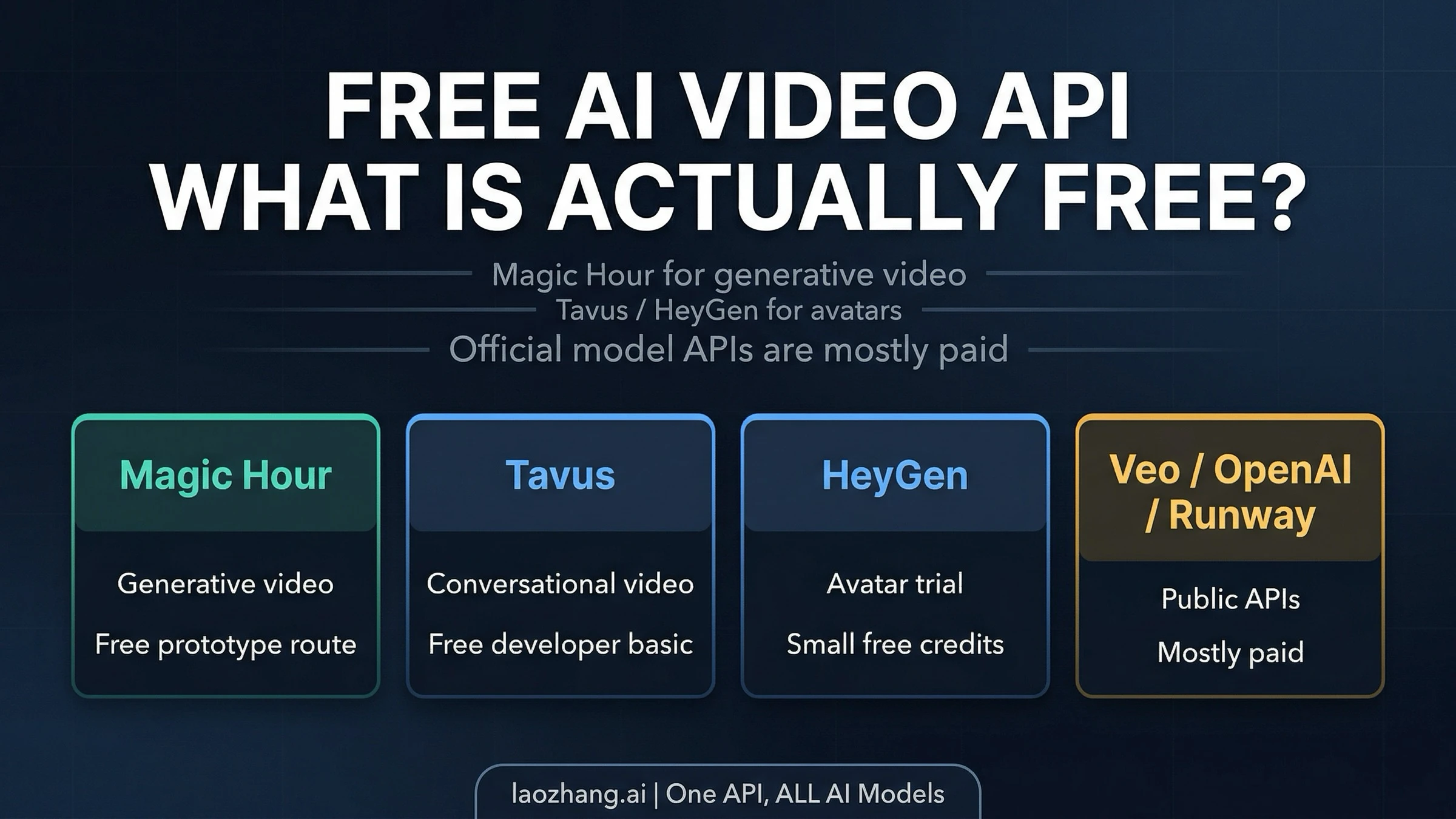
If you need one free AI video API for real text-to-video or image-to-video prototyping, start with Magic Hour. If you need avatar or conversational video, Tavus is the better free route and HeyGen is the easier small trial. If you mean official model APIs like Google's Veo, OpenAI's public video API, or Runway's public API, the honest answer is that those public developer contracts are mostly paid.
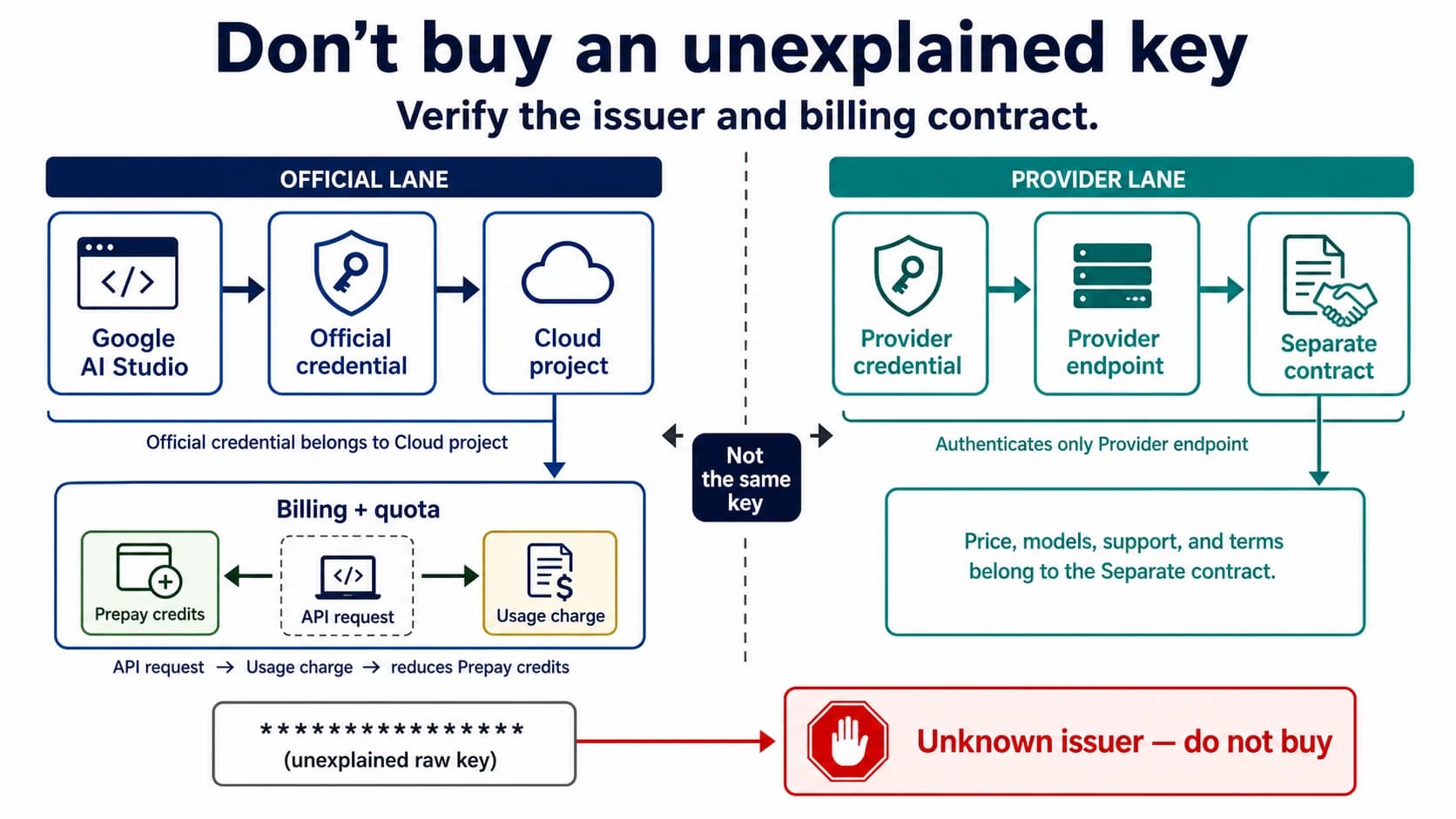
That split matters because "free AI video API" sounds like one buying decision when it is really four different contract shapes hiding under one phrase. Some routes give you recurring free quota. Some give you a small free trial. Some advertise a free plan that is too small to fund a real video-generation job. And some famous APIs are public, documented, and easy to browse, but not free in the public developer contract at all.
Freshness note: all pricing- and availability-sensitive claims below were rechecked against official vendor pages on April 2, 2026.
TL;DR
Here is the shortest useful answer.
| If this is your real job | Best free route | Why it wins | Main catch |
|---|---|---|---|
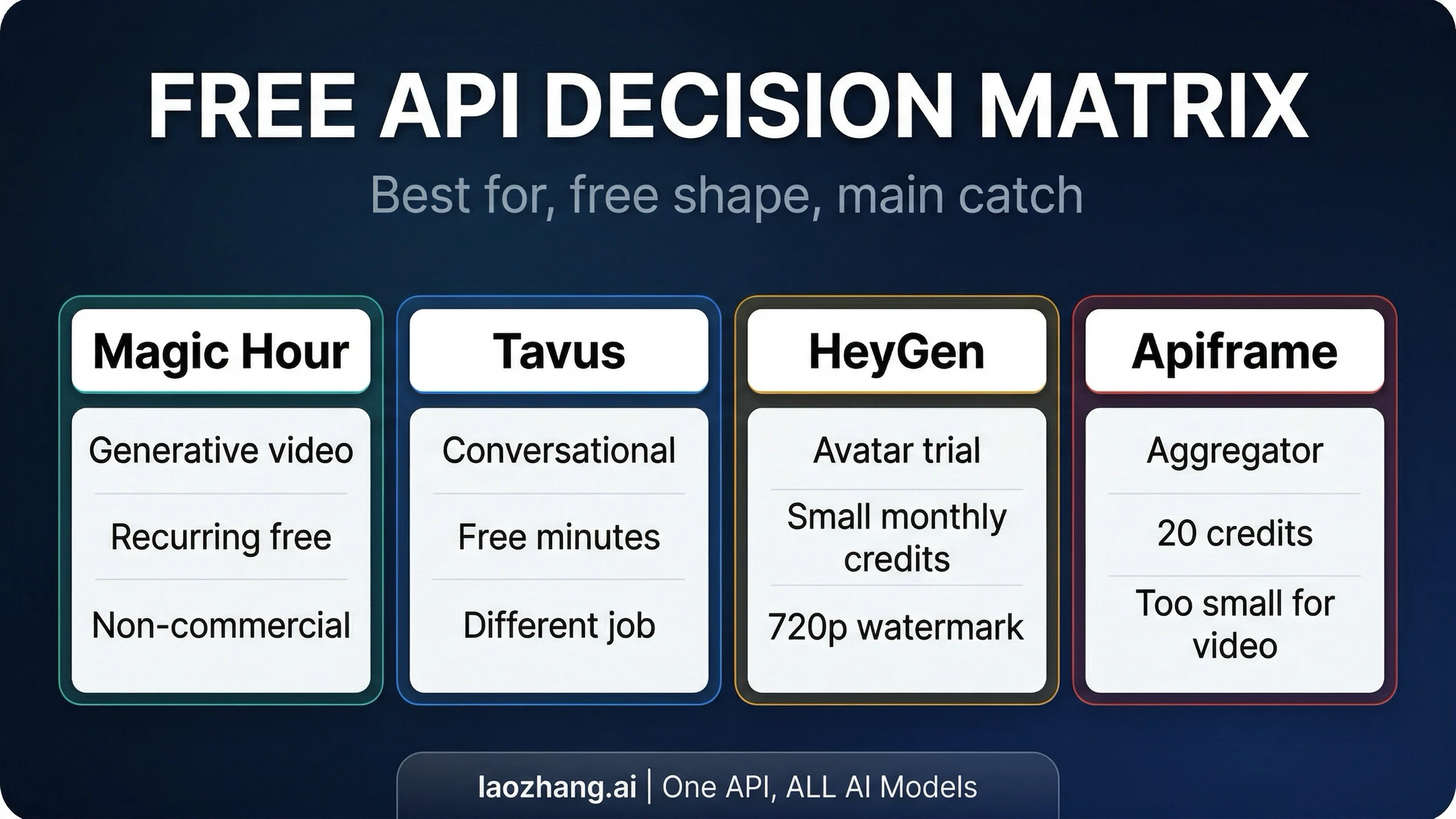
| You want one real generative-video API to prototype with | Magic Hour | Public pricing page says you can start free with API access, a one-time 400 credit pack, and 100 additional daily free credits | Free usage is for personal, non-commercial work, and the exact number of usable generations depends on endpoint credit burn |
| You are building conversational or avatar-style video experiences | Tavus | Free developer basic plan includes whitelabeled APIs, 25 minutes of AI conversational video, and 5 minutes of AI Video Generation | This is not the same product category as a cinematic text-to-video model API |
| You want the smallest, easiest avatar API trial | HeyGen | Official docs surface a small free API route with 10 free API credits per month | The free plan is limited, watermarked, and capped at 720p |
| You want one multi-model API with a nominal free plan | Usually none | Some plans look free at first glance | Apiframe's free plan includes 20 credits, while its own FAQ says video generation may cost 100-500 credits |
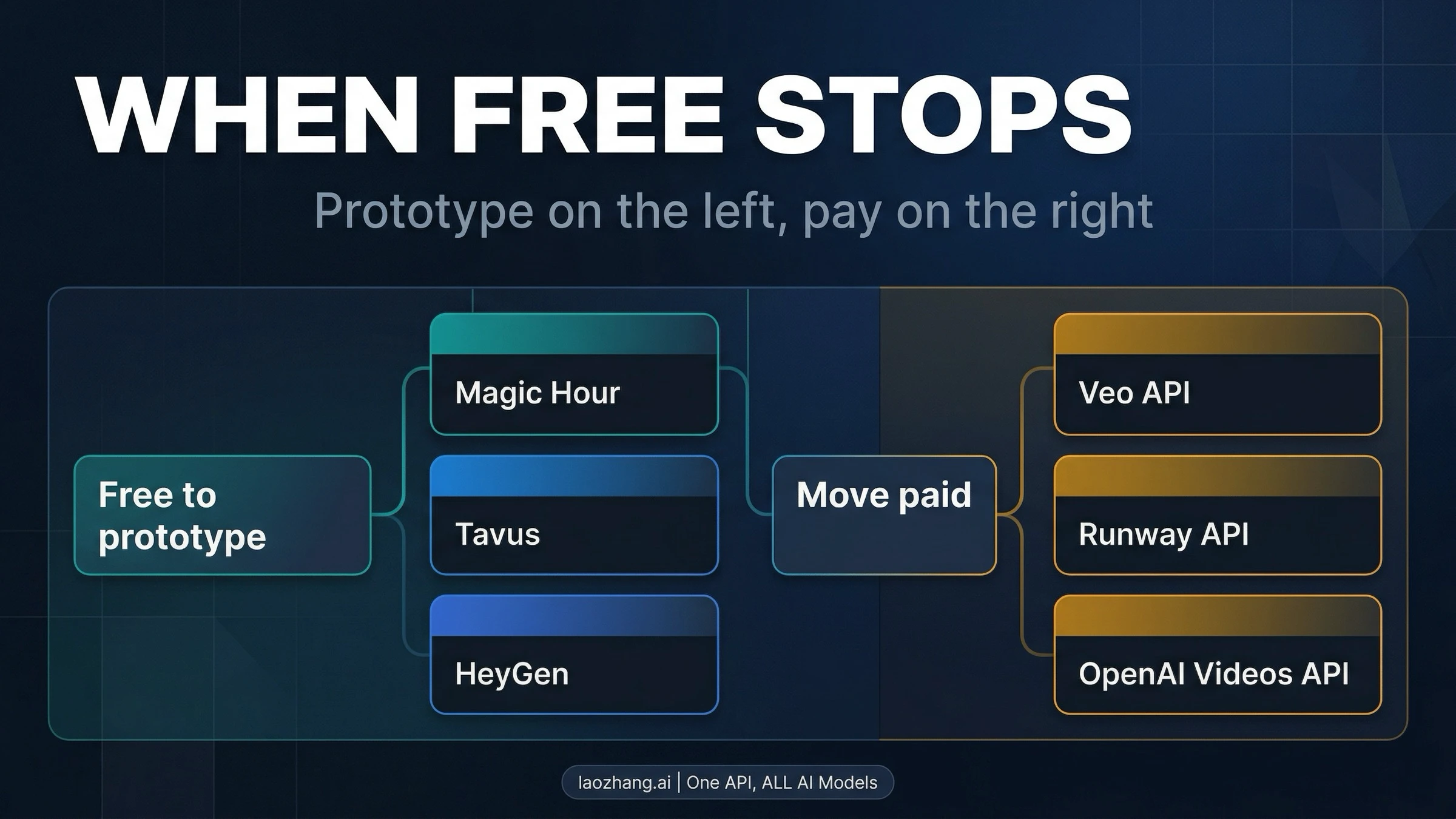
| You want an official high-end model API like Veo, OpenAI, or Runway | No true public free default | Those are the strongest public developer surfaces | Their public pricing/setup docs are paid routes, not durable free tiers |
The useful question is not just which API is free. It is what kind of free contract you are actually getting.
Why "Free" Means Four Different Contracts Here
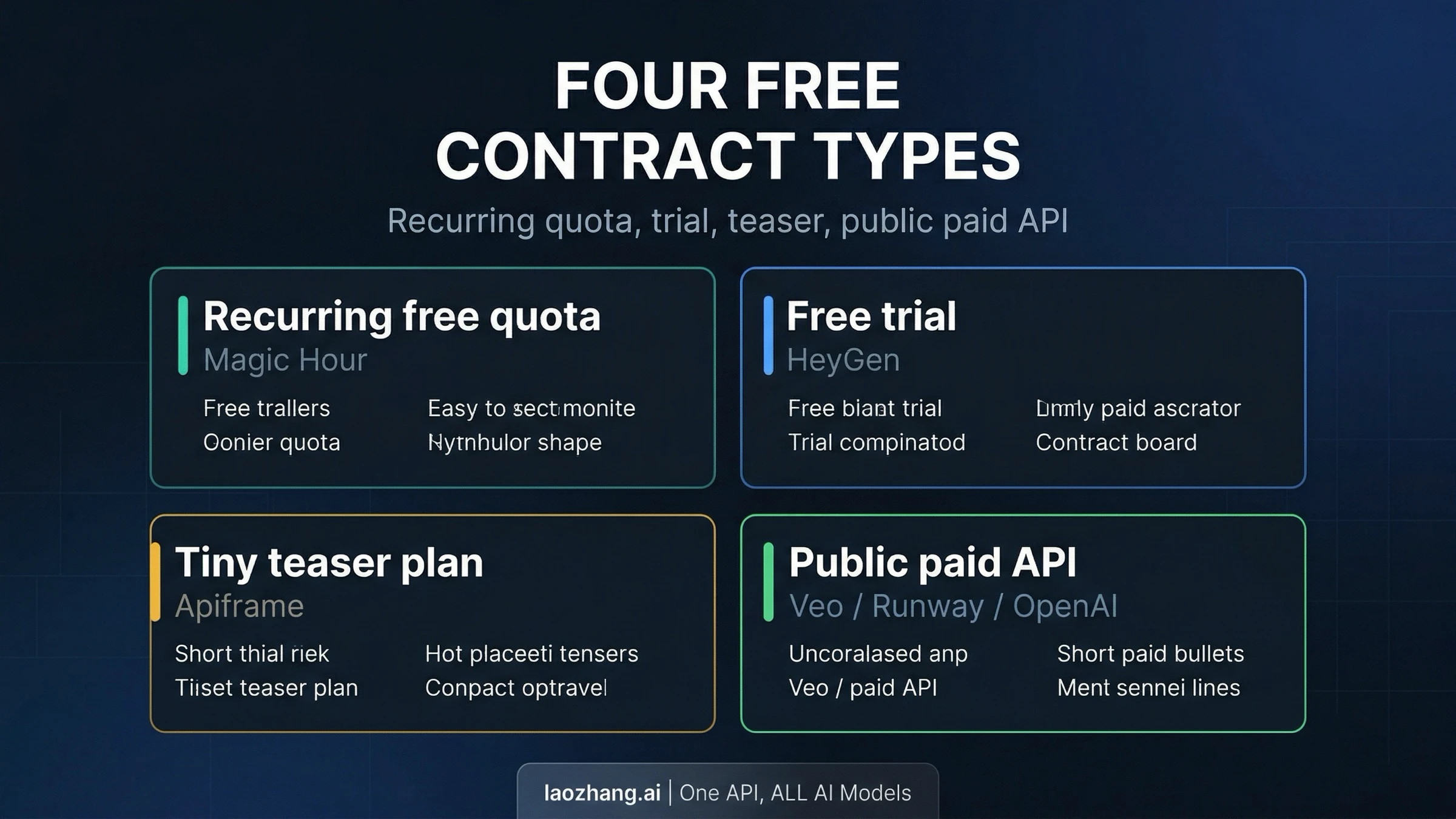
The first category is recurring or renewable free quota. This is the closest thing to what most people mean when they ask for a free API. You can come back tomorrow or next month and still do some meaningful testing without paying. That is why Magic Hour matters so much. Its published pricing page does not just say "try it." It pairs a free starting route with API access and explicit credit language. That makes it more actionable than a vague landing page that uses the word free without showing the contract underneath.
The second category is a small free trial. This is still useful, but it is not the same thing as a lasting no-pay workflow. HeyGen fits here. A small free API allowance can be enough to prove that your avatar flow, streaming path, or webhook handling works. It is not enough to pretend you now have a general-purpose free video-generation backend. That difference is why so many "best free API" lists leave readers with the wrong expectation.
The third category is a nominal free plan that does not actually fund a real video job. Apiframe is the clearest current example of this problem. Its pricing page offers a free plan with API access and 20 credits, which sounds promising until you read the FAQ that says video generation may cost 100-500 credits. That is not useless, but it is not a serious answer to the reader who wants to test a real video-generation workflow without paying.
The fourth category is the most important one to state directly: public, official APIs that are not free at all. Runway's public API setup guide says you need to add credits before you can start, with a minimum payment of $10. Google's Veo pricing table marks the free-tier column as Not available. OpenAI's API pricing page exposes paid video pricing rather than a public durable free tier. These routes matter, but they belong in the paid official API bucket, not the best free AI video API bucket.
Once you see those four shapes clearly, the category stops feeling noisy.
The Three Free APIs Actually Worth Testing
Magic Hour: Best Free Generative-Video API Starting Point
Magic Hour is the best default answer if your mental model is "I want a real generative-video API, not just an avatar product, and I do not want to pay up front." Its current pricing page is unusually explicit about the free contract. It says you can start free with no card required, it includes API access in the pricing language, and its FAQ spells out that free users get an initial one-time 400 credits plus 100 additional free credits they can claim daily. That is the kind of public contract clarity most pages in this category still avoid.
What makes Magic Hour more useful than a lot of "free AI video API" landing pages is not only the free language. It is the fact that the same site also exposes a real AI video and image API page. That means the free route is attached to an actual developer surface rather than just a UI-only consumer generator. If you need to validate prompts, webhook behavior, request/response flow, or simple integration wiring, Magic Hour is the cleanest current generative-video route to start with.
The catch is important enough that it should sit right beside the recommendation. Magic Hour's own pricing FAQ says free users are limited to personal, non-commercial use. That makes it a prototyping answer, not a forever-free commercial answer. The other catch is that free-credit usefulness still depends on which endpoint you call and how expensive that workflow is. So the right way to think about Magic Hour is: best free generative-video API for prototyping, not a guarantee of long-term free production volume.
Tavus: Best Free Conversational-Video API
Tavus is the better answer when your real job is not cinematic prompt-to-video generation, but AI humans, video agents, onboarding avatars, or conversational product flows. Its current developer pricing page makes the free contract visible right away: the basic developer plan is free, includes whitelabeled APIs, and comes with 25 minutes of AI conversational video plus 5 minutes of AI Video Generation.
That is a strong free contract, but it solves a different problem from Magic Hour. Tavus is not the default answer when you want to generate a short stylized clip from a text prompt the way you might evaluate Veo or Runway. It is the better answer when the product you are building is closer to a video assistant, digital human, or conversational experience. In that context, the free plan is more useful than a bare teaser because it gives you enough room to validate the whole interaction loop rather than just a single decorative generation.
The mistake to avoid is comparing Tavus against generative model APIs as if they were direct substitutes. They are not. If the reader wants conversational video, Tavus belongs near the top. If the reader wants general generative video, Tavus is an override, not the default.
HeyGen: Best Small Avatar Trial
HeyGen is the easier answer when you want a small, low-friction avatar API test rather than a broader free workflow. Its official API docs language currently surfaces a free trial with 10 free API credits per month, and official search-snippet language around the same docs points to the free route as a 720p output path with a watermark. That is exactly the kind of contract that can be useful for a fast proof of concept and disappointing for anyone who mistakes it for a bigger free tier.
That is why HeyGen ranks below Tavus in this guide. It is not because HeyGen is weak as a product. It is because the free contract is smaller, more visibly trial-shaped, and more constrained in presentation. If your main goal is simply to make sure your avatar pipeline works, HeyGen is fine. If your main goal is to spend time inside a larger free conversational-video sandbox, Tavus is the better route.
The right way to phrase the recommendation is therefore narrow and practical: HeyGen is the best free AI video API for quick avatar experimentation when you care more about low-friction setup than about generous free volume.
The Routes That Sound Free But Aren't
Apiframe is the clearest "looks free, not really free for video" example right now. Its pricing page gives you a real free plan with API access. That part is true. But the same page's FAQ says video generation may cost 100-500 credits, while the free plan comes with only 20 credits. That is enough to make the free tier relevant to this article, but only as a warning. It is not a serious answer for someone who wants a free AI video API they can actually use to generate meaningful video output.
Runway's public API belongs in the same reality-check section for a different reason. Runway is not pretending to be a public free tier. Its setup guide is direct: before you can use the API, you need to add credits to your organization, and the minimum payment is $10 at $0.01 per credit. That is operationally clear and honestly easier to work with than a fake-free plan. It just means Runway is not the answer if the goal is to stay on a free route.
Google's Veo API surface should be treated the same way. Google's current pricing table is explicit: the free-tier column for Veo 3.1 Standard, Veo 3.1 Fast, and Veo 3.1 Lite is Not available. That does not make Veo a bad option. In fact, if you are already willing to pay, Veo 3.1 Fast is one of the cleaner official paid routes to start with. It just does not belong in an honest list of public free AI video APIs.
OpenAI's public video route is also a paid developer surface rather than a public durable free tier. If you specifically want OpenAI's developer video stack, read our OpenAI Sora API guide, which explains the current public route in more detail. And if you are evaluating adjacent vendor-specific API status rather than a broad free-routing question, our Seedance 2 API guide covers that narrower path.
The broader lesson is simple: public API does not mean free API. A lot of confusion disappears once you stop letting those two ideas collapse into one.
How to Choose in 30 Seconds
Use this rule and you will usually pick the right route fast:
- If you want a real generative-video API and you do not want to pay up front, start with Magic Hour.
- If you want a digital human, onboarding avatar, or conversational-video API, start with Tavus.
- If you just need a small avatar API trial with low setup friction, use HeyGen.
- If you need commercial-safe output, stable production volume, or an official model API, stop optimizing for "free" and switch to the paid route that matches your model needs.
The last bullet is the most important one. Free routes are strongest when the reader's job is evaluation. Once the job becomes commercial delivery or official model access, the free answer usually becomes less honest than a cheap paid answer.
FAQ
What is the best free AI video API right now?
For actual generative-video prototyping, it is Magic Hour. For conversational or avatar video, Tavus is the stronger free route. Those are different answers because they solve different video jobs.
Is there a truly free Veo API?
Not in the public developer contract. Google's current Veo pricing table marks the free-tier column as Not available.
Is OpenAI's public video API free?
No public durable free tier is exposed on the current API pricing surface. If you want OpenAI's route specifically, treat it as a paid developer path rather than a free default.
Which free AI video API is best for avatar video?
Use Tavus if you want the stronger free conversational-video route. Use HeyGen if you want the simplest smaller avatar trial.
Why doesn't Apiframe count as the best free AI video API?
Because its own pricing FAQ says video generation may cost 100-500 credits while the free plan includes only 20 credits. That makes the free tier too small to anchor a serious free-video recommendation.
What if I need commercial use, not just prototyping?
That is usually the point where you should stop forcing a free answer. Magic Hour's free plan is non-commercial, HeyGen's free path is visibly trial-shaped, and official model APIs are mostly paid anyway. Move to the paid route that matches the actual product job.