Nano Banana 2.1 API Pricing: Per-Image Price vs Cost per Call
Nano Banana 2.1 costs $0.0336 (1K), $0.0504 (2K) or $0.113 (4K) per image on the Gemini API; six live calls added $0.006 to $0.011 each in thinking and text.
On this page
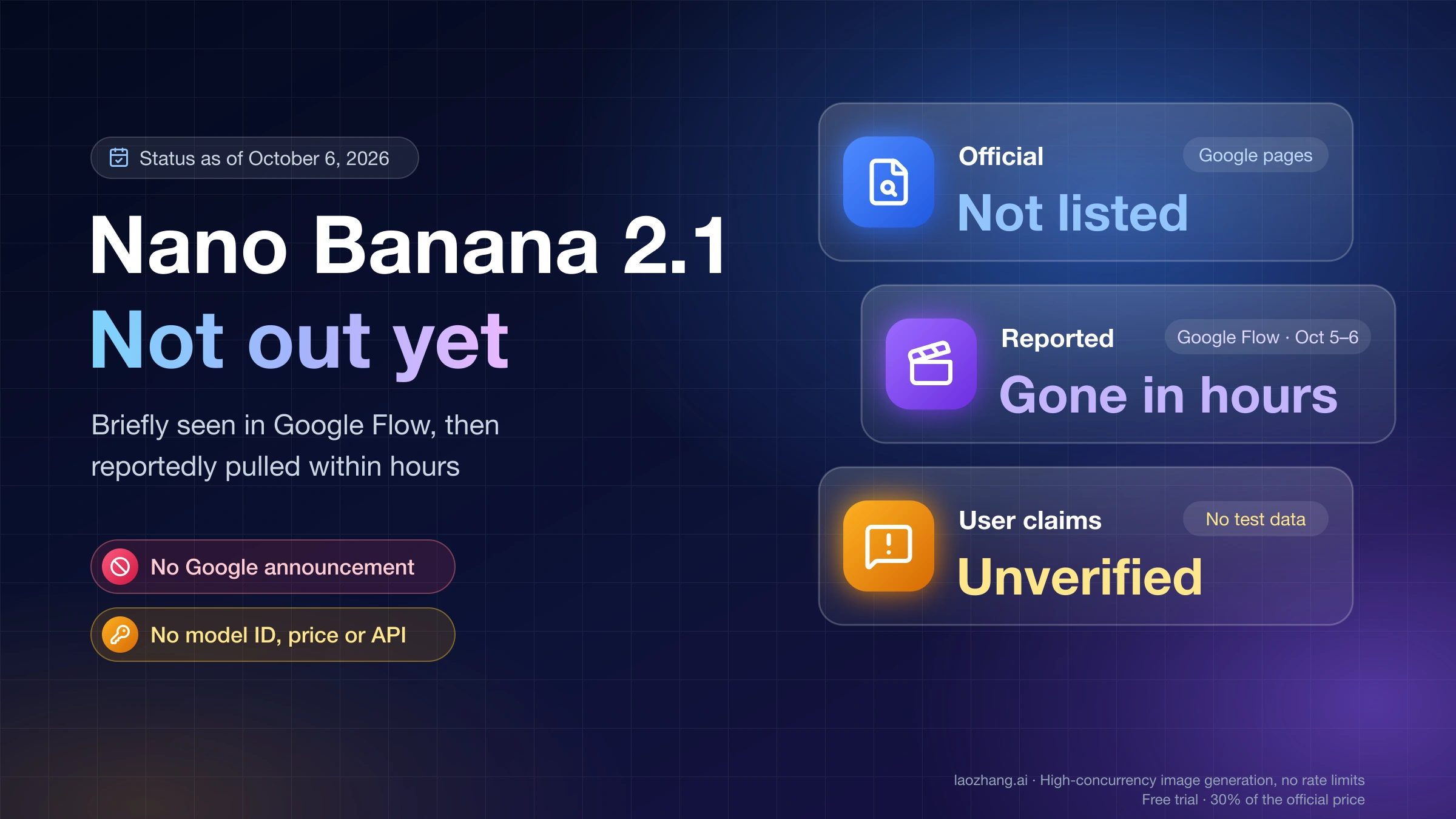
Nano Banana 2.1 is Google's new primary Flash image model, generally available since October 6, 2026 under the API ID gemini-nano-banana-2.1. It is an update to Nano Banana 2 (gemini-3.1-flash-image), built on Gemini 3.6 Flash according to Google DeepMind's model card. It is available on the Gemini API and rolling out in the Gemini app, Google AI Studio and Google Flow. Google has deprecated Nano Banana 2 and recommends 2.1 for new projects, but as of October 8, 2026 it has announced no shutdown date.
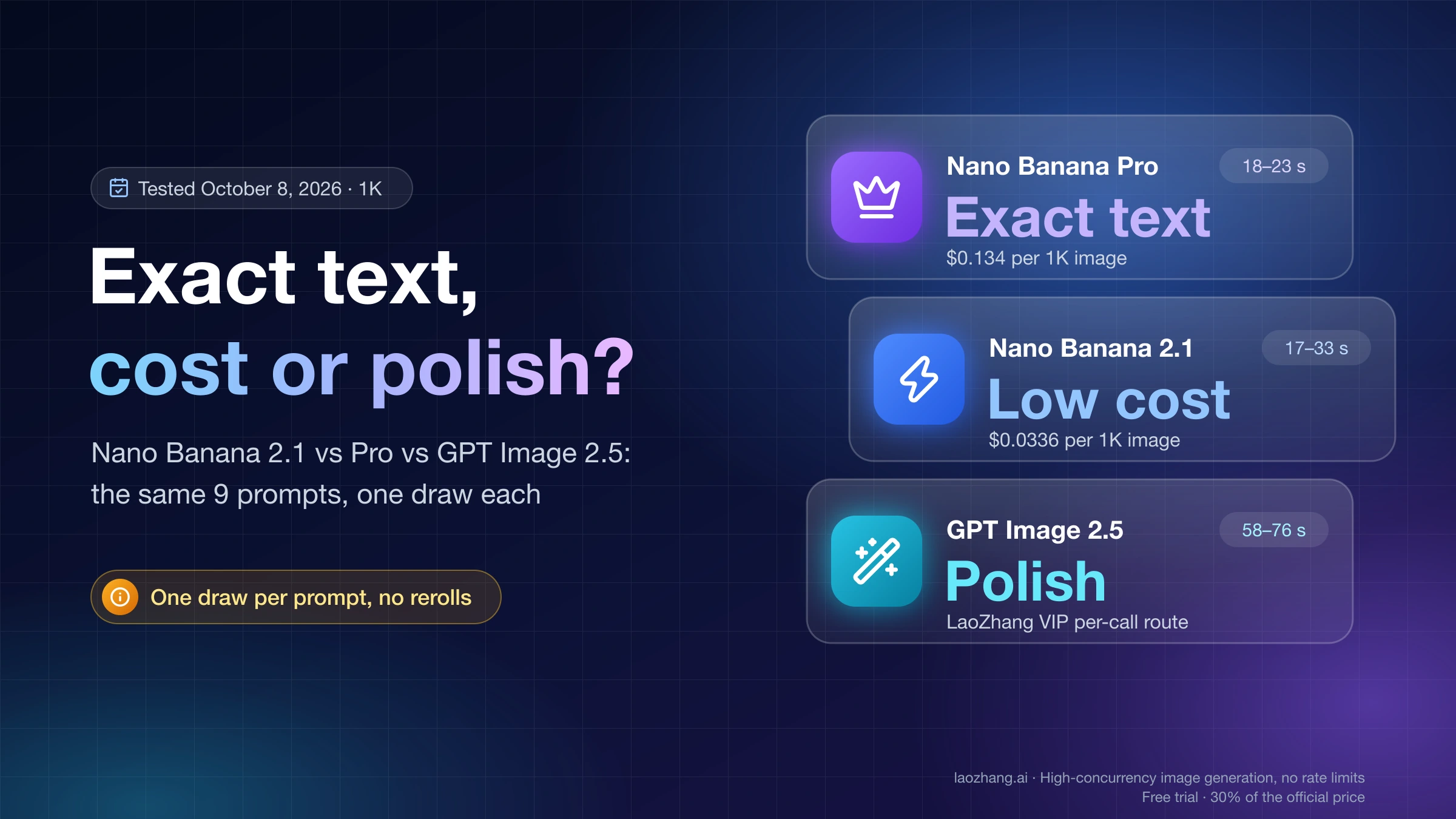
On the Gemini API pricing page, as of October 8, 2026, a 2.1 image costs $0.0336 at 1K, $0.0504 at 2K and $0.113 at 4K. That is half of Nano Banana 2's $0.067 and $0.101 at 1K and 2K, but only about 25% below its $0.151 at 4K. These are image output prices only. Input tokens cost three times as much as on Nano Banana 2, text and thinking output costs 2.5 times as much, and 2.1 thinks at a medium level by default.
Six live calls to 2.1 on October 8, 2026, made through LaoZhang API (the provider behind this blog), showed thinking tokens on every call: 510 to 1,107 of them. Counted with the text the model also returned, that output adds roughly $0.006 to $0.011 per image at Google's list rates, which still leaves 2.1 cheaper than Nano Banana 2 at every size in those samples. No call went directly to Google, and each setting ran once.
Disclosure: laozhang.ai is our own service. Its prices are platform pricing, not an independent comparison.
On quality, the strongest evidence so far is Google's own: its model card rates 2.1 above Nano Banana 2 and Nano Banana Pro in internal side-by-side tests. The independent Arena text-to-image board has 2.1 at #5 with a preliminary score, behind both GPT Image 2.5 variants. In the Gemini app, 2.1 is for paid Google AI plans; free users get Nano Banana 2.
Nano Banana 2.1 vs Nano Banana 2, 2 Lite and Pro: price, sizes and limits
The table compares Google's current image models on the Gemini API as of October 8, 2026. Prices are Standard paid tier, image output only.
| Nano Banana 2.1 | Nano Banana 2 | Nano Banana 2 Lite | Nano Banana Pro | |
|---|---|---|---|---|
| API model ID | gemini-nano-banana-2.1 | gemini-3.1-flash-image | gemini-3.1-flash-lite-image | gemini-3-pro-image |
| Status on the Gemini API | GA since October 6, 2026 | Deprecated, no shutdown date announced | No shutdown date announced | No shutdown date announced |
| Price per image | $0.0336 (1K), $0.0504 (2K), $0.113 (4K) | $0.045 (0.5K), $0.067 (1K), $0.101 (2K), $0.151 (4K) | $0.0336 (1K only) | $0.134 (1K or 2K), $0.24 (4K) |
| Batch price per image | $0.0168, $0.0252, $0.0567 | Half of Standard | Half of Standard | Half of Standard |
| Input tokens, per 1M | $1.50 | $0.50 | See Google's pricing page | See Google's pricing page |
| Text and thinking output, per 1M | $7.50 | $3 | See Google's pricing page | See Google's pricing page |
| Output sizes | 1K, 2K, 4K; no 512px | 512px (0.5K) to 4K | 1K only | 1K, 2K, 4K |
| Reference images | Up to 14; up to 4 characters and 10 objects | Same as 2.1 | Not optimized for multiple references | Up to 5 characters and 6 objects |
| Grounding | Google Web and Image Search | Google Web and Image Search | None | Google Search |
| Default thinking level | medium (also minimal, high) | minimal (also high) | minimal (also high) | Not in Google's thinking-level table |
| Arena text-to-image, October 6, 2026 | #5, 1328, preliminary | #11, 1261 | #15, 1250 | #16 (2K), 1248 |
Sources: the Gemini API pricing page, the Gemini API image generation guide, the Gemini API deprecations page and the Arena text-to-image leaderboard.
Three rows change decisions:
- Price per image. 2.1 at 1K costs the same as Nano Banana 2 Lite, but adds 2K and 4K output, grounding and multi-reference editing. Pro costs 4 times as much at 1K ($0.134 ÷ $0.0336), about 2.7 times at 2K ($0.134 ÷ $0.0504) and about 2.1 times at 4K ($0.24 ÷ $0.113).
- Sizes. Google's guide says 512px output is "not supported on Gemini Nano Banana 2.1". Nano Banana 2 is the only Google model with that size, so 512px previews still need Nano Banana 2.
- Reference limits. 2.1 keeps Nano Banana 2's limits of 4 characters and 10 objects, so consistency gains come from quality, not from a larger reference budget.
Other API limits from the Gemini Nano Banana 2.1 model page: 131,072 input tokens, 32,768 output tokens, Batch API supported, Flex and Priority inference not supported, and no caching, function calling or structured outputs. There is no free API tier.
Outside Google, as of October 6, 2026, OpenAI prices GPT Image 2.5 at $30 per 1M image output tokens and estimates $0.0059 to $0.2107 per 1024×1024 image depending on quality (OpenAI API pricing). ByteDance's Seedream 5.0 Pro costs $0.045 per image up to 2.61 megapixels and $0.09 above that on BytePlus ModelArk pricing, as of late September 2026. A 2K square from 2.1 (2048×2048, about 4.2 megapixels) costs $0.0504, against $0.09 for an image of that size on Seedream. Above 2.61 megapixels, Seedream's flat $0.09 is below 2.1's $0.113 at 4K.
Nano Banana 2.1 cost per image: output price plus input and thinking
Google's per-image figures cover the image output tokens only. A full call has three parts:
cost per call = image output price + input tokens × input rate + thinking and text tokens × output rate
Here is what each part does on 2.1 compared with Nano Banana 2, using Gemini API Standard prices as of October 8, 2026:
| Cost part | Nano Banana 2.1 | Nano Banana 2 | Difference |
|---|---|---|---|
| Image output, 1K | $0.0336 | $0.067 | 2.1 saves $0.0334 |
| Image output, 2K | $0.0504 | $0.101 | 2.1 saves $0.0506 |
| Image output, 4K | $0.113 | $0.151 | 2.1 saves $0.038 |
| One reference image (about 1,120 tokens) | about $0.0017 | about $0.00056 | 2.1 costs about $0.0011 more |
| Every 1,000 thinking or text tokens | $0.0075 | $0.003 | 2.1 costs $0.0045 more |
The reference-image row uses the 1,120 tokens per input image listed on Google's Vertex AI page for Nano Banana 2.1, times each model's input rate ($1.50 and $0.50 per 1M). Even with all 14 reference images, the extra input cost on 2.1 is about $0.016 (15,680 tokens × $1.00 per 1M difference), less than the saving at any size.
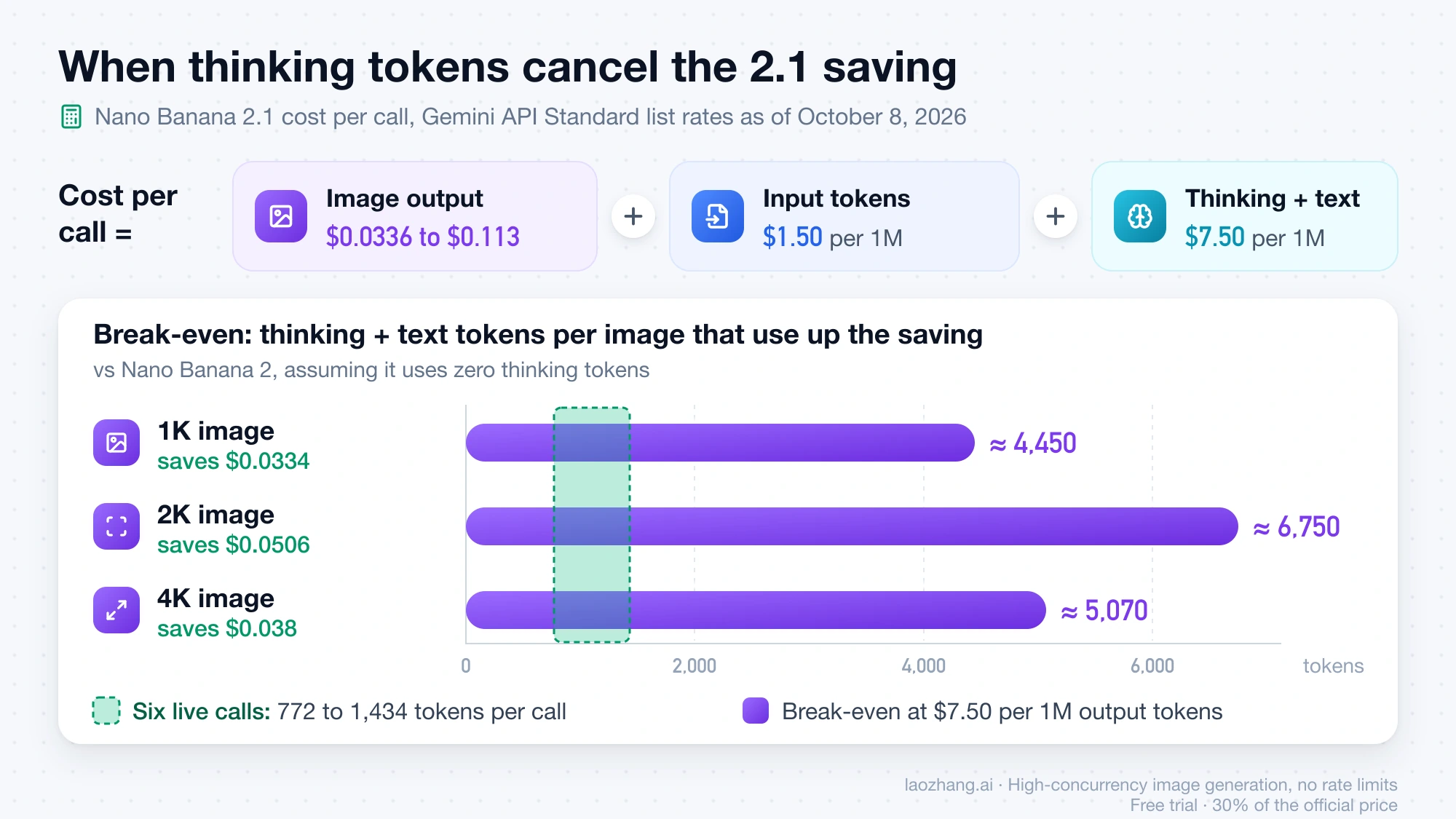
Thinking tokens are the variable that decides the rest. Google's image guide says "thinking tokens are billed by default", and 2.1 starts at medium while Nano Banana 2 starts at minimal. To see when thinking could cancel the output saving, divide the saving by 2.1's output rate of $7.50 per 1M tokens:
- 1K: $0.0334 ÷ $0.0000075 ≈ 4,450 thinking and text tokens per image
- 2K: $0.0506 ÷ $0.0000075 ≈ 6,750 tokens per image
- 4K: $0.038 ÷ $0.0000075 ≈ 5,070 tokens per image
These break-even points assume Nano Banana 2 uses zero thinking tokens, so the real thresholds are a little higher. In the six live calls described in the next section, thinking plus text output ran from 772 to 1,434 tokens per call, well under all three thresholds. That is one prompt, so measure your own: send a sample of your real prompts, read the token counts in each response, and price them with the formula above.
The Nano Banana 2.1 cost per image calculator does that arithmetic: choose 1K, 2K or 4K and Standard or Batch, enter your thinking tokens and reference images, and it returns the cost per image and per 1,000 images.
Planning examples, image output only: 1,000 images at 2K cost $50.40 on 2.1 ($0.0504 × 1,000) against $101 on Nano Banana 2, or $25.20 against $50.50 in Batch mode, which returns results within up to 24 hours. At 4K, 1,000 images cost $113 against $151, or $56.70 against $75.50 in Batch.
Grounding with Google Web and Image Search includes 5,000 free search requests per month, shared across all Gemini 3.x models, then costs $14 per 1,000 requests. One stale figure to ignore: Google's image generation guide still shows 2,520 tokens for a 4K image, but the pricing page and the Gemini Enterprise Agent Platform (formerly Vertex AI) page both list 3,780, and the 4K test call below reported 3,780.
Six live Nano Banana 2.1 calls: thinking tokens, sizes and a 512px surprise
On October 8, 2026, six calls were made to gemini-nano-banana-2.1 through LaoZhang API, with the same prompt each time: a coffee cup on a cafe table, with a chalkboard that should read "NANO BANANA 2.1 - TEST 08 OCT". Five used LaoZhang's Gemini-native generateContent route and one its OpenAI-compatible route. Each charge is the change in the account's billing usage from before to after the call.
Disclosure: laozhang.ai is our own service. Its prices are platform pricing, not an independent comparison.
What was not run: no call went directly to Google's API, each setting ran once, and nothing tested editing, reference images, grounding or Batch. Timings include the network path from one machine and say nothing general about speed. Token counts are the ones LaoZhang returned in each response.
| Call | Route and settings | Time | Output | Thinking tokens | At Google's list rates | Charged by LaoZhang |
|---|---|---|---|---|---|---|
| 1 | Gemini-native, 1K, default thinking | 20.3 s | 1024×1024 | 854 | about $0.043 | $0.045 |
| 2 | Gemini-native, 2K, 16:9, minimal | 24.7 s | 2752×1536 | 936 | about $0.060 | $0.045 |
| 3 | Gemini-native, 2K, 16:9, high | 34.8 s | 2752×1536 | 847 | about $0.061 | $0.045 |
| 4 | Gemini-native, 4K, 16:9, default thinking | 32.0 s | 5504×3072 (8.6 MB) | 510 | about $0.119 | $0.045 |
| 5 | OpenAI-compatible, no size setting | 17.9 s | 1024×1024 | 812 | about $0.042 | $0.045 |
| 6 | Gemini-native, imageSize "512" | 19.9 s | 1024×1024 | 1,107 | about $0.044 | $0.045 |
The "Google's list rates" column applies $1.50 per 1M input tokens, $7.50 per 1M text and thinking tokens and $30 per 1M image tokens to the reported counts. For call 1 that is 42 input tokens, 1,120 image tokens and 1,248 text and thinking tokens: $0.0001 + $0.0336 + $0.0094 ≈ $0.043. It is an estimate, not a Google invoice.
What the six calls showed:
- Thinking happened on every call, including the one set to
minimal. In the singleminimal/highpair,minimalreported 936 thinking tokens andhigh847, whilehightook about 10 seconds longer. One pair can't show how the levels compare in general, but it is a reason not to assumeminimalremoves thinking cost. - Sizes matched Google's table. Image token counts were 1,120, 1,680 and 3,780 for 1K, 2K and 4K, and 16:9 output came back at 2752×1536 and 5504×3072. Every image was a JPEG; no format was requested.
512was not rejected. On October 7 a512request still returned HTTP 400; on October 8 call 6 returned HTTP 200 with a 1024×1024 image and was charged $0.045, and LaoZhang's documentation now describes this behavior. Don't send512to 2.1; if you need 512px, use Nano Banana 2.- Text came out legible, with extras. The requested chalkboard line was readable in the 1K and 2K samples, but the model added cut-off or scribbled filler text around it in both, close to the text limitations Google lists for 2.1.
The request below is the one used for call 2 (2K, 16:9, minimal thinking), with the key read from an environment variable. It was run on October 8, 2026 and returned the 2752×1536 JPEG in the table:
import base64
import os

import requests

url = "https://api.laozhang.ai/v1beta/models/gemini-nano-banana-2.1:generateContent"
body = {
    "contents": [{"parts": [{"text": "A small ceramic coffee cup on a wooden cafe table by a window, morning light. A chalkboard menu behind it reads exactly: 'NANO BANANA 2.1 - TEST 08 OCT'."}]}],
    "generationConfig": {
        "responseModalities": ["IMAGE"],
        "imageConfig": {"imageSize": "2K", "aspectRatio": "16:9"},
        "thinkingConfig": {"thinkingLevel": "minimal"},
    },
}
r = requests.post(
    url,
    headers={"Authorization": f"Bearer {os.environ['LAOZHANG_API_KEY']}"},
    json=body,
    timeout=300,
)
r.raise_for_status()
data = r.json()
for part in data["candidates"][0]["content"]["parts"]:
    if "inlineData" in part and not part.get("thought"):
        with open("nb21-2k.jpg", "wb") as f:  # JPEG on all six test calls
            f.write(base64.b64decode(part["inlineData"]["data"]))
print(data.get("usageMetadata"))
Is Nano Banana 2.1 better? Google's evals, Arena and early users
Probably better than Nano Banana 2, but the evidence differs a lot in strength. Here it is from strongest to weakest.
Google's own claims. The Gemini API changelog entry for October 6, 2026 lists "significant improvements in visual quality, prompt adherence, multi-turn character consistency, text rendering, and wide and panoramic aspect ratio generation (1:4, 4:1, 1:8, 8:1)". The model page adds a concrete fix: tiling artifacts on those wide ratios at 2K and 4K. 2.1 supports 14 aspect ratios, from 1:8 to 8:1.
Google's internal ratings. The Nano Banana 2.1 model card from Google DeepMind reports side-by-side human preference scores (Elo) from Google's own test sets:
| Google's internal test | 2.1 with thinking | 2.1 without thinking | Nano Banana 2 with thinking | Nano Banana Pro |
|---|---|---|---|---|
| Overall preference | 1050 ±14 | 1015 ±13 | 990 ±7 | 935 ±8 |
| General editing | 1026 | 980 | 938 | 939 |
| Multi-character consistency | 1106 | 1068 | 978 | 1011 |
| Mask or ink-based editing | 1049 | 1042 | 965 | 927 |
| Multi-reference editing | 1066 | 1041 | 988 | 989 |
| Infographic factuality (autorater score) | 0.521 | 0.328 | 0.179 | 0.265 |
These numbers are only comparable within Google's test set, and nobody outside Google can rerun them. They also show 2.1 scoring lower without thinking. The card does not say which API thinking level its "no thinking" run matches.
Arena's blind votes. On the Arena text-to-image leaderboard, last updated October 6, 2026, gemini-nano-banana-2.1 ranks #5 with 1328 ±9 from 5,312 votes, marked preliminary. That is well above Nano Banana 2 (#11, 1261) and Nano Banana Pro 2K (#16, 1248), and roughly level with #4 mai-image-2.6 (1333) and #6 grok-imagine-image-2.0 (1321), whose ranges overlap. GPT Image 2.5 Sunburst (1425) and Flare (1398) hold #1 and #2. Arena measures single text-to-image results only, not editing, speed or cost, and early ranks move as votes come in.
Google's listed weaknesses. The model card lists small text that is "often blurry in 1k model", long paragraphs, imperfect character consistency, "partial instruction following" in mask and doodle edits, left/right confusion, and "occasional slowness or timeout issues". If your images carry small print, test at 2K before you settle on 1K.
Early user reports. Launch-day YouTube videos and X posts compare 2.1 with GPT Image 2.5, Nano Banana Pro and Seedream 5.0; they are individual creators' tests, not controlled benchmarks. One r/GeminiAI user wrote that 2.1 "seems to be very unhappy with blank spaces" and fills empty areas with furniture or backgrounds. Treat reports like these as prompts worth testing, not results.
Migrating from gemini-3.1-flash-image: deprecated, no shutdown date yet
Google's changelog now reads: "The gemini-3.1-flash-image model is deprecated (no shutdown date announced). Migrate to gemini-nano-banana-2.1." On launch day the same notice and the deprecations page gave an October 29, 2026 shutdown; Google later removed the date, and as of October 8, 2026 neither page shows one. So there is no hard deadline today, but Nano Banana 2 is the previous generation and Google recommends 2.1 for all new projects. Watch the Gemini API deprecations page for a date.
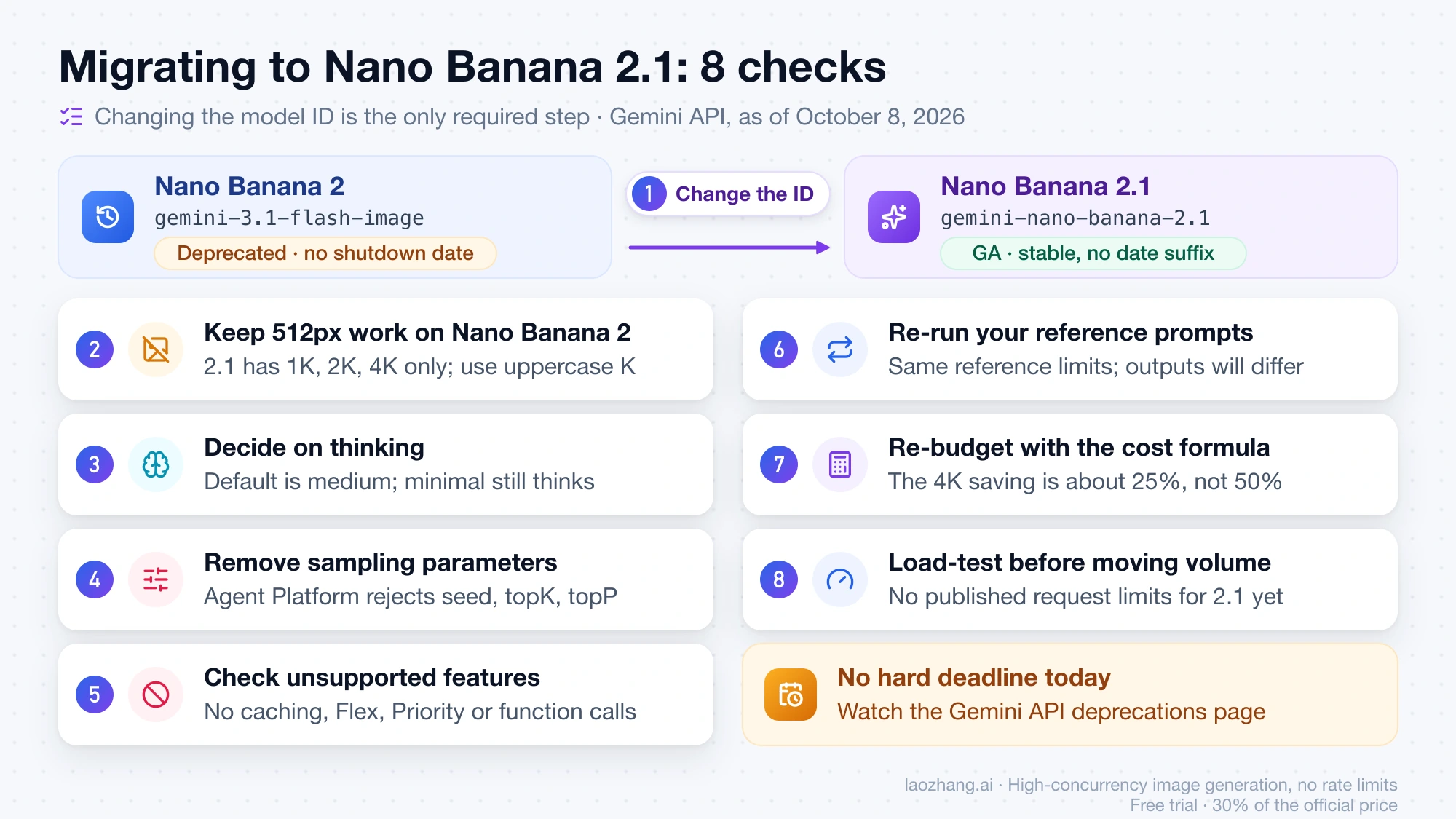
Changing the model string is the required step. The rest of this checklist covers what can break or cost more after the swap:
- Change the model ID to
gemini-nano-banana-2.1. It has no date suffix and is listed as the stable version. - Keep 512px work on Nano Banana 2. 2.1 has no 512px size. Move other small images to
1K, which costs $0.0336 on 2.1 against $0.045 for a 0.5K image on Nano Banana 2. Google requires an uppercase K; lowercase values such as1kare rejected. On LaoZhang's route, a512request returned a 1K image and was billed instead of failing; how Google's own endpoint answers512was not tested. - Decide on thinking. 2.1 defaults to
medium. You can setminimal(on the Interactions API,generation_config={"thinking_level": "minimal"}), but in the live test pairminimalstill produced 936 thinking tokens. Compare token counts and outputs on your own prompts before counting on savings. - Remove sampling parameters on Agent Platform. Google's Vertex AI page for 2.1 says "the
seed,topK,logprobs,temperature, andtopPparameters aren't supported for Nano Banana 2.1. Setting any of these parameters returns an API error." The Gemini API docs don't say whether the same applies there, so test any call that sets them. - Check unsupported features. 2.1 has no Flex or Priority inference, caching, function calling or structured outputs. Batch is supported.
- Re-run your reference prompts. The limits of 14 references, 4 characters and 10 objects are unchanged, but outputs will differ. Compare your saved character and product prompts before switching traffic.
- Re-budget. Use the cost formula above with your measured input and thinking tokens, and note that the 4K saving is about 25%, not 50%.
- Load-test before moving volume. Google has not published request limits for 2.1, so watch for rate-limit errors on a test load before you move high-volume traffic.
Google's current examples for 2.1 use the Interactions API. The Python snippet below is Google's documented text-to-image example from its image generation guide, reproduced without being run, so no output, timing or cost is claimed for it:
from google import genai
import base64

client = genai.Client()

interaction = client.interactions.create(
    model="gemini-nano-banana-2.1",
    input="Create a picture of a nano banana dish in a fancy restaurant with a Gemini theme",
)

with open("generated_image.png", "wb") as f:
    f.write(base64.b64decode(interaction.output_image.data))
In the same guide, size and aspect ratio go in response_format, for example {"type": "image", "aspect_ratio": "16:9", "image_size": "2K"}. Multi-turn edits pass previous_interaction_id. The REST endpoint is POST https://generativelanguage.googleapis.com/v1beta/interactions with your key in the x-goog-api-key header.
Two older models are on different schedules. The original Nano Banana (gemini-2.5-flash-image) shuts down on March 15, 2027, according to Google's deprecations page, which points it to Nano Banana 2 Lite. The Imagen 4 models were shut down on August 17, 2026, and Google now lists Nano Banana 2.1 as their replacement.
Using Nano Banana 2.1 in the Gemini app, Flow and AI Studio
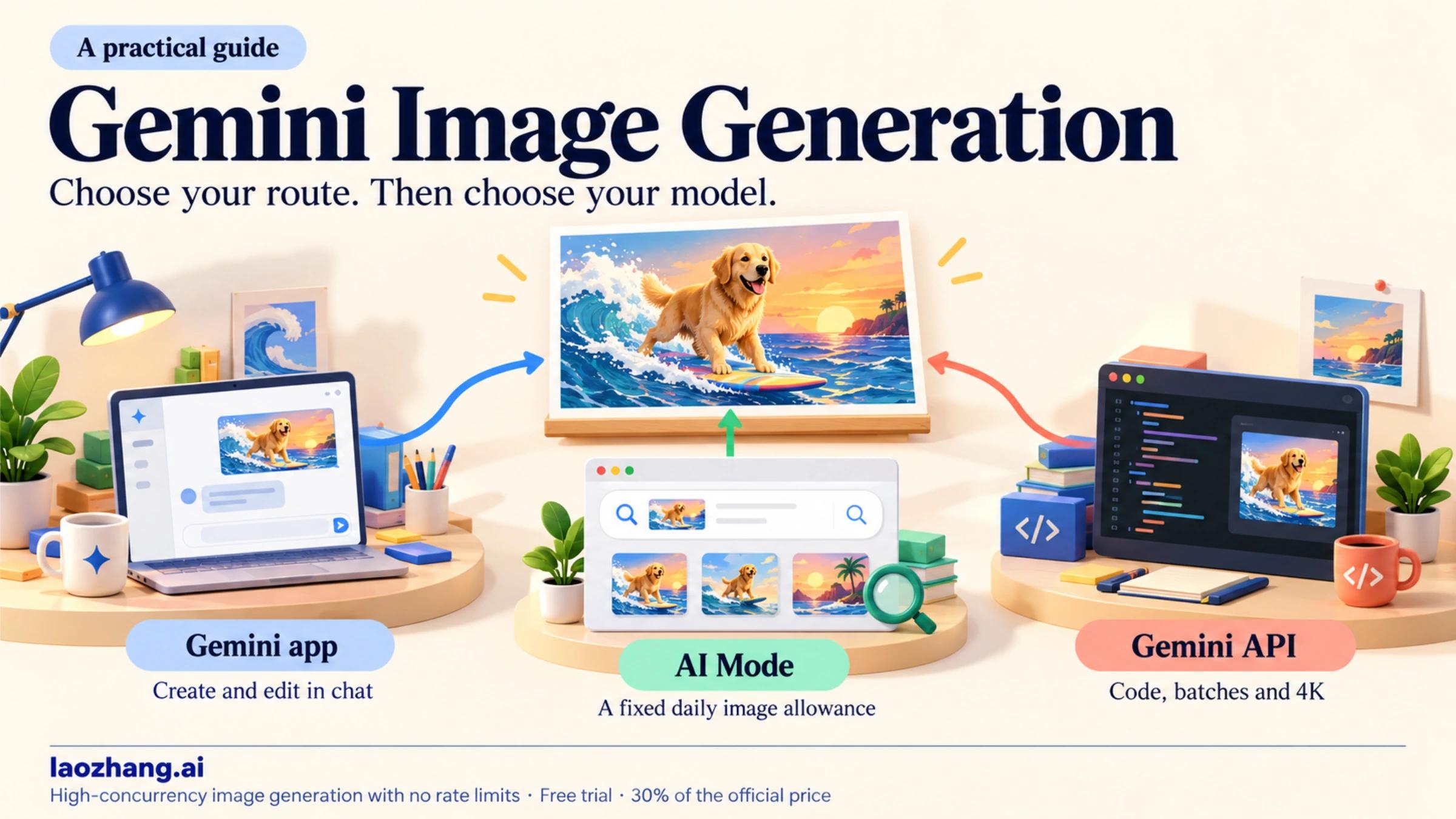
In the Gemini app, Nano Banana 2.1 needs a paid plan. Google's Gemini app image generation page lists Nano Banana 2 as "Free" and Nano Banana 2.1 as "With a Google AI plan", and says Google AI Pro, Plus and Ultra subscribers get 2.1 and can still use "Redo with Pro" to regenerate an image with Nano Banana Pro. You reach it through "Create images" in the tools menu. Both models are listed with 2K resolution in the app, and 2.1 adds "higher generation limits with paid plans".
Google's model card also lists Google AI Studio, Google Flow, AI Mode in Search, Google Ads and Google Stitch. Launch coverage such as Android Authority's report describes the rollout as gradual, so some accounts may not see it yet.
Still not published as of October 8, 2026: the exact number of 2.1 images per day on each plan, and how many Flow credits a 2.1 image costs.
Which Google image model to use now
Pick by the job, not by the version number:
- New work at 1K to 4K, with editing or references: Nano Banana 2.1. It is the cheapest Google route to 2K, and Google's own ratings put it ahead of Nano Banana 2 on editing and consistency. The request format, SDK versions, and migration steps are in Nano Banana API Docs and Tutorial: Key, Model IDs, and Code.
- 512px previews: Nano Banana 2, the only model with that size, while it remains available.
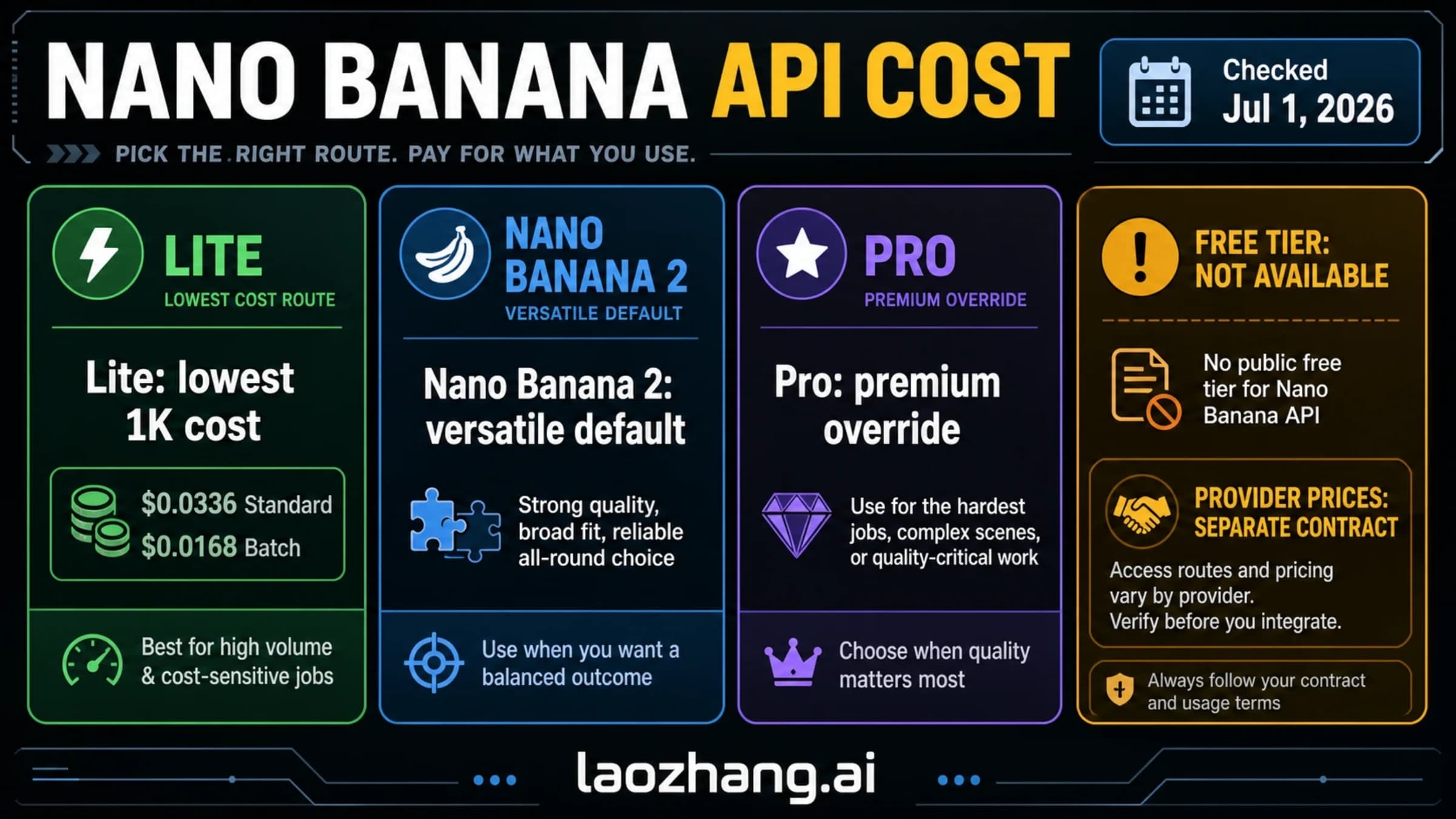
- Plain 1K images where you want the lowest input and thinking cost: test Nano Banana 2 Lite against 2.1. Both cost $0.0336 per 1K image, but Lite defaults to
minimalthinking and has no grounding or multi-reference optimization. Nano Banana API Cost: Lite, Nano Banana 2, Pro, Free Reality, and Which Route To Use sets the Lite, 2.1, and Pro rows against each other with Batch prices and worked budgets. - Work you sent to Nano Banana Pro for quality: test 2.1 first. Pro costs about twice as much per image at 4K and up to 4 times as much at 1K, and Google rates 2.1 higher in its own tests. Pro still keeps 5-character consistency and Google's "premium" positioning for complex localization and brand work. Pro's plan and per-image cost are in How Much Is Nano Banana Pro? API, Plan, and Usable-Image Cost.
- The highest blind-vote preference regardless of vendor: GPT Image 2.5 still leads Arena. OpenAI estimates $0.0059 to $0.2107 per 1024×1024 image depending on the quality setting, so it can cost less or far more than 2.1's $0.0336 at 1K.
- A non-Google model in a similar price band: Seedream 5.0 Pro; see Nano Banana Pro vs Seedream 5.0 Pro: Which to Run First.
Third-party Nano Banana 2.1 APIs: check the model ID and the price
With a public model ID, resellers can route to the real model, and several already list it: OpenRouter as google/gemini-nano-banana-2.1, plus OpenArt and Higgsfield. From the outside you still can't see which model a site calls, so a few checks help:
- Ask for the model ID. It should be
gemini-nano-banana-2.1. A site that namesgemini-3.1-flash-imageis selling Nano Banana 2 under a new label. - Compare against Google's price. $0.0336 at 1K, $0.0504 at 2K and $0.113 at 4K is what Google charges for image output, before thinking tokens. A markup can be fair for convenience, but you should know its size.
- Check the size list. A "512px" 2.1 option is not a native 2.1 size.
- Discount unsourced speed claims. OpenRouter's model page claims 2.1 takes about 4 seconds and is 2.7 times faster than Nano Banana 2, without showing how that was measured. Google publishes no speed figure.
LaoZhang API's Nano Banana 2.1 page lists gemini-nano-banana-2.1 at $0.045 per call (its public pricing as of October 7, 2026), the same for 1K, 2K and 4K, any thinking level, any number of references, and generation or editing. Google Search grounding adds $0.014 per search. Against Google's list price, that flat rate is $0.0114 more than a 1K image before tokens; in the live calls above, LaoZhang's flat price was about the same as Google's rates at 1K, about 25% lower at 2K and about 60% lower at 4K. It fits teams that want a fixed price per image, mostly 2K or 4K output, or no Google Cloud billing setup.
Disclosure: laozhang.ai is our own service. Its prices are platform pricing, not an independent comparison.
A few conditions from that page and the test: the key must be in the default group with billing mode set to Usage first or Per-call; an HTTP 200 response without an image is still charged; and the OpenAI-compatible route returns 1K images only, with no ratio or size setting. LaoZhang still lists Nano Banana 2 at $0.055, Lite at $0.025 and Pro at $0.09 per call.
How the Nano Banana 2.1 name leaked before the launch
If you saw "Nano Banana 2.1" in Google Flow on October 5 or 6 and then lost it, you were watching the run-up to the launch. The name surfaced in stages:
- From September 9, 2026: testers on Image Arena reported an anonymous Google model codenamed "spicy-mayo", which some called Nano Banana 2.5.
- September 24 and 27, 2026: TestingCatalog found a "Nano Banana 2.5 Flash" label in the Google Flow web build, then saw it renamed "Nano Banana 2.1".
- October 5–6, 2026: some Flow users reported 2.1 as selectable; forum users said it was pulled again within hours.
- October 6, 2026: Google published the model card, API model page, pricing and deprecation notice.
Whether "spicy-mayo" was an early 2.1 build has never been confirmed. One unrelated model shares the version number: Qwen-Image-2.1 is Alibaba's open-weights image model, ranked #19 on the same Arena board; to run it yourself, see Run Qwen-Image-2.1 Locally: Which Weights Fit Your GPU or Mac.
Nano Banana 2.1 FAQ
Is Nano Banana 2.1 free?
No. In the Gemini app it requires a Google AI Pro, Plus or Ultra plan; free users get Nano Banana 2. The Gemini API pricing page lists no free tier for gemini-nano-banana-2.1.
Is Nano Banana 2.1 better than GPT Image 2.5?
Not on Arena's blind votes. As of October 6, 2026, GPT Image 2.5 Sunburst and Flare rank #1 and #2, with 2.1 at #5 on a preliminary score. On price, 2.1's $0.0336 per 1K image sits between OpenAI's estimates for GPT Image 2.5 at a 1024×1024 size: $0.0059 at low quality and $0.2107 at max. Google's own tests don't include GPT Image 2.5.
Is Nano Banana 2.1 better than Nano Banana Pro?
Google's internal ratings and Arena both put 2.1 ahead, and 2.1 costs $0.0336 to $0.113 per image against Pro's $0.134 to $0.24. Pro still keeps up to 5 characters consistent against 2.1's 4, so test both on your own character or brand work.
Does Nano Banana 2.1 support 512px images?
No. It outputs 1K, 2K and 4K only, with 1K as the default. Nano Banana 2 is the only Google model with 512px output. On LaoZhang API, a 512 request to 2.1 returned a 1K image and was charged, so don't rely on an error to catch it.
Is Nano Banana 2 being shut down?
Not on a set date. As of October 8, 2026, Google lists gemini-3.1-flash-image as deprecated with no shutdown date announced and names gemini-nano-banana-2.1 as its replacement. New projects should start on 2.1; existing ones can migrate on their own schedule while watching the deprecations page.
Sources12
External pages this guide links to, in the order they appear. Last updated Oct 21, 2026.
Sources12
External pages this guide links to, in the order they appear. Last updated Oct 21, 2026.
- 1.Gemini API pricing pageai.google.dev/gemini-api/docs/pricing
- 2.Gemini API image generation guideai.google.dev/gemini-api/docs/image-generation
- 3.Gemini API deprecations pageai.google.dev/gemini-api/docs/deprecations
- 4.Arena text-to-image leaderboardarena.ai/leaderboard/text-to-image
- 5.Gemini Nano Banana 2.1 model pageai.google.dev/gemini-api/docs/models/gemini-nano-banana-2.1
- 6.OpenAI API pricingdevelopers.openai.com/api/docs/pricing
- 7.BytePlus ModelArk pricingdocs.byteplus.com/en/docs/ModelArk/1544106
- 8.Gemini API changelog entry for October 6, 2026ai.google.dev/gemini-api/docs/changelog
- 9.Nano Banana 2.1 model card from Google DeepMinddeepmind.google/models/model-cards/nano-banana-2-1
- 10.Gemini app image generation pagegemini.google/overview/image-generation
- 11.Android Authority's reportandroidauthority.com/google-launches-nano-banana-2-1-3719823
- 12.TestingCatalogtestingcatalog.com/new-google-flow-build-now-points-to-nano-banana-2-1