Nano Banana Pro vs Seedream 5.0 Pro: Which to Run First
No single winner: Seedream 5.0 Pro costs less per standard 2K attempt and outputs layers; Nano Banana Pro alone offers 4K, 14 references and Search grounding.
On this page
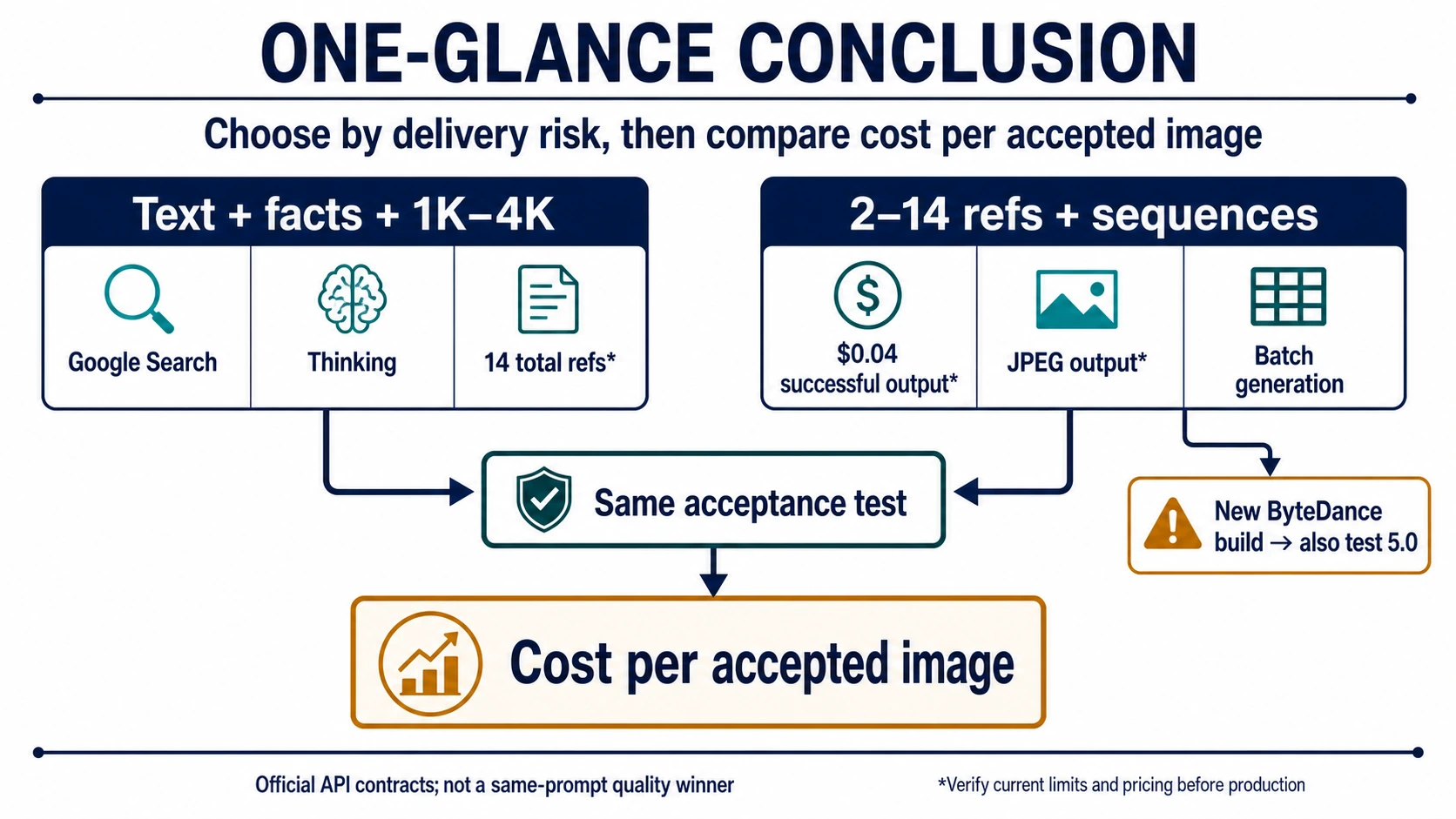
Neither model wins every job, but the official specs settle the first pick for most of them. Run Seedream 5.0 Pro first when the image must carry dense, exact text or a structured layout at 2K or below, when designers need layered PNGs, a transparent cutout, or edits pinned to a box or arrow, and when per-attempt price at 1K–2K matters. Run Nano Banana Pro first when the deliverable must be 4K, when you need more than 10 reference images or separate character and object references, when the image depends on current facts from Google Search, or when your 2K jobs can wait for Google's Batch API, which prices a 2K image below Seedream's 2K rate. All prices and limits below are first-party list figures as of September 24, 2026.
The head-to-head results behind the "Seedream 5 Pro beats Nano Banana Pro" claim come from three tests run by API resellers that sell both models: 11 prompts in total, one output per model per prompt. They consistently favor Seedream on dense text and constrained layouts, which makes those jobs the right ones to test first. They are not a pass rate, and a broad text-to-image preference leaderboard (Artificial Analysis, as quoted by GPT Proto in August 2026) still had Nano Banana Pro slightly ahead. What decides your bill is the cost of each image you can actually ship, and that comes from a short pilot on your own assets, using the break-even ratios further down.
Which models are being compared
Seedream 5.0 Pro goes by several names: Seedream 5 Pro, Seedream 5.0 Pro, and Seedream V5 Pro all mean the same model. BytePlus ModelArk, ByteDance's international API platform, lists it under the family label "Dola Seedream 5.0" with the model ID dola-seedream-5-0-pro-260628. The suffix is the build date, June 28, 2026, and the model became publicly available in early July 2026. ByteDance describes it as a "multimodal image generation model that features advanced reasoning," with text-rich infographics, spatial editing, and photographic realism as its headline claims (ByteDance Seed product page).
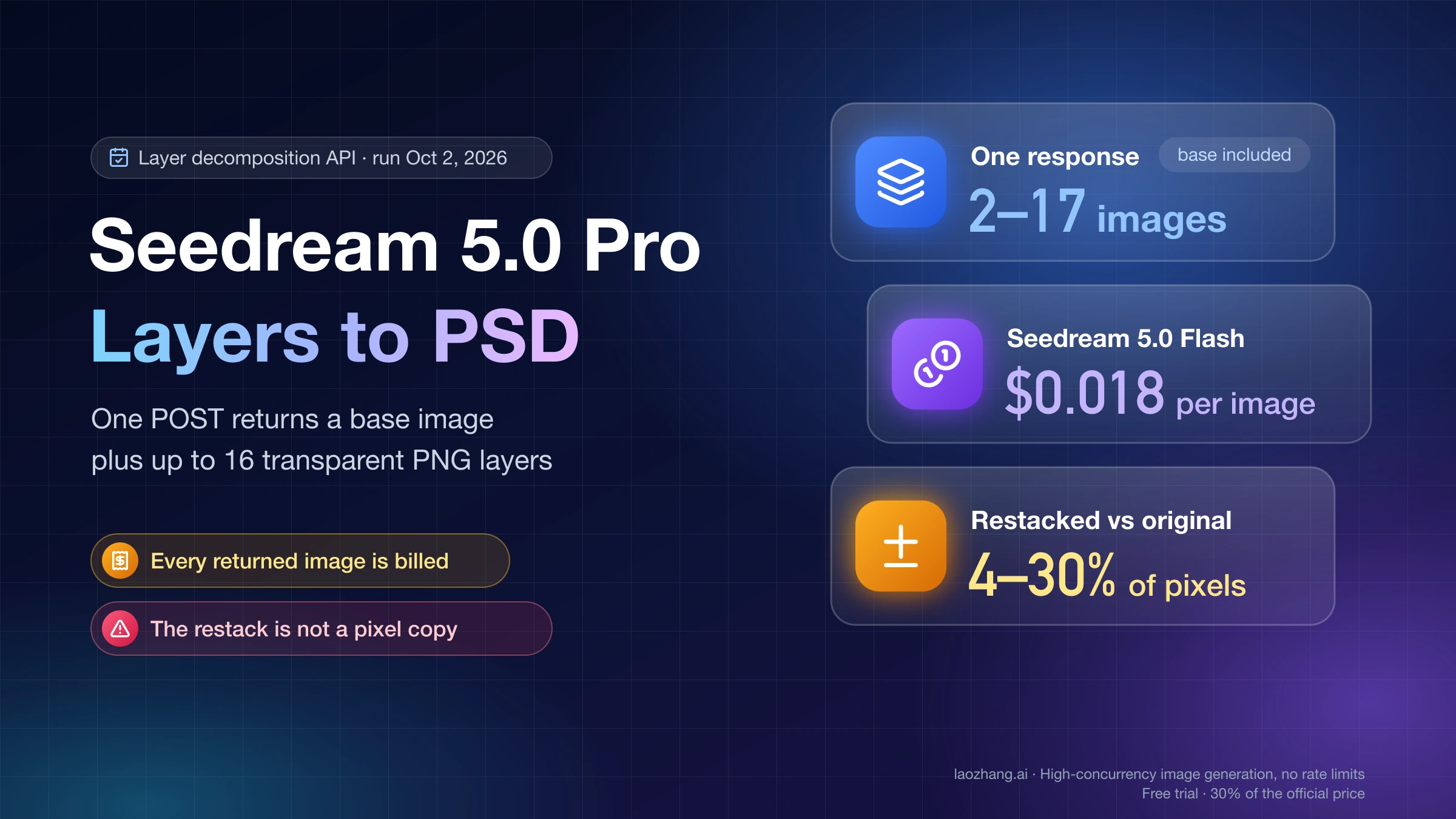
It is not the same model as Seedream 5.0 lite (seedream-5-0-260128, the February 2026 build), which is cheaper, accepts 14 references, and can generate a related set of images in one request. When a comparison says only "Seedream 5.0", check the model ID before trusting its conclusions. A third sibling, dola-seedream-5-0-flash-260915, shares the Pro's documented feature set at $0.018 per image; none of the tests below include it.
Nano Banana Pro is Google's own nickname for gemini-3-pro-image, the stable Gemini API model; code still pointing at gemini-3-pro-image-preview should move to the stable ID. Google calls Pro "the premium choice for the most complex visual tasks" and "designed for professional asset production and complex instructions," while recommending Nano Banana 2 as the go-to model for most work (Gemini 3 Pro Image model page). Thinking is always on for Pro in the API; it can produce up to two interim "thought images," which are not charged. If your real question is whether you need Pro at all, Nano Banana 2 Lite vs 2 vs Pro: Pick the Right Route covers that choice.
First pick by job
"Run first" means the model to start your pilot with for that job, based on documented limits and the published tests. It is a starting point, not a guarantee.
| Job | Run first | Deciding fact |
|---|---|---|
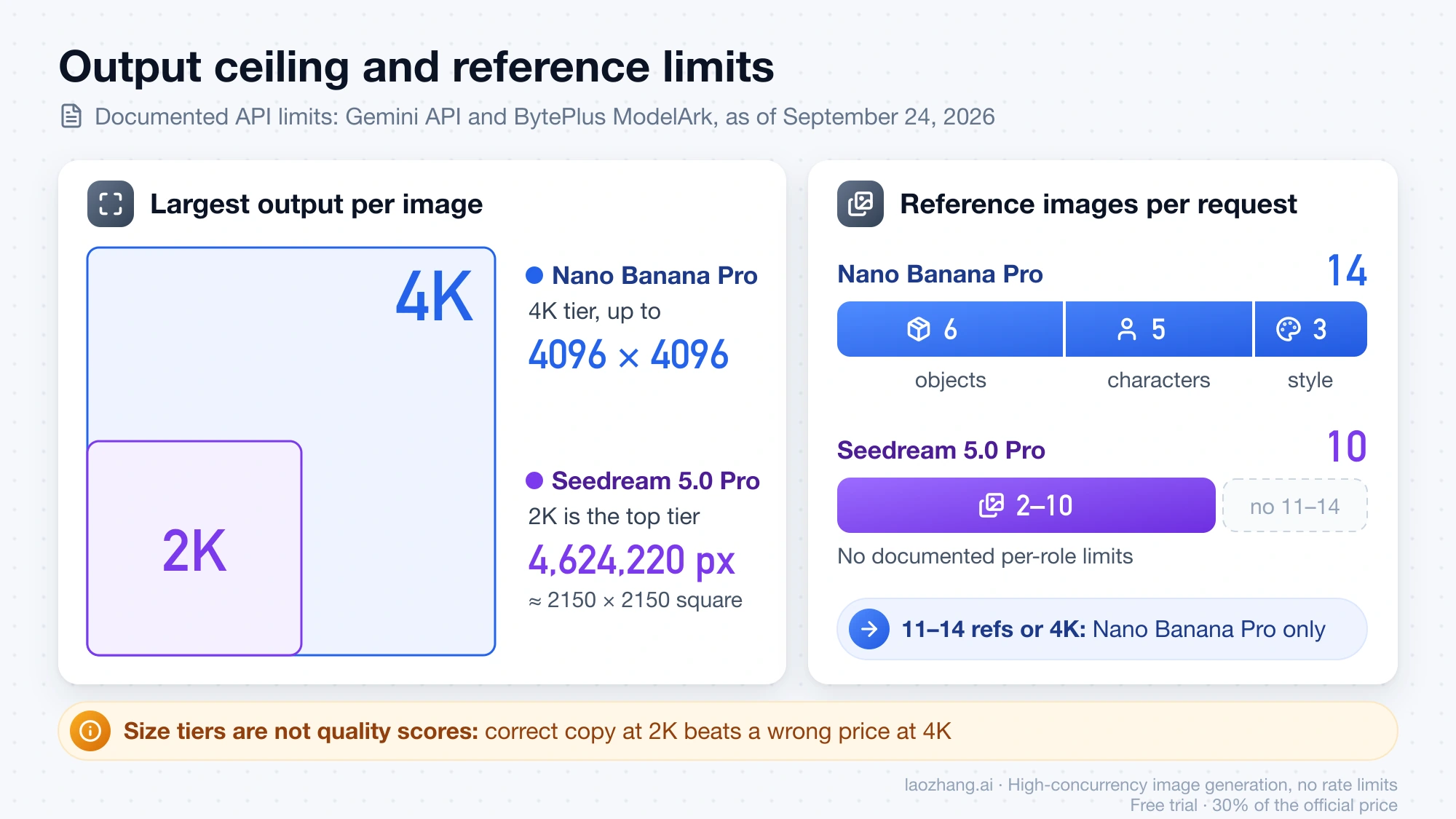
| Final asset at 4K: print, large displays, heavy cropping | Nano Banana Pro | Google offers 1K, 2K, and 4K tiers, with 4K up to 4096×4096. Seedream 5.0 Pro stops at 2K, a maximum of 4,624,220 pixels (about 2150×2150 for a square). |
| Menus, book spines, posters with exact prices or times, dense infographics | Seedream 5.0 Pro | In all three published tests, Seedream reproduced dense copy more faithfully. Single outputs only; details below. |
| Packaging or thumbnails where a few large words must read at a glance | Nano Banana Pro, then test Seedream | Nano Banana Pro won GPT Proto's simple packaging round because its type stayed readable at thumbnail size. |
| Composites built from 11–14 references, or with separate object, character, and style references | Nano Banana Pro | Up to 14 references: at most 6 object images, 5 character images, and 3 style references. Seedream 5.0 Pro takes 2–10 references with no documented per-role limits. |
| Layered files for designers, transparent PNGs, edits located by box, arrow, or coordinates | Seedream 5.0 Pro | BytePlus documents layer decomposition, transparent backgrounds, and interactive region editing. Google documents no layer or transparent output. |
| Images that depend on current facts: scores, schedules, product specs, weather | Nano Banana Pro | Grounding with Google Search is available. BytePlus states that web search is "not currently supported" on Seedream 5.0 Pro. |
| A set of related images from one request: storyboards, variant sets | Seedream 4.5 or 5.0 lite | Seedream 5.0 Pro has no sequential generation. Seedream 4.5 and 5.0 lite do. Google's Batch API runs independent requests in bulk, not a linked set. |
| Large 2K runs that can wait for asynchronous results | Nano Banana Pro via Batch | $0.067 per 2K image on Batch or Flex, below Seedream 5.0 Pro's $0.09 at 2K. |
| Interactive 1K–1.5K volume where price per attempt dominates | Seedream 5.0 Pro | $0.045 per image against Nano Banana Pro's $0.134 on standard pricing. |
If your backlog mixes these jobs, splitting it between the two models is usually cheaper than forcing one model onto everything.
Where the specs actually differ
The table lists what each vendor documents. "Not documented" means the vendor's API docs describe no such option; it does not prove the model can never do it.
| Spec | Nano Banana Pro | Seedream 5.0 Pro |
|---|---|---|
| API model ID | gemini-3-pro-image | dola-seedream-5-0-pro-260628 |
| Output size control | image_size of 1K, 2K, or 4K | size of 1K, 1.5K, or 2K (default 2K), or an explicit width×height between 921,600 and 4,624,220 total pixels |
| Aspect ratios | 10 presets: 1:1, 3:2, 2:3, 3:4, 4:3, 4:5, 5:4, 9:16, 16:9, 21:9 | Any ratio from 1:16 to 16:1 with explicit sizes; with a size tier, you describe the ratio in the prompt and the model picks the final dimensions |
| Reference images | Up to 14; at most 6 objects, 5 characters, 3 style references | Up to 10 |
| Related image sets in one request | No | No (Seedream 4.5 and 5.0 lite only) |
| Region-specific edits | Multi-turn conversational editing | Coordinates, selection boxes, and arrows; BytePlus examples use <bbox>x1 y1 x2 y2</bbox> tags in the prompt |
| Layer output | Not documented | One base image plus up to 16 PNG layers with alpha, each with z_index, bounding_box, name, and description; if any layer fails, the whole request fails |
| Transparent background | Not documented | background: "transparent" for image-to-image with exactly one input that has an alpha channel; output is PNG |
| Web search | Grounding with Google Search | "Not currently supported" |
| Watermark | Invisible SynthID on every image; cannot be turned off | watermark defaults to true; set it to false explicitly |
| Where the API runs | Gemini API; availability depends on your country, and the United States is on the list | BytePlus ap-southeast-1 endpoint only; the EU endpoint does not serve 5.0 Pro |
Sources: Google's image generation guide and available regions; BytePlus's model list and image generation API reference.
Three readings of that table are easy to get wrong. First, "4K" and "2K" are output tiers, not quality scores. A 2K image with correct copy beats a 4K image with a wrong price. Second, BytePlus says its 1.5K tier costs the same as 1K and "also provides better image generation quality." That is the vendor's own description, but it costs nothing to test, so include 1.5K in your pilot if 2.6 MP is enough. Third, 14 versus 10 references is a count limit. Neither number tells you how well a character's face or a product's label survives the composite.
What one attempt costs, and what one accepted image costs
List prices per output image, in USD, from Google's Gemini API pricing and BytePlus ModelArk pricing:
| Output | Seedream 5.0 Pro | Nano Banana Pro, standard | Nano Banana Pro, Batch or Flex |
|---|---|---|---|
| 1K, or any size up to 2.61 MP (includes 1.5K) | $0.045 | $0.134 (1K) | $0.067 (1K) |
| 2K, or any size above 2.61 MP | $0.09 | $0.134 | $0.067 |
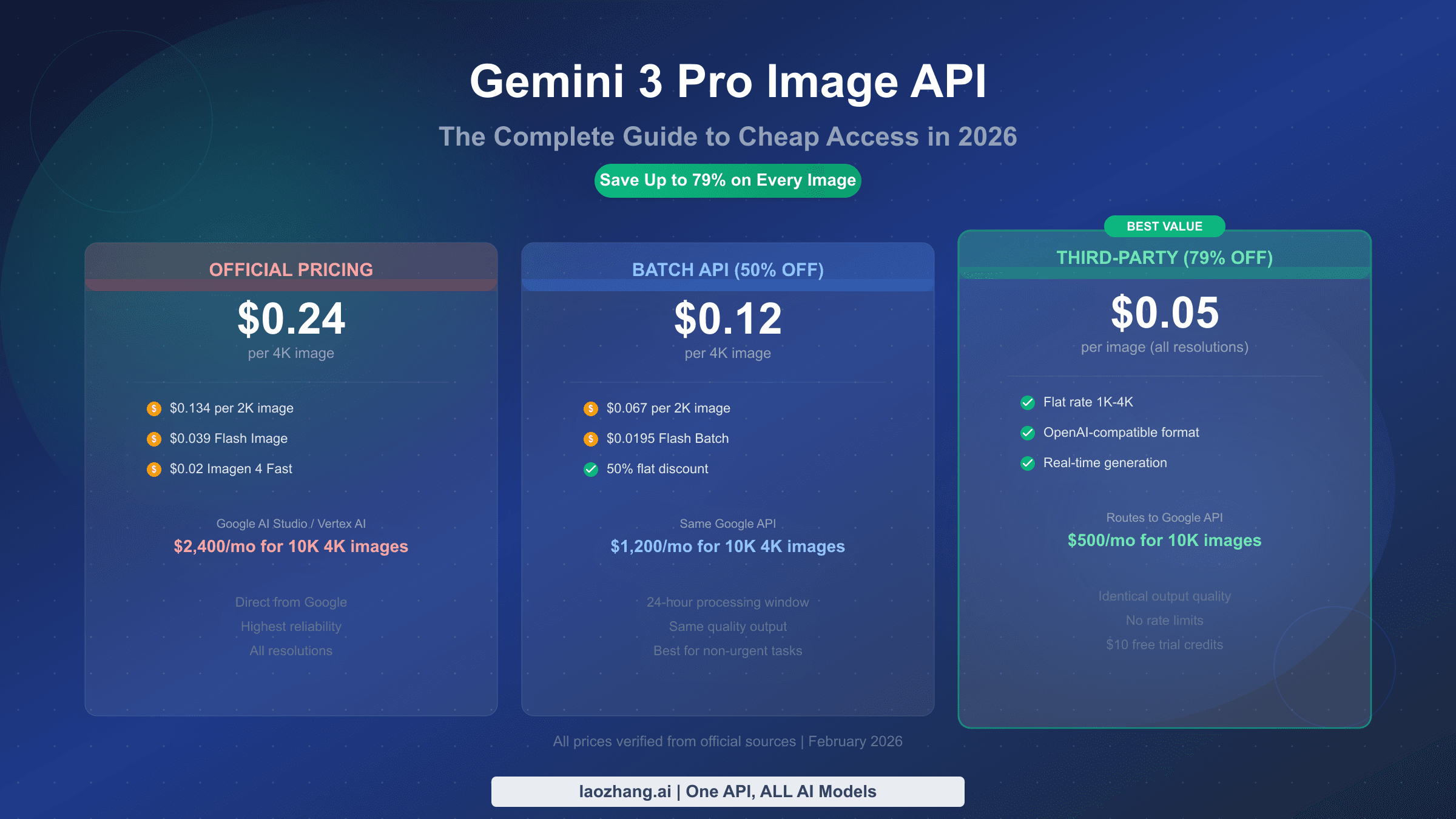
| 4K | Not offered | $0.24 | $0.12 |
The 2.61-megapixel line matters more than the tier names. A 1920×1080 banner is 2,073,600 pixels, so on Seedream 5.0 Pro it bills at $0.045. A 2048×2048 square is 4,194,304 pixels and bills at $0.09.
Several charges sit outside that table:
- Reference images. Seedream 5.0 Pro bills the first input image free and $0.003 for each one after it. Nano Banana Pro input costs about $0.0011 per image on standard pricing.
- Thinking and text. Nano Banana Pro's thinking and text output is billed at $12 per million tokens. That is small per image but not zero.
- Search. Grounding with Google Search is free for 5,000 requests a month, shared across Gemini 3.x models, then $14 per 1,000.
- Layers. Seedream 5.0 Pro bills each returned layer at $0.0225 or $0.045, depending on that layer's own pixel size. A request that returns eight layers above 2.61 MP carries 8 × $0.045 = $0.36 in layer charges.
- Blocked outputs. BytePlus does not bill images that fail to output because of content moderation or similar reasons.
With 10 reference images at 2K, a Seedream 5.0 Pro call costs $0.09 + 9 × $0.003 = $0.117. The same call on Nano Banana Pro standard costs about $0.134 + 10 × $0.0011 ≈ $0.145, plus thinking tokens. Google lists no free API tier for Nano Banana Pro, though you can try it in Google AI Studio. BytePlus lists only per-image rates for Seedream 5.0 Pro.
The number that actually decides
A billable image is not a usable one. A wrong price on a menu or a drifted logo means you pay for the attempt and then pay again. The useful unit is:
cost per accepted image = price per attempt ÷ acceptance rate
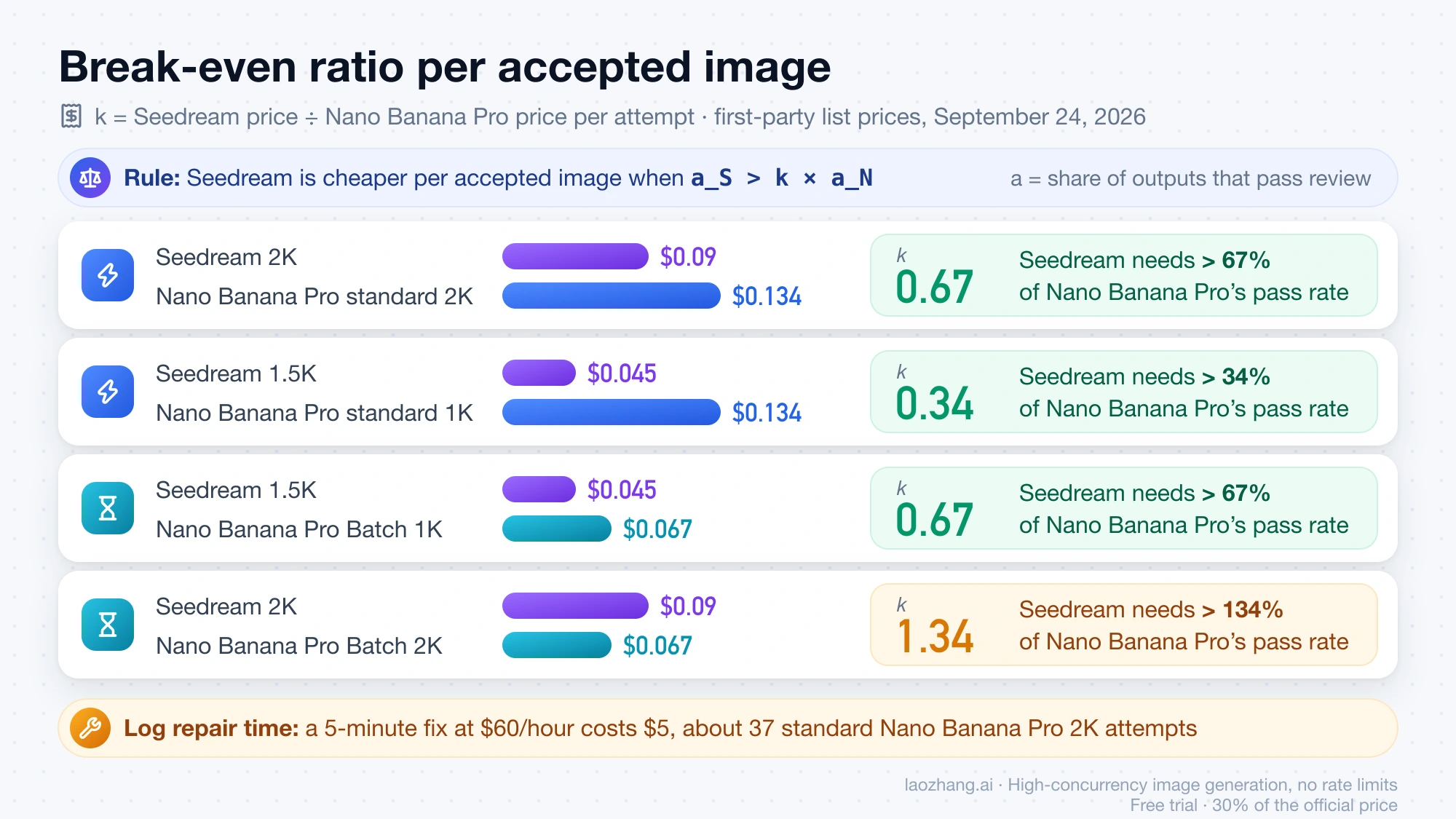
Let a_S be the share of Seedream 5.0 Pro outputs that pass your review, and a_N the share for Nano Banana Pro. Seedream is cheaper per accepted image whenever a_S > k × a_N, where k is the ratio of the two attempt prices:
| Comparison | k | What it means |
|---|---|---|
| Seedream 2K vs Nano Banana Pro standard 2K | 0.09 ÷ 0.134 ≈ 0.67 | Seedream stays cheaper unless its pass rate falls below two-thirds of Nano Banana Pro's |
| Seedream 1.5K vs Nano Banana Pro standard 1K | 0.045 ÷ 0.134 ≈ 0.34 | Seedream stays cheaper unless its pass rate falls below about one-third of Nano Banana Pro's |
| Seedream 1.5K vs Nano Banana Pro Batch 1K | 0.045 ÷ 0.067 ≈ 0.67 | Same threshold as the standard 2K case |
| Seedream 2K vs Nano Banana Pro Batch 2K | 0.09 ÷ 0.067 ≈ 1.34 | Seedream must pass about 34% more often to break even |
A worked example with illustrative pass rates, not measured ones: on dense-text posters at 2K, suppose Nano Banana Pro passes 5 of 10 and Seedream passes 8 of 10. Nano Banana Pro costs $0.134 ÷ 0.5 = $0.268 per accepted poster on standard pricing and $0.067 ÷ 0.5 = $0.134 on Batch. Seedream costs $0.09 ÷ 0.8 ≈ $0.113. Flip the job to simple packaging where Nano Banana Pro passes 9 of 10 and Seedream 6 of 10, and Batch Nano Banana Pro costs about $0.074 per accepted image against Seedream's $0.15.
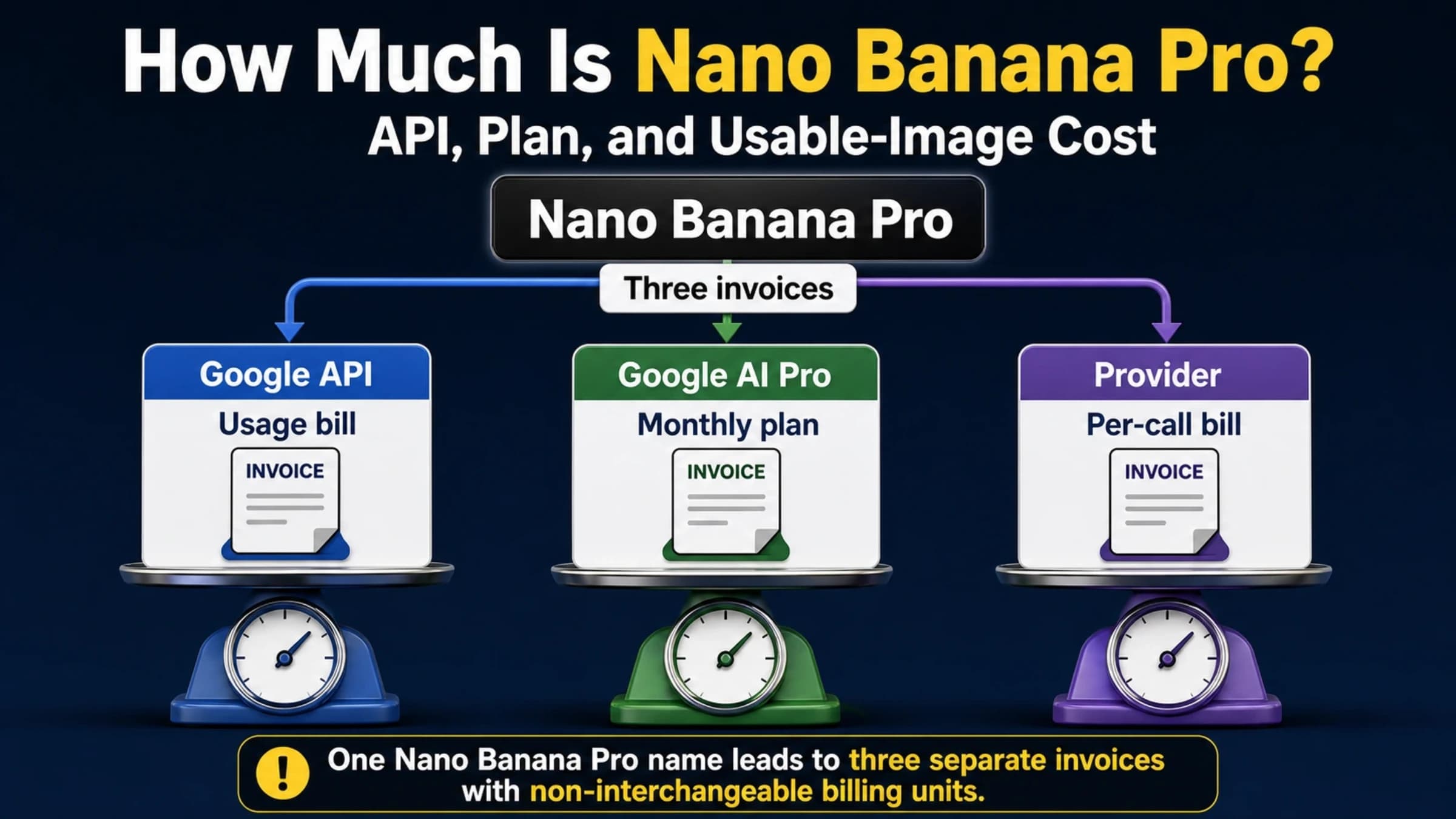
Repair time can outweigh both. If a designer spends five minutes fixing a typo at $60 an hour, that fix costs $5, the price of about 37 standard Nano Banana Pro 2K attempts. Log repair minutes next to the provider bill, or the cheaper model on paper can turn out to be the more expensive one in practice. For a fuller breakdown of Google's side, including consumer plans, see How Much Is Nano Banana Pro? API, Plan, and Usable-Image Cost.
What the published tests show, and what they leave out
Each test below used one generation per prompt and kept the first result, through a service that resells both models.
- AIReiter, July 9, 2026. Three prompts combining a person with dense text, same relay, 3:4 at about 1 MP (Seedream 864×1152, Nano Banana Pro 896×1200). On a six-item chalkboard menu, Seedream got every item and price right, while Nano Banana Pro priced one drink at $4.60 instead of $4.75. A sneaker ad with a headline and fine print was a tie. On eight book spines, Seedream's titles were legible and Nano Banana Pro's were "severely garbled." Realism was judged close, with a slight edge to Seedream. The test did not cover 4K, speed, editing, or layers (AIReiter).
- PiAPI, July 17, 2026. Three matched playground scenarios: a watch product shot, an event poster with exact times and numbers, and a four-change sneaker edit. Seedream followed the requested watch details, poster text, and source framing more closely. Nano Banana Pro followed the requested landscape poster layout better but repeated the time "14:05" and separated times from their labels. Output dimensions were not identical across models (PiAPI).
- GPT Proto, August 21, 2026. Five ecommerce rounds with
dola-seedream-5-0-pro-260628. Seedream won three: the product hero shot narrowly, a multilingual poster decisively, and a dense product infographic. Nano Banana Pro won simple packaging, where its large type read well at thumbnail size. A background replacement edit was too close to call (GPT Proto).
The same GPT Proto post quotes Artificial Analysis leaderboards as of August 21: Nano Banana Pro at 1,297 Elo (6th) against Seedream 5.0 Pro at 1,279 (10th) for text-to-image, and Seedream at 1,247 (8th) against Nano Banana Pro at 1,245 (9th) for image editing. A broad blind-preference board and a set of tightly constrained ecommerce prompts measure different things. Both can be true.
Read together, the tests say Seedream 5.0 Pro is the stronger candidate when many exact strings, numbers, and layout rules must hold at once. Nano Banana Pro stays competitive on simpler, open-ended scenes and large, simple typography. What the tests cannot tell you is how often either model passes, because each prompt ran once. None tested 4K output, layer quality, or reference sets near the 10-image limit.
One more detail from PiAPI: reseller pricing can reverse the first-party order. On July 17, PiAPI listed Nano Banana Pro at $0.105 and Seedream 5 Pro at $0.136 per 2K image, while BytePlus and Google list $0.09 and $0.134. Check which price sheet a cost claim comes from before you use it.
Run a same-input pilot with a switch rule
Four to six job cards from your real backlog are enough to decide which model to start with. Include at least one card each model is expected to lose. Dense small text is a good stress test for Nano Banana Pro, and large-type packaging is a good one for Seedream.
- Pick inputs both models can take. Use 10 references or fewer. If a job needs 11 or more, or needs 4K, it belongs to Nano Banana Pro and needs no pilot. If it needs layers or a transparent cutout, it belongs to Seedream 5.0 Pro.
- Match the requests. Use the same prompt, references, and aspect ratio, and compare at the size you deliver. For Seedream, set
watermarktofalse, and setoutput_formattopngif you need lossless output, since the default is JPEG. - Write the pass rule before generating. List every string, number, product detail, and layout rule that must be exact. A beautiful image with one wrong price fails.
- Run three to five attempts per card per model. Record attempts, accepted outputs, repair minutes, and the full bill, including reference fees and thinking tokens.
Minimal request bodies for a 4:5 card at the 2K tier look like this. First, Seedream 5.0 Pro on BytePlus ModelArk, with an explicit size (1728×2160 is 3,732,480 pixels, so it bills at $0.09):
{
  "model": "dola-seedream-5-0-pro-260628",
  "prompt": "Vertical 4:5 ecommerce infographic for SOLARA SPF 50 ...",
  "size": "1728x2160",
  "output_format": "png",
  "watermark": false
}
Then Nano Banana Pro through the Gemini API's generateContent:
{
  "contents": [{
    "role": "user",
    "parts": [{"text": "Vertical 4:5 ecommerce infographic for SOLARA SPF 50 ..."}]
  }],
  "generationConfig": {
    "responseModalities": ["IMAGE"],
    "imageConfig": {"aspectRatio": "4:5", "imageSize": "2K"}
  }
}
Reference images go in Seedream's image field as URLs or Base64 data URIs, and in additional parts for Gemini.
Then apply one switch rule and stick to it:
- Start each job with the model the first-pick table assigns.
- If a must-pass rule fails in two of the first three attempts, stop tuning the prompt and run the other model on the same inputs.
- Compute cost per accepted image, including repair time, for both. Compare your observed
a_S ÷ a_Nwith thekfor your size tier and keep the cheaper model for that job type. - Re-run the pilot when a model ID or price changes, or when BytePlus adds a feature it currently lists as unsupported, such as sequential generation or web search.
If you already run Seedream 4.5
Seedream 4.5 (seedream-4-5-251128) is still listed on BytePlus at $0.04 per image and is not marked for retirement, so there is no deadline forcing a move. Two differences keep a 4.5 pipeline from moving to 5.0 Pro unchanged. 5.0 Pro takes at most 10 references against 4.5's 14, and it cannot generate a sequential set of related images in one request. The output_format switch to PNG is also documented only for the 5.0 models.
A practical split is to move single-image jobs with dense text, layered deliverables, or transparent cutouts into a 5.0 Pro pilot, and keep sequential sets on 4.5 or test them on 5.0 lite. The cheaper pair of that generation, Nano Banana 2 against Seedream 5.0 Lite, is covered in Gemini 3.1 Flash Image Preview vs Seedream 5.0 Lite, with prices as of April 2026.
Where to call each model
Nano Banana Pro runs on the Gemini Developer API, with the country limits noted above, and has no free API tier. Seedream 5.0 Pro runs on BytePlus ModelArk through the ap-southeast-1 endpoint (https://ark.ap-southeast.bytepluses.com/api/v3), with a listed maximum of 500 images per minute.
If you want a single key for the Nano Banana Pro side of the pilot, LaoZhang API documents gemini-3-pro-image at $0.09 per call for every size, including 4K, as of September 24, 2026. Use its Gemini-native generateContent endpoint to set 4K and the aspect ratio; its OpenAI-compatible chat endpoint has no size settings. At that price, a Nano Banana Pro 2K attempt costs the same as a Seedream 5.0 Pro 2K attempt on BytePlus, so k becomes 1.0 and the pass rate alone decides. This is the provider's price, not Google's; confirm it in the console before budgeting. LaoZhang's Seedream page lists Seedream 5.0 lite at $0.035 and 4.5 at $0.045, but not 5.0 Pro, so the Seedream 5.0 Pro side of the pilot still needs a BytePlus account.
Disclosure: laozhang.ai is our own service. Its prices are platform pricing, not an independent comparison.
Common questions
Is Seedream 5.0 Pro better than Nano Banana Pro?
For dense, exact text and multi-constraint layouts at 2K or below, the published tests favor Seedream 5.0 Pro, and it costs less per standard attempt. For 4K output, more than 10 references, or images that need current facts from Google Search, Nano Banana Pro is the only one of the two that documents those options. On a broad blind-preference leaderboard, Nano Banana Pro was slightly ahead in August 2026.
Can Seedream 5.0 Pro generate 4K images?
No. Its largest documented output is 4,624,220 pixels, roughly 2150×2150 for a square. If the final asset must be 4K, use Nano Banana Pro's 4K tier or budget for an upscaling step and test it separately.
Is Nano Banana Pro still worth paying for?
It is for 4K deliverables, reference-heavy composites, and grounded images. For everyday generation, Google itself recommends Nano Banana 2 as the default. If you are also weighing OpenAI's current model, see Nano Banana Pro vs GPT Image 2.5: Which to Run First for Each Job.
Is there a free way to compare them?
Not at API scale. Google lists no free tier for Nano Banana Pro but lets you try it in Google AI Studio. BytePlus's pricing table lists per-image rates for Seedream 5.0 Pro, with only the first reference image in each request free. For the wider ByteDance lineup, see the ByteDance Seed Model Family Guide, which predates 5.0 Pro.
Sources11
External pages this guide links to, in the order they appear. Last updated Sep 24, 2026.
Sources11
External pages this guide links to, in the order they appear. Last updated Sep 24, 2026.
- 1.ByteDance Seed product pageseed.bytedance.com/en/seedream5_0_pro
- 2.Gemini 3 Pro Image model pageai.google.dev/gemini-api/docs/models/gemini-3-pro-image
- 3.image generation guideai.google.dev/gemini-api/docs/image-generation
- 4.available regionsai.google.dev/gemini-api/docs/available-regions
- 5.model listdocs.byteplus.com/en/docs/ModelArk/1330310
- 6.image generation API referencedocs.byteplus.com/en/docs/ModelArk/1541523
- 7.Google's Gemini API pricingai.google.dev/gemini-api/docs/pricing
- 8.BytePlus ModelArk pricingdocs.byteplus.com/en/docs/ModelArk/1544106
- 9.AIReiteraireiter.com/blog/seedream-5-pro-vs-nano-banana-pro
- 10.PiAPIpiapi.ai/blogs/seedream-5-pro-vs-nano-banana-pro
- 11.GPT Protogptproto.com/blog/nano-banana-pro-vs-seedream-5-pro