Kling 4.0 vs Seedance 2.5: Pick by Shot Type and Cost per Clip
Try Kling 4.0 first for keyframed action, camera moves and text, Seedance 2.5 for acting and product shots. On the official APIs Seedance costs 1.5–2.4× more.
On this page
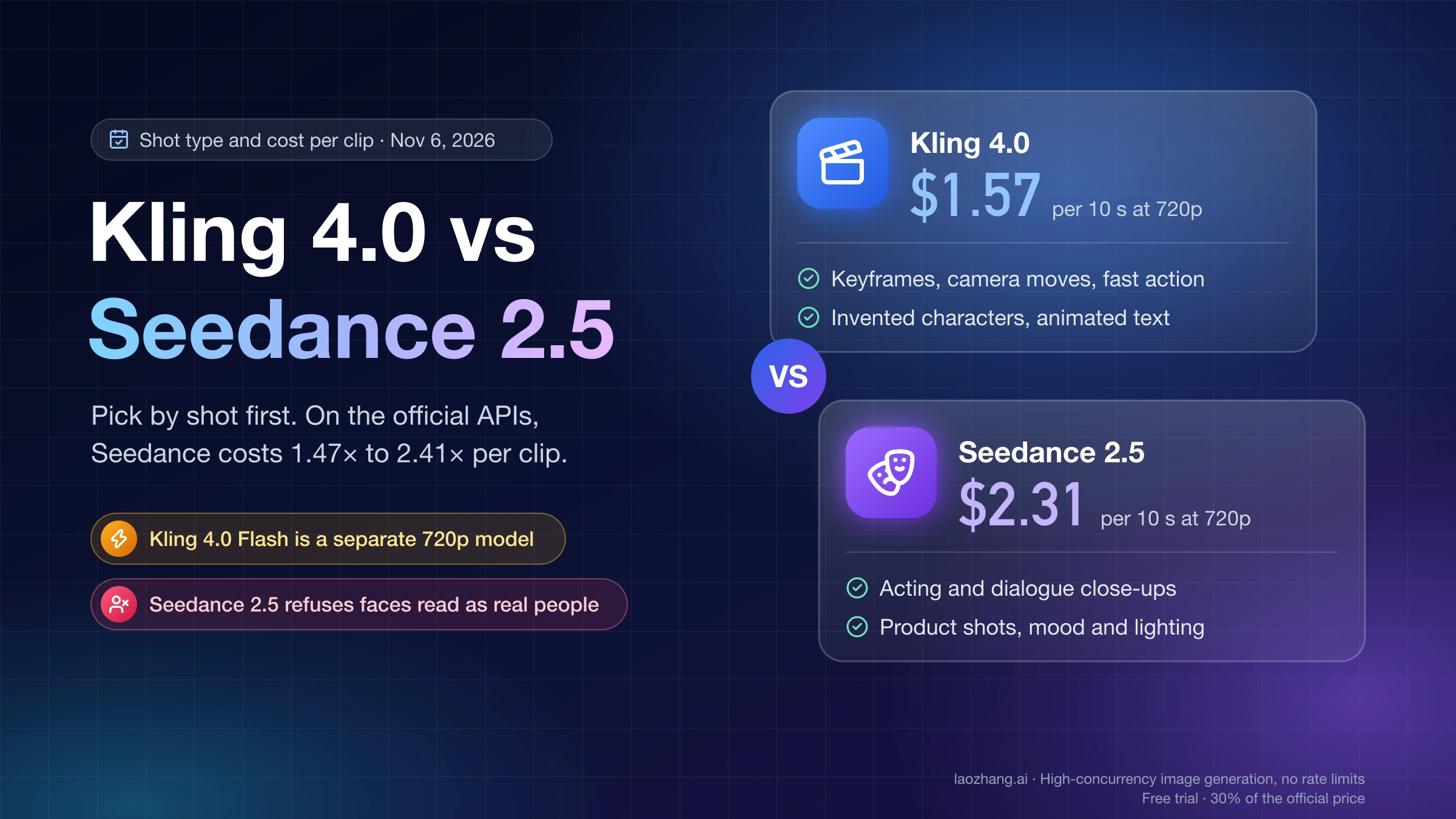
If you have to pick one model to try first, pick by shot. Start with Kling 4.0 for shots you direct beat by beat: sequences built from up to 10 keyframes, written camera moves such as an orbit, fast two-person action, an invented character locked from reference portraits, and animated text. Start with Seedance 2.5 for acting and dialogue close-ups, product shots built from several reference photos, and scenes where mood and lighting carry the shot. As of November 6, 2026, no independent benchmark rates the two against each other, and the published same-prompt tests split by task instead of naming an overall winner.
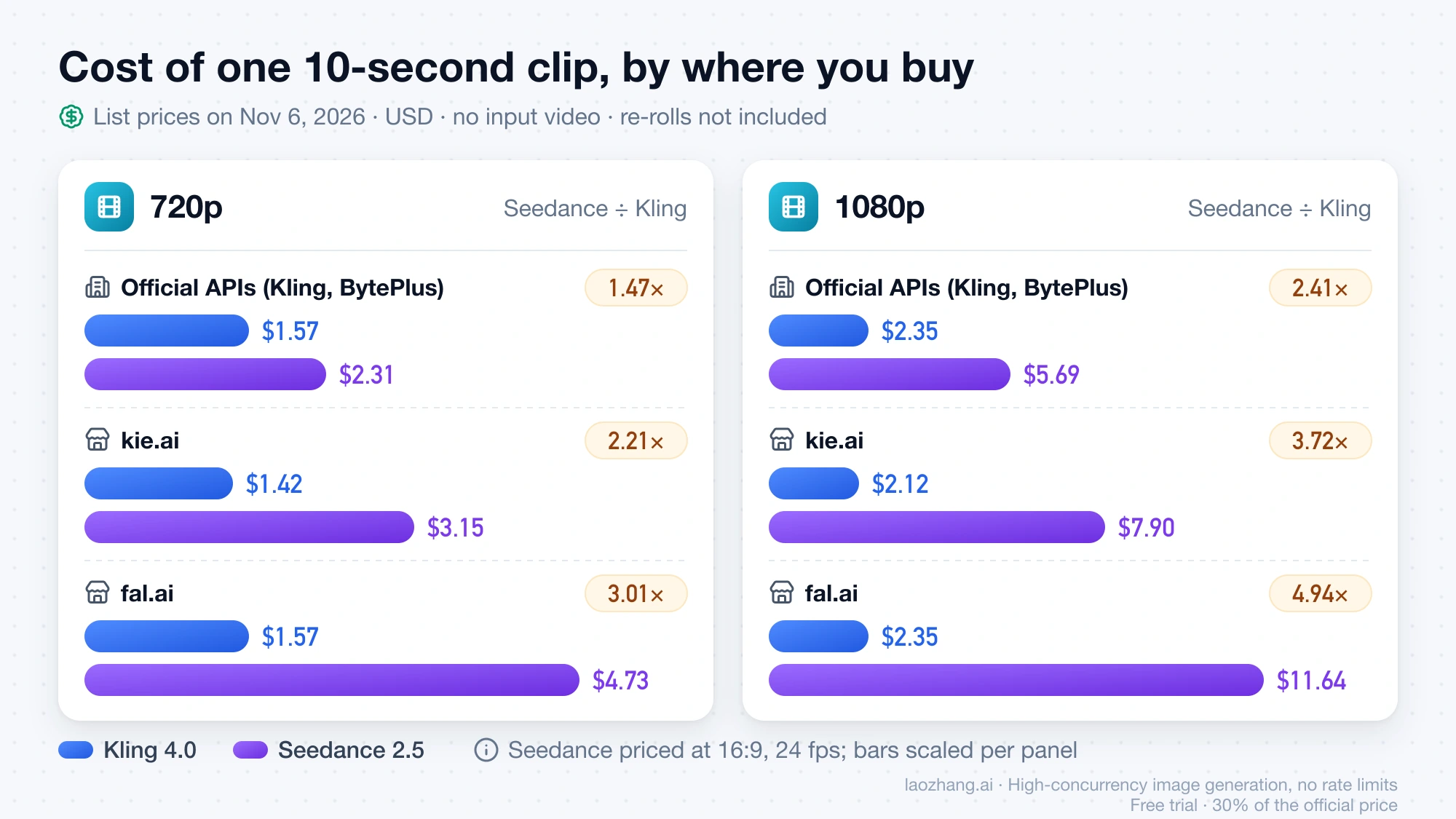
Kling 4.0 costs less per second than Seedance 2.5 on every platform that lists both, but the size of the gap depends on where you buy and at what resolution. On the two vendors' own APIs, at list prices on November 6, 2026, a 10-second clip costs $1.57 on Kling 4.0 against $2.31 on Seedance 2.5 at 720p (1.47×), and $2.35 against $5.69 at 1080p (2.41×). The "3× cheaper" and "5× at 1080p" figures in comparison videos and test pages match reseller price lists such as fal.ai's, where Seedance carries the bigger markup.
Two details change that picture before you spend anything. Kling 4.0 Flash is a separate, cheaper model capped at 720p and 20 seconds with first-frame input only, and some of the results that favor Seedance were run against Flash rather than full Kling 4.0. Adding a reference video to a Kling 4.0 job lowers the per-second rate but doubles the billed seconds, and Seedance 2.5 refuses reference faces it classifies as real people, so a refused or re-rolled take never shows up in a per-clip price.
Which model to try first for each shot type
Kling 4.0 leads where you need control and Seedance 2.5 where you need look and performance, according to the same-prompt tests published between October 2 and November 5, 2026. The table maps each shot type to the model to try first, what the named tester found, and the result that cuts the other way. Most rows rest on one or two single-take comparisons run by platforms that sell both models, so read each row as the first test to run, not a verdict.
| Shot type | Try first | What the public tests showed | What cuts the other way |
|---|---|---|---|
| Dialogue and acting close-ups | Seedance 2.5 | Atlas Cloud (Oct 27) preferred Seedance on a two-person dialogue scene. A Reddit acting test run through Atlas Cloud (Nov 4) had Seedance's lines within 0.2 s of the cue and Kling about 1 s late. | Atlas tested Kling 4.0 Flash, not full 4.0. Fuser (Oct 23) found both models delivered the line on time; dxbuilder (Oct 17) scored a Kling-only dialogue with a cloned voice 9.2/10. |
| Fast two-person action | Kling 4.0, with keyframes | Fuser's capoeira test (Oct 23): Kling kept both players readable while Seedance's bodies overlapped for about 0.5 s. | dxbuilder scored Kling's text-only fights 4.5/10 and a 10-keyframe action scene 9.0/10. PhotoGPT's multi-character action test had no winner. |
| Product shot from several reference images | Seedance 2.5 | Atlas Cloud (Oct 27, five shoe photos, about 8 s): Seedance held shape, texture, laces and shot order; Kling 4.0 Flash changed the shoe's shape across cuts. | Again Flash, not full Kling 4.0. Atlas reports Flash rendered faster and made the better splash. |
| Invented character locked from reference portraits | Kling 4.0 | Fuser (Oct 23): Kling held the face, glasses and coat. Seedance refused the generated portraits as possible real-person likenesses. | dxbuilder (Oct 17) found Seedance followed a multi-reference short film better (Kling scored 6.8/10). Atlas preferred Seedance's character consistency over Flash. |
| Sequence directed by many keyframes | Kling 4.0 | Kling 4.0 accepts up to 10 keyframe images; Seedance 2.5 takes a first frame or a first and last frame only. dxbuilder's 10-keyframe action scene scored 9.0/10. | Atlas's start-and-end-frame interpolation test failed on both models, with Flash on the Kling side. |
| Written camera move (orbit, push-in) | Kling 4.0 | Fuser's half-orbit test: Seedance pushed in instead of orbiting. In a Reddit ad test run through Atlas Cloud (Oct 28), Kling orbited smoothly and Seedance moved the camera less. | One Reddit user says Seedance follows reference clips well but misreads camera words; a post from the reseller budgetpixel found the opposite on a knee-height shot. |
| Animated text and typography | Kling 4.0 | PhotoGPT (published Oct 2, updated Nov 5): Kling kept all nine text compositions; Seedance dropped rows and broke the final circle. | One test only. |
| Mood, lighting, realistic look | Seedance 2.5 | Fuser's timed-beats test: Seedance handled the light change and mood better. Six Reddit users in r/Seedance_AI threads (Oct 20–Nov 4) say Seedance looks more real. | In the same Fuser test Seedance lost the main character after about 2 s. Three users say Kling 4.0 has closed much of the gap. |
| One 30-second take | Either; Kling costs less per take | Both generate up to 30 s in one request. A Reddit poster's Atlas Cloud bill (Oct 28) shows a 30 s 1080p Kling clip at 6.42 that took 9 min 14 s to render. | Kling 4.0 Flash stops at 20 s. Length doesn't help if the motion is wrong, as another commenter on the same post pointed out. |
If two or more characters talk in the same scene, decide first whether to generate them in one shot or cut between them: AI Video Dialogue With Multiple Characters: One Shot or Cuts?.
Why the Kling 4.0 vs Seedance 2.5 tests disagree
Most contradictions between the tests come from three things: which Kling model was tested, who ran the test, and how many takes they kept. Character and reference lock is the clearest case. Fuser ran full Kling 4.0 on October 23 and found it held faces better, while Atlas Cloud ran Kling 4.0 Flash on October 27 and found Seedance better. Flash is the cheaper 720p model, so the split may say as much about Flash as about Kling 4.0.
Dialogue splits the same way. Atlas preferred Seedance over Flash on lip sync, a Reddit acting test run through Atlas Cloud measured Seedance closer to the cue, Fuser heard both land the line on time with Kling's mix 5–12 dB louder, and dxbuilder gave a Kling-only voice-clone scene 9.2/10. Fast action depends on setup more than on the model: dxbuilder's Kling fights went from 4.5/10 on text alone to 9.0/10 with ten keyframes.
The four published pages that run both models on the same prompts come from companies that sell access to both: PhotoGPT's eight-test comparison (published October 2, updated November 5), Fuser's same-prompt test, Atlas Cloud's Kling 4.0 Flash vs Seedance 2.5 product-shot test and dxbuilder's Kling 4.0 review. Moe Lueker's Kling 4.0 review (October 21), sponsored by Artlist, compares Kling 4.0 with Seedance 2.0, not 2.5. None of these pages reports retry counts or per-test cost, and Fuser kept one take per model with no retries. The Reddit posts with measured tables appear in r/Seedance_AI, which pins an Atlas Cloud notice on every post, and their authors ran them through Atlas Cloud. The numbers may be accurate, but no neutral party has repeated them.
As of November 6, 2026, the only independent ranking is Artificial Analysis's blind-vote image-to-video leaderboard and its text-to-video twin, which place Seedance 2.5 first for image-to-video (Elo 1159) and fifth for text-to-video (Elo 1155) but list no Kling 4.0 or Kling 4.0 Flash rating, so no independent head-to-head exists yet.
Is Kling 4.0 really 3× cheaper? Cost per clip by platform
Kling 4.0 is cheaper per second wherever both models are sold, by about 1.5× to 5× depending on the platform and the resolution. The table below is a calculation from list prices published on November 6, 2026, not a bill: USD, no input video, audio included at no extra charge on every platform, and Seedance figures for a 16:9 clip at 24 fps. It leaves out re-rolls and refused generations.
| Model and where you buy it | $ per second at 720p | 10 s at 720p | 30 s at 720p | 10 s at 1080p | 30 s at 1080p |
|---|---|---|---|---|---|
| Kling 4.0, Kling API (same list on fal.ai, Replicate, WaveSpeed, EvoLink) | $0.157 | $1.57 | $4.71 | $2.35 | $7.06 |
| Kling 4.0 Flash, Kling API (720p only, 20 s maximum) | $0.094 | $0.94 | — | — | — |
| Kling 4.0, kie.ai | $0.1425 | $1.42 | $4.27 | $2.12 | $6.38 |
| Seedance 2.5, BytePlus ModelArk (Replicate matches at 720p, no 1080p) | $0.231 | $2.31 | $6.94 | $5.69 | $17.06 |
| Seedance 2.5, laozhang.ai (needs a key in its SeeDance2 group) | $0.262 | $2.62 | $7.86 | $6.46 | $19.38 |
| Seedance 2.5, kie.ai ("beta" prices) | $0.315 | $3.15 | $9.45 | $7.90 | $23.70 |
| Seedance 2.5, WaveSpeed | $0.360 | $3.60 | $10.80 | $9.00 | $27.00 |
| Seedance 2.5, fal.ai | $0.473 | $4.73 | $14.19 | $11.64 | $34.92 |
Disclosure: laozhang.ai is our own service. Its prices are platform pricing, not an independent comparison.
Kling prices by the second in units. Kling's API pricing page charges Kling 4.0 1.0 unit per second at 720p and 1.5 at 1080p, and Kling 4.0 Flash 0.6 unit per second at 720p. A unit costs about $0.157 at list ($100 for 637 units), so 10 seconds at 1080p is 10 × 1.5 × $0.157 = $2.35. Seedance 2.5 on BytePlus prices tokens, roughly (input-video seconds + output seconds) × width × height × fps ÷ 1024. A 720p 16:9 clip at 24 fps is 1280 × 720 × 24 ÷ 1024 = 21,600 tokens per second, which at BytePlus ModelArk's $10.70 per million tokens is $0.231 per second. At 1080p it's 48,600 tokens per second at $11.70 per million, or $0.569. Other aspect ratios change the pixel count and the price.
Where the "3×" comes from is now easy to see. On the vendors' own APIs, Seedance 2.5 costs 1.47× Kling 4.0 at 720p, 2.41× at 1080p, and 2.45× Kling 4.0 Flash at 720p. On one reseller that sells both, the gap widens: 3.01× at 720p and 4.94× at 1080p on fal.ai, and 2.21× and 3.72× on kie.ai. So Fuser's "about 3× at 720p, about 5× at 1080p" (October 23) and the Artlist credit prices in Moe Lueker's review (5,000 against 1,750 credits for 10 seconds at 720p, about 2.9×) describe reseller pricing, not the vendors' own list prices. Seedance 2.5's per-platform prices, including 480p and longer budgets, are in Seedance 2.5 API Pricing: Cost per Second at 480p, 720p, 1080p.
Kling 4.0 is available through Kling's own API now. As of November 6, 2026, the developer pricing page sells it only in separate Flagship prepaid packages, "available only for Kling 4.0 and Kling 4.0 Flash", from $10 for 64 units valid for 30 days, while the older General packages are "not compatible" with either model; on September 30, 2026, none of Kling's API packages covered 4.0. The first-purchase 10% discount brings 10 seconds at 1080p to $2.12, and the $500 package to $2.31. No platform sells Kling 4.0 at 4K, and OpenRouter doesn't offer Kling 4.0 at all.
Does a reference video make Kling 4.0 cheaper? It bills more seconds
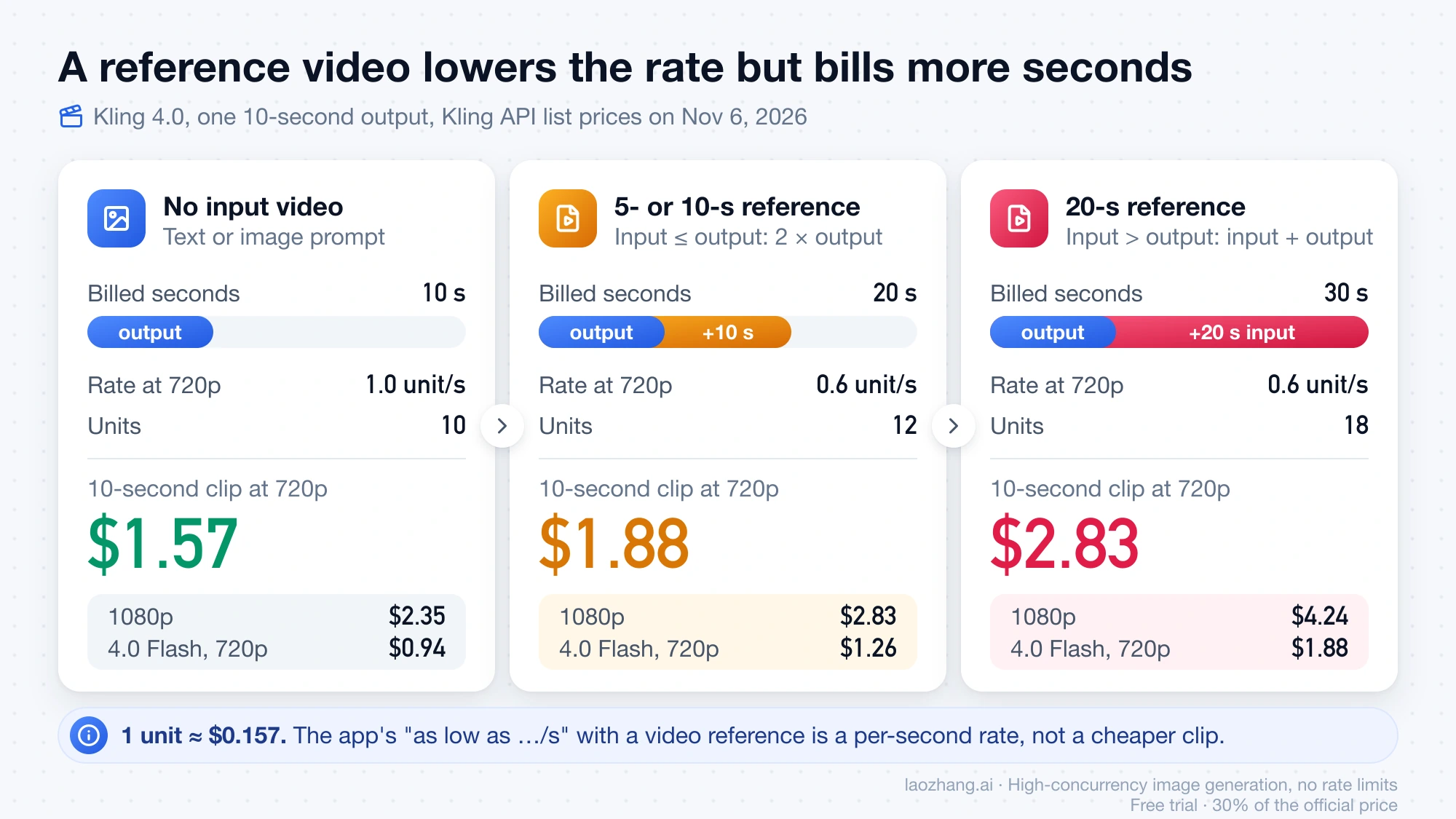
No. A reference or edit video lowers Kling 4.0's per-second rate but raises the number of seconds you pay for, so the clip usually costs more. Kling's API charges 0.6 unit per second at 720p and 0.9 at 1080p when you supply an input video, against 1.0 and 1.5 without one. The billed duration, however, becomes twice the output length when the input is no longer than the output, or input plus output when the input is longer.
Recomputed from those rules on November 6, 2026, a 10-second 720p clip costs $1.57 with no input video, $1.88 with a 5- or 10-second reference video (20 billed seconds × 0.6 unit = 12 units), and $2.83 with a 20-second one (30 billed seconds × 0.6 = 18 units). At 1080p the same three cases cost $2.35, $2.83 and $4.24. Kling 4.0 Flash follows the same pattern: $0.94, then $1.26, then $1.88. The Kling app's "720p with video reference as low as …/s" promotion is therefore a per-second rate, not a cheaper clip. Seedance 2.5 on BytePlus also counts input-video seconds in its token formula, at a lower $6.40 per million tokens, so a reference video isn't free there either.
Seedance 2.5 before you pay: 720p-only resellers and real-person refusals
The two Seedance surprises are resolution and refusals. Seedance 2.5 itself renders 480p, 720p and 1080p, with 1080p in 10-bit, according to BytePlus's Seedance 2.5 documentation (last updated October 28, 2026). Several platforms stop at 720p: Replicate and OpenRouter list no 1080p option, and ByteDance's Dreamina app prices 720p only (37 credits per second, an introductory offer). Fuser's tests ran at 720p for both models. If you need 1080p, check the platform before you compare prices, and note that BytePlus activates the model only once your balance is above $30 or you hold a savings plan or resource pack. Where Seedance 2.5 is usable by app and API is covered in Seedance 2.5 Release, Access, Availability, and API Status.
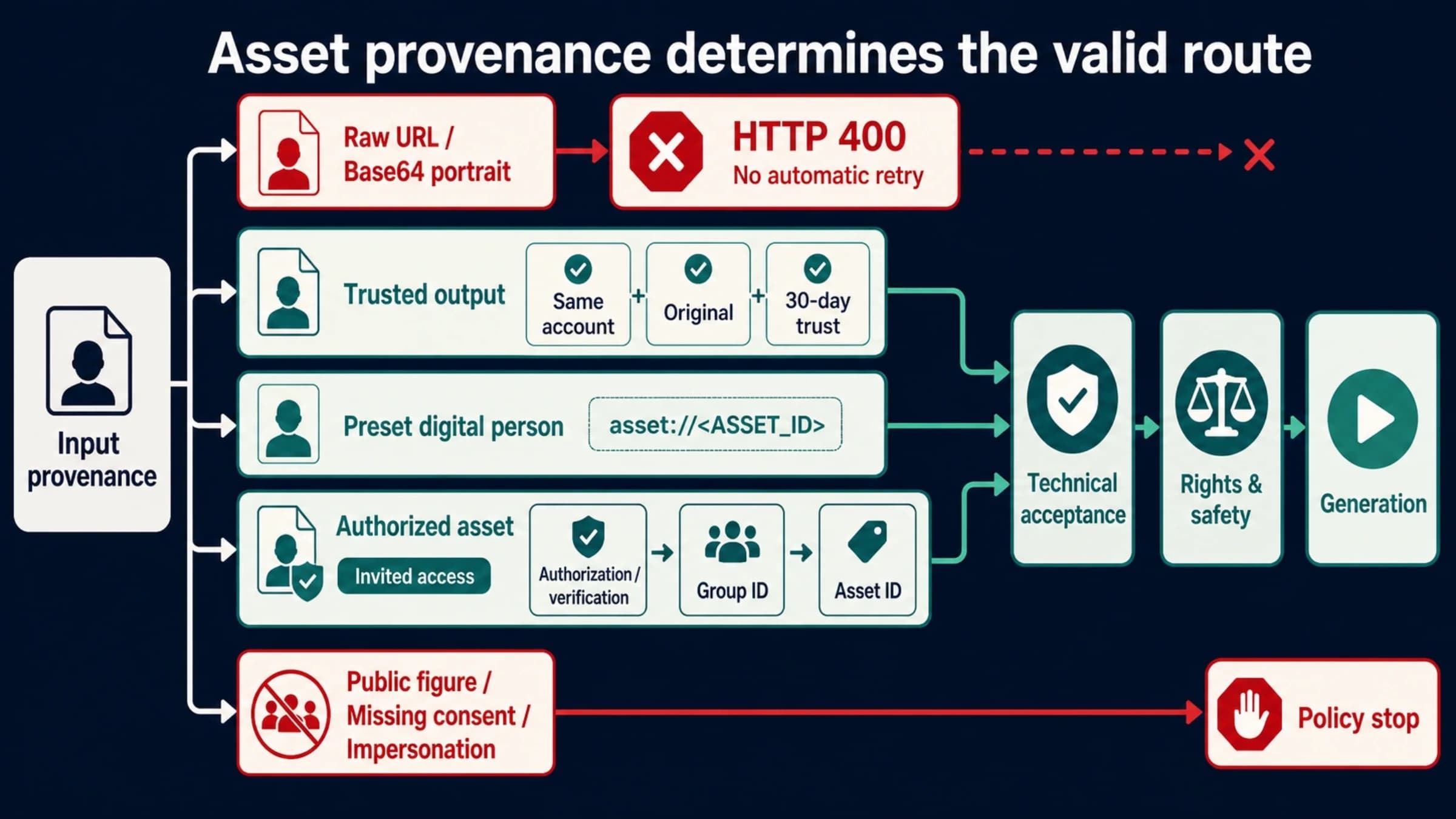
Refusals are the strongest non-quality complaint. Fuser's Seedance run refused AI-generated portraits of an invented woman as possible real-person likenesses, and four users in r/Seedance_AI threads between October 20 and November 4 say Seedance's filters blocked character sheets or faces, and two users, one of them among those four, say the strictness varies by hosting platform. No user in those threads reported a Kling 4.0 refusal. A blocked job costs you time even when it isn't billed, so a character-driven project can be cheaper on Kling even at the same output price. Legitimate fixes are in Seedance Input Image May Contain a Real Person: Legitimate Fixes.
Kling 4.0, 4.0 Flash and Seedance 2.5 limits side by side
Both full models generate up to 30 seconds per request with built-in audio. The differences that change a shot plan are keyframes (Kling), reference volume and audio references (Seedance), and the resolutions each one actually sells. The Kling columns come from Kling's 4.0 release note and the Seedance column from BytePlus's model documentation, both as of November 6, 2026.
| Limit | Kling 4.0 | Kling 4.0 Flash | Seedance 2.5 |
|---|---|---|---|
| Length per generation | 3–30 s | 3–20 s | 4–30 s, or let the model choose |
| Resolution you can buy | 720p, 1080p | 720p | 480p, 720p, 1080p |
| 4K and HDR | 4K and 10-bit HDR listed, HDR "coming soon"; 4K not sold on any API | 8-bit SDR | 4K not supported; 1080p is 10-bit |
| Aspect ratios | 21:9, 16:9, 1:1, 9:16, Auto | Not listed | 21:9, 16:9, 4:3, 1:1, 3:4, 9:16, adaptive |
| Frame control | First frame, first and last, up to 10 keyframes | First frame only | First frame, or first and last frame |
| References in one request | Up to 15 items: 10 images, 5 videos (30 s combined), 7 elements, voice reference | Omni Reference supported | Up to 50: 30 images, 10 video clips, 10 audio clips; audio alone is allowed |
| Editing and extension | Edit up to 5 clips (30 s total); extension to 2 minutes "coming soon" | Not listed | Edit, multi-round extension, timestamp-based edits |
| Cheaper preview | Kling 4.0 Flash is a different model | — | Draft mode: 480p draft, then a 1080p final from the draft's task ID |
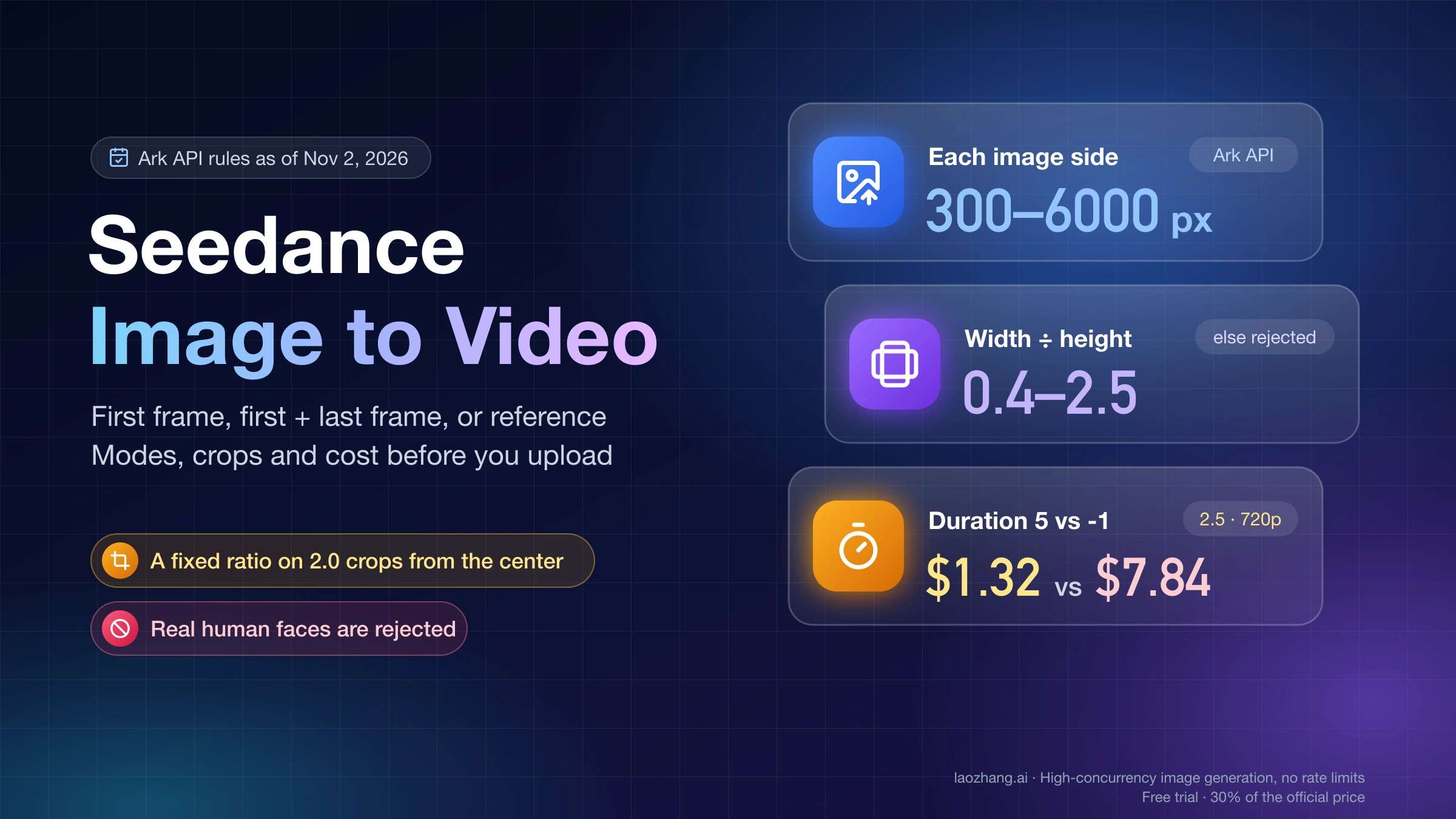
Kling 4.0 Flash is not a speed setting on Kling 4.0. It is a separate model with its own spec and price, so a result from Flash, good or bad, tells you little about the full model. Seedance 2.5's three image modes (first frame, first and last frame, reference images) can't be mixed in one request; How to Use Seedance Image to Video: Modes, Crops, and Cost walks through each, and Seedance 2.5 API Guide: Model IDs, Python, and Node.js has the integration code.
Run your own Kling 4.0 vs Seedance 2.5 test on the hardest shot
Because the public tests are thin and mostly single takes, a few dollars on your own hardest shot is the most reliable tie-breaker. On the official APIs, one 10-second 720p take costs $1.57 on full Kling 4.0 and $2.31 on Seedance 2.5, so three takes of each come to $11.64. Run the same prompt, references, length and aspect ratio on both, and keep every take you generate, including the failures.
Draft on full Kling 4.0 at 720p rather than on Flash if you plan to ship on full 4.0, because Flash is a different model. On Seedance, Draft mode renders a 480p preview at the normal 480p rate (BytePlus's own example is $0.514 for 5 seconds, so about $1.03 for 10) and then produces the final from the draft's task ID, but only at 1080p; draft IDs created since October 28, 2026 stay valid for 14 days.
Then count cost per usable take, not per generation. At 1080p on the official APIs, Seedance's $5.69 buys about 2.4 Kling takes at $2.35, so Kling 4.0 stays cheaper only while it needs fewer than about 2.4 tries for every take Seedance gets right. At 720p the break-even is about 1.5 tries ($2.31 ÷ $1.57). If Seedance nails your shot first time and Kling needs three attempts, Seedance is the cheaper model for that shot.
Kling 4.0 vs Seedance 2.5: other questions
When did Kling 4.0 come out? Kling's release note says Kling 4.0 "officially became available to everyone on October 15," 2026. The same note describes Kling 4.0 Flash as a separate, faster model "built for frequent creation."
How many credits does Kling 4.0 use in the Kling app? Kling shows the credit cost only after you sign in. kie.ai reported on October 16, 2026, that Kling 4.0 uses 10 credits per second at 720p and 15 at 1080p; Kling hasn't confirmed this publicly. At the Pro plan's regular price of $32.56 for 3,000 credits, 150 credits for 10 seconds at 1080p works out to about $1.63. The app's "Starting at $0.027/s" banner is a best-case figure tied to 720p, a video reference and launch discounts.
Is Kling 4.0 free to try? Kling gives paid subscribers bonus credits on their first login each day, but 7-Day Trial and Pass users don't get them and Kling publishes no amount, according to Kling Daily Free Credits for Subscribers: Who Gets Them, How Many.
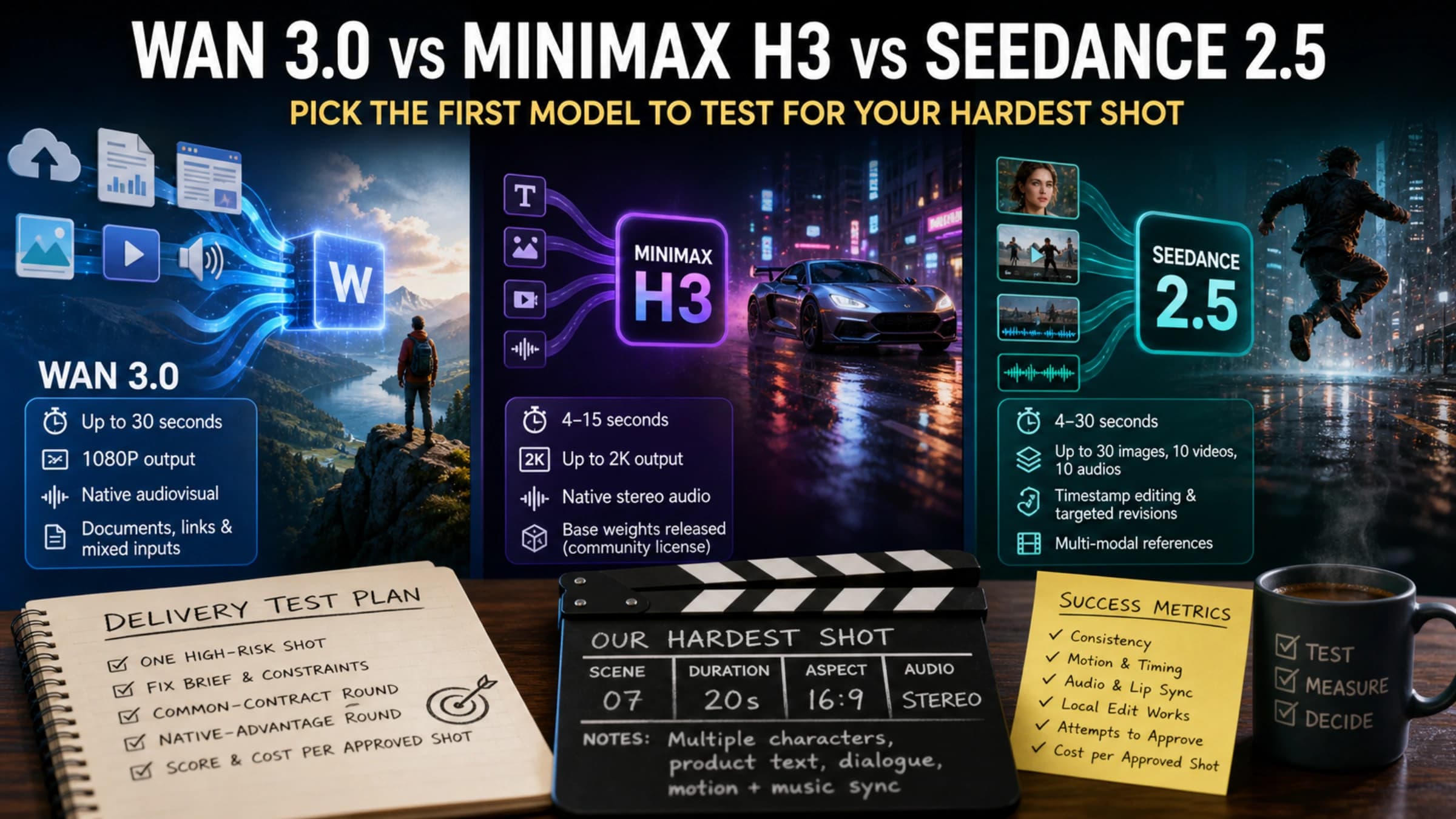
Should I compare Wan 3.0 or MiniMax H3 too? If neither Kling 4.0 nor Seedance 2.5 fits your length, resolution or deployment needs, Wan 3.0 vs MiniMax H3 vs Seedance 2.5: Pick the First Model to Test compares those three by duration, output and API access.
Sources10
External pages this guide links to, in the order they appear. Last updated Nov 6, 2026.
Sources10
External pages this guide links to, in the order they appear. Last updated Nov 6, 2026.
- 1.PhotoGPT's eight-test comparisonphotogptai.com/blog/seedance-2-5-vs-kling-4
- 2.Fuser's same-prompt testfuser.studio/articles/kling-4-vs-seedance-2-5
- 3.Atlas Cloud's Kling 4.0 Flash vs Seedance 2.5 product-shot testatlascloud.ai/blog/tips/kling-4-flash-vs-seedance-2.5
- 4.dxbuilder's Kling 4.0 reviewdxbuilder.io/blog/kling-4-0-review-photorealism-comparison-171026
- 5.Moe Lueker's Kling 4.0 reviewmoelueker.com/blog/kling-4-review
- 6.Artificial Analysis's blind-vote image-to-video leaderboardartificialanalysis.ai/video/leaderboard/image-to-video
- 7.Kling's API pricing pagekling.ai/dev/pricing
- 8.BytePlus ModelArk'sdocs.byteplus.com/en/docs/modelark/model-pricing
- 9.BytePlus's Seedance 2.5 documentationdocs.byteplus.com/en/docs/modelark/seedance-2-5
- 10.Kling's 4.0 release notekling.ai/release-note/release-notes/Kling_4