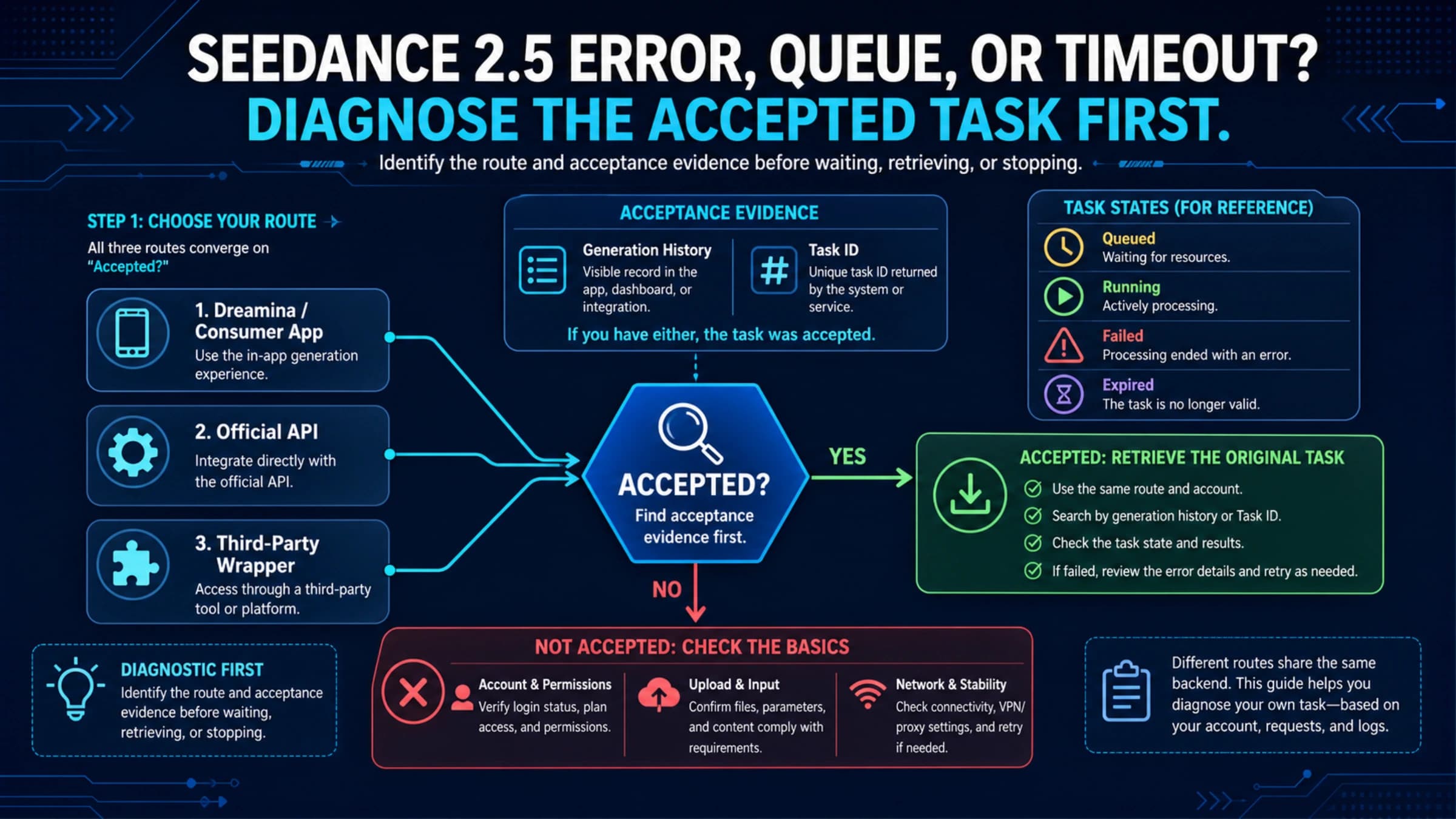
Wan 3.0 vs MiniMax H3 vs Seedance 2.5: Pick the First Model to Test
There is no task-free winner: Seedance 2.5, MiniMax H3, and Wan 3.0 optimize different delivery constraints. Choose a first test from your hard requirements, then compare cost per approved shot.
On this page
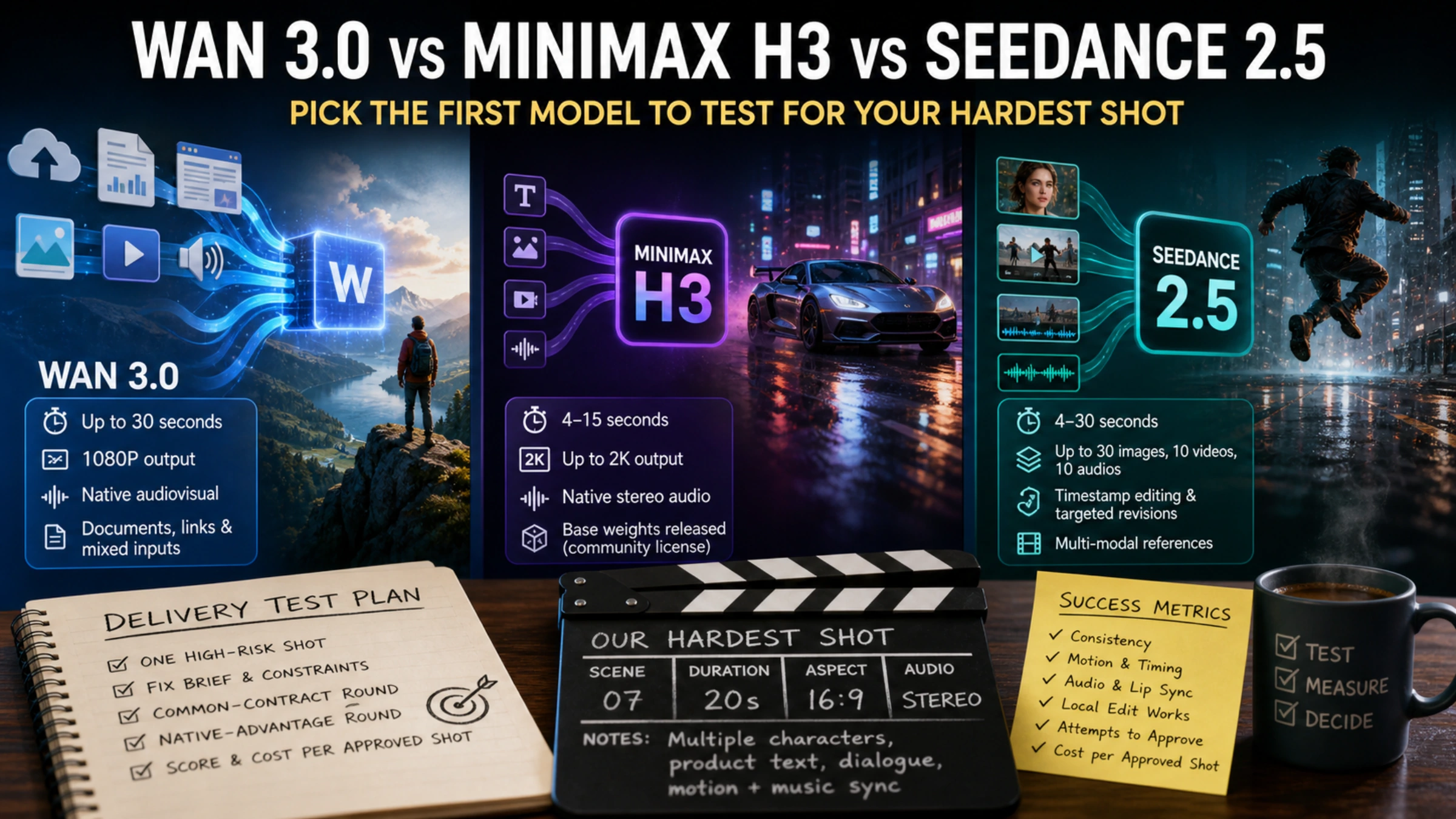
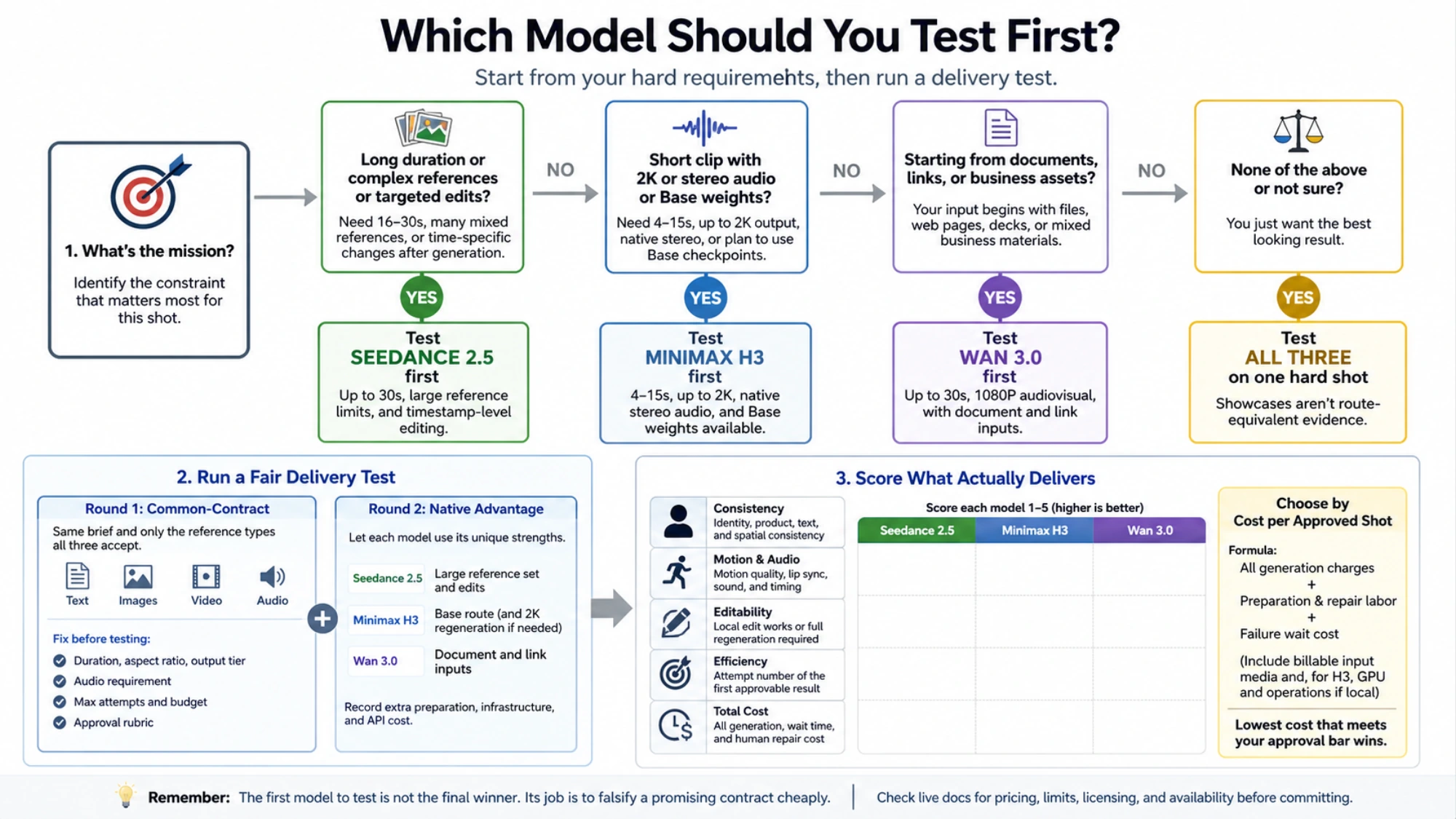
Start with Seedance 2.5 when a scene needs 16–30 seconds, a large mixed reference pack, or targeted edits after generation. Start with MiniMax H3 when the job is a 4–15 second clip that benefits from up-to-2K output, native stereo audio, or a controllable Base-weight route. Start with Wan 3.0 when a 30-second audiovisual brief begins with documents, web pages, and several media types rather than a clean prompt.
That is a first-test decision, not a quality ranking. The vendors publish different contracts and curated showcases. They do not provide one controlled benchmark with the same inputs, output target, retry budget, and human selection policy. Your hardest deliverable shot is the useful tie-breaker.
The fast decision
| Hard requirement | Test first | Contract-level reason | Verify before committing |
|---|---|---|---|
| 16–30 seconds, many mixed references, or time-specific revisions | Seedance 2.5 | 30-second generation, large reference limits, timestamp-level editing | Account/region access, current API route, input billing |
| 4–15 seconds, up to 2K, native stereo, or Base weights | MiniMax H3 | Short 2K audio-video contract plus released Base checkpoints | Community License, hardware, 2K regeneration dependencies |
| 30 seconds from documents, links, and mixed business assets | Wan 3.0 | 1080P audiovisual generation with File and Link inputs | Alibaba Cloud region, model access, preview/GA status |
| “Whichever looks best” | Test all three on one failure-prone shot | Showcases are not route-equivalent evidence | Fix a brief, budget, and approval rubric first |
The first model to test does not have to become the final production route. Its job is to falsify a promising contract cheaply.
Seedance 2.5 is built around dense references and revision
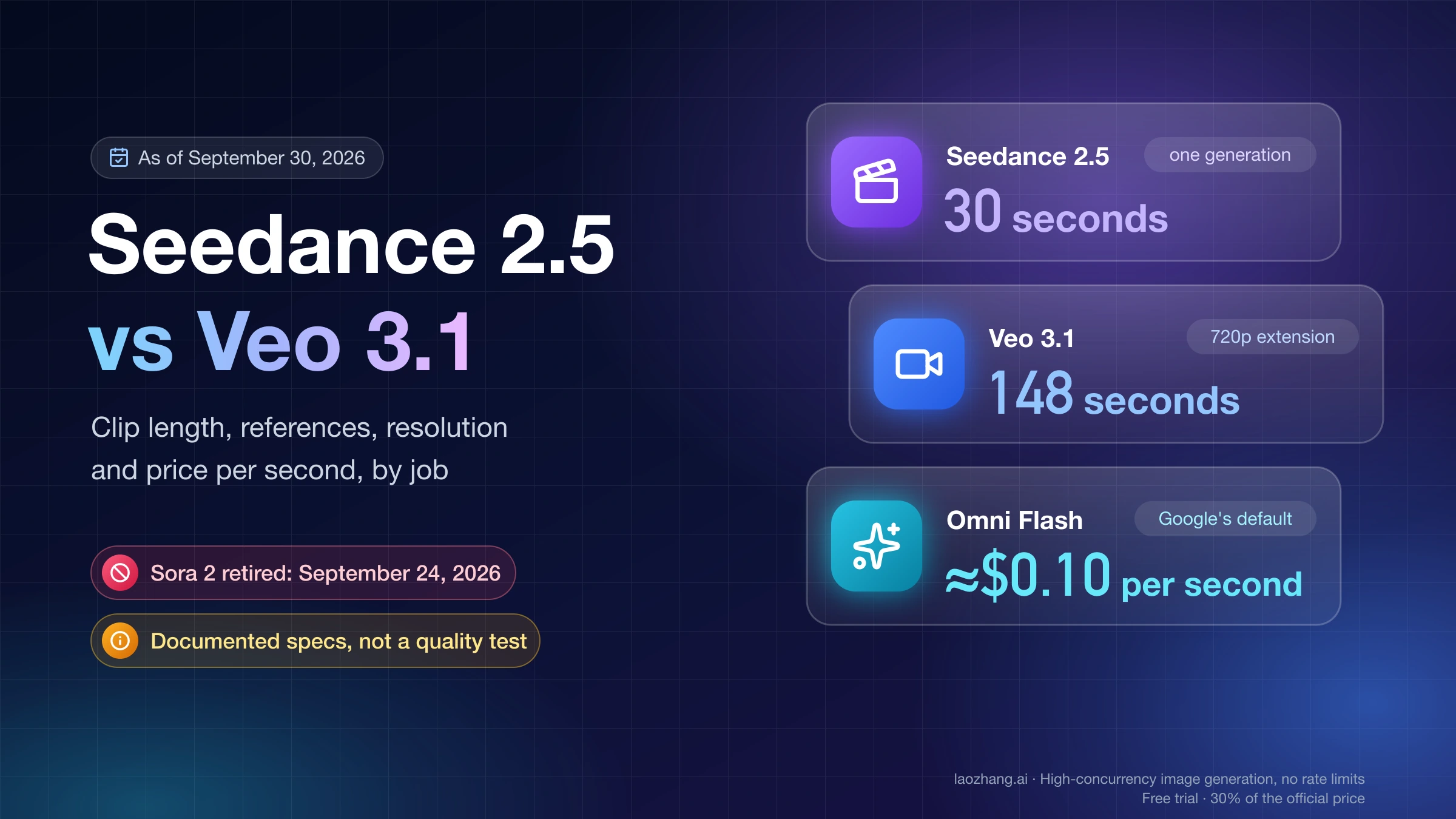
ByteDance Seed says Seedance 2.5 can produce up to 30 seconds in one generation and supports further extensions. Its published reference ceiling is unusually broad: up to 30 images, 10 videos, and 10 audio clips. The launch also describes timestamp-level control during generation and targeted modification of selected clips afterward.
That combination matters when the job is more than “make a long video.” A campaign may need several people, approved products, a location, movement references, a voice, and music timing in one scene. If feedback is likely to be “change the action from second 12 to 16 without rebuilding the rest,” revision behavior can matter more than first-pass beauty.
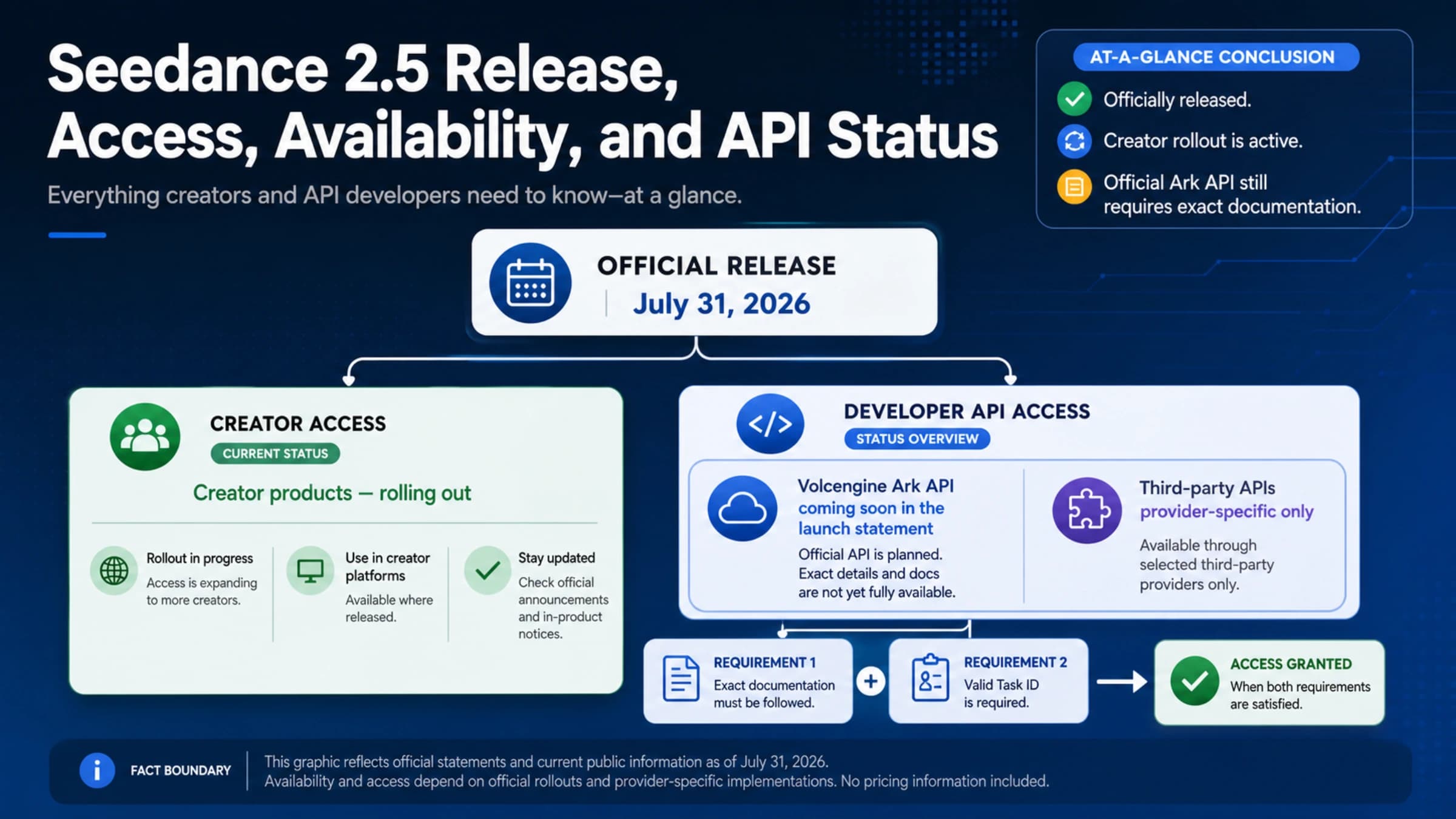
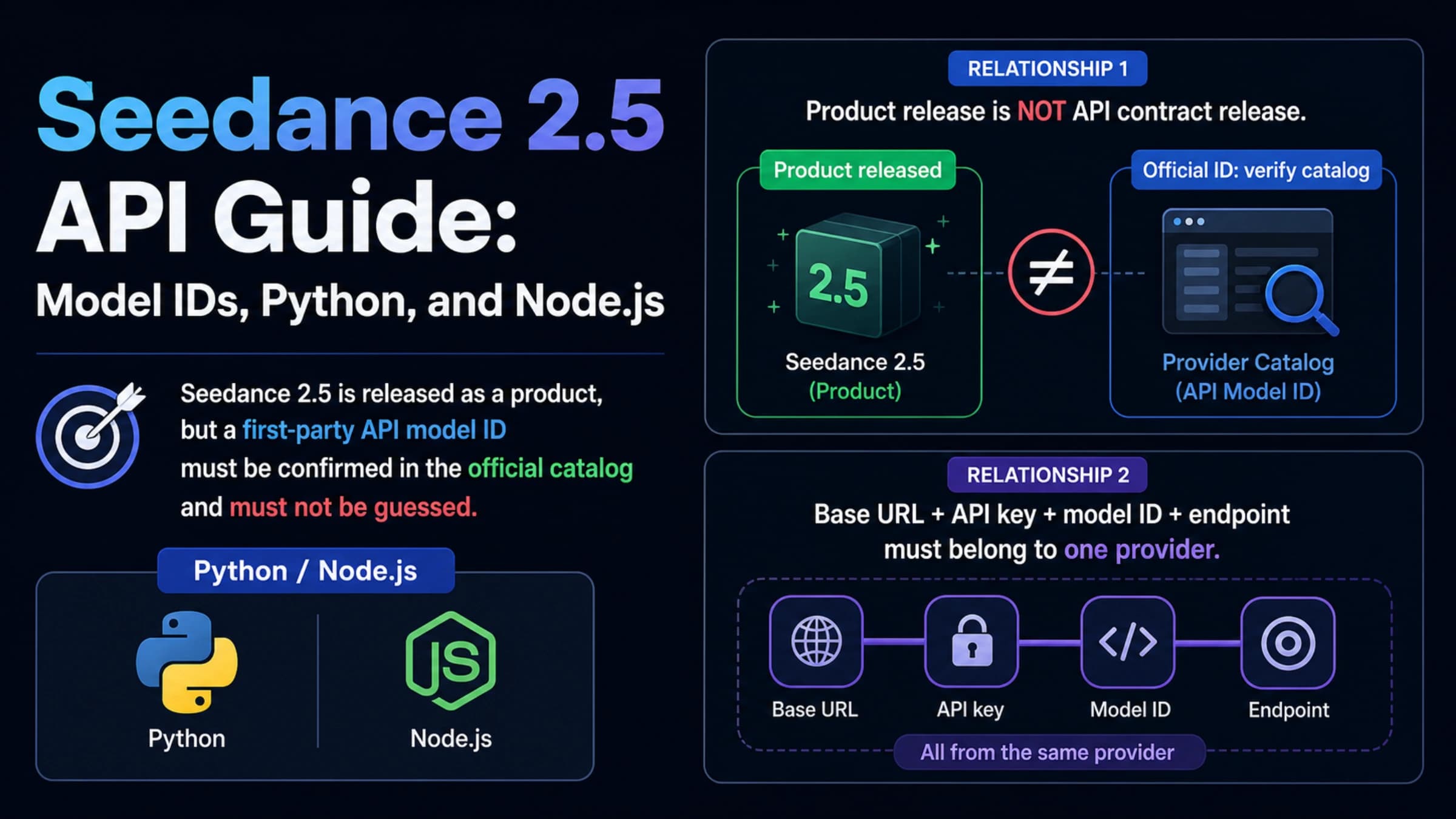
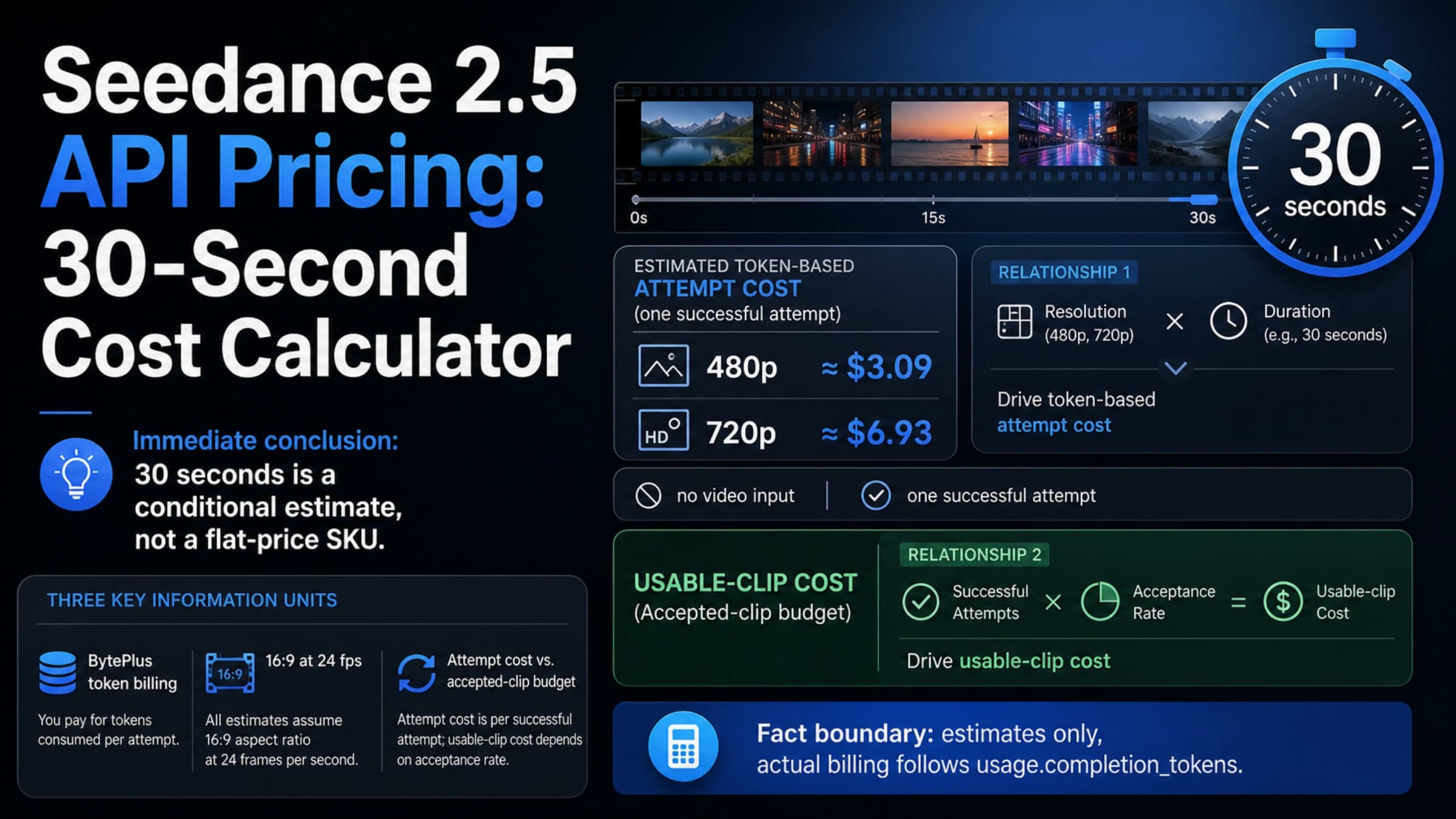
The current BytePlus enhanced-generation contract lists model ID dreamina-seedance-2-5-260628, 4–30 second output, and text, image, video, and audio inputs. Check the live BytePlus documentation before integration: route-specific pricing and the presence of an input video can change what is billed. If your question is whether a particular entry point is actually available, use the separate Seedance 2.5 access and API status guide.
MiniMax H3 makes a different short-form trade
The MiniMax H3 launch specifies up to 15 seconds at up to 2K with native stereo audio. H3 accepts context composed of text, images, video, and audio. That makes it an obvious first candidate for compact ads, product shots, animated interfaces, or dialogue-led clips where a short delivery window is acceptable.
H3 also opens a deployment branch the other two hosted contracts do not expose in the same way. MiniMax released H3 Base checkpoints on August 3 and documents serving options plus a hybrid path that combines Base inference with official regeneration/API stages for 2K results.
Do not collapse that into “free local 2K.” Downloadable weights create control and customization options, but they also create GPU, storage, serving, and operations costs. The weights use the MiniMax H3 Community License. A production team should review territory, use restrictions, downstream obligations, and the role of official regeneration endpoints before approving commercial use.
Wan 3.0 turns more of the brief into model input
Alibaba Cloud's Wan 3.0 release page lists native 30-second generation, 1080P output, native audiovisual creation, and an all-in-one input surface. The notable difference is not only support for text, images, video, and audio. It also accepts documents and web pages.
That can be useful when the real starting point is a product page, campaign deck, spreadsheet, or event brief. The model may reduce the manual step of translating business material into a single prompt. This remains something to test, not an automatic workflow win: the team still has to check what information survives, what is invented, and how much cleanup the output needs.
Alibaba Cloud's model reference identifies wan3.0-video, Video output, and 480P, 720P, and 1080P routes. Those facts belong to Alibaba Cloud Model Studio. A third-party endpoint with the same marketing name does not automatically inherit the same inputs, audio behavior, limits, or failure-billing policy.
“Same prompt” is not always a fair test
Sending identical text to all three models sounds scientific, but it can hide the question you actually need answered. A model designed for a large mixed reference pack should not be judged only as a text-to-video engine. A Base-weight route should not be compared with a hosted 2K result without counting the regeneration stage.
Use two rounds instead:
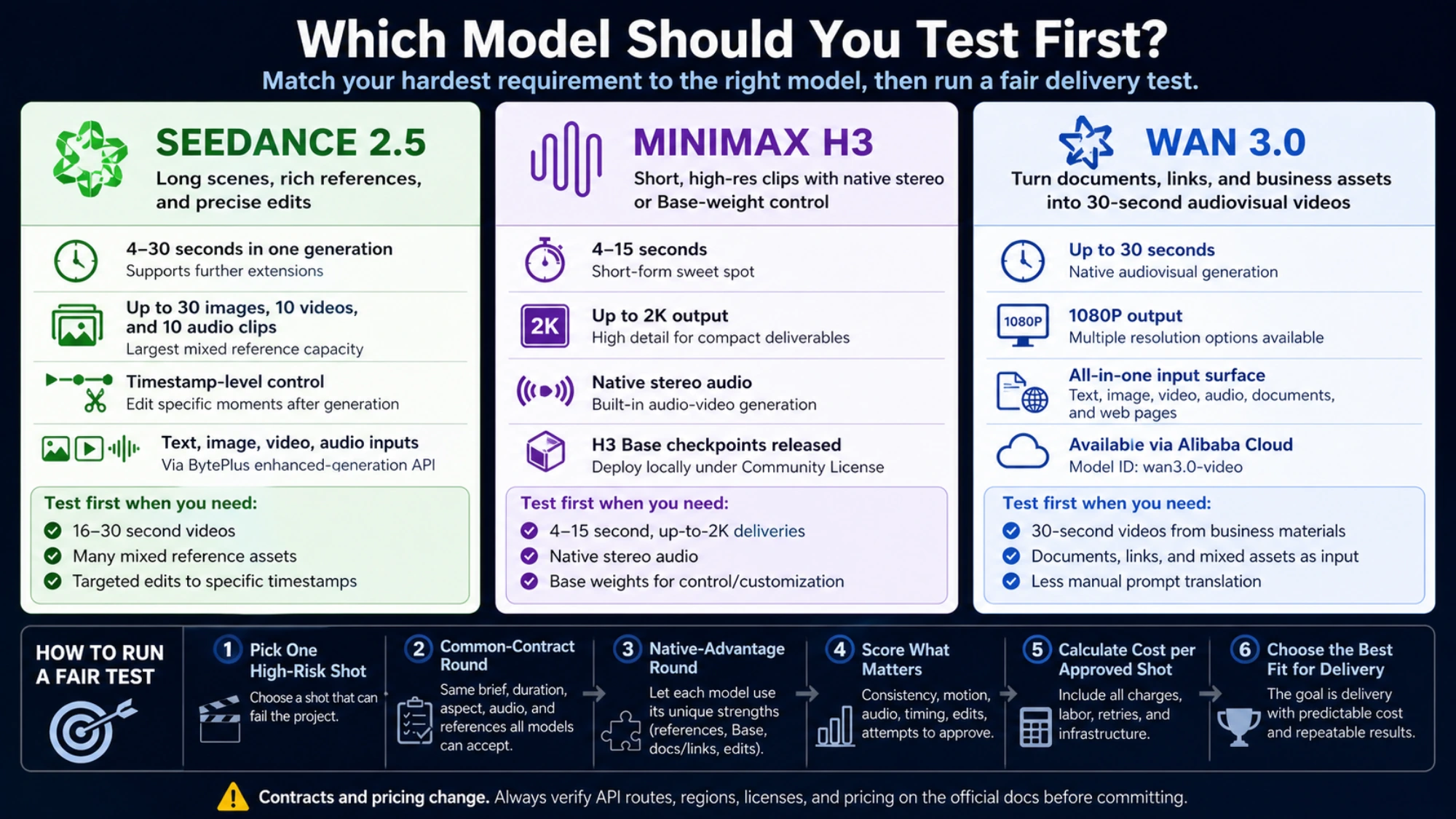
- Common-contract round. Give every model the same creative brief and only the reference types all three can accept. Fix duration, aspect ratio, output tier, audio requirement, and maximum attempts.
- Native-advantage round. Let each model use the capability that made it a candidate—Seedance's larger reference set and edits, H3's Base route, or Wan's document/link input. Record the extra preparation, infrastructure, and API cost.
Choose a shot that can fail the project: multiple characters crossing, small product text, spoken dialogue, a required opening and ending frame, a continuous camera move, or action synchronized to music. A generic landscape says little about delivery risk.
Score only observable outcomes:
- identity, product, text, and spatial consistency;
- motion, lip sync, sound, and timing against the brief;
- whether a local edit works or the entire clip must be regenerated;
- attempt number of the first approvable result;
- total generation, waiting, and human repair cost.
Budget cost per approved shot, not cost per second
Headline price is not the production bill. A cheap generation that needs eight retries can cost more than an expensive route that clears review on attempt two. A 30-second output is not valuable if only six seconds survive the edit.
A more useful metric is:
cost per approved shot = all generation charges + preparation and repair labor + failure wait cost
If reference video duration is billable, include it. For local H3, separate GPU rental, checkpoint storage, serving work, and any official 2K regeneration/API call. Do not compare a cloud sticker price with a self-hosted compute line while ignoring operations.
A defensible recommendation
- Test Seedance 2.5 first for long scenes, dense multimodal references, and time-targeted revisions.
- Test MiniMax H3 first for short up-to-2K clips, native stereo, or a team that genuinely benefits from Base-weight control.
- Test Wan 3.0 first for 30-second audiovisual work that begins with documents, links, and mixed business assets.
- If visual quality is the only deciding factor, do not buy from a comparison claim. Run the same approval test on one hard shot.
All three belong in a serious shortlist. Only your inputs, approval bar, and retry budget can determine the production winner. A small test that exposes contract differences is more valuable than a large collection of unrelated demo clips.
Sources6
External pages this guide links to, in the order they appear. Last updated Aug 28, 2026.
Sources6
External pages this guide links to, in the order they appear. Last updated Aug 28, 2026.
- 1.Seedance 2.5seed.bytedance.com/en/blog/one-take-creation-flexible-referencing-introducing-seedance-2-5
- 2.live BytePlus documentationdocs.byteplus.com/en/docs/byteplus_las/video_gen_enhanced
- 3.MiniMax H3 launchminimax.io/blog/minimax-h3
- 4.released H3 Base checkpoints on August 3minimax.io/news/minimax-h3-open-source
- 5.Wan 3.0 release pagemodelstudio.console.alibabacloud.com/model-releases/wan3.0-video
- 6.model referencehelp.aliyun.com/zh/model-studio/wan3-0-video