Gemini Omni vs Seedance 2.5: Pick by Job Type, 3.3× Cost Gap
Gemini Omni 1.2 Flash ties Seedance 2.5 on text-to-video and edges it on editing at $0.70 vs $2.32 per 10 s clip; Seedance leads image-to-video and 30 s takes.
On this page
Gemini Omni is not better than Seedance across the board, so send each job to the model that wins it. Send text-to-video drafts and follow-up edits of an existing clip to Gemini Omni 1.2 Flash (gemini-omni-1.2-flash), and send image-to-video shots and single continuous takes of 16–30 seconds to Seedance 2.5. As of November 12, 2026, the Artificial Analysis Video Arena, which ranks models by blind human votes, has the two tied on text-to-video (Elo 1155 for Seedance 2.5, 1154 for Omni 1.2), Seedance 75 points ahead on image-to-video, and Omni 17 points ahead on editing.
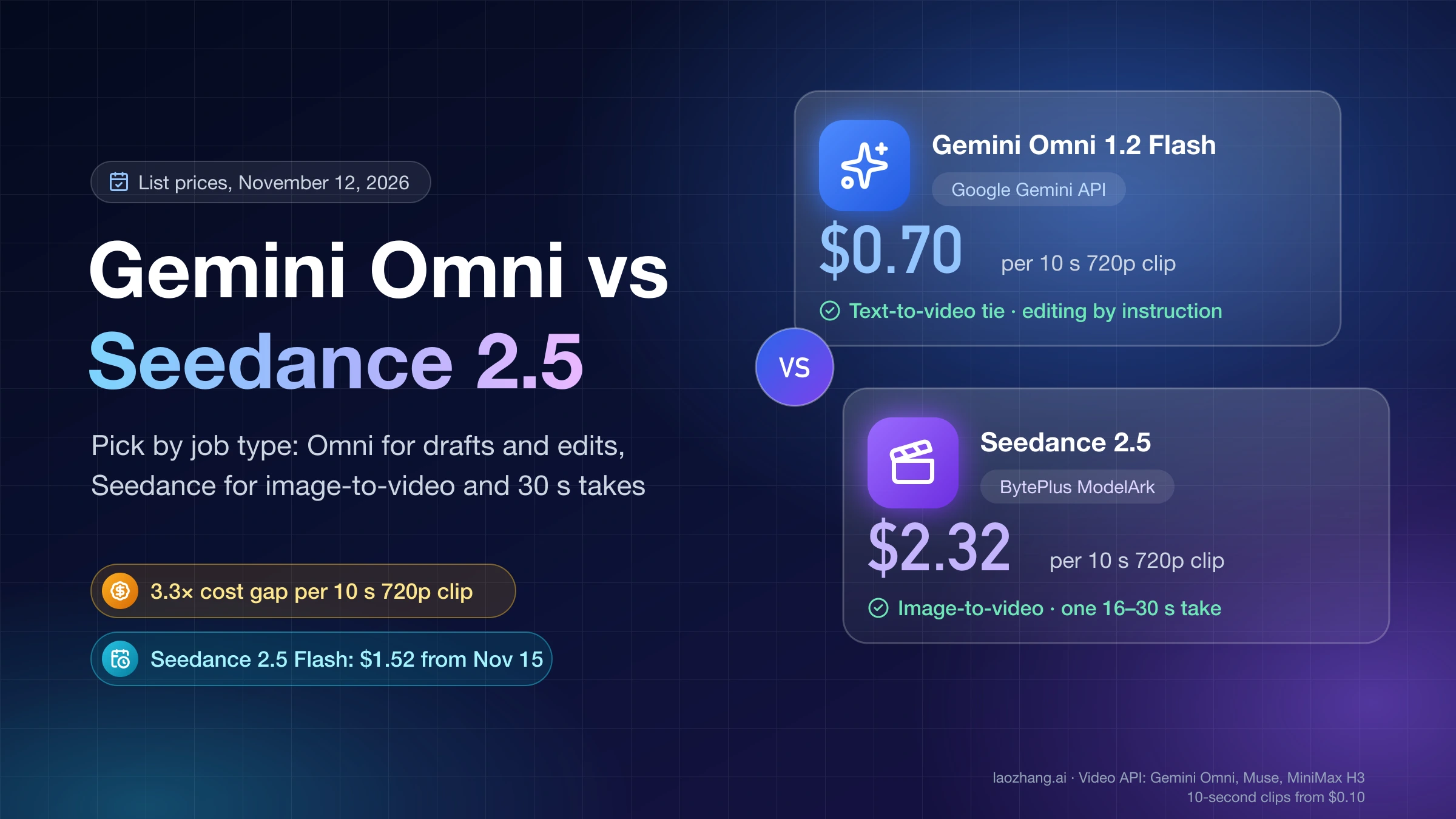
Price is what breaks the text-to-video tie. At list prices on November 12, 2026, a 10-second 720p 16:9 clip costs $0.70 on Google's Gemini API and $2.32 on BytePlus for Seedance 2.5, so each Seedance take costs as much as 3.3 Omni takes. Seedance 2.5 Flash, which BytePlus opens for API calls on November 15, brings that clip to $1.52, still more than twice Omni.
Two conditions override the job-type rule. Omni outputs only 16:9 or 9:16 and at most 15 seconds per generation, so a 21:9, 1:1 or 4:3 deliverable, or a 30-second scene in one pass, goes to Seedance whatever it costs. Access is the other: the Gemini API runs Omni on the paid tier only and is not offered in mainland China, Hong Kong, Macao, Russia or Belarus, while BytePlus is not available in the United States and asks for USD 30 of balance or a savings plan before enabling Seedance 2.5.
Is Gemini Omni better than Seedance? Edits yes, image-to-video no
Gemini Omni 1.2 Flash is the better pick for editing a clip through follow-up instructions and the cheaper equal for text-to-video, while Seedance 2.5 is clearly better when the job starts from a still image. The table below maps the four job types readers usually weigh to the model to try first, using the Artificial Analysis arenas for text-to-video, image-to-video and video editing as of November 12, 2026, all with audio.
| Job | Try first | Arena Elo, Seedance 2.5 vs Omni 1.2 | What decides it |
|---|---|---|---|
| Text-to-video | Gemini Omni 1.2 Flash | 1155 ±13 vs 1154 ±14, a statistical tie | Same rated quality at 30% of the price per 10 s clip |
| Image-to-video | Seedance 2.5 | 1161 ±15 (#1) vs 1086 ±15 (#14) | A 75-point gap that the price difference does not erase if the shot matters |
| Editing a clip by instruction | Gemini Omni 1.2 Flash | 1147 ±11 vs 1164 ±12 | Omni ahead by 17, but the 95% intervals overlap (1152–1176 vs 1136–1158); Omni edits over several turns of conversation |
| One continuous 16–30 s take | Seedance 2.5 | not rated | Seedance renders 4–30 s in one pass; Omni stops at 15 s and has to extend in turns |
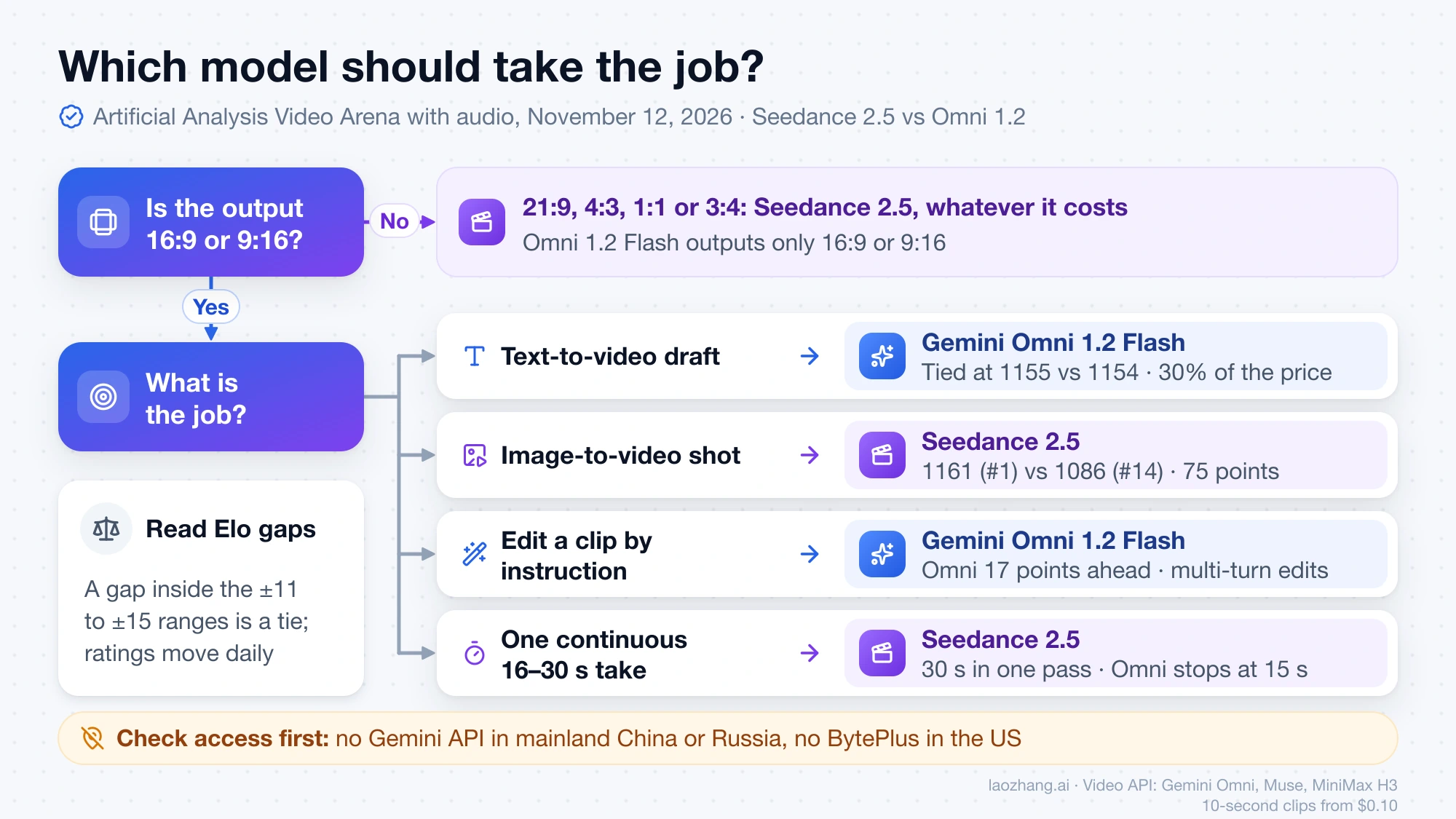
Arena Elo moves daily, and each rating rests on 4,714 to 7,765 vote samples per model, so treat a gap inside the ± ranges as a tie. Seedance 2.5 Flash has no rating yet. The ratings also explain why many same-prompt videos on YouTube favor Seedance across the board: tests such as JSFILMZ's August 28, 2026 comparison, which found Seedance 2.5 "generally performs better in text-to-video and image-to-video", were run against Omni 1.1, which rates 1127 on text-to-video and 1044 on image-to-video on the same boards. Version 1.2 gained 27 and 42 points, enough to close the text-to-video gap but not the image-to-video one.
"Omni" here means Google's video model, not Kling 3.0 Omni or the "omni reference" task type inside Seedance's own API, which is the BytePlus name for generating from reference images, videos and audio. When a comparison page or video title says only "Omni" or only "Flash", check which product it means: Gemini Omni 1.2 Flash and Seedance 2.5 Flash are different models from different companies.
Specs that rule one out: 15 s vs 30 s takes, 2 vs 7 aspect ratios
Before quality or price, check whether your deliverable fits each model's envelope, because several jobs have only one candidate. The rows below come from Google's Omni documentation as of November 6, 2026 and the BytePlus Seedance 2.5 tutorial, current as of November 12, 2026.
| Spec | Gemini Omni 1.2 Flash | Seedance 2.5 |
|---|---|---|
| Length per generation | 3–15 s in 1 s steps, default 10 s | 4–30 s, or -1 to let the model choose (the default) |
| Longer scenes | Extension of 3–10 s per turn, up to 30 s total | One pass up to 30 s, plus multi-round extension |
| Resolution | 360p, 720p; 1080p and 4K are upsampled | 480p, 720p (default), native 1080p; no public 4K price |
| Aspect ratio | 16:9 or 9:16 | 21:9, 16:9, 4:3, 1:1, 3:4, 9:16, adaptive |
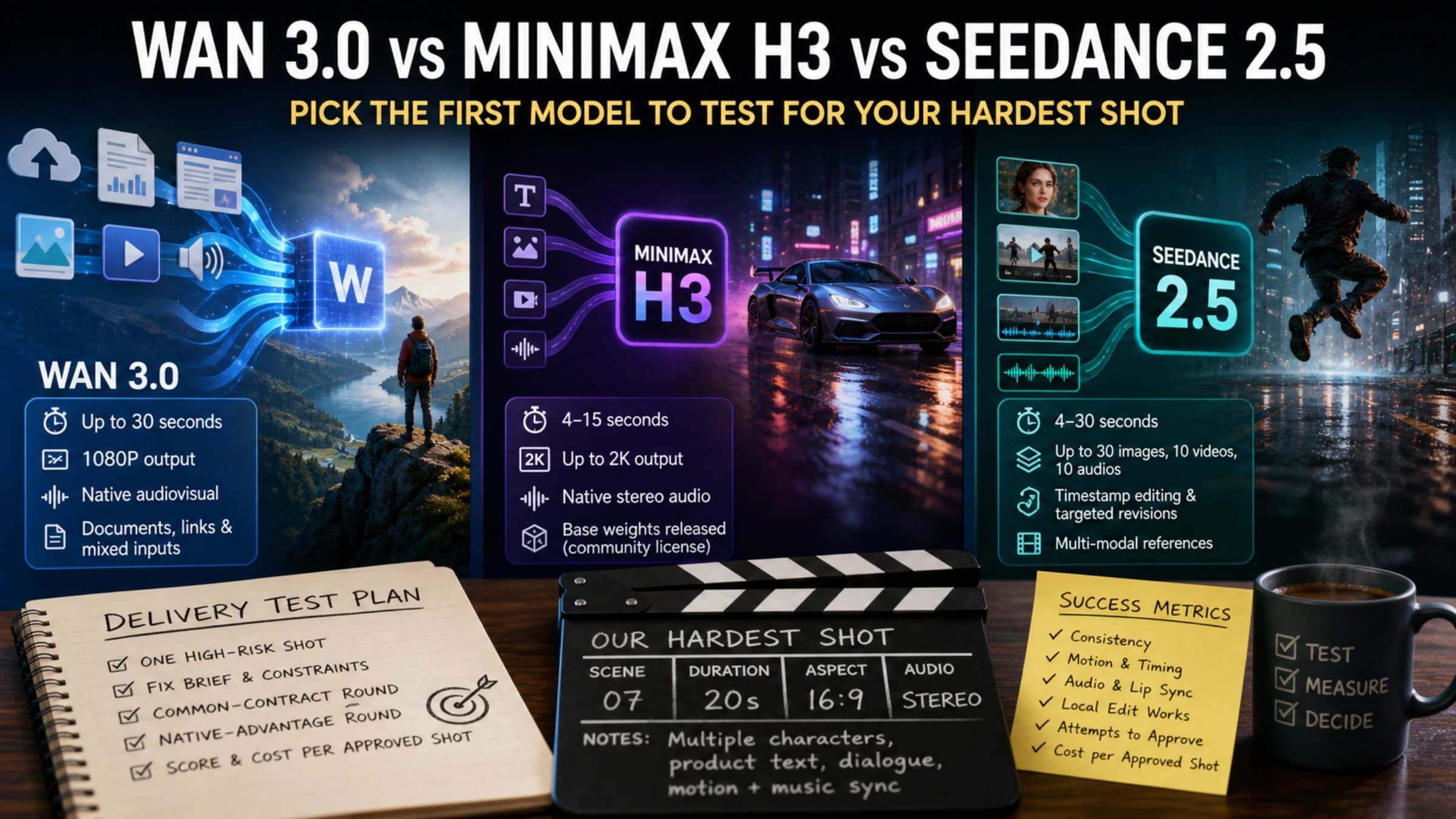
| References | Up to 6 images; first and last frame (3–10 s); reference video | Up to 50 assets: 30 images, 10 videos, 10 audio clips |
| Editing | Multi-turn conversational edits of a generated or uploaded clip | Video editing, timestamp-based edits |
| Audio | Native audio | Native audio; an audio reference can be used alone |
Three of these rows correct figures that still circulate from older versions. Omni 1.2 generates up to 15 seconds in a single request, not the 3–10 seconds of Omni 1.1, and its extension cap is 30 seconds in total, not 40. Seedance 2.5 generates its own soundtrack and accepts audio references, so "limited native audio" no longer describes it. The resolution row matters for price comparisons: a 1080p Omni clip is upscaled from a lower native resolution, while Seedance renders 1080p directly, so the two 1080p prices below do not buy the same thing.
If your job starts from a still image, the crop and first-frame rules on the Seedance side are covered in How to Use Seedance Image to Video: Modes, Crops, and Cost.
What a 10 s clip costs: $0.70 on Omni, $2.32 on Seedance 2.5
A 10-second 720p clip costs $0.70 on Gemini Omni 1.2 Flash and $2.32 on Seedance 2.5 at the two vendors' list prices on November 12, 2026, a ratio of 3.34×. The table is a calculation run on November 12, 2026 from Google's Gemini API pricing page, the BytePlus ModelArk pricing page and the laozhang.ai documentation, for a 16:9 clip with no input video. It is a list-price estimate, not a measured bill, and excludes re-rolls, failed takes, Omni input tokens ($1.50 per million, small for a prompt) and taxes.
Disclosure: laozhang.ai is our own service. Its prices are platform pricing, not an independent comparison.
| Clip | Omni 1.2, Google | Omni 1.2, laozhang.ai | Seedance 2.5, BytePlus | Seedance 2.5 Flash, BytePlus | Seedance 2.5, laozhang.ai |
|---|---|---|---|---|---|
| 5 s, 720p | $0.35 | $0.30 | $1.17 | $0.76 | $1.31 |
| 10 s, 720p | $0.70 | $0.30 | $2.32 | $1.52 | $2.60 |
| 10 s, 1080p | $1.04 (upsampled) | $0.45 (upsampled) | $5.71 | not offered | $6.44 |
| 15 s, 720p | $1.04 | not offered | $3.48 | $2.27 | $3.90 |
| 30 s, 720p, one pass | not offered | not offered | $6.94 | $4.54 | $7.79 |
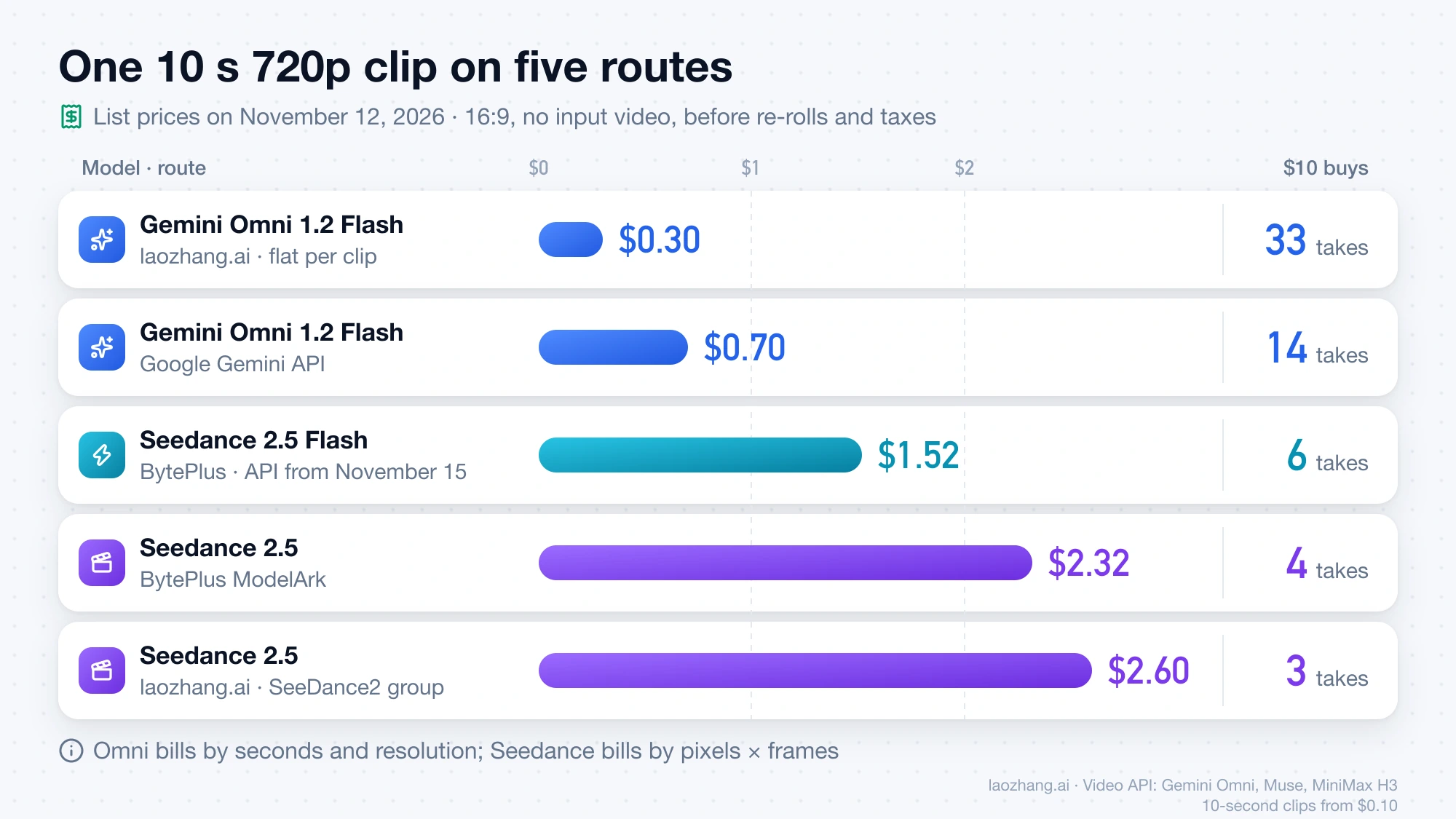
You can rerun the numbers. Omni bills video output at $12.00 per million tokens and counts 5,792 tokens per second at 720p, so a second costs $0.0695 and 10 seconds cost $0.70. Seedance bills tokens equal to width × height × frames ÷ 1,024: a 10-second 1280×720 clip at 24 fps has 241 frames, which is 216,900 tokens, and at $10.70 per million that is $2.32. At 1080p the Seedance rate rises to $11.70 per million and the pixel count more than doubles, so the per-second gap widens to $0.571 against Omni's $0.104. Because Seedance charges by pixels, a ratio or resolution with more pixels costs more even at the same length, while Omni charges only by seconds and resolution.
The gap grew with Omni 1.2. At Omni 1.1's $17.50 per million tokens the same 10-second 720p clip cost $1.01, so Seedance 2.5 was 2.29× the price; the 1.2 cut of 31.4% widened that to 3.34×. With $10 at list price you get 14 ten-second 720p Omni takes on Google, 4 Seedance 2.5 takes on BytePlus, or 6 on Seedance 2.5 Flash, which is the practical meaning of the ratio when a shot needs several attempts.
For a 30-second scene, Seedance renders it in one pass for $6.94 at 720p. Omni needs a 10-second clip plus two 10-second extensions, and Google does not publish how extension turns are billed. If each turn charges only the seconds it adds, the scene would cost about $2.09, but that is an estimate, not a listed price.
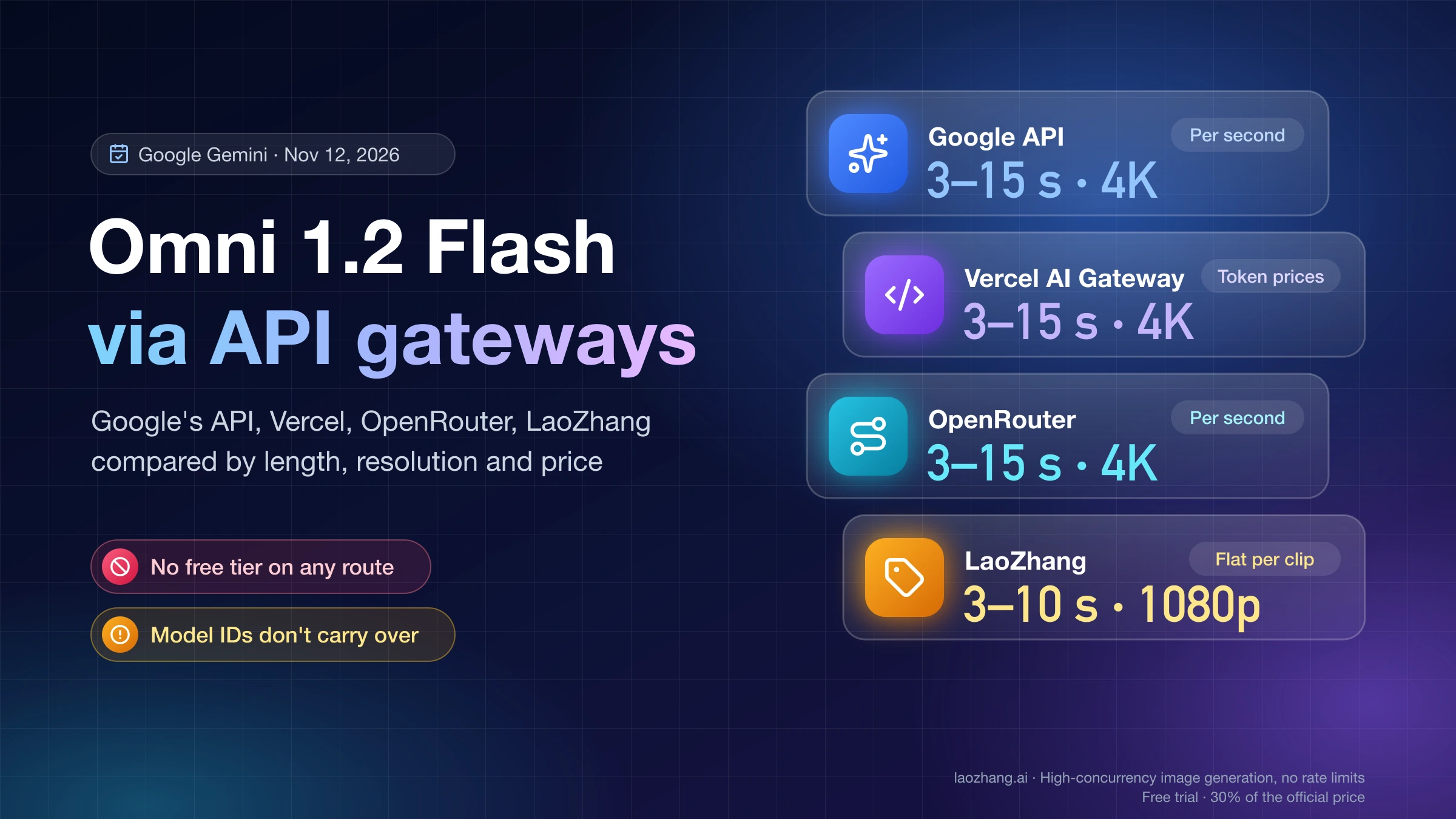
The laozhang.ai columns use that platform's own prices. Its Omni 1.2 route (POST /v1/videos) charges a flat $0.10, $0.30 or $0.45 per clip at 360p, 720p or 1080p for any length from 3 to 10 seconds, which is why 10 seconds costs the same as 5, and $10 buys 33 ten-second 720p takes. That route has no 4K, no 11–15 s clips, no reference video, no last frame and no extension. Its Seedance 2.5 model doubao-seedance-2-5-260628 is priced at $12.00 per million tokens at 480p and 720p and $13.20 at 1080p, so $10 covers 3 ten-second 720p takes. The two models need different tokens there: Omni works with a default-group token, while Seedance requires a SeeDance2-group token and fails with a no-channel error on any other. Seedance's duration also defaults to -1, so set it explicitly if you want a predictable bill. Where flat per-clip pricing beats per-second billing is worked out in Gemini Omni 1.2 Flash API Gateway: 4 Routes, Cost by Clip Length, and the Seedance price on every route is in Seedance 2.5 API Pricing: Cost per Second at 480p, 720p, 1080p.
Why some pages quote Seedance 2.5 at $0.47 per second
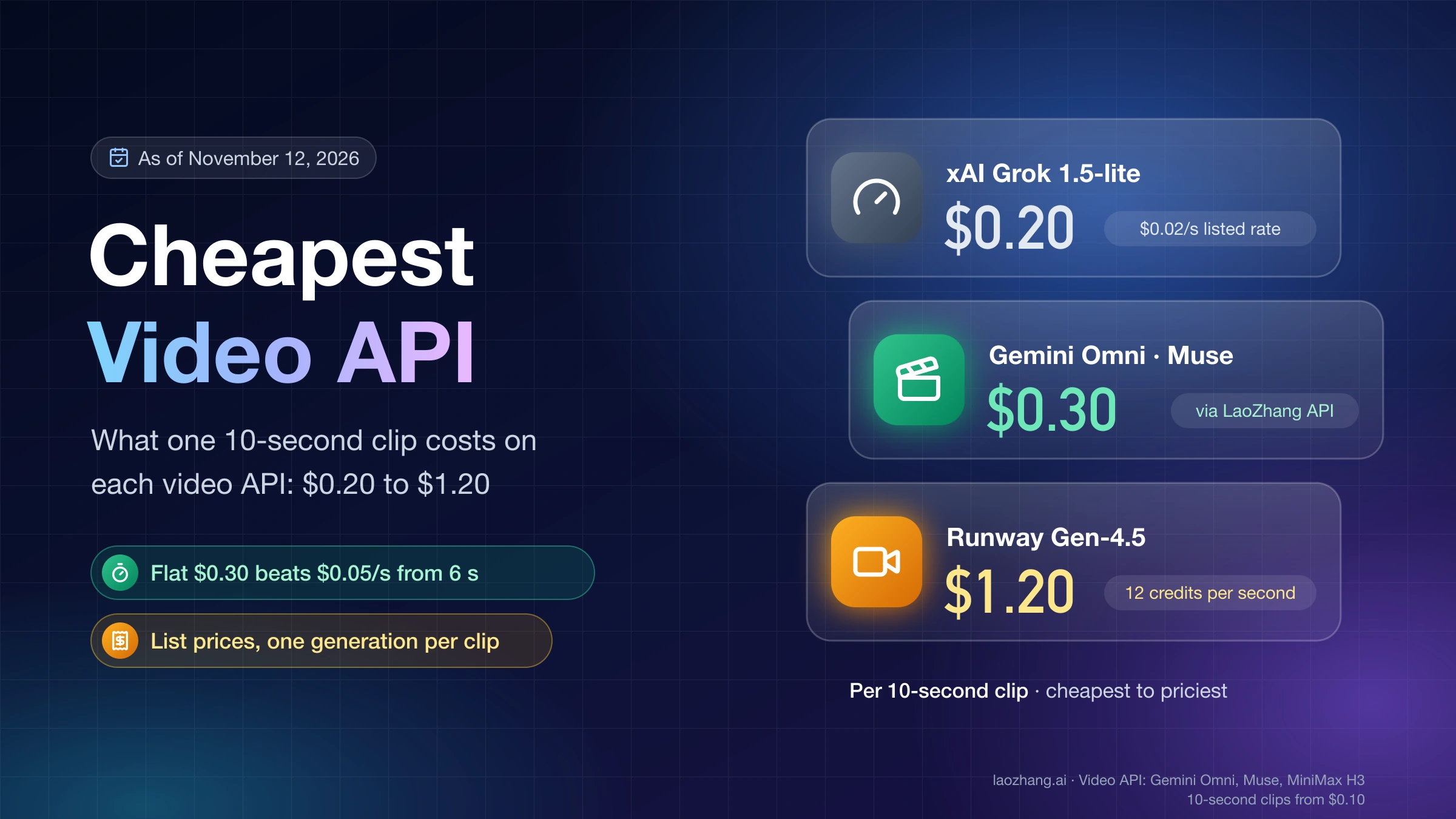
The $0.47-per-second figure is fal.ai's price for Seedance 2.5 at 720p, about $0.473 as of November 6, 2026, roughly double BytePlus's $0.232. Resellers set their own markups: on the same date Replicate charged $0.2312 per second at 720p, kie.ai $0.315 and WaveSpeed $0.36. A comparison that puts Omni's Google price next to a reseller's Seedance price will show a gap of nearly seven times, so compare like with like, official against official or one reseller against itself. For 10-second prices across many more models, see Cheapest Video Generation API: What a 10-Second Clip Costs.
Seedance 2.5 Flash from November 15: 35% cheaper, 720p cap
Seedance 2.5 Flash (dreamina-seedance-2-5-flash-261115) lowers the Seedance side of the comparison but does not close it. BytePlus opens it for online use and API calls at 14:00 UTC+8 on November 15, 2026, at $7.00 per million tokens for 480p and 720p, 65% of the flagship's $10.70, with no 1080p or 4K. That makes a 10-second 720p clip $1.52, or 2.18× the Omni 1.2 price on Google.
BytePlus describes Flash as "near-flagship quality with faster speed and lower cost" and "2x speed at a lower price". Both are the vendor's claims: as of November 12 no arena rating or independent test exists, and laozhang.ai does not list it. If your Seedance jobs are 720p image-to-video, Flash is the version to test after November 15, since that is the job where Seedance's lead is large enough to survive some quality loss. For 1080p or text-to-video, it changes little.
Disclosure: laozhang.ai is our own service. Its prices are platform pricing, not an independent comparison.
Which is faster? Omni 1.2 took 30.7–67.2 s per clip on November 12
On November 12, 2026, six Gemini Omni 1.2 Flash generations sent through laozhang.ai between 03:42 and 03:48 UTC all completed, taking 30.7 to 67.2 seconds from submission to a finished file. Three 360p 3-second text-to-video clips took 30.7, 30.8 and 30.9 seconds, a 360p 5-second image-to-video clip 37.2 seconds, a 720p 10-second clip 67.2 seconds, and a 1080p 5-second 9:16 clip 61.1 seconds. Every file matched the requested size and length, encoded as H.264 at 24 fps with 48 kHz stereo AAC audio (the 720p 10-second file was 4.99 MB), and all six carried a valid C2PA manifest issued by Google LLC. The six clips cost $1.15 at the platform's list price.
Disclosure: laozhang.ai is our own service. Its prices are platform pricing, not an independent comparison.
Those times include a 5–6 second submit call and polling every 5 seconds through a gateway, so they are an upper bound on Google's own generation time, not a measurement of the Gemini API direct. They also come from one key in one six-minute window, which makes them a sample rather than a success rate. They do sit well above the 10–25 seconds for Omni in MindStudio's June 2026 comparison table, which was written against Omni 1.1 and states no test method; the same table gives Seedance 2.5 45–120 seconds.
No Seedance clips were generated in that session. Community-posted Seedance 2.5 render times through a reseller ranged from 1 minute 33 seconds to 5 minutes 4 seconds across five tests, a small sample from one venue. On that evidence Omni most likely returns a clip faster, but the gap is narrower than the 10–25 versus 45–120 second figures suggest, and the "2x speed" BytePlus claims for Seedance 2.5 Flash is still untested.
Real people: both models refuse them, at different steps
Neither model will put a real, identifiable person on screen, so a job built on a celebrity or a real face has no home on either. In the same November 12, 2026 session on laozhang.ai, a prompt naming a real celebrity was accepted with HTTP 200 and then ended as failed 11.6 seconds later with Google's message: "The prompt or images were blocked: the model can't create videos of real people's names or likenesses. This request is not charged." The usage counter returned to its previous value about 30 seconds later, so the attempt cost nothing.
Disclosure: laozhang.ai is our own service. Its prices are platform pricing, not an independent comparison.
Seedance refuses at the input stage, when an uploaded image is classified as showing a real person, and BytePlus does not charge for moderation failures either. What you can legitimately change in that case is covered in Seedance Input Image May Contain a Real Person: Legitimate Fixes.
Can you use Gemini Omni and Seedance from the US, China or Russia?
Where you are decides which official route exists before any comparison starts. As of November 12, 2026, the Gemini API lists no free tier for Omni 1.2 and its available regions exclude mainland China, Hong Kong, Macao, Russia and Belarus. BytePlus states that it "is not available in the United States", and its Seedance 2.5 tutorial asks for an account balance above USD 30, a USD 30 or larger AI Savings Plan, or a Seedance 2.5 resource pack before the model can be enabled.
| Region | Gemini Omni 1.2 Flash | Seedance 2.5 |
|---|---|---|
| United States | Gemini API, paid tier | Not through BytePlus; third-party platforms set their own terms |
| Mainland China | Gemini API not offered | Volcengine, ByteDance's China platform, at ¥70 per million tokens for 480p and 720p |
| Russia | Gemini API not offered | BytePlus's announcement names the United States as unavailable, not Russia |
Batch size is the other access limit. On the Gemini API, Omni 1.2 allows 8 requests per minute and 40 per day at Tier 1, 200 per day at Tier 2 and 2,000 at Tier 3, and Google does not guarantee those figures. A team sending hundreds of drafts a day on a new account will hit the daily cap before it hits a budget. How to make the first call, and what happens to Omni 1.1 requests, is covered in Gemini Omni 1.2 Flash API: Model ID, Cost per Clip, 1.1 Routing.
Gemini Omni vs Seedance: other questions
Is Gemini Omni different from Gemini?
Yes. Gemini Omni is Google's video generation model family, called through the Gemini API's Interactions API or Google Cloud, while "Gemini" on its own usually means Google's chat assistant and text models. Omni 1.2 Flash generates and edits 3–15 second clips with audio.
What happens to Gemini Omni 1.1 Flash?
From December 3, 2026, requests to gemini-omni-1.1-flash on the Gemini API are routed to Omni 1.2 Flash and billed at 1.2 prices, according to Google's pricing page. Any comparison you read that tests Omni 1.1 describes a model that will no longer answer under its own name after that date.
Is Kling 4.0 a better alternative to Seedance 2.5?
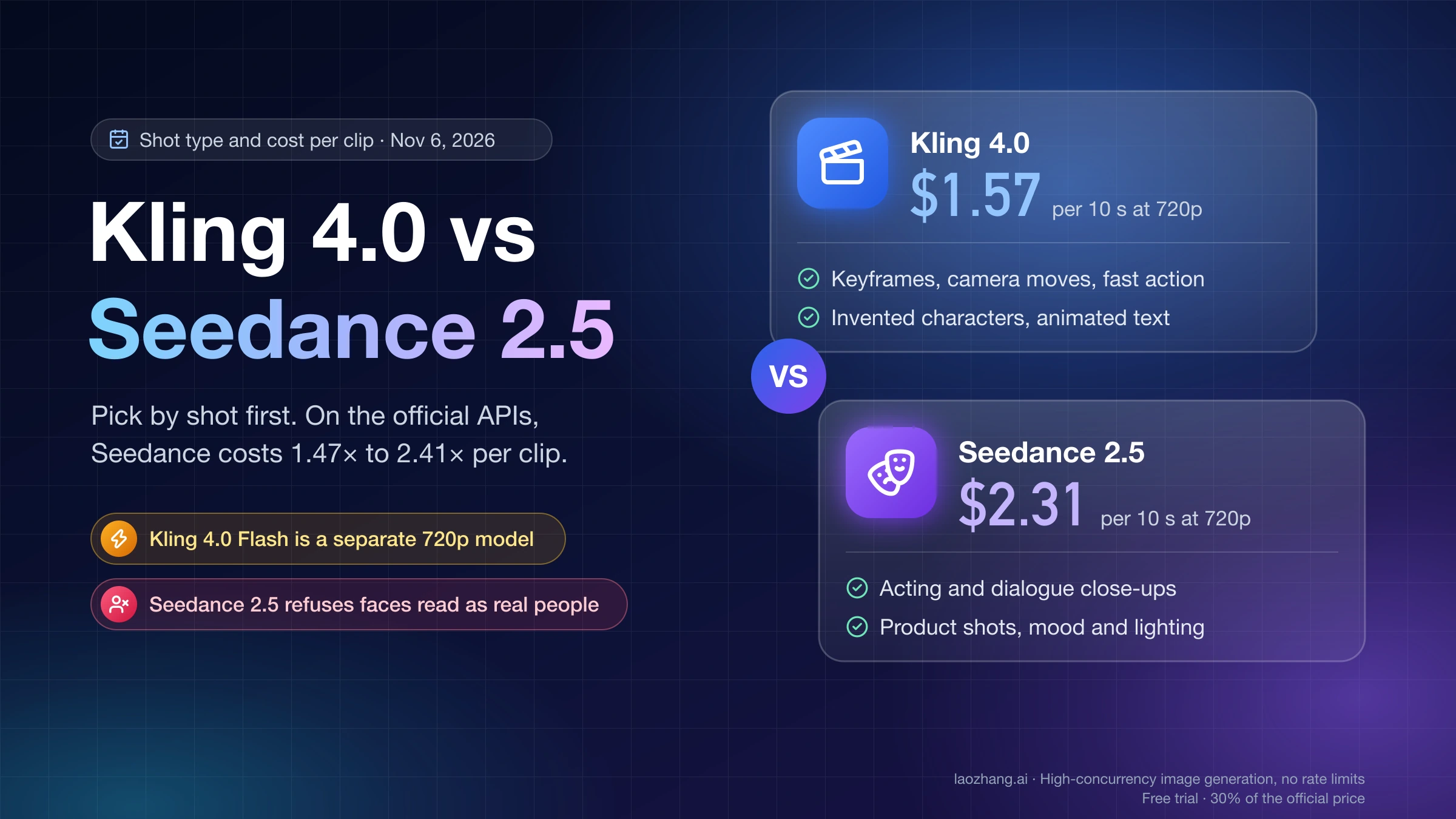
If Seedance 2.5 costs too much for image-to-video or keyframed shots, Kling 4.0 is the other candidate, compared shot by shot in Kling 4.0 vs Seedance 2.5: Pick by Shot Type and Cost per Clip. For a monthly budget across subscriptions and per-clip APIs, see How Much Does an AI Video Generator Cost Per Month and Per Clip?
Sources6
External pages this guide links to, in the order they appear. Last updated Nov 12, 2026.
Sources6
External pages this guide links to, in the order they appear. Last updated Nov 12, 2026.
- 1.Artificial Analysis Video Arenaartificialanalysis.ai/video/leaderboard/text-to-video
- 2.image-to-videoartificialanalysis.ai/video/leaderboard/image-to-video
- 3.video editingartificialanalysis.ai/video/leaderboard/video-editing
- 4.BytePlus Seedance 2.5 tutorialdocs.byteplus.com/en/docs/modelark/seedance-2-5
- 5.Gemini API pricing pageai.google.dev/gemini-api/docs/pricing
- 6.BytePlus ModelArk pricing pagedocs.byteplus.com/en/docs/modelark/model-pricing