Gemini 4 Carbon Release Date: Cyber Defenders Only for Now
Google announced Gemini 4 Carbon on October 28, 2026, but only Fairwind cyber defenders can use it. No public API or app date yet; build on Argon meanwhile.
On this page
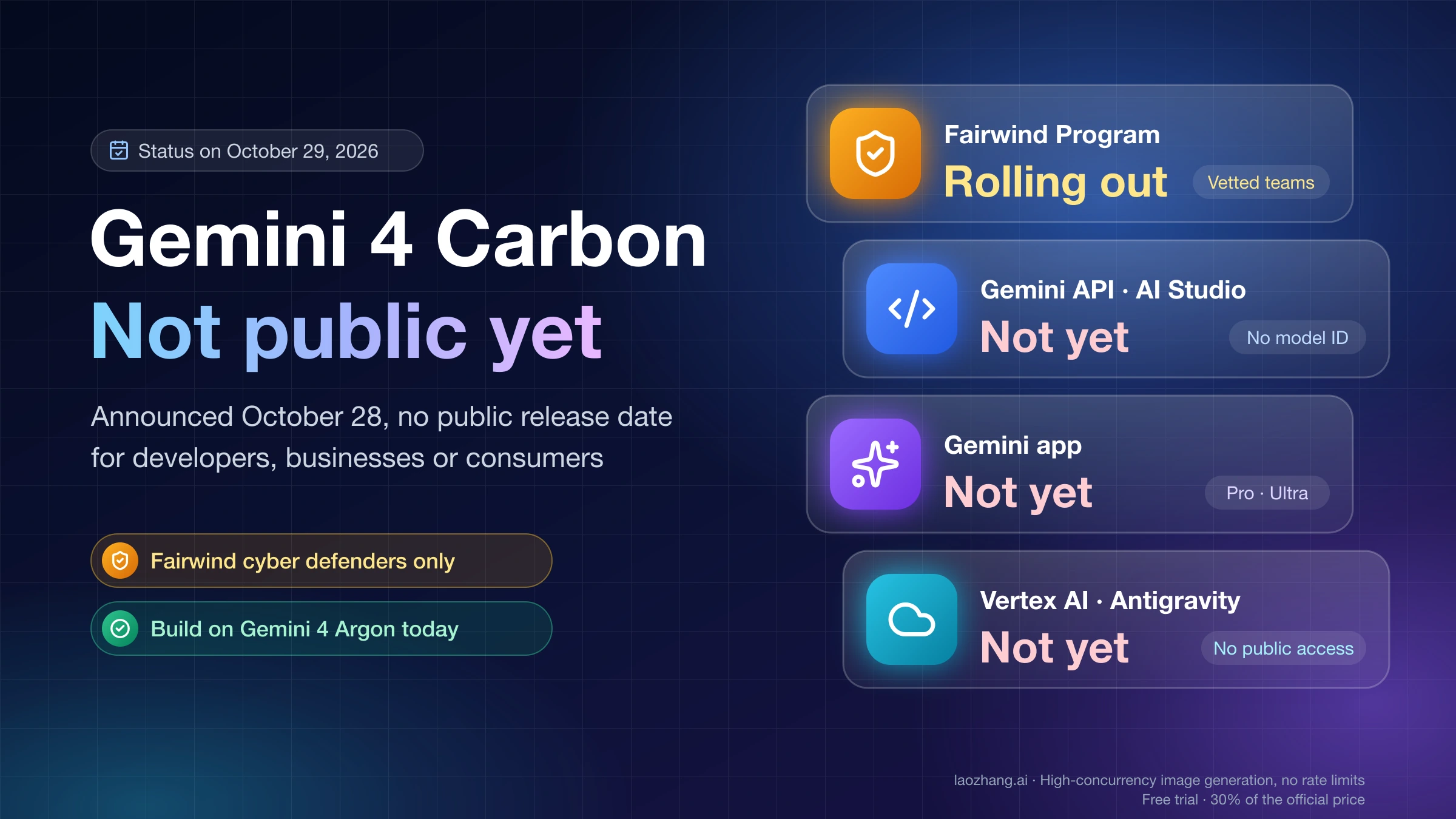
Gemini 4 Carbon has an announcement date but no public release date. Google announced it on October 28, 2026, and said that starting that week it would make Carbon available only to "a subset of cyber defenders" in its Fairwind Program. As of October 29, 2026, there is no date for developers, businesses or consumers, no Carbon model ID on the Gemini API models or pricing pages, and no Carbon entry in the Gemini app release notes or the Vertex AI model list. Google's own heading for the next step is "Coming soon to developers, businesses, and consumers."
If you need Google's strongest model that you can actually call today, use Gemini 4 Argon: gemini-4-argon on the paid tier of the Gemini API, or Argon in the Gemini app with Google AI Pro or Ultra. Plan around one date while you do, because Argon's introductory price ends November 30. To catch the moment Carbon opens, watch the Gemini API models page and changelog for a Carbon model ID rather than waiting for a social post, since none of Google's launch posts named a date or a product.
The exception is security teams at governments, healthcare providers, telecoms and similar critical-infrastructure organizations, which can apply to Fairwind. Individual developers and ordinary subscribers are not who that program admits.
Where Gemini 4 Carbon is available as of October 29, 2026
Outside Google's vetted cyber-defender cohort, Gemini 4 Carbon is not available on any product surface as of October 29, 2026. Google's Gemini 4 Carbon announcement says it will "gradually phase access to additional trusted partners through our Fairwind Program" and keep iterating on guardrails "before making Carbon available to developers, businesses, and consumers via our product surfaces as soon as possible." Artificial Analysis, which tested Carbon before the announcement, puts it the same way: Carbon "is being rolled out to selected users and is not yet publicly available."
| Where you'd use it | Carbon status on October 29, 2026 | What Google has said |
|---|---|---|
| Fairwind Program (vetted security organizations) | Rolling out to a subset of cyber defenders from the week of October 28 | Access widens "gradually" to more trusted partners |
| Gemini API and Google AI Studio | No Carbon model ID on the Gemini API models page, pricing page or changelog | Developers "as soon as possible," no date |
| Gemini app (Google AI Pro, Ultra) | No Carbon in the Gemini app release notes | Consumers "soon," no plan named |
| Google Antigravity | Used inside Google; no public access announced | VentureBeat reports Antigravity's Varun Mohan said Fairwind access expands before wider Antigravity availability |
| Vertex AI (Google Cloud) | Not on the Vertex AI models page | Businesses "soon," no date |
The announcement leaves out most of what a developer would need: it gives no release date, model ID, plan or tier names, context window or rate limits. Google DeepMind's Gemini models page does list "Gemini 4 Carbon: Our next frontier model" with an evaluation methodology document, but a model page is not access. Absence from public pages also says nothing about private access arrangements, which Google doesn't publish.
Fairwind is not a waitlist for early adopters. According to the Fairwind Program page, Google vets applying organizations with background checks, limits use to defensive dual-use work, and requires phishing-resistant MFA and tracked employee access; as of October 29 the page still describes only Gemini 4 Argon. Who qualifies is covered in Gemini 3.8 Flash Cyber Access: A Fairwind Eligibility Guide, written in September 2026 for 3.8 Flash Cyber; the program it describes is the one Carbon is now rolling out through.
When will Gemini 4 Carbon open to developers and subscribers?
Google has not given a date. The closest thing to a timeline is staff wording from October 28: Logan Kilpatrick wrote that "Carbon is rolling out first to cyber defenders and we are working to make it more widely available soon," Josh Woodward called wider availability "the next step," and the Google DeepMind account said feedback from the first cyber defenders will shape guardrails "before we expand access soon." Koray Kavukcuoglu, who wrote the announcement, called the release on X "a preview of Gemini 4 Carbon." None of those posts names a date or a product.
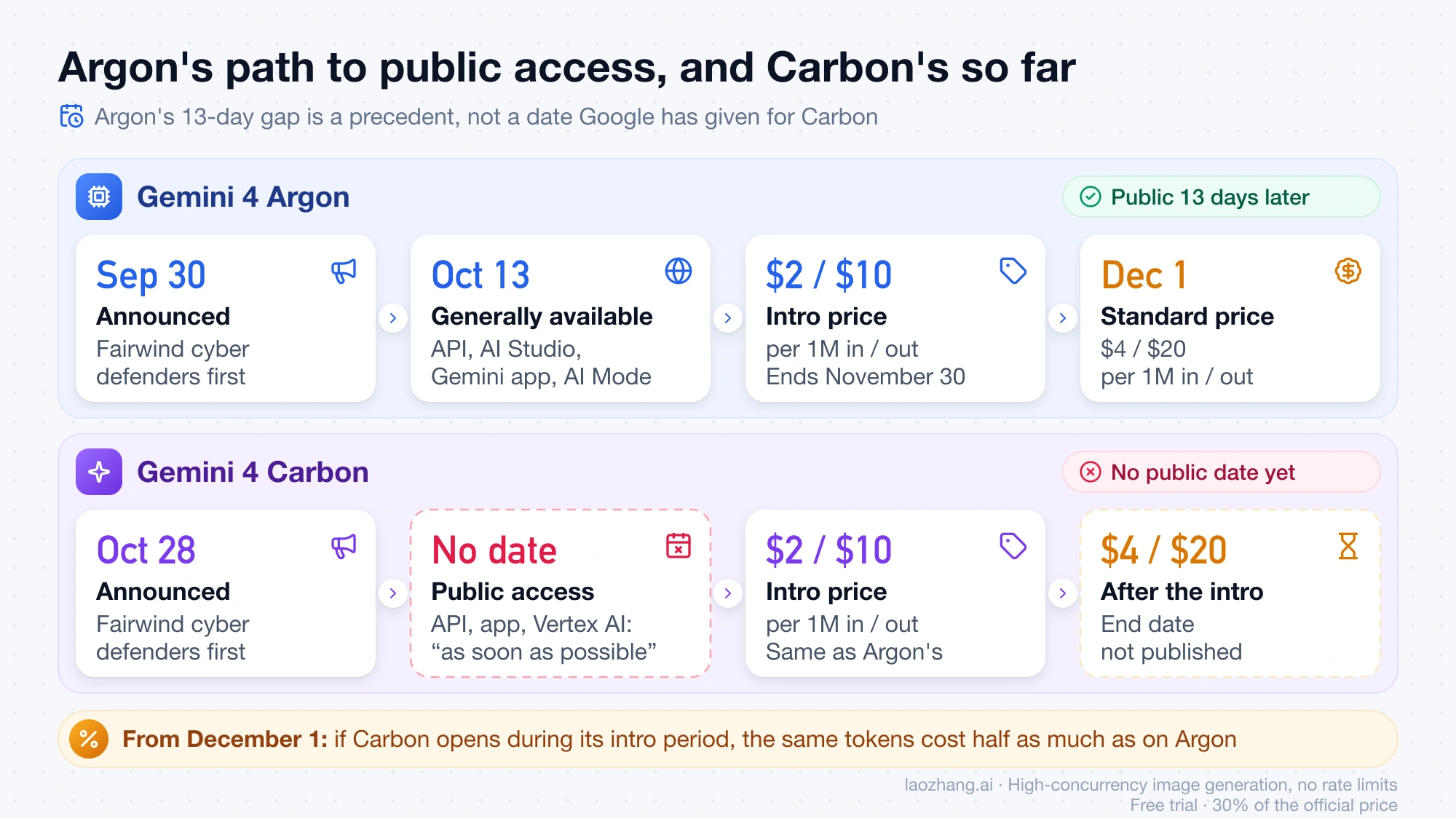
Argon offers a precedent, and it should be read only as that. Google announced Argon on September 30, 2026, rolling out first to trusted cyber defenders through Fairwind, and made it generally available on October 13, 13 days later, in the Gemini API, AI Studio, the Gemini app and AI Mode. The same gap from October 28 would land around November 10, but nothing Google has published commits to it. One detail differs: Argon's announcement said wider access would start "with paid API customers and Google AI Ultra subscribers," while Carbon's announcement doesn't say who comes first. Both announcements say Google is taking part in the U.S. government's voluntary pre-release testing process, so that step doesn't set Carbon apart.
Calling gemini-4-carbon on October 29: HTTP 503, nothing billed
On October 29, 2026 at 01:36 UTC, requests for Carbon sent through the laozhang.ai API gateway (api.laozhang.ai) with a pay-as-you-go key were refused with HTTP 503 in about 1.1 seconds, and none of them was billed. The gateway's GET /v1/models returned 190 models, and the only Gemini 4 entry among them was gemini-4-argon. Three Carbon requests failed the same way: POST /v1/chat/completions with gemini-4-carbon, the same endpoint with gemini-4-carbon-preview, and Google's native request format at POST /v1beta/models/gemini-4-carbon:generateContent.
Disclosure: laozhang.ai is our own service. Its prices are platform pricing, not an independent comparison.
POST https://api.laozhang.ai/v1/chat/completions   model: gemini-4-carbon
HTTP 503 (1.11 s)
{"error": {"message": "Current group default has no available channels for model
gemini-4-carbon under billing mode [pay-as-you-go, pay-per-request] (request id: ...)",
"type": "shell_api_error"}}
A control request to gemini-4-argon with the same key worked: it replied "ok" with finish_reason stop, using 37 input and 5 output tokens. That rules out a broken key or a blocked account as the cause of the Carbon errors.
The test shows only that Carbon could not be routed on one gateway at one moment. No request went to Google's own Gemini API with a Google key, so it doesn't prove that Google rejects the name, and gemini-4-carbon-preview was a guessed ID, not one Google has announced. What it does is match Google's developer pages the same day, none of which lists a Carbon model.
How to tell Gemini 4 Carbon has opened: six places to check
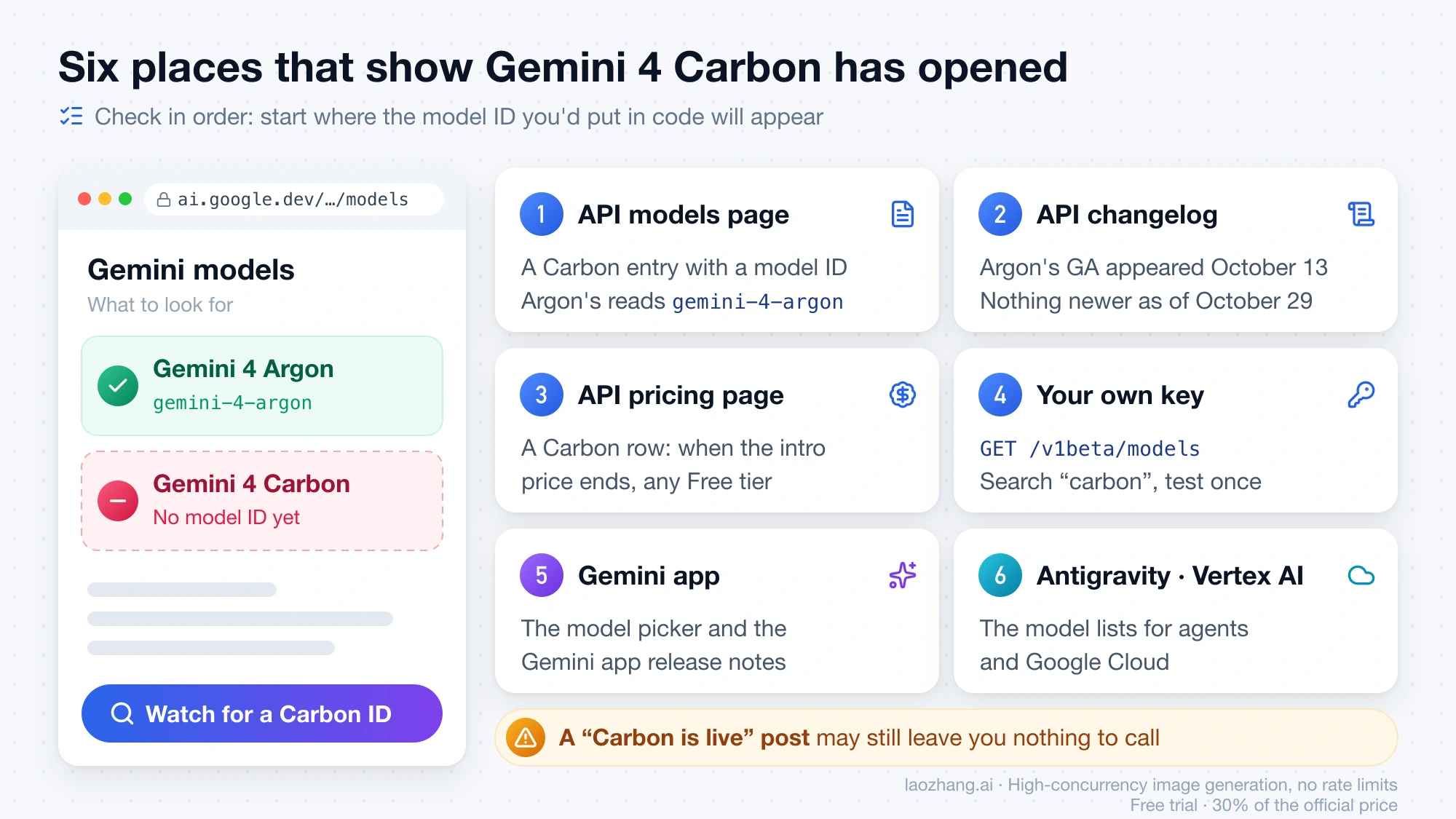
The Gemini API models page is the first signal that matters, because it is where the model ID you'd put in code will appear. Google's launch posts on October 28 announced the model without naming one, so a social post that says "Carbon is live" may still leave you without anything to call. Check these in order:
- Open the Gemini API models page and look for a Gemini 4 Carbon entry with a model ID. Argon's entry reads
gemini-4-argon; Carbon's ID has not been published. - Read the Gemini API changelog. Argon's general availability appeared there on October 13 with its model ID, and as of October 29 that is still the latest Gemini 4 entry.
- Check the Gemini API pricing page for a Carbon row, and note whether it states when the introductory price ends and whether Carbon has a Free tier.
- List models with your own key by calling
GET https://generativelanguage.googleapis.com/v1beta/modelsand searching the response for "carbon". If it shows up there, send one small test request before you change production code. - For subscriptions, look at the model picker in the Gemini app and the Gemini app release notes, where Google posts model changes in the app.
- For agents and Google Cloud, check the model list in Antigravity and the Vertex AI models page.
Gemini 4 Carbon price: $2/$10 at launch, $4/$20 after
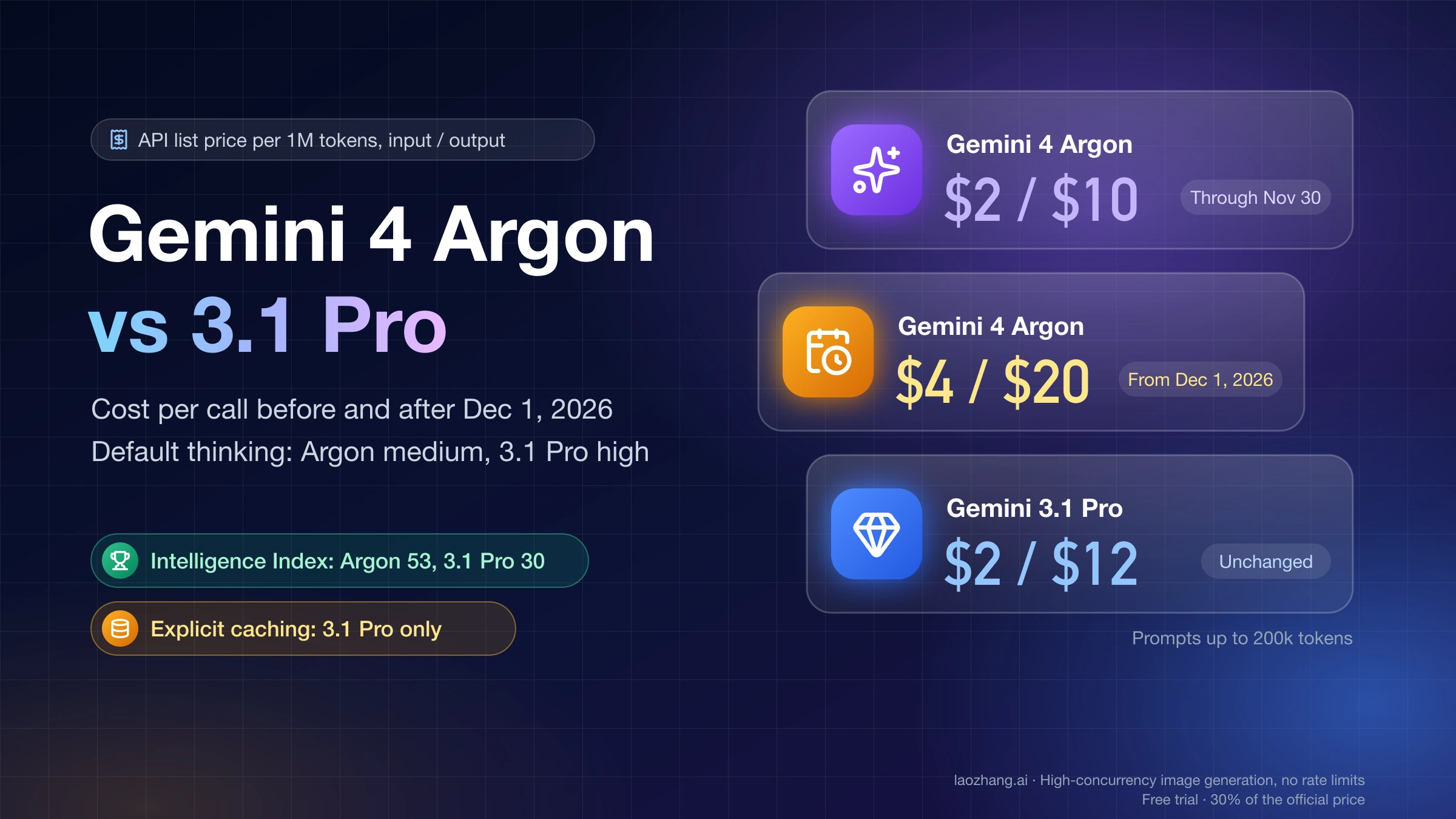
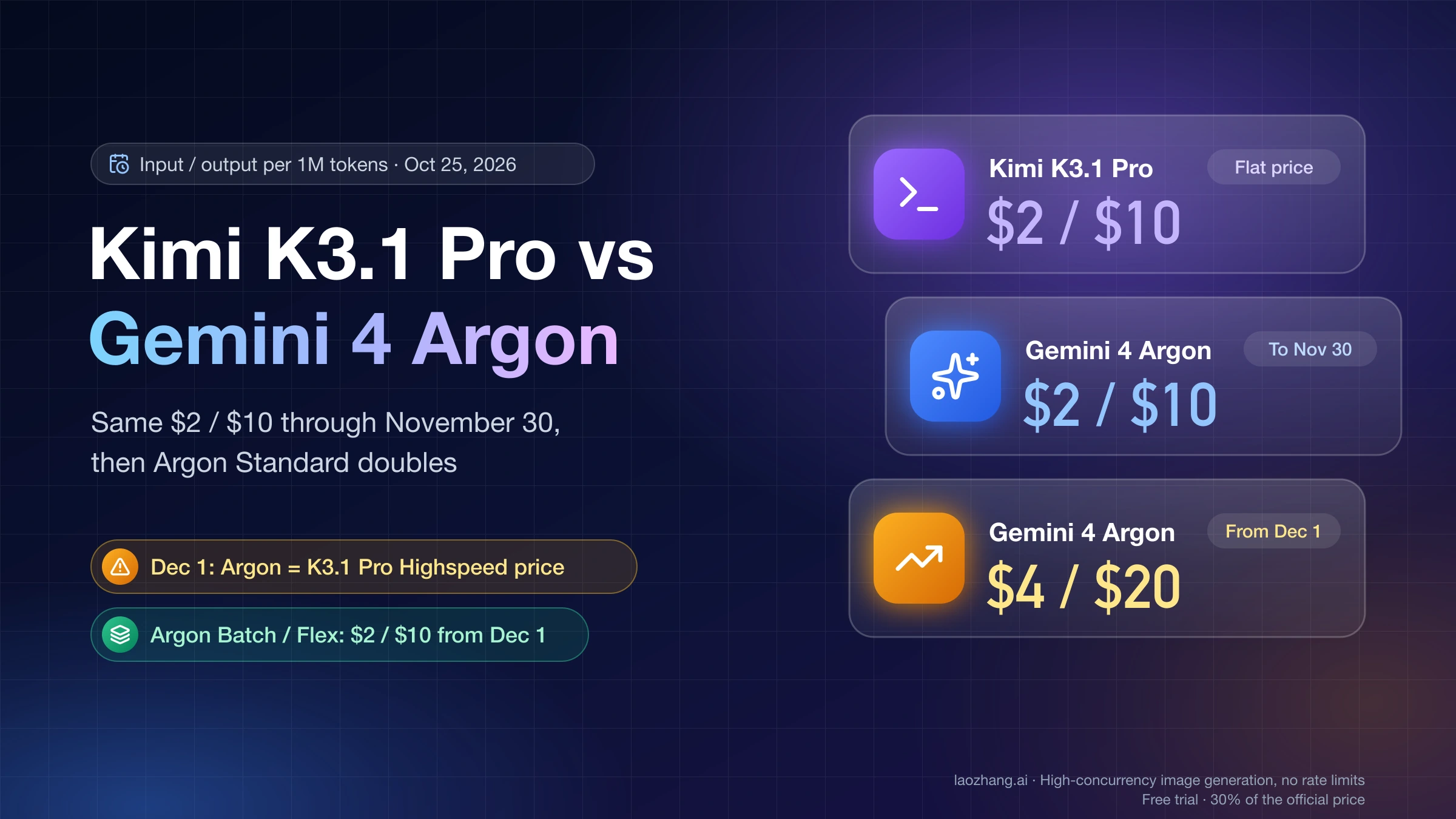
Google set Carbon's price before opening it. It "will launch at the same introductory price as Argon at $2 per million input tokens and $10 per million output tokens," with cached input 95% off, which works out to $0.10 per million cached tokens. A footnote in the announcement adds that $4 per million input and $20 per million output apply once the introductory period expires, putting cached input at $0.20. Google hasn't said when that period ends; Artificial Analysis calls it a 50% launch discount "with no confirmed end date."
| Workload (Gemini API, list price) | Introductory price | Standard price |
|---|---|---|
| One request: 20k input, 2k output tokens | $0.06 | $0.12 |
| Agent session: 200k fresh + 800k cached input, 60k output | $1.08 | $2.16 |
| A month at 10M input, 1M output, no caching | $30 | $60 |
| A month at 100M input (80% cached), 5M output | $98 | $196 |
Each row is input tokens times the input price plus output tokens times the output price, with cached tokens at the cached rate. For the agent session at introductory prices that is 200k × $2 per million ($0.40), plus 800k cached × $0.10 per million ($0.08), plus 60k × $10 per million ($0.60), for $1.08. These are list prices only: Google hasn't published Batch, Flex or Priority prices for Carbon, or whether long prompts cost more.
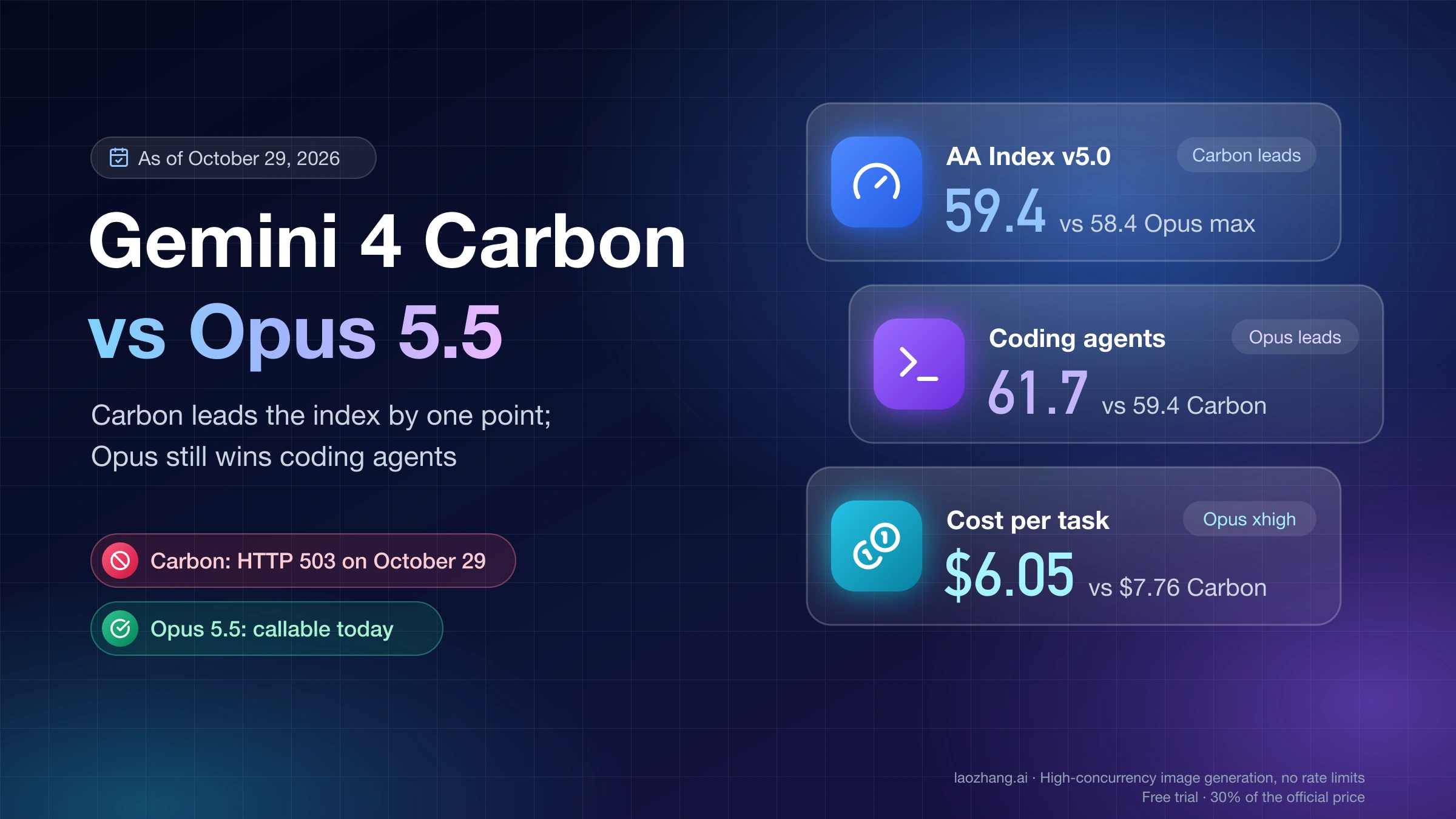
Per task, the two models cost about the same at equal prices. Artificial Analysis, which charts standard pricing, measured $7.76 per Intelligence Index task for Carbon at high reasoning and $7.68 for Argon, against $10.04 for Claude Opus 5.5 at max effort and $6.25 for GPT-6 Astra at max. Carbon used 123k output tokens per task, 29% fewer than Opus 5.5's 173k, and comes in about 23% cheaper per task than Opus 5.5 with a similar score. At the introductory price, the same token use would come to roughly $3.88 per task. How paid Gemini API billing works in general is explained in Gemini API Pricing 2026: Token Rates, Free Tier, and Key Cost.
Gemini 4 Carbon and Argon: build on Argon now or wait?
Build on Argon now unless the work genuinely can't start until Carbon exists. Carbon has no date and no model ID, so anything you ship or budget before the Gemini API models page changes will run on Argon anyway. Keep the model name in one configuration value, and when Carbon appears, rerun your own evaluation before switching rather than relying on launch benchmarks.
| What changes the choice | Gemini 4 Argon | Gemini 4 Carbon |
|---|---|---|
| Can you call it on October 29, 2026? | Yes: gemini-4-argon, paid tier | No, Fairwind cohort only |
| Introductory price ends | November 30, 2026 | No date published |
| Artificial Analysis Intelligence Index v5.0 | 50 | 59 |
| ExploitGym (exploit validation, Google's table) | 42.0% | 54.8% |
| AA-Omniscience hallucination rate | 4% | 11% |
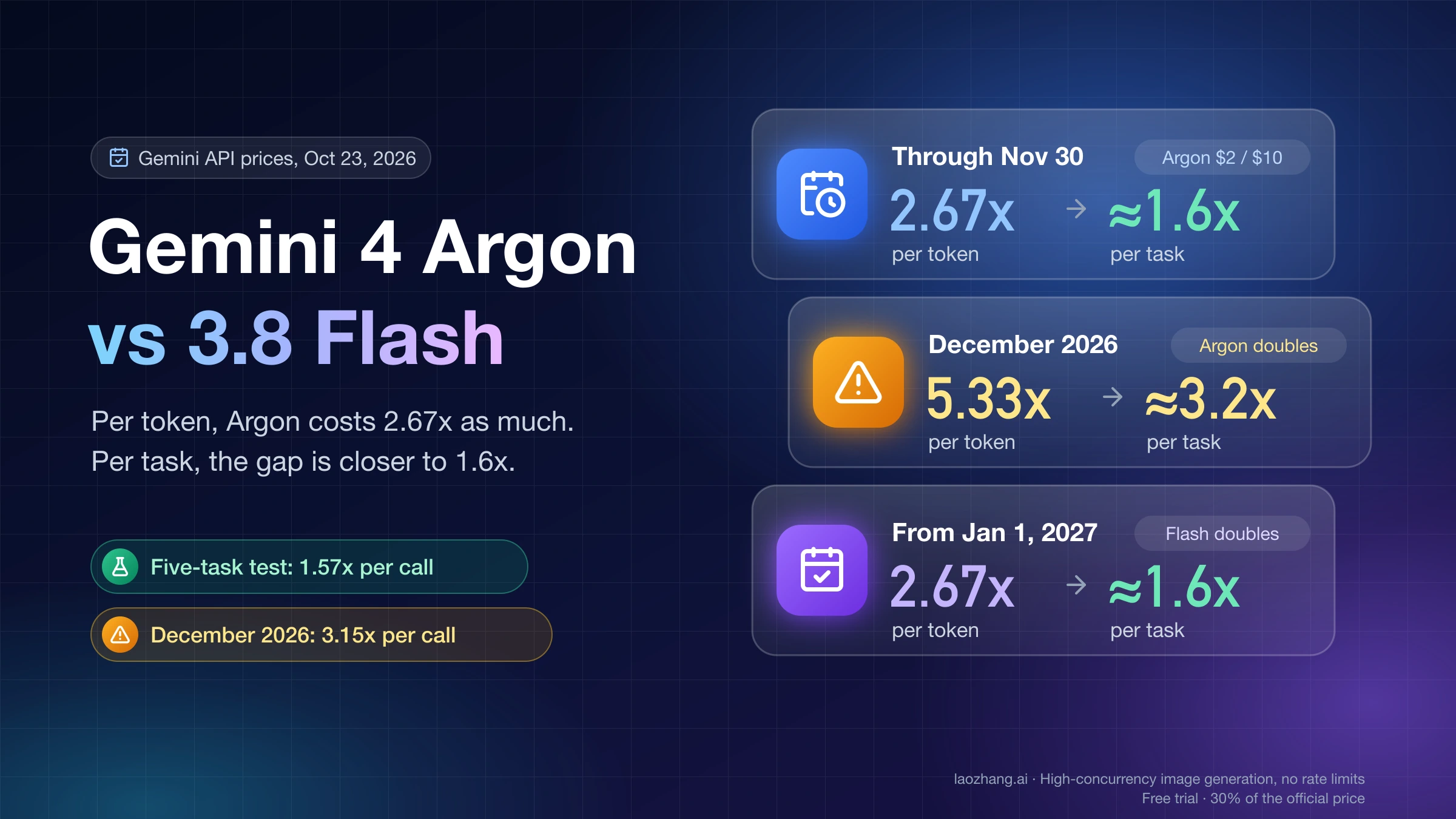
Waiting makes the most sense for security and long-horizon agent work, where Carbon's gains are largest. Google says Carbon has run "for days" on multi-step engineering tasks internally, and the ExploitGym gap above is the largest of its cyber results. For that kind of workload, prototype on Argon and plan a switch. For everyday chat, summarizing or drafting, Carbon's lead matters less, and if Argon itself is more than you need, Gemini 4 Argon vs 3.8 Flash: Cost per Task and When to Switch covers when the cheaper model is enough.
Timing can tip the cost as well. From December 1, 2026, Argon bills at the standard price, while Carbon's introductory price has no published end, so if Carbon opens during its introductory period, the same tokens would cost half as much on Carbon as on Argon. That follows from the published prices, not from anything Google has promised about timing. One trade-off cuts the other way: on AA-Omniscience, Artificial Analysis's knowledge test, Carbon's accuracy rose 10 points over Argon to 58%, but its hallucination rate rose from 4% to 11%. That is still the second-lowest Artificial Analysis has measured, behind only Argon, yet if confident wrong answers are costly in your product, test for them before you switch.
If you're building on Argon in the meantime, its plan quotas and API credits are in Gemini 4 Argon Usage Limits: Pro vs Ultra, Resets, API Credits, and its long-response behavior in Gemini 4 Argon API finish_reason: CONTINUATION and Empty Replies.
Gemini 4 Carbon benchmarks vs Opus 5.5 and GPT-6 Astra
Carbon leads overall but not everywhere. On the Artificial Analysis Intelligence Index v5.0 it scores 59, ahead of Claude Opus 5.5 at 58, GPT-6 Astra at 57 and Gemini 4 Argon at 50, according to Artificial Analysis's Gemini 4 Carbon report and Google's own comparison table. On the Coding Agent Index, Carbon at high reasoning with Antigravity CLI scores 59, three points behind Claude Code with Opus 5.5 at max effort (62). Index v5.0 was released the same week and its numbers can't be compared with v4.3.2 scores quoted before late October.
Google's comparison table, as reported by VentureBeat, puts Carbon first in 15 of 17 rows. The two exceptions are a coding test and a computer-use test: GPT-6 Astra leads FrontierSWE 2 (65.5 against Carbon's 61.2), and Opus 5.5 leads OSWorld-2.1 offline (87.2 against 81.5). Google ran its numbers at the highest thinking setting and "without guardrails," so expect the released product to score somewhat differently. For a flagship you can use today, Gemini 4 Argon vs Claude Opus 5.5 vs GPT-6.1 Sol: Cost and Access compares cost per task and access across the three vendors. Which of the two to use for which kind of work, and what each costs by effort level and language, is covered in Gemini 4 Carbon vs Opus 5.5: Opus Still Wins Coding Agents.
Gemini 4 Carbon release: other questions
Is Gemini 4 Carbon just a checkpoint of Gemini 4 Argon?
No. Business Insider reported on October 9, 2026 that Google staff were testing an internal Gemini 4 build codenamed Carbon, and before the announcement it was unclear whether it would ship as an updated Argon. Google's October 28 announcement settled that: Gemini 4 Carbon is a separately named model "building on Gemini 4 Argon," with its own benchmarks and its own rollout.
Will Gemini 4 Carbon be free in the Gemini API?
Google hasn't said. Carbon's announcement gives only paid token prices, and as of October 29, 2026, Gemini 4 Argon is not on the Gemini API Free tier, so a free Carbon tier would be a departure from how Google handles its top model.
What inputs and context window will Gemini 4 Carbon support?
Google's announcement doesn't list them. Artificial Analysis, which had access before launch, lists a 1M-token context window and text, image, video and speech input with text output. Treat those as a preview until the Gemini API models page publishes Carbon's own entry.
Sources8
External pages this guide links to, in the order they appear. Last updated Oct 29, 2026.
Sources8
External pages this guide links to, in the order they appear. Last updated Oct 29, 2026.
- 1.Gemini 4 Carbon announcementblog.google/innovation-and-ai/models-and-research/gemini-models/introducing-gemini-4-carbon
- 2.Fairwind Program pagedeepmind.google/fairwind-program
- 3.Gemini API models pageai.google.dev/gemini-api/docs/models
- 4.Gemini API changelogai.google.dev/gemini-api/docs/changelog
- 5.Gemini API pricing pageai.google.dev/gemini-api/docs/pricing
- 6.Gemini app release notesgemini.google/release-notes
- 7.Vertex AI models pagecloud.google.com/vertex-ai/generative-ai/docs/models
- 8.Artificial Analysis's Gemini 4 Carbon reportartificialanalysis.ai/articles/gemini-4-carbon-new-number-1