Gemini 4 Carbon vs Opus 5.5: Opus Still Wins Coding Agents
Gemini 4 Carbon edges Claude Opus 5.5 on AA's index, 59.4 to 58.4, but Opus still leads coding agents and office work, and it is the one you can call today.
On this page
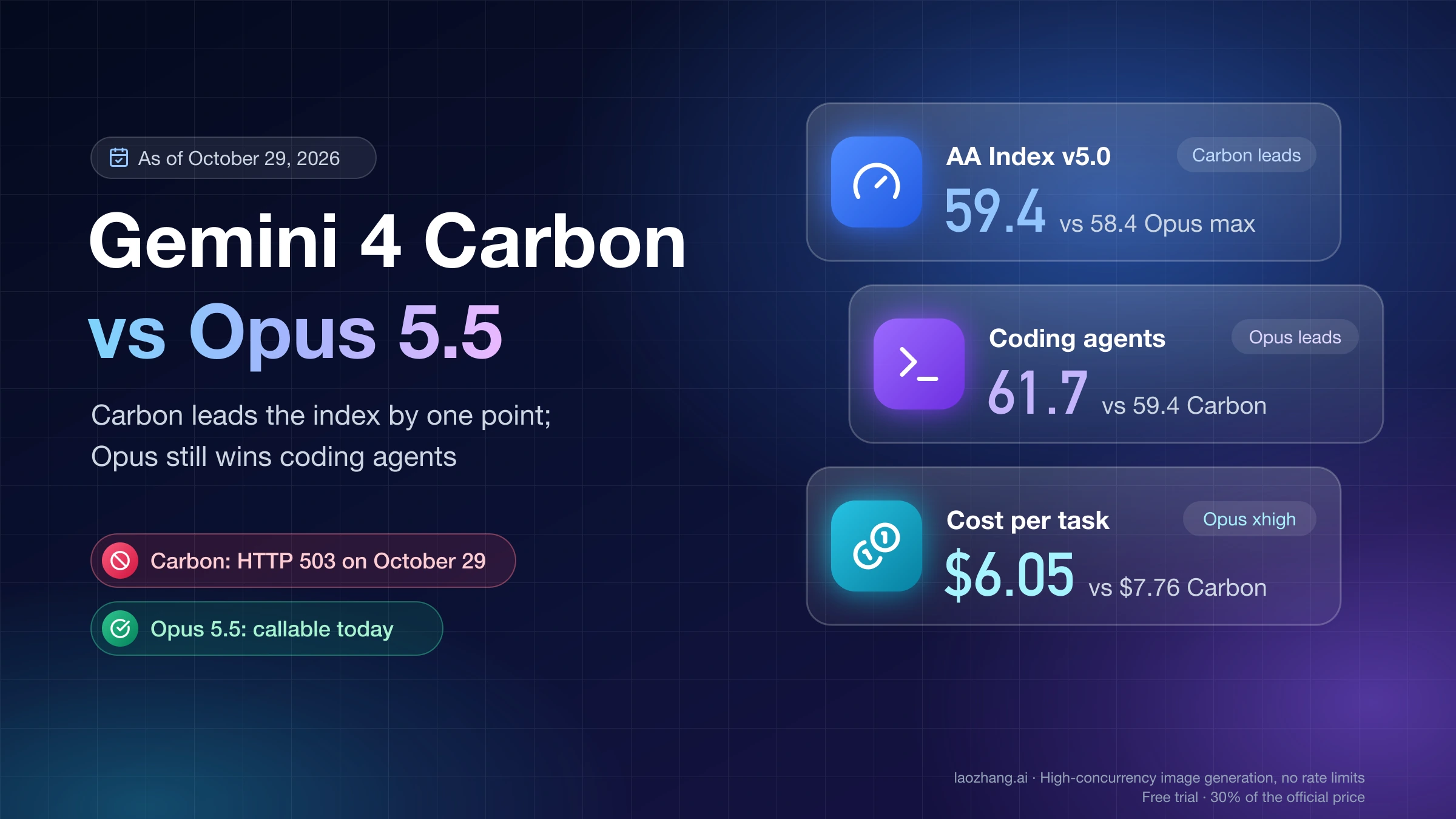
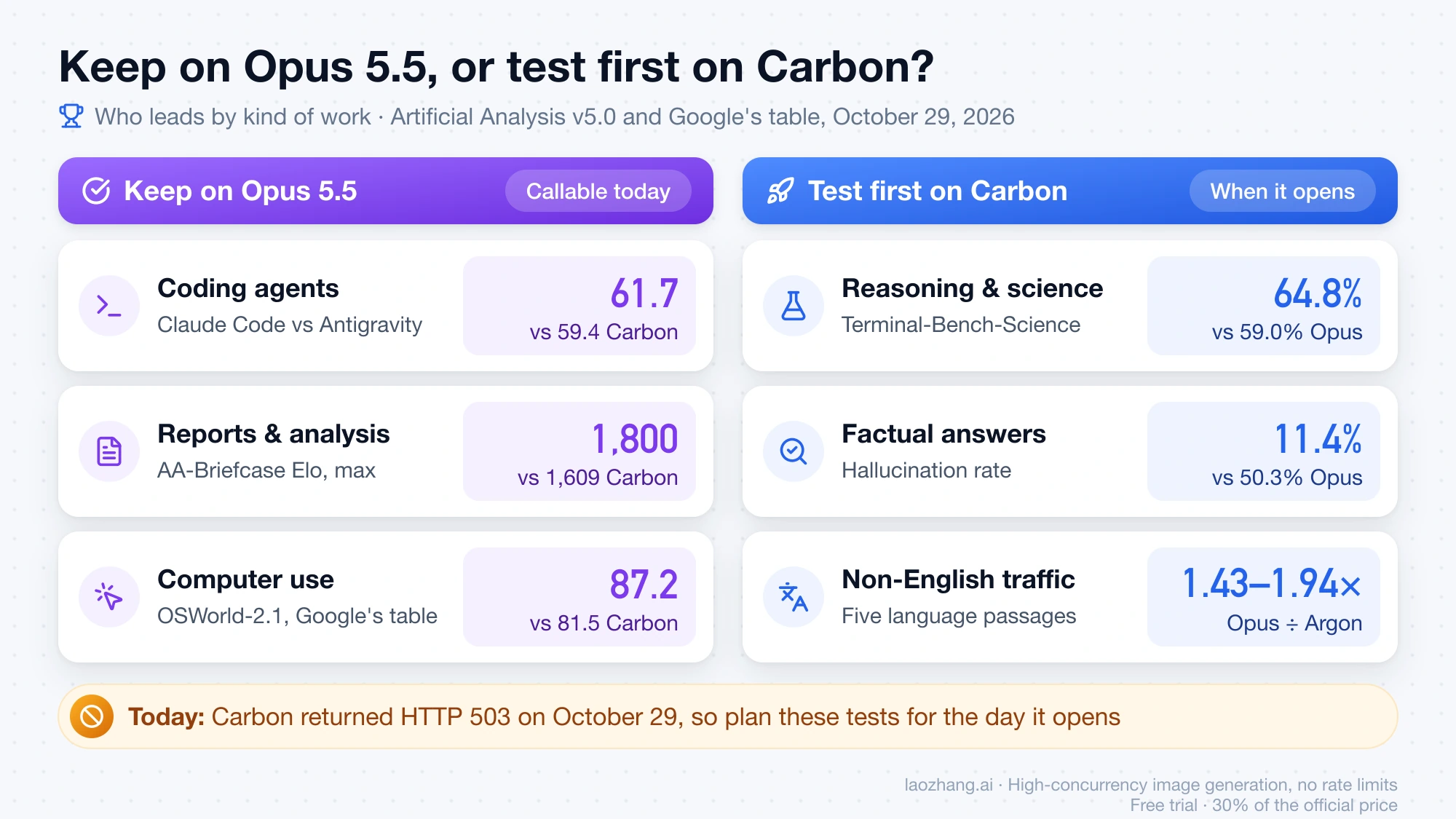
Gemini 4 Carbon is ahead of Claude Opus 5.5 on most of Artificial Analysis's new Intelligence Index v5.0, but not on the work many Opus users pay for. As of October 29, 2026, Carbon (high) scores 59.4 against 58.4 for Opus 5.5 at max effort and leads on reasoning, science, factual accuracy, automation and terminal tasks. Opus 5.5 still leads agentic knowledge work (AA-Briefcase, 1,800 vs 1,609 Elo), hard coding problems (FrontierCode 2.0, 46.4% vs 40.6%) and coding agents, where Claude Code with Opus scores 61.7 against 59.4 for Google's Antigravity CLI with Carbon, according to Artificial Analysis's Gemini 4 Carbon model page and its Coding Agent Index.
So keep running claude-opus-5-5 for now, because it is the only one of the two you can call. Google is giving Carbon to a subset of cyber defenders through its Fairwind Program, and a request to gemini-4-carbon on October 29, 2026 returned HTTP 503; who gets access and when is tracked in Gemini 4 Carbon Release Date: Cyber Defenders Only for Now. When Carbon opens, test it first on reasoning, research and fact-lookup work, and keep Claude Code and document work on Opus until your own results say otherwise.
The cost headlines need the same care. "23% cheaper per task" compares Carbon with Opus at max effort; Opus at xhigh scores 57.0 for $6.05 a task, less than Carbon's $7.76 at the standard price. Both models list $4 input and $20 output per million tokens at standard rates, yet Opus counted 1.23 times as many tokens as Google's Gemini 4 Argon for the same English text and 1.94 times for Korean, so the same price does not produce the same bill.
Where Carbon beats Opus 5.5, and where Opus still leads
Carbon (high) scores higher than Opus 5.5 at max effort on 7 of the 9 evaluations in Artificial Analysis's Intelligence Index v5.0, as of October 29, 2026. The two Opus wins are the ones closest to day-to-day paid work: AA-Briefcase, which grades agentic knowledge work such as analysis and presentations, and FrontierCode 2.0, a set of hard coding problems. Google's own comparison table adds one more Opus lead, computer use on the offline subset of OSWorld-2.1.
| Kind of work | Benchmark and who ran it | Gemini 4 Carbon (high) | Claude Opus 5.5 (max) | Ahead |
|---|---|---|---|---|
| Coding agents | Coding Agent Index, AA (Claude Code vs Antigravity CLI) | 59.4 | 61.7 | Opus |
| Hard coding problems | FrontierCode 2.0, AA | 40.6% | 46.4% | Opus |
| Agentic knowledge work | AA-Briefcase, Elo, AA | 1,609 | 1,800 | Opus |
| Computer use | OSWorld-2.1 offline, Google's table | 81.5 | 87.2 | Opus |
| Terminal tasks | Terminal-Bench 4.0, AA model run | 65.2% | 59.6% | Carbon |
| Scientific work in a terminal | Terminal-Bench-Science, AA | 64.8% | 59.0% | Carbon |
| Hard reasoning | HLE-Diamond, AA | 69.1% | 67.9% | Carbon, narrowly |
| Factual questions | AA-Omniscience score / hallucination rate, AA | 53.5 / 11.4% | 48.1 / 50.3% | Carbon |
| Business automation | AutomationBench-AA, AA | 77.8% | 69.5% | Carbon |
| Long-context graph lookups | GraphWalks, Google's table | 96.2 | 66.8 | Carbon |
The rows marked AA come from Artificial Analysis's own runs; the two marked Google's table are Google's figures as transcribed by VentureBeat's report on the Carbon launch, and they read as vendor claims. The two remaining AA evaluations are close calls: on CritPt v2 (hard) Carbon scores 63% against 61% for Opus max and 63% for Opus xhigh, and on GDP.pdf Carbon's 28.4% beats Opus max (26.2%) but not Opus high (28.8%).
The biggest gap is factual reliability. On AA-Omniscience, Opus 5.5 at max has a hallucination rate of 50.3% against 11.4% for Carbon, which AA calls the second lowest of any model. If your work is answering questions where a confident wrong answer costs more than "I don't know", that row matters more than the overall index. The biggest gap the other way is AA-Briefcase: 191 Elo points separate the two, and Opus keeps the lead at xhigh (1,760) and high (1,681) as well.
AA's per-domain capability scores show the same split in office work. Carbon is ahead in finance (62.6 vs 59.4) and legal (62.0 vs 58.0), the two are level in engineering (64.7 vs 64.6), and Opus is slightly ahead in strategy and operations (61.4 vs 60.9) and economics (62.3 vs 61.0). Security is where Google makes its strongest claim: Carbon scores 88.2% on SEC-bench Pro, 54.8% on ExploitGym and 71.0% on CWE-bench in Google's Gemini 4 Carbon announcement, which calls these state of the art. The announcement's text gives no Opus 5.5 scores for those three, so treat security as Google's claim rather than a measured head-to-head.
All of these numbers are Intelligence Index v5.0, which AA announced on October 27, 2026. Opus 5.5 scores published before then use v4.3.2, a different scale, and cannot be compared with them.
Which is better for coding and Claude Code?
For agentic coding you can run today, Claude Code with Opus 5.5 is ahead. On Artificial Analysis's Coding Agent Index it scores 61.7 at max effort against 59.4 for Carbon (high) in Antigravity CLI, and it leads two of the three tasks in that index: FrontierCode v1.1 (56.0% vs 50.9%) and SWE-Atlas QnA (65.9% vs 63.7%). Carbon edges ahead on the third, Terminal-Bench 4.0, at 63.6% against 63.1%. AA's own summary is that Carbon is "behind only Claude Opus 5.5 on coding agents", a large step for a Google model.
That index scores each model inside its own vendor's agent, so it compares two products, not two models. Carbon has been measured only in Antigravity CLI and Opus only in Claude Code; AA has not run Carbon inside Claude Code, and the result for your repository could move either way once both can be called from the same tool. Google's table points the same direction on software engineering: on FrontierSWE 2, Opus scores 62.3 against Carbon's 61.2, with GPT-6 Astra ahead of both at 65.5.
Watch which Terminal-Bench 4.0 number you are reading, because three are in circulation. Google's table gives Carbon 65.2, AA's run of the bare model also gives 65.2% (Opus max: 59.6%), and AA's agent run inside Antigravity CLI gives 63.6% (Claude Code with Opus: 63.1%). The bare-model gap is six points; the agent gap is half a point.
Is Opus 5.5 faster? Not as an agent. In AA's coding runs, Antigravity CLI with Carbon averaged 30 minutes per task against 61 minutes for Claude Code with Opus max, and wrote 109k output tokens against 279k. On the Intelligence Index tasks without an agent, the two are close at the top setting (Carbon 20.8 minutes, Opus max 19.1), and Opus is clearly faster once you drop to xhigh (13.0 minutes) or high (7.7 minutes). Google also says its teams have seen Carbon run "for days" on long engineering tasks and that it rose to #4 on WebDev Arena (1,768); both are Google's own observations, with no Opus comparison.
Is Gemini 4 Carbon cheaper than Opus 5.5? Only against Opus at max
Per token, the two cost the same at standard prices: $4 per million input tokens, $20 per million output tokens and $0.20 for cached input reads. Carbon is cheaper only during an introductory period at half those rates ($2 / $10, cached input $0.10), which Google has given no end date. Per task, the answer depends on which Opus effort level you compare it with.
Opus prices come from Anthropic's Claude pricing page, which also lists cache writes at $5 per million tokens for 5 minutes and $8 for 1 hour, at the same rate across the full 1M-token context window. Google has not published cache-write, batch or long-context rates for Carbon. For comparison, Gemini 4 Argon has the same $2 / $10 introductory price and leaves it on November 30, 2026.
| Model and setting | AA Index v5.0 | Cost per Index task | Time per task |
|---|---|---|---|
| Gemini 4 Carbon (high), standard price | 59.4 | $7.76 | 20.8 min |
| Gemini 4 Carbon (high), intro price (estimate) | 59.4 | ≈$3.88 | 20.8 min |
| Claude Opus 5.5 (max) | 58.4 | $10.04 | 19.1 min |
| Claude Opus 5.5 (xhigh) | 57.0 | $6.05 | 13.0 min |
| Claude Opus 5.5 (high) | 51.7 | $3.46 | 7.7 min |
| Claude Opus 5.5 (medium) | 48.1 | $2.45 | 5.5 min |
AA prices Carbon at the standard $4 / $20, so the $7.76 figure is what Carbon would cost after the discount ends. The introductory figure is $7.76 ÷ 2: every Carbon rate halves, so the same token use costs half as much. Against Opus max ($10.04), Carbon is 23% cheaper at standard and 61% cheaper at the intro price. Against Opus xhigh ($6.05), Carbon at standard costs 1.28 times as much, and only the intro price makes it cheaper, by 36%. Opus high ($3.46) is cheaper than even the discounted Carbon, which costs 1.12 times as much, though at a 51.7 index score it is a weaker setting.
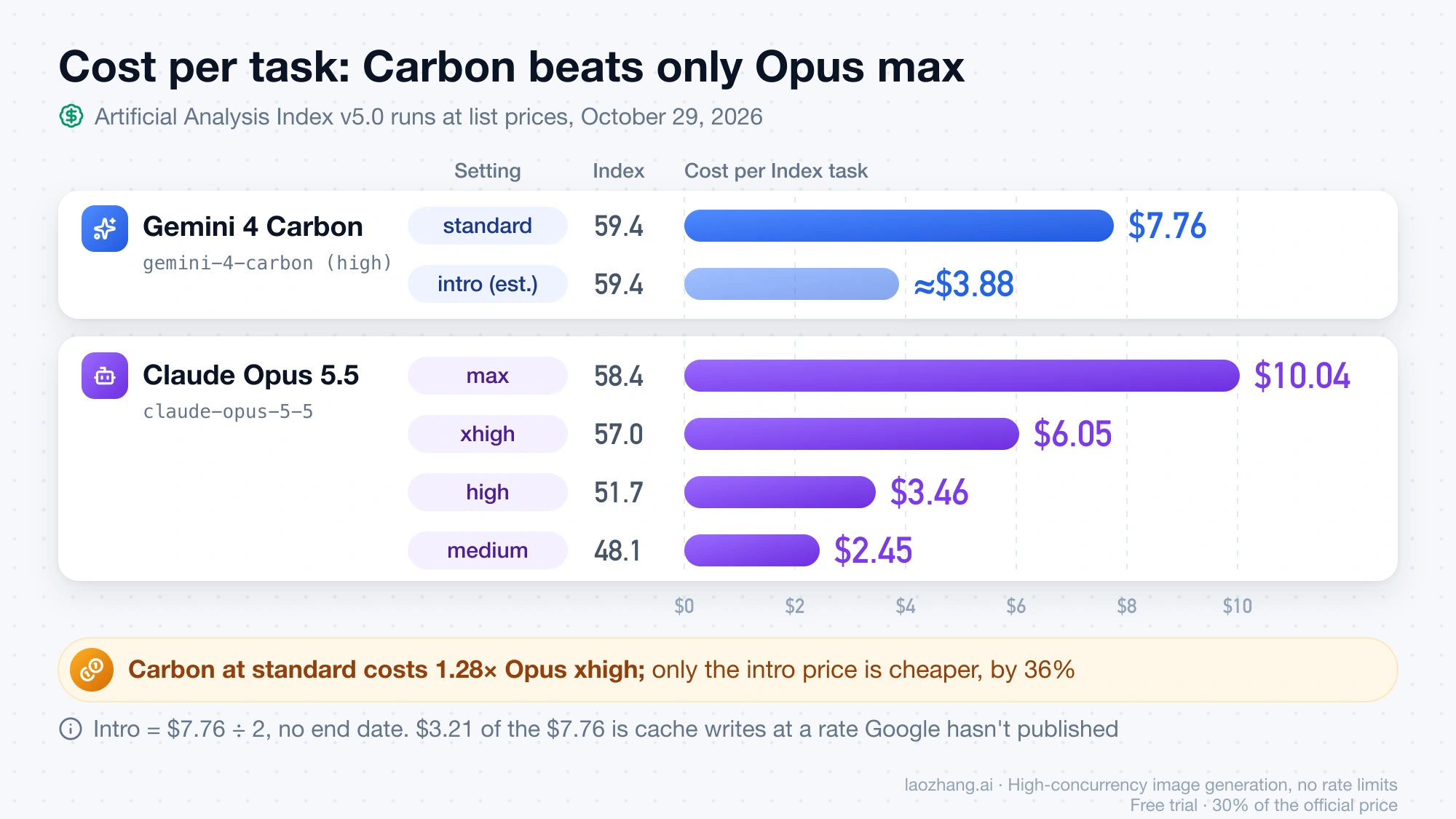
One part of Carbon's figure rests on an assumption. Of the $7.76, $3.21 is cache writes, which AA charged at $4 per million tokens, a rate Google has not published for Carbon. If Google prices cache writes differently, the standard figure moves with it. Opus's $10.04 includes $1.80 of cache writes at Anthropic's published $5 rate.
On the coding agent runs the gap is wider, because Claude Code with Opus max spends more per task. Antigravity CLI with Carbon averaged $7.74 per task against $11.42, which is 32% cheaper at standard prices; at the introductory price the same tokens would cost about $3.87, 66% less than Opus. Those agent figures compare Carbon with Opus at max only.
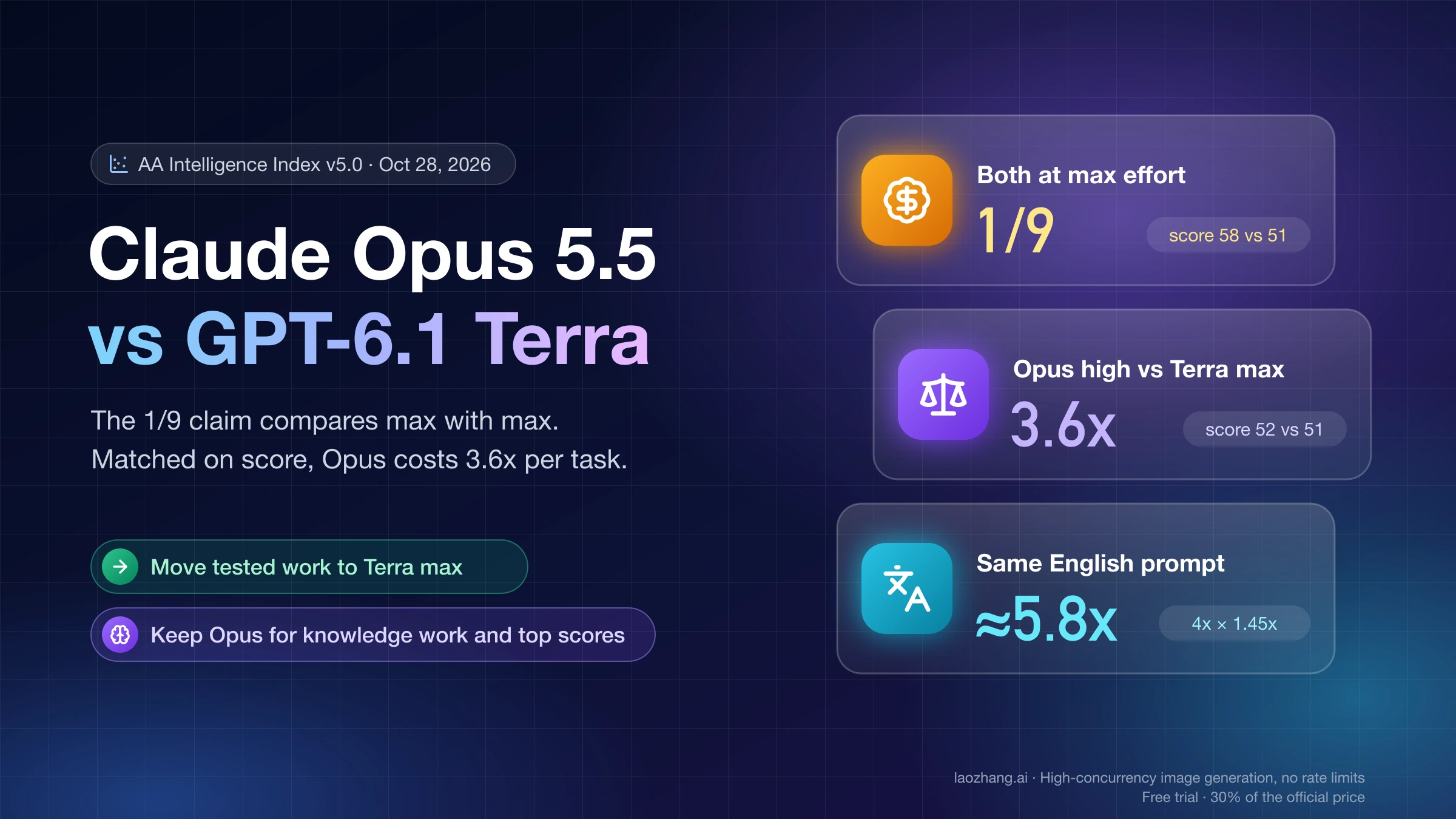
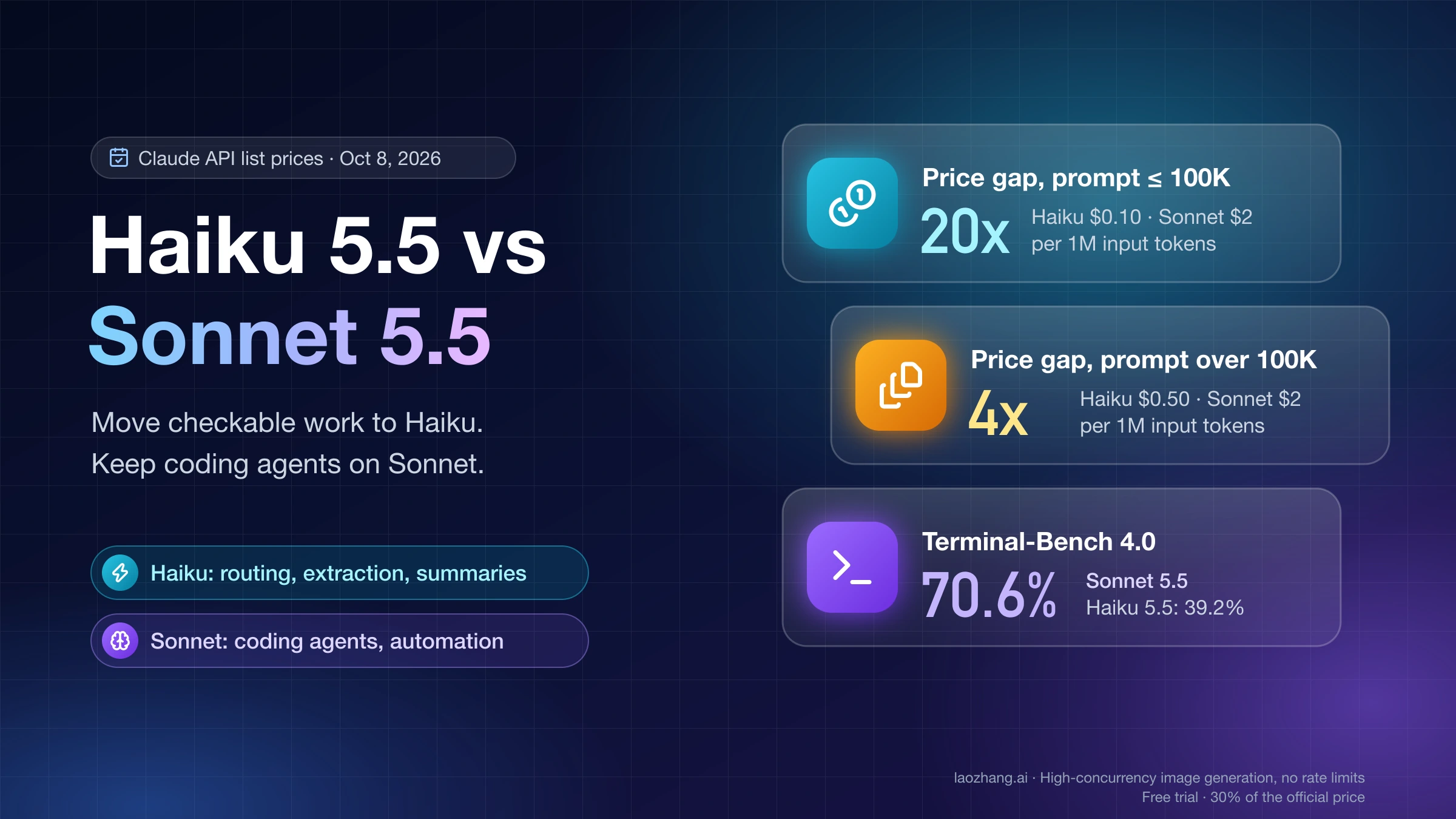
If you already run Opus at xhigh or high, Carbon's standard price would raise your cost per task, and the case for Carbon becomes quality on specific work rather than savings. The same effort-level comparison against OpenAI's cheaper model is in Claude Opus 5.5 vs GPT-6.1 Terra: 1/9 the Cost Only at Max, and if Opus itself is the problem, Claude Sonnet 5.5 vs Opus 5.5: When Half the Price Really Saves covers the cheaper Claude.
Same $4/$20 price, different bills: token counts by language
Opus 5.5 turns the same text into more billable tokens than Google's Gemini 4 tokenizer, so identical list prices still produce different bills. A test on October 29, 2026 found Opus counting 1.23 times as many input tokens for an English passage and 1.94 times for a Korean one.
The test ran at 03:00 UTC through the api.laozhang.ai gateway. One passage per language, with the same one-line instruction, went to claude-opus-5-5 (Anthropic Messages API, max_tokens 16, effort low) and to gemini-4-argon (native generateContent, maxOutputTokens 16, thinking level low), and the input token count each API returned was recorded. Carbon could not be called, so Gemini 4 Argon stands in for it. Carbon is built on Argon, but Google has not said whether the two share a tokenizer, so treat the Gemini column as a proxy until Carbon can be counted directly. The whole run cost $0.039 at list price.
Disclosure: laozhang.ai is our own service. Its prices are platform pricing, not an independent comparison.
| Text | Opus 5.5 input tokens | Gemini 4 Argon input tokens | Opus ÷ Gemini | Opus for the 1,000-call example |
|---|---|---|---|---|
| English passage | 217 | 176 | 1.23x | $135.62 |
| Chinese passage | 265 | 182 | 1.46x | $160.16 |
| Japanese passage | 330 | 228 | 1.45x | $159.21 |
| Korean passage | 414 | 213 | 1.94x | $213.80 |
| Russian passage | 320 | 223 | 1.43x | $157.85 |
| Spanish passage | 322 | 194 | 1.66x | $182.58 |
| English document, 40,625 characters | 15,495 | 11,081 | 1.40x | $153.82 |
The Opus count for the long document was taken on October 28, 2026 with the same wrapper; the six Opus passage counts matched that day's measurement exactly. In practice, a million tokens as Gemini counts them cost $4 of input on Carbon at standard, and the same text costs $4.93 on Opus in English, $5.59 for the long English document and $7.77 in Korean.
The last column is a worked example: 1,000 calls, each with 20,000 input and 1,500 output tokens as Gemini counts them. Carbon costs $110 at standard (1,000 × (0.02 × $4 + 0.0015 × $20)) and $55 at the intro price, in every language. Opus costs $110 times the ratio in each row. That assumes Opus writes an answer of the same text length, which real tasks will not hold to: in AA's runs Carbon wrote 123k output tokens per task, fewer than Opus max (173k) but about twice Opus high (60k).
Do not multiply AA's per-task costs by these ratios. AA's $7.76 and $10.04 already come from each model's own token counts, so the tokenizer difference is inside them. Use the ratios for your own traffic, where you know the input size and language; if most of it is Korean or Spanish, you pay the biggest token penalty on Opus even at an identical list price.
Can you call Gemini 4 Carbon yet? HTTP 503 on October 29, 2026
No, unless you are one of the cyber defenders in Google's Fairwind Program. Google's October 28 announcement gives no date, model ID or plan tiers for wider access, and a request to gemini-4-carbon through a commercial gateway on October 29, 2026 was refused with HTTP 503. As of that date Carbon is not in the Gemini app, AI Studio, the Gemini API, Vertex AI or Antigravity, and the rollout stages are covered in Gemini 4 Carbon Release Date: Cyber Defenders Only for Now.
The check ran on October 29, 2026 at 03:00 UTC against api.laozhang.ai with a usage-billed key. GET /v1/models returned 190 models; the only Gemini 4 entry was gemini-4-argon, and claude-opus-5-5 was listed alongside older Opus versions. POST /v1/chat/completions and the native POST /v1beta/models/gemini-4-carbon:generateContent both returned HTTP 503 with "Current group default has no available channels for model gemini-4-carbon", and neither request was billed. The same response had come back at 01:36 UTC that morning, and the same key got answers from claude-opus-5-5 for all six token-count calls above.
Disclosure: laozhang.ai is our own service. Its prices are platform pricing, not an independent comparison.
That shows Carbon cannot be routed through this gateway on that date. It does not show what Google's own Gemini API returns to a Fairwind participant with a Google key, which was not tested. The same gateway lists claude-opus-5-5 at $4 / $20 per million tokens with cached reads at $0.20 and cache writes at $5, on both Anthropic Messages and OpenAI-compatible endpoints, with a single-output cap of 32,768 tokens on its Claude routes, below Anthropic's own 128K maximum.
Opus 5.5, released September 22, 2026, is available in the Claude apps on Pro, Max, Team and Enterprise plans, in Claude Code, through the Claude API as claude-opus-5-5, and on AWS, Google Cloud and Azure. Google's nearest model you can call is Gemini 4 Argon, at 50.4 on the same index, which is compared with Opus 5.5 and GPT-6.1 Sol in Gemini 4 Argon vs Claude Opus 5.5 vs GPT-6.1 Sol: Cost and Access.
Should you switch to Carbon or stay on Opus 5.5?
Stay on Opus 5.5 for now, because there is nothing to switch to outside Fairwind. The decision you can make today is which of your workloads to test on Carbon first when it opens, and that depends on the kind of work.
If your main use is Claude Code or another coding agent, keep Opus and retest when Carbon can be called from the same tool, since today's lead is 2.3 points measured in two different agents. Document-heavy knowledge work, such as reports, analysis and presentations, also stays on Opus: the AA-Briefcase gap is 191 Elo at max and Opus is ahead at every effort level from high up. Computer-use automation leans Opus too, on Google's own OSWorld-2.1 row.
Plan to test Carbon first on reasoning, scientific and research work, and anywhere a wrong factual answer is expensive, because those are its clearest leads and the hallucination gap (11.4% vs 50.3%) is large. Security teams are the one group Google is serving first; if you defend systems for a living, the Fairwind route is the practical way in. And if much of your traffic is in Korean, Spanish, Chinese, Japanese or Russian, Carbon's tokenizer advantage is worth checking even at the standard price, because Opus counted 1.43 to 1.94 times as many tokens for those passages.
On the day Carbon opens, four checks will tell you more than any of the numbers above, and each one replaces an estimate above with a figure from your own work.
- Recount a sample of your own prompts with Carbon's token counter, replacing the Argon proxy in the table above.
- Run the same set of your real tasks on Carbon and on Opus at xhigh and max, and compare cost per accepted result, not cost per token.
- Check whether Google has published an end date for the introductory price and a cache-write rate, since the $7.76 per-task figure depends on both.
- Compare output tokens and wall time per task, which decide both the bill and how long an agent run keeps you waiting.
Can you trust the benchmarks behind "Carbon beats Opus"?
Partly. Google's own comparison table and Artificial Analysis's runs agree that Carbon is at or near the top, but they are different kinds of evidence, and neither tested Carbon the way you would use it.
Google's table, where Carbon leads 15 of 17 rows, was run by Google at the highest thinking setting, pass@1, and "evaluated without guardrails", so it shows the model without the guardrails Google says it is still refining before wider release. AA's numbers are independent, but they come from one run per configuration, with Carbon tested only at high reasoning and before it had a public API; AA's model page labels it "No publicly available API". Google's behavioral claims, such as 0.0% cheating success on Terminal-Bench 4.0, 0.0% on Gray Swan's indirect prompt-injection test and about half as many unsupported claims as Argon, are self-reported and come with no Opus comparison.
Neither source tells you how Carbon handles your prompts, your codebase or your languages, which is why the day-one test above matters more than the index lead of one point.
Gemini 4 Carbon vs Opus 5.5: other questions
Is Gemini 4 Carbon the same model as Gemini 4 Argon?
No. Google describes Carbon, announced October 28, 2026, as building on Gemini 4 Argon, and AA scores Carbon 59.4 against Argon's 50.4 on Intelligence Index v5.0. Argon is the one you can call today; how the two differ in access and timing is covered in Gemini 4 Carbon Release Date: Cyber Defenders Only for Now.
Has Anthropic announced a model to answer Carbon?
Not as of October 29, 2026. Anthropic's news page lists Claude Opus, Sonnet and Haiku 5.5 as its latest models, and reports of a newer Claude model are speculation without an announcement, so any plan should assume Opus 5.5 is the Claude you will be comparing against.
Do Carbon and Opus 5.5 have the same context window?
Both take up to 1M tokens of context, according to AA's Carbon page and Anthropic's pricing page, and Anthropic charges the same Opus rate across that full window. Opus 5.5 can write up to 128K tokens in one response; Google has not published Carbon's output limit, long-context pricing or rate limits.
Sources5
External pages this guide links to, in the order they appear. Last updated Oct 29, 2026.
Sources5
External pages this guide links to, in the order they appear. Last updated Oct 29, 2026.
- 1.Artificial Analysis's Gemini 4 Carbon model pageartificialanalysis.ai/models/gemini-4-carbon
- 2.Coding Agent Indexartificialanalysis.ai/agents/coding
- 3.VentureBeat's report on the Carbon launchventurebeat.com/technology/google-unveils-gemini-4-carbon-retaking-the-worlds-no-1-spot-on-updated-harder-benchmarks-but-access-is-limited
- 4.Google's Gemini 4 Carbon announcementblog.google/innovation-and-ai/models-and-research/gemini-models/introducing-gemini-4-carbon
- 5.Anthropic's Claude pricing pageplatform.claude.com/docs/en/about-claude/pricing