Claude Opus 5.5 vs GPT-6.1 Terra: 1/9 the Cost Only at Max
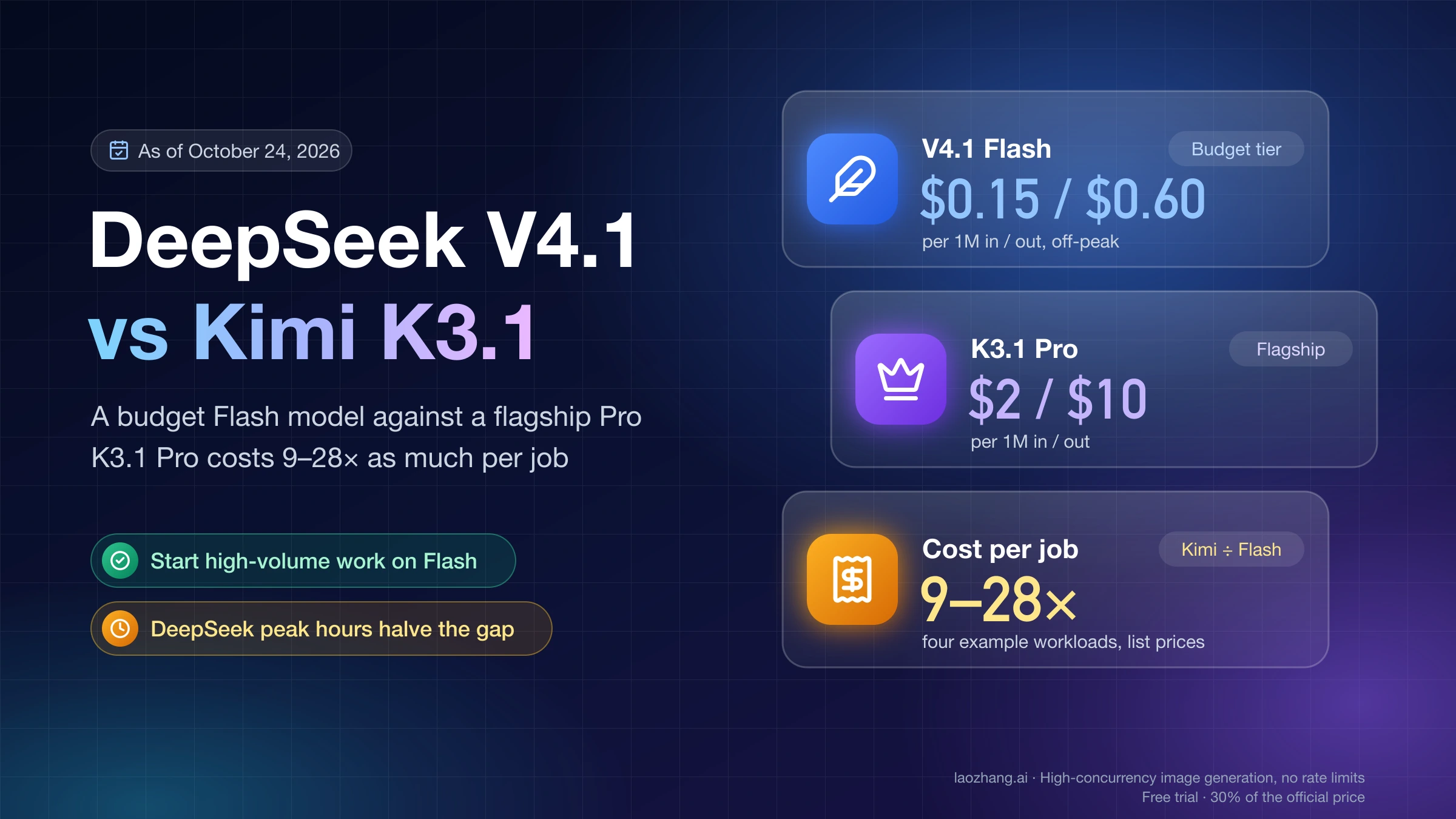
GPT-6.1 Terra's 1/9 cost claim is max vs max. At equal AA scores, Opus 5.5 high costs 3.6x Terra max per task, and English input bills about 5.8x.
On this page
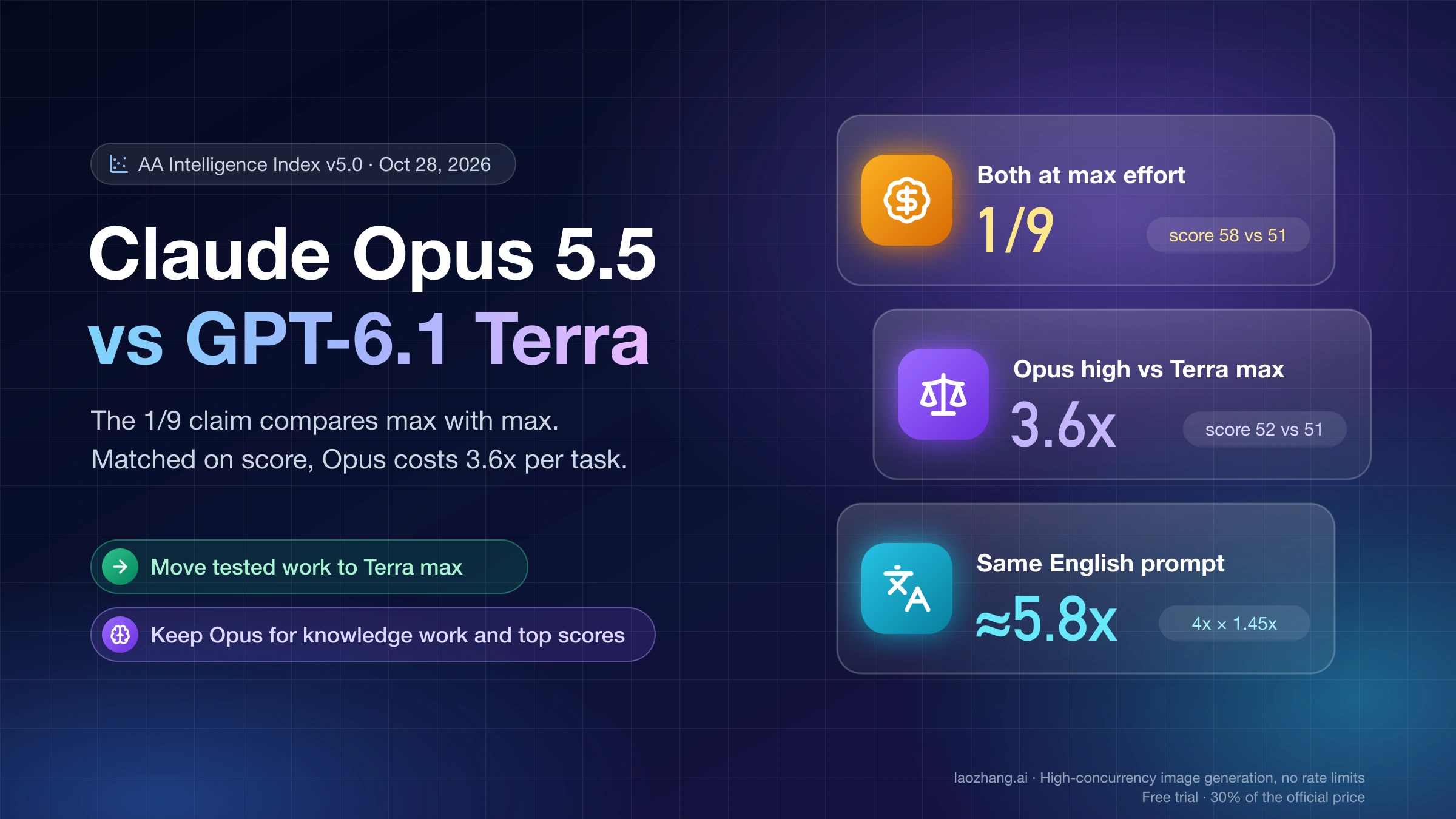
OpenAI released GPT-6.1 Terra on October 26, 2026 and said it finishes a task for about one-ninth of what Claude Opus 5.5 costs. If you pay for Opus 5.5 today, move well-specified coding, extraction, and document work to gpt-6.1-terra at reasoning effort max (through the LaoZhang API gateway on October 28, 2026, max worked only on the Responses API), check it against your current Opus setting, and expect Opus to cost roughly 3.6 to 6 times as much for the same work, not 9 times. Keep claude-opus-5-5 at high or above for knowledge-heavy analysis and for anything that needs a higher score than Terra can reach, because only Opus gets to 57–58 on Artificial Analysis's Intelligence Index v5.0.
Disclosure: laozhang.ai is our own service. Its prices are platform pricing, not an independent comparison.
The one-ninth figure holds only when both models run at max, and at that setting Opus also scores 7 points higher. Matched on score instead, Opus 5.5 at high (52) and Terra at max (51) are nearly equal, and Opus costs 3.6x as much per task. A same-prompt test on October 28, 2026 found the same pattern on a smaller scale: both models passed all 7 tasks, and Opus cost 4.5x at list price.
The ratio moves with three things. Prompts longer than 272K tokens put Terra on its long-context rate and shrink the per-token gap to 2–2.7x. Non-English input widens it, because Opus counts more tokens for the same text. And if you work inside ChatGPT rather than the API, Terra appears only in Work and Codex, not in Chat.
Is GPT-6.1 Terra really one-ninth the cost of Opus 5.5?
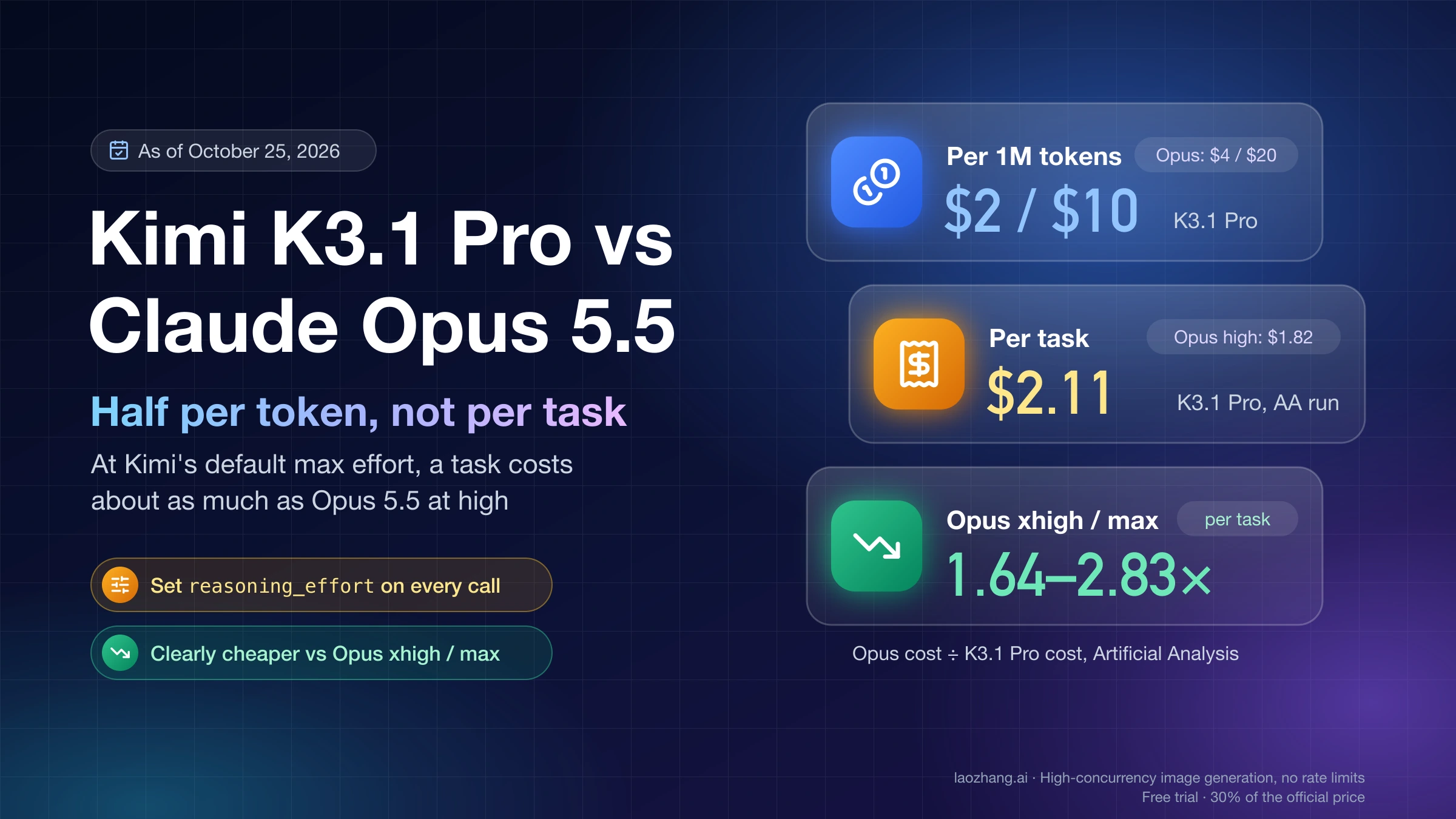
Yes, but only at max effort on both sides. In the GPT-6.1 Terra launch post, OpenAI says that at maximum reasoning effort Terra is more than three times as token-efficient as Claude Opus 5.5 and charges a quarter of its per-token price, which multiplies out to about one-ninth of the cost. Those are OpenAI's own evaluations. The independent numbers agree: on the Artificial Analysis release comparison (Intelligence Index v5.0, as of October 28, 2026), Opus max costs $10.04 per index task and Terra max $0.96, a ratio of 10.5x.
The catch is what that pairing compares. Opus max is the most expensive Opus setting, scores 58 against Terra max's 51, and spends 173K output tokens per task (120K of them reasoning) against Terra's 60K (39K reasoning). If you already run Opus at high, you were never paying $10.04 a task, so the one-ninth figure overstates your savings. OpenAI's own post also says GPT-6.1 Sol and GPT-6 Astra remain the better choice for the most complex coding, which places Terra below the top tier, not as an Opus replacement at every level.
If you have seen "54 vs 48" or "58 vs 48" for this pair, those scores come from Artificial Analysis's previous index, v4.3.2, which was replaced by v5.0 between October 27 and 28, 2026. Under v4.3.2 Terra max scored 48 and took 384 seconds per task; under v5.0 it scores 51 and takes 657 seconds. The two versions use different evaluation sets, so mixing their numbers produces a gap that neither version shows.
Opus 5.5 vs Terra at each effort level: score, cost, and time per task
The fair comparison is Opus 5.5 at high against GPT-6.1 Terra at max, because they score 52 and 51 on the Intelligence Index v5.0. At that match Opus costs $3.46 per task against Terra's $0.96, which is 3.6x, and it finishes faster: 464 seconds per task against 657. Every row below is from the Artificial Analysis release comparison as of October 28, 2026, sorted by score.
| Setting | Intelligence Index v5.0 | Cost per index task | Time per task |
|---|---|---|---|
Opus 5.5 max | 58 | $10.04 | 1,133 s |
Opus 5.5 xhigh | 57 | $6.05 | 779 s |
Opus 5.5 high | 52 | $3.46 | 464 s |
Terra max | 51 | $0.96 | 657 s |
Opus 5.5 medium | 48 | $2.45 | 337 s |
Terra xhigh | 45 | $0.40 | 287 s |
Terra high | 42 | $0.26 | 182 s |
Terra medium | 38 | $0.17 | 118 s |
Opus 5.5 low | 35 | $0.98 | 147 s |
Terra none (no reasoning) | 30 | $0.23 | 104 s |
Terra low | 29 | $0.07 | 48 s |
Read down the table and the lower Opus settings lose their case. Opus medium scores 48, below Terra max, and still costs 2.6x as much. Opus low costs almost exactly what Terra max does ($0.98 vs $0.96) but scores 16 points lower. Terra xhigh at $0.40 trails Opus medium by 3 points at one-sixth of the cost. Above 52 there is no Terra row at all: if your work needs Opus xhigh (57) or max (58), Terra has no setting that reaches it.
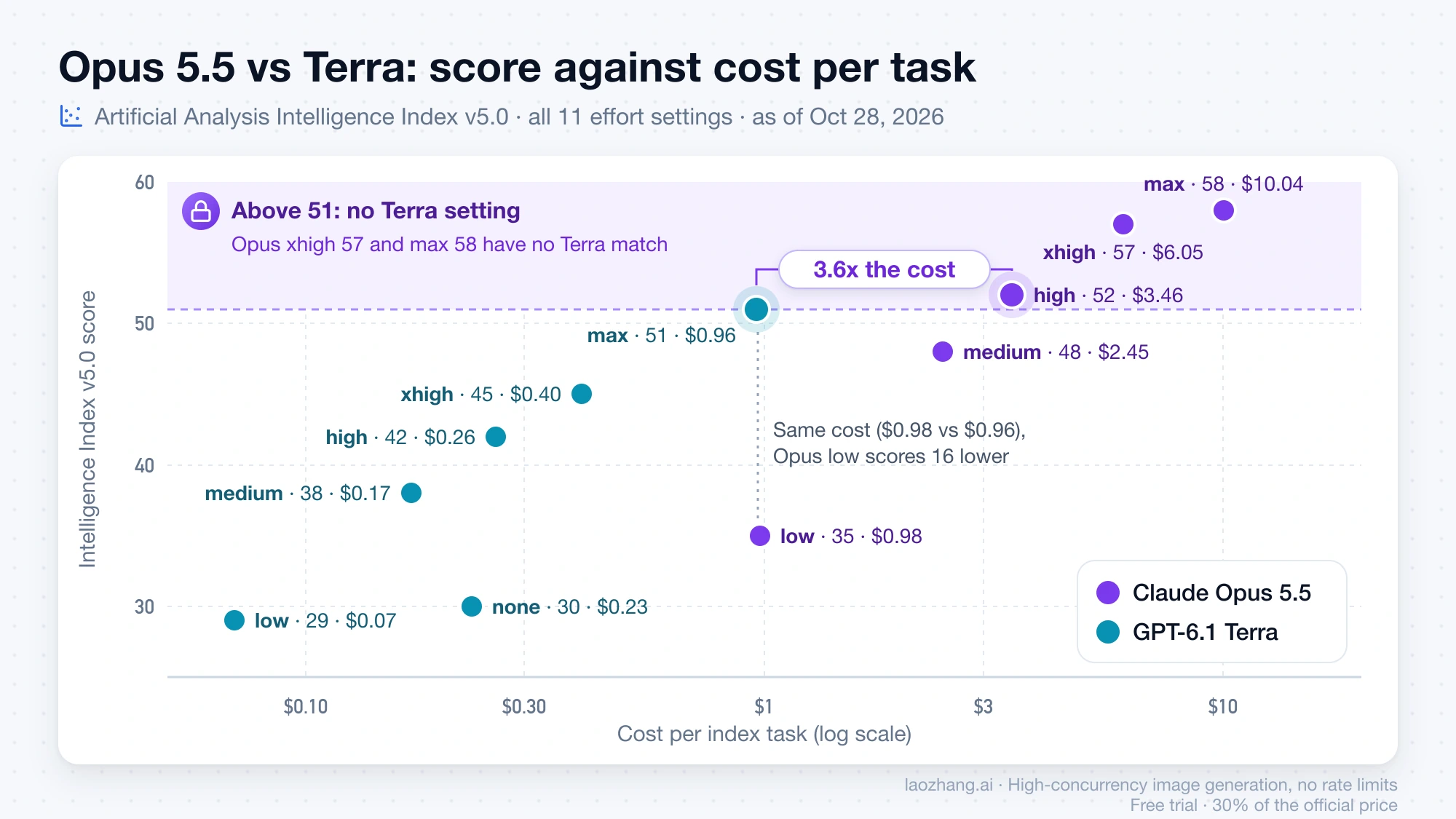
Cost per task here is the token mix Artificial Analysis's own runs used, priced at list rates, and time per task is its measurement at each setting through the first-party APIs. Your tasks will use a different mix, which is why the bill section below works from token counts.
Where Opus 5.5 still leads, and where GPT-6.1 Terra does
At matched scores, Terra max leads on coding and science problems, while Opus high leads on knowledge recall and office deliverables. Terra max beats Opus high on FrontierCode 2.0, CritPt, and Terminal-Bench-Science; Opus high pulls ahead on HLE-Diamond, AA-Omniscience, AA-Briefcase, and every one of Artificial Analysis's industry indexes. Terminal-Bench 4.0 and GDP.pdf are effectively tied.
| Evaluation (v5.0) | Opus 5.5 high | Terra max | Opus 5.5 max |
|---|---|---|---|
| FrontierCode 2.0 | 35.9% | 42.3% | 46.4% |
| CritPt v2 (Hard Subset) | 58.0% | 64.5% | 61.0% |
| Terminal-Bench-Science 0.1 | 49.0% | 57.6% | 59.0% |
| Terminal-Bench 4.0 | 56.6% | 55.6% | 59.6% |
| AutomationBench-AA | 63.2% | 60.2% | 69.5% |
| HLE-Diamond | 55.6% | 47.3% | 67.9% |
| AA-Omniscience v1.1 | 42 | 30 | 48 |
| AA-Briefcase v1.1 | 1,681 | 1,402 | 1,800 |
| GDP.pdf | 28.8% | 28.6% | 26.2% |
The coding result goes further down the effort scale than you might expect. Terra at high scores 37.5% on FrontierCode 2.0, above Opus high's 35.9%, for $0.26 per index task. On the knowledge side the gap is wide and consistent: Opus high scores 53 vs 49 on Finance & Accounting, 58 vs 50 on Strategy & Ops, 52 vs 46 on Legal, 58 vs 54 on Engineering, and 57 vs 49 on Economics. Each figure comes from one Artificial Analysis run per setting, so treat differences of a point or two as noise and the 8-point gaps as signal.
Which work to move to GPT-6.1 Terra, and at which effort
Start from the Opus setting you use today and find the cheapest Terra setting that matches its score on the work you actually do. For Opus medium and low, Terra max already scores higher, so the move is almost free of risk. For Opus high, Terra max matches on overall score and wins on coding but loses on knowledge-heavy tasks. For Opus xhigh and max there is no Terra match, so keep Opus there.
Through the LaoZhang API gateway, Terra max needed the Responses API. In a check on October 28, 2026 through that gateway, Chat Completions rejected reasoning_effort: "max" for gpt-6.1-terra with HTTP 400 and listed none, low, medium, high, and xhigh as the supported values, while POST /v1/responses with reasoning: {"effort": "max"} worked. OpenAI's own API was not part of that check, so send one max request on Chat Completions before you rely on it there. If max is rejected where you call Terra and your code stays on Chat Completions, your ceiling is xhigh, which scores 45 at $0.40 per index task: above Opus low, but below Opus medium and high.
Disclosure: laozhang.ai is our own service. Its prices are platform pricing, not an independent comparison.
Coding with tests is the safest work to move, and it may not need max at all. Functions, parsers, and refactors that a test suite can grade are where Terra at high matched Opus in the October 28 test and edges it on FrontierCode 2.0, so start there, step up to xhigh, and keep Opus only if your tests still fail on Terra at max. Terminal and automation agents are closer: Opus high leads AutomationBench-AA 63.2% to 60.2% and Terminal-Bench 4.0 by one point, so run Terra at max through the Responses API, which its tool calling requires, and keep Opus if your agent finishes fewer runs.
Research, legal or financial analysis, and fact-heavy writing should stay on Opus high, because Opus leads there by 4–8 points on every industry index and by 12 on AA-Omniscience. Work that needs the top score stays on Opus xhigh or max without a test, since Terra stops at 51.
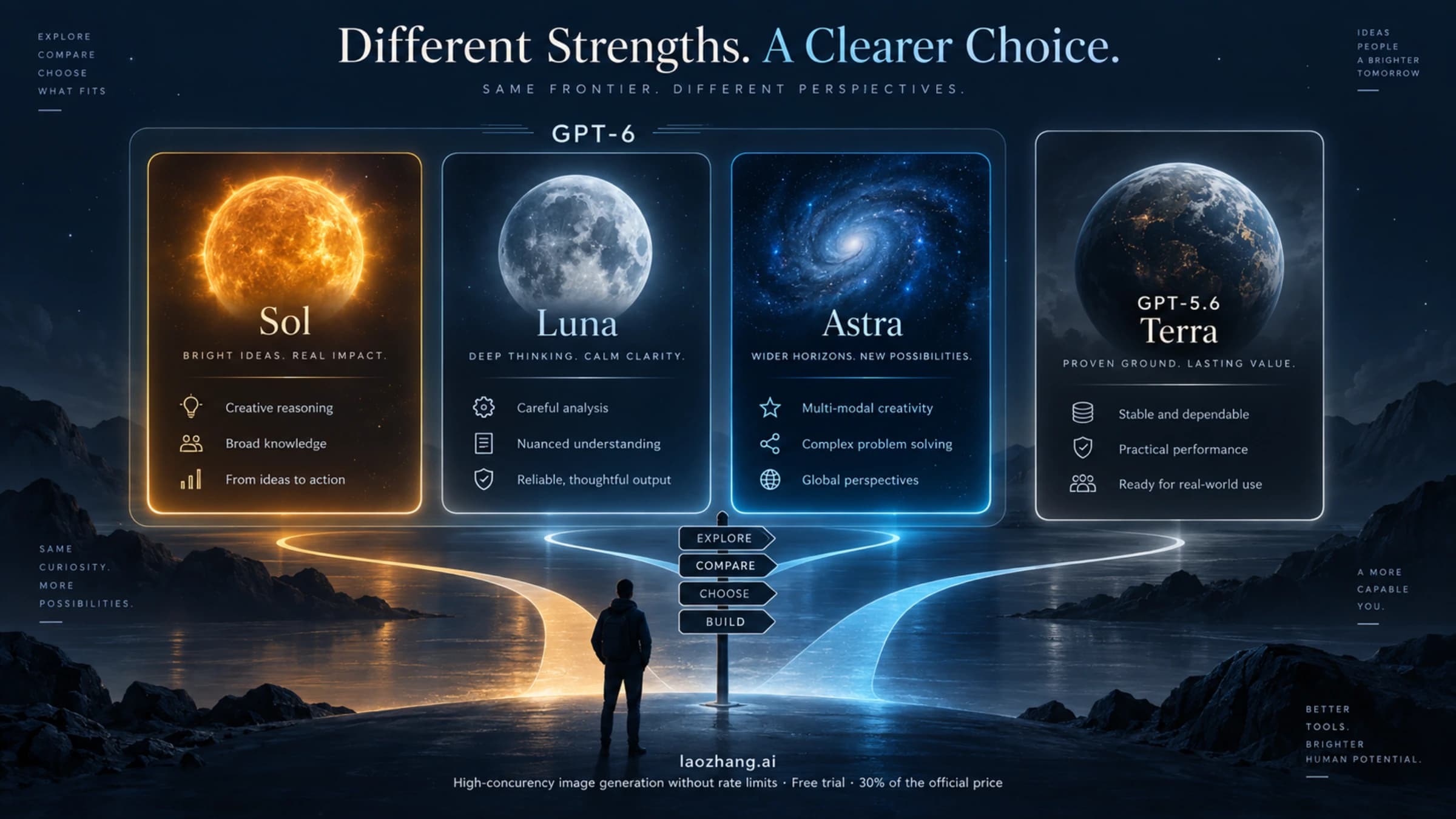
There is a middle option between the two. GPT-6.1 Sol scores 55 at max for $1.27 per index task on the same v5.0 index, and Claude Opus 5.5 vs GPT-6.1 Sol and GPT-6 Sol: When Opus Pays Off covers that pairing. If you are choosing inside OpenAI's lineup, see GPT-6.1 Terra vs GPT-6.1 Sol: Half the Price, Not Always Cheaper. If you want to stay with Anthropic and still cut the bill, Claude Sonnet 5.5 vs Opus 5.5: When Half the Price Really Saves is the comparison to read.
What your bill ratio will be: unit price × token count × effort
For prompts up to 272K tokens, Opus 5.5 charges exactly 4x Terra's rate for every kind of token, and it also counts more tokens for the same text, so your real ratio starts above 4x. On English input Opus counted 1.45x as many tokens in a test on October 28, 2026, which makes the same English prompt bill about 5.8x as much. How much each model writes back, which effort controls, decides the rest.
The list rates per 1M tokens are on the OpenAI API pricing page and the Claude API pricing page. With U as fresh input, W as cache writes, R as cache reads, and O as output including reasoning, all in millions of tokens:
- Opus 5.5, any length up to 1M: 4U + 5W (5-minute cache) + 0.2R + 20O
- Terra, input up to 272K: 1U + 1.25W (30-minute cache) + 0.05R + 5O
- Terra, input over 272K: 2U + 2.5W + 0.1R + 7.5O
The token-count gap comes from the two tokenizers. On October 28, 2026 the same short passage was sent to each model in six languages and the input tokens read from each API's usage field. The Opus-to-Terra ratio was 1.45 in English, 1.49 in Chinese, 1.24 in Japanese, 1.87 in Korean, 1.55 in Russian, and 1.84 in Spanish; a 6,723-word English prompt came out at 15,495 vs 10,198 tokens, or 1.52x. Multiplied by the 4x rate, the same input text bills between 5.0x (Japanese) and 7.5x (Korean) as much on Opus. The ratios almost match those measured for another Anthropic–OpenAI pair in GPT-6 Astra vs Claude Fable 5.1: Same Price, 1.5x the Tokens.
Here is what the formulas give for three common shapes of work, calculated on October 28, 2026 from the list prices above, assuming both models write the same number of output tokens and Opus counts input at the measured English or Korean ratio:
| Workload | Terra | Opus 5.5, English | Opus 5.5, Korean |
|---|---|---|---|
| 1,000 calls of 2K input, 1K output | $7.00 | $31.60 (4.5x) | $34.96 (5.0x) |
| One 400K-token request, 20K output | $0.95 | $2.72 (2.9x) | $3.39 (3.6x) |
| Agent session: 50K fresh input, 950K cache reads, 30K output | $0.25 | $1.17 (4.7x) | $1.33 (5.4x) |
The agent row assumes each request in the session stays under 272K tokens and leaves cache writes out. Equal output is the generous assumption for Opus: at max, Artificial Analysis measured Opus writing 2.9x as many output tokens per task as Terra, which is largely how the max-vs-max ratio reaches 10.5x. Caching also bills differently by default. OpenAI caches automatically for GPT-5.6 and later models and bills the cache writes unless you set prompt_cache_options.mode to "explicit", so an OpenAI bill can carry write charges you didn't plan for.
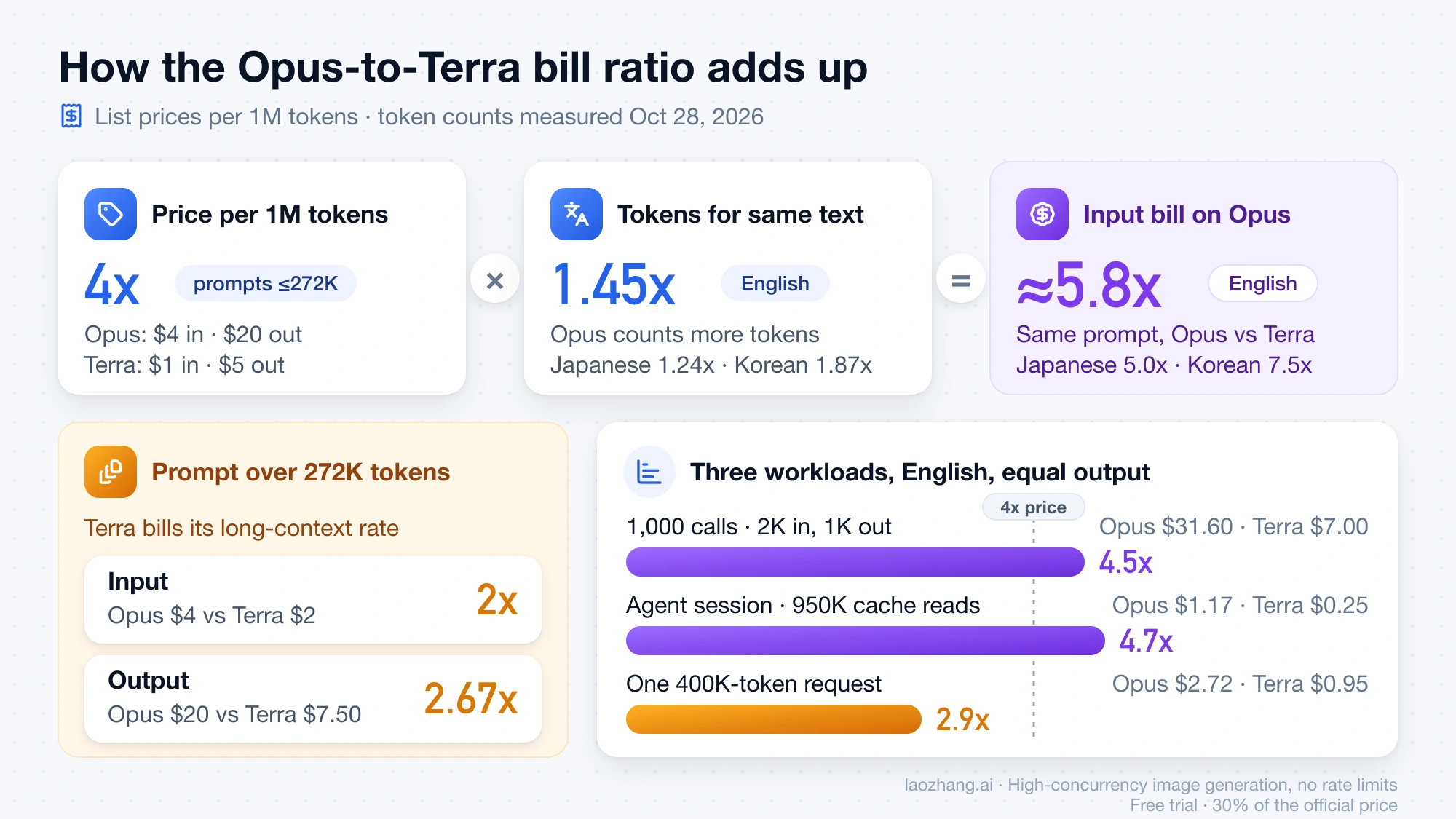
Prompts over 272K tokens: the gap narrows to 2–2.7x per token
Once a single request carries more than 272K input tokens, OpenAI bills the whole request at Terra's long-context rate: $2 input and $7.50 output per 1M tokens. Opus 5.5 keeps its $4 and $20 rates across its full 1M-token window, so the per-token gap falls to 2x on input and cache tokens and 2.67x on output. That is why the 400K-token row above comes out at 2.9x in English rather than 4.5x. The saving is still large, just smaller: moving the 1,000 short calls from Opus to Terra cuts that spend by about 78%, and moving the 400K-token request cuts it by about 65%. If most of your Opus spend goes to whole-repository or long-document prompts, plan with the second figure.
Same-prompt test on October 28, 2026: both passed all 7 tasks
On October 28, 2026, Opus 5.5 at high and Terra at high answered the same 7 single-turn tasks, each graded by hidden tests written before any answer came back. Opus passed 11 of 11 calls and Terra 15 of 15, so no task separated them. At list price, one average call per task cost $0.2812 on Opus and $0.0632 on Terra, a ratio of 4.5x.
Both models ran through one LaoZhang API key: Opus on the Anthropic Messages endpoint with thinking: {"type": "adaptive"} and output_config: {"effort": "high"}, Terra on Chat Completions with reasoning_effort: "high". Every call was streamed with a single user message, no system prompt, and no tools. Costs are each response's returned token usage multiplied by OpenAI's and Anthropic's list prices, not what the gateway charged, and no call reported cached tokens.
Disclosure: laozhang.ai is our own service. Its prices are platform pricing, not an independent comparison.
| Task (hidden checks) | Opus 5.5 high: passed, mean cost | Terra high: passed, mean cost | Cost ratio |
|---|---|---|---|
Expression evaluator without eval (25 tests) | 1/1, $0.0389 | 2/2, $0.0106 | 3.7x |
CSV line parser without the csv module (16 tests) | 1/1, $0.0184 | 2/2, $0.0030 | 6.2x |
| Count numbers below 1,000,000 with digit sum 27 | 1/1, $0.0178 | 2/2, $0.0021 | 8.4x |
| npm-style semver range matcher (36 tests) | 2/2, $0.0640 | 2/2, $0.0169 | 3.8x |
| 6,723-word document with three planted notes, answer $76.80 | 1/1, $0.0667 | 2/2, $0.0106 | 6.3x |
| Spot two made-up Python 3.13 standard-library functions | 2/2, $0.0056 | 2/2, $0.0008 | 7.3x |
Cron next_run for 5-field expressions (41 tests) | 3/3, $0.0698 | 3/3, $0.0192 | 3.6x |
| All 7 tasks, one mean call each | 11/11, $0.2812 | 15/15, $0.0632 | 4.5x |
The ratio depends on answer length. On the two long code tasks both models wrote about the same number of output tokens (3,066 vs 3,294 on semver, 3,391 vs 3,763 on cron), so the gap stayed close to the 4x unit price. On short answers Opus wrote about twice as many tokens, which pushed the ratio to 6–8x. Wall time per call was similar, for example 32.2 seconds vs 27.5 seconds on the cron task, measured from one machine in Asia through the gateway.
The test shows that for well-specified, single-turn coding and reasoning, Terra at high matched Opus at high at under a quarter of the cost. It does not show where Opus is stronger: there was no tool calling, no multi-step agent work, no images, no context beyond about 15K tokens, and neither model ran at max. For those, the Artificial Analysis numbers above are the better guide.
How to test your own prompts on Opus 5.5 and Terra before switching
A small same-prompt check on your own work settles what the benchmarks can't: whether Terra passes the same share of your tasks. The 26 calls in the October 28 test cost $0.64 at list price in total, so the check is cheap next to the bill it decides.
-
Pick 5–10 prompts from real work and write the pass/fail check for each before you run anything: unit tests, an expected value, or a short rubric. Fixing the check first keeps the grade from bending toward an answer you've already read.
-
Choose settings by score, not by name. Run Terra at
maxand one level lower (xhigh), and run Opus at the effort you use today. Through the LaoZhang API gateway on October 28, 2026, Terramaxworked only on the Responses API and Chat Completions returned HTTP 400 for it. -
Send each prompt unchanged to both models and set effort explicitly on each side. For Terra at
max, callPOST /v1/responses:{ "model": "gpt-6.1-terra", "reasoning": { "effort": "max" }, "input": "..." }For Terra at
xhighor lower you can also use Chat Completions, but usemax_completion_tokens: on October 28, 2026, a non-streaming request togpt-6.1-terrawithmax_tokensreturned HTTP 400 ("Unsupported parameter: 'max_tokens' is not supported with this model. Use 'max_completion_tokens' instead.").{ "model": "gpt-6.1-terra", "reasoning_effort": "xhigh", "max_completion_tokens": 32000, "messages": [{ "role": "user", "content": "..." }] }For Opus on the Messages API, set both the thinking mode and the effort so you know which setting you're paying for:
{
  "model": "claude-opus-5-5",
  "max_tokens": 32000,
  "thinking": { "type": "adaptive" },
  "output_config": { "effort": "high" },
  "messages": [{ "role": "user", "content": "..." }]
}
If your tasks call tools, test Terra through the Responses API at every effort level, because Terra's tool calling requires it.
-
Record input, output, and cached tokens from each response's usage field and price them with the formulas above. Opus's
output_tokensinclude thinking even when no thinking text is returned. -
Divide each model's total cost by the tasks it passed, and run every prompt at least twice. Switch a kind of work to Terra when its pass rate matches and its cost per passed task is lower.
Disclosure: laozhang.ai is our own service. Its prices are platform pricing, not an independent comparison.
Using GPT-6.1 Terra in ChatGPT and Opus 5.5 in Claude apps
GPT-6.1 Terra is in ChatGPT's Work and Codex surfaces, not in regular Chat. OpenAI's launch post lists Plus, Pro, Enterprise, and Edu, and the Codex documentation adds Business. In the API the model ID is gpt-6.1-terra. Claude Opus 5.5, released on September 22, 2026, is available in the Claude apps on Pro, Max, Team, and Enterprise, in Claude Code, in the Claude API as claude-opus-5-5, and on AWS, Google Cloud, and Azure.
Subscription allowances aren't set from API prices, so the cost ratios above don't carry over to plans. As of October 27, 2026, Codex lists 35–285 local Terra messages per 5-hour window on Plus against 15–160 for GPT-6.1 Sol, while Anthropic publishes no message count for Opus 5.5; Claude Opus 5.5 Pricing and Limit Reset: What Each One Changes covers the Claude side.
As of October 28, 2026, LaoZhang API lists both models. gpt-6.1-terra is billed at OpenAI's list formula on the OpenAI-compatible endpoint, and claude-opus-5-5 at $4 input and $20 output per 1M tokens on both the Anthropic and OpenAI-compatible endpoints. One limit matters for long generations: LaoZhang caps a single Claude response at 32,768 output tokens and treats a larger max_tokens as that cap, while Anthropic's own API allows up to 128K.
Disclosure: laozhang.ai is our own service. Its prices are platform pricing, not an independent comparison.
Opus 5.5 vs GPT-6.1 Terra: other questions
Is GPT-6.1 Terra the same model as GPT-5.6 Terra?
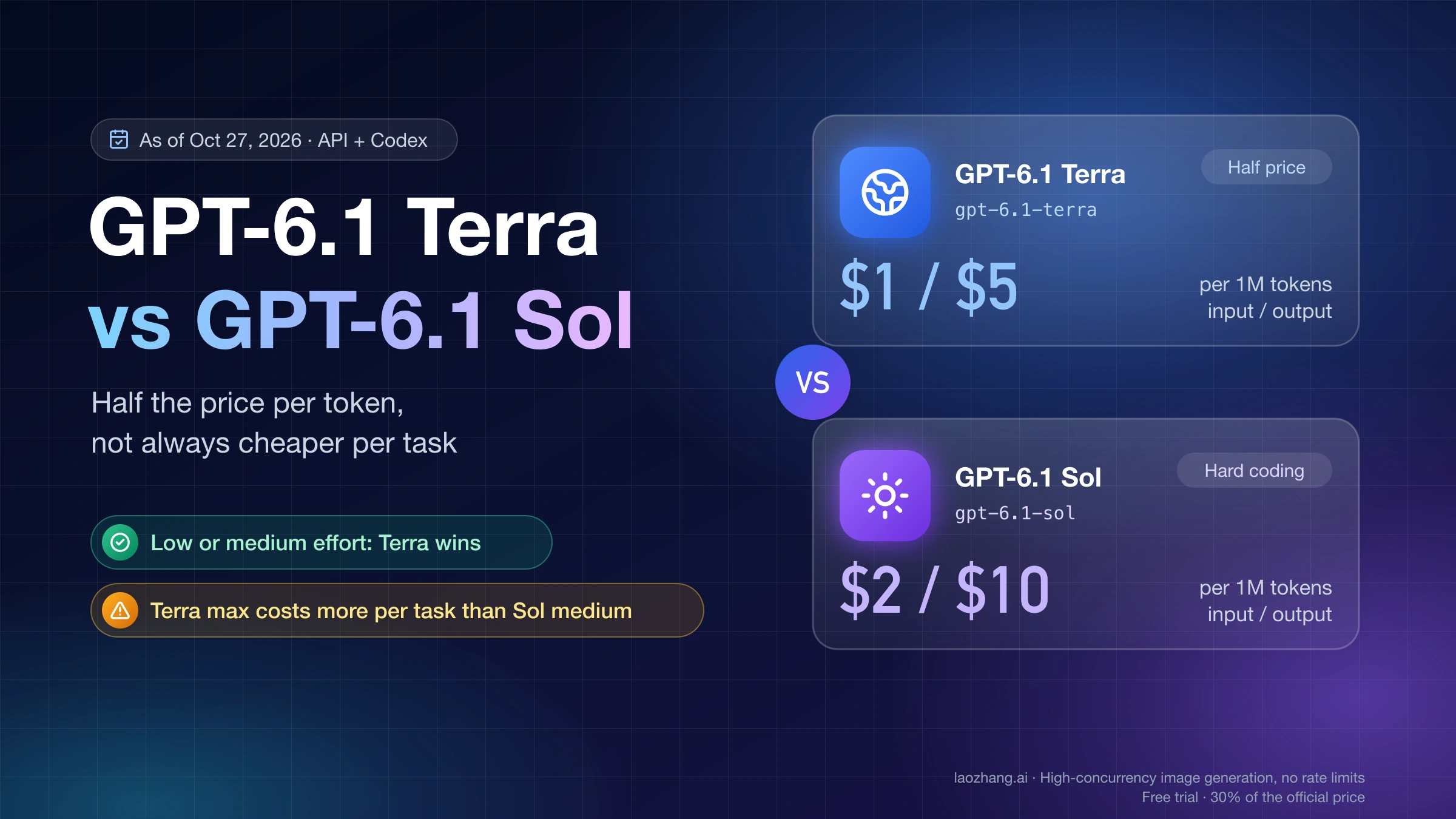
No. GPT-6.1 Terra (gpt-6.1-terra), released on October 26, 2026, is a newer model priced at $1 input and $5 output per 1M tokens on the Standard API. GPT-5.6 Terra (gpt-5.6-terra) is the older model at $2 input and $12 output, both on the OpenAI API pricing page as of October 27, 2026. Use the full model ID in configuration and when you read comparisons, because pages about "Terra" from before late October 2026 describe GPT-5.6 Terra.
Do Opus 5.5 and GPT-6.1 Terra have the same context window and output limit?
Close to it. As of October 28, 2026, GPT-6.1 Terra accepts 1.05M tokens of context and Claude Opus 5.5 accepts 1M, and both allow up to 128K output tokens per response on their vendors' APIs. Terra takes text and images as input and returns text, with a knowledge cutoff of June 1, 2026. The prices differ more than the windows: Terra's long-context rate applies once a request passes 272K input tokens, while Opus keeps one rate across its whole window.
Sources4
External pages this guide links to, in the order they appear. Last updated Oct 28, 2026.
Sources4
External pages this guide links to, in the order they appear. Last updated Oct 28, 2026.
- 1.GPT-6.1 Terra launch postopenai.com/index/introducing-gpt-6-1-terra
- 2.Artificial Analysis release comparisonartificialanalysis.ai/models/releases/comparisons/claude-opus-5-5-vs-gpt-6-1-terra
- 3.OpenAI API pricing pagedevelopers.openai.com/api/docs/pricing
- 4.Claude API pricing pageplatform.claude.com/docs/en/about-claude/pricing