Claude Opus 4.7 vs GPT-5.4 vs Gemini 3.1 Pro: API Costs and Capabilities
Compare the three APIs by input formats, context limits, tools, and request costs. Worked pricing examples show why the cheapest model changes with prompt size.
On this page
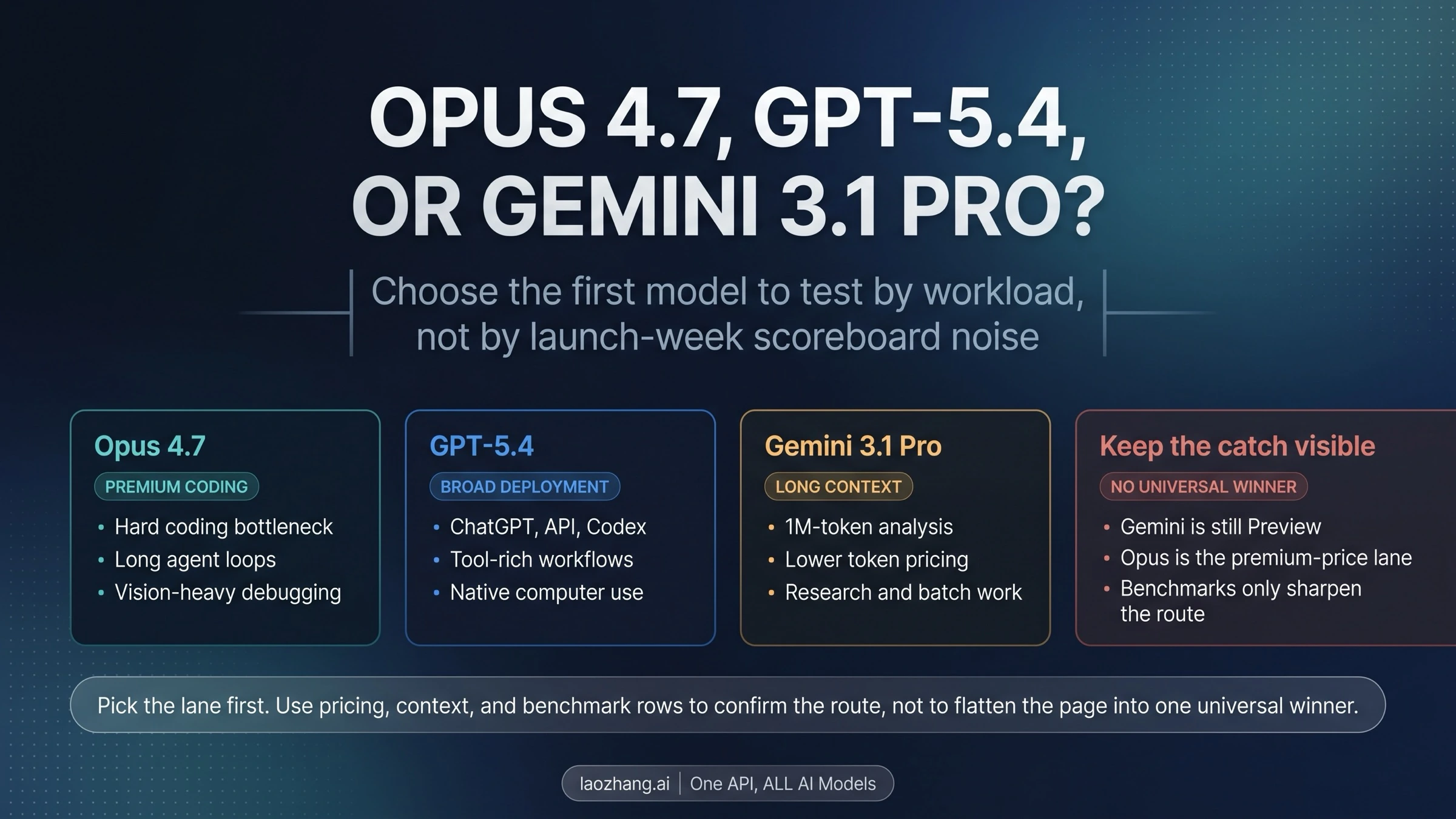
For API developers, the useful differences between Claude Opus 4.7, GPT-5.4, and Gemini 3.1 Pro are the inputs they accept, the tools your application needs, and what happens to the bill when a request crosses a pricing threshold. All three support large contexts. That alone does not establish which one solves your task most reliably.
The cost ranking can even change before you change the task. With 100,000 input tokens and 10,000 billed output tokens, the token-only estimates are $0.75 for Opus, $0.40 for GPT, and $0.32 for Gemini. At 250,000 input tokens with the same output, GPT costs less than Gemini because Gemini has crossed its long-input pricing threshold and GPT has not.
This comparison covers these exact API models using official documentation checked September 7, 2026. It does not report independent performance or latency measurements, or compare ChatGPT, Claude, and Gemini subscriptions.
Check whether the API can handle your workload
Start with requirements that can rule out a model before spending money on a quality evaluation.
| API detail | Claude Opus 4.7 | GPT-5.4 | Gemini 3.1 Pro |
|---|---|---|---|
| Model ID | claude-opus-4-7 | gpt-5.4 | gemini-3.1-pro-preview |
| Documented context or input limit | 1M-token context window | 1,050,000-token context window | 1,048,576 input tokens |
| Maximum output | 128,000 tokens | 128,000 tokens | 65,536 tokens |
| Inputs listed for the model | Text and images | Text and images | Text, images, video, audio, and PDFs |
| Output modality | Text | Text | Text |
| Integration details to check | Adaptive thinking; tool definitions and results contribute to token usage | Responses, Chat Completions, and Batch; tool availability depends on the endpoint | Function calling, code execution, search grounding, and structured outputs; preview status |
Sources: Anthropic's Opus 4.7 overview, OpenAI's GPT-5.4 model documentation, and Google's Gemini 3.1 Pro Preview model documentation. Anthropic currently lists this specific Opus version as active but legacy; Gemini's exact API identifier remains a preview model. These are version-specific comparisons, not claims that the three are each provider's newest offering.
A context window and an input limit describe different constraints. Do not assume that a quoted million-token context leaves another 128,000 tokens available for output. Reserve space according to the provider's request rules, including conversation history, tool responses, and the output budget. A large accepted request also says nothing by itself about whether the answer uses distant passages correctly.
Gemini's documented audio and video inputs make it a candidate when you need the model to analyze those formats directly. Its text output does not imply audio or image generation: the model page lists neither generation mode nor Live API support. A workflow that first transcribes audio or samples video frames is a different pipeline and should include those steps in its cost and quality comparison.
For tool-based applications, verify the actual combination you plan to call. GPT-5.4 supports function calling, and its model page lists built-in tools such as web and file search for the Responses API. Check the endpoint before assuming those tools are available through another interface. Google's model page marks file search for Gemini 3.1 Pro as AI Studio only, so it is not evidence that the same capability is available through your production API request. Google's separate customtools variant prioritizes custom tools; it should be evaluated as a separate configuration rather than assumed to improve every task.
Compare the price of your request, including the input threshold
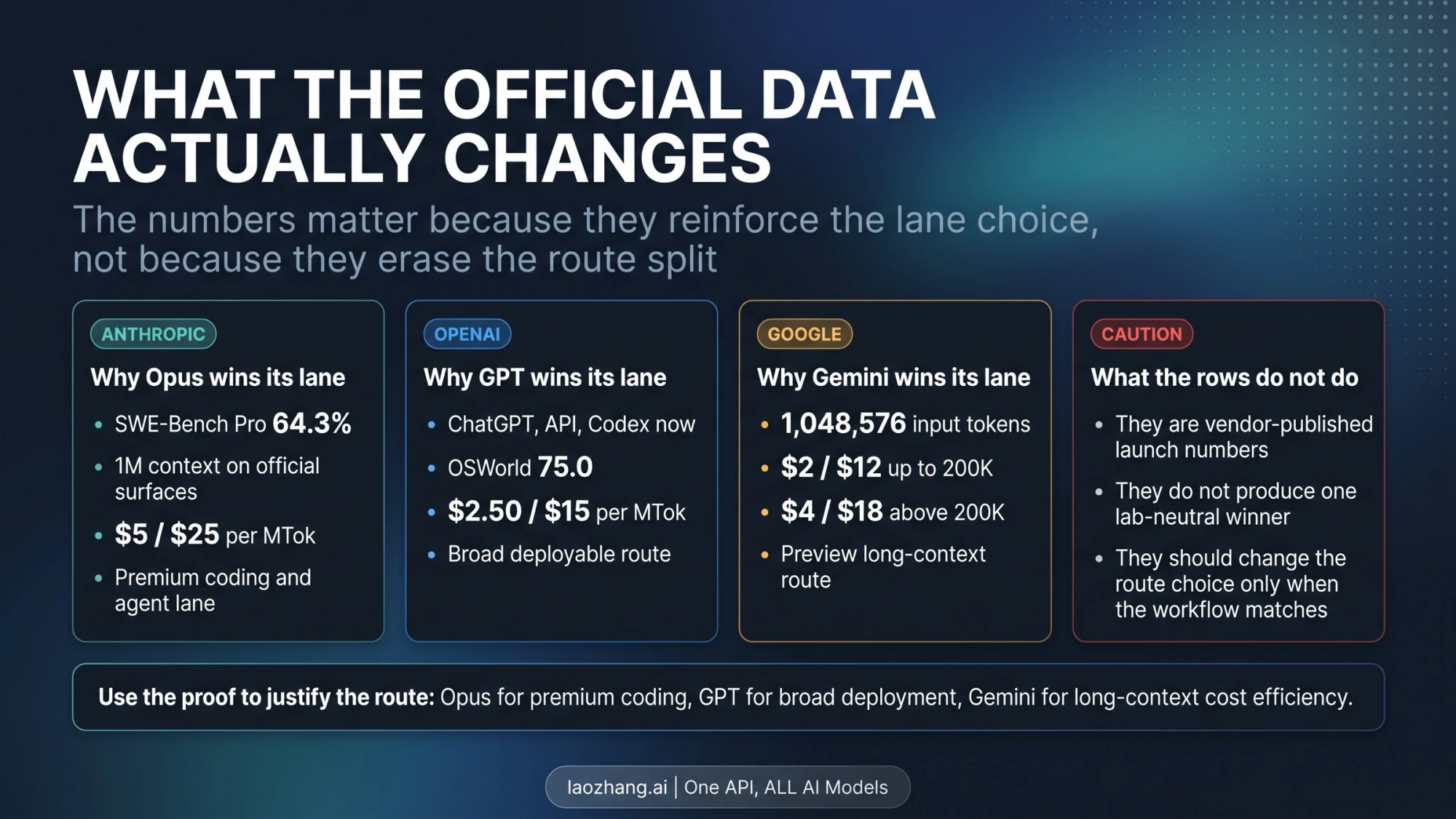
The following rates are in US dollars per million tokens for standard, uncached API usage. They exclude tools, storage, and other charges.
| Model and input size | Input | Billed output |
|---|---|---|
| Claude Opus 4.7, within its supported context | $5.00 | $25.00 |
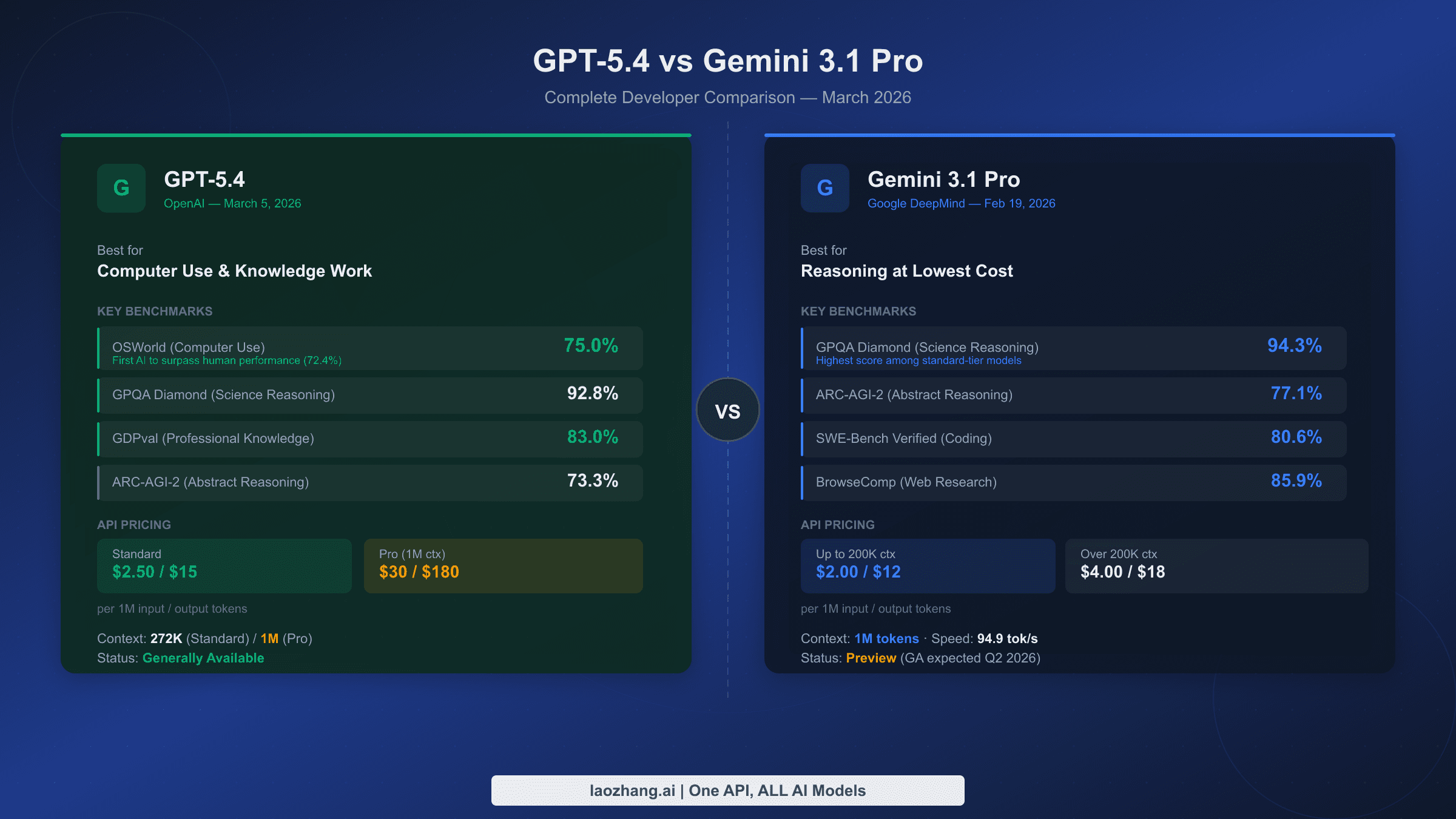
| GPT-5.4, up to 272K input tokens | $2.50 | $15.00 |
| GPT-5.4, above 272K input tokens | $5.00 | $22.50 |
| Gemini 3.1 Pro, up to 200K input tokens | $2.00 | $12.00 |
| Gemini 3.1 Pro, above 200K input tokens | $4.00 | $18.00 |
Anthropic documents standard pricing throughout the full 1M context for Opus 4.6 and later in its API pricing guide. GPT-5.4's current model documentation lists its base rates and specifies that requests above 272K input tokens apply double input pricing and 1.5 times output pricing for the full session. Google's Gemini API pricing page supplies the two Gemini tiers and specifies that output pricing includes thinking tokens.
The thresholds are not marginal brackets. Do not charge the lower rate for the first 200K Gemini input tokens and the higher rate only for the remainder. Likewise, GPT-5.4's documented full-session multiplier is not just a surcharge on tokens beyond 272K. Both the input rate and the output rate change under the applicable long-input rule.
For a simple request with no caching or additional charges:
Estimated token cost =
  (input tokens × applicable input rate
   + billed output tokens × applicable output rate) / 1,000,000
Three examples that change the cost ranking
These are calculated scenarios, not observed bills or model tests. Each assumes the model reports the input count shown and 10,000 billed output tokens. There is no caching, Batch or Flex discount, regional surcharge, tool fee, or tax in the calculation.
| Input tokens per model | Opus 4.7 | GPT-5.4 | Gemini 3.1 Pro | Lowest token-only estimate |
|---|---|---|---|---|
| 100,000 | $0.750 | $0.400 | $0.320 | Gemini |
| 250,000 | $1.500 | $0.775 | $1.180 | GPT |
| 300,000 | $1.750 | $1.725 | $1.380 | Gemini |
At 250K input tokens, GPT's estimate is 0.25 × $2.50 + 0.01 × $15 = $0.775. Gemini has moved to its higher tier, so its estimate is 0.25 × $4 + 0.01 × $18 = $1.18. At 300K, GPT has also crossed its threshold, giving 0.30 × $5 + 0.01 × $22.50 = $1.725.
This is why “Gemini is always cheapest for long documents” is too broad. It has the lowest listed input and output rates in the lower tier, but the result depends on the applicable tier, billed output, and other charges. A cheaper request also need not produce a cheaper accepted result if it needs more retries or manual correction.
Identical files do not produce identical token counts across providers. Even within the Claude family, Anthropic's Opus 4.7 launch notes say its tokenizer can use roughly 1.0–1.35 times as many tokens as Opus 4.6 for the same input, depending on content. Count the actual prompt with each provider's supported tooling, then compare the response's usage and the final bill. Do not apply a flat 30% token adjustment.
Caching and tools need a separate calculation
Caching can change repeated-workload economics, but “cached input price” is not a complete cost model. Anthropic lists Opus 4.7 cache reads at $0.50 per million tokens, five-minute writes at $6.25, and one-hour writes at $10. OpenAI's GPT-5.4 model page lists a $0.25 base cached-input rate; long-input rules still need to be accounted for. Google lists Gemini cache reads at $0.20 or $0.40 depending on the input tier, plus $4.50 per million cached tokens per hour of storage. See the Anthropic, OpenAI, and Google pricing sources for their respective conditions.
Record cache writes, reads, hits, and any storage duration separately. A one-off request cannot be priced as though every input token were a cache hit. For agents, include tool schemas and returned content in token usage, plus any separately billed search, code execution, or other server-side tool usage. An agent that makes six model calls has a six-call bill, even if the user sees one final answer.
Run an evaluation that can reject a bad answer
The capability table tells you which models are eligible. Your own acceptance criteria determine which one to keep. Vendor benchmarks can help generate hypotheses, but different prompts, reasoning settings, tools, and evaluation environments do not establish a controlled three-model result for your application.
For a coding comparison, choose a small set of real issues with a known starting commit and a verifiable expected behavior. For example, use a previously resolved CSV import defect: quoted commas and embedded newlines must parse correctly, malformed records must return the documented error, and existing import behavior must still pass its regression tests. Preserve those acceptance tests outside the model's writable workspace so a patch cannot pass by weakening them.
Use the same starting code, task description, allowed tools, dependency environment, time limit, and retry budget for each candidate. Start each attempt in a clean checkout. Configure each API using its supported controls and record the settings; providers' reasoning options are not interchangeable just because the names sound similar.
For every attempt, save a compact record:
| Record | What to capture |
|---|---|
| Configuration | Exact model ID, returned version if available, endpoint, reasoning settings, output limit, and enabled tools |
| Task result | Acceptance tests passed or failed, regression outcome, and any manual changes needed |
| Resource use | Provider-reported input, billed output, cache usage, tool calls, and number of model requests |
| Delivery | Elapsed time, timeout or error, retries, and final cost including failed attempts |
GPT-5.4 offers the dated snapshot gpt-5.4-2026-03-05 in its model documentation, which can help make a rerun identifiable. Record what the other APIs actually return rather than inventing equivalent snapshot names.
Compute cost per accepted task as total evaluated spend, including retries and failures, divided by the number of tasks that pass the predetermined criteria. Report pass rate and completion time alongside that cost. If no tasks pass, report that directly instead of producing a cost-per-success figure. This comparison has no measured results to fill those columns; it gives you a method for collecting them.
For document analysis, replace the coding tests with questions whose answers can be checked against specific passages, plus questions the documents cannot answer. Check whether citations support each answer and whether the model appropriately withholds unsupported claims. Include the full preprocessing pipeline in the evaluation when one candidate needs extracted text and another receives the original media.
Choose the first test from a concrete requirement
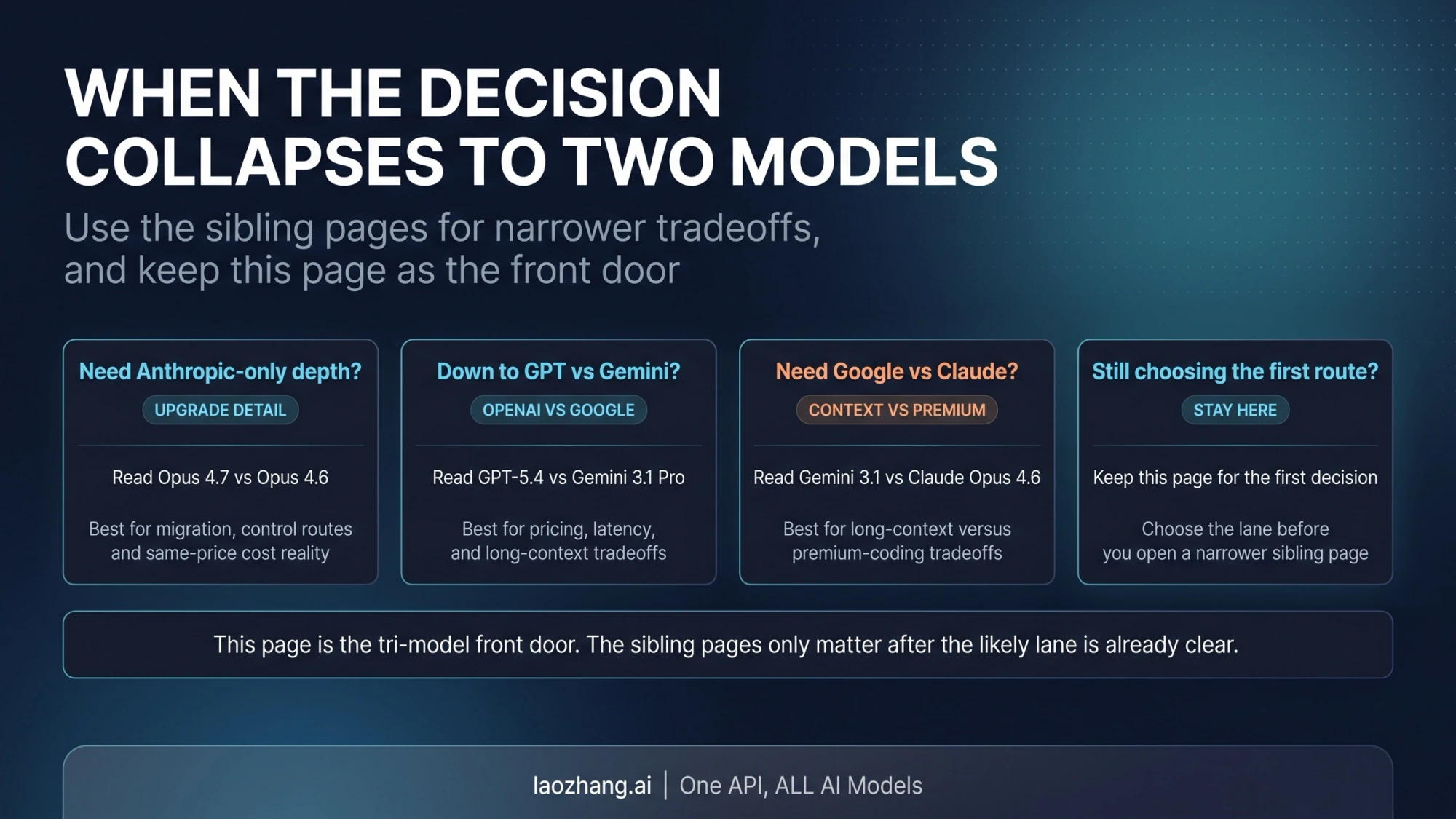
If your task requires direct audio or video input, start by testing Gemini's documented support. If the application already depends on an OpenAI endpoint or built-in tool, first verify that GPT-5.4 supports the required combination. If you are upgrading an existing Claude workflow, compare Opus 4.7 with your working baseline, including the tokenizer's effect on spend. The Opus 4.7 vs Opus 4.6 migration comparison addresses that narrower decision.
When all three satisfy the requirements, use your actual prompt-size distribution to prioritize trials. The 250K example shows why a request near a price threshold deserves its own test case. Then select on accepted results within your cost and time budget. Neither a million-token limit nor a higher list price proves better coding, reasoning, or factual accuracy.
If the choice has narrowed to OpenAI and Google, continue with the GPT-5.4 vs Gemini 3.1 Pro comparison. For Gemini access, Google's pricing page lists no free API tier for this model; testing in AI Studio is a separate offering. The Gemini 3.1 Pro Preview access guide covers that distinction and setup.
Sources6
External pages this guide links to, in the order they appear. Last updated Sep 7, 2026.
Sources6
External pages this guide links to, in the order they appear. Last updated Sep 7, 2026.
- 1.Anthropic's Opus 4.7 overviewplatform.claude.com/docs/id/models/opus-4-7/overview
- 2.OpenAI's GPT-5.4 model documentationdevelopers.openai.com/api/docs/models/gpt-5.4
- 3.Google's Gemini 3.1 Pro Preview model documentationai.google.dev/gemini-api/docs/models/gemini-3.1-pro-preview
- 4.API pricing guideplatform.claude.com/docs/en/about-claude/pricing
- 5.Gemini API pricing pageai.google.dev/gemini-api/docs/pricing
- 6.Opus 4.7 launch notesanthropic.com/news/claude-opus-4-7