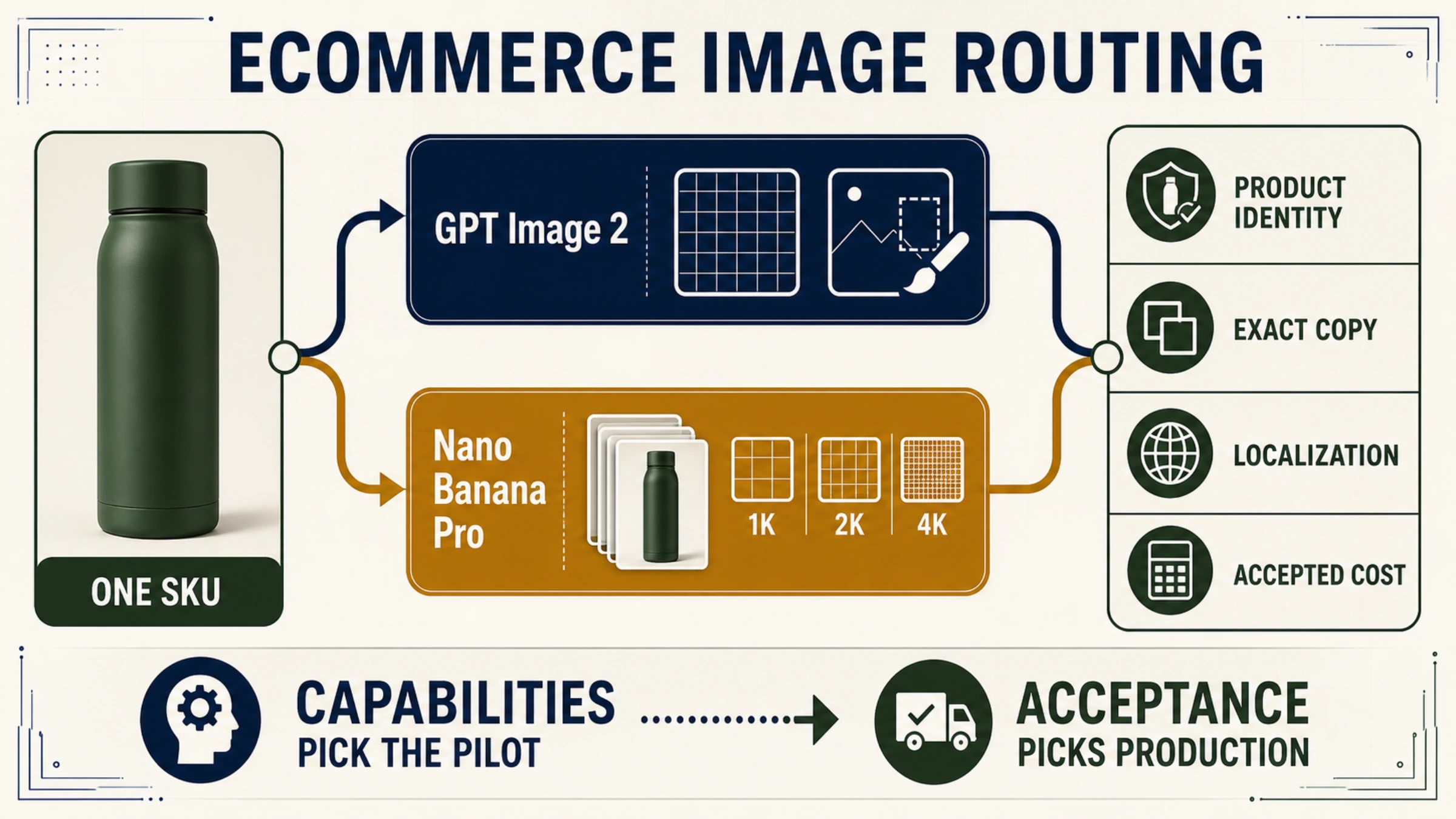
For ecommerce product images, GPT Image 2 is the stronger first test when flexible pixel dimensions, masks, high-fidelity reference processing, or an existing OpenAI integration defines the workflow. Nano Banana Pro is the stronger first test when you need Google's API, declared 1K/2K/4K delivery, many object/character/style references, or Search-grounded visual work. Test both for packaging, exact localized copy, brand masters, and product heroes that are costly to reject.
That is a testing order, not a universal quality verdict. A polished lifestyle image can still be unusable if the product silhouette changes. A beautiful sale banner fails if the price, unit, or claim is wrong. The production winner is the route that preserves the SKU, passes copy and file checks, and stays inside the repair budget.
If your task is the broader image-quality, ChatGPT, and API comparison rather than an ecommerce production decision, use the general Nano Banana Pro vs GPT Image 2 comparison. This page stays scoped to product assets, localization, and listing acceptance.
Choose the first model by the asset that must ship
“Product image quality” hides several independent failures: product identity, material and color, exact text, layout, returned pixels, unintended changes, and human repair. Start with the failure that would force your team to reject the file.
| Ecommerce asset | First test | Hard failures to record |
|---|---|---|
| Product-only or white-background image | Either; favor the API already in your stack | Changed silhouette, cap or port geometry, color, finish, logo outline, unsafe crop |
| Lifestyle scene | Nano Banana Pro for multi-reference composition; GPT Image 2 as the control | Product deformation, implausible contact, hands, reflections, material mismatch |
| Text-callout graphic | Test both | Misspelled copy, invented claims, wrong numbers, logo damage, unusable negative space |
| Product-detail or A+ module | Nano Banana Pro for complex composition; GPT Image 2 for flexible canvases | Broken hierarchy, wrong relations, small-screen illegibility, inconsistent modules |
| Market localization | GPT Image 2 for narrow edits; test Pro when many visual references matter | Copy change redraws the product, unit/decimal errors, overflow, wrong market version |
| Revision of an approved asset | GPT Image 2 when a mask can isolate the change | The requested edit lands, but untouched regions drift |
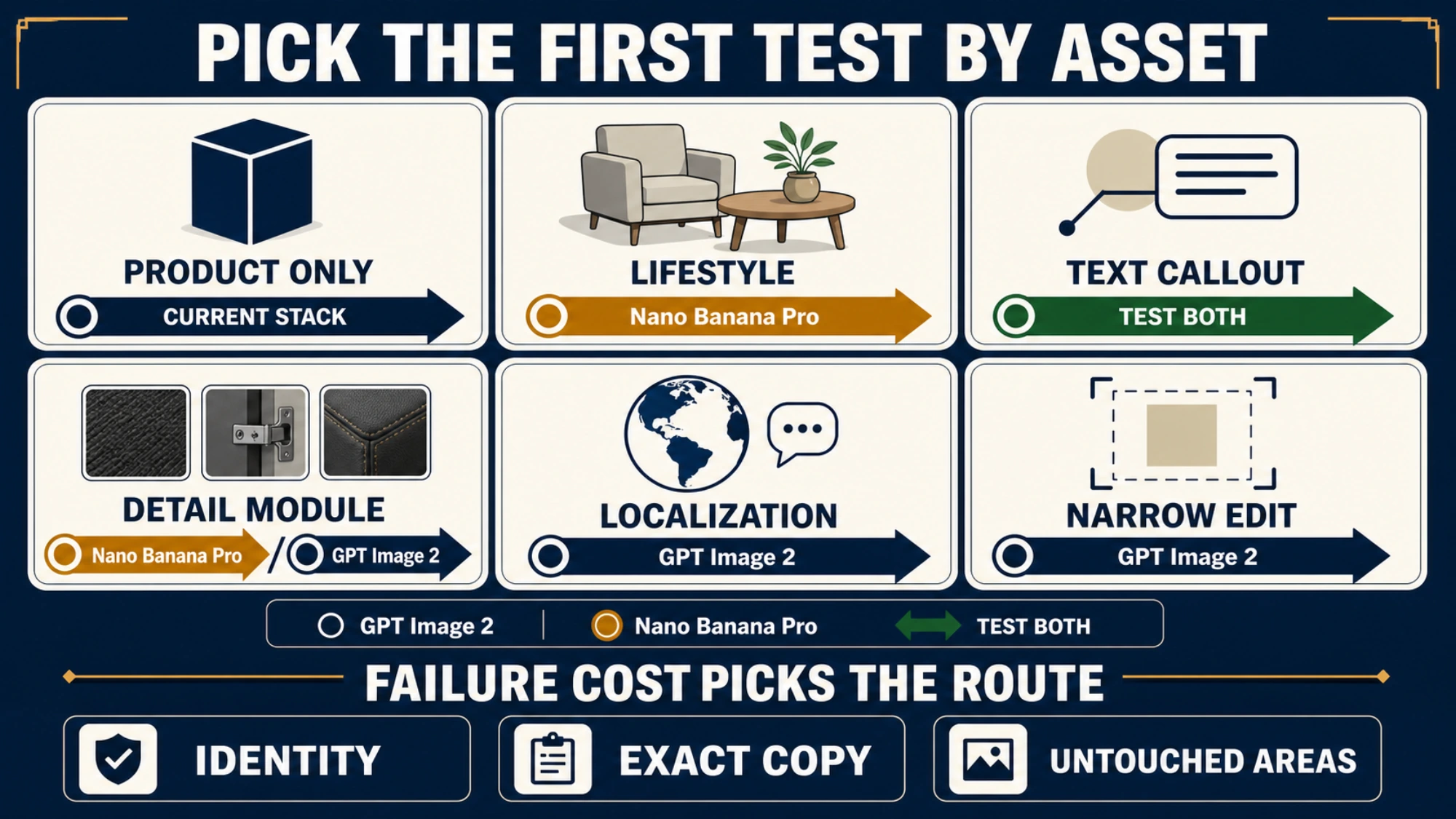
The table is not a scorecard. Product-only images can fail on geometry even when they look clean. A text graphic can look more premium yet fail on one digit. Write those hard failures before opening either API so a lucky beauty shot cannot move the standard.
What GPT Image 2 gives an ecommerce workflow
OpenAI's current model page identifies the direct API model as gpt-image-2, with snapshot gpt-image-2-2026-04-21. It supports generation, edits, flexible sizes, and high-fidelity image inputs. This says which model and controls you are testing; it does not say that ChatGPT's consumer image experience uses the same contract or that a product reference will always remain exact.
The flexible size contract matters when a listing, ad network, or storefront needs a precise canvas. OpenAI's output guide lists popular examples from 1024×1024 through 3840×2160 and accepts other sizes that meet its pixel rules. Quality can be low, medium, high, or auto. Outputs above 2560×1440 total pixels are still labeled experimental, so a successful 4K-shaped request is not proof that every final asset is production-safe. Inspect the returned file, not the prompt.
For reference-driven edits, gpt-image-2 processes every image input at high fidelity. This makes it a sensible pilot for replacing a background, changing one colorway, or updating a localized panel from an approved product image. It can also increase image-input token use. High-fidelity processing is a technical behavior, not a guarantee that the bottle cap, label, logo, or reflections will remain unchanged.
There is also a clean stop rule for transparent catalog assets: the direct API does not currently support background: "transparent" for gpt-image-2. Do not treat “transparent background” in the prompt as an alpha-channel contract. Use a route that explicitly supports transparency or generate against a controlled key color and remove it deterministically.
What Nano Banana Pro gives an ecommerce workflow
Google identifies Nano Banana Pro's stable model as gemini-3-pro-image. Google positions it for complex graphic design, high-fidelity product mockups, accurate text, and real-world grounding through Search. Those capabilities make Pro a credible first pilot for composed listing modules and multi-source product scenes; they are vendor positioning, not an independent win over GPT Image 2.
Its reference contract is useful when a scene must combine several approved inputs. Google's image-generation documentation permits up to 14 references for Pro: up to six high-fidelity objects, five characters, and three styles. A team can separate front, side, material, model, and art-direction references instead of forcing everything into one collage. The maximum is not a preservation guarantee; every object, face, label, and relationship still needs review.
Google offers Pro image output in 1K, 2K, and 4K pricing bands, and the current guide says generated images include SynthID. Delivery size and provenance both matter, but neither replaces marketplace rules, rights review, or a file-level quality check. If exact alpha, a rigid template, or pixel-locked untouched regions are requirements, test those directly rather than inferring them from “professional product mockups.”
Build the acceptance test around one SKU
Use a licensed or owned product, not different demos for each model. A fictional insulated bottle called NORTH CUP 750 makes the acceptance logic concrete. Prepare a front reference, side reference, and material close-up. Lock these requirements before generation:
- the silhouette, cap geometry, handle position, and logo outline must remain unchanged;
- the body is matte forest green and the metal rim cannot become plastic;
- the only product name is
NORTH CUP 750; - a callout version must contain exactly “12-hour insulation” and “750 mL,” with no invented certification or environmental claim;
- a 16:9 scene reserves negative space on the right and survives the planned mobile crop;
- a localized edit may change only copy, units, and the approved callout panel;
- manual repair per accepted image must remain below the team's agreed limit.
Run the exact API models with the same references, target canvas, and meaning. Keep the prompt version, source-image version, request ID, requested and returned dimensions, quality, error, billed usage, and repair minutes. Separate product-only, lifestyle, and callout jobs rather than asking one overloaded prompt to solve every variable.
| Acceptance field | Pass condition | Reject when |
|---|---|---|
| Product identity | Geometry, proportions, ports, and logo outline match | The model redesigns the cap, handle, label, or body |
| Material and color | Finish and color remain credible under the target light | Metal becomes plastic or brand color moves outside tolerance |
| Copy and numbers | Every character is correct and no claim is invented | Capacity, duration, currency, decimal, or market claim is wrong |
| Composition and file | Returned pixels, crop, and negative space meet delivery | The image only looks like the ratio or needs destructive cropping |
| Edit stability | Only the requested region changes | Product, shadow, background geometry, or prior edits drift |
| Repair budget | Normal correction fits the agreed minutes | A designer must rebuild type, logo, or product structure |
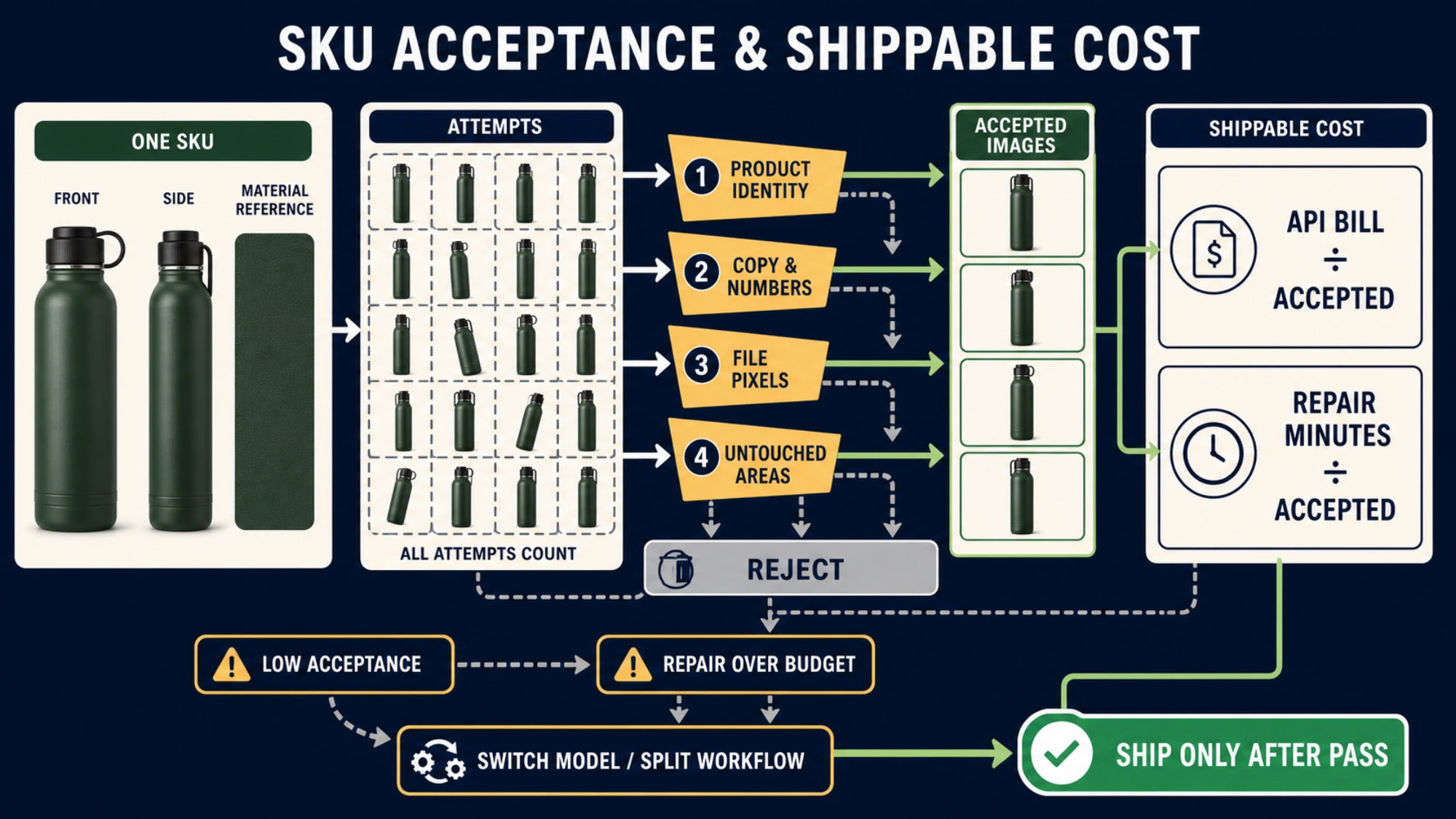
Compare accepted-output cost, not request price
Accepted-output cost means the cost of an image that actually passes listing review. The providers use different units and controls, so OpenAI medium is not a Google 2K equivalent.
OpenAI's current example table estimates 1024×1024 gpt-image-2 image output at $0.006 low, $0.053 medium, or $0.211 high, before text and reference-image inputs. Google's current Nano Banana Pro pricing lists no Standard free tier and image output at $0.134 per 1K/2K image or $0.24 per 4K image, plus applicable inputs, text/thinking output, and grounding.
Keep two metrics visible:
textgeneration cost per accepted image = total billed API cost / accepted images

repair load per accepted image = total review and repair minutes / accepted images
If Route A costs $0.36 across six attempts and accepts three, generation cost is $0.12 per accepted image. If Route B costs $0.72 and accepts five, it is $0.144. Route A looks cheaper until its accepted images each need 18 minutes of repair and Route B needs three. Convert labor to money only with a documented loaded hourly rate; otherwise keep dollars and minutes separate.
Use failure-specific stop rules
- Product identity keeps drifting: switch models. If both fail, generate only the environment and composite the approved product photography.
- Exact copy or numbers fail: generate a text-free background and add price, claim, unit, and legal text through a design system.
- Narrow edits damage untouched regions: restart every market version from the approved source, not from a drifted intermediate; use a mask or deterministic editor if needed.
- Returned pixels or alpha miss the file contract: change the workflow. Visual sharpness is not proof of dimensions or transparency.
- Repair exceeds the budget: reject the route even if one attempt is attractive or cheap.
- The upstream model is unclear: a third-party service cannot support a public model verdict unless it establishes model mapping, parameters, failure billing, and data handling.
The next action is a controlled pilot with one authorized SKU, one target market, one canvas, exact copy, and written rejection conditions. Use gpt-image-2 and gemini-3-pro-image under their direct contracts, then stop when one route meets the required acceptance rate, file contract, and repair budget. For implementation, continue with the GPT Image 2 API guide; for Google's image family boundaries, use the Gemini image model comparison.