GPT Image 2 vs Nano Banana Pro: Which API Should You Test First?
There is no proven universal quality winner. Compare the exact API models on four repeatable tasks, then choose by accepted-output cost rather than one attractive sample.
On this page
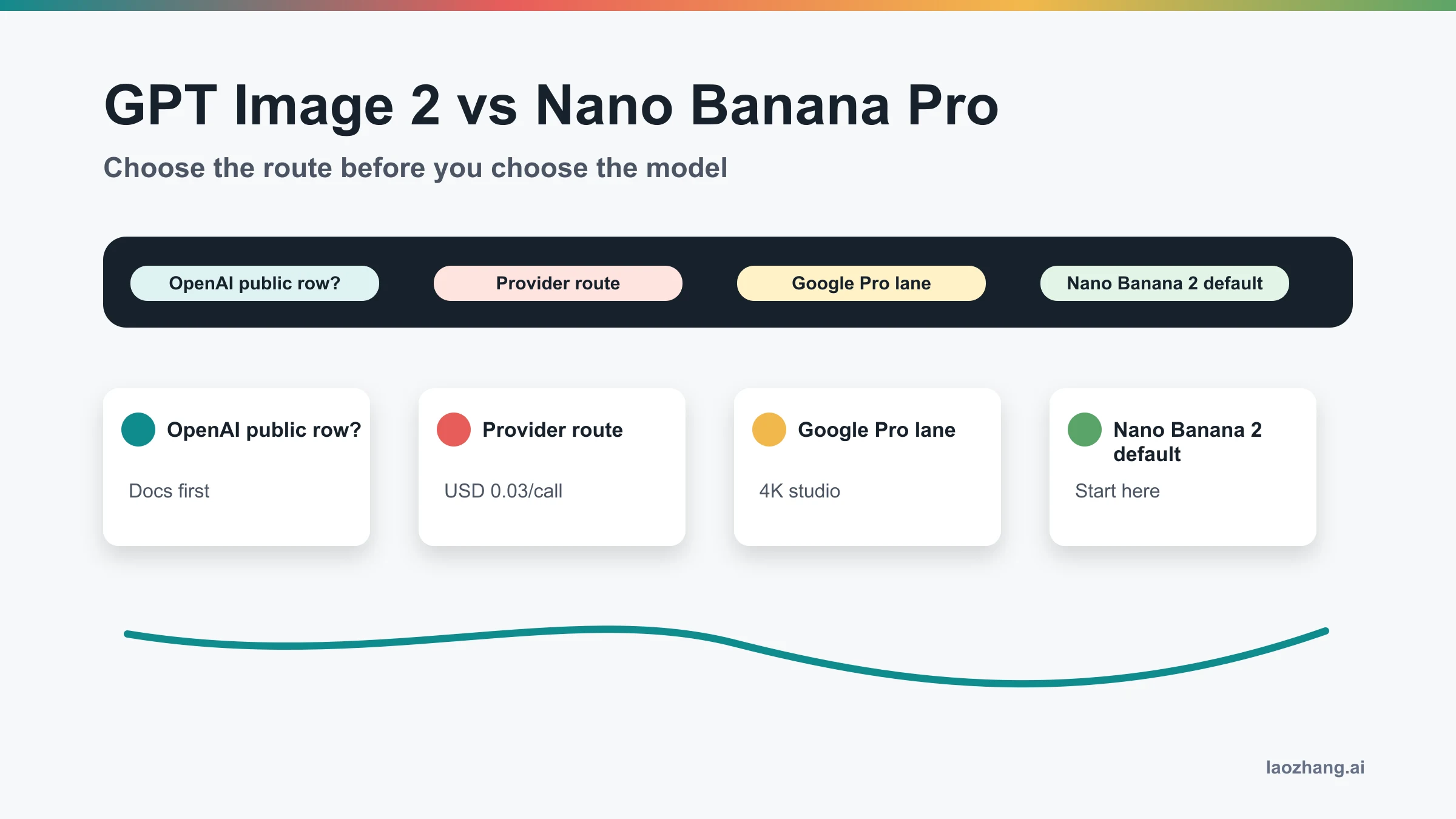
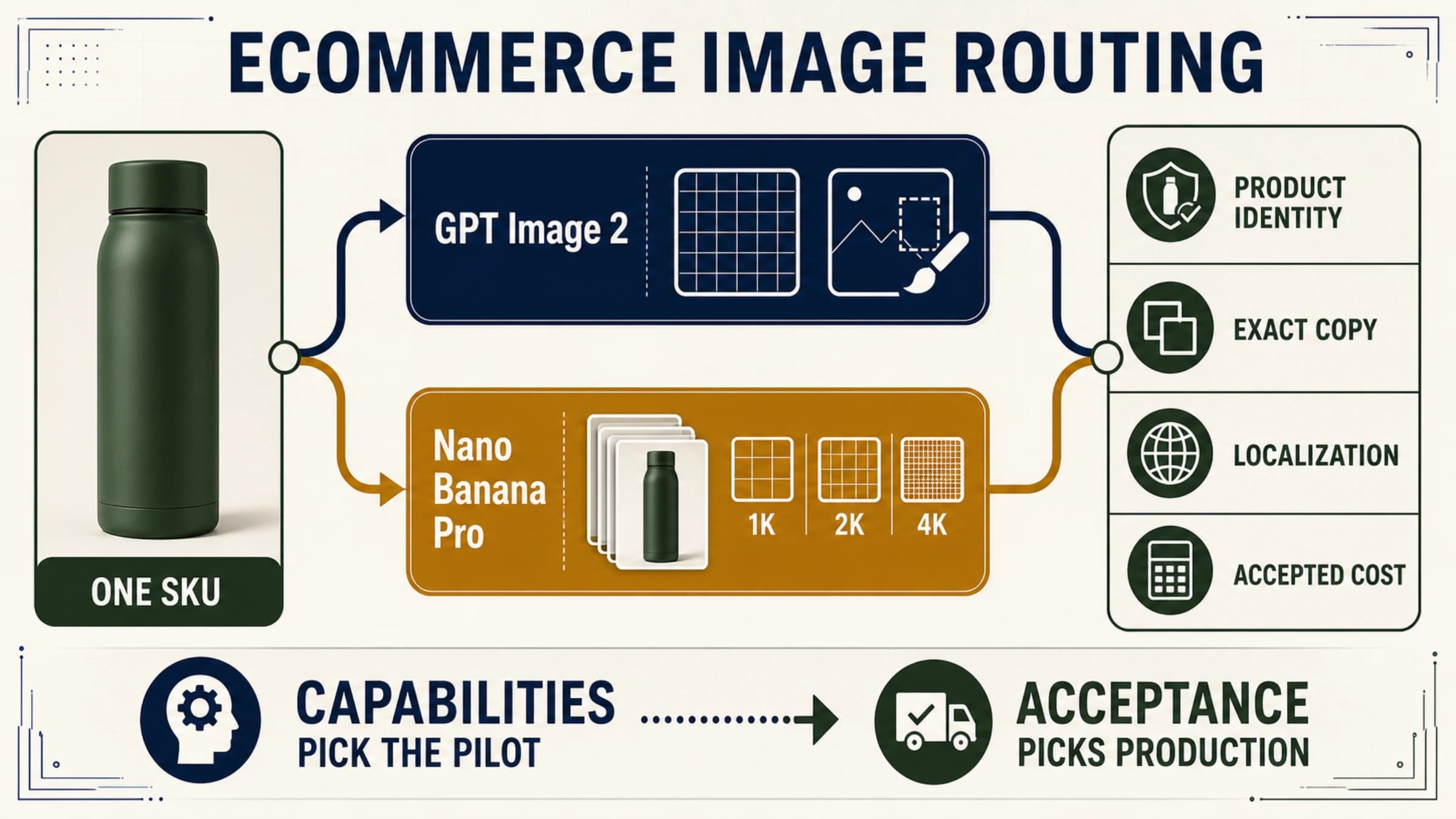
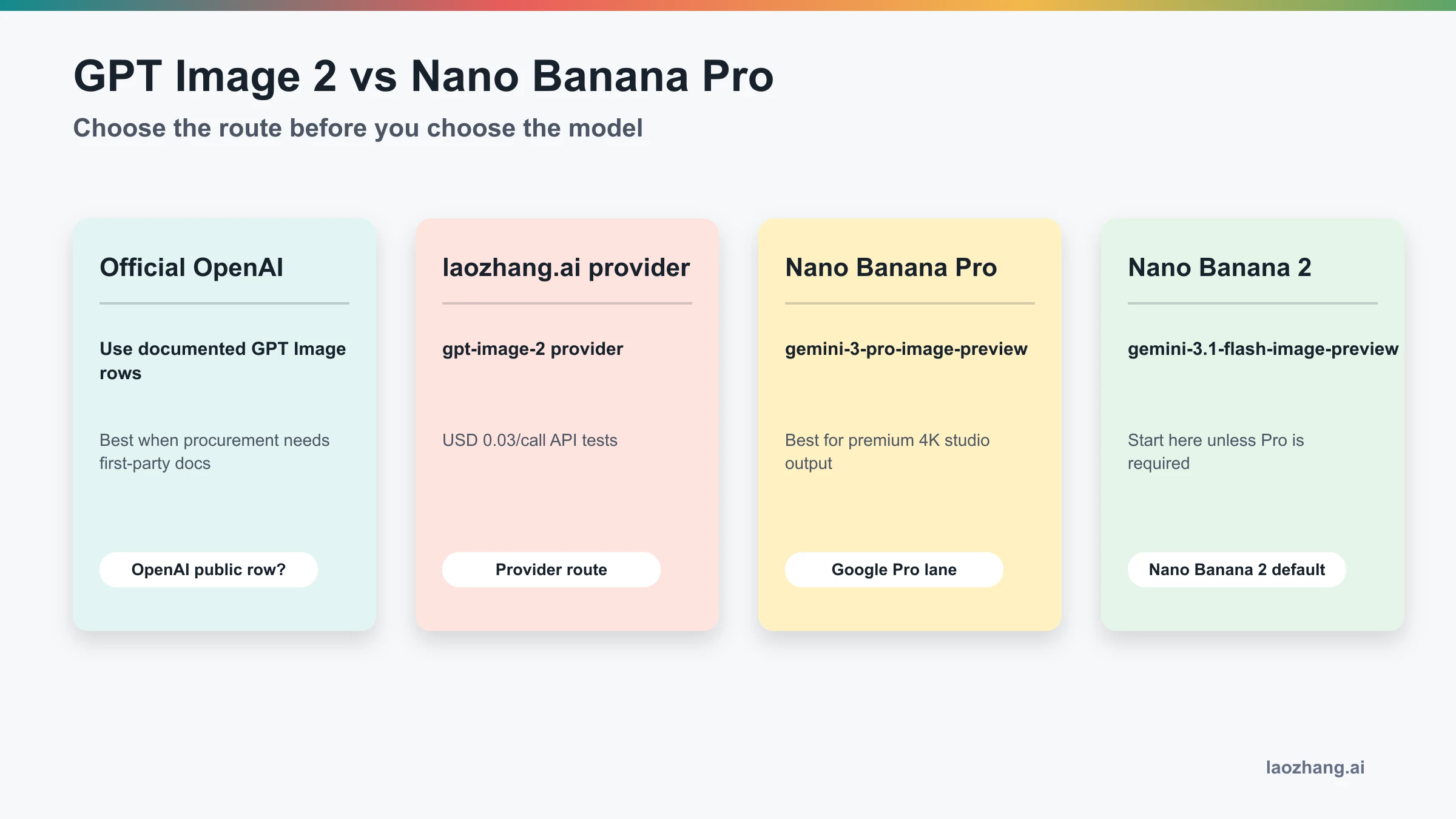
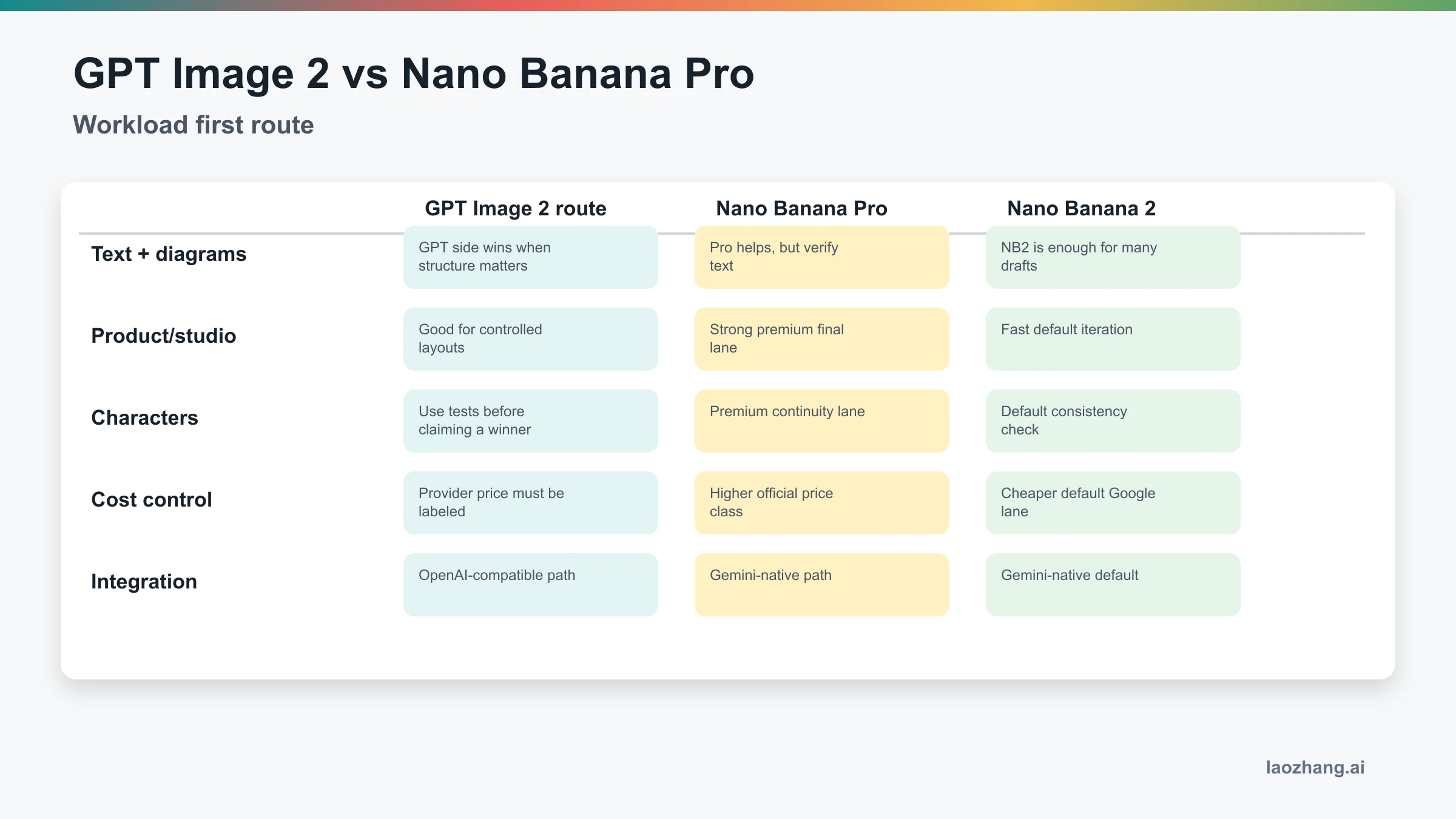
GPT Image 2 vs Nano Banana Pro has no proven universal quality winner. Start with GPT Image 2 when the official OpenAI API, flexible pixel dimensions, masks, or high-fidelity reference inputs define the workflow. Start with Nano Banana Pro when a Google-native route, declared 1K/2K/4K output, many reference images, Search grounding, or a complex multilingual design is the requirement. If the decision is about realism, text, layout, or edit consistency, test both exact models at least three times on the same brief and choose by accepted-output cost.
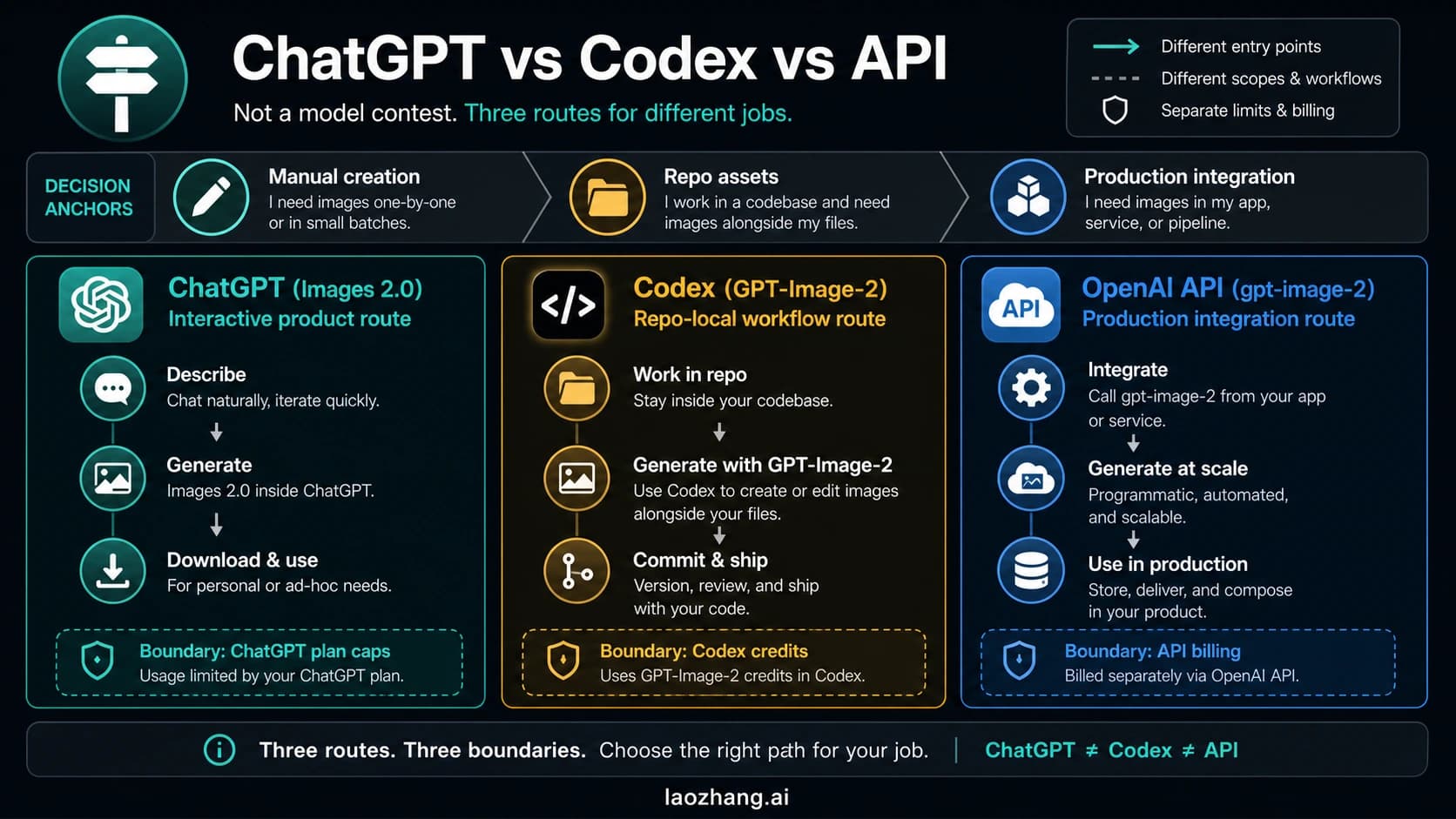
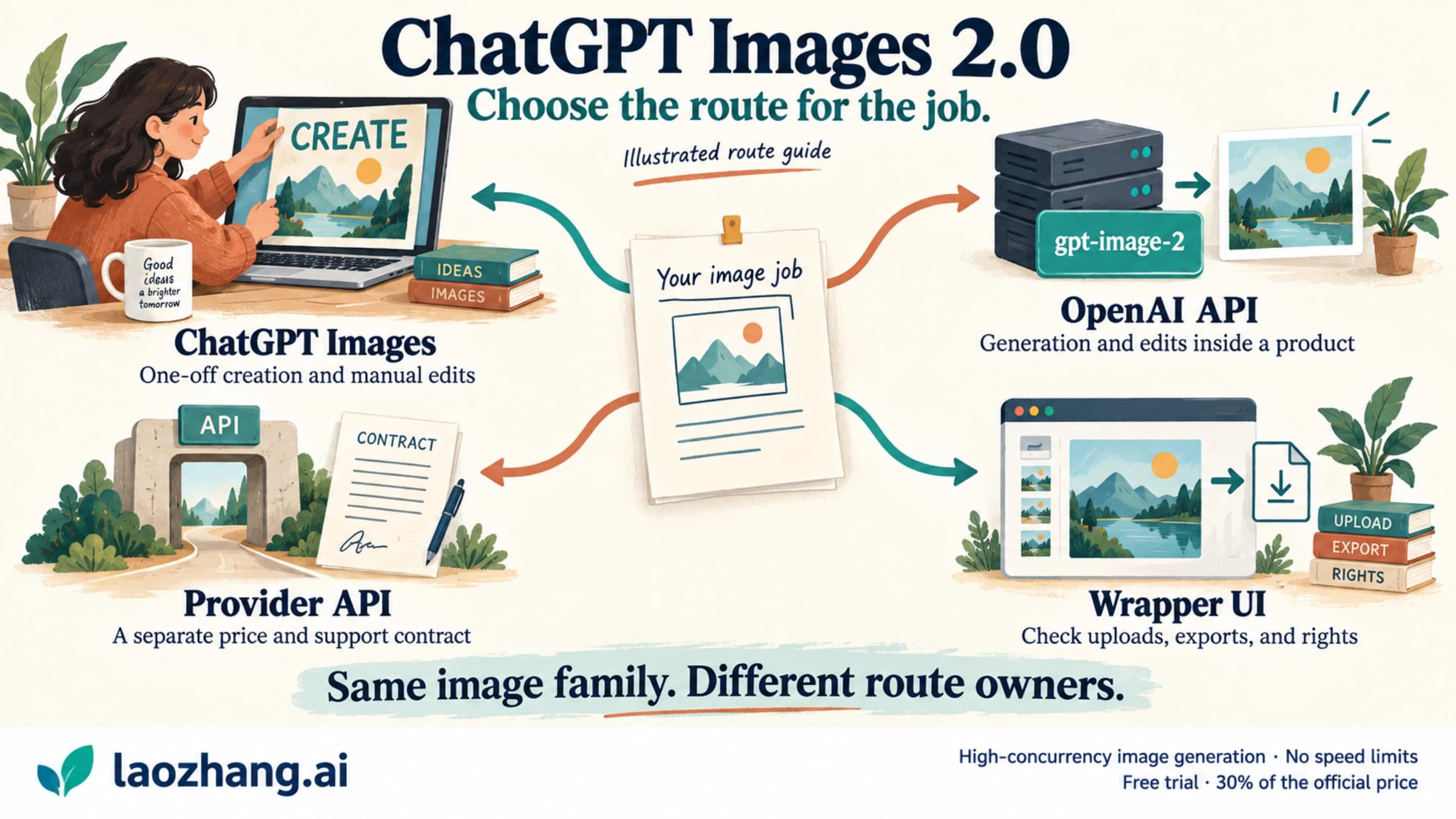
One identity correction comes first. ChatGPT Images 2.0 is a consumer product surface; gpt-image-2 is an OpenAI API model. Their access, controls, limits, and billing are not interchangeable. Nano Banana Pro is Google's stable gemini-3-pro-image; Nano Banana 2 is a different Flash-tier model. A Nano Banana 2 comparison cannot prove how Nano Banana Pro performs.
| Start with | Best reason to test it first | Switch when |
|---|---|---|
| GPT Image 2 | Your product already uses OpenAI; exact pixel dimensions, quality levels, masks, or high-fidelity image inputs matter. | Text, layout, identity, or final-size acceptance repeatedly misses the written rubric. |
| Nano Banana Pro | You need Google's Pro image route, 1K/2K/4K delivery, Search-grounded visual work, or a complex multi-reference composition. | The output repeatedly fails the exact copy, edit lock, or realism criteria, or Pro's added cost does not reduce repair. |
| Test both | The asset is expensive to reject: localized packaging, a campaign master, a product mockup, a factual infographic, or a recurring character. | One route wins the controlled three-attempt minimum on pass rate, repair minutes, and total billed cost. |
ChatGPT is not an API model name
OpenAI calls its consumer experience ChatGPT Images 2.0. Its release notes describe image generation across ChatGPT plans, while Images with thinking is a paid-plan feature. These are product entitlements, not API credits, and they do not promise a stable daily image count.
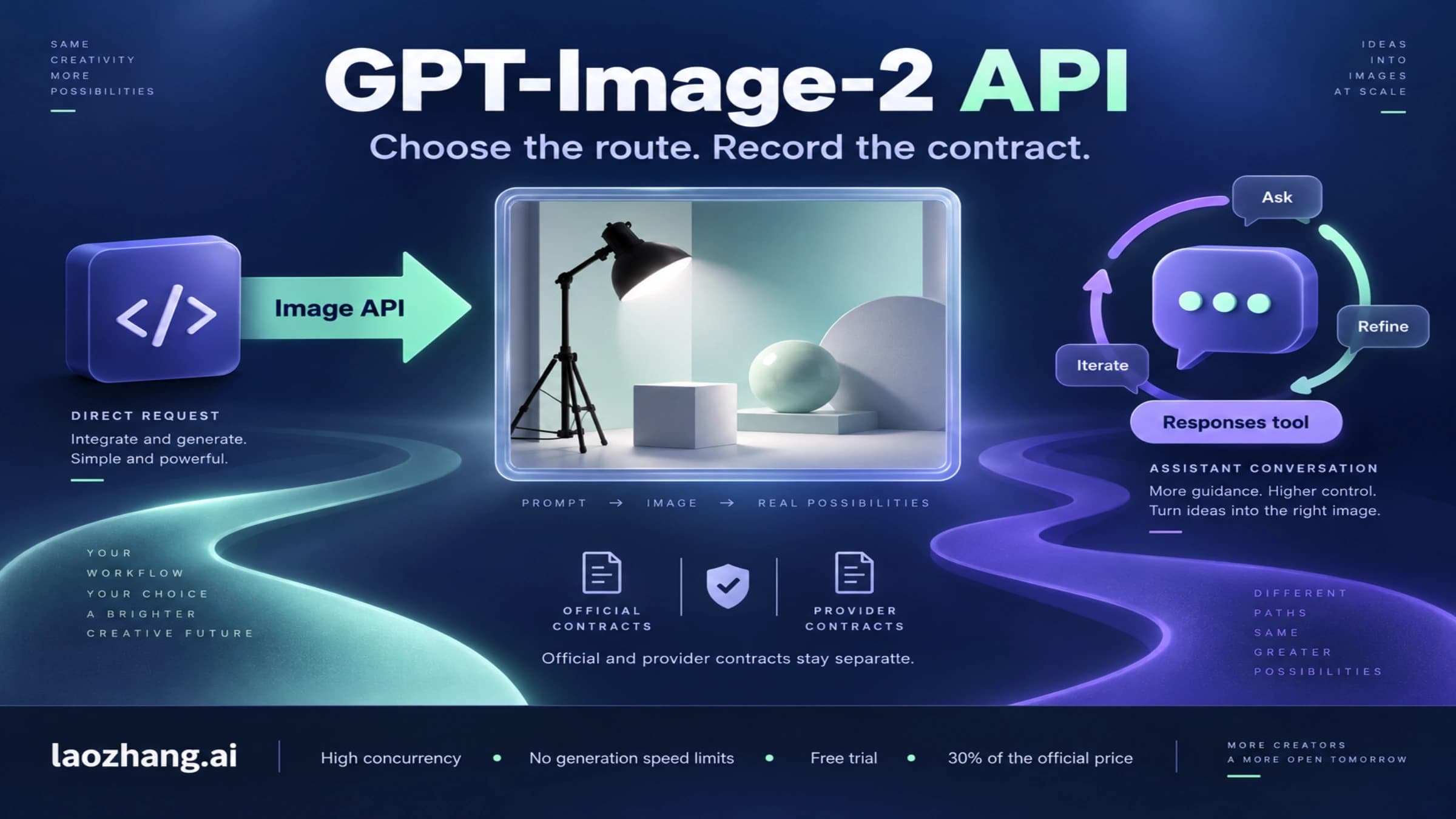
The API contract is different. OpenAI's GPT Image 2 model page identifies gpt-image-2 and snapshot gpt-image-2-2026-04-21. The image-generation guide documents direct generations and edits. Keep the product-surface test separate from an API-model test even when both are useful to your team.
This distinction changes a “Nano Banana Pro vs ChatGPT” decision:
- Choose between consumer products when you care about subscription access, an interactive editor, convenience, and app-level controls.
- Choose between API models when you care about exact model identity, request parameters, logs, rate limits, cost attribution, and repeatable automation.
- Do not use a ChatGPT sample as if it documented the direct
gpt-image-2endpoint. Official pages do not establish that the two surfaces are interchangeable.
The product and API controls can also diverge. ChatGPT can accept arbitrary aspect-ratio and transparent-background requests at the app level. The direct GPT Image 2 API has a documented pixel contract and currently does not support transparent backgrounds. Compare the surface you will actually ship.
Compare the exact two models
Nano Banana Pro is not a loose name for every current Google image model. Google's model page identifies the stable API model as gemini-3-pro-image. Google positions it for complex graphic design, product mockups, factual data visualization, accurate text, and real-world grounding. That is vendor positioning, not an independent win over GPT Image 2.
Nano Banana 2 belongs to a separate Flash-tier route. Search pages and community comparisons often substitute it for Pro, then reuse the result in a “Nano Banana Pro vs GPT” conclusion. Treat those pages as signals about tasks worth testing, not evidence about the exact Pro model.
The same rule applies to third-party quality claims. Current comparison pages disagree about photorealism, typography, layouts, direct-flash lighting, and “production-ready” polish. Those disagreements are useful signals: they tell us to separate prompt adherence from attractiveness and to count failures across repeated runs. They do not establish a winner because routes, settings, reference inputs, retries, and review rubrics are usually different or missing.
What the official contracts establish
Official documentation can define a fair test boundary. It cannot replace the test.
| Contract question | GPT Image 2 | Nano Banana Pro |
|---|---|---|
| Official API identity | gpt-image-2; current documented snapshot gpt-image-2-2026-04-21 | Stable gemini-3-pro-image |
| Output controls | Flexible resolutions within the published pixel rules; low, medium, high, or auto quality | 1K, 2K, and 4K generation; API thinking is always on |
| Editing | Generations, edits, multiple inputs, masks/inpainting; inputs are processed at high fidelity | Image generation/editing with up to 14 references under Google's documented object, character, and style limits |
| Grounding | Not established for the direct model in the cited image contract | Google Web Search grounding is supported |
| Important boundary | More than 2560×1440 total pixels is marked experimental; direct API transparency is unsupported | Requested image count is not guaranteed; generated images include SynthID |
OpenAI's output guide permits a maximum edge of 3840 pixels, requires both edges to be multiples of 16, limits the aspect ratio to 3:1, and documents a total-pixel range. Examples include 3840×2160 and 2160×3840, but output above 2560×1440 total pixels is experimental. “It can request a 4K-sized image” is therefore not the same as “every 4K asset is production-safe.”
Google's image-generation guide documents 1K, 2K, and 4K output for Nano Banana Pro, advanced multilingual text rendering, Search grounding, and up to 14 reference inputs: up to six high-fidelity objects, five characters, and three styles. Those numbers define a supported input contract. They do not guarantee that all references, labels, or identities will survive every generation.
Both vendors also publish limits. OpenAI says complex prompts may take roughly two minutes and that precise text placement, recurring character or brand consistency, and exact layout composition can still fail. Google markets Pro for the same classes of hard work. The honest conclusion is to test the failure that would make your asset unusable.
Run this four-lane quality-to-acceptance test
This page does not claim that we ran a new head-to-head benchmark. Instead, it provides a reproducible test that prevents a one-shot beauty contest from becoming a production decision.
Use the direct, exact API models when model quality is the question: gpt-image-2 and gemini-3-pro-image. Run at least three attempts per model in every lane. Four lanes × two models × three attempts means a minimum of 24 recorded outputs. If you test ChatGPT or Gemini apps instead, treat that as a separate product-surface experiment and do not merge its costs or results into the API model score.
Before starting:
- Fix one review date, target market, canvas, output format, and source-image set.
- Keep prompt meaning and required copy identical. When controls cannot be matched, write down the mismatch.
- Randomize filenames so the reviewer does not see the model name.
- Define hard failures before viewing outputs.
- Preserve every attempt, including policy blocks, timeouts, misspelled text, and unattractive results.
Lane 1: dense English UI and infographic
Use a brief with exact copy and an explicit information flow:
Create a 16:9 editorial infographic titled "How a Support Ticket Gets Resolved."
Show exactly five labeled stages: Intake, Verify, Route, Fix, Confirm.
Use one arrow from Intake to Verify to Route, then branch Route to Fix and Confirm.
Include the exact footer "Owner: Support Operations" and no other readable text.
Use a restrained navy, cream, and amber palette with a clear grid.
Hard-fail an output for a misspelled required label, invented readable copy, a missing stage, the wrong branch, or a layout that cannot be read at delivery size. Record small-type legibility, hierarchy, spacing, and minutes needed to recreate incorrect text in a design tool. This lane separates usable information design from a merely attractive poster.
Lane 2: prompt-faithful realism
Use an original scene where lighting instructions can conflict with a flattering aesthetic:
Documentary night portrait of a rain-soaked bicycle courier at a quiet bus shelter.
Use a hard on-camera flash: bright facial highlights, a sharp shadow behind the subject,
wet pavement reflections, visible fabric texture, and an unretouched candid expression.
Keep the shelter geometry physically plausible. No cinematic fill light or beauty retouching.
Score prompt adherence and perceived realism separately. A polished portrait fails adherence if it removes the hard flash. A faithful flash image still fails realism if anatomy, reflections, shadows, or shelter geometry are implausible. Record both scores; never collapse them into “looks better.”
Lane 3: 16:9 product and brand composition
Create a fictional product brief so trademark familiarity does not decide the output:
Create a 16:9 launch visual for a fictional notebook called "FIELDNOTE ONE."
Show one closed charcoal notebook, one open cream notebook, and a brass mechanical pencil.
The closed notebook must be left of the open notebook; the pencil must cross only the lower-right corner.
Print exactly "FIELDNOTE ONE" and "Built for field research" with no extra copy.
Use soft window light, realistic paper grain, and clear negative space on the upper right.
Reject incorrect product counts, object relations, copy, material behavior, or a composition that needs destructive cropping. Request the actual target size supported by each route and inspect it at delivery resolution. Record crop/upscale work, text repair, material cleanup, and whether the result could ship without rebuilding the layout.
Lane 4: identity-preserving edit
Use the same licensed reference portrait for both routes. Keep the edit deliberately narrow:
Change only the subject's jacket from dark blue to forest green.
Preserve the face, skin texture, hair, expression, body proportions, pose, hands,
camera position, crop, background objects, lighting direction, and depth of field.
Do not add text, accessories, or new objects.
Hard-fail any output that changes identity, expression, hand structure, crop, background geometry, or lighting. Compare the edited image to the reference at matched scale. Record unintended-change count and repair minutes, not just whether the jacket became green.
Record results without inventing a benchmark
For every request, save:
| Field | Why it matters |
|---|---|
| Exact route, model ID, timestamp, endpoint, and region | Prevents model and contract leakage |
| Prompt, source-image hashes, requested and returned dimensions, quality, and format | Makes the run reproducible |
| Request ID, latency, billed usage, and failure state | Separates a pretty sample from an operable route |
| Hard-fail reason, soft observations, and repair minutes | Converts taste into a shipping decision |
| Accepted or rejected after normal review | Supplies the denominator for cost |
Do not publish a model-wide score when only one lane has evidence. Report 0/3, 1/3, 2/3, or 3/3 accepted for each model and lane. Keep visual preference as a note; the production metric is whether the output passes the prewritten requirements.
Calculate accepted-output cost
API sticker prices are not directly comparable because the billing units and quality controls differ.
Use the current OpenAI image cost table at the time of your test instead of copying a stale per-image estimate. Image output, text input, and reference-image input can all contribute to the request bill; the direct GPT Image 2 API does not support the Free tier.
Check the current Gemini API pricing before each batch. Include image input, text/thinking output, grounding where used, retries, and the applicable service tier. A Google 2K label and an OpenAI medium label are not equivalent quality settings.
Use two separate metrics:
generation cost per accepted output =
  total billed API cost across all attempts / accepted outputs

repair load per accepted output =
  total human review and repair minutes / accepted outputs
If labor must be converted to money, document the loaded hourly rate and add it after calculating the two transparent components. Never add dollars and minutes into one unlabeled score.
Example: Route A costs $0.06 per attempt and accepts 2 of 3, so generation cost per accepted output is $0.09. Route B costs $0.12 per attempt and accepts all 3, so its generation cost per accepted output is $0.12. Route A is cheaper on generation, but Route B can still be the lower total-cost route if Route A's accepted images need enough manual repair. This is illustrative arithmetic, not a claim about either model.
Stop rules prevent endless prompt tuning
Set the switch conditions before the first image:
- Three failures of the same hard-fail class: stop paying for prompt synonyms. Switch models, split text into a deterministic overlay, simplify the layout, or move the edit to a design tool.
- Zero accepted outputs in a lane: do not call that route production-ready for the task.
- One accepted output out of three: run a second controlled batch only if the expected value justifies it; do not publish the lucky image as the norm.
- Unmatched controls: if one route cannot reproduce the target canvas or input contract, report the mismatch and make a workflow decision rather than a quality ranking.
- Repair exceeds the agreed budget: reject the route even when the raw image is aesthetically strong.
- Identity or factual errors are high-impact: require human review and deterministic correction; never waive the failure because the image looks polished.
- Product surface is the actual workflow: retest in ChatGPT or Gemini rather than assuming direct-API results transfer to the app.
Once one route reaches the agreed acceptance rate, repair budget, delivery size, and contract requirements, stop testing. More generations can find a prettier outlier without improving production reliability.
Which route should you choose?
Choose GPT Image 2 first when the OpenAI API is already your operating environment, exact pixel controls matter, or the job needs masks/inpainting and high-fidelity image inputs. Its broad size contract is useful, but large outputs retain the official experimental boundary, and text/layout/identity still need review.
Choose Nano Banana Pro first when the Google API is the required route, the task needs its documented 1K/2K/4K modes, many reference roles, Search-grounded visual work, or Google's Pro design workflow. Its official positioning is a reason to pilot it, not proof that it will beat GPT Image 2 on your brief.
Choose ChatGPT Images 2.0 or the Gemini app when the actual job is interactive consumer creation rather than API production. Their plan access and app limits use their own current product rules. Do not turn a subscription into an imagined per-image API price or fixed daily quota.
Choose a third-party gateway only when easier payment, model switching, or a controlled A/B pilot is worth adding another contract. Verify upstream mapping, accepted parameters, billing on failures, logs, data handling, and support ownership. If the route cannot prove the current stable Nano Banana Pro mapping, do not use it to publish a model-quality verdict.
The shortest honest answer is this: use the official contracts to select the first route, then use the four-lane acceptance test to select the production winner. Until those controlled results exist, “Nano Banana Pro is better” and “GPT Image 2 is better” are both larger claims than the evidence supports.
For implementation details, continue with the GPT Image 2 API guide, GPT Image 2 pricing mechanics, ChatGPT versus GPT Image 2 API route guide, Gemini image model comparison, or Nano Banana Pro API key access guide.
Next action: write the pass, repair, and reject criteria before either model creates its first production candidate.
Official documentation
Request parameters, pricing, and billing rules are documented in the LaoZhang API developer docs: Image generation guide.
Disclosure: laozhang.ai is our own service. Its prices are platform pricing, not an independent comparison.
Sources6
External pages this guide links to, in the order they appear. Last updated Aug 3, 2026.
Sources6
External pages this guide links to, in the order they appear. Last updated Aug 3, 2026.
- 1.release noteshelp.openai.com/en/articles/6825453-chatgpt-release-notes
- 2.GPT Image 2 model pagedevelopers.openai.com/api/docs/models/gpt-image-2
- 3.image-generation guidedevelopers.openai.com/api/docs/guides/image-generation
- 4.model pageai.google.dev/gemini-api/docs/models/gemini-3-pro-image
- 5.image-generation guideai.google.dev/gemini-api/docs/image-generation
- 6.Gemini API pricingai.google.dev/gemini-api/docs/pricing