Cheapest Real 4K GPT Image 2 / 2.5 API: $0.03 Native, Tested
As of October 29, 2026, $0.03 per image on LaoZhang API is the lowest price found for native 4K GPT Image 2 and 2.5, at every quality tier, edits included.
On this page
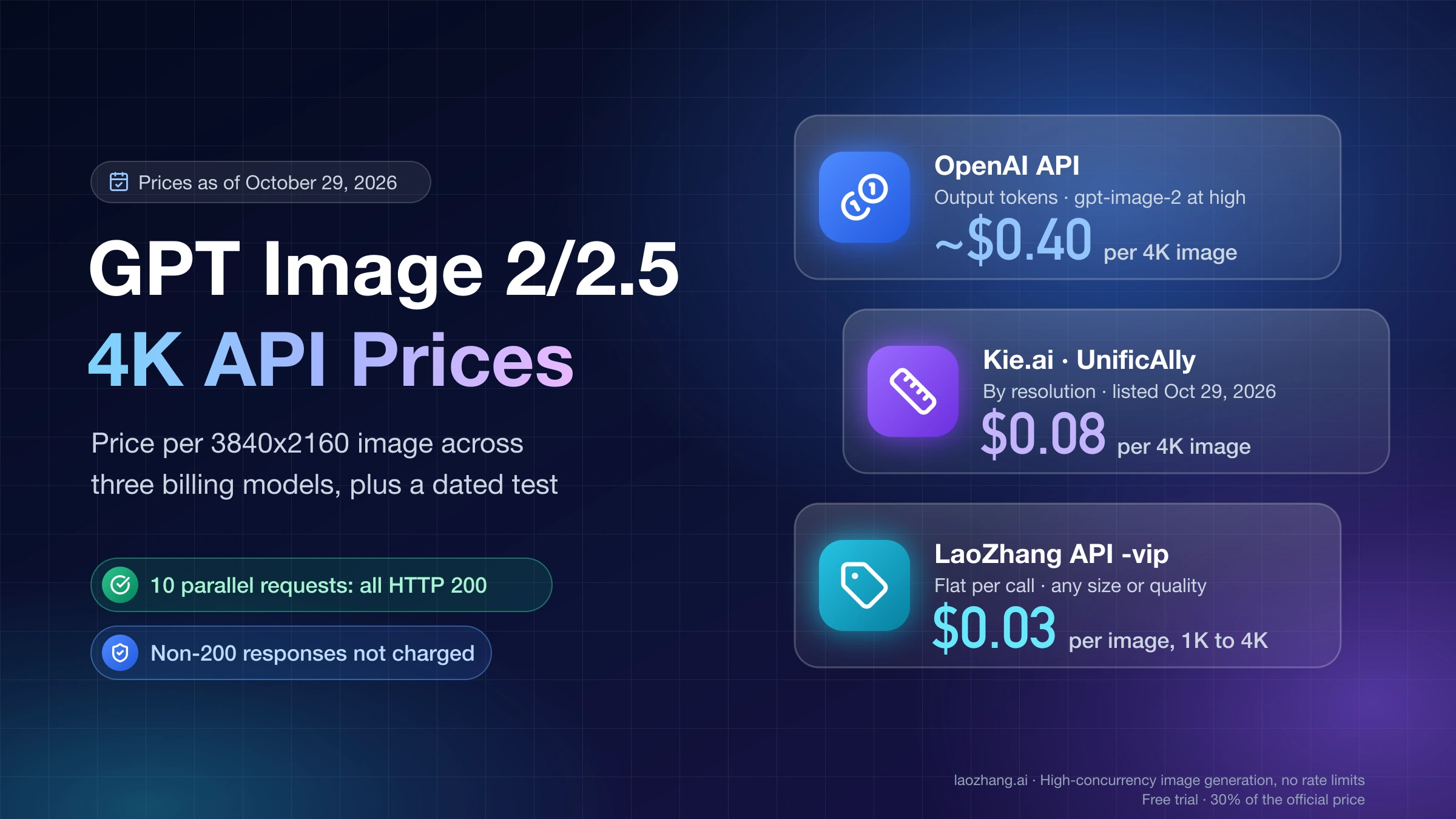
As of October 29, 2026, $0.03 per image is the lowest price for native 4K GPT Image 2 and GPT Image 2.5 among the offers the LaoZhang team has bought and tested and the providers whose own pages state native 4K. That is what LaoZhang API charges for gpt-image-2-vip, gpt-image-2.5-flare-vip and gpt-image-2.5-sunburst-vip at every size from 1K to 4K and every quality tier, edits included. For comparison, OpenAI's API bills a 3840x2160 high GPT Image 2 image at about $0.40 in output tokens, and Kie.ai and UnificAlly, which price by resolution, list $0.08 for a 4K GPT Image 2 image and $0.05 at 2K.
Disclosure: laozhang.ai is our own service. Its prices are platform pricing, not an independent comparison.
Some offers list 4K for less, but the cheaper 4K offers the LaoZhang team tested were either upscaled from about 1.5–1.8K to the 4K size, so the file had 4K pixels without 4K detail, or failed for long periods in October 2026. To get native 4K at $0.03, send POST https://api.laozhang.ai/v1/images/generations with the -vip model ID and an explicit size such as 3840x2160. Without the suffix you get either token billing or a model that ignores size and quality.
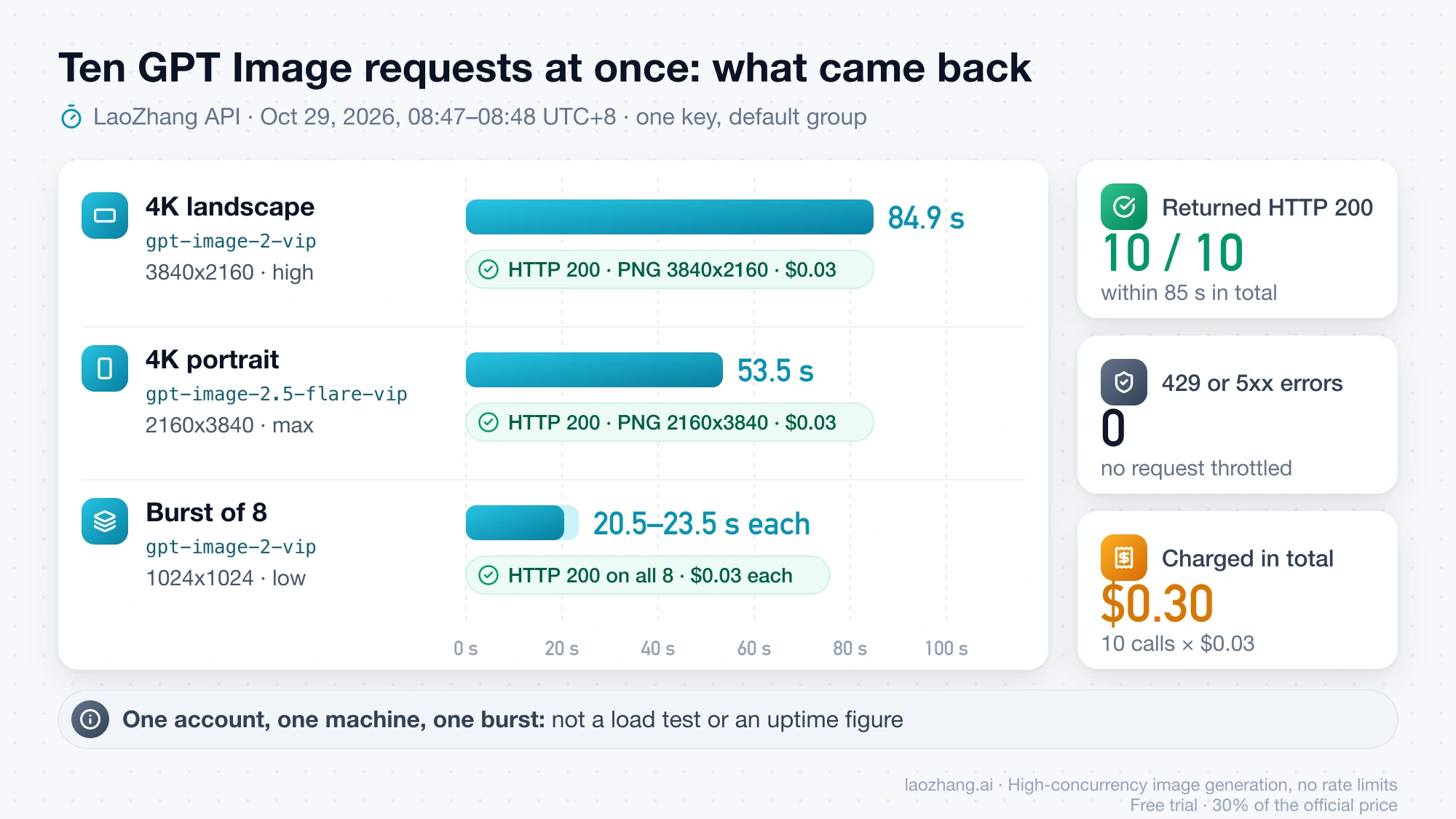
On October 29, 2026, ten requests fired at the same moment from one LaoZhang API account all returned HTTP 200 with no 429, both 4K images came back at their full pixel size, and the usage log showed $0.03 for each image; requests fail over across several upstream lines automatically. Two cases change the choice: if every image you generate is 1K, Kie.ai and UnificAlly also list $0.03, and if your team needs OpenAI's own token billing and usage fields, pay by token on OpenAI directly or through LaoZhang's official forwarding at OpenAI's token price.
GPT Image 2 and 2.5 API prices at 2K and 4K (October 29, 2026)
At 2K and 4K, how a provider bills decides the price more than the provider itself. OpenAI bills output tokens, so a larger image or a higher quality tier costs more. Kie.ai and UnificAlly charge by size only, and their GPT Image 2 pages offer no quality setting. LaoZhang API's -vip models charge one price per call whatever the size or quality. The third-party prices below are as listed on each provider's own page on October 29, 2026.
Disclosure: laozhang.ai is our own service. Its prices are platform pricing, not an independent comparison.
| Provider and model | How it bills | 2K image | 4K image (3840x2160) | Does quality change the price? |
|---|---|---|---|---|
OpenAI API, gpt-image-2 at high | Output tokens, $30 per 1M | $0.42816 (2048x2048) | $0.40026 | Yes: $0.01113 at low, $0.10008 at medium for 4K |
OpenAI API, GPT Image 2.5 Flare at max | Output tokens, $30 per 1M | More than $0.21 | More than $0.21 | Yes: $0.0059 at low up to $0.2107 at max for 1024x1024 |
| Kie.ai, GPT Image 2 | Per image, by resolution | $0.05 | $0.08 | No quality tiers |
| UnificAlly, GPT Image 2 | Per image, by resolution | $0.05 | $0.08 | No quality setting; a resolution field replaces it |
LaoZhang API, gpt-image-2-vip, gpt-image-2.5-flare-vip, gpt-image-2.5-sunburst-vip | Per call | $0.03 | $0.03 | No: the same at every tier |
The OpenAI figures cover output only. A 3840x2160 high image uses 13,342 output tokens, and 13,342 × $30 / 1,000,000 = $0.40026, per the cost table in OpenAI's image generation guide; text input and reference images are billed on top. For GPT Image 2.5, measured max output at 1024x1024 is 7,024 tokens, about $0.21, and larger sizes use more tokens, so 2K and 4K max cost more than that. The Kie.ai and UnificAlly rows come from Kie.ai's GPT Image 2 page and UnificAlly's GPT Image 2 pricing post; both also list $0.03 at 1K. The LaoZhang API row is from the LaoZhang GPT Image 2.5 documentation and the GPT Image 2 documentation.
OpenAI's Batch API halves the output price for jobs that can wait up to 24 hours, which still leaves a 4K high image at about $0.20. Token-by-token costs for every size and tier are in GPT Image 2 API Pricing: Cost per Image, Batch, and $0.03 Calls and GPT Image 2.5 Sunburst Pricing: Official Costs vs $0.03 per Call.
Which GPT Image API option fits your workload?
For batch jobs and user-facing apps that generate 4K or high-quality images in bursts, a flat price per call keeps the bill predictable. Take 1,000 images at 3840x2160 high: output alone costs $400.26 on OpenAI (1,000 × $0.40026), $80 at the $0.08 4K price of Kie.ai or UnificAlly, and $30 on LaoZhang API's -vip models. On the -vip models you can also raise GPT Image 2 to high or GPT Image 2.5 to max without the price moving, which Kie.ai and UnificAlly do not offer as a setting.
Disclosure: laozhang.ai is our own service. Its prices are platform pricing, not an independent comparison.
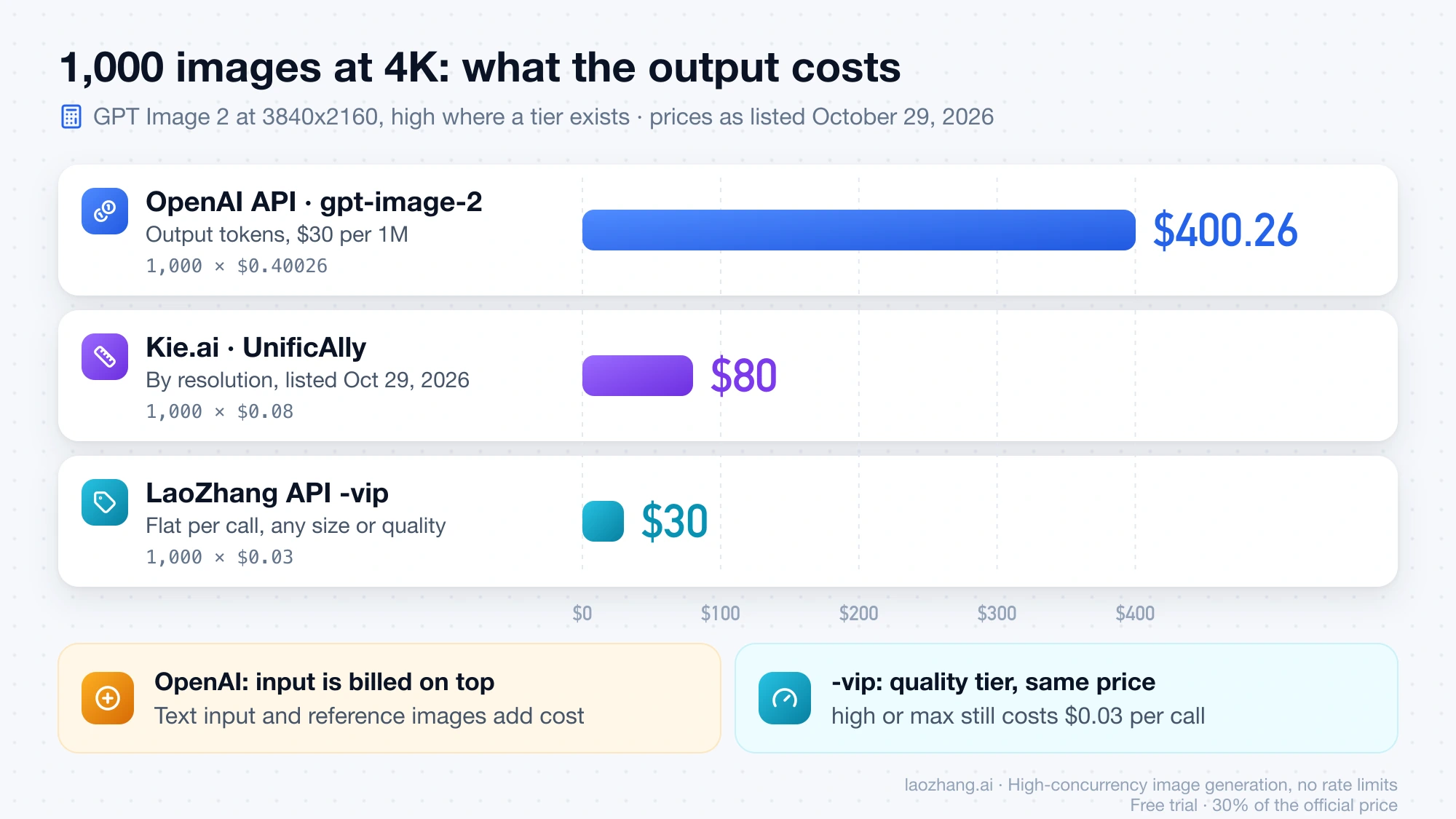
Edits with reference images widen the gap on token billing. A -vip edit is one $0.03 call whether you send one image[] reference or several. OpenAI's token rates add image input at $8 per 1M tokens on top of the output, so every reference image raises the cost of the call.
Token billing is the better fit when your team needs OpenAI's own accounting: per-token usage fields, cost reports by token, or the same bill format as the rest of your OpenAI usage. You can pay OpenAI directly, or use LaoZhang API's official forwarding with the unsuffixed IDs gpt-image-2, gpt-image-2.5-flare and gpt-image-2.5-sunburst on a key in the OpenAI Official group, which bills at OpenAI's token price. The group belongs to the key, not to the request.
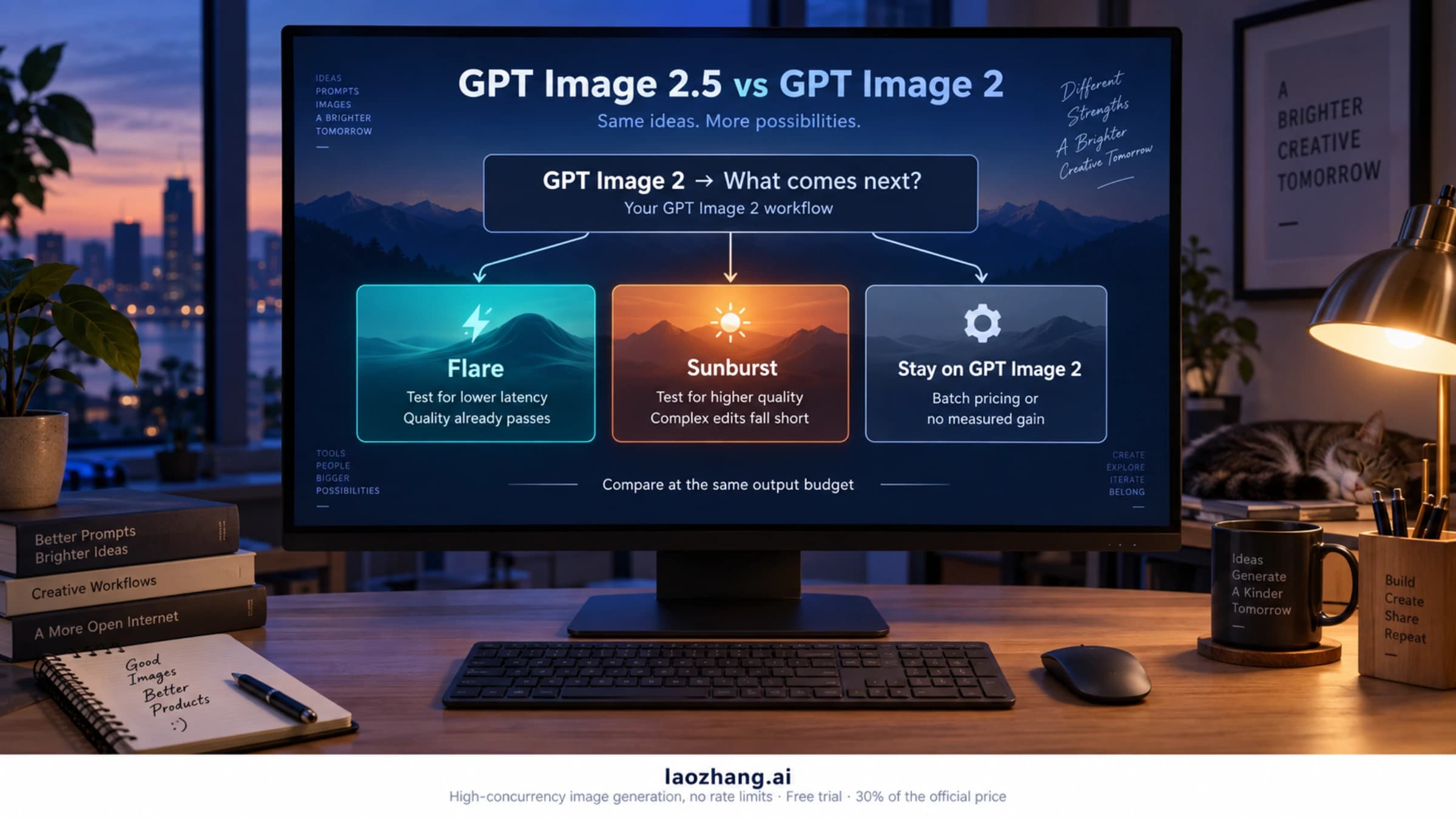
For quick drafts that never need more than about 2K, LaoZhang's -web models render natively up to that size; for 4K detail, stay on -vip. Every -vip model costs the same $0.03, so which one to run is a quality and style choice, covered in GPT Image 2.5 Flare vs Sunburst vs GPT Image 2: Which to Run.
What the October 29, 2026 test on LaoZhang API returned
The test sent ten image requests at once and checked three things: the pixel size of the 4K files, whether any request was throttled, and what the account was charged. It ran on October 29, 2026, between 08:47 and 08:48 UTC+8, from one machine, using one key on a normal customer account in the default group, against POST https://api.laozhang.ai/v1/images/generations. Two requests asked for 4K and eight asked for small low images, all fired from a 10-thread pool at the same moment.
Disclosure: laozhang.ai is our own service. Its prices are platform pricing, not an independent comparison.
| Request | Model | Size and quality | Result | Time | Charged |
|---|---|---|---|---|---|
| 4K landscape | gpt-image-2-vip | 3840x2160, high | HTTP 200, PNG 3840x2160, 9.8 MB | 84.9 s | $0.03 |
| 4K portrait | gpt-image-2.5-flare-vip | 2160x3840, max | HTTP 200, PNG 2160x3840, 8.4 MB | 53.5 s | $0.03 |
| Burst of 8 | gpt-image-2-vip | 1024x1024, low | HTTP 200 on all 8 | 20.5–23.5 s each | $0.03 each |
All ten finished within 85 seconds of wall time, with no 429 and no 5xx. The usage log listed ten charges of $0.03, $0.30 in total, which confirms that the 4K high and 4K max images were billed at the same price as the 1K low ones. This is one account, one machine and one moment: it shows what a burst of ten did on that day, not an uptime figure, a load test or a service-level promise, and latency changes with load.
Why some 4K GPT Image offers cost less than $0.03
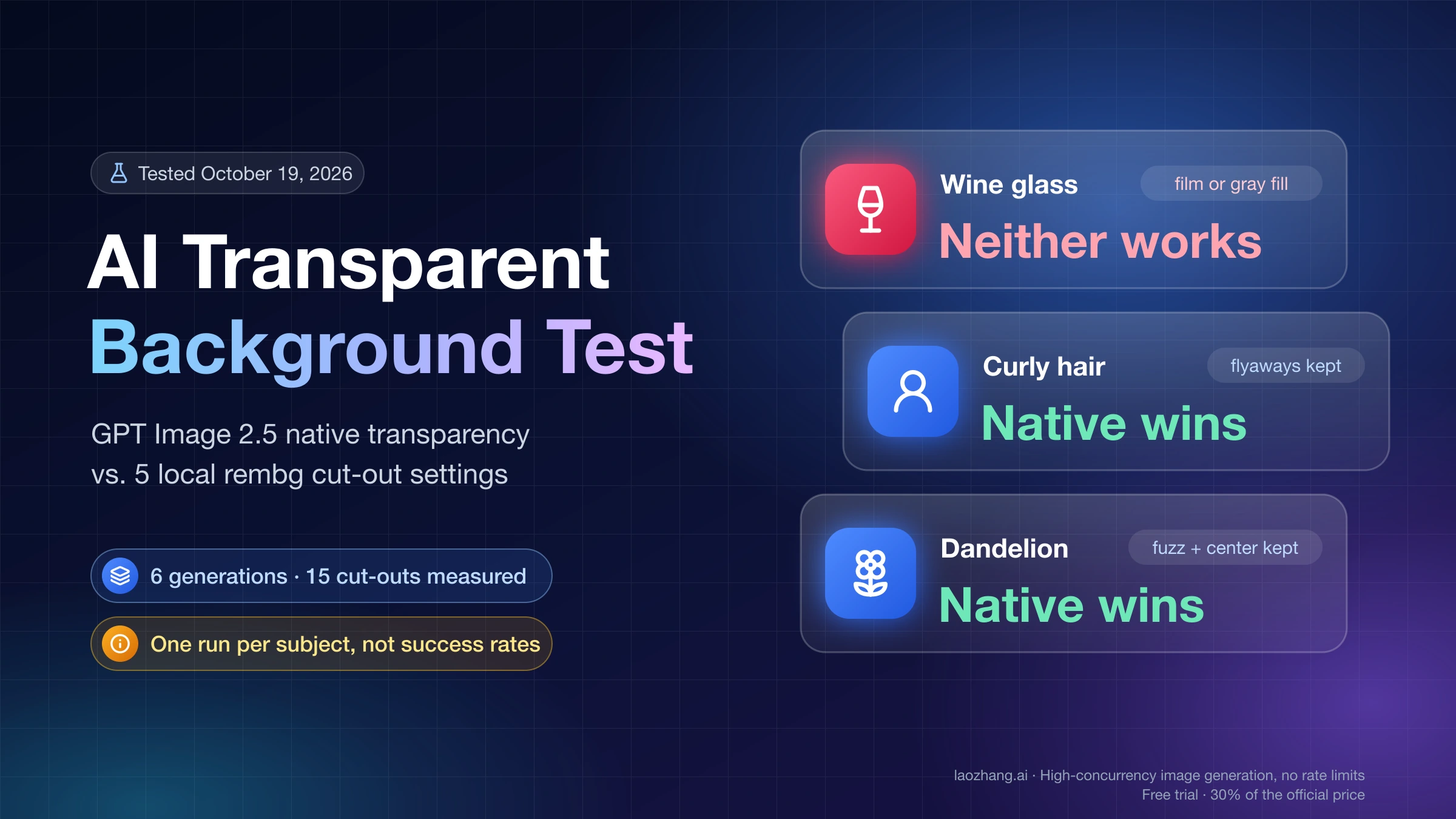
Rendering a real 4K image costs more than rendering one at about 1.5–1.8K, and some offers close that gap by rendering small and upscaling to the size you asked for. The returned file then has exactly 3840x2160 pixels, so a dimension check passes, but small text, fabric and hair look soft at 100% because that detail was never generated. The cheaper 4K offers the LaoZhang team bought and tested in October 2026 were either upscaled this way from about 1.5–1.8K or failed for long periods, so a 4K price below $0.03 on a pricing page does not by itself mean a 4K image.
Two checks tell them apart. First, open the file at 100% and look at small lettering and fine texture: native 4K keeps letter edges crisp, while an upscaled image looks smooth or painted. Second, shrink the image to half size, enlarge it back, and compare the result with the original. An image upscaled from about 1.5–1.8K loses almost nothing in that round trip, around 47 dB PSNR in those October tests, while a native 4K image loses visible detail, around 32 dB. With ImageMagick 7:
magick out.png -resize 50% -resize 200% roundtrip.png
magick compare -metric PSNR out.png roundtrip.png null:
If your output needs 4K detail, such as print, product close-ups or text that will be cropped, use a source that renders natively at 4K and passes both checks, and judge price only among those.
Is LaoZhang's 4K native, and is high or max quality applied?
In the October 29 test, both 4K files decoded to exactly the requested 3840x2160 and 2160x3840, and a 100% crop of the landscape image showed paper texture and a sharp hand-lettered label on the mug. That a -vip 4K image is "generated natively at the requested size, not upscaled" is LaoZhang's documented statement in the GPT Image 2.5 documentation; the test confirms the dimensions and that fine detail held up at full size.
Disclosure: laozhang.ai is our own service. Its prices are platform pricing, not an independent comparison.
Quality is harder to verify than size, because nothing in the file says which tier produced it. The practical check is to run the same image request at low and at high or max and compare 100% crops of text, hair or fabric; if the two look the same, the tier you pay for may not be applied. On Kie.ai and UnificAlly this question does not arise in the same form, since their GPT Image 2 pages as of October 29, 2026 offer no quality parameter to request.
Will bursts hit a rate limit or a 429 error?
On LaoZhang API, a single key has no RPM, IPM or concurrency cap, according to the LaoZhang API concurrency FAQ. Requests fail over across several upstream lines automatically. An occasional 429 can still come from upstream capacity; it is not charged and can be retried after a short wait, so build a retry with a short delay into batch jobs anyway.
Disclosure: laozhang.ai is our own service. Its prices are platform pricing, not an independent comparison.
The October 29, 2026 burst matched that statement for ten simultaneous requests, two of them at 4K, with no 429. As of the same date, the GPT Image 2 pages of Kie.ai and UnificAlly do not publish a per-key concurrency or requests-per-minute figure, so if your workload depends on bursts, run the parallel-request check in the next section on any provider before you commit a budget.
What you pay when a GPT Image call fails on LaoZhang API
On LaoZhang API, non-200 responses are not charged. A 400 for an invalid parameter, an authentication error or a 429 is not charged, as the LaoZhang GPT Image 2.5 documentation states. Once a call returns HTTP 200 with an image, the per-call models charge $0.03, even if the image is not what you wanted, so count retries for quality reasons as new images in your budget.
Disclosure: laozhang.ai is our own service. Its prices are platform pricing, not an independent comparison.
How to check any GPT Image 2 provider before you pay
Run these checks with a small top-up before moving a production workload to any provider, including LaoZhang API. Most of them are the steps used in the October 29 test, and they take a few dollars and a few minutes.
Disclosure: laozhang.ai is our own service. Its prices are platform pricing, not an independent comparison.
- Request an explicit
sizeandqualityinstead ofauto, so the price you compare is the price you will pay. - Decode the
b64_jsonresponse, save it, and read its width and height withsips -g pixelWidth -g pixelHeight out.pngon macOS oridentify out.pngwith ImageMagick. - Open the 4K file at 100% and inspect small text and fine texture, run the half-size round trip shown above, and repeat at
lowand at your target tier to see whether the tier makes a visible difference. - Fire 10 or more requests at the same moment and count the status codes, especially 429 against 200.
- Compare the provider's usage log with the number of 200 responses, so you know whether failed or throttled calls were billed.
- For edits, send the same reference images once and then with more references, and check whether the charge per call changes.
Treat steps 2 and 3 together as a screen rather than proof, because judging detail at 100% is subjective.
First 4K call with gpt-image-2-vip or gpt-image-2.5-flare-vip
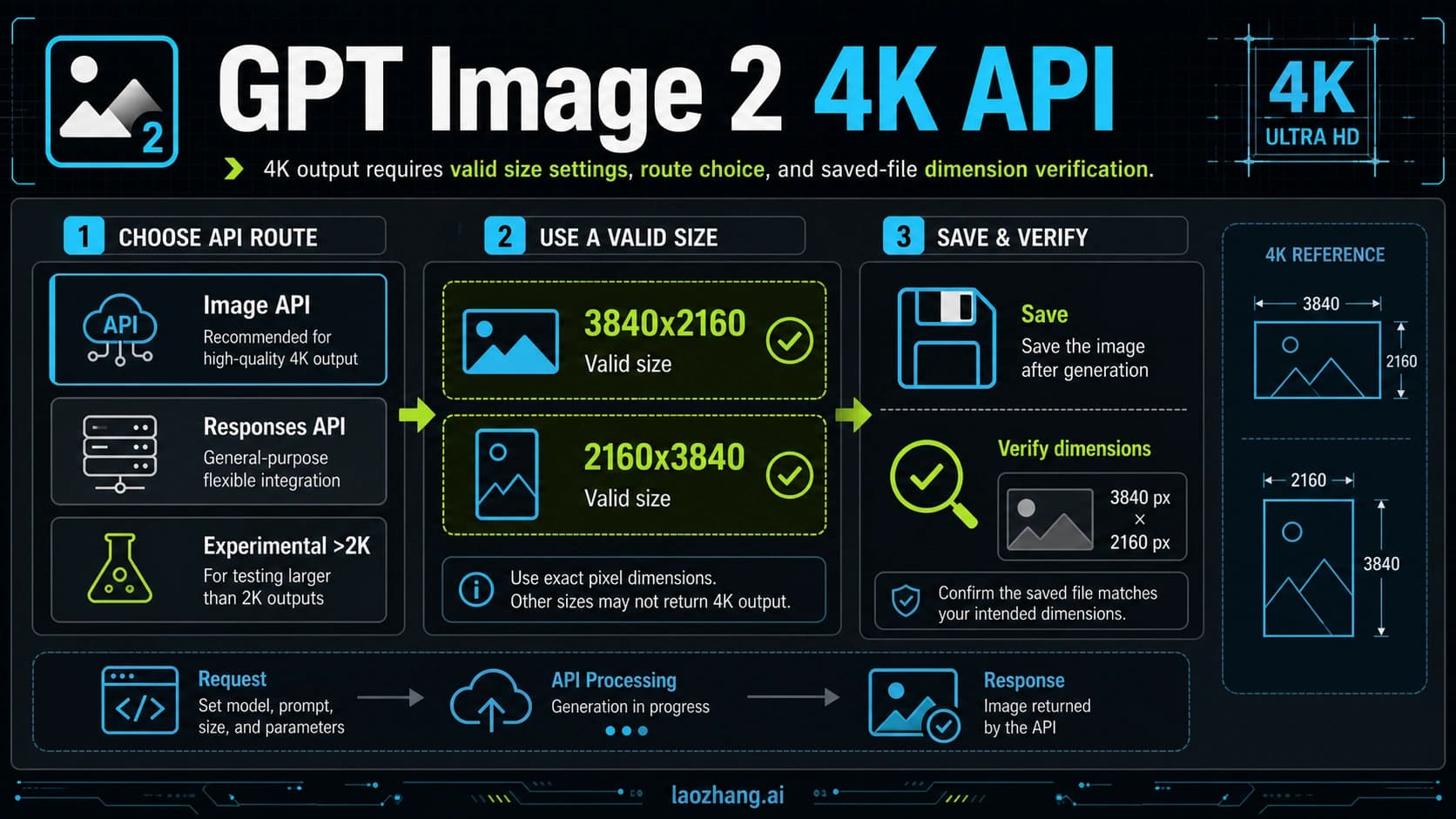
Use the base URL https://api.laozhang.ai/v1, keep the -vip suffix on the model ID, and set size to 3840x2160, 2160x3840 or 2880x2880 for 4K. GPT Image 2 accepts quality values low, medium and high; GPT Image 2.5 goes from low up to max. The response returns the image as b64_json, which this command decodes into a PNG:
Disclosure: laozhang.ai is our own service. Its prices are platform pricing, not an independent comparison.
curl -s https://api.laozhang.ai/v1/images/generations \
  -H "Authorization: Bearer $LAOZHANG_API_KEY" \
  -H "Content-Type: application/json" \
  -d '{
    "model": "gpt-image-2.5-flare-vip",
    "prompt": "A product photo of a ceramic mug on a wooden desk, morning light, a paper label that reads 4K TEST",
    "size": "3840x2160",
    "quality": "max",
    "n": 1
  }' \
  | python3 -c 'import sys, json, base64; open("out.png", "wb").write(base64.b64decode(json.load(sys.stdin)["data"][0]["b64_json"]))'

sips -g pixelWidth -g pixelHeight out.png
For GPT Image 2, swap the model for gpt-image-2-vip and quality for high. Two IDs look similar but behave differently: unsuffixed GPT Image 2.5 IDs are token-billed official forwarding and are not served in the default group, and plain gpt-image-2 in default costs $0.03 but takes no size or quality. Saving large base64 responses, other valid 4K sizes and checking dimensions in code are covered in GPT Image 2 4K API Guide: Generate, Save, and Verify 3840x2160 Images. You can create a key in the LaoZhang API console.
Sources3
External pages this guide links to, in the order they appear. Last updated Oct 29, 2026.
Sources3
External pages this guide links to, in the order they appear. Last updated Oct 29, 2026.