Gemini 4 Hydrogen Pricing: API Cost per Call by Thinking Level
Gemini 4 Hydrogen API: $1.50 input and $7.50 output per 1M tokens, thinking billed as output. Test calls cost $0.0016 at low to $0.0495 at xhigh.
On this page
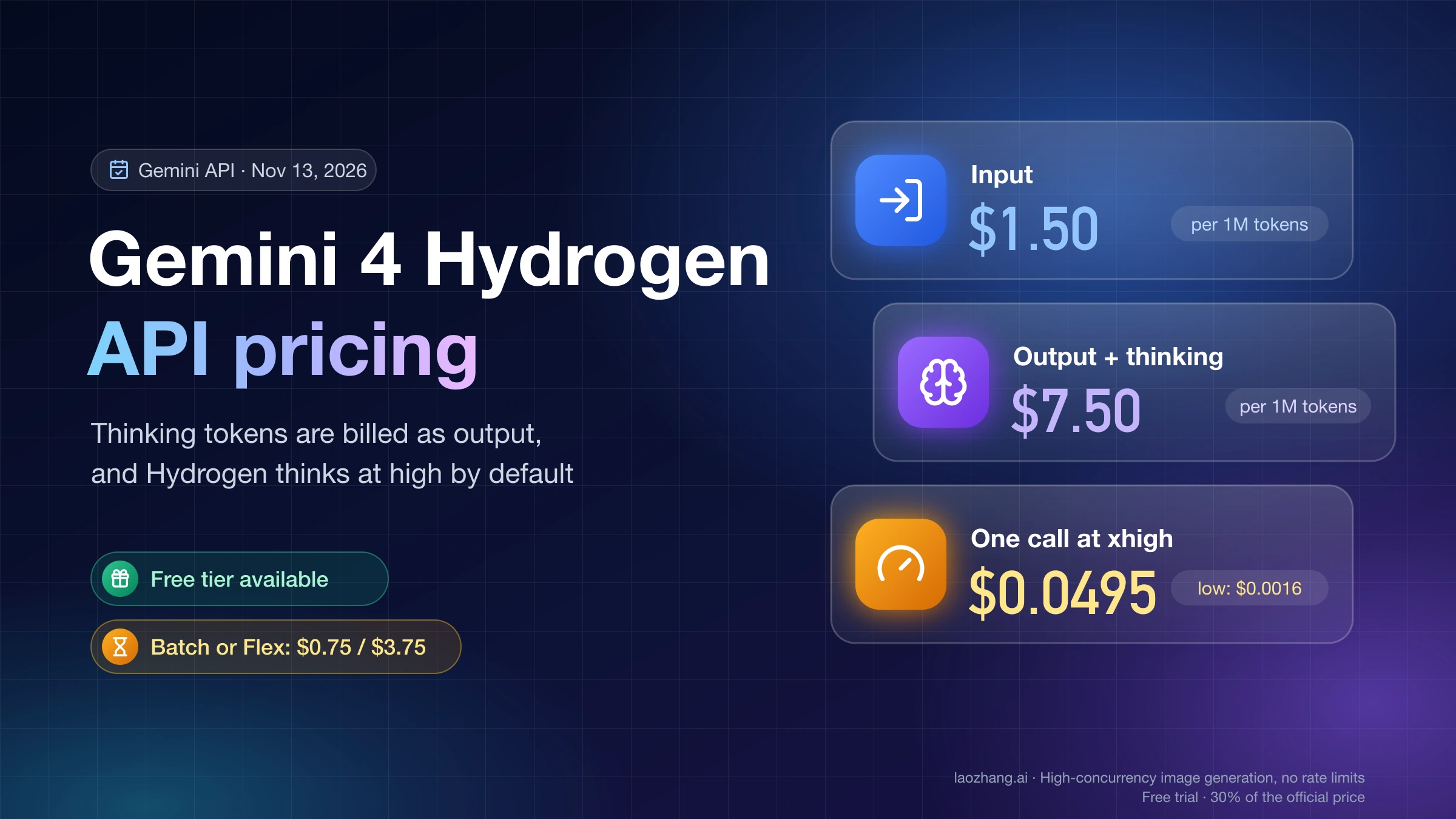
Gemini 4 Hydrogen (gemini-4-hydrogen) costs $1.50 per 1M input tokens and $7.50 per 1M output tokens on the paid Standard tier of the Gemini API, at the same rate across its whole 1M-token context window. The catch is in the output line: thinking tokens are billed as output, and Hydrogen thinks at high unless you tell it otherwise. In a test in Google AI Studio on November 13, 2026, output made up 89% to 99.7% of the cost of every call. A short call at the default level cost between $0.005 and $0.012, and the same calls at xhigh cost up to $0.0495.
So budget on output tokens, not on the price list. Set thinking_level in every request: low or medium for short, high-volume calls, high for coding and tool-using agents, and xhigh only where high falls short. Anything that can wait should go through Batch or Flex, which cost half as much ($0.75 input, $3.75 output). For a monthly figure, multiply your request count by input tokens × $1.50 plus visible-and-thinking output tokens × $7.50, then divide by 1M; the worked example below shows how quickly thinking adds up.
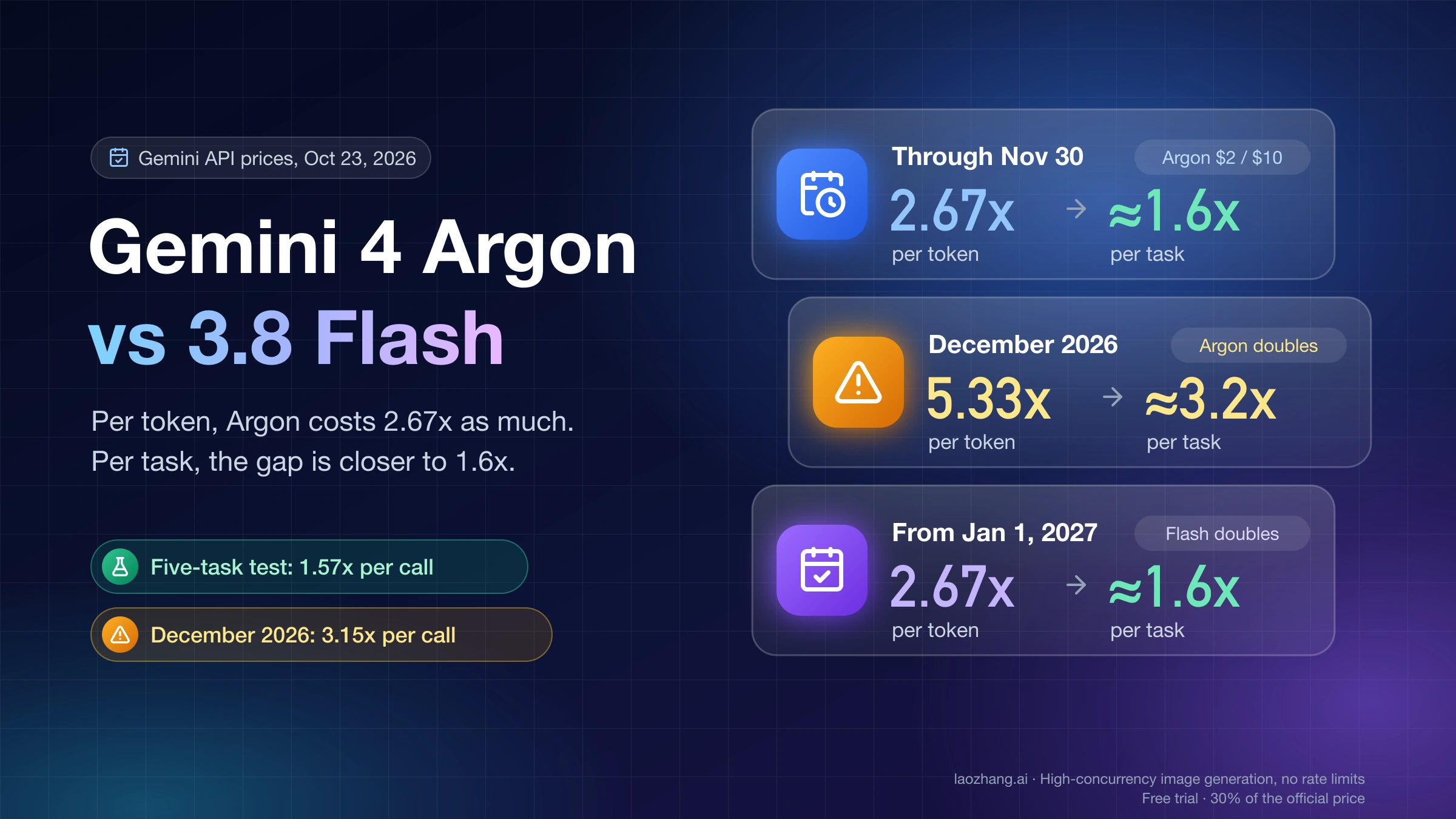
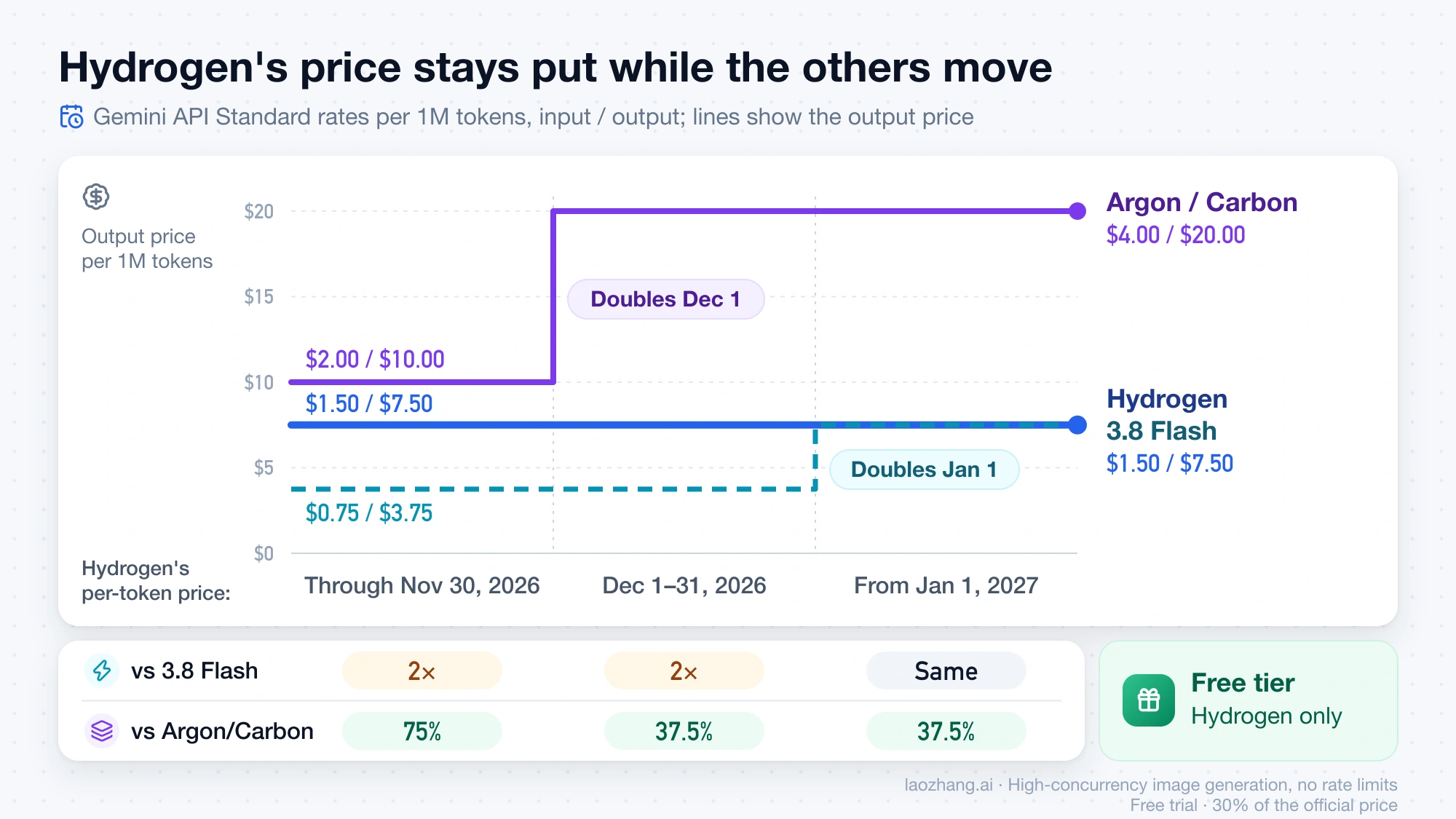
The comparison with other Gemini models shifts twice in the next seven weeks, while Hydrogen's own price stays put. Per token, Hydrogen costs twice as much as Gemini 3.8 Flash through December 31, 2026 and the same from January 1, 2027. Against Gemini 4 Argon and Carbon it costs 75% until November 30, then 37.5% once their price doubles on December 1. Hydrogen also has a free tier, which Argon and Carbon don't.
Gemini 4 Hydrogen API prices: $1.50/$7.50 Standard, half on Batch
Hydrogen has one price per consumption option, with no surcharge for long prompts, and the options differ mainly in rate, availability on the free tier and how Google may use your data. The rates below are per 1M tokens in USD from the Gemini 4 Hydrogen section of Google's Gemini API pricing page and the Google Cloud generative AI pricing page for Vertex AI, as of November 13, 2026. Output always includes thinking tokens.
| How you call Hydrogen | Input | Output, incl. thinking | Cached input | What else differs |
|---|---|---|---|---|
| Free tier (AI Studio and Gemini API) | Free | Free | Free | Google uses free-tier data to improve its products; no Batch, Flex or Search grounding |
| Standard, paid | $1.50 | $7.50 | $0.075 | Implicit caching only; prompts and responses not used to improve Google products |
| Batch or Flex, paid | $0.75 | $3.75 | $0.0375 | Two separate options at the same price; neither is on the free tier |
| Priority, paid | $2.70 | $13.50 | $0.135 | 1.8x Standard; default rate limits are 0.3x Standard's |
| Vertex AI, Global endpoint | $1.50 | $7.50 | $0.075 read; $1.875 write from January 12, 2027 | Billed through Google Cloud |
| Vertex AI, Non-global endpoint | $1.65 | $8.25 | $0.0825 read; $2.0625 write from January 12, 2027 | 10% above Global |
On Vertex AI the same 10% gap applies to the other options: Batch and Flex cost $0.75 / $3.75 at the Global endpoint and $0.825 / $4.125 at Non-global ones, and Priority costs $2.70 / $13.50 or $2.97 / $14.85. Google also lists an invite-only Contributor tier at the Batch rate, but there your prompts are used to improve Google's products. If you saw "$0.75 input, $3.75 output" in posts on X before the November 12 launch, that's the Batch and Flex rate, not the Standard one. For the rates of every other Gemini model, see Gemini API Pricing 2026: Token Rates, Free Tier, and Key Cost.
What one Gemini 4 Hydrogen call costs at each thinking level
On two short tasks run in Google AI Studio on November 13, 2026, one Hydrogen call cost $0.0016 to $0.0056 at low, $0.0051 to $0.0120 at the default high, and $0.0156 to $0.0495 at xhigh. Each task ran once per level in a fresh chat on the free tier of one Google account, so nothing was billed. The costs below are AI Studio's Token Usage readouts (input tokens and output tokens, thinking included) priced at Standard rates.
Task A asked for a Python parse_duration function and said to return only the code. Task B asked for the monthly bill of a SaaS app with 12,000 users, each making 40 requests a month at 1,800 input and 450 output tokens per request at Hydrogen's rates, answered in five lines or fewer.
| Task and thinking level | Input tokens | Output tokens, incl. thinking | Cost per call | Per 1,000 calls |
|---|---|---|---|---|
A (code), low | 85 | 732 | $0.0056 | $5.62 |
A (code), medium | 85 | 1,169 | $0.0089 | $8.89 |
A (code), high | 85 | 1,588 | $0.0120 | $12.04 |
A (code), xhigh | 85 | 6,586 | $0.0495 | $49.52 |
B (bill math), low | 118 | 187 | $0.0016 | $1.58 |
B (bill math), medium | 118 | 906 | $0.0070 | $6.97 |
B (bill math), high | 118 | 651 | $0.0051 | $5.06 |
B (bill math), xhigh | 118 | 2,053 | $0.0156 | $15.57 |
To check a row, take prompt A at high: 85 × $1.50 / 1M is $0.00013 and 1,588 × $7.50 / 1M is $0.01191, so $0.0120 per call, of which output is 98.9%. Moving from high to xhigh multiplied output by 4.15 on task A and 3.15 on task B, and xhigh produced 9.0 and 11.0 times the output of low. The extra tokens bought nothing visible on these two short tasks. Every level gave the correct $2,916 for task B, and every level returned a regex-based parser for task A (read in the interface, not executed); only the xhigh version changed approach in a small way, using [0-9] instead of \d and a precompiled pattern. At low, task B showed no thinking block at all.
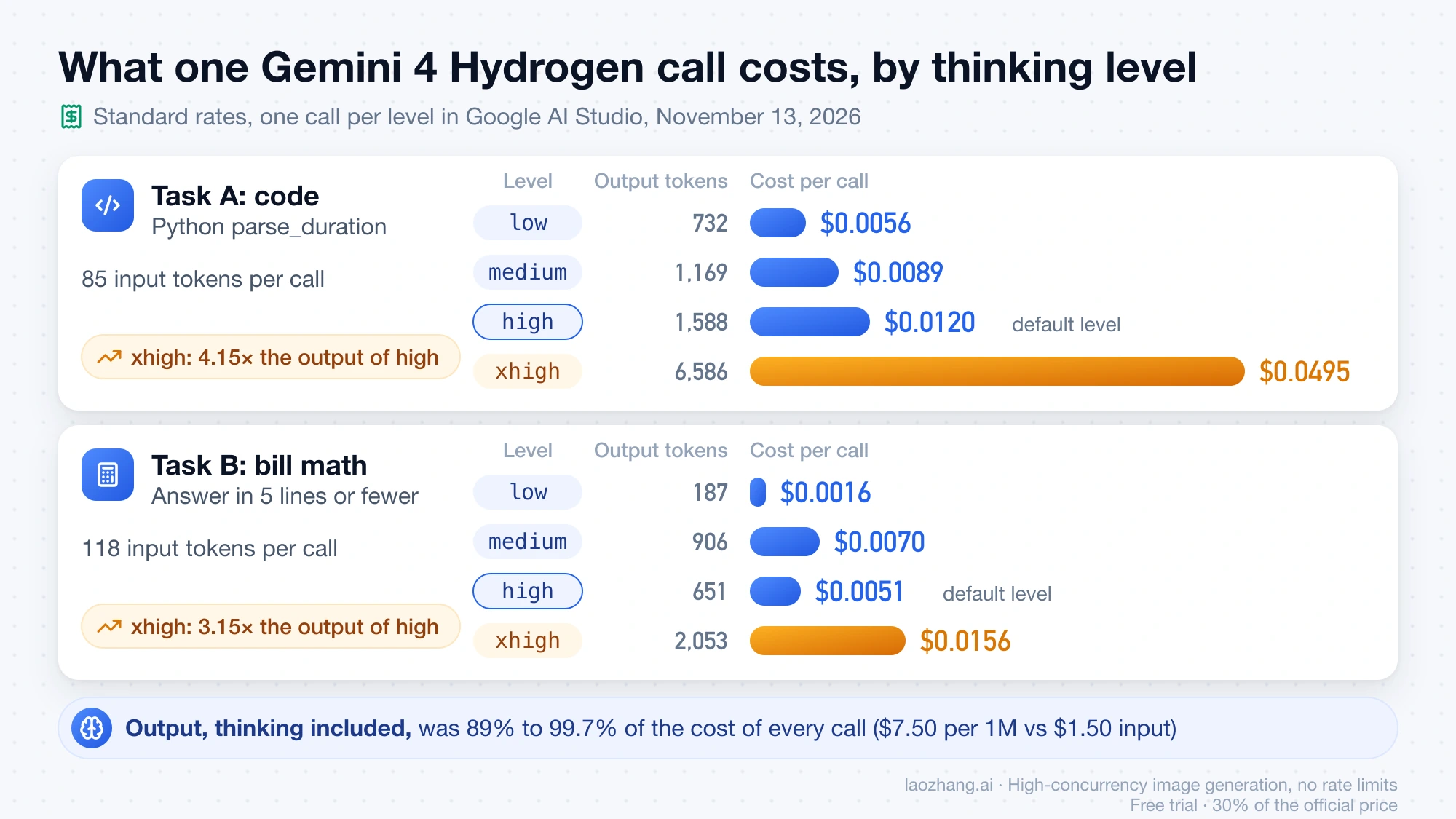
These are single samples, so treat them as a sense of scale rather than a rate you can quote. Task B used more tokens at medium (906) than at high (651), which shows that a single call doesn't always rise with the level; averages over many of your own requests will be steadier. The counts come from the AI Studio interface, not an API invoice, but Google's pricing page says every token the model processes is billed, thinking included, so the paid API should charge on the same counts. Implicit caching wasn't part of the test.
Gemini 4 Hydrogen cost per month: formula and a 480,000-request example
Monthly cost is requests × (input tokens × $1.50 + output tokens × $7.50) ÷ 1,000,000, where output tokens are the visible answer plus thinking. Estimates go wrong in the thinking part, because your prompt and expected answer tell you nothing about it. Measure it on a sample of real requests: in the Interactions API, usage.total_thought_tokens reports thinking tokens separately from total_output_tokens, and Google's thinking guide for the Gemini API states that billed output is the sum of the two.
Take task B's app: 12,000 users × 40 requests is 480,000 requests a month. Visible tokens alone come to 864M input tokens × $1.50 = $1,296 plus 216M output tokens × $7.50 = $1,620, or $2,916 a month. Every 500 thinking tokens per request adds 240M output tokens, which is $1,800 a month. In the test above, task B at high produced 651 output tokens for an answer capped at five lines and task A at xhigh produced 6,586, so 500 and 2,000 thinking tokens per request are realistic rather than worst-case assumptions.
| Thinking tokens per request | Standard | Batch or Flex | Priority |
|---|---|---|---|
| 0 (visible tokens only) | $2,916 | $1,458 | $5,248.80 |
| 500 | $4,716 | $2,358 | $8,488.80 |
| 2,000 | $10,116 | $5,058 | $18,208.80 |
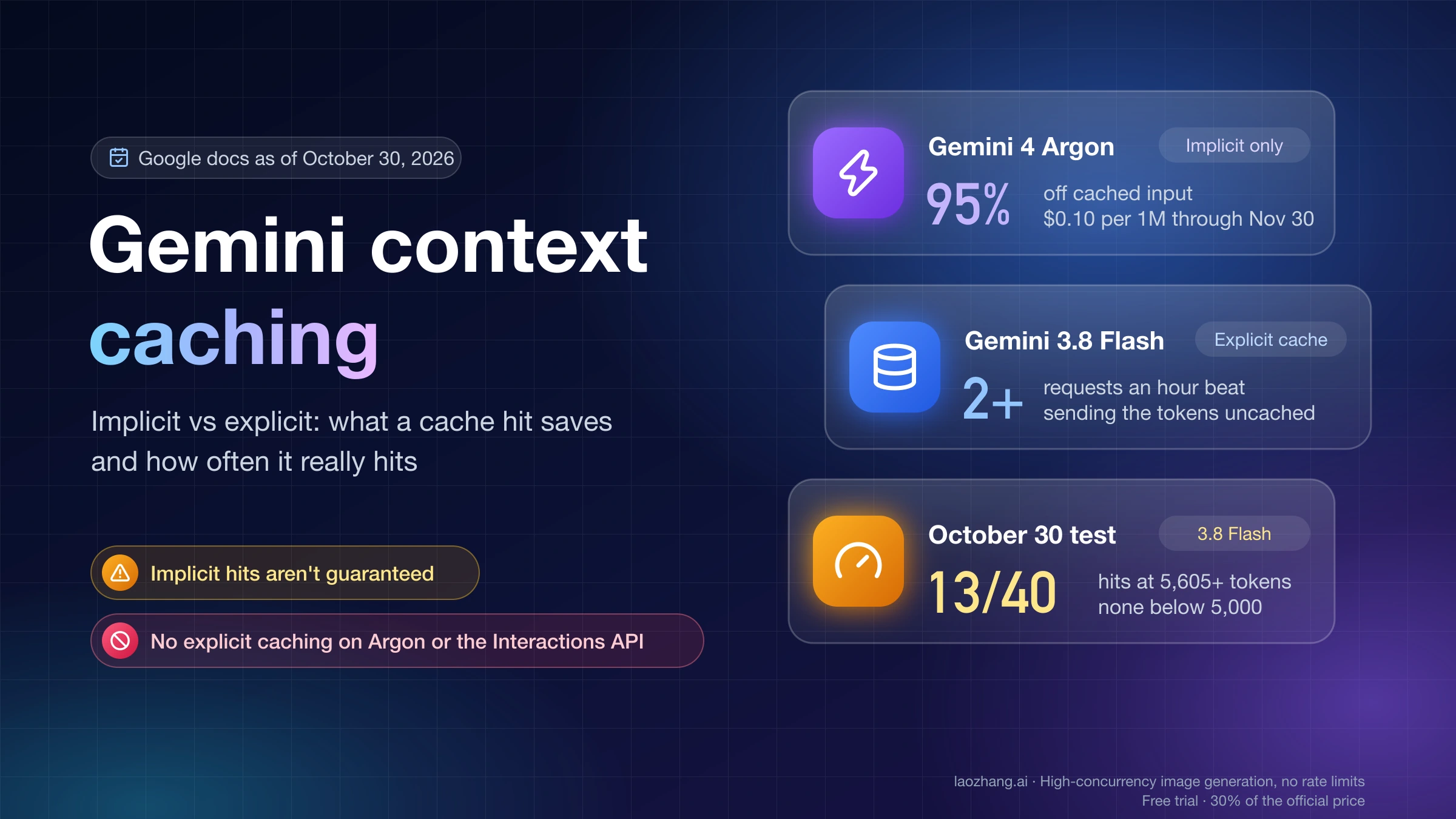
Caching wouldn't change this example. Hydrogen supports only implicit caching, which applies automatically to prompts of at least 4,096 tokens and cuts cached input tokens by 95% to $0.075 per 1M on a cache hit, according to Google's Gemini 4 Hydrogen migration guide. A 1,800-token request is below that minimum. Even for long prompts that share a fixed prefix, input is often the smaller part of the bill (44% of the visible-only figure here, before any thinking), so the thinking level usually moves a Hydrogen budget more than caching does.
Which thinking level is cheapest for your Hydrogen workload
The cheapest level is the lowest one that still passes your own quality check, and for short tasks that's usually low or medium, not the default high. Google's advice is to run your evaluation set at all four levels with a generous max_output_tokens, then pick the lowest level that meets your bar. In practice, start extraction, classification, routing, arithmetic and short chat at low; use medium for interactive coding and latency-sensitive tool calls; keep high for multi-step coding and tool-using agents; and switch to xhigh only for the specific problems where high fails.
Artificial Analysis's Gemini 4 Hydrogen results by thinking level show the trade on a hard benchmark set, at AA's own token mix and list prices (Intelligence Index v5.0.1, as of November 13, 2026). Hydrogen scored 27 at low for $0.29 per index task and 1.3 minutes per task, 41 at medium for $0.80 and 3.7 minutes, 51 at high for $1.87 and 8.3 minutes, and 54 at xhigh for $3.16 and 13.5 minutes.
Going from high to xhigh adds 69% to the cost per task and 63% to the time for 3 index points, and Google's own docs warn that xhigh can overthink simple prompts. That matches the short-task test above, where xhigh used 3 to 4 times the tokens of high with no better answer. The step from medium to high is different: 2.3 times the cost for 10 points, which is often worth paying on agent work and rarely on single-turn tasks.
Gemini 4 Hydrogen vs 3.8 Flash, Argon and Carbon: prices on Dec 1 and Jan 1
Hydrogen's price doesn't change, but its position does: Argon and Carbon double on December 1, 2026, and Gemini 3.8 Flash's introductory price ends on December 31, 2026, which brings Flash to exactly Hydrogen's rate. The table shows Standard rates per 1M input / output tokens from Google's pricing page, and in brackets what task A's high call (85 input, 1,588 output tokens) would cost at each rate if the other model produced the same tokens.
| Model | Through November 30, 2026 | December 1–31, 2026 | From January 1, 2027 |
|---|---|---|---|
| Gemini 4 Hydrogen | $1.50 / $7.50 ($0.0120) | $1.50 / $7.50 ($0.0120) | $1.50 / $7.50 ($0.0120) |
| Gemini 3.8 Flash | $0.75 / $3.75 ($0.0060) | $0.75 / $3.75 ($0.0060) | $1.50 / $7.50 ($0.0120) |
| Gemini 4 Argon or Carbon | $2.00 / $10.00 ($0.0161) | $4.00 / $20.00 ($0.0321) | $4.00 / $20.00 ($0.0321) |
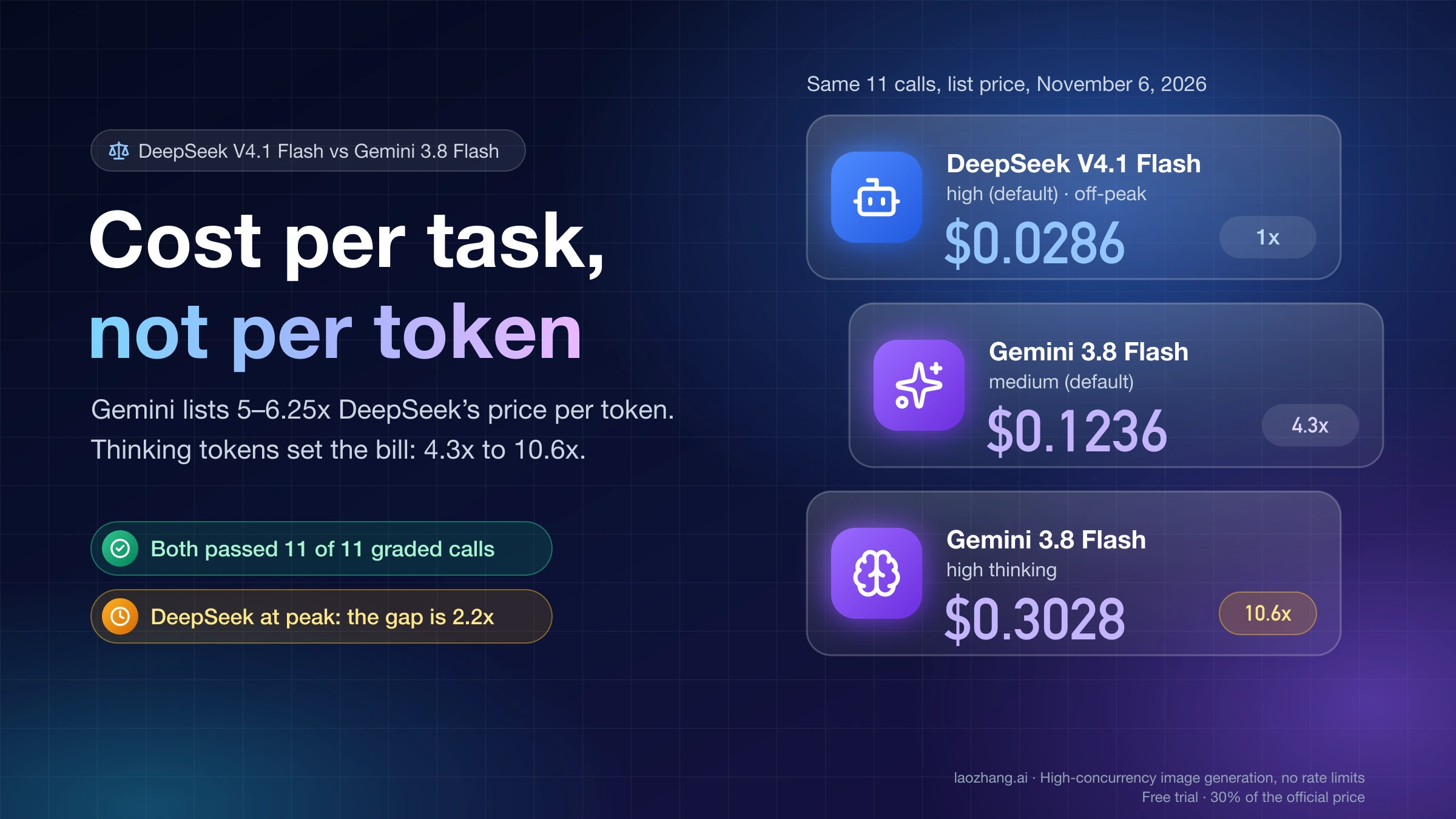
Real models don't produce the same tokens, and that changes the picture against 3.8 Flash. On Artificial Analysis's Gemini 4 Hydrogen vs Gemini 3.8 Flash comparison, Hydrogen at high cost $1.87 per index task against $7.77 for Flash at high, even with Flash priced at its current half rate, and scored 51 to Flash's 31. Flash took 14.7 minutes per task against Hydrogen's 8.3. At Flash's 2027 price its figure would roughly double. So on hard, multi-step benchmark tasks Hydrogen is already the cheaper model per task; on short calls where Flash thinks little, the 2x per-token gap can still show on your bill until January 1.
Against Argon and Carbon, Google's November 12 launch post puts Hydrogen at 51 on the Artificial Analysis index at its default level, one point above Argon's 50, with no free tier on either of the larger models. From December 1, that makes Hydrogen at 37.5% of the per-token price the first model to try for work you now send to Argon, keeping Carbon for the hardest problems. For measured comparisons of those two, see Gemini 4 Argon vs 3.8 Flash: Cost per Task and When to Switch and Gemini 4 Carbon vs Gemini 4 Argon: When Slower Carbon Pays Off.
Switching from gemini-3.8-flash to Hydrogen: what changes on the bill
Changing the model ID from gemini-3.8-flash to gemini-4-hydrogen doubles the per-token rate until December 31, and two defaults can raise the bill further if you don't set them. Hydrogen thinks at high by default where 3.8 Flash uses medium, so a request that never set thinking_level will think more after the switch; set medium explicitly when you compare the two. Flash's own thinking isn't small either: in a November 11, 2026 run of five everyday prompts through an API gateway, 3.8 Flash spent 4,500 thinking tokens at medium and 6,326 at high across the five calls, so the gap per call depends on your traffic, not on the rate card.
Caching changes too. Hydrogen doesn't support explicit caching (cachedContents, caches.create), so remove cached_content from requests. A pipeline that kept a large document in an explicit Flash cache, paying $0.075 per 1M for cached reads plus $0.50 per 1M tokens per hour for storage through December 31, now depends on implicit cache hits for prompts of at least 4,096 tokens. Those hits cost the same $0.075 but aren't guaranteed. If your app hardcodes a low max_output_tokens such as 8,192, Google recommends raising it to 65,536 and lowering the thinking level instead. Requests that still send minimal from older Flash models now return an error, and temperature, top_p and top_k are ignored. Google says launch partners saw 12% to 23% fewer tokens than 3.8 Flash on their workloads; that's a vendor claim worth checking on a sample of yours.
Is Gemini 4 Hydrogen free? Free tier and rate limits
Yes. Gemini 4 Hydrogen is on the free tier of the Gemini API and in Google AI Studio, and free-tier input, output and caching cost nothing. In return, Google uses free-tier prompts and responses to improve its products, and the free tier has no Batch, Flex, or Search and Maps grounding. Google publishes no fixed requests-per-minute or requests-per-day numbers for Hydrogen's free tier; your project's active limits appear on the AI Studio rate limit page. Limits apply per project rather than per API key, and daily quotas reset at midnight Pacific time. For how free use works across models, see Gemini API Free Tier 2026: Limits, Free Models, and Free API Keys; for paid tiers and 429 errors, see Gemini API Rate Limits 2026: Free vs Paid Tiers and How to Raise.
Hydrogen is also available on every Google AI Studio plan, including the Free plan, and in the model picker of the Gemini app, where use is covered by your Google account plan rather than billed per token.
Gemini 4 Hydrogen billing traps: truncated thinking, Vertex timeouts, grounding
A few charges don't show up in the per-token rates, and each can surprise a budget built only on the table above. As of November 13, 2026, these are the ones in Google's documentation:
- Capping
max_output_tokensdoesn't cap thinking cost safely. If Hydrogen hits the cap while reasoning, the response ends as incomplete with truncated or empty output, and the thinking tokens are still billed, per the Gemini API thinking guide. Lowerthinking_levelinstead. - On Vertex AI, from November 13, 2026, a Gemini 4 completion longer than 32K tokens is billed for its retrievable tokens even if the request fails on a client or server timeout. Otherwise Vertex AI bills only requests that return HTTP 200.
- Vertex AI will charge for cache writes on Hydrogen from January 12, 2027, at $1.875 per 1M tokens on the Global endpoint and $2.0625 on Non-global ones. The Gemini Developer API pricing page lists no cache-write charge.
- Grounding with Google Search costs extra on paid tiers: 5,000 search requests a month are free, shared across all Gemini 3 and newer models, then $14 per 1,000, with a default cap of 1,500 a day per project. One request can trigger several searches, and each is billed; Google Maps grounding has the same 5,000 then $14 per 1,000. Google also bills the internal tool system instructions and function declarations that grounding adds, so a grounded request carries more input tokens than your prompt alone.
Sources7
External pages this guide links to, in the order they appear. Last updated Nov 13, 2026.
Sources7
External pages this guide links to, in the order they appear. Last updated Nov 13, 2026.
- 1.Gemini 4 Hydrogen section of Google's Gemini API pricing pageai.google.dev/gemini-api/docs/pricing
- 2.Google Cloud generative AI pricing page for Vertex AIcloud.google.com/vertex-ai/generative-ai/pricing
- 3.thinking guide for the Gemini APIai.google.dev/gemini-api/docs/thinking
- 4.Google's Gemini 4 Hydrogen migration guideai.google.dev/gemini-api/docs/whats-new-gemini-4-hydrogen
- 5.Gemini 4 Hydrogen results by thinking levelartificialanalysis.ai/models/gemini-4-hydrogen
- 6.Gemini 4 Hydrogen vs Gemini 3.8 Flash comparisonartificialanalysis.ai/models/releases/comparisons/gemini-4-hydrogen-vs-gemini-3-8-flash
- 7.AI Studio rate limit pageaistudio.google.com/rate-limit