Gemini 4 Neon vs Opus 5.5 vs GPT-6.2 Sol: Cost at Equal Score
Gemini 4 Neon at high scores 60 for 0.37x the cost per task of Claude Opus 5.5 at max (59). GPT-6.2 Sol is cheaper than both but tops out at 57.
On this page
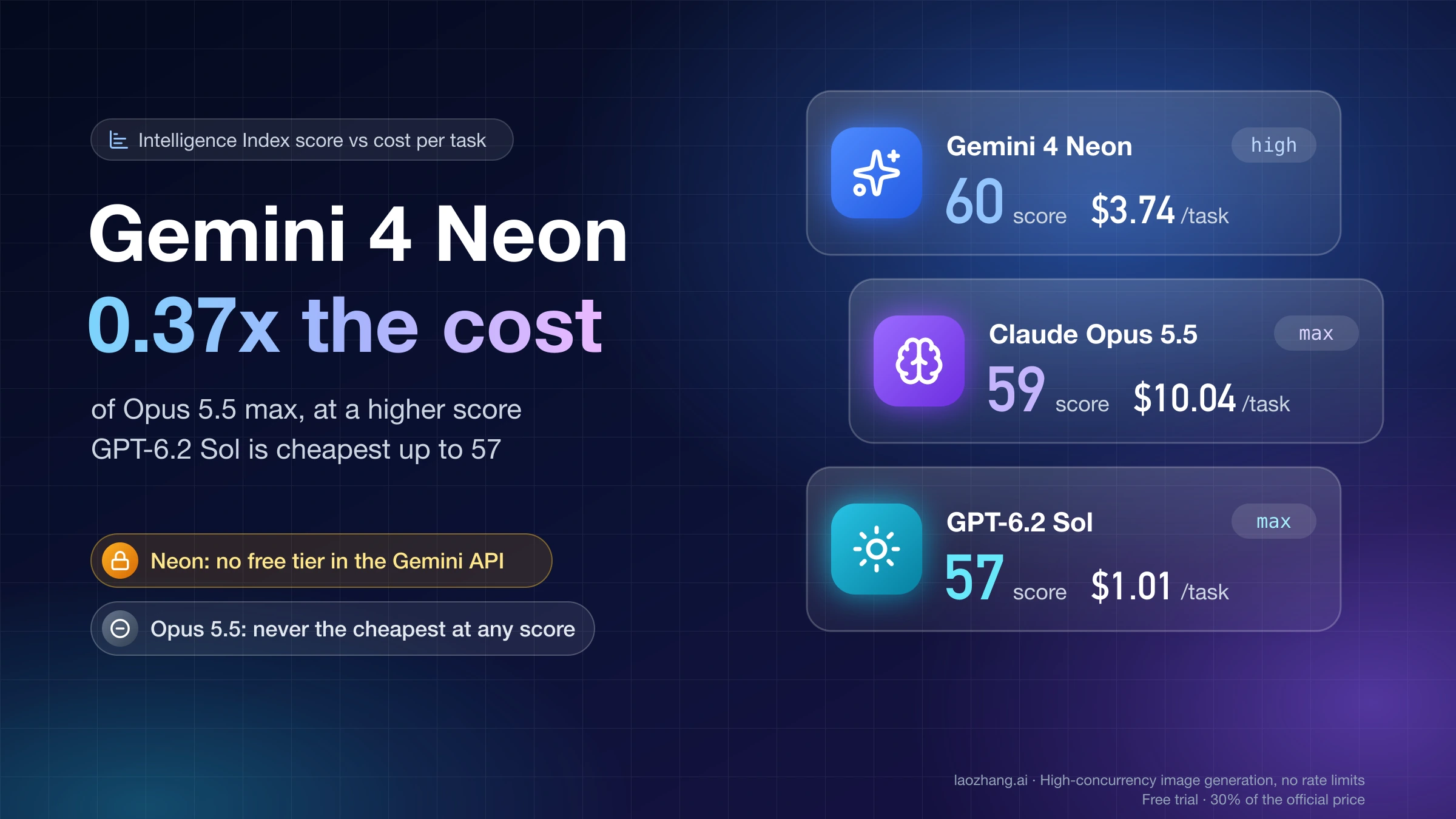
Google released Gemini 4 Neon (gemini-4-neon) on November 18, 2026, one day after OpenAI shipped GPT-6.2 Sol, at $3 input and $15 output per million tokens: 25% below Claude Opus 5.5's $4 / $20 and 50% above Sol's $2 / $10. The claim that Neon "beats Opus 5.5 for less money" holds once you compare the models at the same score instead of the same setting. On the Artificial Analysis Intelligence Index v5.0.1, as of November 19, 2026, Neon at its default high level scores 60 for $3.74 and 14.8 minutes per task, while Opus 5.5 needs max to reach 59, at $10.04 and 24.6 minutes. That is 0.37x the cost and 0.60x the time. GPT-6.2 Sol never gets that high: its best is 57 at max, for $1.01 per task.
So the right switch depends on the score your work needs. If you run Opus 5.5 at max for hard analysis or long agent tasks, try gemini-4-neon at high on the same jobs first, because it is the only move here that can cut the bill by more than half without lowering the score. If you run Opus at xhigh (57), the bigger saving is gpt-6.2-sol at max, which ties that score for $1.01 against $6.05 per task; Neon high saves only about 38% there, though it scores 3 points higher. If a score in the low-to-mid 50s is enough, as it is for most routine coding, writing and extraction, use gpt-6.2-sol at medium or high: Sol at high matches Neon medium's score of 55 for less than a third of the cost. Keep Opus 5.5 where your own results favor it; even Google's benchmark table has Opus ahead of Neon on Terminal-Bench 4.1 and FrontierCode 2.0.
Check access before you plan a move. Neon has no free tier in the Gemini API, a free Google AI Studio account gets an "Unlock Gemini 4 Neon" screen, and in the Gemini app it needs Google AI Pro or Ultra.
Which model for which job: Neon high, Sol medium, or Opus 5.5
Pick the lowest-cost setting that reaches the score your work needs, then confirm it on your own tasks. Neon at high is the cheapest way to get above 57 on the Artificial Analysis index; Sol is the cheapest way to get any score up to 57, from low through max; Opus 5.5 is never the cheapest setting at any score on that index, so it earns its place only where your own results or a specific benchmark favor it. Costs below are per Artificial Analysis Intelligence Index task at list prices, as of November 19, 2026.
| Your work | Start with | Level | Cost per index task | Move away when |
|---|---|---|---|---|
Hard analysis and long agent runs you now give Opus 5.5 at max | gemini-4-neon | high | $3.74 | Neon's output needs more fixing than Opus's on your tasks |
Work you now give Opus 5.5 at xhigh | gpt-6.2-sol | max | $1.01 | You need more than 57; then try Neon high |
| The highest score available, time no object | gemini-4-neon | xhigh | $6.44 | Prompts are simple: Google warns xhigh can overthink or use up the output limit |
| Routine coding with tests, writing, extraction, high volume | gpt-6.2-sol | medium (default) | $0.41 | Tasks start failing; try Sol high, then Neon medium |
| Mid-difficulty work that needs about 55 | gpt-6.2-sol | high | $0.56 | You need more than Sol max (57) can give |
| Video or audio input | gemini-4-neon | medium or high | $1.90–$3.74 | No alternative here: Opus 5.5 and Sol take only text and images |
| Coding agent in a terminal, top score | Neon in Antigravity CLI or Opus 5.5 in Claude Code | xhigh / max | $6.86 / $12.61 per coding-agent task | Your team's repos show a clear winner |
Compare levels, not defaults. Neon's API default is high, Sol's is medium, and in the Gemini app a model you pick by hand runs at Low unless you choose a thinking level, according to the Gemini app plans help page. A "default vs default" test therefore puts Neon at a much higher reasoning level than Sol, and a Gemini app test can put Neon at a lower one than you expect.
API prices: Neon $3 / $15, Opus 5.5 $4 / $20, Sol $2 / $10
Per token, Neon costs 0.75x Opus 5.5 and 1.5x GPT-6.2 Sol, and Opus costs 2x Sol. The full rates per million tokens, as of November 19, 2026, from the Gemini API pricing page, the GPT-6.2 Sol model page and Anthropic's Claude pricing page:
| Rate per 1M tokens | Gemini 4 Neon | Claude Opus 5.5 | GPT-6.2 Sol |
|---|---|---|---|
| Input | $3.00 | $4.00 | $2.00 |
| Cached input | $0.15 (implicit caching only) | $0.20 (cache read) | $0.10 |
| Cache writes | Explicit caching not supported | $5 (5-minute), $8 (1-hour) | $2.50 (30-minute) |
| Output, including thinking | $15.00 | $20.00 | $10.00 |
| Long input | Same rate at every length up to 1M | Same rate across the 1M window | Whole request $4 / $15 once input passes 272K |
| Batch (input / output) | $1.50 / $7.50 | $2 / $10 | $1 / $5 |
The per-token gap does not carry over to each task at the same setting, because Neon writes more. At high, Neon produces about 90,000 output tokens per index task against about 60,000 for Opus, so it costs $3.74 against $3.46, slightly more, and at xhigh it costs $6.44 against $6.05. The "costs 25% less" in launch-day posts is a token price. The real saving comes from Neon reaching a given score at a lower level than Opus does.
Does Neon beat Opus 5.5 for less money? At equal score, 0.37x the cost
Yes, when you line up settings by score. Neon at high scores 60 against 59 for Opus 5.5 at max, for 0.37x the cost per task, 0.60x the time and 0.52x the output tokens; Neon at xhigh scores 61 for 0.64x Opus max's cost. Even Neon at medium (55) outscores Opus at high (52) for 0.55x the cost. The table lists every reasoning level of all three models on the Artificial Analysis Intelligence Index v5.0.1, sorted by score, as of November 19, 2026, from the Artificial Analysis Neon vs Opus 5.5 comparison and the Artificial Analysis Neon vs GPT-6.2 Sol comparison.
| Model and level | Index score | Cost per task | Time per task | Time to first answer token | Output tokens per task |
|---|---|---|---|---|---|
Gemini 4 Neon xhigh | 61 | $6.44 | 21.5 min | 56.5 s | 141,631 |
Gemini 4 Neon high (API default) | 60 | $3.74 | 14.8 min | 40.6 s | 90,188 |
Claude Opus 5.5 max | 59 | $10.04 | 24.6 min | 359.2 s | 173,323 |
Claude Opus 5.5 xhigh | 57 | $6.05 | 15.9 min | 64.1 s | 103,401 |
GPT-6.2 Sol max | 57 | $1.01 | 8.5 min | 75.1 s | 40,360 |
GPT-6.2 Sol xhigh | 56 | $0.65 | 5.3 min | 30.0 s | 24,323 |
GPT-6.2 Sol high | 55 | $0.56 | 4.6 min | 11.0 s | 20,160 |
Gemini 4 Neon medium | 55 | $1.90 | 8.3 min | 20.1 s | 50,000 |
GPT-6.2 Sol medium (API default) | 53 | $0.41 | 3.2 min | 3.2 s | 13,651 |
Claude Opus 5.5 high | 52 | $3.46 | 9.3 min | 21.3 s | 60,076 |
Claude Opus 5.5 medium | 48 | $2.45 | 6.9 min | 12.8 s | 43,821 |
Gemini 4 Neon low | 44 | $0.75 | 3.7 min | 13.9 s | 21,726 |
GPT-6.2 Sol low | 41 | $0.18 | 1.5 min | 2.0 s | 5,980 |
Claude Opus 5.5 low | 35 | $0.98 | 3.1 min | 5.2 s | 19,063 |
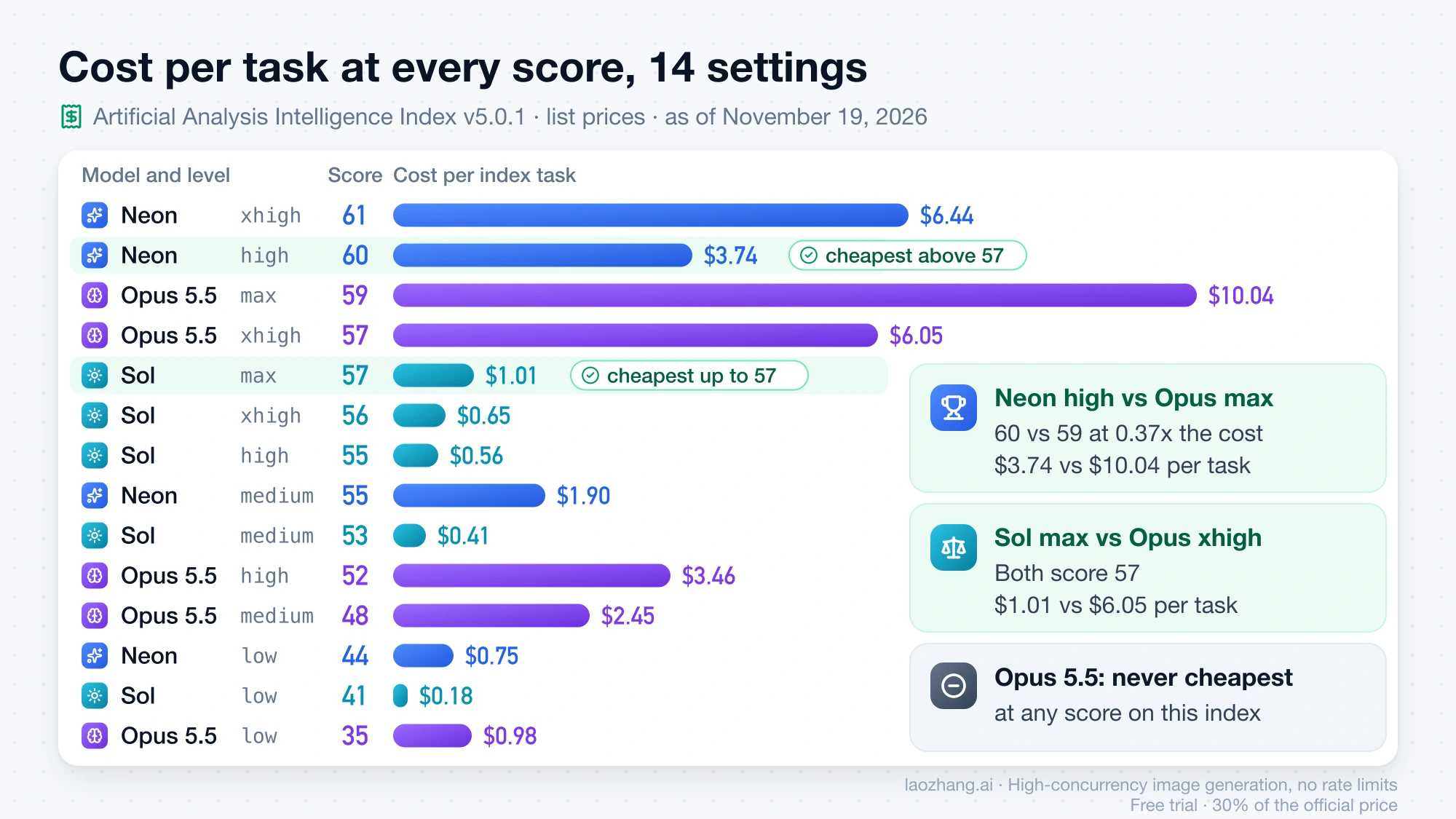
Artificial Analysis labels its Opus rows "Default Fallback", which is the name of its own test setup, not an Anthropic setting. The output-token column comes from a recompute done on November 19, 2026, which backs each model's per-task token counts out of the Artificial Analysis cost breakdown and prices them at the list rates above (input × input rate + cached input × cached rate + output × output rate). All 14 rows come back to the published cost per task to the cent, so the costs reflect list prices, and the Sol rows match without any 272K long-input surcharge. This is a calculation on Artificial Analysis's token counts, not a new set of model calls. Scaled to 1,000 index-sized tasks a month, Neon high comes to $3,740 and Opus max to $10,040.
Google's own cost claims hold against Opus. Its launch post says Neon at xhigh costs "36%+ less per task than competing models at their highest setting", and $6.44 against Opus max's $10.04 is about 36% less, per the Google blog post introducing Gemini 4 Neon. The "roughly 50% to 80% lower cost per task" at high fits Opus max (63% lower) but not Sol, which costs less than Neon at every level, so Google's "competing frontier models" can only mean the pricier ones.
Two things the index cannot settle are wait time and how the answers read. Artificial Analysis calls Neon at xhigh "notably slow per task and very verbose": it wrote 283M output tokens across the index, against a median of 65.1M for comparable models. If you chat with these models, time to first answer token matters more than total task time, and there Sol medium answers in 3.2 seconds, Neon high in 40.6 and Opus max in about 6 minutes. On quality, one X user, notjazii, gave both models the same prompt at their highest reasoning level and reported that "neon took 20 mins and cost ~3.5" while "opus took 18 mins and cost ~$7.2", adding that "opus still did way better". That is a single run by one person, but it is a reason to compare outputs on your own work before moving everything.
Is GPT-6.2 Sol dead on arrival? Cheapest at every score up to 57
No. At every score GPT-6.2 Sol reaches, it is the cheapest of the three by a wide margin; its limit is the ceiling. Sol at high scores 55, the same as Neon at medium, for $0.56 against $1.90 per task, so Neon costs 3.39x as much and takes 1.80x as long. Sol at max ties Opus 5.5 at xhigh on 57 for $1.01 against $6.05, making Opus 5.99x the cost. What Sol cannot do is pass 57 on this index: if your work needs Neon high's 60, there is no Sol setting to compare, and Neon high costs 3.70x Sol max for those 3 extra points.
The same table answers whether Sol at low or medium can stand in for Opus 5.5 at medium. Sol medium scores 53 against Opus medium's 48, while Opus costs 5.98x as much per task ($2.45 against $0.41) and takes 2.16x as long. Sol low scores 41, below Opus medium, so it is a cheaper tool for simpler work rather than a replacement, even at 0.07x the cost. The "Sol costs 10x less than Opus" line is only true at the top: comparing the same level by name, Opus costs 5.4x Sol at low, 6.0x at medium, 6.2x at high, 9.3x at xhigh and 9.9x at max. Even at low, Neon costs 4.2x Sol ($0.75 against $0.18) for 3 more points.
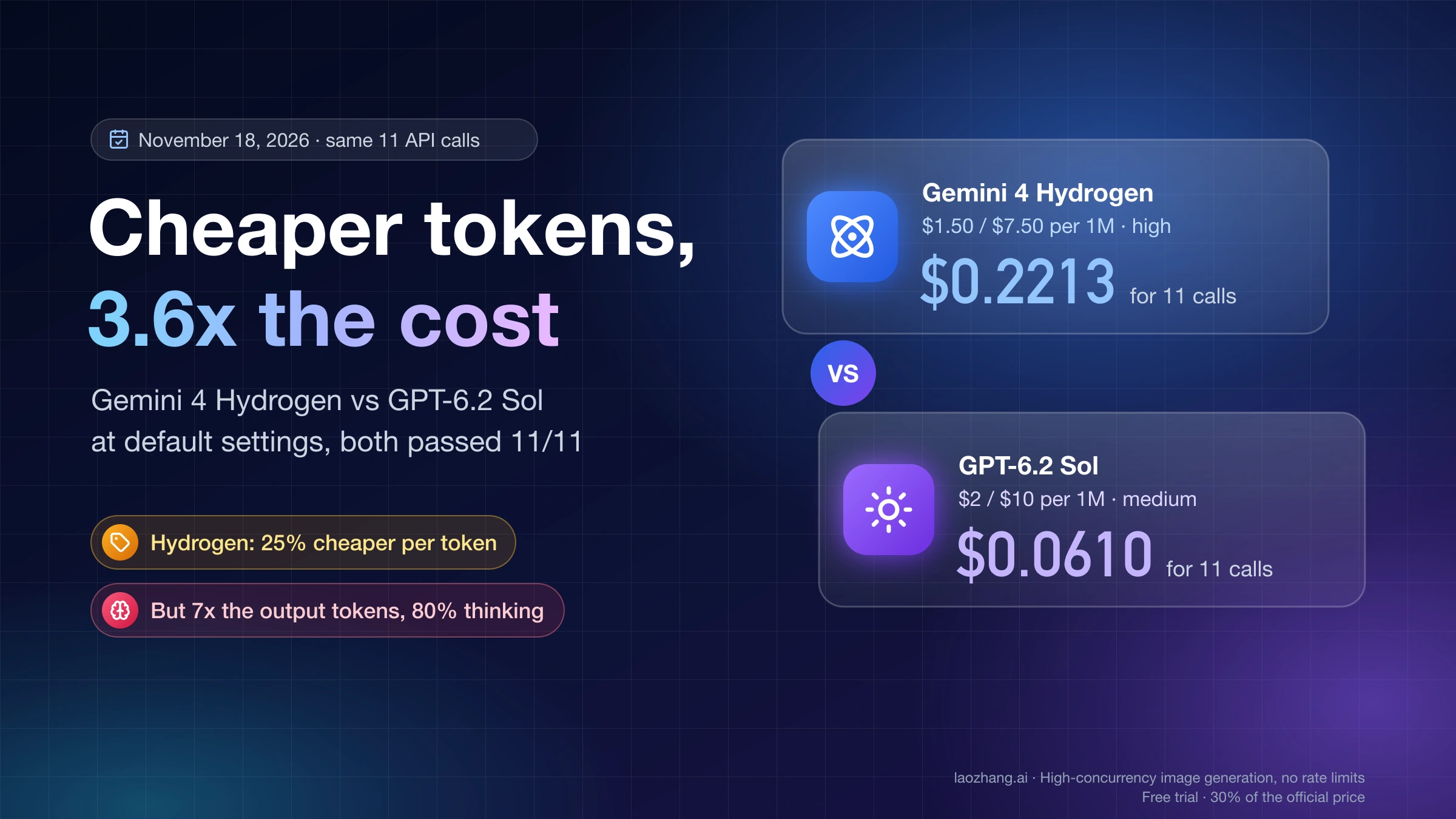
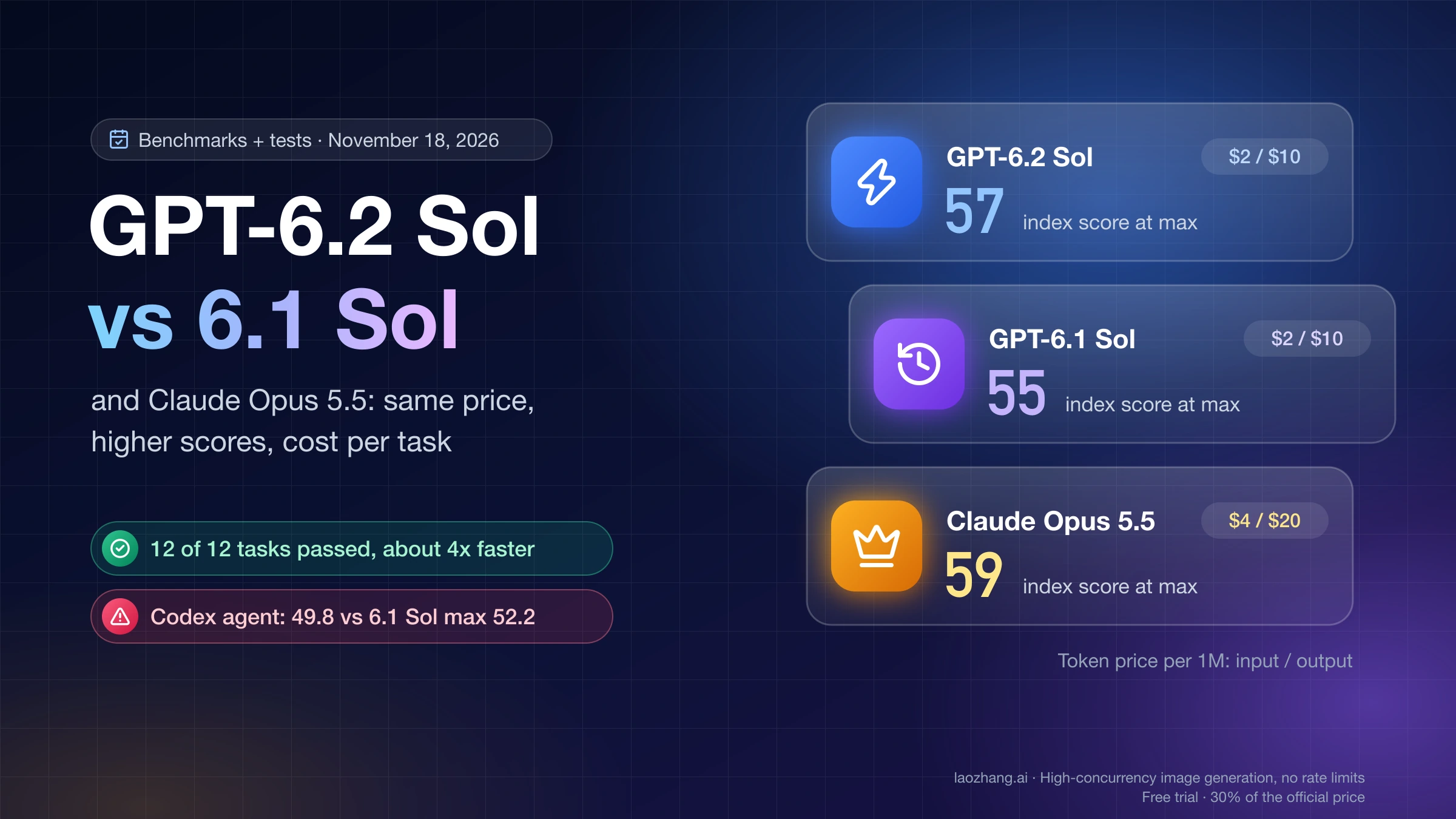
If you are deciding whether to move from GPT-6.1 Sol and want the full same-task test, see GPT-6.2 Sol vs 6.1 Sol vs Opus 5.5: Benchmarks and Tested Cost. For Google's cheaper model against Sol, Gemini 4 Hydrogen vs GPT-6.2 Sol: Cheaper Tokens, 3.6x the Cost has its own same-task test.
Coding agents: Neon 58.6 in Antigravity CLI, Opus 5.5 58.2 in Claude Code
As coding agents, Neon and Opus 5.5 are tied at the top and Sol sits about 9 points lower, but Neon gets there for about half of Opus's cost and in under half the time. The Artificial Analysis Coding Agent Index v2.1 runs each model inside its own vendor's CLI on FrontierCode-AA 2.0, Terminal-Bench 4.1 and SWE-Atlas-QnA-AA, three attempts per task. Figures as of November 19, 2026:
| Agent and model | Coding Agent Index | Cost per task | Time per task |
|---|---|---|---|
Antigravity CLI, Gemini 4 Neon xhigh | 58.6 | $6.86 | 30.5 min |
Claude Code, Claude Opus 5.5 max | 58.2 | $12.61 | 65.3 min |
Codex, GPT-6.2 Sol xhigh | 49.8 | $0.90 | 12.6 min |
Codex, GPT-6.2 Sol max | 48.6 | $1.22 | 17.5 min |
Codex, GPT-6.2 Sol medium | 45.4 | $0.57 | 8.4 min |
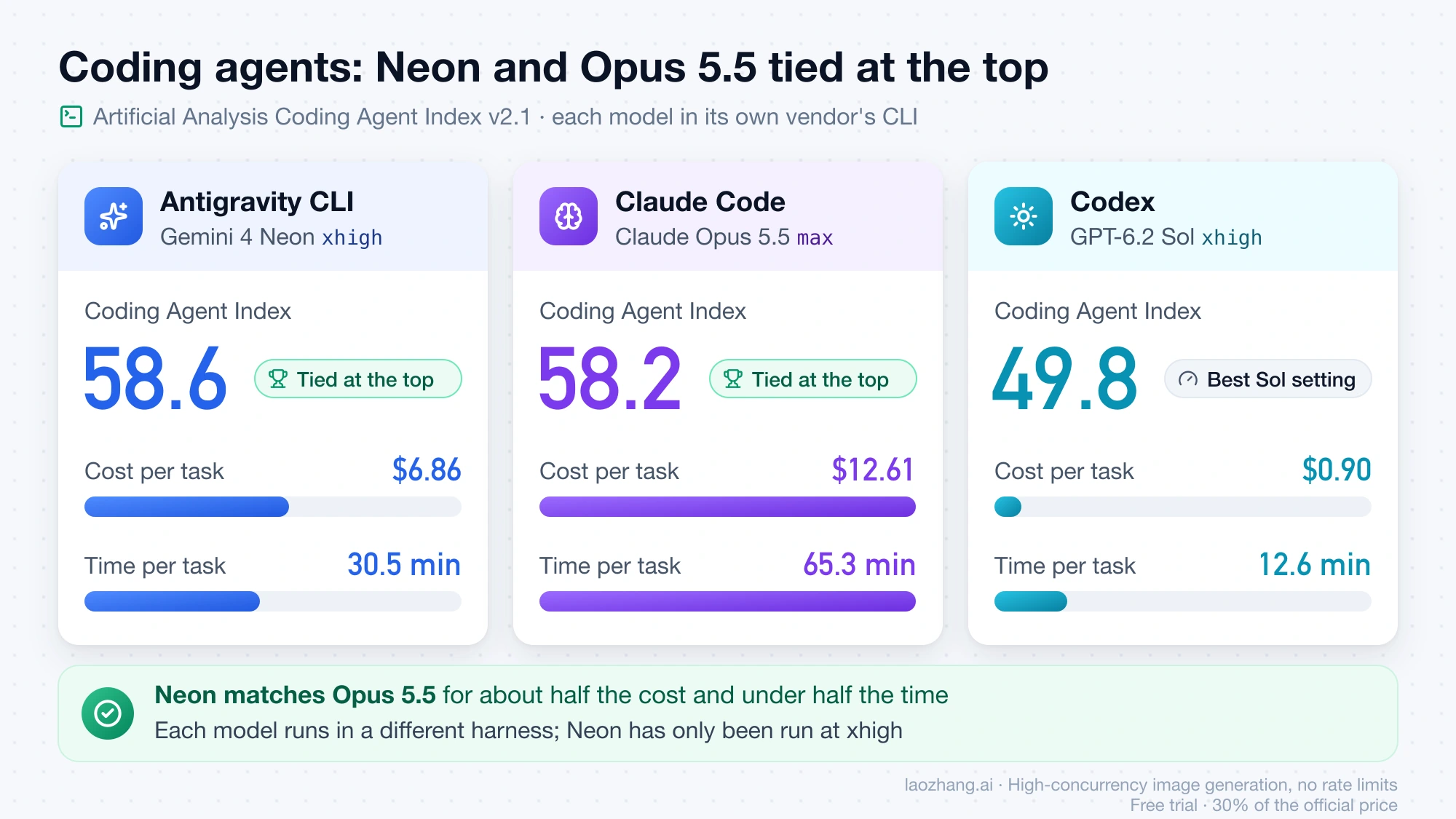
The $6.86 here is a cost per coding-agent task in Antigravity CLI, not the $6.44 per Intelligence Index task in the previous table; the two measure different work. Neon has only been run at xhigh on this index, so there is no reading yet for its default high as an agent. Sol scores lower at max than at xhigh, so xhigh is its best agent setting. For context, Claude Fable 5.2 at xhigh scores 58 in Claude Code at $15.47 per task, and GPT-6.2 Astra at max scores 53.5 in Codex at $5.12. Because each model runs in a different harness, the index compares agent and model together; Google's own SWE-sweep numbers show how much the harness alone can move a score, as the next section explains. For Google's top tier against Opus in agents, see Gemini 4 Carbon vs Opus 5.5: Opus Still Wins Coding Agents.
Google's benchmark table: Neon leads 16 of 19, not Terminal-Bench
Google's launch table puts Neon ahead of Opus 5.5 and GPT-6.2 Sol on 16 of 19 results. The three it does not lead are Terminal-Bench 4.1 and FrontierCode 2.0, where Opus is ahead by under 1.2 points, and Chartography, where Sol is ahead. These are Google-run numbers, re-reported on November 19, 2026 in OfficeChai's Gemini 4 Neon benchmarks report, not independent measurements.
| Benchmark (Google's numbers) | Gemini 4 Neon | Claude Opus 5.5 | GPT-6.2 Sol |
|---|---|---|---|
| Vals Index v2.2 | 70.9% | 70.1% | 66.1% |
| AutomationBench | 56.3% | 42.5% | 41.3% |
| GraphWalks, BFS 256K–1M | 95.2% | 66.8% | 80.1% |
| HLE-Diamond | 71.3% | 67.9% | 64.0% |
| Terminal-Bench 4.1, cheating-adjusted | 65.2% | 65.8% | 61.5% |
| FrontierCode 2.0 | 46.2% | 47.3% | 43.8% |
| Chartography | 73.5% | 66.3% | 75.1% |
| SWE-sweep, provider harness | 39.0% | 10.1% | 8.3% |
| SWE-sweep, mini-SWE harness | 12.8% | 3.6% | 11.6% |
The two SWE-sweep rows are the clearest case of harness effects. In the provider harness, Neon runs inside Google Antigravity and scores almost four times Opus; in the shared mini-SWE harness the gap to Sol shrinks to 1.2 points. The large leads that survive a neutral setup are GraphWalks, a long-context test where Neon scores 95.2% against Opus's 66.8%, and AutomationBench. On Terminal-Bench 4.1 and FrontierCode 2.0, the coding benchmarks closest to day-to-day agent work, the three are within about 4 points of each other.
Tested on November 18, 2026: Sol vs Opus 5.5 on 12 tasks, Neon not run
Gemini 4 Neon was not part of this test. On November 19, 2026 it was not yet offered on the API gateway used for these runs, and a free Google AI Studio account could not open it, so every Neon number on this page comes from Google, Artificial Analysis or the recompute above. GPT-6.2 Sol and Claude Opus 5.5 were run on the same 12 single-turn tasks, each with hidden tests or one exact answer, and every configuration passed all 12.
| Configuration | Passed | Output tokens | Call time, 12 tasks | Cost as billed |
|---|---|---|---|---|
GPT-6.2 Sol, default (medium) | 12/12 | 4,220 | 59.7 s | $0.0721 |
GPT-6.2 Sol, high | 12/12 | 6,765 | 76.6 s | $0.1217 |
Claude Opus 5.5, medium | 12/12 | 11,833 | 130.5 s | $0.3699 |
Claude Opus 5.5, high | 12/12 | 13,674 | 159.3 s | $0.4067 |
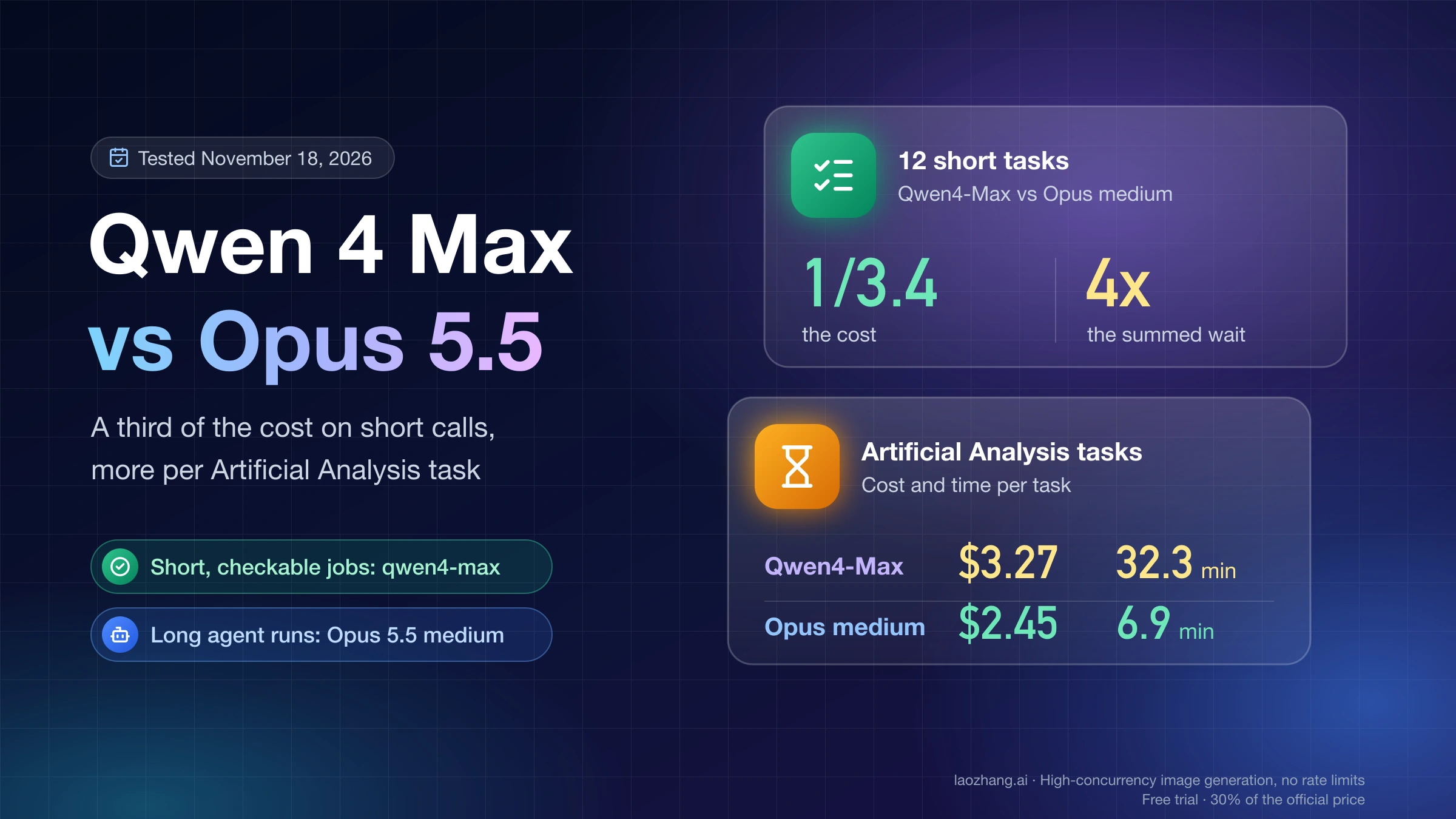
Opus 5.5 at medium cost 5.13x Sol at its default as billed (4.29x against Sol's $0.0862 with no input cached), took 2.19x the time and wrote 2.80x the output tokens. That lines up with the index, where Opus medium costs 5.98x Sol medium. A second task asked for 7 exact numbers from a 146 KB log file, and both models got all 7 right: Sol at default took 13.6 seconds and $0.1581 on November 18, and Opus at medium took 57.6 seconds and $0.4681 on November 11. Opus counted the same log as 78,537 input tokens against Sol's 55,843, 1.41x as many, so part of its premium is paid before it starts reasoning.
The limits matter. The tasks were easy enough for both models to pass, so the test measures speed and cost, not which model solves harder problems. Each cell is one sample, times are wall-clock through the gateway rather than vendor latency, and the Opus rows for 8 of the 12 tasks were run on November 11, 2026 with the same prompts. GPT requests used /v1/chat/completions and Opus requests used /v1/messages with adaptive thinking and output_config.effort. The gateway was laozhang.ai, which lists gpt-6.2-sol and claude-opus-5-5 under one API key and, as of November 19, 2026, had Gemini 4 Argon, Carbon and Hydrogen but not Neon on its model list. The task list and per-task results are in GPT-6.2 Sol vs 6.1 Sol vs Opus 5.5: Benchmarks and Tested Cost.
Disclosure: laozhang.ai is our own service. Its prices are platform pricing, not an independent comparison.
Where you can run Gemini 4 Neon: paid API, Google AI Pro or Ultra
There is no free way to run Neon. The Gemini API pricing page says "Gemini 4 Neon is not available on the Free tier", so API use starts on the paid tier at the rates above. In Google AI Studio on a free account, on November 19, 2026, the model picker lists "Gemini 4 Neon · New · Paid", and selecting it shows "Unlock Gemini 4 Neon — Gemini 4 Neon is only available with a Google AI plan, or pay per request with an API key."
In the Gemini app, the plans help page lists Neon for Google AI Pro (with Auto and Hydrogen) and Google AI Ultra (which adds Carbon); no plan and Google AI Plus get Auto and Hydrogen only. The same page says higher models and thinking levels use more of your allowance, and a model you pick by hand runs at Low unless you choose a level, so pick High if you want app results close to the API default. That page does not say how many Neon prompts a plan includes, and we found no prompt counts for Claude's or ChatGPT's $20-class plans to set beside it, so whether Neon on Google AI Pro goes further than Claude or ChatGPT at $20 cannot be settled by numbers. Google Antigravity offers Neon to paid Pro and Ultra subscribers, and businesses get it through Gemini for business. One caution from the Hacker News launch thread: a user pointed to Antigravity's FAQ, which says that using third-party software or tools to access Antigravity violates its Terms of Service, so a subscription is not a back door for other coding tools.
Neon takes text, images, video, audio and PDF input and has a 1,048,576-token context window shared by input, thinking and output, per Google's model documentation. If you are coming from Opus 5.5 and want to keep using it alongside Neon, How to Access Claude Opus 5.5: 6 Ways In, Which Free Routes Work covers the plans and API routes.
How to set the reasoning level in the Gemini, OpenAI and Claude APIs
Each vendor names the setting differently and starts from a different default, so set the level explicitly in every request you compare. The values are the same literals used in the tables above.
| API | Parameter | Levels | Default |
|---|---|---|---|
| Gemini API (Neon) | thinking_level; REST generationConfig.thinkingConfig.thinkingLevel | low, medium, high, xhigh | high |
| OpenAI API (GPT-6.2 Sol) | reasoning.effort in Responses; reasoning_effort in Chat Completions | low, medium, high, xhigh, max; none is rejected | medium |
| Anthropic API (Opus 5.5) | output_config.effort, sent with thinking: {"type": "adaptive"} | low through max, the levels Artificial Analysis tests | Set it explicitly |
Google's Gemini thinking guide recommends starting Neon at high and keeping xhigh for hard multi-step problems, because on simpler prompts it can overthink or run out of output tokens. Two gateway details came up in testing on laozhang.ai: a Sol Chat Completions request with max failed on November 18, 2026, so send max through the Responses API, and a Claude Sonnet 5.5 request that left out thinking returned no thinking blocks on October 26, 2026, so send both fields for Opus 5.5 as well.
Disclosure: laozhang.ai is our own service. Its prices are platform pricing, not an independent comparison.
Gemini 4 Neon, Opus 5.5 and GPT-6.2 Sol: other questions
Is Gemini 4 Neon replacing Gemini 4 Argon?
Google has not said so. As of November 19, 2026, the Gemini app plans help page no longer lists Argon, but the Gemini API still serves gemini-4-argon and its deprecations page gives no shutdown date for Argon or Neon. OfficeChai reports that Neon replaces Gemini 3.1 Pro in the app; Google's launch post describes Neon as sitting between Carbon, for the hardest long-horizon work, and Hydrogen, for fast everyday tasks.
Is Gemini 4 Neon better than Gemini 4 Carbon?
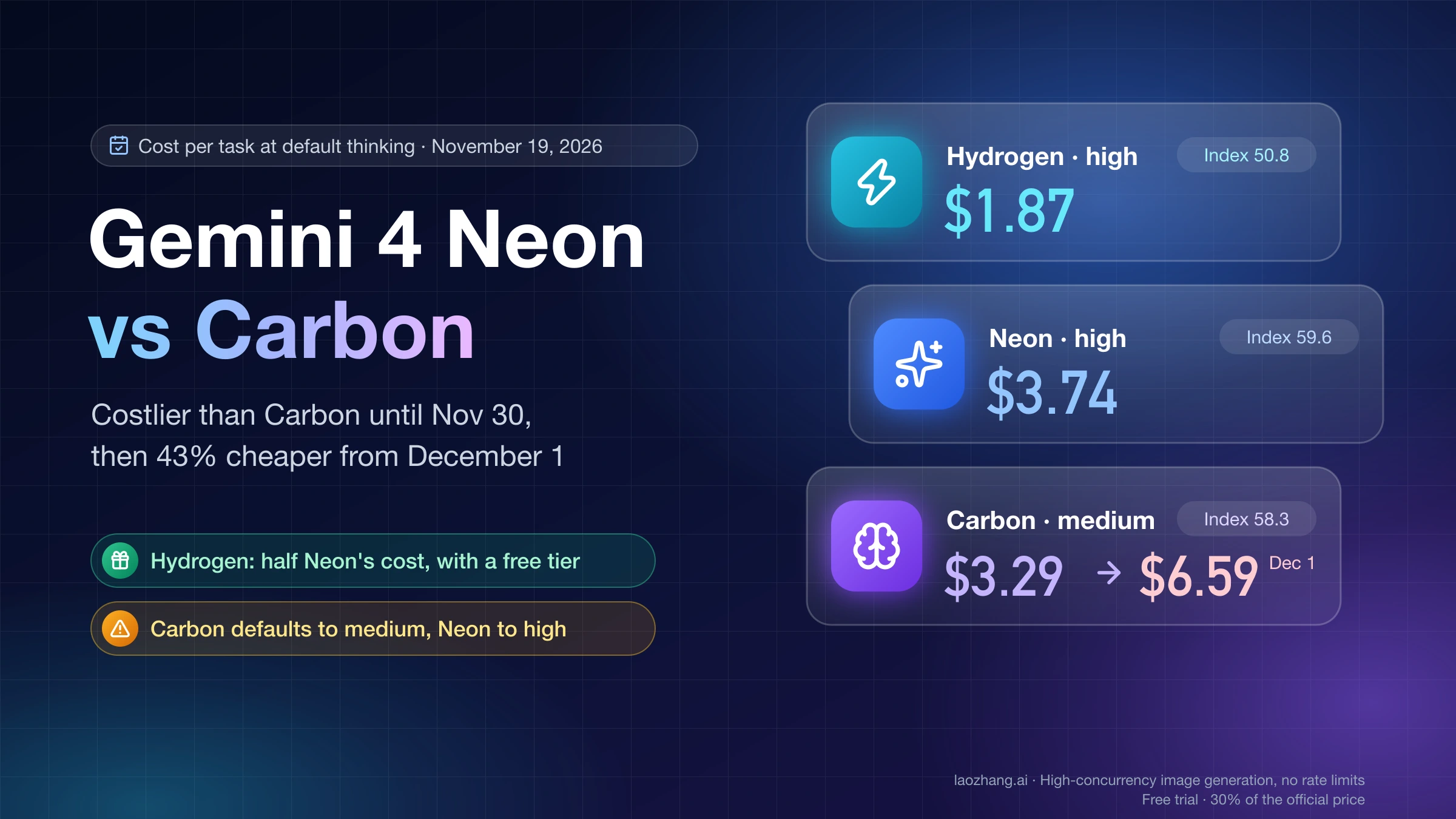
Slightly, on the Artificial Analysis Intelligence Index: Neon at xhigh scores 61, "1 point ahead of Gemini 4 Carbon (high)", according to the Artificial Analysis Gemini 4 Neon launch analysis. Artificial Analysis says Neon costs less per task than Carbon at Carbon's standard $4 / $20 "purely from its 25% lower token prices", since Neon writes about 15% more output tokens. Carbon's discounted $2 / $10 per million tokens runs through November 30, 2026, so until then Carbon is cheaper per token, and from December 1 Neon is. The full Neon, Carbon and Hydrogen breakdown, including cost per task before and after December 1, is in Gemini 4 Neon vs Carbon: Costlier Until Dec 1, Then 43% Cheaper.
Sources11
External pages this guide links to, in the order they appear. Last updated Nov 19, 2026.
Sources11
External pages this guide links to, in the order they appear. Last updated Nov 19, 2026.
- 1.Gemini app plans help pagesupport.google.com/gemini/answer/18648722
- 2.Gemini API pricing pageai.google.dev/gemini-api/docs/pricing
- 3.GPT-6.2 Sol model pagedevelopers.openai.com/api/docs/models/gpt-6.2-sol
- 4.Anthropic's Claude pricing pageplatform.claude.com/docs/en/about-claude/pricing
- 5.Artificial Analysis Neon vs Opus 5.5 comparisonartificialanalysis.ai/models/comparisons/gemini-4-neon-vs-claude-opus-5-5
- 6.Artificial Analysis Neon vs GPT-6.2 Sol comparisonartificialanalysis.ai/models/comparisons/gemini-4-neon-vs-gpt-6-2-sol
- 7.Google blog post introducing Gemini 4 Neonblog.google/innovation-and-ai/models-and-research/gemini-models/introducing-gemini-4-neon
- 8.Artificial Analysis Coding Agent Indexartificialanalysis.ai/agents/coding
- 9.OfficeChai's Gemini 4 Neon benchmarks reportofficechai.com/ai/gemini-4-neon-benchmarks
- 10.Gemini thinking guideai.google.dev/gemini-api/docs/thinking
- 11.Artificial Analysis Gemini 4 Neon launch analysisartificialanalysis.ai/articles/gemini-4-neon-intelligence-gain