Gemini 4 Carbon vs GPT-6.1 Sol for Coding: Same Rate, 7x the Cost
Same $2/$10 list price until Nov 30, 2026, yet on 7 identical coding tasks Carbon cost 7x Sol and took 3.4x longer. Its lead shows on terminal agent work.
On this page
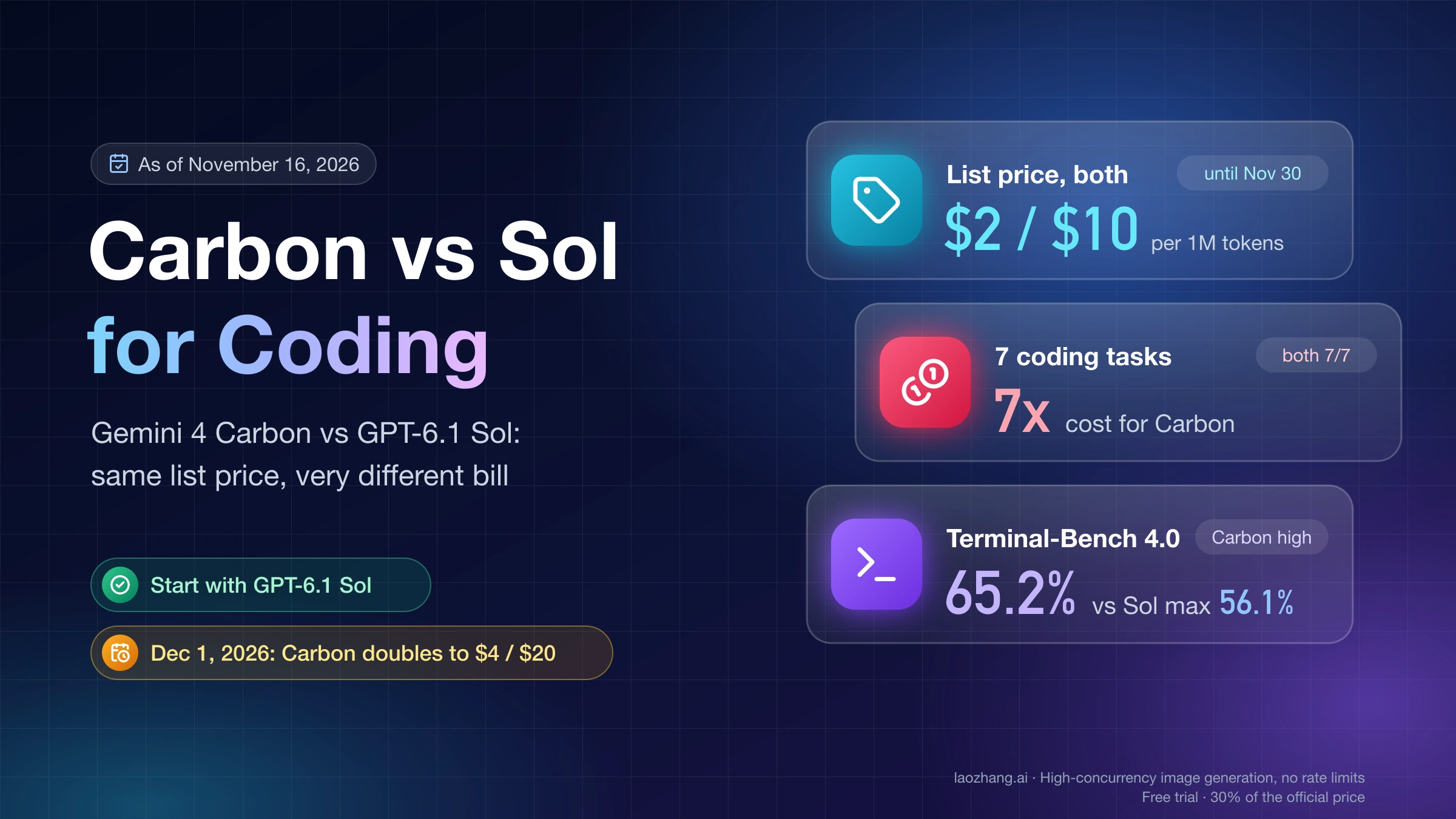
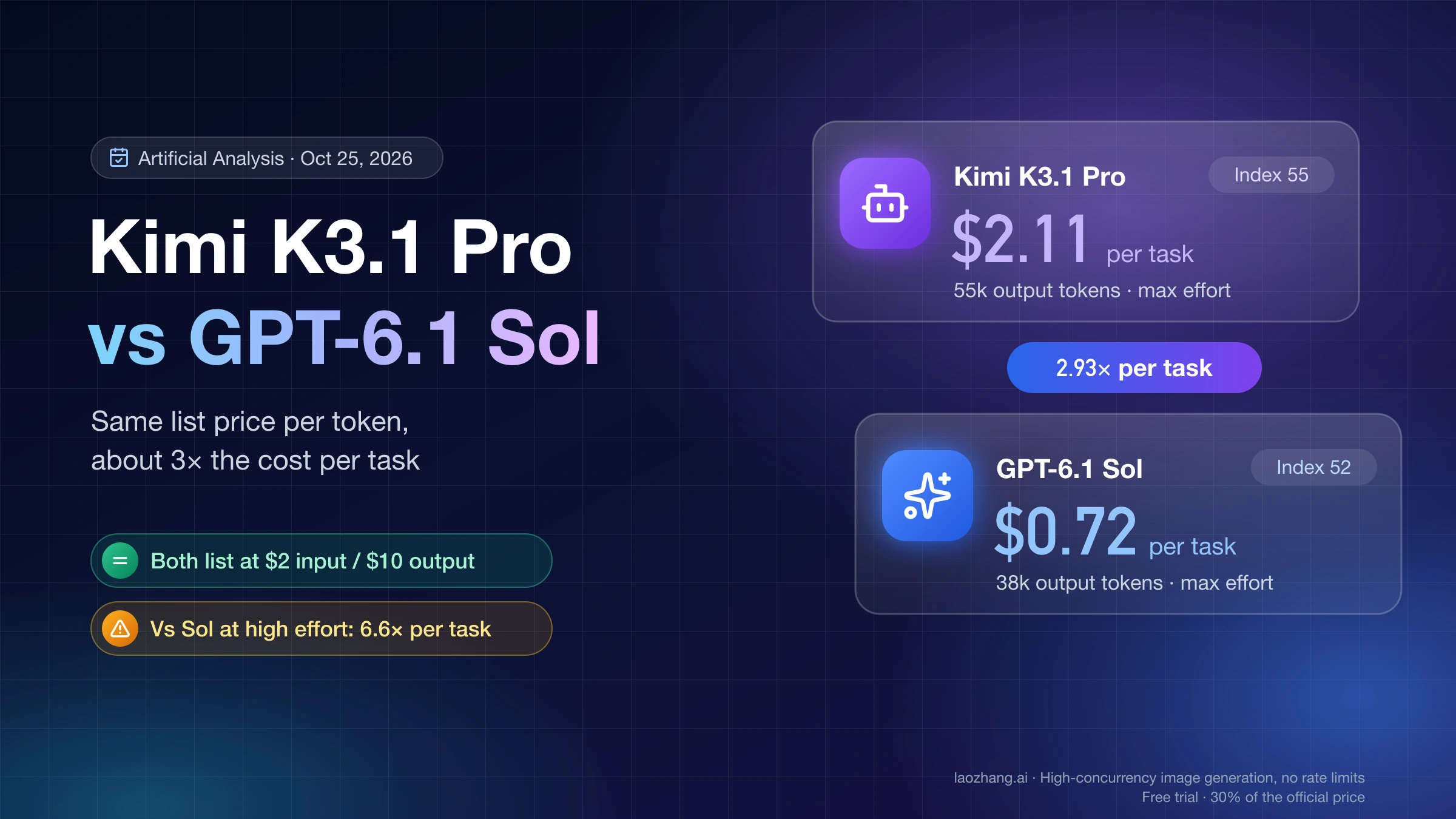
For most coding work, start with GPT-6.1 Sol (gpt-6.1-sol) at its default medium effort, and try Gemini 4 Carbon (gemini-4-carbon) at its default medium thinking level only on the jobs where Sol keeps failing, especially long, multi-step command-line tasks. The two list at the same API price through November 30, 2026, $2 per million input tokens and $10 per million output tokens, but they don't spend the same number of tokens. On seven test-backed coding tasks called through the laozhang.ai gateway between October 28 and November 16, 2026, both models passed all seven at their default settings, while Carbon cost about 7 times as much as Sol and took 3.4 times as long, because it spent far more tokens thinking on two of the tasks. On a wider set of eleven tasks the gap was 4.9 times, and on one long log it was 2.6 times.
Disclosure: laozhang.ai is our own service. Its prices are platform pricing, not an independent comparison.
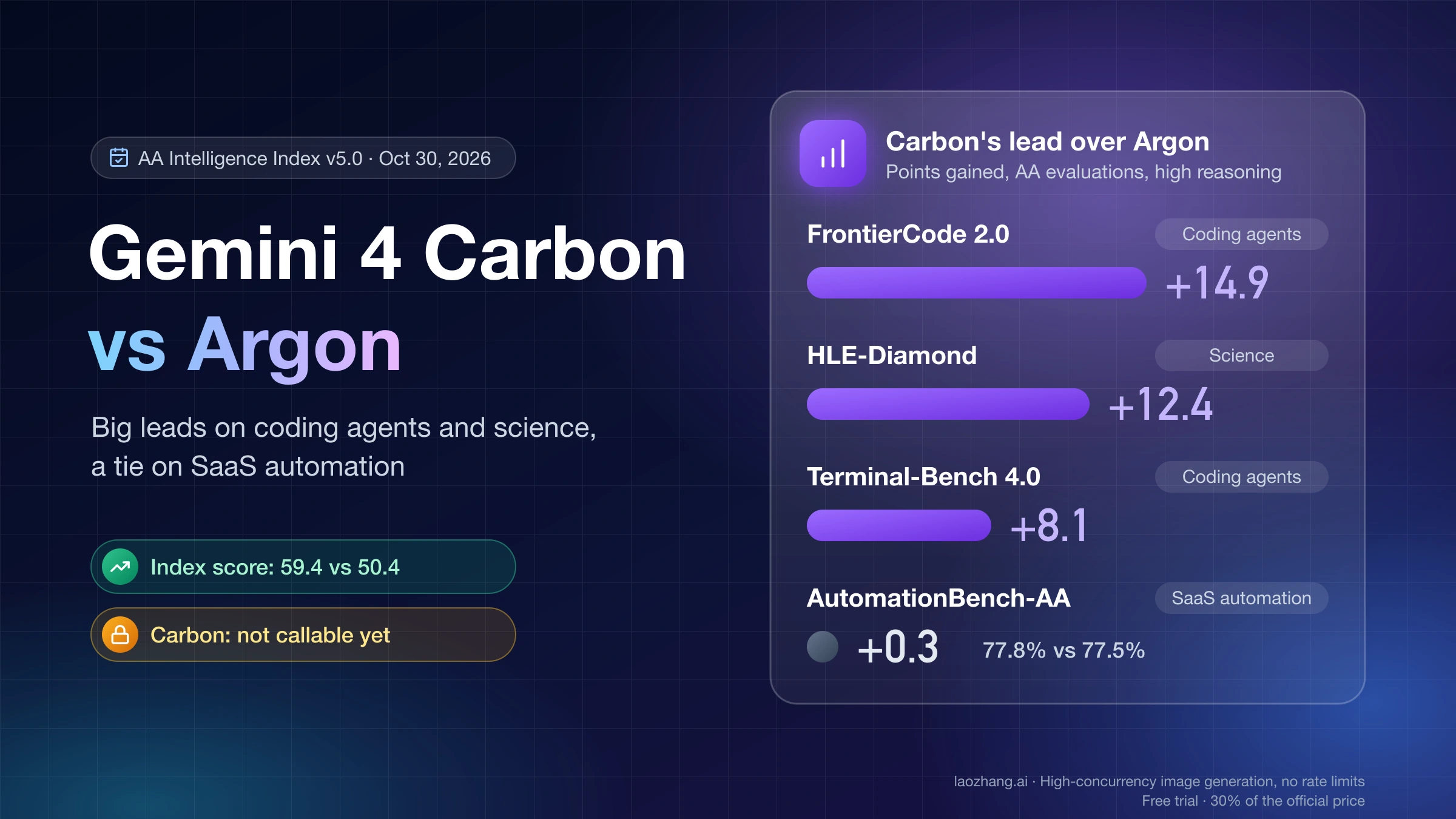
Carbon's lead is real where it shows up. On Artificial Analysis's Intelligence Index v5.0.1, as of November 16, 2026, every Carbon level beats Sol's best setting on Terminal-Bench 4.0, with 65.2% for Carbon high against 56.1% for Sol max. On FrontierCode-AA 2.0, the same page's other coding test, Carbon high and Sol max tie at 40.6%, and Carbon low falls below Sol medium. So the extra money buys a better chance on terminal-heavy agent work, not on every coding task.
Two conditions change the math. On December 1, 2026, Carbon's price doubles to $4 and $20 per million tokens while Sol's stays the same, which turns the 7x gap on those seven tasks into about 14x. And if a single request sends more than 272K input tokens, Sol bills the whole request at $4 input and $15 output, while Carbon has no long-context surcharge, so very large inputs are the one place Carbon can be cheaper per token.
Carbon or Sol for coding: start with Sol, try Carbon on terminal work
GPT-6.1 Sol is the better default for coding through the API or Codex because it passes routine, well-specified tasks at a fraction of Carbon's spend and wait. Gemini 4 Carbon is the model to bring in when a task looks like Terminal-Bench, where an agent works through a real problem at the command line over many steps, and Sol at high or xhigh still doesn't finish it. Judge the switch by cost per accepted task on your own work: what a batch costs, divided by the number of results you'd keep without fixing.
| Your coding work | Try first | Start at | Bring in the other model when |
|---|---|---|---|
| Functions, parsers, and spec-driven fixes with tests you can run | gpt-6.1-sol | medium (default) | Sol at high still fails your tests |
| Multi-step terminal work: environment setup, debugging in the shell, long agent runs | gpt-6.1-sol, then gemini-4-carbon | Sol at high; Carbon at medium (default) | Sol at xhigh or max still fails; compare Carbon's cost per accepted task before keeping it |
| Reading a long log or many files, under 272K input tokens | gpt-6.1-sol | medium (default) | Rarely; on the log test below Sol was right at a fraction of the cost |
| Single requests over 272K input tokens through the API | Test both | medium on each | Sol's whole-request surcharge applies; Carbon has none, but it was not tested at this size |
Two practical details affect the setup. Sol's tool calling requires the Responses API, so a coding agent that calls tools can't use Chat Completions with Sol. Carbon supports function calling, code execution, computer use, and grounding with Google Search, and has only implicit caching. If you're moving an existing GPT-6 Sol integration, GPT-6.1 Sol: Pricing, Access, and What Breaks When You Switch lists the parameter changes.
Same 7 coding tasks: both passed, Carbon cost 7x and took 3.4x longer
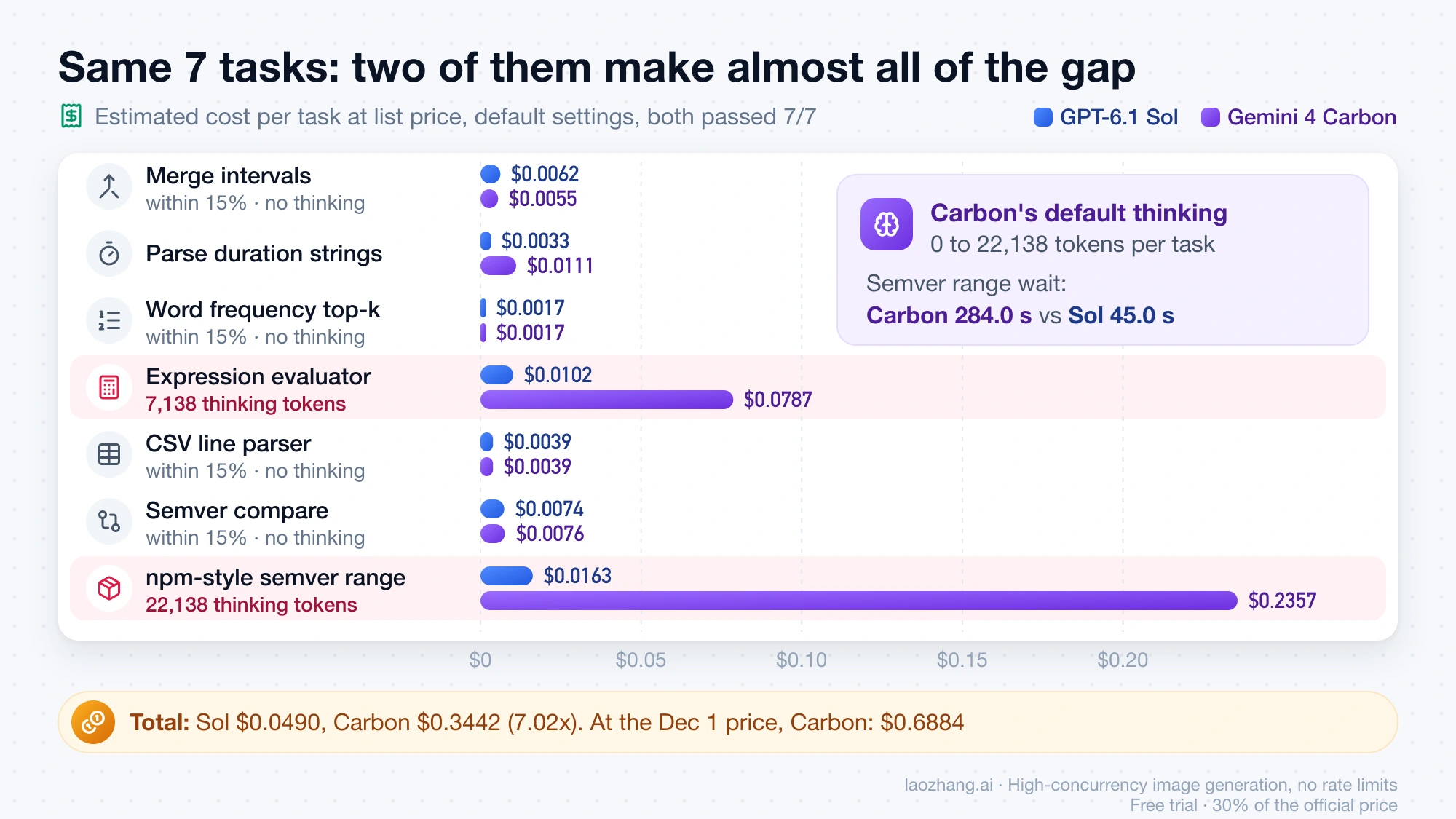
On the same seven coding tasks with hidden tests, GPT-6.1 Sol and Gemini 4 Carbon both passed 7/7 at their default settings. Sol spent $0.0490 and 133.9 seconds of call time in total; Carbon spent $0.3442 and 459.1 seconds. That is 7.02 times the cost and 3.43 times the wait, and Carbon wrote 34,088 output tokens against Sol's 4,613, of which 30,047 were thinking tokens.
The runs were made on different days through the laozhang.ai gateway, one sample per cell, with no system prompt, no tools, and a single turn. Sol was called on October 28, 2026 through POST /v1/chat/completions without reasoning_effort, which means OpenAI's default medium. Carbon was called through the Gemini-native generateContent endpoint without a generationConfig, which means Google's default medium thinking level: five of the tasks on November 11, 2026, and the two semver tasks on November 16, 2026, with prompts word for word the same and the same hidden tests. Costs are estimates from the returned token usage at list price, not invoices, and Carbon's from-December-1 column is the same usage at double the price.
Disclosure: laozhang.ai is our own service. Its prices are platform pricing, not an independent comparison.
| Coding task (hidden tests) | GPT-6.1 Sol, default | Gemini 4 Carbon, default | Carbon from Dec 1, 2026 |
|---|---|---|---|
| Merge intervals | $0.0062 | $0.0055 | $0.0110 |
| Parse duration strings | $0.0033 | $0.0111 | $0.0222 |
| Word frequency top-k | $0.0017 | $0.0017 | $0.0034 |
| Expression evaluator | $0.0102 | $0.0787 | $0.1574 |
| CSV line parser | $0.0039 | $0.0039 | $0.0078 |
| Semver compare (30 tests) | $0.0074 | $0.0076 | $0.0152 |
| npm-style semver range (36 tests) | $0.0163 | $0.2357 | $0.4714 |
| Total, 7/7 passed by both | $0.0490 | $0.3442 | $0.6884 |
Read the table by row, not by the total. On four tasks Carbon cost within 15% of Sol, and on all four it used zero thinking tokens. Almost the whole gap comes from two tasks: the expression evaluator, where Carbon thought for 7,138 tokens, and the npm-style semver range checker, where it wrote 23,481 output tokens (22,138 of them thinking) and took 284.0 seconds against Sol's 1,547 output tokens and 45.0 seconds. Carbon's default thinking swung from 0 to 22,138 tokens per task on work that both models solved, so a total ratio depends heavily on which tasks you include. Across the five tasks that were also run at high effort, Carbon default cost 4.00 times Sol default, and across all eleven tasks below it was 4.93 times.
These tasks are small and clearly specified, which is why both models passed nearly everything. They show what the same correct result costs in money, output volume, and waiting time; they don't show which model is smarter on hard problems. That comparison comes from Artificial Analysis in the next section. Two unverified single runs posted on X point the same way: X user notjazii reported one prompt at each model's highest reasoning setting taking Sol 30 minutes and about $1.4 and Carbon 40 minutes and about $2.9, and X user EnvolDev reported Carbon at $8.83 and 2 h 39 min against Sol at $3.11 and 54 min on a 3D generation prompt.
Four non-coding checks were run alongside: a word problem, a digit-sum count, a five-point summary of a 6,723-word text, and a CPython 3.13 standard-library question that hid two functions that don't exist. Sol answered all four correctly at both settings and said both made-up functions do not exist. Carbon got the first three right, and on November 16, at default, it said functools.memoize_method does not exist but gave a one-line description of the made-up statistics.winsorized_mean, in a call with zero thinking tokens. That is one sample, so treat it as a reason to check unfamiliar API names in Carbon's code, not as a measured hallucination rate; on Artificial Analysis's AA-Omniscience v1.1 knowledge test, Carbon actually scores higher than Sol (54 at high against 42 at max).
To repeat the comparison on your own tasks, call each model through its official route, the Gemini API paid tier for gemini-4-carbon and the OpenAI API for gpt-6.1-sol, or use one laozhang.ai key, which lists both model IDs in its /v1/models catalog as of November 16, 2026 and is how the runs above were made.
Where Carbon's benchmark lead shows up: Terminal-Bench, not FrontierCode
Gemini 4 Carbon leads GPT-6.1 Sol clearly on terminal-style coding benchmarks and not on FrontierCode, and on Artificial Analysis it costs 3.7–4.3 times as much per task as Sol max for that lead. The figures below are from the Artificial Analysis Gemini 4 Carbon vs GPT-6.1 Sol release comparison, Intelligence Index v5.0.1, as of November 16, 2026. Cost per task there means the average cost of one task in Artificial Analysis's own evaluation suite, priced at $2 and $10 for both models, so it can't be added to or divided by the same-task costs above.
| Setting | Intelligence Index | Cost per task | Time per task | Terminal-Bench 4.0 | FrontierCode-AA 2.0 |
|---|---|---|---|---|---|
| Carbon high | 60 | $5.48 | 32.1 min | 65.2% | 40.6% |
| Carbon medium (default) | 58 | $4.68 | 28.0 min | 60.6% | 39.5% |
| Carbon low | 54 | $5.22 | 25.9 min | 62.6% | 29.6% |
| Sol max | 55 | $1.27 | 22.7 min | 56.1% | 40.6% |
| Sol xhigh | 52 | $0.76 | 9.8 min | 54.0% | 38.5% |
| Sol high | 50 | $0.59 | 7.6 min | 51.5% | 36.7% |
| Sol medium (default) | 46 | $0.36 | 4.4 min | 48.0% | 33.4% |
| Sol low | 35 | $0.16 | 1.9 min | 30.8% | 20.2% |
Even Carbon's weakest Terminal-Bench 4.0 result, 60.6% at medium, is above Sol at max. The same pattern holds on Terminal-Bench-Science 0.1 (Carbon 61.9–64.8% against Sol's best 58.1%) and on Artificial Analysis's Engineering score (60–65 against 59). FrontierCode-AA 2.0 is different: Carbon high and Sol max tie at 40.6%, Carbon medium edges Sol xhigh by one point, and Carbon low at 29.6% falls below Sol medium at 33.4%. On the overall Index, Sol max scores 55, one point above Carbon low, for $1.27 per task against $5.22. Carbon medium and high score higher than anything Sol reaches, at $4.68 and $5.48 per task.
If you've seen $7.76 per task quoted for Carbon high, that is what Artificial Analysis showed on November 11, 2026, with $6.59 for medium and $7.19 for low; by November 16 it had recalculated them to the figures above. The AA costs also use Carbon's November price, so from December 1 they would roughly double to about $10.96, $9.36, and $10.44 if the cache share stays the same.
Which effort level: Carbon at default medium, Sol from medium up
Keep Gemini 4 Carbon at its default medium thinking level, and start GPT-6.1 Sol at its default medium, raising it to high, xhigh, or max only when a task fails. The two scales don't line up: Carbon has three thinking levels (low, medium, high, set with thinkingLevel), Sol has five reasoning efforts (low, medium, high, xhigh, max, set with reasoning.effort in the Responses API or reasoning_effort in Chat Completions), and Carbon high scores 60 on the Index where Sol high scores 50. "High on both" is not a like-for-like test; the closest score pair on the Index is Carbon low (54) against Sol max (55).
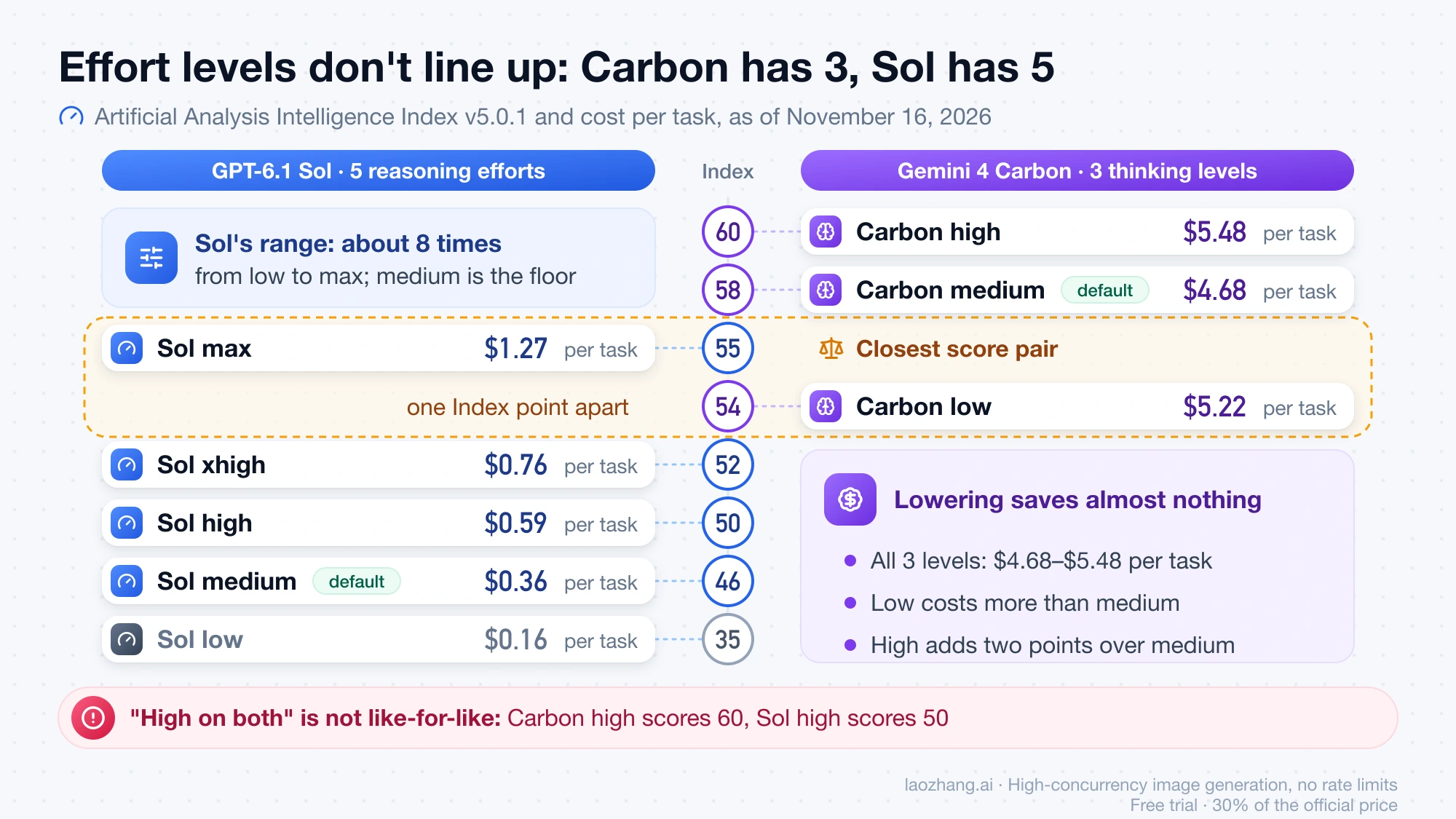
Lowering Carbon saves almost nothing. On Artificial Analysis, its three levels cost $4.68–$5.48 per task, low actually costs more than medium, and low saves only about two minutes per task while dropping four Index points. Raising Carbon costs a lot for little: high adds two Index points over medium, and its first answer token took 73.49 seconds against 20.89 seconds at medium. On the five coding tasks run at both levels, Carbon high passed the same 5/5 as default but cost $0.6121 against $0.1009 and took 614.5 seconds against 169.7, because it wrote 58,816 thinking tokens instead of 7,909. On the long log described below, Carbon high hit the output limit twice and returned no answer at all.
Sol's range is wider, about 8 times from low to max on Artificial Analysis ($0.16 to $1.27 per task), which is what makes it adjustable. Medium is the sensible floor for coding, because low drops Terminal-Bench 4.0 to 30.8%. Each step up costs time as well as money: time per task goes from 4.4 minutes at medium to 7.6 at high, 9.8 at xhigh, and 22.7 at max, and the first answer token from 4.81 seconds to 166.70 seconds at max. On the seven same-task coding problems, Sol high also passed 7/7 and cost $0.0859 over 237.9 seconds, so even against Sol high, Carbon default cost 4.01 times as much and took 1.93 times as long. If Sol at high feels too slow, GPT-6.1 Sol Slow in Codex or API? Causes and Tested Speed Fixes covers effort and speed-tier fixes.
Codex vs Antigravity CLI: Carbon scores 55.5, Sol 52.2 at a fifth of the cost
Inside each vendor's own coding agent, Gemini 4 Carbon scores higher, but GPT-6.1 Sol costs about a fifth as much per task and finishes sooner. On the Artificial Analysis Coding Agent Index v2.1, as of November 16, 2026, Antigravity CLI with Carbon at high scored 55.5 at $7.13 per task, 33.6 minutes, and an average of 186 steps; Codex with Sol at max scored 52.2 at $1.51 per task, 21.9 minutes, and 43 steps. The index averages three attempts on each of 132 FrontierCode-AA 2.0 tasks, 66 Terminal-Bench 4.1 tasks, and 124 SWE-Atlas-QnA-AA tasks, weighted equally.
The split follows the model results. Carbon in Antigravity CLI passed 129 of 198 Terminal-Bench attempts against 107 for Sol in Codex, while Sol in Codex passed 183 of 396 FrontierCode attempts against 166 for Carbon. Keep in mind what is being compared: two products, each a model inside its own vendor's agent, with no row for Carbon in Codex or Sol in Antigravity, and only Sol's max setting listed. Carbon's $7.13 is also at the November price.
Access differs more than the agents do. Carbon became generally available on the Gemini API paid tier on November 10, 2026, with no free tier, and in the Gemini app and Antigravity it requires a Google AI Ultra subscription; Gemini 4 Carbon Release Date: Out Nov 10 on Paid API and Ultra covers where it is available. Sol in Codex and ChatGPT Work runs with a 500K default context and no long-context surcharge within subscription usage.
Long logs and large repos: Sol answered the same 146 KB log 4.7x faster
On a single long-input task, GPT-6.1 Sol got every answer right faster and cheaper than Gemini 4 Carbon. The task was a 146 KB application log of 1,500 lines with one question asking for seven numbers: the count of each of five error codes, the number of distinct users who hit E503, and the request ID with the most retries. Both models were called through the laozhang.ai gateway with one sample per setting, Carbon on November 11, 2026 and Sol on November 16, 2026.
Disclosure: laozhang.ai is our own service. Its prices are platform pricing, not an independent comparison.
| Setting | Result | Time | Output tokens (thinking) | Estimated cost |
|---|---|---|---|---|
| Sol default (medium) | All 7 right | 45.7 s | 2,576 (2,527) | $0.1654 |
| Sol high | All 7 right | 87.7 s | 5,866 (5,817) | $0.1983 |
| Carbon default (medium) | All 7 right | 213.9 s | 26,952 (26,867) | $0.4281 |
| Carbon high | No answer, stopped at the output limit twice | 507.6 s on the second try | 65,533 thinking on the second try | $0.4863 + $0.8140 |
Carbon default cost 2.59 times Sol default and took 4.68 times as long. Part of that is input size: the same log counted as 79,312 input tokens for Carbon and 55,843 for Sol, 1.42 times as many, because the two tokenizers differ. Sol's usage recorded almost all of its input as a cache write, so its cost is estimated at the $2.50 cache-write rate; at the plain $2.00 input rate, Sol default would be $0.1375. Carbon high failed the first time at 32,765 thinking tokens without streaming, and again with streaming and maxOutputTokens set to 65,536, the synchronous maximum, still billing for every thinking token. If you send Carbon long counting or analysis jobs, keep it at medium and check for a MAX_TOKENS finish reason.
This log is far below 272K input tokens, so it says nothing about Sol's long-context rule. Above 272K input tokens, Sol bills the whole request at twice the input and cache rates and 1.5 times the output rate, $4 and $15 per million. Carbon has no such surcharge, so for one request that large, Carbon is cheaper per token through November 30 ($2 and $10) and from December 1 charges the same $4 input but $20 output. Neither model was tested at that size, and on this log Carbon counted 1.42 times as many tokens for the same text, so measure a real request before assuming Carbon wins there. One counting task also doesn't prove Sol is better on long input in general.
Is Carbon still worth it after December 1, 2026? Same tasks at double
From December 1, 2026, Gemini 4 Carbon costs twice GPT-6.1 Sol per token, so it is worth keeping only for tasks Sol cannot pass even at xhigh or max. Google's Gemini API pricing page lists the new Standard paid-tier rates already; OpenAI's GPT-6.1 Sol model page shows no change for Sol as of November 16, 2026.
| Rate per 1M tokens | GPT-6.1 Sol | Carbon through Nov 30 | Carbon from Dec 1 |
|---|---|---|---|
| Input, request up to 272K input tokens | $2.00 | $2.00 | $4.00 |
| Output, thinking tokens included | $10.00 | $10.00 | $20.00 |
| Cached input | $0.10 | $0.10 | $0.20 |
| Request over 272K input tokens (input / output) | $4.00 / $15.00 | $2.00 / $10.00 | $4.00 / $20.00 |
Applied to the same-task results, doubling Carbon's price doubles every ratio. On the seven coding tasks, Carbon default goes from 7.02 to 14.05 times Sol default. On all eleven tasks, Carbon default goes from $0.4421 to $0.8842 against Sol's $0.0897, from 4.93 to 9.86 times. On the long log, Carbon's $0.4281 becomes $0.8563, 5.18 times Sol default. On the five tasks run at high effort, Carbon high was already 15.82 times Sol high and becomes 31.63 times. Batch pricing halves both models, so it lowers the bill without changing these ratios.
So the December decision is narrower than the November one. If Carbon passes a task that Sol fails at every effort, compare the cost per accepted task including Sol's retries, because a passed task at 14 times the price can still beat a failed one. If Sol passes at any setting, it is the cheaper choice from December 1, since even Sol max costs $1.27 per Artificial Analysis task against $4.68 for Carbon medium at the November price.
Gemini 4 Carbon vs GPT-6.1 Sol for coding: other questions
Which has more room for long code output?
GPT-6.1 Sol can return up to 128,000 output tokens per request, per OpenAI's model page. Gemini 4 Carbon's synchronous maximum is 65,536 output tokens, thinking included, with long decode allowing up to 1,048,576, per Google's model page as of November 16, 2026. Because Carbon counts thinking toward that limit, a long reasoning run can use up the room before any code is written, as it did on the log task above.
Is GPT-6.1 Terra or Gemini 4 Argon a cheaper option than Sol?
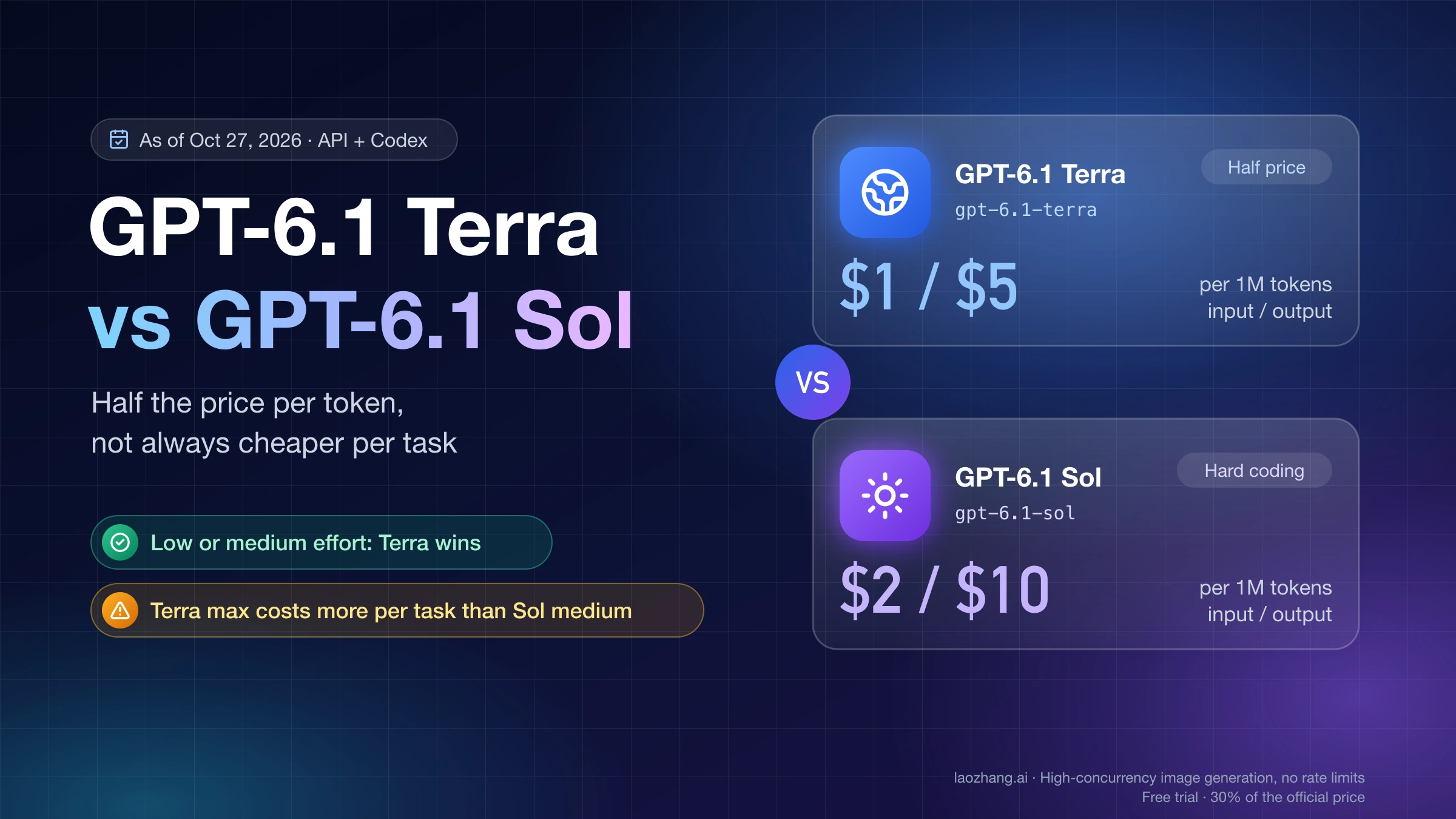
Both are cheaper options with their own trade-offs. GPT-6.1 Terra vs GPT-6.1 Sol: Half the Price, Not Always Cheaper shows where Terra's half-price tokens stop saving money, and Gemini 4 Argon vs Claude Opus 5.5 vs GPT-6.1 Sol: Same-Task Test runs Argon on the same kind of tasks.
Do Batch or Flex change which model is cheaper?
No. Batch halves the price of both Gemini 4 Carbon and GPT-6.1 Sol, and Sol's Flex tier is also half price, so the same-task ratios stay the same. Sol's Fast tier costs 2 times and Ultrafast 6 times its Standard rate, per OpenAI's model page as of November 16, 2026, which can make Sol more expensive than Carbon per token if you need its fastest output.
Sources4
External pages this guide links to, in the order they appear. Last updated Nov 16, 2026.
Sources4
External pages this guide links to, in the order they appear. Last updated Nov 16, 2026.
- 1.Artificial Analysis Gemini 4 Carbon vs GPT-6.1 Sol release comparisonartificialanalysis.ai/models/releases/comparisons/gemini-4-carbon-vs-gpt-6-1-sol
- 2.Artificial Analysis Coding Agent Indexartificialanalysis.ai/agents/coding-agents
- 3.Gemini API pricing pageaistudio.google.com/docs/pricing
- 4.GPT-6.1 Sol model pagedevelopers.openai.com/api/docs/models/gpt-6.1-sol