Gemini 4 Hydrogen vs GPT-6.2 Sol: Cheaper Tokens, 3.6x the Cost
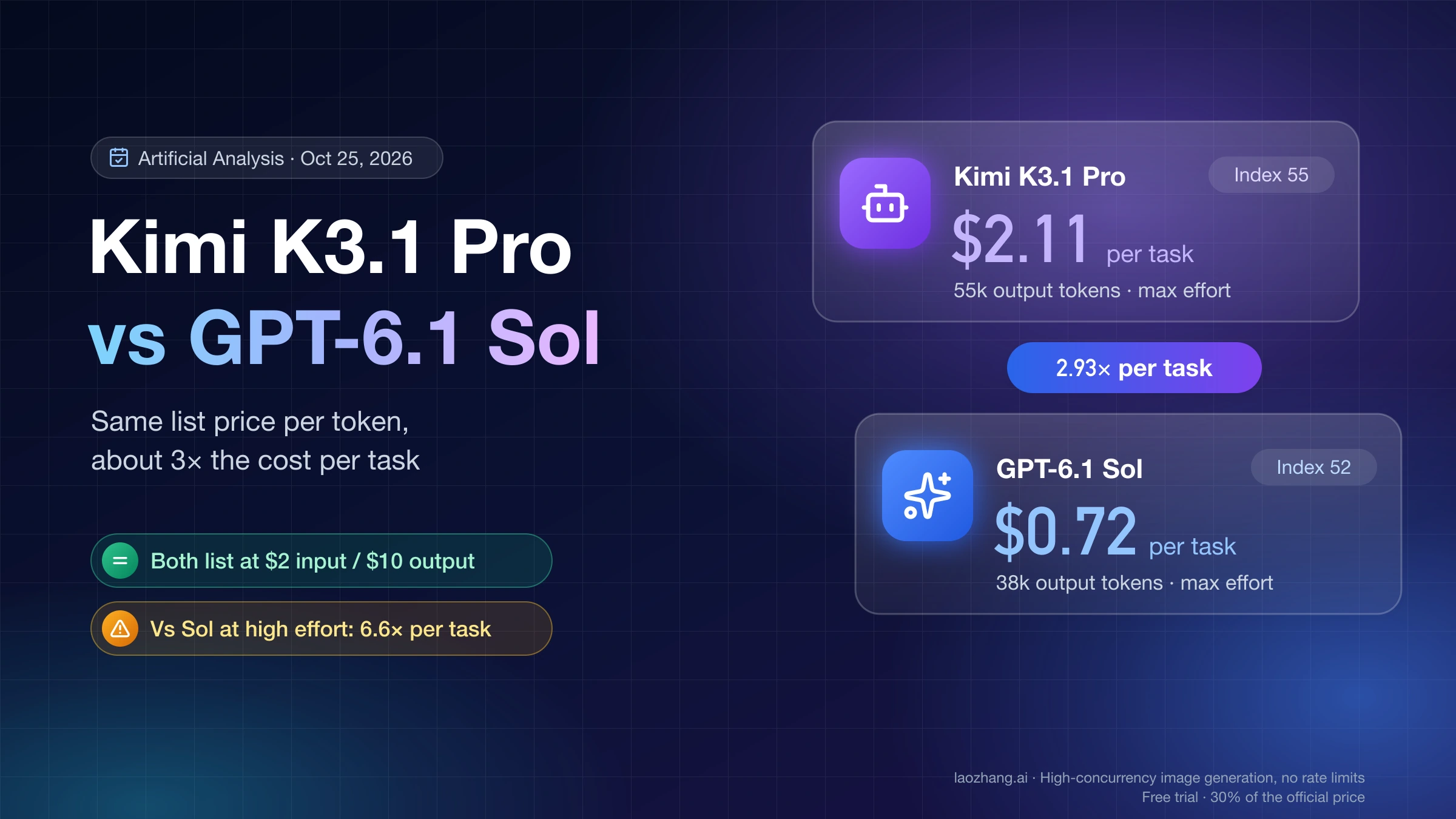
Gemini 4 Hydrogen is 25% cheaper per token, yet on the same 11 API calls at default settings it cost 3.6x more than GPT-6.2 Sol and took 3.7x as long.
On this page
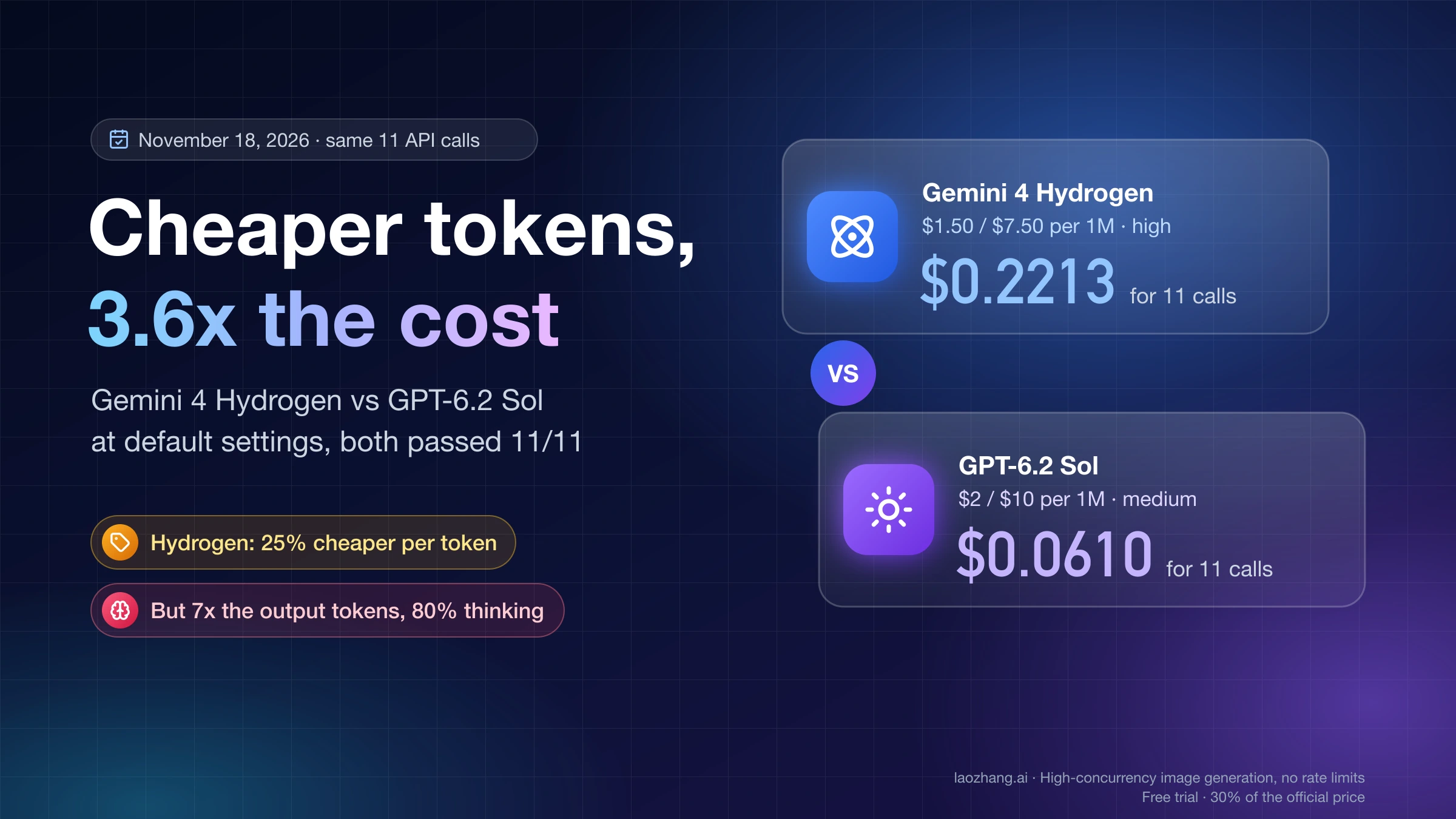
For most API work, make GPT-6.2 Sol (gpt-6.2-sol) at its default medium effort your everyday model, even though Gemini 4 Hydrogen (gemini-4-hydrogen) is 25% cheaper per token: $1.50 input and $7.50 output per million tokens against Sol's $2 and $10. On November 18, 2026, the same 11 API calls ran on both models at their defaults. Both passed all 11, and Hydrogen cost $0.2213 against $0.0610 (3.6x) and took 206 seconds against 56, because it wrote 26,966 output tokens, 80% of them thinking, to Sol's 3,820. Artificial Analysis points the same way as of November 18: Sol at medium scores 53 on its Intelligence Index for $0.41 per task, Hydrogen at its default high scores 51 for $1.87.
Hydrogen is the better default in four situations. If you have no budget, it has a Gemini API free tier and Sol has none. If your inputs include video, audio or PDF, Sol can't read them. If single requests go above 272K input tokens, Sol moves the whole request to a higher rate while Hydrogen's stays flat, so Hydrogen is likely cheaper there, by price arithmetic rather than a test. And for factual questions answered from memory, Hydrogen leads Sol on Artificial Analysis's recall test. In coding agents, Antigravity with Hydrogen at xhigh tops every Codex + GPT-6.2 Sol setting on Artificial Analysis's agent board, but at about 6.3 times the cost of Sol at high, so it pays only when the top score matters more than the bill.
Posts saying Hydrogen "uses fewer tokens" or is "much faster" are mostly about agent sessions against the older GPT-6.1 Sol, often run at max effort. On single requests to GPT-6.2 Sol, Hydrogen used seven times the output tokens; it streams more than twice as fast, but at the defaults Sol finishes its answer sooner.
Which to use: GPT-6.2 Sol at medium by default, Hydrogen in four cases
Pick by the kind of work and your budget, not by the per-token price. Sol at medium is the cheaper and quicker way to get a passing answer on ordinary requests, and it scores higher on the composite benchmark. Hydrogen wins where Sol has a hard limit (no free tier, no audio or video input, a price step above 272K tokens) or where its lead on fact recall and its top agent score matter more to you than cost.
| Your work | Start with | Setting | Switch to the other when |
|---|---|---|---|
| Single API requests: code, extraction, short reasoning, summaries | gpt-6.2-sol | medium (default) | You need video, audio or PDF input, or a free tier |
| Harder single requests where medium misses | gpt-6.2-sol | high | Sol high still fails; Hydrogen at high or xhigh is the next candidate, at a higher bill |
| Logs and documents up to about 272K input tokens | gpt-6.2-sol | medium | The input crosses 272K tokens |
| Requests above 272K input tokens | gemini-4-hydrogen | high (default) | Measure first: Hydrogen's thinking volume can eat the input saving |
| Video, audio or PDF input | gemini-4-hydrogen | high | Not applicable: Sol takes text and images only |
| Long coding-agent runs | Codex with gpt-6.2-sol | medium or high | The top agent score is worth about 6.3x the cost: Antigravity with Hydrogen at xhigh |
| Factual questions answered from memory | gemini-4-hydrogen | high | Answers must come from your documents anyway, which removes the recall edge |
| Zero budget | gemini-4-hydrogen on the Gemini API free tier | high | Your prompts must not be used to improve Google's products: move to the paid tier |
Same 11 API calls on November 18: both passed, Hydrogen cost 3.6x
Both models passed every call, so the test shows what the same work costs and how long it takes, not which model is smarter. On November 18, 2026, between 03:18 and 03:20 UTC, the same eight tasks were sent to both models through the LaoZhang API gateway with one key: a word problem, merging intervals, parsing a duration string, counting the top words in a text, a five-bullet summary of a document of about 11,000 tokens, and three harder ones (an expression evaluator, a CSV line splitter and a digit-sum reasoning problem) run twice each, for 11 calls per configuration. Each call was a single turn with no system prompt and no tools, non-streaming, four in parallel, and hidden tests graded the answers. Hydrogen ran on Google's native generateContent with thinkingLevel: "high", which is Google's default; Sol ran on Chat Completions, once with no reasoning_effort (the default, medium) and once at high.
Disclosure: laozhang.ai is our own service. Its prices are platform pricing, not an independent comparison.
| Configuration | Passed | Input tokens | Output tokens (thinking) | Cost at list price | Seconds, summed | Median call |
|---|---|---|---|---|---|---|
| Gemini 4 Hydrogen, high (default) | 11/11 | 12,712 | 26,966 (21,565) | $0.2213 | 206 | 15.6 s |
| GPT-6.2 Sol, medium (default) | 11/11 | 11,407 | 3,820 (628) | $0.0610 | 56 | 5.0 s |
| GPT-6.2 Sol, high | 11/11 | 11,407 | 5,843 (2,610) | $0.0812 | 66 | 5.0 s |
Cost is tokens times the published rate, with every input token at the uncached price and thinking or reasoning tokens counted as output, on both sides. For Hydrogen that is 12,712 input tokens at $1.50 per million plus 26,966 output tokens at $7.50; for Sol at medium, 11,407 at $2 plus 3,820 at $10. Dividing the rows, Hydrogen at its default cost 3.63 times Sol at its default, wrote 7.06 times the output tokens and took 3.67 times the summed seconds. Against Sol at high, the gaps narrow to 2.72x on cost and 3.14x on time. Seconds are whole-call times through this gateway and will differ on another route.
The gap is not even across tasks. Sol at medium was cheaper on all eight, but by very different margins: 8.96x on the digit-sum reasoning problem ($0.0571 vs $0.0064 for two samples), 5.47x on the CSV splitter, 4.33x on the expression evaluator, and only 1.61x on the long-document summary and 1.13x on merging intervals, where Hydrogen thought for just 110 tokens this time. Grouped, the five short tasks cost $0.0638 on Hydrogen and $0.0329 on Sol (1.94x), and the three harder ones $0.1575 and $0.0281 (5.60x). So the more a task invites reasoning, the more Hydrogen's default spends on it.
What this does not cover: one sample per task (two on the three harder ones), short well-specified tasks, one day, one gateway. There was no multi-turn conversation, no tool use, no agent loop and no image input. For quality differences on harder work, the Artificial Analysis figures further down are the better guide.
Why Hydrogen costs more per job despite 25% cheaper tokens
Hydrogen spends far more tokens thinking at its default level, and both Google and OpenAI bill thinking or reasoning tokens as output, the expensive side of the price. In the 11-call test, 21,565 of Hydrogen's 26,966 output tokens were thinking, and those alone came to $0.1617 at $7.50 per million, more than two and a half times Sol's whole bill. Sol at medium reported 628 reasoning tokens in total and none at all on 6 of the 11 calls. Even the visible answers were longer on Hydrogen: 5,401 tokens against Sol's 3,192.
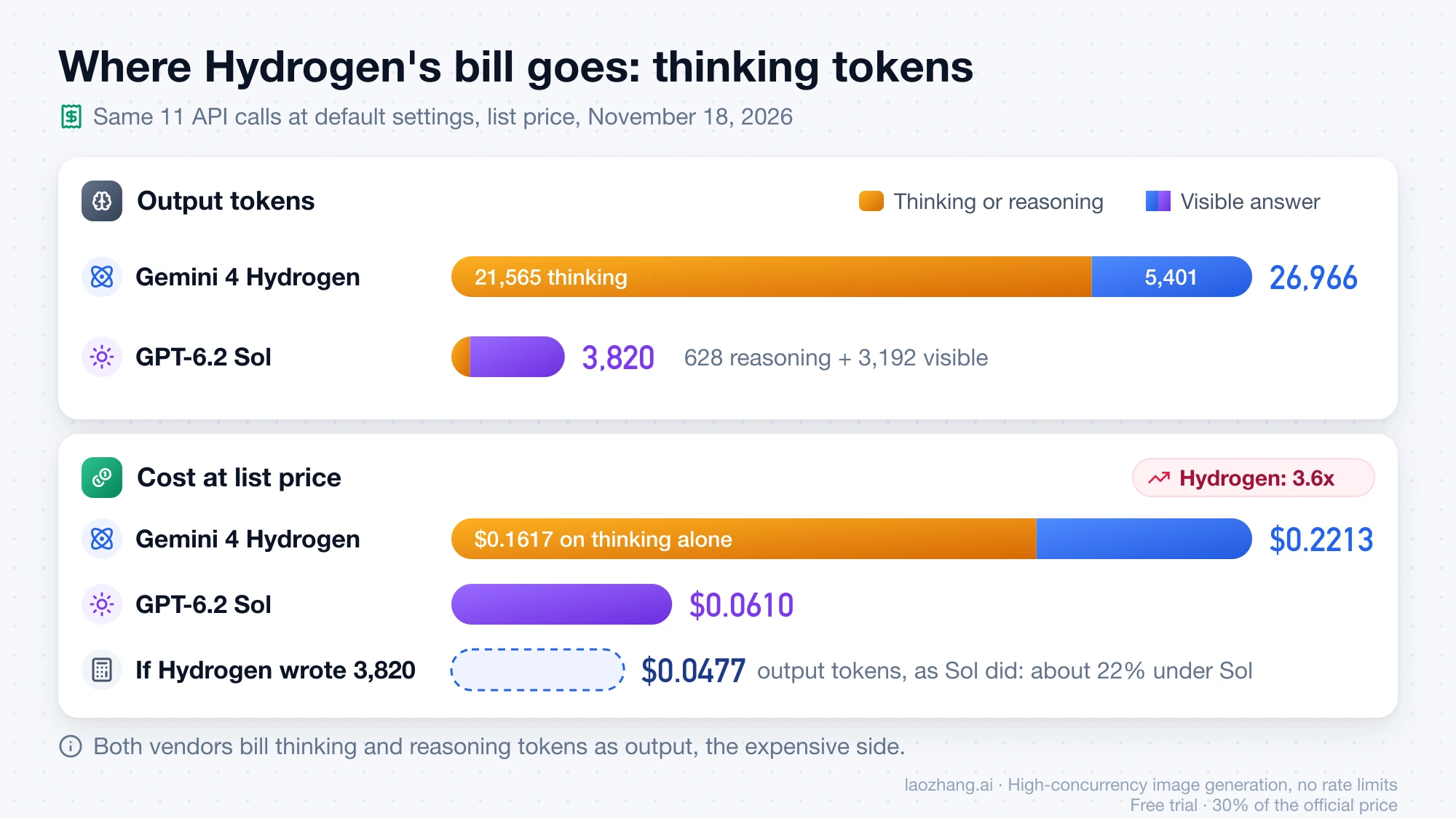
The per-token discount only shows up when the token counts are close. Had Hydrogen written as few output tokens as Sol did (3,820), the same 11 calls would have cost 12,712 × $1.50 + 3,820 × $7.50 per million = $0.0477, about 22% under Sol. That is the gap between the price list and the bill: price per million tokens times a volume that the model, not you, decides.
Input counts differ too. The same prompts came to 12,712 input tokens on Hydrogen and 11,407 on Sol (1.11x); the long document was 11,110 against 10,106, and a 146 KB log was 79,312 against 55,843 (1.42x). So for the same text, expect Hydrogen to count roughly 10% to 42% more input tokens, which eats part of its 25% input discount before any thinking starts.
Does Hydrogen eat 10x more tokens? 7x on single calls; agents differ
On single API requests against GPT-6.2 Sol at its default, the "10x" claim is close: Hydrogen wrote 7.06 times Sol's output tokens on the November 18 calls, and 4.62 times against Sol at high. The figure comes from a Reddit thread on r/GeminiAI titled "gemini hydrogen is better than sol 6.1", where one user wrote that "sol 6.1 is token efficient 10x slower model while hydrogen is much faster and eat 10x more tokens." That user was comparing GPT-6.1 Sol, but on the same tasks GPT-6.2 Sol used 0.68 times the output tokens of 6.1 Sol in a separate November 18 run, so the gap has not narrowed with the new Sol.
The opposite claim, that Hydrogen uses fewer tokens, comes from a different setting. In a personal test published on the Alibaba Cloud developer community on November 13, 2026 (Gemini 4 Hydrogen hands-on test on developer.aliyun.com), the author had a coding agent build whole web pages: a bill-splitting page from a photographed receipt took Hydrogen 110 seconds and 56,500 tokens and GPT-6.1 Sol 136 seconds and 113,000 tokens, and a single-file 3D globe took Hydrogen 113,000 tokens against 495,000 for Sol. Those are token counts for the whole session of multi-turn agent work, against GPT-6.1 Sol at an unstated effort, from one run each.
Both results can be true at once, so neither carries over to the other's setting. If your work is single requests to an API, the 11-call test is the closer match. If it is long agent sessions, test in your own agent, and read the Artificial Analysis coding-agent results below, which also show Hydrogen taking many more steps per task.
Which is faster? Hydrogen streams 2x faster, Sol answers sooner
Hydrogen generates tokens more than twice as fast, but at the defaults Sol gets you a finished answer first, because Hydrogen spends its speed on thinking you never see. Artificial Analysis measured Hydrogen at 169 output tokens per second at high and Sol at 74 at medium, as of November 18, 2026. Yet the first token of Hydrogen's answer arrived after 17.39 seconds against 2.81 seconds for Sol, and the November 18 test calls show the same order.
| Measure | Gemini 4 Hydrogen, high | GPT-6.2 Sol, medium | Source |
|---|---|---|---|
| Output speed | 169 tokens/s | 74 tokens/s | Artificial Analysis |
| Time to first answer token | 17.39 s | 2.81 s | Artificial Analysis |
| Time per Intelligence Index task | 8.4 min | 3.1 min | Artificial Analysis |
| Median call, 11 short tasks | 15.6 s | 5.0 s | Test, November 18 |
| One call on a 146 KB log | 201.2 s | 13.6 s | Test, November 18 |
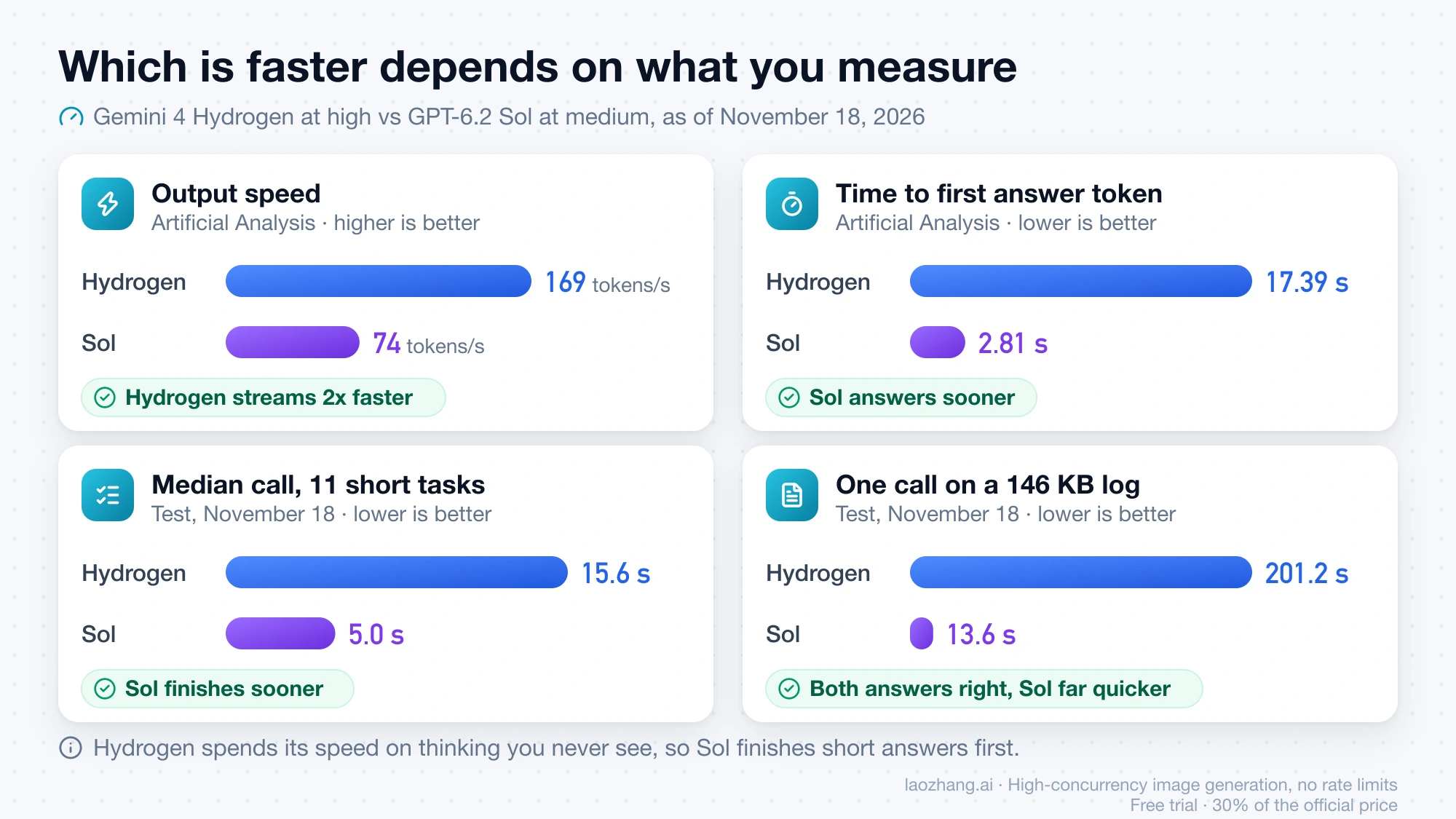
So if you stream long visible output, such as a big file or a long article, Hydrogen's raw speed helps. If you wait for a short answer, Sol at medium is quicker. Sol at high barely changes this: on the 11 calls its median stayed at 5.0 seconds and its summed time rose 1.17x. One-off posts on X go both ways, from a GPT-6.1 Sol run that was "the cheapest and the fastest of all four" on one long prompt to a Hydrogen run of about 5 minutes against roughly 20 for GPT-6.1 Sol at max in Codex CLI. Those were single runs, mostly against the older Sol at its highest effort.
Benchmarks at each level: Sol 53 for $0.41, Hydrogen 51 for $1.87
On the Artificial Analysis Intelligence Index v5.0.1, GPT-6.2 Sol at medium scores higher than Hydrogen at high for less than a quarter of the cost per task, as of November 18, 2026, one day after Sol's release. At nearly equal scores, Sol at medium (53) against Hydrogen at xhigh (54) is $0.41 against $3.16 per task (7.7x), and Sol at low (41) against Hydrogen at medium (41) is $0.18 against $0.80 (4.4x). "Cost per task" here is the average cost of one task in Artificial Analysis's own suite, priced at the same list rates, not the cost of a request of yours. The figures come from the Artificial Analysis GPT-6.2 Sol vs Gemini 4 Hydrogen comparison; the site re-computes, so they can move.
| Model and setting | Index | Cost per task | Time per task | Terminal-Bench 4.0 | AA-Omniscience (recall) |
|---|---|---|---|---|---|
| GPT-6.2 Sol, max | 57 | $1.01 | 7.9 min | 60.1% | 40 |
| GPT-6.2 Sol, xhigh | 56 | $0.65 | 5.1 min | 56.1% | 39 |
| GPT-6.2 Sol, high | 55 | $0.56 | 4.2 min | 58.6% | 38 |
| GPT-6.2 Sol, medium (default) | 53 | $0.41 | 3.1 min | 56.1% | 34 |
| GPT-6.2 Sol, low | 41 | $0.18 | 1.4 min | 37.9% | 25 |
| Gemini 4 Hydrogen, xhigh | 54 | $3.16 | 14.8 min | 53.5% | 46 |
| Gemini 4 Hydrogen, high (default) | 51 | $1.87 | 8.4 min | 54.0% | 44 |
| Gemini 4 Hydrogen, medium | 41 | $0.80 | 4.0 min | 29.3% | 42 |
| Gemini 4 Hydrogen, low | 27 | $0.29 | 1.5 min | 6.6% | 36 |
The sub-scores split by kind of task. Comparing each model's best score, Sol leads on terminal and codebase work: Terminal-Bench 4.0 (60.1% vs 54.0%), FrontierCode-AA 2.0 (44.4% vs 39.0%) and Terminal-Bench-Science (67.6% vs 49.5%), plus the HLE-Diamond reasoning set (64.0% vs 58.8%). Hydrogen leads on AA-Omniscience factual recall (46 vs 40), AutomationBench-AA (76.1% vs 71.3%) and, narrowly, CritPt (66.0% vs 64.0%) and GDP.pdf (32.8% vs 30.0%). Google's own launch post cites the same 51 at high and 54 at xhigh, and OpenAI says Sol "nearly matches Astra on merge-ready changes to real codebases at about one-fifth the cost" on FrontierCode 2.0; those are vendor claims, not independent results.
Coding agents: Hydrogen xhigh tops Codex + Sol at 6.3x the cost
Inside each vendor's own coding agent, Hydrogen at xhigh scores higher than any GPT-6.2 Sol setting, but its run cost about 6.3 times Sol at high and took about ten times as many steps. The Artificial Analysis Coding Agent Index, which averages FrontierCode 2.0, Terminal-Bench and SWE-Atlas-QnA-AA, had these rows as of November 18, 2026: Antigravity CLI with Hydrogen at xhigh scored 52.3, with a total evaluation cost of $1,482, 32.1 minutes per task and 405 steps on average. Codex with GPT-6.2 Sol scored 49.8 at xhigh, 47.5 at high ($237, 10.6 minutes, 42 steps) and 45.4 at medium ($176, 8.4 minutes). There is no Hydrogen row at its default high.
Two things limit that comparison. It measures "model plus its vendor's agent", Antigravity CLI against Codex, not the two models in one harness. And on this board GPT-6.2 Sol trails its predecessor: Codex with GPT-6.1 Sol at max scored 52.2. The Decoder reports that the drop comes from a 14-point fall on SWE-Atlas-QnA-AA, where 6.2 Sol "omits key facts from its answers more often than its predecessor did" (The Decoder's GPT-6.2 Astra and Sol launch report, November 17, 2026).
For long agent runs, then, start with Codex and GPT-6.2 Sol at medium or high, and try Antigravity with Hydrogen at xhigh on the tasks Sol keeps failing, knowing each attempt costs several times more and runs about three times longer. The single-run reports of Hydrogen being faster in agents are mostly against GPT-6.1 Sol at max, the slowest Sol setting.
Long inputs: Sol won below 272K tokens, Hydrogen's flat rate above it
On one long log, GPT-6.2 Sol was cheaper and far faster; above 272K input tokens, the price list turns in Hydrogen's favor, though nothing was measured there. On November 18, 2026, both models got the same 146 KB, 1,500-line application log and a question asking for seven exact numbers, as a single call with no tools. Both got all seven right. Hydrogen at high took 201.2 seconds and cost $0.3667, counting the log as 79,312 input tokens and writing 33,029 output tokens, almost all thinking. Sol at medium took 13.6 seconds, with 55,843 input tokens and 1,845 output, which comes to $0.1301 with every input token at the uncached $2 rate, the same basis as the 11-call table. On that basis Hydrogen cost 2.82 times as much and took 14.8 times as long. The bill actually returned for Sol was $0.1581, because 55,840 of its input tokens were charged as a cache write at $2.50 per million; even then Hydrogen cost 2.32 times as much. Sol at high was also right, in 17.3 seconds. Hydrogen ran once on this log, so treat its time as one sample.
At 56K to 79K tokens, that log is far below the line where Sol's price changes. Once a request's input passes 272K tokens, OpenAI bills the whole request at $4 input and $15 output per million, according to the OpenAI API pricing page; Hydrogen stays at $1.50 and $7.50 across its full 1M-token context per the Gemini API pricing page. As a rough calculation, take a document Sol counts as 300,000 tokens and assume Hydrogen counts it 42% higher, as it did with the log: Sol's input costs 300,000 × $4 per million = $1.20, Hydrogen's 426,000 × $1.50 per million = $0.64. The $0.56 difference pays for about 75,000 Hydrogen output tokens, more than twice what it wrote on the log, before counting Sol's own output at $15. So above 272K, Hydrogen is likely cheaper unless its thinking grows sharply with input size, which is worth one test on your own data.
Context sizes are close: 1,048,576 tokens for Hydrogen, 1,050,000 for Sol with at most 922,000 of input. Sol can write up to 128,000 output tokens in one response; Hydrogen's synchronous default cap is 65,536.
Which thinking level or effort to use, and what dropping one saves
Keep each model at its default to start: high for Hydrogen, medium for Sol. The two scales are not the same ruler, so "both at high" is not a fair pairing: Hydrogen's thinking levels are low, medium, high and xhigh, and Sol's reasoning effort runs low, medium, high, xhigh and max. Lowering Hydrogen to medium does not close the cost gap, and raising Sol to high adds about a third to the bill.
Hydrogen at medium ran the same 11 calls on November 16, 2026 for $0.1927, still 3.16 times Sol's default bill from November 18 and inside the range of the two high runs ($0.2213 on November 18, $0.2509 on November 14), so run-to-run variation in thinking is about as large as the saving. Meanwhile its Artificial Analysis score falls from 51 to 41 and Terminal-Bench 4.0 from 54.0% to 29.3%. That is a poor trade: the November tasks were too easy to show the loss, but harder work will. More on what each Hydrogen level costs per call is in Gemini 4 Hydrogen Pricing: API Cost per Call by Thinking Level.
On Sol, moving from medium to high cost 1.33 times as much on the 11 calls and 1.17 times the time, for 2 more points on the Index (53 to 55). That is the first step to take when Sol at medium misses on harder work, before switching models. Sol at low scores 41 for $0.18 per task, a better deal than Hydrogen at medium at the same score, but low was not part of the November test.
GPT-6.2 Sol pricing, Hydrogen's free tier, and where each runs
GPT-6.2 Sol costs exactly what GPT-6.1 Sol does per token and has no free tier. Hydrogen is 25% cheaper on every standard rate and has a Gemini API free tier, but prompts sent on the free tier are used to improve Google's products, while paid-tier prompts are not. Prices are as of November 18, 2026, from the official pricing pages; Hydrogen has been generally available since November 12 and GPT-6.2 Sol since November 17.
| Gemini 4 Hydrogen | GPT-6.2 Sol | |
|---|---|---|
| Standard, per 1M tokens (input / cached / output) | $1.50 / $0.075 / $7.50 at any length | $2.00 / $0.10 / $10.00 up to 272K input; whole request at $4 / $0.20 / $15 above |
| Batch, per 1M tokens (input / output) | $0.75 / $3.75 | $1.00 / $5.00 |
| API free tier | Yes, prompts used to improve Google's products | No |
| Chat app | Gemini app: Google's help page lists it as selectable from Google AI Plus up, and the free plan's Auto mode sends some prompts to it | ChatGPT Work for Plus, Pro, Enterprise and Edu |
| Coding tools | Antigravity for AI Pro and Ultra; AI Studio on all tiers | Codex for Plus, Pro, Enterprise and Edu; GitHub Copilot Pro+, Max, Business and Enterprise |
| Input types | Text, image, video, audio, PDF | Text, image |
| Effort setting and default | thinkingLevel low to xhigh, default high | reasoning_effort low to max, default medium |
Hydrogen only supports implicit caching, so its cached rate applies automatically when a prompt prefix repeats; Sol charges for cache writes ($2.50 per million for 30-minute retention, $5 for 12 hours). Free-tier details and limits are in Gemini API Free Tier 2026: Limits, Free Models, and Free API Keys. On the ChatGPT side, OpenAI's launch post lists Plus, Pro, Enterprise and Edu for GPT-6.2 Sol, so Free and Go users don't get it; GitHub says Copilot access is rolling out gradually.
Switching between them: effort settings, tool calls and model IDs
Changing the model ID is not enough, because the effort parameter, the API you need for tools and the model name you get back all differ. Hydrogen takes thinkingConfig.thinkingLevel on Google's API and has no minimal level. Sol takes reasoning_effort and rejects none; on November 18, sending it returned HTTP 400 with Unsupported value: 'none' is not supported with the 'gpt-6.2-sol' model. Supported values are: 'low', 'medium', 'high', 'xhigh', and 'max'. On the Chat Completions route used for the test, max was not accepted and needed the Responses API.
Tool calling on GPT-6.2 Sol requires the Responses API, per the GPT-6.2 Sol model page, so an agent that calls tools through Chat Completions has to move before it can use Sol. Also, through the LaoZhang gateway's Chat Completions route, the response's model field read gpt-6.2-sol-2026-11-17 on every Sol call, while the Responses route returned gpt-6.2-sol. That dated name is the gateway's label, not a snapshot ID OpenAI publishes, so if your code checks the returned model, match on the prefix rather than the exact string. On Hydrogen, leave room in maxOutputTokens: on the 146 KB log its output, almost all thinking, reached 33,029 tokens, and that call ran with the 65,536-token synchronous cap.
To compare the two on your own prompts, you can call gemini-4-hydrogen and gpt-6.2-sol with one key at laozhang.ai, at the vendors' list prices, which is how the tests above ran. With no budget, start instead with a free Gemini API key from Google AI Studio for Hydrogen; the direct route for Sol is the OpenAI API.
Disclosure: laozhang.ai is our own service. Its prices are platform pricing, not an independent comparison.
Gemini 4 Hydrogen vs GPT-6.2 Sol: other questions
Is GPT-6.2 Sol better than GPT-6.1 Sol?
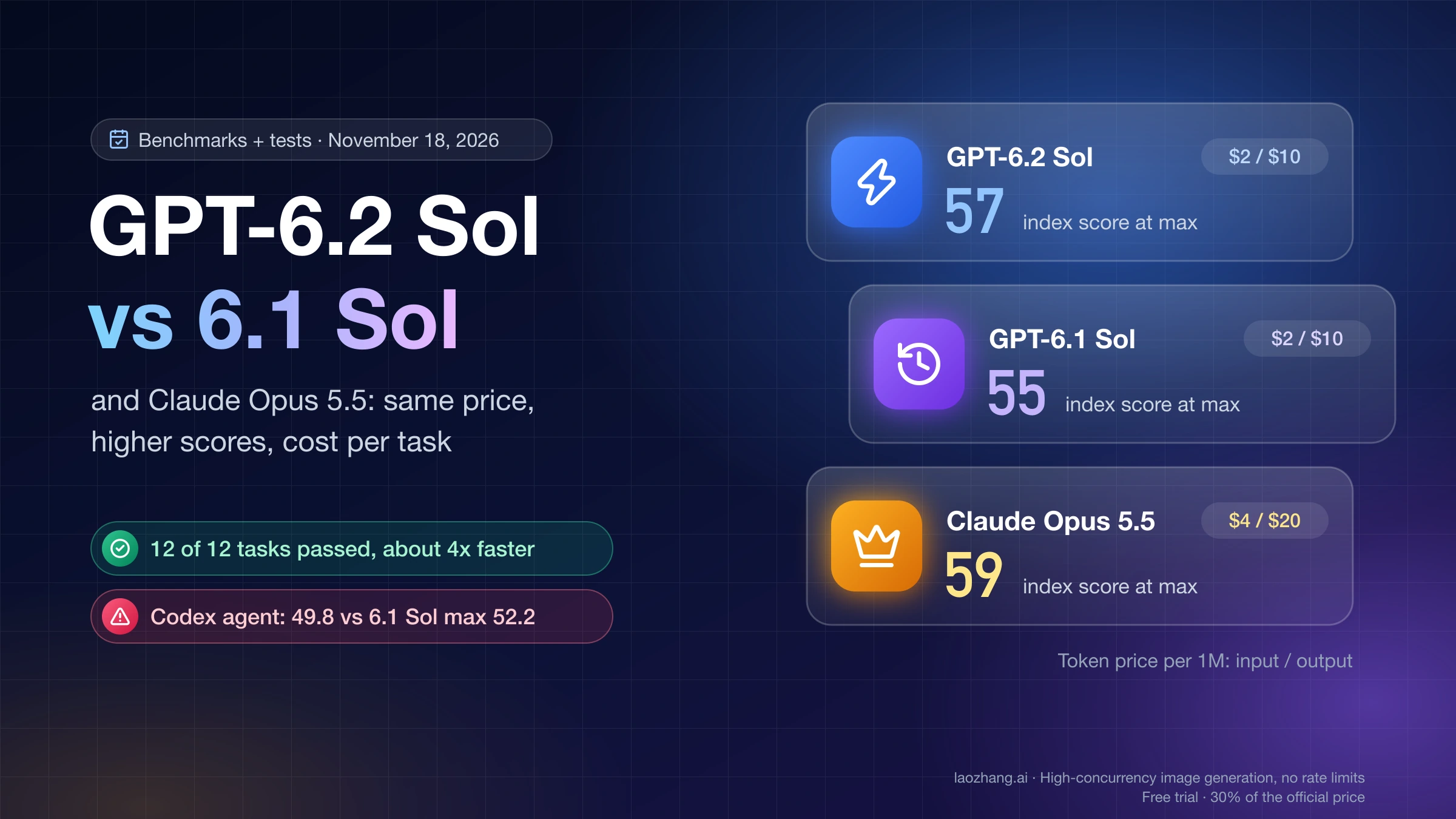
On Artificial Analysis, GPT-6.2 Sol scores 2 to 7 points higher than GPT-6.1 Sol at every effort level at a similar cost per task (6.2 figures as of November 18, 2026, 6.1 figures as of November 16), and the two have the same per-token price. It trails GPT-6.1 Sol at max on the Codex coding-agent board. The full comparison, including Claude Opus 5.5, is in GPT-6.2 Sol vs 6.1 Sol vs Opus 5.5: Benchmarks and Tested Cost.
How does Gemini 4 Hydrogen compare with Claude Sonnet 5.5 or Gemini 3.1 Pro?
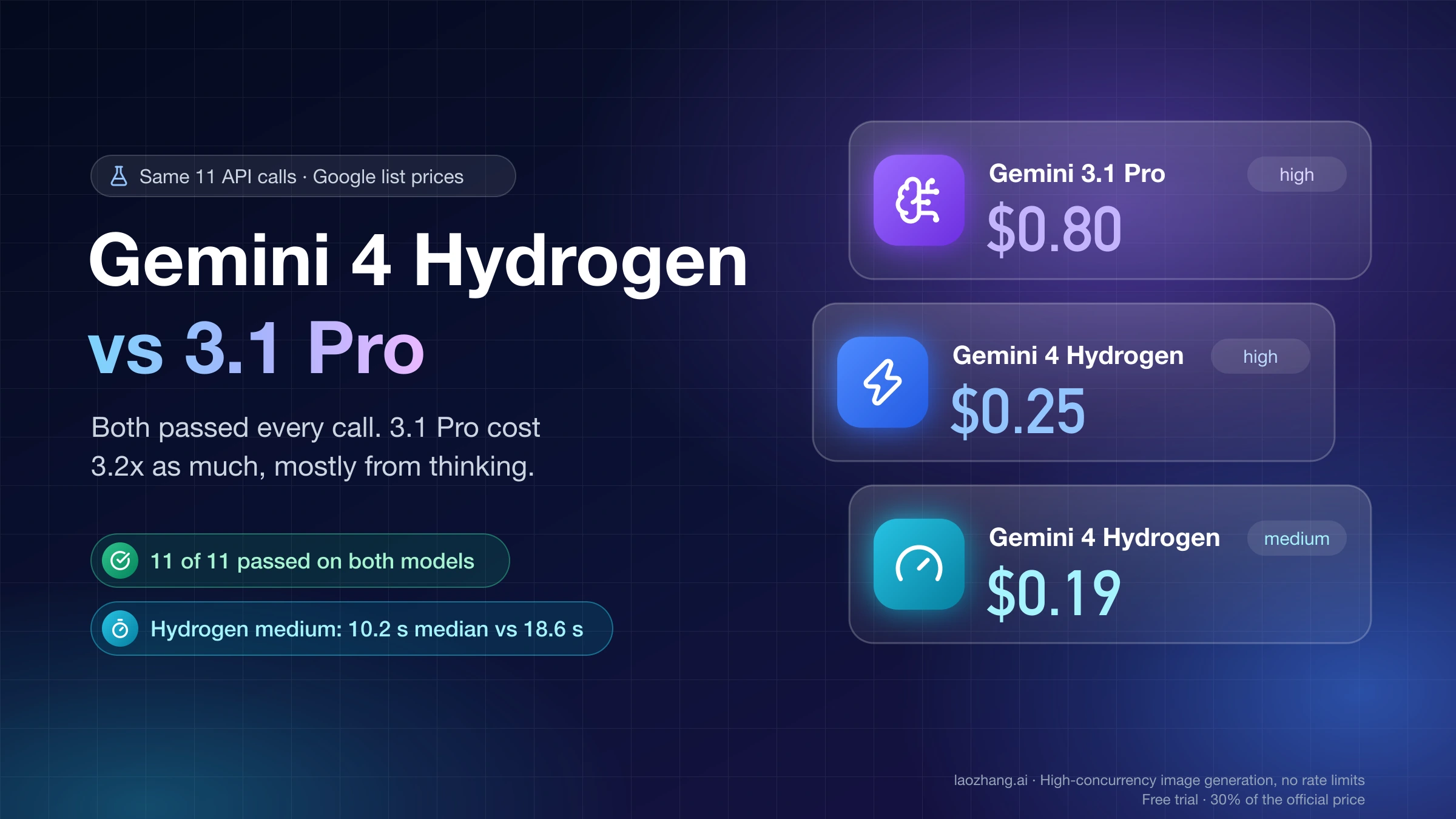
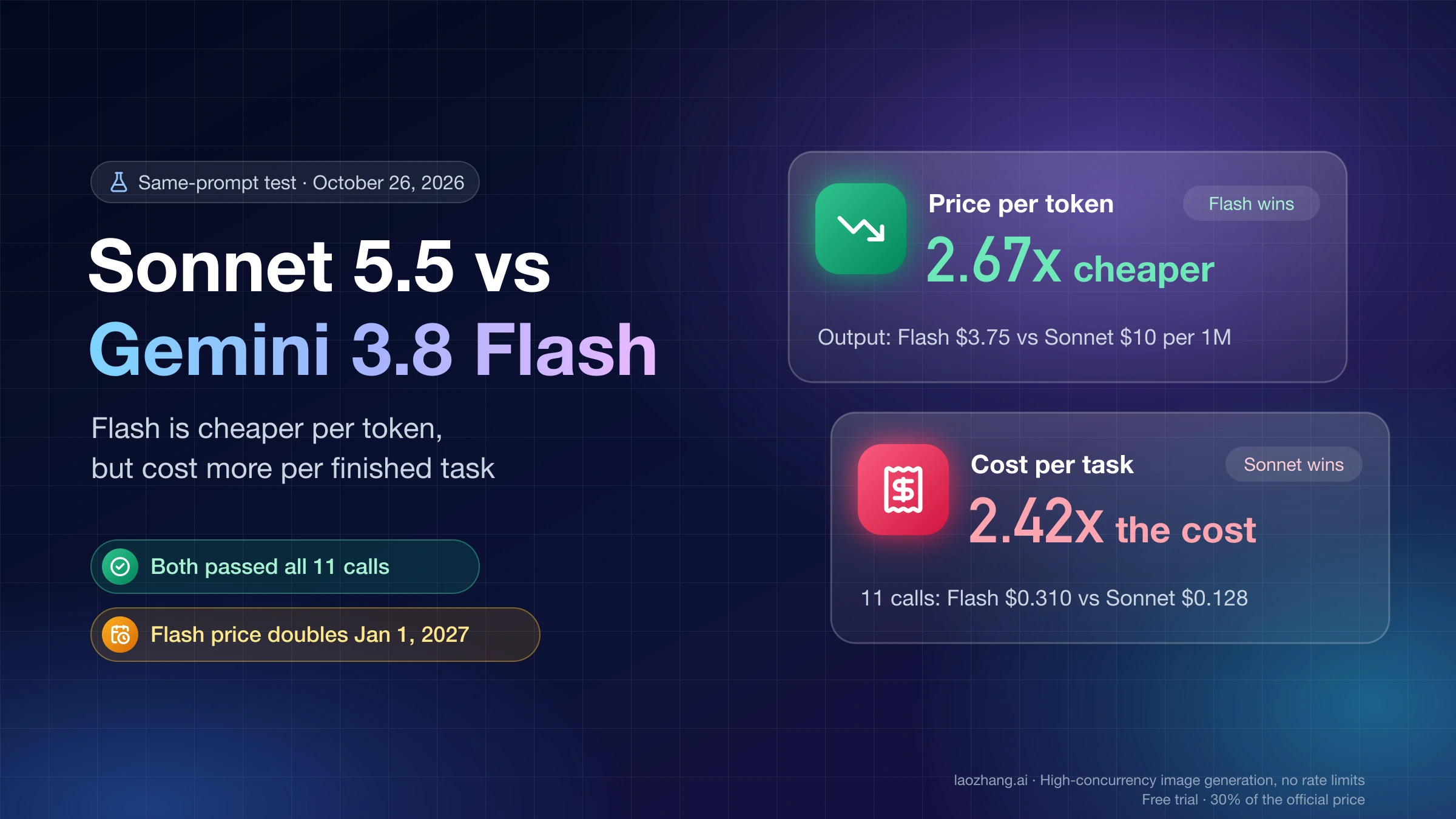
Both comparisons ran Hydrogen through the same task set used here, in a November 14, 2026 run where Hydrogen at high cost $0.2509 for the 11 calls, a little more than in the November 18 re-run because thinking volume varies from run to run. See Claude Sonnet 5.5 vs Gemini 3.8 Flash, 4 Hydrogen: Cost per Task and Gemini 4 Hydrogen vs 3.1 Pro: 3x Cheaper on the Same Tasks.
Should I use Gemini 4 Carbon instead of Hydrogen?
Carbon is Google's flagship and not a cheaper alternative: on the same 146 KB log on November 11, 2026, Carbon at its default took 213.9 seconds and cost $0.4281, more than Hydrogen's $0.3667. How it compares with the previous Sol is in Gemini 4 Carbon vs GPT-6.1 Sol for Coding: Same Rate, 7x the Cost.
Sources7
External pages this guide links to, in the order they appear. Last updated Nov 18, 2026.
Sources7
External pages this guide links to, in the order they appear. Last updated Nov 18, 2026.
- 1.Gemini 4 Hydrogen hands-on test on developer.aliyun.comdeveloper.aliyun.com/article/1782979
- 2.Artificial Analysis GPT-6.2 Sol vs Gemini 4 Hydrogen comparisonartificialanalysis.ai/models/comparisons/gpt-6-2-sol-vs-gemini-4-hydrogen
- 3.Artificial Analysis Coding Agent Indexartificialanalysis.ai/agents/coding
- 4.The Decoder's GPT-6.2 Astra and Sol launch reportthe-decoder.com/openai-launches-gpt-6-2-astra-and-sol-with-lower-api-prices-and-some-benchmark-gains
- 5.OpenAI API pricing pagedevelopers.openai.com/api/docs/pricing
- 6.Gemini API pricing pageai.google.dev/gemini-api/docs/pricing
- 7.GPT-6.2 Sol model pagedevelopers.openai.com/api/docs/models/gpt-6.2-sol