Claude Opus 5.5 vs GPT-6 Astra: 60% Less per Token, Not per Task
Claude Opus 5.5 lists 60% below GPT-6 Astra per token. On small coding tasks it cost 0.5–0.7x as much; on long agentic work at equal score, about the same.
On this page
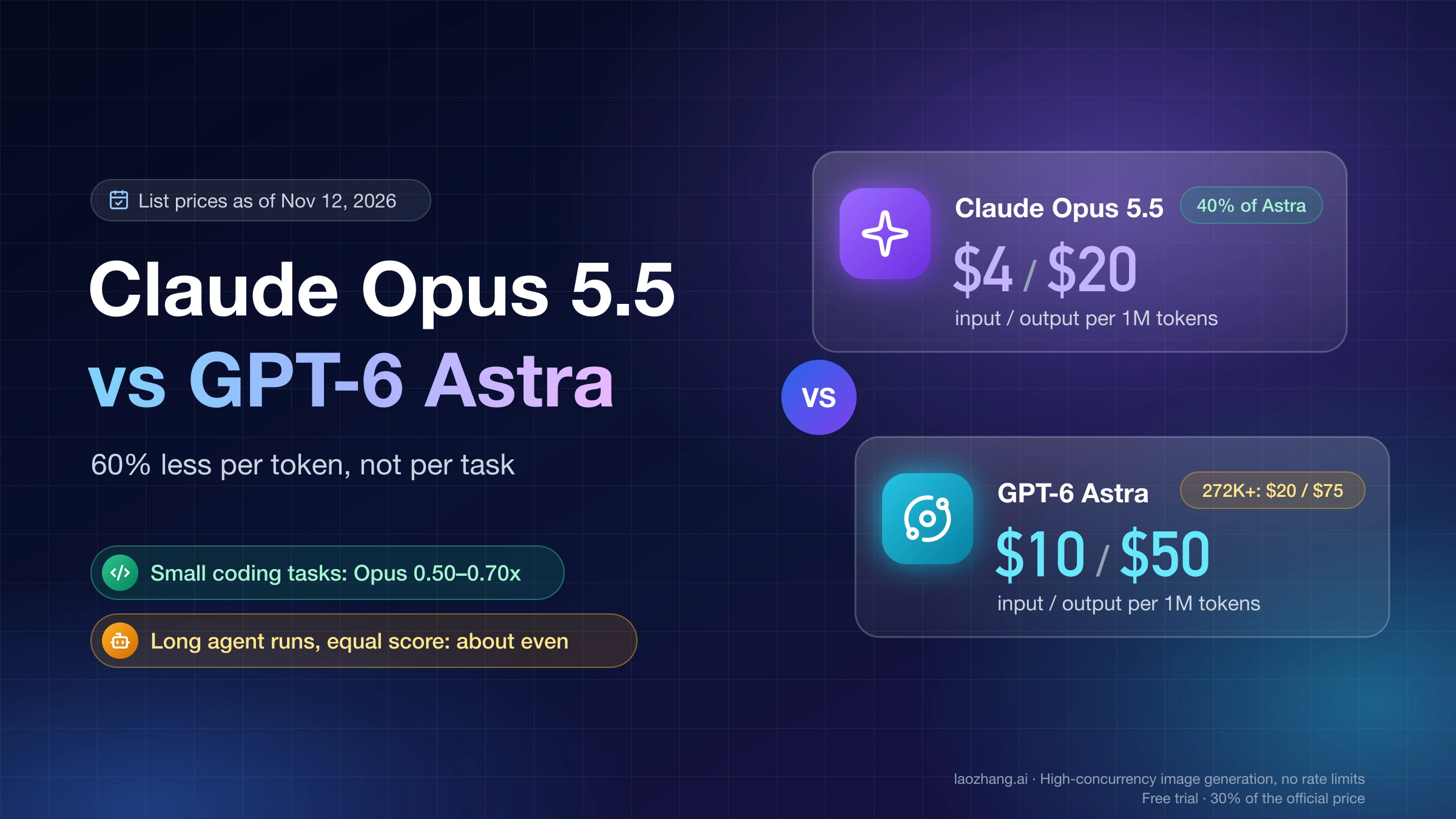
Make Claude Opus 5.5 (claude-opus-5-5) at medium your default for well-specified coding and document work sent one request at a time, and hand long, unattended agent runs and science-heavy research to GPT-6 Astra (gpt-6-astra) at medium or high. As of November 12, 2026, Opus lists at $4 input and $20 output per million tokens against Astra's $10 and $50, which is 60% less per token. That discount never reaches the bill intact, because Opus counts the same text as about 1.5 times as many tokens and, at the same effort label, usually writes more.
How much survives depends on the job. On November 11, 2026, both models ran the same 8 small coding and reasoning tasks through one gateway and passed all 44 graded answers, and Opus at medium cost 0.70x what Astra cost with no effort set. On long agentic tasks the gap closes: on Artificial Analysis's Intelligence Index v5.0.1, as of November 12, 2026, Astra at medium reaches the score of Opus at high (52) for 21% less per task. Only at the top does Opus pull ahead again, where Opus xhigh matches Astra max at 57 for 3% less money and 35% less time.
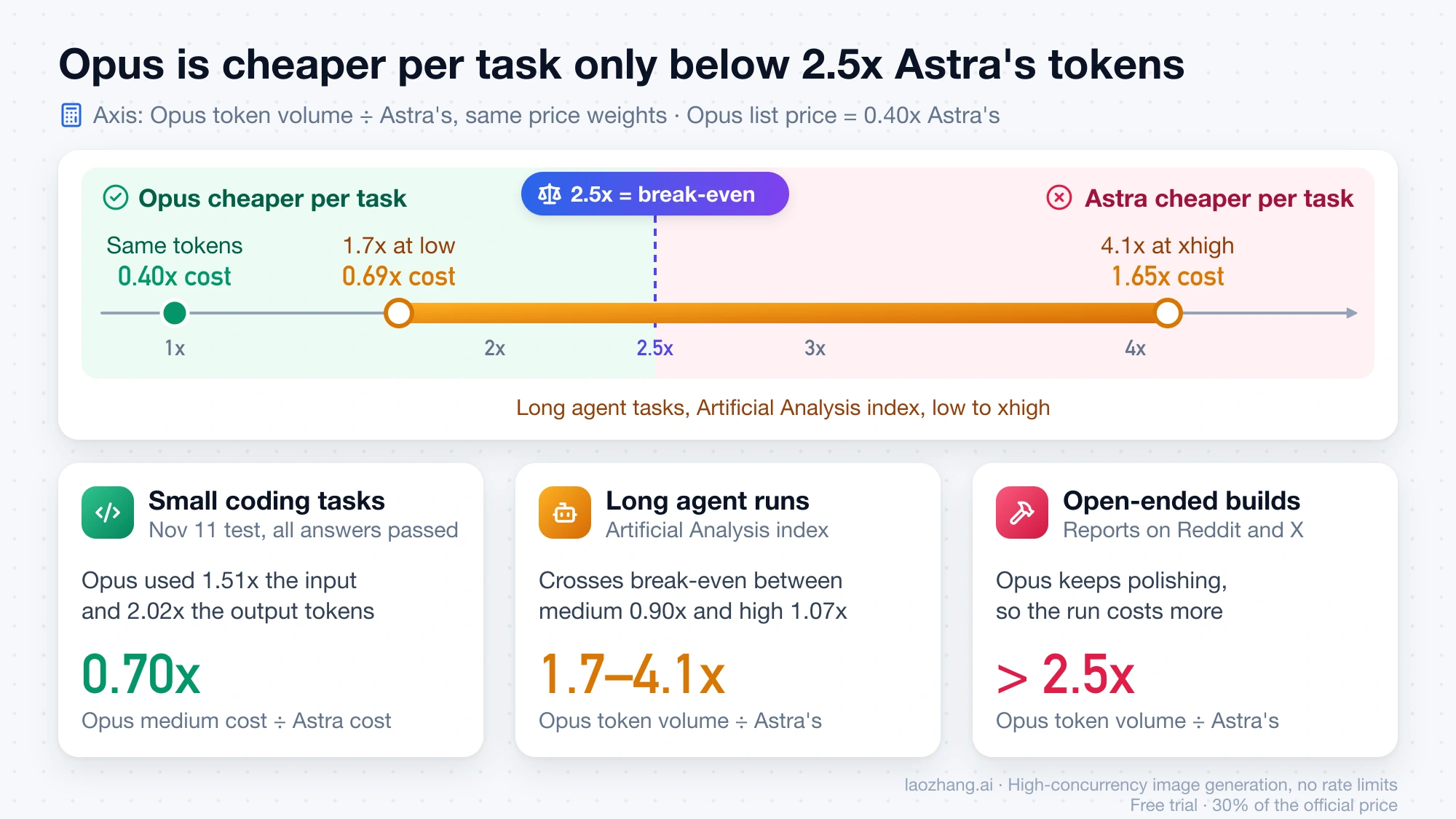
The rule underneath is simple arithmetic: Opus is cheaper per task only while its token use stays under 2.5 times Astra's, counting input and output at the same relative weights. A few conditions decide before that: an Astra request above 272K input tokens is billed whole at $20 / $75, Astra's function calling needs the Responses API, Opus hands cybersecurity tasks to an older model, and in Korean or Spanish Opus's input discount falls to about 25%.
GPT-6 Astra and Opus 5.5 prices: $10/$50 against $4/$20 per 1M tokens
Per token, Opus 5.5 costs 40% of GPT-6 Astra on input and output and one fifth of it on cache reads, as of November 12, 2026, according to Anthropic's Claude API pricing page and OpenAI's API pricing page. Anthropic released Opus 5.5 on September 22, 2026 and OpenAI released Astra on September 3; neither vendor has announced a price change since. "Astra 6" and "GPT Astra" in searches refer to GPT-6 Astra, which is still OpenAI's top general model: the price list shows gpt-6-astra, gpt-6.1-sol, gpt-6.1-terra and gpt-6-luna, and there is no GPT-6.2.
| USD per 1M tokens, as of November 12, 2026 | Claude Opus 5.5 | GPT-6 Astra (Standard) |
|---|---|---|
| Input | $4 | $10 |
| Output | $20 | $50 |
| Cache read (cached input) | $0.20 | $1.00 |
| Cache write, default duration | $5 (5 minutes) | $12.50 (30 minutes) |
| Cache write, long duration | $8 (1 hour) | $25 (12 hours) |
| Above 272K input tokens | same rates up to 1M context | whole request at $20 / $75 |
| Batch | $2 / $10 | half price (Flex too) |
| Faster tiers | fast mode $8 / $40 | Fast 2x, Ultrafast 6x |
Two rows change real bills more than the headline. Astra caches every prompt of 1,024 tokens or more by default and bills that write at 1.25x the input price, so a long prompt you send only once costs a little more than its plain input price; you can opt out with prompt_cache_options.mode: "explicit". On the Claude API nothing is cached unless the request carries cache_control, so a long prompt you reuse costs full price every time until you add it. Opus's 1M-token context has no price step, while Astra's 1,050,000-token context (922,000 tokens of input at most) switches to the long-context price for the whole request once input passes 272,000 tokens. The rest of Astra's price mechanics, including Batch and Fast, are in GPT-6 Astra API Pricing: $10/$50 per 1M Tokens, Caching Costs.
Is Opus 5.5 cheaper per task? 0.50–0.70x Astra on 8 small tasks
On small, fully specified tasks that both models solve, Opus 5.5 cost half to 70% of what GPT-6 Astra cost, not 40%. On November 11, 2026, the same 8 tasks went to both models through the laozhang.ai gateway with one key, each in its vendor's native request format, streamed, with no system prompt and no tools. The set had a word problem, three small functions graded by hidden tests (merge_intervals, parse_duration, top_words), a summary of a 6,723-word article into exactly 5 bullets, an expression evaluator written without eval (25 hidden tests), a CSV line parser written without the csv module (16 hidden tests) and a digit-sum count. The last three were asked twice, so each configuration produced 11 graded answers. Opus ran at medium, its API default, sent explicitly, and at high; Astra ran with no reasoning_effort set and at high.
Disclosure: laozhang.ai is our own service. Its prices are platform pricing, not an independent comparison.
| Configuration | Passed | Input tokens | Output tokens | Cost at list price | Wall time |
|---|---|---|---|---|---|
Opus 5.5 medium | 11/11 | 17,202 | 11,056 | $0.2899 | 126.1 s |
Opus 5.5 high | 11/11 | 17,202 | 11,968 | $0.3082 | 147.2 s |
| GPT-6 Astra, no effort set | 11/11 | 11,407 | 5,471 (1,964 reasoning) | $0.4129 | 91.8 s |
GPT-6 Astra high | 11/11 | 11,407 | 9,455 (6,042 reasoning) | $0.6121 | 141.7 s |
Opus at medium cost 0.70x Astra with no effort set ($0.2899 ÷ $0.4129), and Opus at high cost 0.50x Astra at high ($0.3082 ÷ $0.6121). The 60% discount shrank because of token counts, not quality: Opus read the identical prompts as 1.51x as many input tokens and, medium against Astra's default, wrote 2.02x as many output tokens (1.27x at high against high). Opus reports its thinking inside the output count, while Astra reports reasoning separately. Astra's totals include one billed cache write on the long-article task, $0.0253 above the plain input price per configuration; without it Opus would still cost 0.75x and 0.53x. Across the 11 answers, Astra with no effort set was cheaper than Opus medium on only one, a CSV-parser run ($0.0173 against $0.0227).
Because every answer passed, this test says nothing about which model is smarter. It measures what a solved task costs and how long it takes when the task is short and clearly specified, on one gateway, on one day, with one or two samples per cell. Timings include the gateway. Long agent loops with tools were not part of it, and that is where the next section points the other way.
Which effort levels match: Opus high scores like Astra medium
The same effort label does not buy the same result on these two models, so pair them by score, not by name. On Artificial Analysis's Intelligence Index v5.0.1, as of November 12, 2026, Astra scores higher at low, medium and high, and Opus scores higher at xhigh and max. Opus 5.5's API default is medium, and so is Claude Code's; OpenAI does not document Astra's default effort.
| Effort | Opus 5.5: index / cost per task / minutes | GPT-6 Astra: index / cost per task / minutes | Opus cost ÷ Astra cost |
|---|---|---|---|
low | 35 / $0.98 / 3.0 | 43 / $1.42 / 4.0 | 0.69x |
medium | 48 / $2.45 / 7.1 | 52 / $2.73 / 7.3 | 0.90x |
high | 52 / $3.46 / 9.5 | 55 / $3.24 / 9.5 | 1.07x |
xhigh | 57 / $6.05 / 15.8 | 55 / $3.66 / 11.1 | 1.65x |
max | 59 / $10.04 / 25.0 | 57 / $6.24 / 24.3 | 1.61x |
Figures are from Artificial Analysis's Claude Opus 5.5 vs GPT-6 Astra release comparison, which prices both models at list. Artificial Analysis labels the Opus max row "Max, Default Fallback", a reference to the safeguards described further down.
Read across equal scores instead of equal rows. At 52, Opus high costs $3.46 and 9.5 minutes per task against Astra medium's $2.73 and 7.3 minutes, so Astra is 21% cheaper. Astra high scores 55, three points above Opus high, for 6% less. At 57, Opus xhigh costs $6.05 and 15.8 minutes against Astra max's $6.24 and 24.3 minutes, so Opus is 3% cheaper and 35% faster. Only Opus at max reaches 59, and only Opus at low goes below Astra's floor, scoring 35 for $0.98.
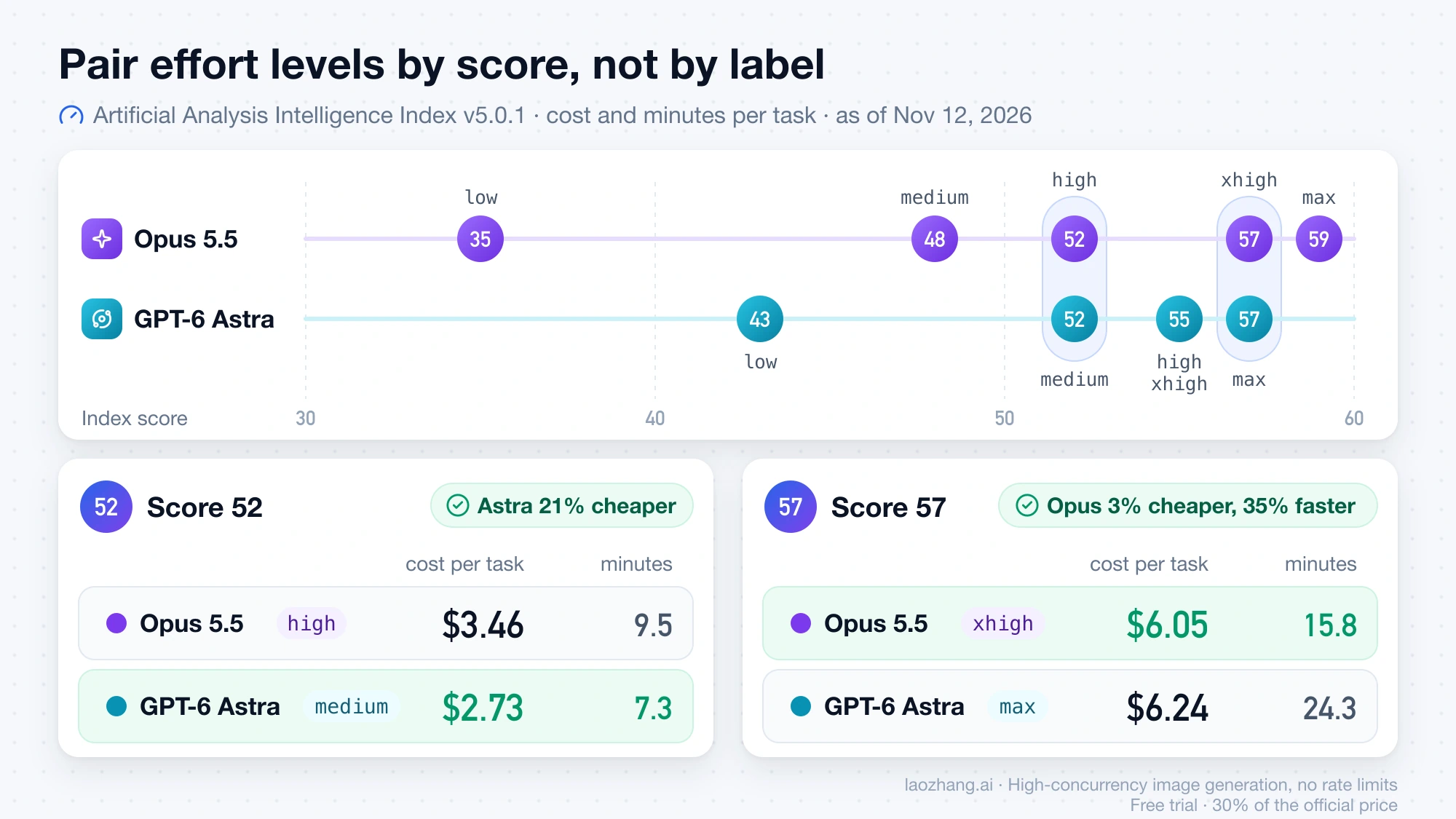
The cost column also shows why the price list misleads on long work. If both models spent the same tokens, Opus would always cost 0.40x Astra. The observed 0.69x to 1.65x means that, on these tasks, Opus spends roughly 1.7 times (at low) to 4.1 times (at xhigh) as much token volume as Astra, priced at the same weights. That multiple is an estimate (cost ratio ÷ 0.40) that assumes a similar mix of input, output and cache on both sides, and it is the number that decides cost per task.
A 146 KB log: Opus's first call cost $0.47, Astra's $0.75–0.82
On one long input read once, Opus 5.5 cost 57–64% of GPT-6 Astra, and both were always right. The task was a 146 KB synthetic application log (1,500 lines, 326 ERROR lines) with seven exact values to report: ERROR counts for five codes, the number of distinct users with an E503 error, and the request with the highest retry value, all checked by script before any call. On November 11, 2026, Opus got all seven right in 4 of 4 runs (medium and high, twice each), reading 78,537 input tokens and writing 7,699–8,255 output tokens, for $0.47–0.48 and 56–59 seconds per run. Astra with no effort set got all seven right in 3 of 3 runs (two on November 4, one on November 11), reading 55,843 input tokens and writing 2,423–3,793, for $0.75 when nothing was cached or $0.82 when the default cache write was billed, in 26–46 seconds. Astra at high, 2 of 2 right on November 4, cost $0.90 uncached and took 72–78 seconds.
A repeat changes the order. When the same log was sent again inside Astra's cache window, Astra read it from cache and the call cost $0.21, below Opus's uncached $0.47. Opus was sent no cache_control, so a cached Opus repeat was not run. At list price, reading 78,537 tokens from Opus's cache would cost about $0.016, plus roughly $0.15–0.17 for the same output, about $0.17–0.18 in total. That is a calculation, not a measurement, and it assumes you paid the cache write first: 78,537 tokens at the 5-minute write price of $5 come to about $0.39, against $0.31 at the plain input price. If you query the same long document or codebase repeatedly, add cache_control on Opus before you compare; Astra does the equivalent without being asked.
Same prompt in other languages: Opus input is 24–51% cheaper, not 60%
Opus 5.5 counts identical text as more tokens than GPT-6 Astra in every language tested, so its input discount depends on the language you write in. The same short passage per language, with the same one-line instruction and the instruction-only baseline subtracted, was counted by Opus on November 11, 2026 and by Astra on November 4; tokenizers do not change between those dates.
| Same text | Opus 5.5 tokens | GPT-6 Astra tokens | Opus ÷ Astra | Opus input cost as a share of Astra's |
|---|---|---|---|---|
| English passage | 199 | 137 | 1.45x | 0.58x |
| Chinese | 247 | 165 | 1.50x | 0.60x |
| Japanese | 312 | 254 | 1.23x | 0.49x |
| Korean | 396 | 208 | 1.90x | 0.76x |
| Russian | 302 | 193 | 1.56x | 0.63x |
| Spanish | 304 | 162 | 1.88x | 0.75x |
| 6,723-word English article | 15,335 | 10,106 | 1.52x | 0.61x |
| 146 KB application log | 78,537 | 55,843 | 1.41x | 0.56x |
The last column is the token ratio times $4 ÷ $10. In Japanese Opus input stays about half the price of Astra's; in Korean and Spanish it is only about a quarter cheaper. The passages were short, about 250–800 characters, so treat these as ratios rather than exact counts for long documents, although the two long English inputs landed in the same range. Output tokens follow the task, not the language, as the small-task test showed.
Opus 5.5 vs Astra for coding: Astra leads FrontierCode until xhigh
For coding, the answer changes with the benchmark and the effort level, and neither model leads everywhere. On Artificial Analysis's v5.0.1 coding rows, as of November 12, 2026, Astra leads FrontierCode-AA 2.0 at medium (36.6% against 33.1%) and high (40.1% against 35.9%), while Opus leads at xhigh (43.8% against 41.4%) and max (46.4% against 42.4%). On Terminal-Bench 4.0, a benchmark of tasks done in a terminal, Opus leads at medium (52.5% against 49.5%) and high (56.6% against 54.0%), the two tie at 59.6% at xhigh, and Astra leads only at low (41.9% against 31.3%). Artificial Analysis's Engineering sub-index follows FrontierCode: Astra 57 and 60 at medium and high against Opus's 54 and 58, Opus 63 and 65 at xhigh and max against Astra's 60 and 62.
So if your coding agent runs at middle effort, as Claude Code does by default with Opus at medium, Astra at the same label is slightly ahead on FrontierCode and slightly behind on Terminal-Bench. If you are willing to pay for xhigh or max, Opus is ahead on FrontierCode at both levels, while Terminal-Bench is a tie at xhigh and half a point apart at max, and the effort table shows that Opus xhigh costs about the same as Astra max.
Anthropic's own numbers favor Opus more strongly. Its September 22, 2026 launch post reports Opus at its default effort scoring 54.6% on FrontierCode v1.1, against Astra's top score of 53.3%, and claims Opus "beats GPT-6 Astra at roughly 20% of the cost per task" on that benchmark and matches Astra on Terminal-Bench 4.0 "for about 40% of the cost". Those are vendor-run results on an earlier benchmark version, and the next section explains why they differ from Artificial Analysis's. For a well-specified coding task that both models solve, the small-task test above is the closer guide: both passed everything, and Opus cost less.
Opus 5.5 vs Astra benchmarks: whose numbers, and why they differ
Two sets of numbers circulate, and they disagree because different people ran different benchmark versions in different harnesses. Anthropic published the first set in its Claude Opus 5.5 launch post on September 22, 2026, with Opus mostly at max and Astra's figures as OpenAI reported them; OpenAI has published no table against Opus 5.5. Artificial Analysis ran both models itself at every effort level; the second column below is its max row, as of November 12, 2026.
| Evaluation | Anthropic, September 22 (Opus / Astra) | Artificial Analysis v5.0.1 at max (Opus / Astra) |
|---|---|---|
| Terminal-Bench 4.0 | 66.4% / 57.9% (Opus xhigh, Astra high) | 59.6% / 59.1% |
| FrontierCode | 54.4% / 53.3% (v1.1 Main) | 46.4% / 42.4% (FrontierCode-AA 2.0) |
| Knowledge-work deliverables | GDPval-AA v2.1: 1846 / 1542 | AA-Briefcase v1.1: 1801 / 1569 |
| AutomationBench | 40.0% / 41.4% (run by Zapier) | 69.5% / 68.5% (AutomationBench-AA) |
| Humanity's Last Exam | 67.7% / 57.2% (with tools) | 67.9% / 63.8% (HLE-Diamond) |
| Terminal-Bench-Science 0.1 | 58.7% / 64.6% | 59.0% / 63.3% |
| CritPt v2 (Hard) | not reported | 68.0% / 70.5% |
| GDP.pdf | not reported | 26.2% / 31.0% |
The two agree on direction more often than on size. Both put Opus ahead on knowledge-work deliverables (Briefcase is an Elo-style score, not a percentage), and Artificial Analysis has Opus ahead on it at every effort level. Both put Astra ahead on Terminal-Bench-Science, and Artificial Analysis also has Astra ahead on CritPt and GDP.pdf at every level, except Opus xhigh on Terminal-Bench-Science (61.9% against Astra xhigh's 54.8%). That makes Astra the stronger candidate for research-style and exact-science reasoning, and Opus for documents, analyses and similar deliverables.
They disagree on cost. Anthropic says Opus at its default effort matches or beats Astra at 20–40% of Astra's cost per task. On Artificial Analysis, Opus medium costs 90% of Astra medium for four points less, and at equal score Opus is 3% cheaper (at 57) or 27% more expensive (at 52). Benchmark versions, harnesses and the safeguards that reroute some Opus requests explain part of the gap; neither source explains all of it. Anthropic itself writes in the same post that "benchmark margins have become a less reliable guide to real-world differences". Treat Anthropic's ratios as what Opus can do on short, well-defined coding problems, and Artificial Analysis's as what happens on long multi-step tasks.
Why Reddit and X reports say the Opus run cost more
People who give both models the same open-ended build often report that the Opus run cost more and took longer, usually alongside a better result. MindStudio (September 24, 2026) wrote that Opus 5.5 won on output quality, while "Astra was both faster and cheaper", finishing in 32 minutes at $11.33. Moe Lueker (September 25) reported that Opus "built the best games both times, but the runner cost $15.25 to Astra's $7.09". The X user EnvolDev (around November 9) posted $60.89 and 2 hours 19 minutes for Opus against $16.89 and 34 minutes for Astra, adding that Astra's result was "nowhere near as good". Nate Herk's 12-use-case comparison reported Astra spending 45% less time at about 38% lower estimated API cost. In the other direction, a top comment in an early-November r/ClaudeCode thread describes about $5,000 spent on a problem Astra "went round and round on", solved by Opus for under $100.
These are other people's runs with unknown effort levels, harnesses and prompts, so they show a pattern rather than prices. The pattern fits the arithmetic: on an open-ended build Opus keeps working and polishing, its token volume passes 2.5 times Astra's, and the run costs more even at 40% of the price per token. When Astra loops on a problem it cannot solve, the reverse happens. Your own runs will look like one of these depending on whether the task has a clear finish line.
Which is faster? Opus streams about 3x faster but writes more
Opus 5.5 generates tokens much faster, but GPT-6 Astra often finishes a short task first because it writes fewer of them. Artificial Analysis measures Opus at 103–116 output tokens per second against Astra's 36–41, as of November 12, 2026, and OpenRouter's comparison page showed 69.0 against 33.0 tokens per second in early November. Time to a finished answer is a different measurement. In the November 11 small-task test, Astra with no effort set finished the set in 91.8 seconds against 126.1 for Opus medium, because Opus wrote twice the output; at high against high it was 141.7 against 147.2 seconds. On the 146 KB log, Astra with no effort set took 26–46 seconds, Opus 56–59 and Astra high 72–78.
On long agentic tasks the two are level at the same label: Artificial Analysis records 7.1 against 7.3 minutes per task at medium and 9.5 against 9.5 at high. At equal score Opus is faster at the top, 15.8 minutes at xhigh against Astra max's 24.3. Median time to first visible text in the small-task test was 6.0–6.5 seconds for Opus and 5.0 seconds for Astra with no effort set (7.4 at high), so for interactive chat the difference is barely noticeable.
What rules out Opus 5.5 or GPT-6 Astra before quality matters
Some limits settle the choice before any benchmark does. Check these against your workload first; each one is independent of the others.
- If your requests regularly exceed 272,000 input tokens, Astra bills the whole request at $20 input and $75 output per million, while Opus keeps $4 / $20 up to its 1M context. Very long inputs favor Opus.
- If your code calls tools through the Chat Completions API, Astra will not do function calling there; it needs the Responses API, so moving to Astra means changing endpoints.
- If you do security work, Opus 5.5's safeguards hand cybersecurity tasks to Opus 4.8 and some biology and frontier-AI research tasks to Opus 5, according to Anthropic's launch notes. That rerouting is the "Default Fallback" in Artificial Analysis's labels.
- If most of your prompts are in Korean or Spanish, Opus's input discount shrinks to about a quarter (0.76x and 0.75x of Astra's input cost), so its price advantage rests mostly on output.
- If you send the same long prompt repeatedly, Astra caches it by default and Opus does not cache anything until you add
cache_control. Compare both with caching set up, or the result will mostly reflect the default setting. - If you need data-residency endpoints, Astra charges 10% more on them.
- If the account is based in Russia, Belarus, mainland China or Hong Kong, neither vendor's supported-countries list includes it, as of November 11, 2026 for Anthropic and November 4 for OpenAI.
Both models accept text and image input and return up to 128K output tokens, so neither is ruled out on those.
Which plans include Opus 5.5 and GPT-6 Astra
On subscriptions, Opus 5.5 starts at Claude Pro and Astra at ChatGPT Plus, and neither subscription covers API use. As of November 6, 2026, Claude Free has no Opus and no Claude Code, while Pro ($20 a month, or $17 billed annually), Max ($100), Ultra ($200), Team and Enterprise include Opus 5.5. As of October 26, 2026, ChatGPT Free and Go get GPT-6 Luna, not Astra; Plus and standard Business get roughly 5–45 Astra local messages per 5 hours in Work and Codex; Pro has no 5-hour limit; and Enterprise and Edu need a workspace owner to turn it on. OpenAI's plan pages do not clearly state which plans can choose Astra in ordinary Chat. Allowances change often; the Claude side is covered in How to Access Claude Opus 5.5: 6 Ways In, None on the Free Plan and Claude Opus 5.5 Pricing and Limit Reset: What Each One Changes.
Choose a default and re-run the estimate on your own tasks
Use Opus 5.5 at medium as the default when tasks are short and clearly specified, and move a workload to GPT-6 Astra when it turns into long, open-ended agent work. The table pairs each situation with the evidence behind it, so you can see which one your work resembles.
| Your work | Start with | Why |
|---|---|---|
| Well-specified coding, fixes with tests, summaries, extraction | Opus medium | Same pass rate, 0.70x Astra's cost on November 11 small tasks |
| One long document or log read once | Opus medium | 0.57–0.64x Astra's first-call cost on the 146 KB log |
| The same long prompt many times | Either, with caching on | Astra caches by default; Opus needs cache_control |
| Long, unattended agent runs at mid budget | Astra medium or high | Same index score as Opus high for 21% less, or 3 points more for 6% less |
| The hardest work, where you would use top effort | Opus xhigh | Matches Astra max at 57 for 3% less and 35% less time; Opus max alone reaches 59 |
| Science and research-style reasoning | Astra | Leads CritPt, Terminal-Bench-Science and GDP.pdf on Artificial Analysis |
| Prompts mostly in Korean or Spanish | Measure both | Opus input is only about 25% cheaper |
To check the choice on your own work, take 10–20 real tasks, write the pass rule before reading any answer, and run them on Opus at medium (sent explicitly) and on Astra with no effort set, then one step up on each. Log the usage each API returns and price it: for Opus, input × $4 + output × $20 + cache writes × $5 + cache reads × $0.20; for Astra, input × $10 + output × $50 + cache writes × $12.50 + cached input × $1, with $20 / $75 replacing input and output above 272K input tokens; divide each by 1,000,000. Divide the total spend, failed attempts included, by the number of passed tasks, and switch the default only if the other model wins on that figure at your quality bar.
You can also estimate before running anything. Suppose a task on Astra reads 20,000 tokens and writes 2,000: that is $0.20 + $0.10 = $0.30. If Opus reads the same text as 1.5x the tokens and writes 2x the output, as on the small tasks, it costs $0.12 + $0.08 = $0.20, or 0.67x. If it writes 4x the output instead, as on an open-ended build where it keeps polishing, it costs $0.12 + $0.16 = $0.28, or 0.93x, and a little more output pushes it past Astra. Those multipliers are illustrations taken from the measurements above, not predictions for your tasks.
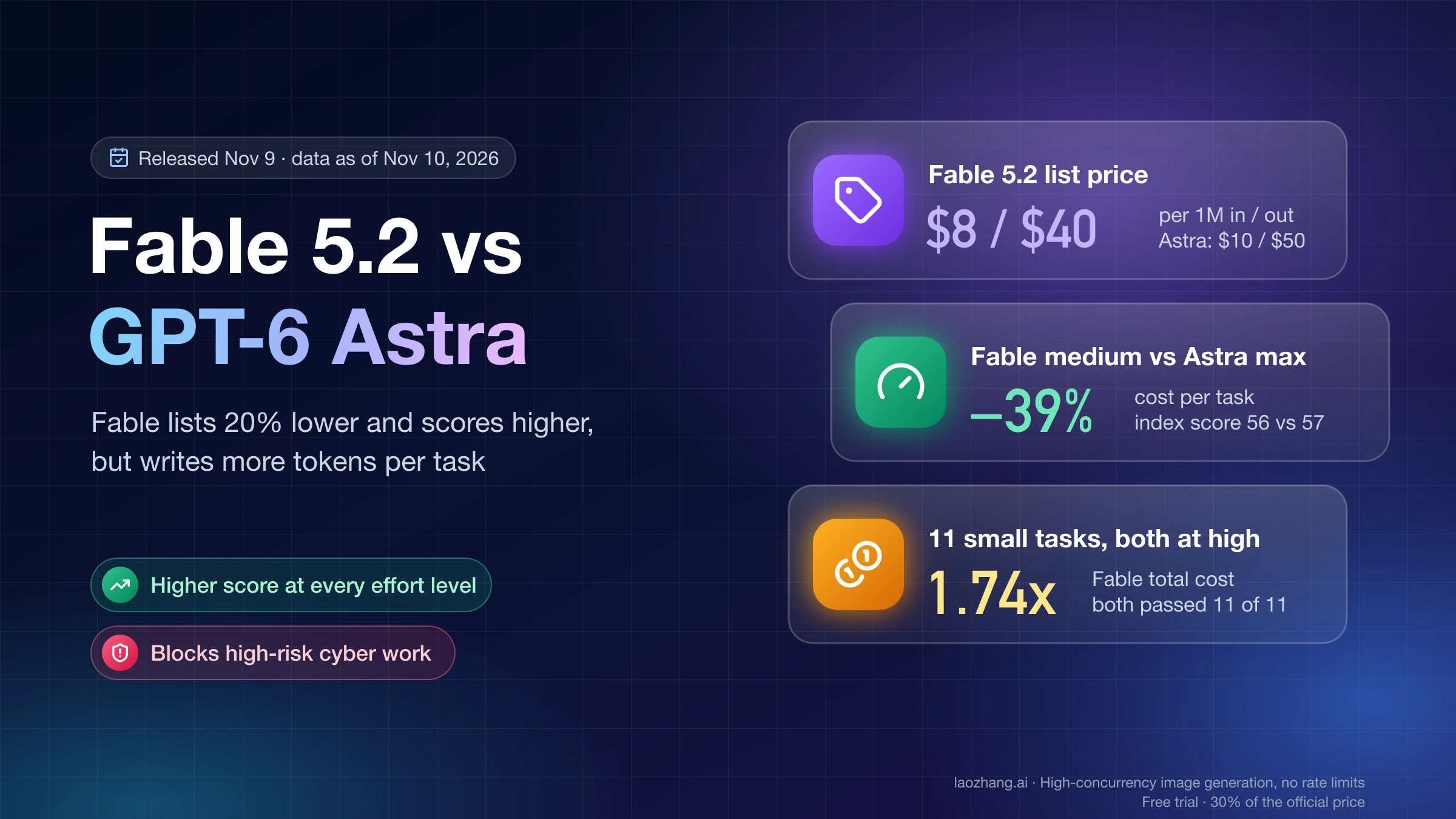
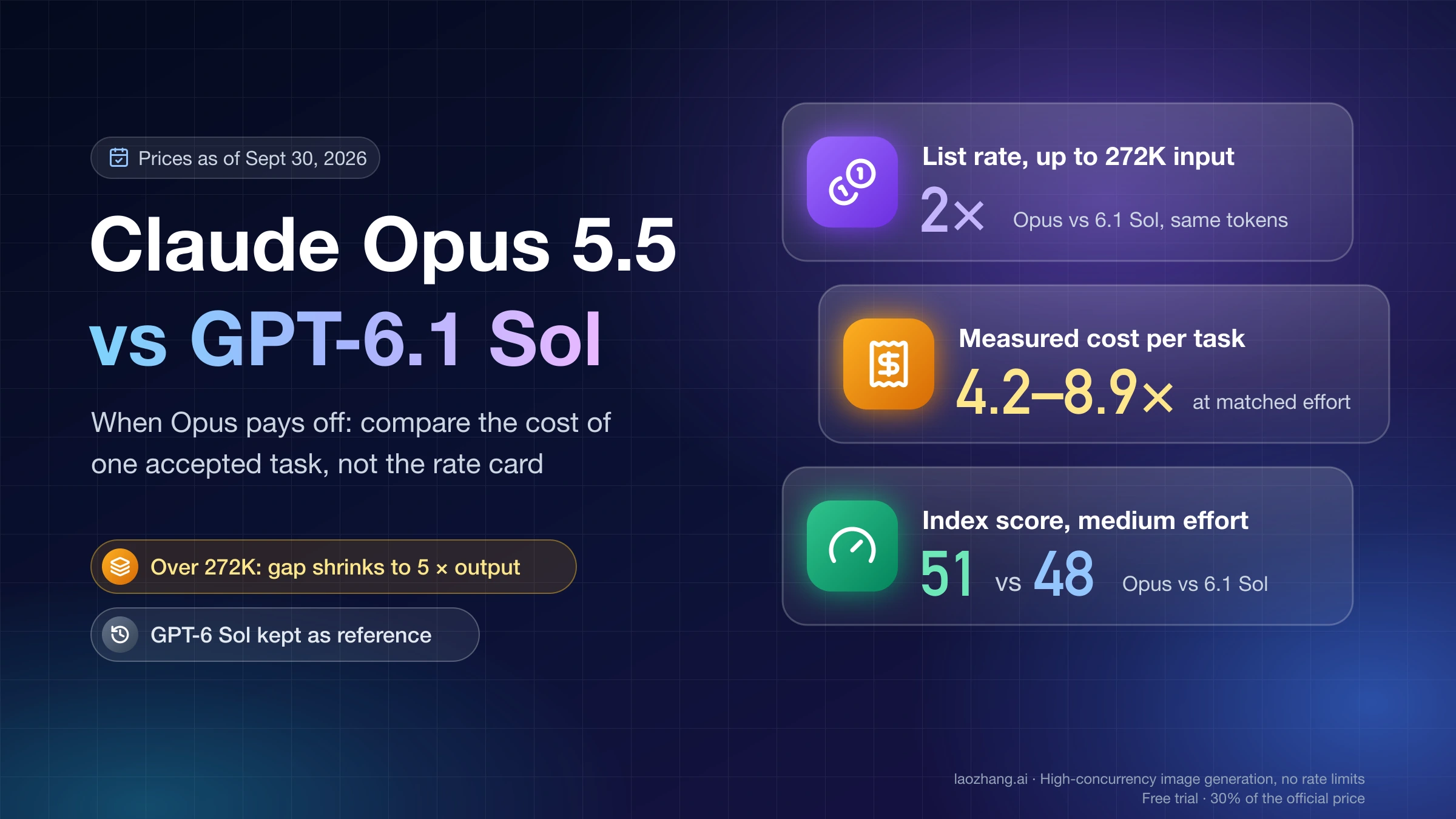
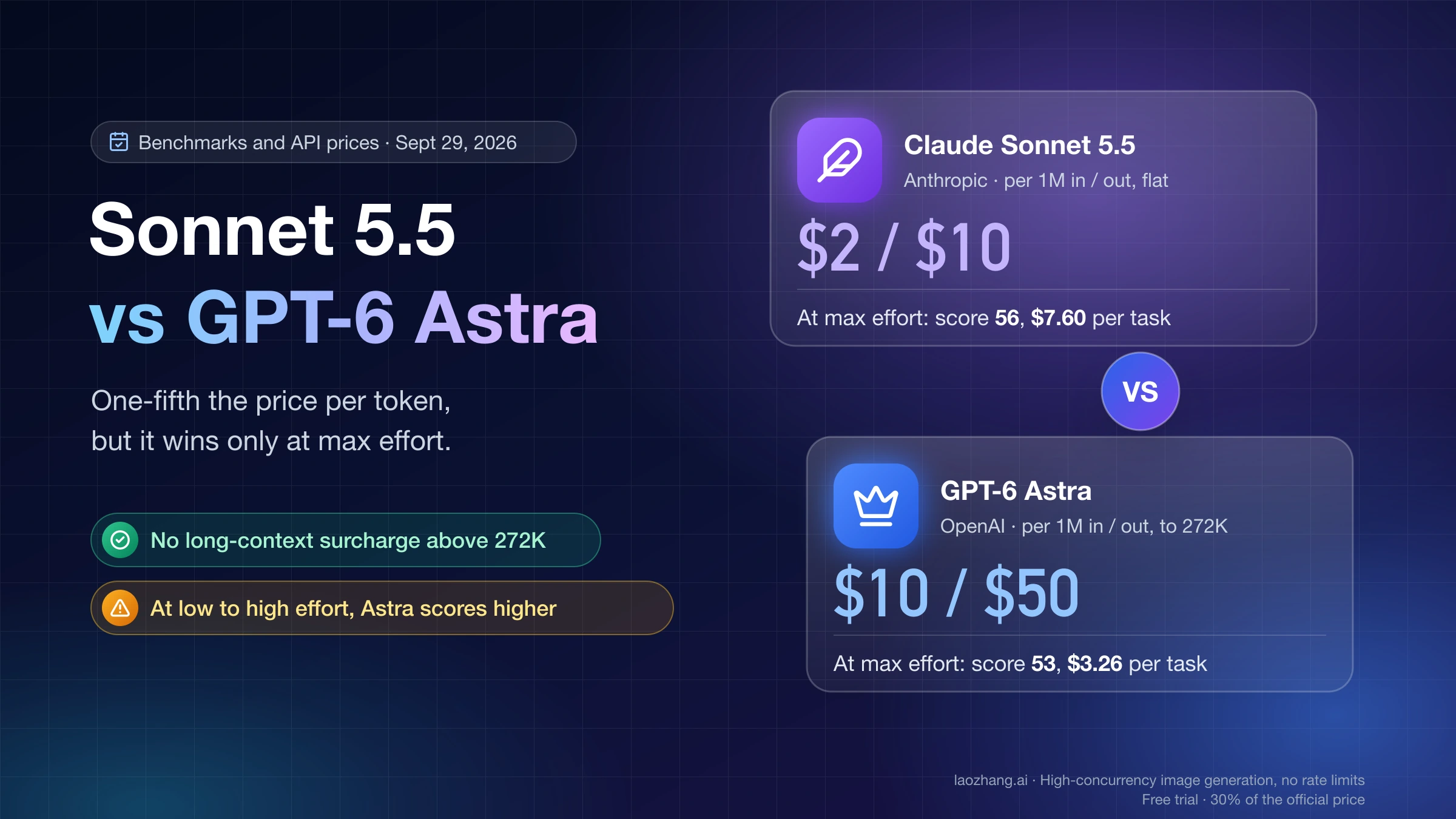
If neither model is the right step, three neighbors are worth a look. Opus 5.5 is no longer Anthropic's top model: Claude Fable 5.2, released November 9, 2026 at $8 / $40, sits above it, though Anthropic still calls Opus 5.5 its "strongest daily driver" and suggests moving up only when needed; see Claude Fable 5.2 vs GPT-6 Astra: When Each Costs Less per Task and Claude Fable 5.2 vs Opus 5.5: When Fable High Beats Opus Max. For cheaper steps, see Claude Sonnet 5.5 vs GPT-6 Astra: When the Cheaper Model Wins, GPT-6.1 Sol vs GPT-6 Astra vs GPT-6 Sol: When Astra Is Worth It and Claude Opus 5.5 vs GPT-6.1 Sol and GPT-6 Sol: When Opus Pays Off.
Sources4
External pages this guide links to, in the order they appear. Last updated Nov 12, 2026.
Sources4
External pages this guide links to, in the order they appear. Last updated Nov 12, 2026.
- 1.Anthropic's Claude API pricing pageplatform.claude.com/docs/en/about-claude/pricing
- 2.OpenAI's API pricing pagedevelopers.openai.com/api/docs/pricing
- 3.Artificial Analysis's Claude Opus 5.5 vs GPT-6 Astra release comparisonartificialanalysis.ai/models/releases/comparisons/claude-opus-5-5-vs-gpt-6-astra
- 4.Claude Opus 5.5 launch postanthropic.com/claude-opus-5-5