GPT-6.1 Sol vs GPT-6 Astra vs GPT-6 Sol: When Astra Is Worth It
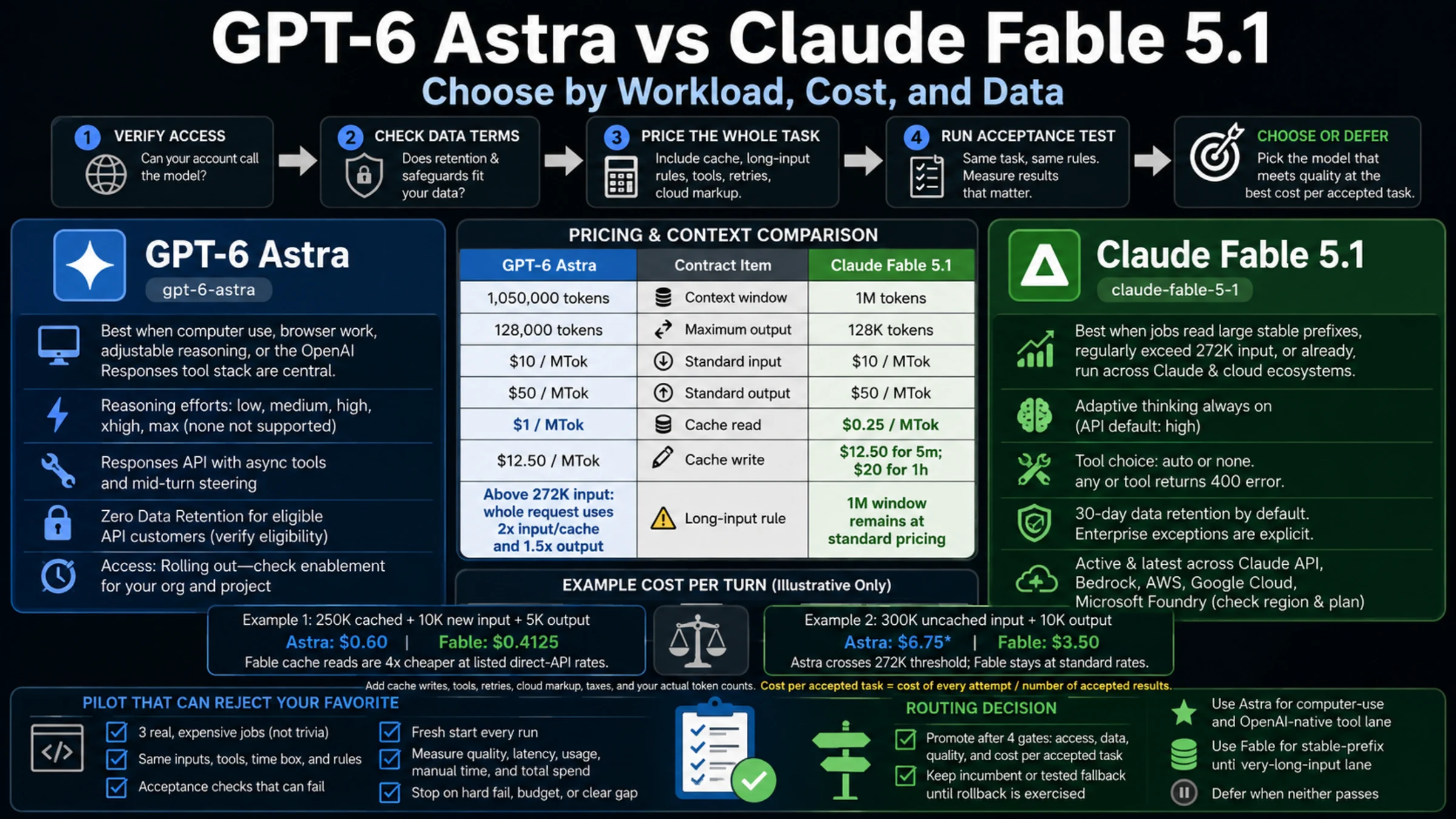
Move gpt-6-sol traffic to GPT-6.1 Sol: same price, higher scores at every effort. Run it one level higher to match Astra for 3–5x less; Astra max has no equal.
On this page
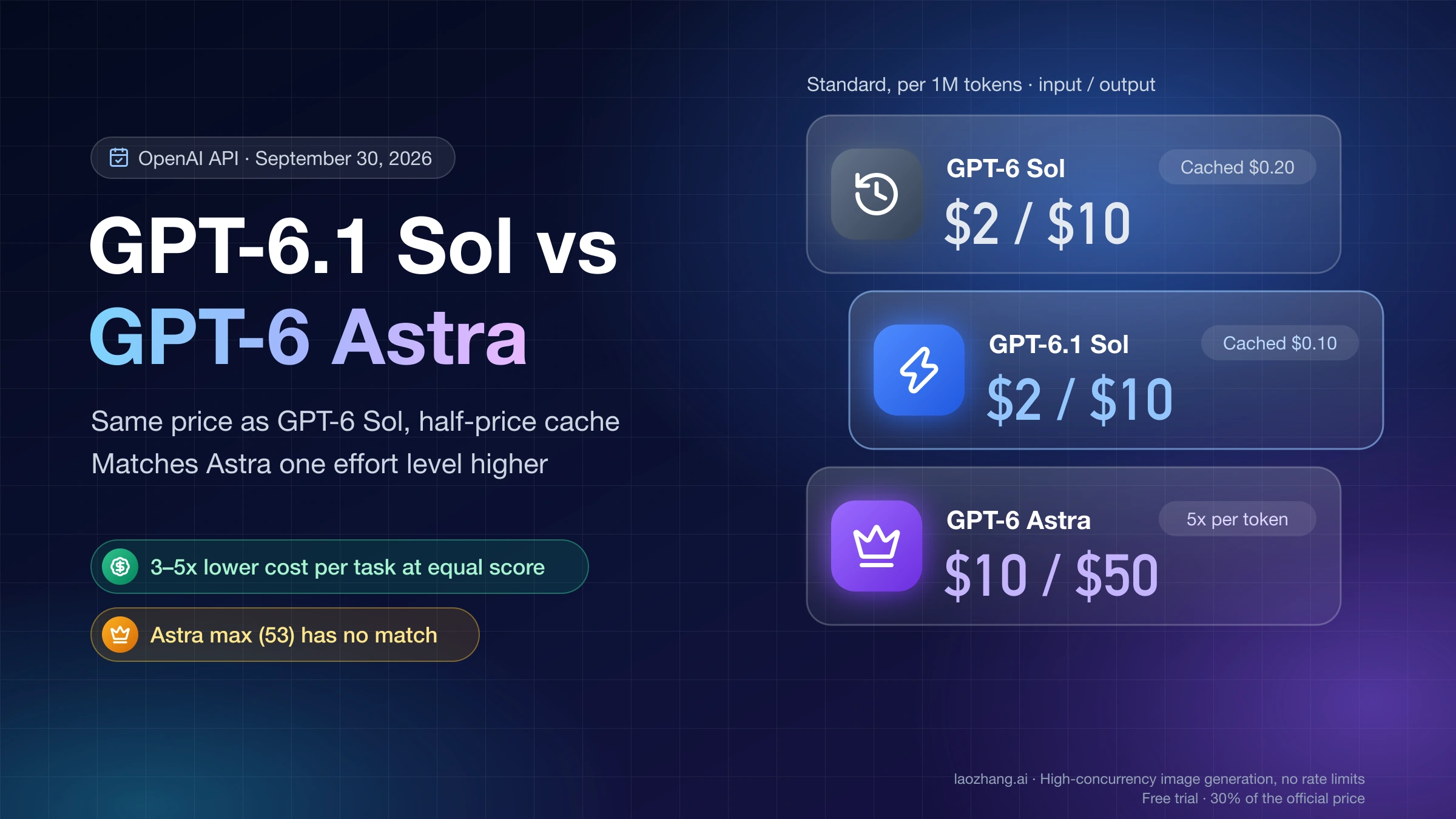
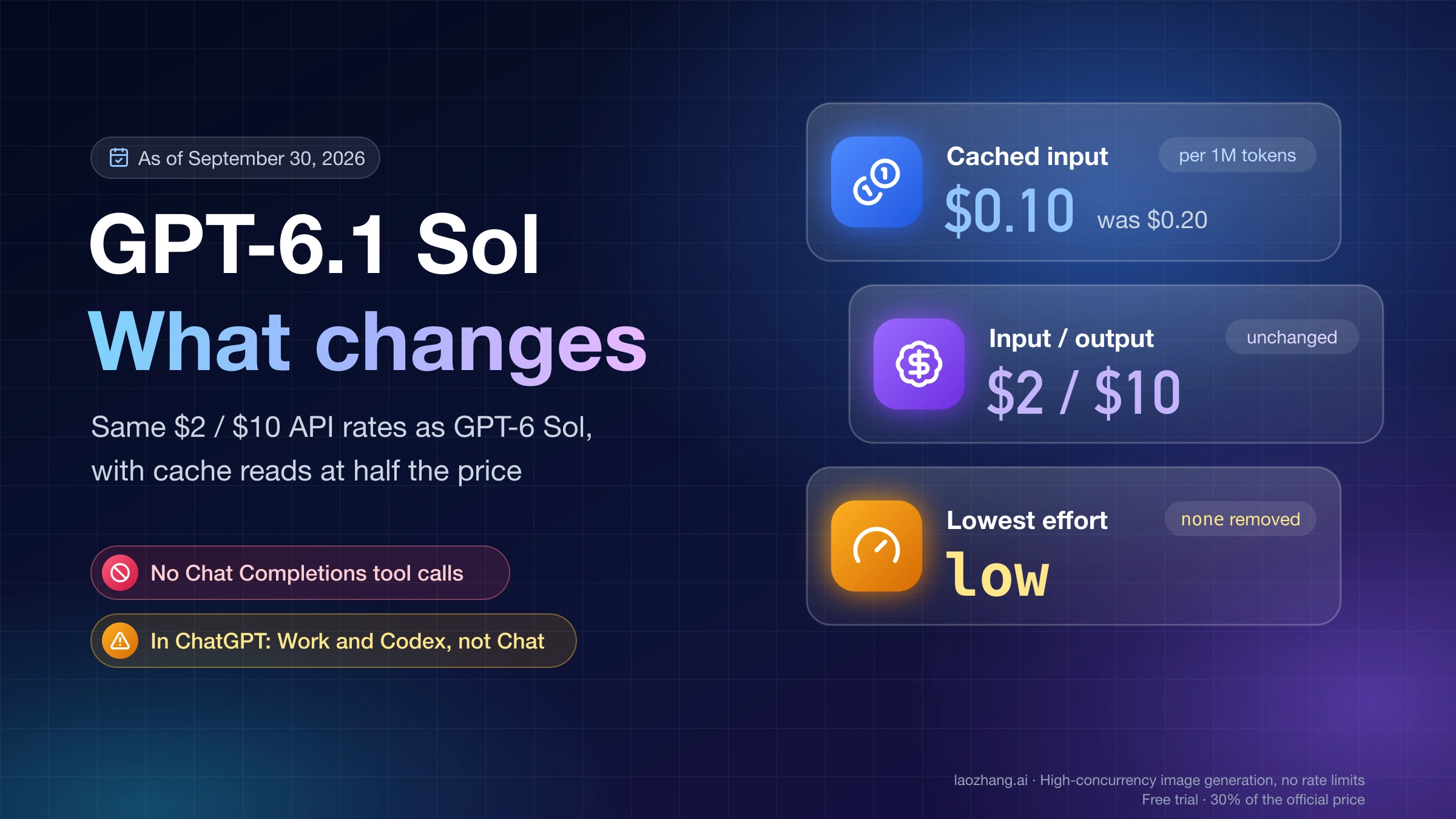
As of September 30, 2026, three names hide a fairly simple choice. GPT-6.1 Sol (gpt-6.1-sol, released September 29) has the same per-token prices as GPT-6 Sol (gpt-6-sol), except that cached input now costs half as much. It also scores higher than GPT-6 Sol at every reasoning effort in Artificial Analysis's independent index. If you run GPT-6 Sol today, move that traffic to GPT-6.1 Sol after fixing the few request settings that don't carry over.
GPT-6 Astra (gpt-6-astra) is still the stronger model, but not by much. At the same effort level, Astra leads GPT-6.1 Sol by 1 to 4 index points and costs five times as much per input and output token. Run GPT-6.1 Sol one effort level higher and it reaches Astra's score at roughly a third to a fifth of the benchmark cost per task. Astra is worth paying for in three cases: you need more than GPT-6.1 Sol's best result (Astra at max effort has no match), you're doing the hardest science work, or your own tests show GPT-6.1 Sol failing often enough that retries and review eat the price gap.
Which model to use, by what you run today
| What you run today | What to do | What to check first |
|---|---|---|
gpt-6-sol at low through max | Switch to gpt-6.1-sol at the same effort | Tool calls in Chat Completions, output-token caps |
gpt-6-sol at none | Try gpt-6.1-sol at low; keep GPT-6 Sol if low is too slow | Response time on your real traffic |
gpt-6-astra at low | Try gpt-6.1-sol at medium | Acceptance rate on your tasks |
gpt-6-astra at medium, high or xhigh | Test gpt-6.1-sol one level higher | Cost per accepted result |
gpt-6-astra at max, hard science, or Ultrafast | Stay on Astra | Nothing to change |
| Codex or ChatGPT Work | Pick GPT-6.1 Sol if your plan shows it | Admin toggle on Enterprise and Edu |
What changed between GPT-6 Sol and GPT-6.1 Sol
On price, almost nothing. OpenAI's model pages and pricing page list these Standard rates per 1M tokens for prompts up to 272K input tokens:
| Per 1M tokens (Standard, ≤272K input) | GPT-6 Sol | GPT-6.1 Sol | GPT-6 Astra |
|---|---|---|---|
| Input | $2.00 | $2.00 | $10.00 |
| Cached input | $0.20 | $0.10 | $1.00 |
| Cache write | $2.50 | $2.50 | $12.50 |
| Output | $10.00 | $10.00 | $50.00 |
| Released | September 22, 2026 | September 29, 2026 | September 3, 2026 |
The only list-price change is cached input, where the discount rises from 90% to 95% of the input rate. Astra costs five times GPT-6.1 Sol on input, cache writes, and output, and ten times on cached input.
The same billing rules apply to all three. A prompt over 272K input tokens is billed at 2x the input and cache rates and 1.5x the output rate for the whole request, so GPT-6.1 Sol becomes $4 input, $0.20 cached, and $15 output, while Astra becomes $20, $2, and $75. Batch and Flex are 50% of Standard, Fast mode is 2x, and regional data residency adds 10% where it's offered. All three have a 1,050,000-token context window and a 128,000-token output limit.
Ultrafast is the exception. The API pricing page lists an Ultrafast price only for gpt-6-astra: $60 input, $6 cached, and $300 output per 1M tokens, six times its Standard rate. OpenAI's launch post names a GPT-6.1 Sol Ultrafast as well, but the ChatGPT and Codex models page says Ultrafast support for GPT-6.1 Sol "is coming later," and the API has no price for it yet. If you need Ultrafast today, Astra is the only option.
What did change is capability. Artificial Analysis measured GPT-6.1 Sol 4 points above GPT-6 Sol at max effort and 7 to 8 points above it at low through xhigh (the full table is below). OpenAI reports gains on its own coding, computer-use, and science evaluations.
GPT-6 Sol is not being shut down. The deprecations page has no entry for gpt-6-sol, and its model page is still live with a pointer to GPT-6.1 Sol as "the newer Sol model." The pricing page's main table dropped the GPT-6 Sol row, and Artificial Analysis headlined the launch as GPT-6.1 Sol replacing GPT-6 Sol. Both mean the newer model is now the recommended Sol, not that the old one is gone. Your existing gpt-6-sol requests keep working.
How close GPT-6.1 Sol gets to Astra, by who measured it
OpenAI pitches GPT-6.1 Sol as near-Astra intelligence at a fifth of the price. Two sources back that up, measured differently, and neither is your workload.
OpenAI's own evaluations
In the GPT-6.1 Sol announcement, OpenAI reports:
- DeepSWE v1.1 (coding): on par with Astra at about a fifth of the cost, and 6.4 points above GPT-6 Sol's best score at lower effort and cost.
- OSWorld 2.0 (computer use): at max effort, within 2.1 points of Astra at about a seventh of the cost per task, and 7 points above GPT-6 Sol at under half its cost.
- Terminal-Bench Science 0.1: more than double GPT-6 Sol's score at max effort. Astra still ranks first at 68.1%, and OpenAI says the most challenging science tasks should use it. Average cost per task was $5.47 for GPT-6.1 Sol and $23.80 for Astra.
- Factual errors on hard prompts (xhigh): GPT-6.1 Sol 4.1%, GPT-6 Sol 4.5%, Astra 4.0%, at about 83% lower cost per task than Astra. The prompts in that test are deliberately hard and, in OpenAI's words, don't represent typical use.
These are the vendor's numbers from a research environment or the API; the announcement's charts don't publish every value.
Artificial Analysis, effort by effort
Artificial Analysis runs all three models through its Intelligence Index v4.3.2, ten evaluations covering agentic work, coding, science, and knowledge. The figures below come from its GPT-6.1 Sol analysis and release pages as of September 30, 2026. "Cost per task" is Artificial Analysis's weighted token cost per index task at API prices, useful for comparing models against each other but not a forecast of your bill.
| Reasoning effort | GPT-6 Sol | GPT-6.1 Sol | GPT-6 Astra |
|---|---|---|---|
| low | 34 · $0.13 | 42 · $0.13 | 46 · $0.82 |
| medium | 40 · $0.25 | 48 · $0.21 | 50 · $1.54 |
| high | 43 · $0.38 | 50 · $0.32 | 51 · $1.73 |
| xhigh | 44 · $0.52 | 51 · $0.39 | 52 · $2.31 |
| max | 48 · $1.05 | 52 · $0.72 | 53 · $3.26 |
Each cell is index score · cost per index task. GPT-6 Sol at none scored 28 at $0.33.
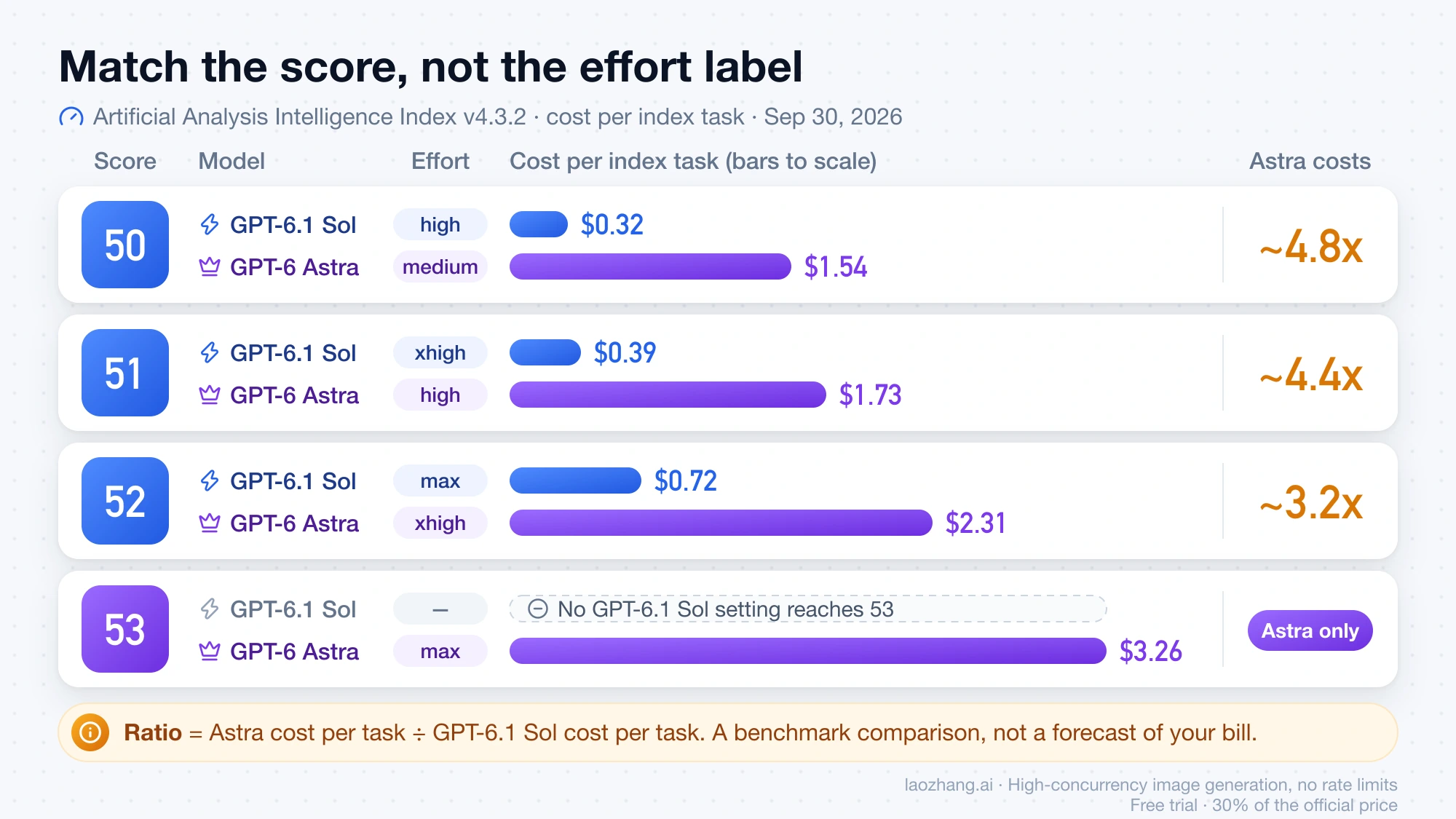
Two readings matter for a decision. First, at every effort level GPT-6.1 Sol beats GPT-6 Sol at the same or lower cost per task. Second, if you match on score instead of on effort label, GPT-6.1 Sol one level up lands exactly on Astra:
| Same index score | GPT-6.1 Sol | GPT-6 Astra | Astra costs |
|---|---|---|---|
| 50 | high, $0.32 | medium, $1.54 | ~4.8x |
| 51 | xhigh, $0.39 | high, $1.73 | ~4.4x |
| 52 | max, $0.72 | xhigh, $2.31 | ~3.2x |
| 53 | no match | max, $3.26 | — |
The ratios are Astra's cost per task divided by GPT-6.1 Sol's. Astra at low effort is the weakest buy of the three: GPT-6.1 Sol at medium scores higher (48 vs. 46) at about a quarter of the cost per task ($0.21 vs. $0.82).
On Artificial Analysis's separate Coding Agent Index, GPT-6.1 Sol at xhigh scored 1 point above GPT-6 Astra for less than 15% of the cost per task, and xhigh beat GPT-6.1 Sol's own max setting by 3 points. At max, it sits 2 points below Astra and 3 points above GPT-6 Sol. If you run coding agents at max, test xhigh too.
GPT-6.1 Sol also generated output faster in these runs, 59 to 66 tokens per second versus 44 to 51 for Astra.
Where the gap is still real
A 1-point gap on a ten-benchmark average can hide a larger gap on one kind of work. Terminal-Bench Science is the clearest example in OpenAI's own data: Astra is first there, and OpenAI points hard science work to Astra. The other hard limit is the top of the scale. Astra at max (53) scored above anything GPT-6.1 Sol reached, so if your task only succeeds at Astra max, no GPT-6.1 Sol setting replaces it.
OpenAI's Codex documentation also describes Astra as better at asking focused questions and keeping the original goal and constraints in view across long workflows. That's a vendor description, but it points to where to look in your own tests: long, loosely specified tasks where a wrong assumption early costs you the whole run.
What "a fifth of the price" means for a real request
The one-fifth figure is exact for Standard input, cache writes, and output. It isn't exact for your bill, for two reasons: cached input is 10x apart, and the models don't emit the same number of tokens for the same task.
Here is one agent-loop request with identical token counts on all three models: 200,000 input tokens, of which 150,000 are cache hits and 50,000 are uncached, plus 20,000 output tokens. Standard rates, under 272K input, cache writes left out.
- GPT-6.1 Sol: 0.05M × $2 + 0.15M × $0.10 + 0.02M × $10 = $0.100 + $0.015 + $0.200 = $0.315
- GPT-6 Sol: $0.100 + 0.15M × $0.20 + $0.200 = $0.100 + $0.030 + $0.200 = $0.330
- GPT-6 Astra: 0.05M × $10 + 0.15M × $1 + 0.02M × $50 = $0.50 + $0.15 + $1.00 = $1.65
Astra costs about 5.2x more for this request, slightly more than 5x because of the cache-heavy input. The larger the cached share of your input, the further the ratio climbs above 5x, since the cached part alone is 10x apart.
Against GPT-6 Sol, the saving is small and can reverse. Artificial Analysis found GPT-6.1 Sol uses roughly 10–30% more output tokens than GPT-6 Sol at the same effort. If this request produced 24,000 output tokens instead of 20,000 (20% more), the extra 4,000 tokens add $0.04 and GPT-6.1 Sol would cost $0.355, more than GPT-6 Sol's $0.330. On Artificial Analysis's index tasks, GPT-6.1 Sol still came out cheaper per task at every effort level, but an output-heavy call can go the other way. The reason to switch from GPT-6 Sol is higher quality at about the same cost, not a lower bill.
Long prompts, Batch, and Flex don't change the ratios between the models, because the same multipliers apply to all three. For a line-by-line Astra bill with cache writes and the 272K threshold, see GPT-6 Astra API Pricing: Rates, Caching, and Cost Examples.
Is Astra worth it for your tasks? Count cost per accepted result
Token prices and benchmark averages tell you what an attempt costs. What you pay for is a result you can use. The number to compare is:
cost per accepted result = (model cost per attempt + review cost per attempt) ÷ acceptance rate
Take the request above and some hypothetical acceptance rates. If nobody reviews the output and failures are caught automatically, Astra at 90% acceptance costs $1.65 ÷ 0.9 = $1.83 per accepted result. GPT-6.1 Sol stays cheaper as long as it accepts more than $0.315 ÷ $1.83 ≈ 17% of attempts. On model cost alone, Astra rarely wins in this example.
Add $3 of human review per attempt, a few minutes of an engineer's time, and the picture changes. Astra becomes ($1.65 + $3) ÷ 0.9 = $5.17 per accepted result. GPT-6.1 Sol at 80% acceptance costs ($0.315 + $3) ÷ 0.8 = $4.14 and still wins, but its break-even falls to $3.315 ÷ $5.17 ≈ 64%. When review time dominates the cost, the per-token discount matters less and the acceptance rate decides.
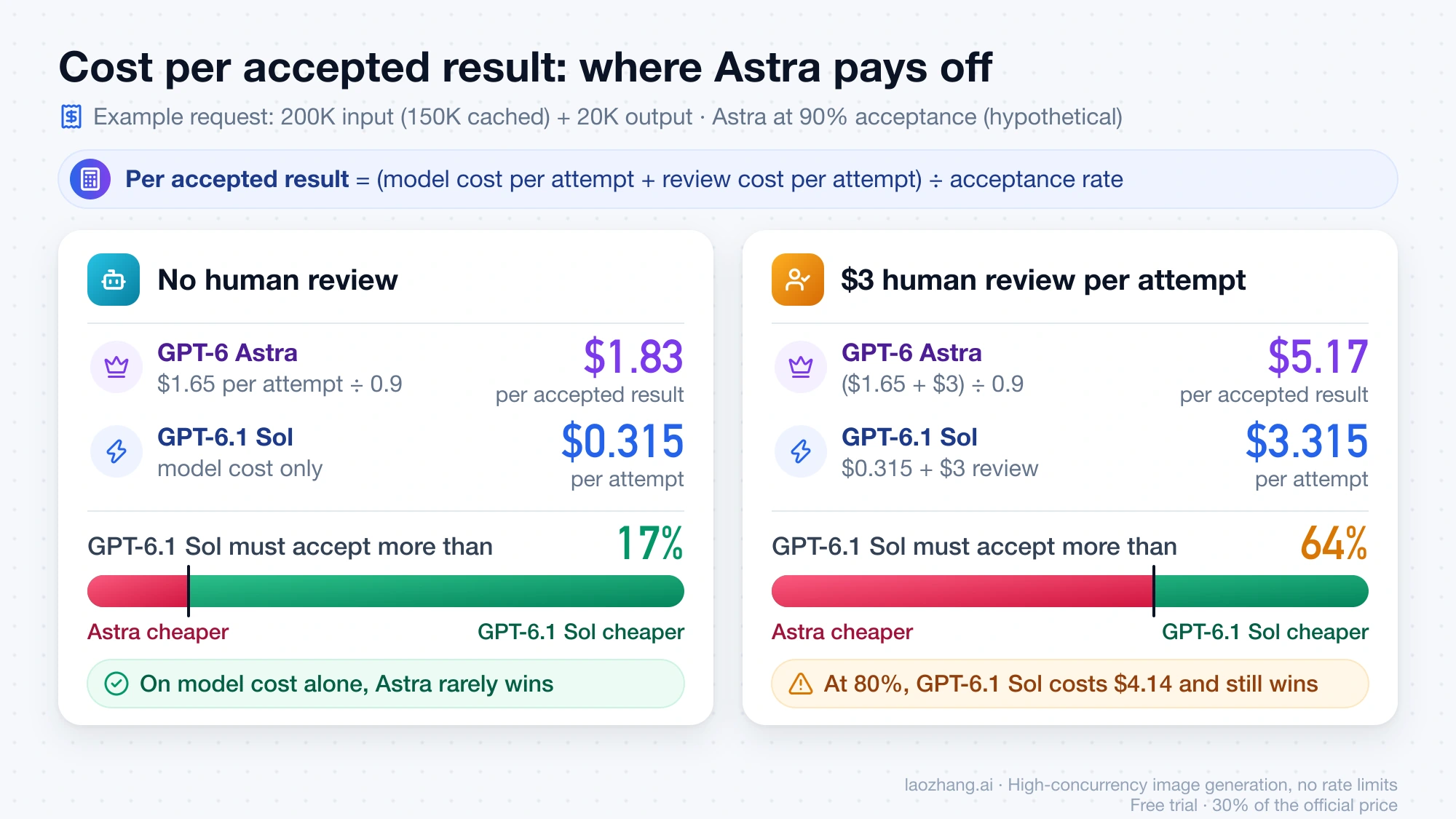
So Astra earns its price when a failed attempt is expensive: a person has to review every run, a wrong result ships before anyone notices, or the task only succeeds at Astra max. For routine work with automated checks, GPT-6.1 Sol wins even with a much lower pass rate.
To measure this on your own work:
- Pick 20 to 30 recent tasks with a clear pass or fail, drawn from the traffic you actually run.
- Run GPT-6.1 Sol at your current effort and one level higher, and Astra at your current effort. For coding agents, include GPT-6.1 Sol at xhigh even if you use max.
- Record input, cached input, and output tokens from each response's usage data, and price them with the table above.
- Count accepted results and add your review cost per attempt.
- Move traffic to the cheapest setting per accepted result, and keep Astra only for the task types where it stays ahead.
If your GPT-6 Sol baseline includes image inputs from before September 25, rerun it first. OpenAI fixed an image-encoding bug that day that had degraded GPT-6 Sol's image understanding in the API and Codex, including computer use, so older numbers understate GPT-6 Sol on visual tasks.
Check these before swapping gpt-6-sol for gpt-6.1-sol
Most requests only need the new model ID. According to OpenAI's GPT-6 migration guide, these are the ones that don't:
| In your GPT-6 Sol setup | On GPT-6.1 Sol | What to change |
|---|---|---|
Reasoning effort none or minimal | Not supported (Astra doesn't support none either) | Use low and compare results on real tasks |
Function calling through Chat Completions (GPT-6 Sol allows it only at none) | Tool calling requires the Responses API | Move tool-using requests to Responses |
temperature, top_p, top_logprobs | Must be removed whenever effort isn't none | Delete them; in Chat Completions also remove logprobs |
| Fast mode with EU data residency | Fast isn't available with EU residency | Use Standard, or global or US processing |
| Output caps and spend alerts sized for GPT-6 Sol | About 10–30% more output tokens per task in Artificial Analysis's runs | Check max_output_tokens and budget alerts |
| Security-related prompts | OpenAI rates GPT-6.1 Sol Critical in cybersecurity and applies Astra's safeguards stack | Retest prompts that GPT-6 Sol handled without intervention |
The first two rows are what usually break: a request that sent none to gpt-6-sol will fail on gpt-6.1-sol, and so will a Chat Completions request with tools. If you used none for speed, measure low on GPT-6.1 Sol before switching. GPT-6 Sol remains available if low adds too much latency. For the request changes themselves, step by step, see GPT-6.1 Sol: Pricing, Access, and What Breaks When You Switch.
In Codex and ChatGPT Work
The API prices above don't apply to ChatGPT plans. In Codex and ChatGPT Work, models use ChatGPT credits, and the per-token table doesn't convert into credit usage. Check your plan's pricing page for that.
GPT-6.1 Sol is rolling out to Plus, Pro, Business, Enterprise, and Edu, in Codex (desktop app and CLI) and in ChatGPT Work on the web and mobile. Enterprise and Edu workspaces keep it off until an administrator turns it on. Free and Go plans aren't included at launch. GPT-6.1 Sol and GPT-6 Sol are available in Work and Codex, not in regular Chat. Standard and Fast modes work at launch; Ultrafast for GPT-6.1 Sol is listed as coming later.
In the CLI, pick the model with codex -m gpt-6.1-sol or codex -m gpt-6-astra. OpenAI's own advice for Codex matches the API data: use GPT-6.1 Sol for repeated, long-running work across code, apps, and documents, and keep Astra for the hardest end-to-end work. Reasoning effort in Codex ranges from Light to Ultra, and OpenAI notes that effort levels don't map exactly between model generations. A task you ran on GPT-6 Sol Medium may need a different setting on GPT-6.1 Sol, so try a familiar task one step lower and adjust.
FAQ
Is GPT-6.1 Sol only a few points better than GPT-6 Sol?
It depends on the effort level. At max effort, Artificial Analysis measured 4 points on its Intelligence Index and 3 on its Coding Agent Index. At low through xhigh the index gap is 7 to 8 points, and GPT-6.1 Sol at xhigh beat GPT-6 Sol at max by 6 points on coding agents. The upgrade is largest below max effort, which is where most production traffic runs.
Is GPT-6 Astra the same thing as GPT-6?
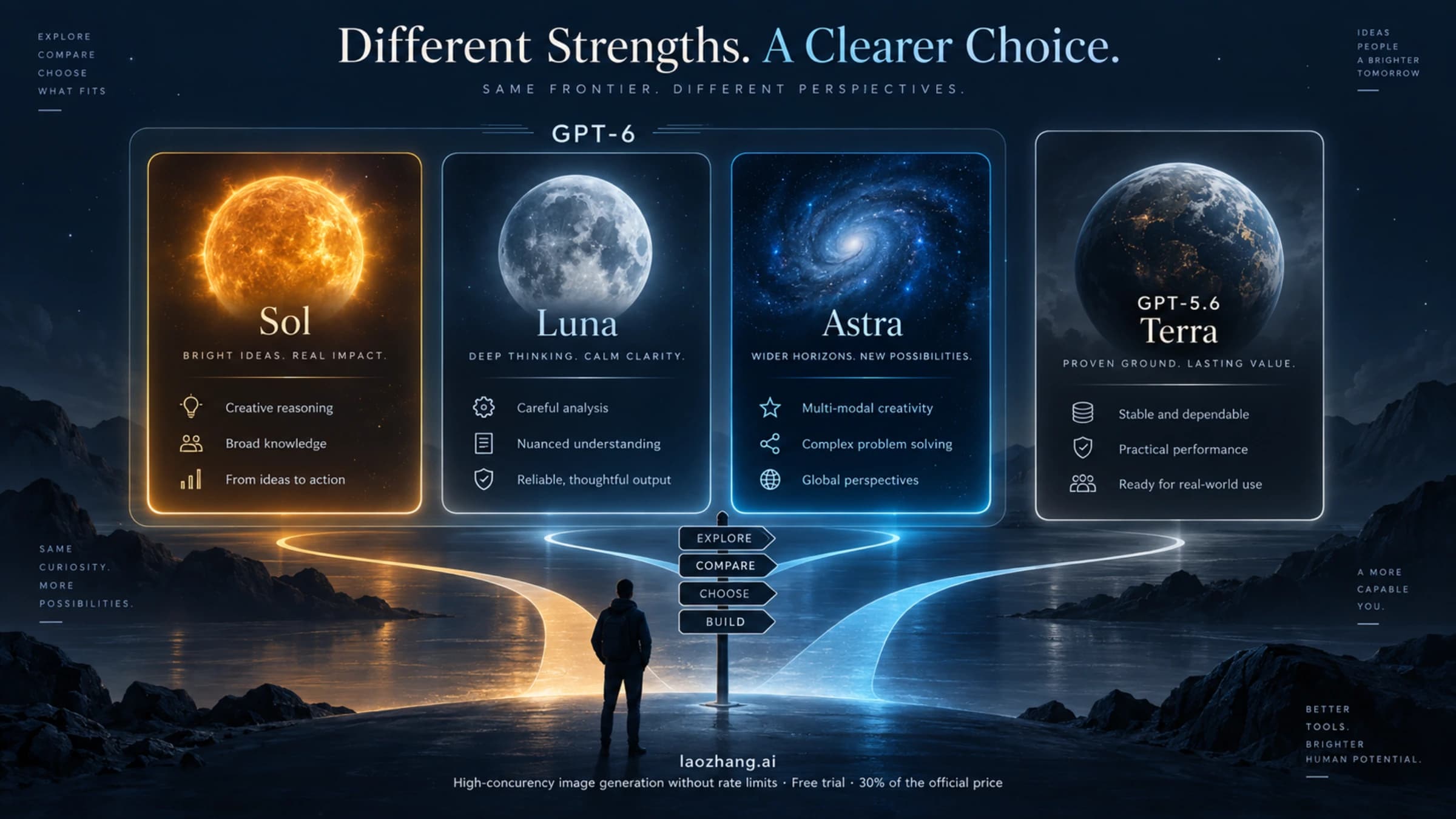
GPT-6 is a family of models. Astra (September 3) is the most capable, Sol is the mid-priced model now in its 6.1 version, and Luna is the fastest and cheapest. In regular ChatGPT Chat, Astra appears as "GPT-6 Pro" on Pro, Business, and Enterprise plans. For the full lineup, including Luna and GPT-5.6 Terra, see GPT-6 Sol vs Terra vs Luna vs Astra: Which Model Should You Use?. That comparison predates GPT-6.1 Sol.
Should I cancel my Astra usage entirely?
Probably not. Move the work that GPT-6.1 Sol one level higher handles at an acceptable pass rate, which on benchmark data is most work at Astra low through xhigh. Keep Astra for tasks that need its max effort, for hard science, for Ultrafast, and anywhere a failed attempt costs you real review time. If you're also weighing a cheaper model from another vendor, Claude Sonnet 5.5 vs GPT-6 Astra: When the Cheaper Model Wins covers that trade-off.