Claude Sonnet 5 Price Increase Canceled: Current Rates and Billing Math
Anthropic canceled the September 1 Sonnet 5 API price increase. See the current USD rates, what changes in a September budget, and how to reconcile uncached input, cache writes, cache reads, and output.
On this page
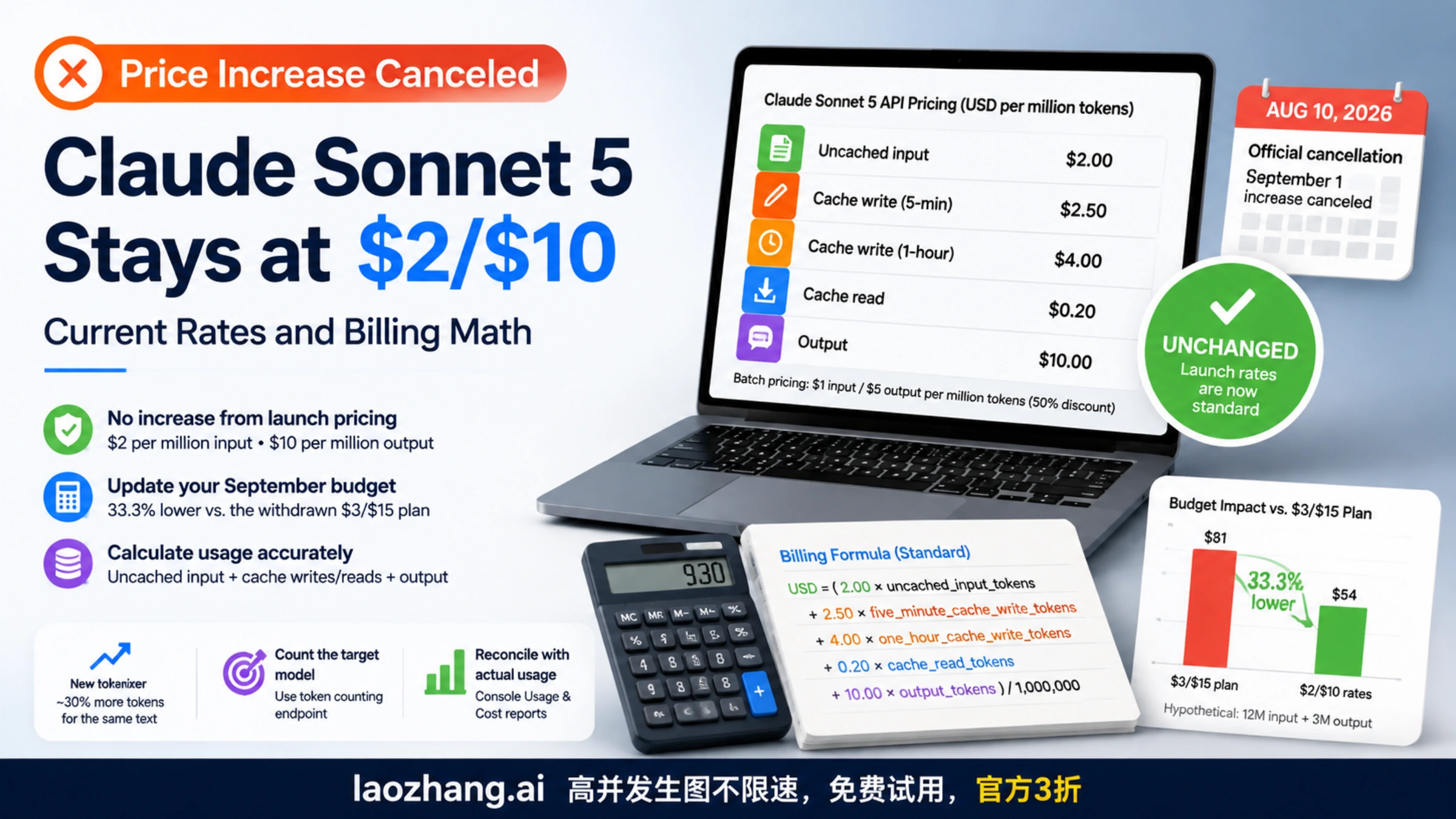
The Claude Sonnet 5 price increase was canceled. As of September 6, 2026, Anthropic's standard API rates remain $2 per million input tokens and $10 per million output tokens. The planned September 1 increase to $3 and $15 did not take effect. Anthropic recorded the cancellation on August 10, making the launch rates its standard pricing. (Official release notes, updated Sonnet 5 announcement)
If your September forecast still uses $3/$15, update it. If your actual bill increased, the cancellation alone will not explain the difference: token counts, output length, caching, and the service issuing the bill still matter.
What changed in the September budget
The announcement changed the scheduled price, not the rate you were already paying during the launch period. The old plan would have raised both basic token rates by 50%. Keeping $2/$10 means no increase from launch pricing, and a 33.3% reduction against a budget calculated using the withdrawn $3/$15 rates, for identical input and output quantities.
Those percentages use different denominators. A price moving from $2 to $3 increases by $1 divided by $2, or 50%. Comparing the current $2 with the planned $3 saves $1 divided by $3, or 33.3%.
For a hypothetical month with 12 million uncached input tokens and 3 million output tokens:
| Budget assumption | Input | Output | Token subtotal |
|---|---|---|---|
| Withdrawn September plan: $3/$15 | $36 | $45 | $81 |
| Current standard rates: $2/$10 | $24 | $30 | $54 |
| Difference from the old forecast | $12 | $15 | $27 |
The $27 difference is a correction to this hypothetical forecast. It is not a refund or a measured saving from an actual account. The example excludes cache pricing, tools, taxes, and provider-specific charges.
The date also matters when reviewing older notes. August 10 is the official cancellation date; August 11 reporting dates do not establish a separate pricing change. Anthropic's updated launch announcement describes the rates as permanent, meaning the launch pricing became standard. That announcement does not establish a contractual guarantee that prices can never change.
The rates to use now
The following prices apply to Sonnet 5 on the standard Claude API, in USD per million tokens. Cache writes and reads have their own rates; they should not all be treated as ordinary input. (Anthropic pricing)
| Billed token category | Current rate |
|---|---|
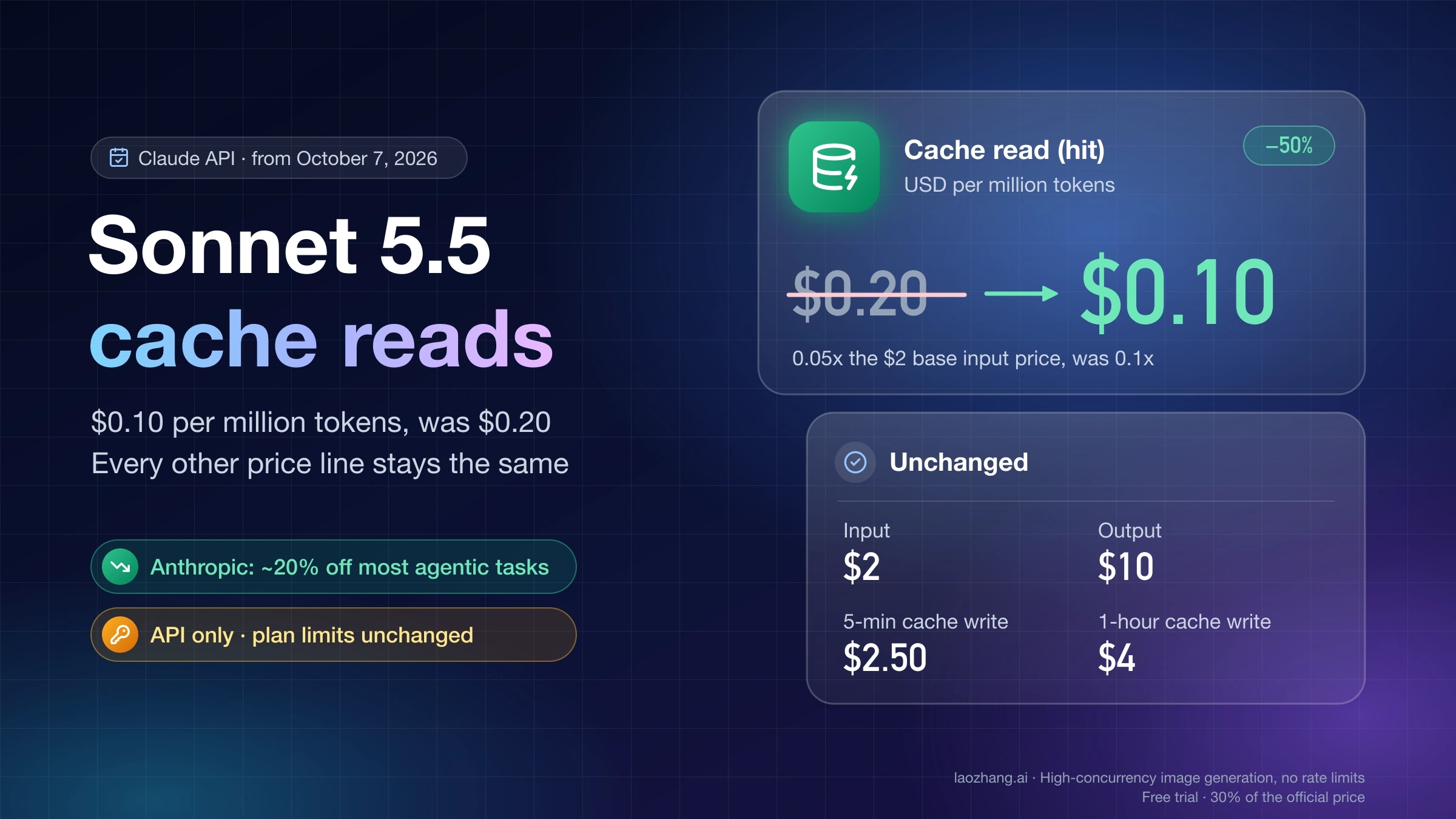
| Uncached input | $2.00 |
| Cache write with a 5-minute lifetime | $2.50 |
| Cache write with a 1-hour lifetime | $4.00 |
| Cache read | $0.20 |
| Output | $10.00 |
Batch processing has separate basic rates of $1 per million input tokens and $5 per million output tokens. It is asynchronous, so use it when the workload can wait for results. The 50% Batch token discount does not mean every request qualifies or every component of an invoice is halved. (Batch pricing)
These are API token prices. They are not the monthly price of Claude Pro or Max, and they do not determine a reseller's final bill. Cloud providers can have their own pricing and endpoint premiums. If the charge comes from a cloud provider or intermediary, use the applicable provider terms when reconciling it. (Cloud platform pricing)
Calculate usage without charging the same input twice
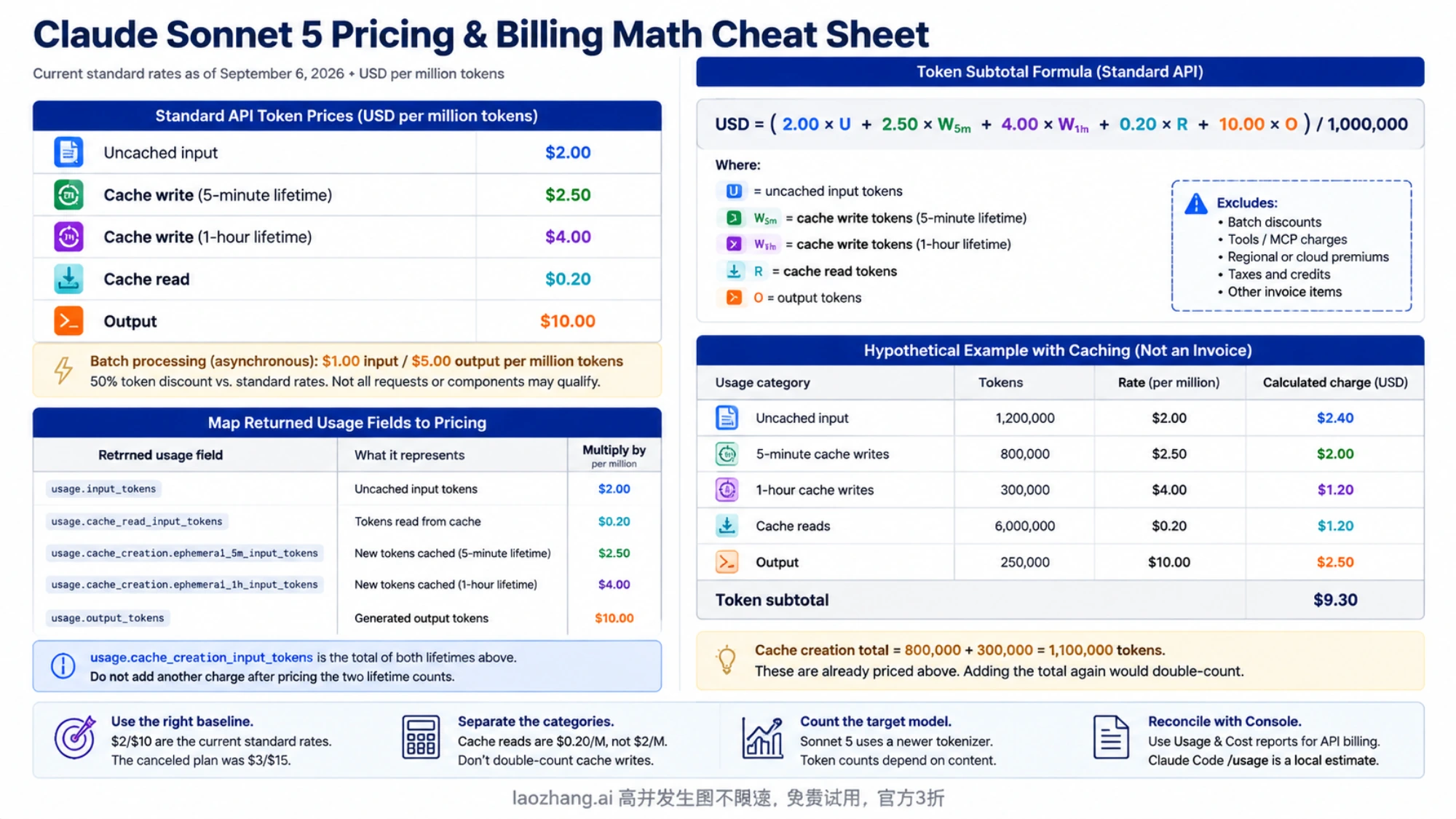
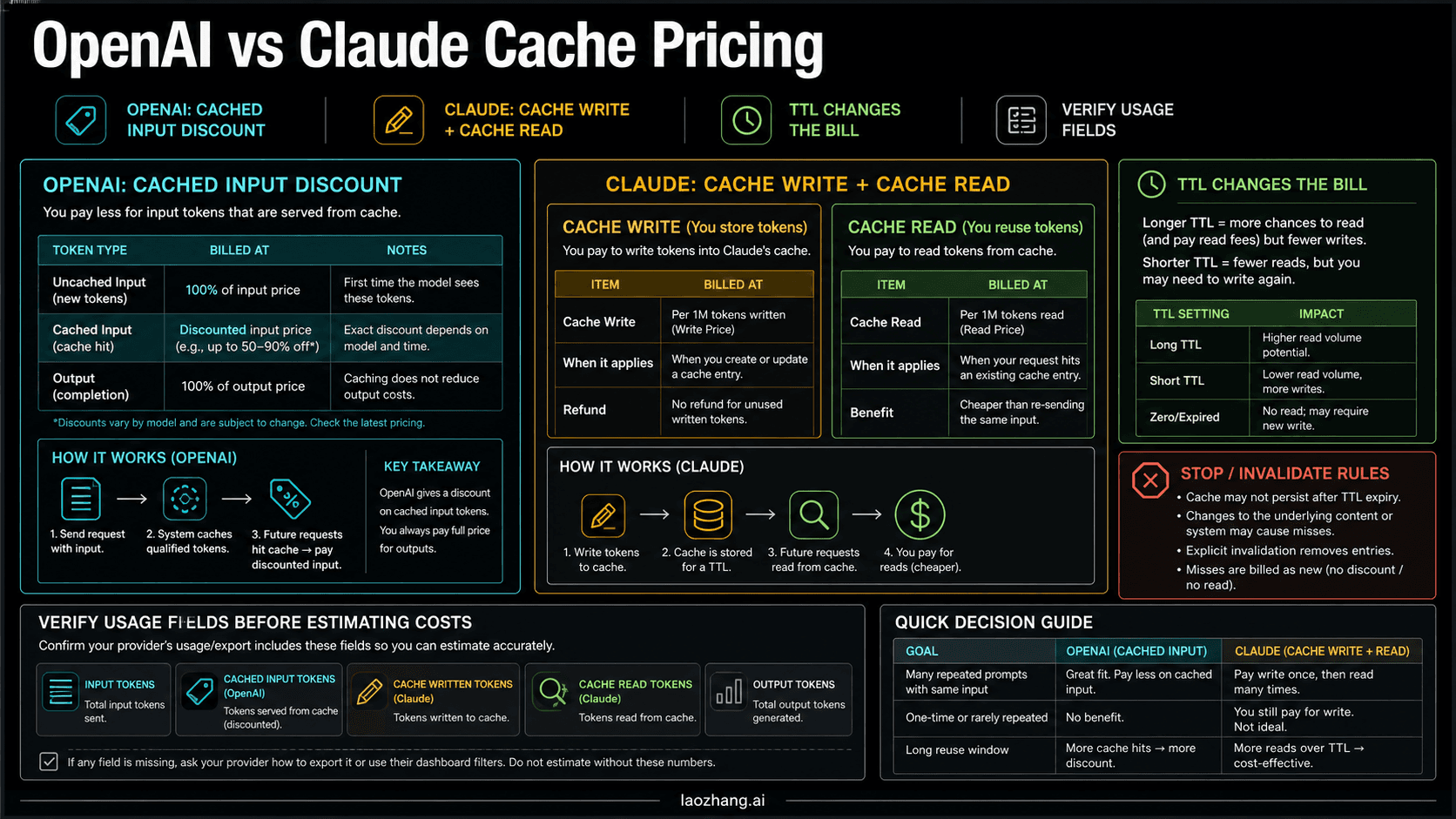
The useful starting point for a standard API request is its returned usage data. Anthropic separates uncached input, newly cached input, and cached input that was read. In particular, input_tokens does not include the separate cache read and cache creation counts. The cache lifetime breakdown is already included in the overall cache creation count. (Prompt caching usage fields)
| Returned usage field | How to price it |
|---|---|
usage.input_tokens | Multiply by $2 per million |
usage.cache_read_input_tokens | Multiply by $0.20 per million |
usage.cache_creation.ephemeral_5m_input_tokens | Multiply by $2.50 per million |
usage.cache_creation.ephemeral_1h_input_tokens | Multiply by $4 per million |
usage.output_tokens | Multiply by $10 per million |
usage.cache_creation_input_tokens | Total cache creation count; do not add another charge after pricing the two lifetime counts |
For standard pricing, calculate the token subtotal as:
USD = (
    2.00 × uncached_input_tokens
  + 2.50 × five_minute_cache_write_tokens
  + 4.00 × one_hour_cache_write_tokens
  + 0.20 × cache_read_tokens
  + 10.00 × output_tokens
) / 1,000,000
The variable names above are explanatory labels, not additional API fields. This calculation excludes Batch discounts, regional adjustments, tools, taxes, credits, and other invoice items.
Consider a second hypothetical example: a reporting period containing both cache lifetimes and substantial reuse.
| Usage category | Tokens | Calculated charge |
|---|---|---|
| Uncached input | 1,200,000 | $2.40 |
| 5-minute cache writes | 800,000 | $2.00 |
| 1-hour cache writes | 300,000 | $1.20 |
| Cache reads | 6,000,000 | $1.20 |
| Output | 250,000 | $2.50 |
| Token subtotal | $9.30 |
The cache creation total here is 1,100,000 tokens: 800,000 plus 300,000. The $2.00 and $1.20 rows already price those tokens. Adding the 1,100,000-token total as another input charge would double-count them.
If you retained only cache_creation_input_tokens, a mixed-lifetime subtotal cannot be reconstructed exactly from that number alone. Recover the lifetime breakdown or reconcile against the corresponding billing report. Assuming every write used five minutes would understate the one-hour portion.
Likewise, a six-million-token cache read in this example costs $1.20, not the $12 it would cost as uncached input. Keeping these categories separate lets you distinguish a higher rate from a change in cache reuse.
Why a Sonnet 4.6 migration may save less than expected
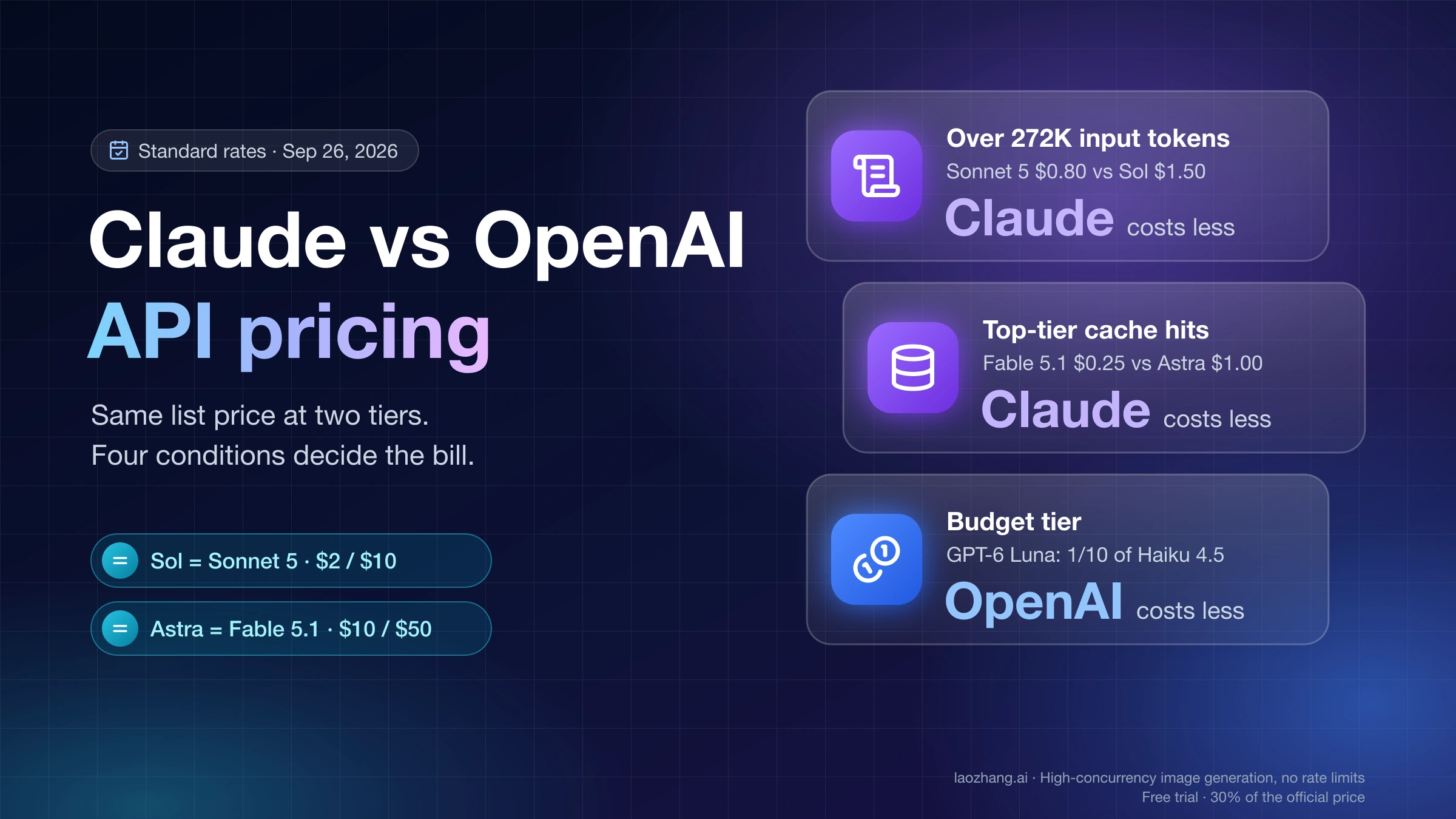
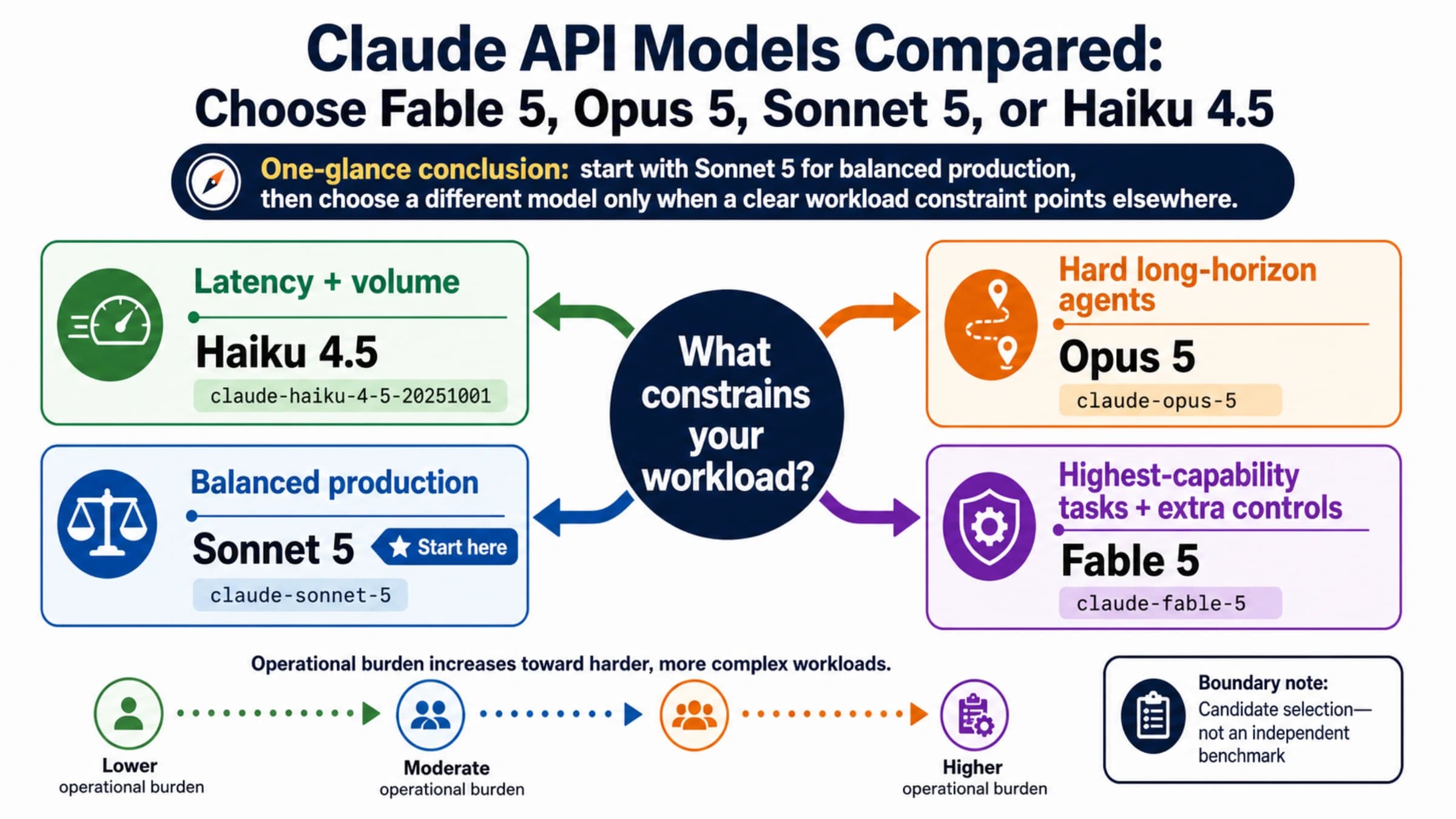
Sonnet 4.6's base rates are $3/$15, but comparing those with Sonnet 5's $2/$10 does not establish a 33.3% saving for the same application. Sonnet 5 uses a newer tokenizer. Anthropic reports approximately 30% more tokens for the same text, with the actual difference depending on the content. Adaptive thinking and effort settings can also change consumption. (What's new in Sonnet 5)
If both billed input and output quantities were exactly 30% higher, the basic cost ratio would be 1.30 × 2/3 = 0.8667: about 13.3% less. That is a conditional calculation, not a prediction for your workload. Your input mix, generated output, thinking, retries, and cache behavior can produce a different result.
Use the target model with Anthropic's token-counting endpoint to estimate representative requests, including their system instructions, tools, images, or PDFs where applicable. Token counting estimates input; it does not predict future output or provide a final charge. (Token counting documentation)
Once you have actual reported usage, price those counts directly. Do not apply another 30% tokenizer multiplier to returned usage: the counts already reflect the model's tokenization.
When the bill still looks too high
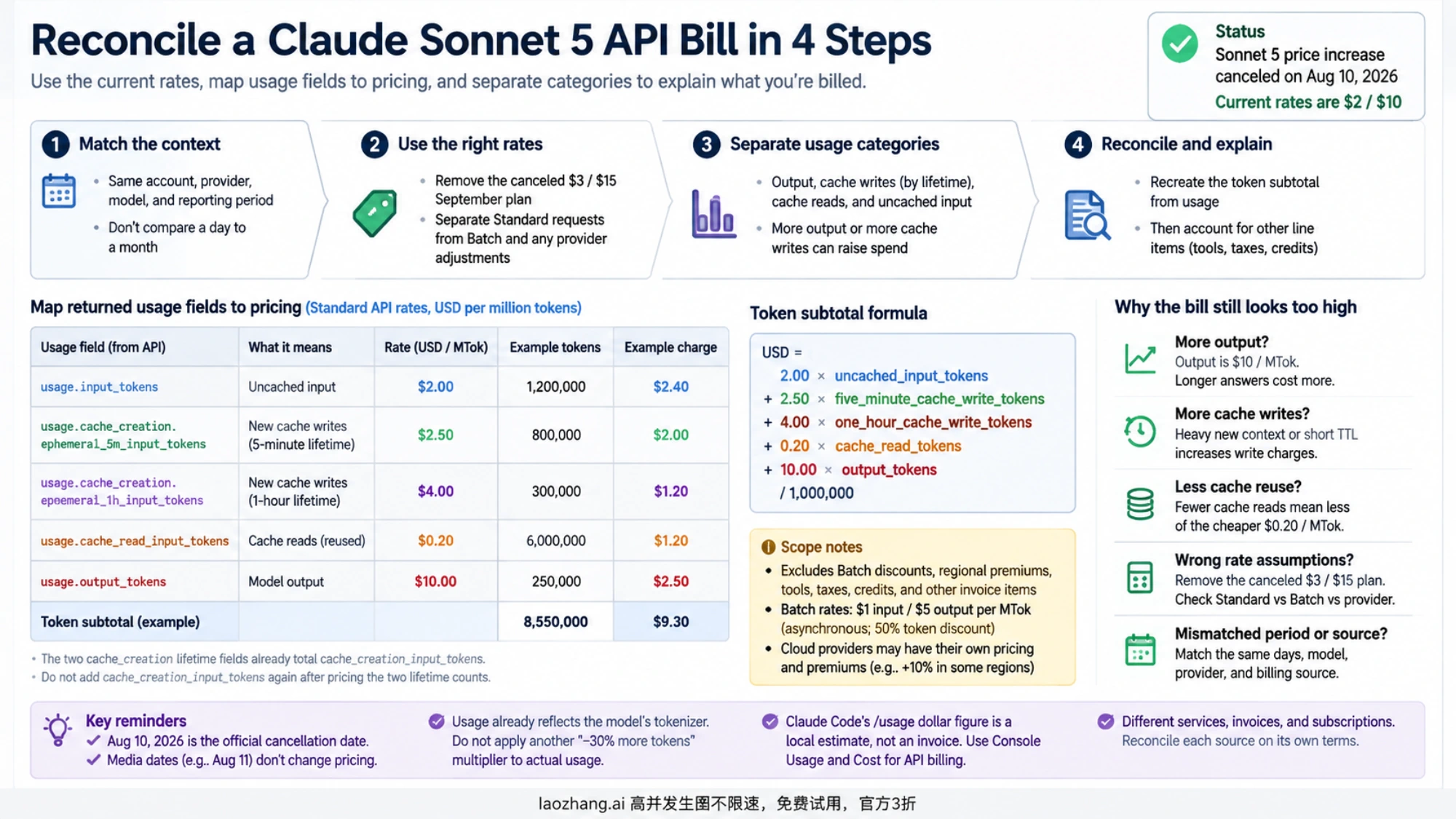
Start with the bill's source and then compare like with like:
- Match the account, provider, model, and reporting period. A cloud invoice, a Claude Platform charge, and a Claude subscription are different records. Avoid comparing one day's request logs with a monthly total.
- Check the rate assumption. Remove the canceled $3/$15 September schedule from Sonnet 5 forecasts. Keep separate calculations for standard requests, Batch, and any provider-specific adjustments.
- Separate the usage categories. Compare output, cache writes by lifetime, cache reads, and uncached input. More output or more cache creation can raise spend even when base rates stay unchanged.
- Reconcile the token subtotal against the billing record. Use Claude Console Usage and Cost reports for first-party API billing, then account for any additional line items. Anthropic's usage and cost reporting supports historical reconciliation. (Usage and Cost documentation)
For Claude Code, the session dollar figure shown by /usage is a local estimate. It is not an invoice, and included Pro or Max usage is separate from API billing. Use Console records to verify API charges. (Claude Code cost documentation) If the uncertainty is which account pays for a session, the next step is to identify Claude Code's API or subscription billing setup.
Sources8
External pages this guide links to, in the order they appear. Last updated Sep 6, 2026.
Sources8
External pages this guide links to, in the order they appear. Last updated Sep 6, 2026.
- 1.Official release notesplatform.claude.com/docs/en/release-notes/overview
- 2.updated Sonnet 5 announcementanthropic.com/news/claude-sonnet-5
- 3.Anthropic pricingplatform.claude.com/docs/en/about-claude/pricing
- 4.Prompt caching usage fieldsplatform.claude.com/docs/en/build-with-claude/prompt-caching
- 5.What's new in Sonnet 5platform.claude.com/docs/en/models/sonnet-5/whats-new-sonnet-5
- 6.Token counting documentationplatform.claude.com/docs/en/build-with-claude/token-counting
- 7.Usage and Cost documentationplatform.claude.com/docs/en/manage-claude/usage-cost-api
- 8.Claude Code cost documentationcode.claude.com/docs/en/costs