For a new coding-agent or knowledge-work workflow, start by testing GPT-6 Sol if you need a cost-conscious default. At standard direct-API rates for requests with no more than 272K input tokens, it lists at half the fresh-input and output price of Claude Opus 5.5. Put Opus 5.5 into the same trial when a wrong answer, repair cycle, or human review is expensive. Its higher per-token price can be worthwhile if it gets sufficiently more work approved—but neither a launch chart nor a public benchmark can tell you whether it will do that on your tasks.
The figures below were checked on September 23, 2026. They describe the vendors' direct APIs, not what a Claude, ChatGPT, or Codex subscription will charge or permit. No head-to-head test on a reader's repository was run for this article.
The choice depends on what fails your review
For routine, well-specified code changes with reliable tests, Sol's lower short-context list rate makes it the practical first candidate. Try Opus alongside it for multi-file changes, ambiguous requirements, or research and writing tasks where a reviewer regularly has to correct plausible but incomplete work. These are trial priorities, not measured claims that one model wins those categories.
Both vendors position their new models for coding and agentic work: the direct API IDs are gpt-6-sol and claude-opus-5-5. Sol offers configurable reasoning effort from none through max, with medium as the default; Opus uses adaptive thinking with medium as its default effort. Fix the effort setting, tool access, prompt, and approval criteria before comparing runs. An apparent quality advantage can disappear when those conditions change. See the OpenAI Sol model page and Anthropic model overview for the current model controls and limits.
If you are choosing a subscription seat rather than an API route, check your own workspace's model picker and usage terms. The OpenAI launch announcement and Anthropic's Opus announcement describe product availability, but API prices do not convert into subscription allowances.
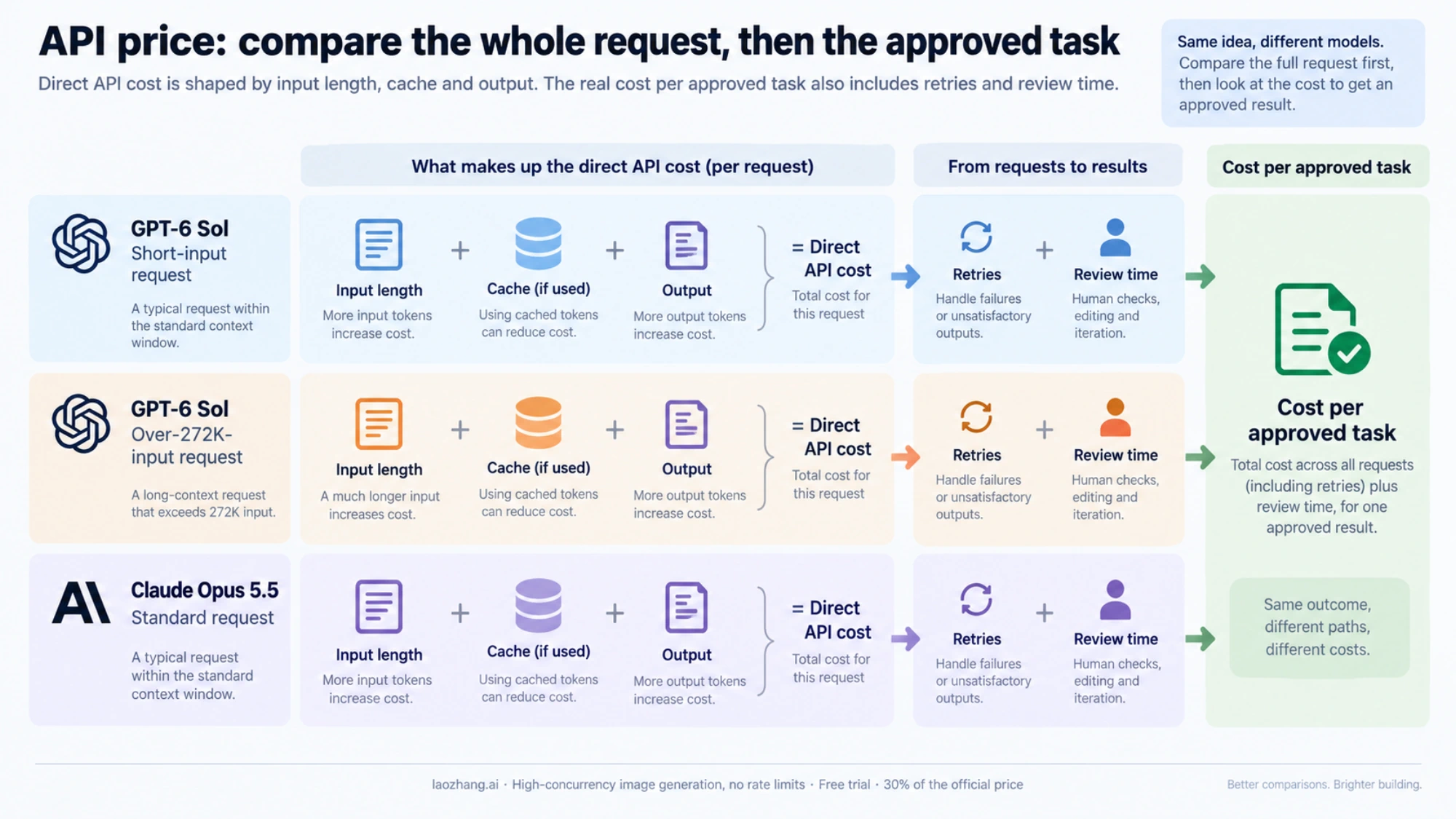
API price: compare the whole request, then the approved task
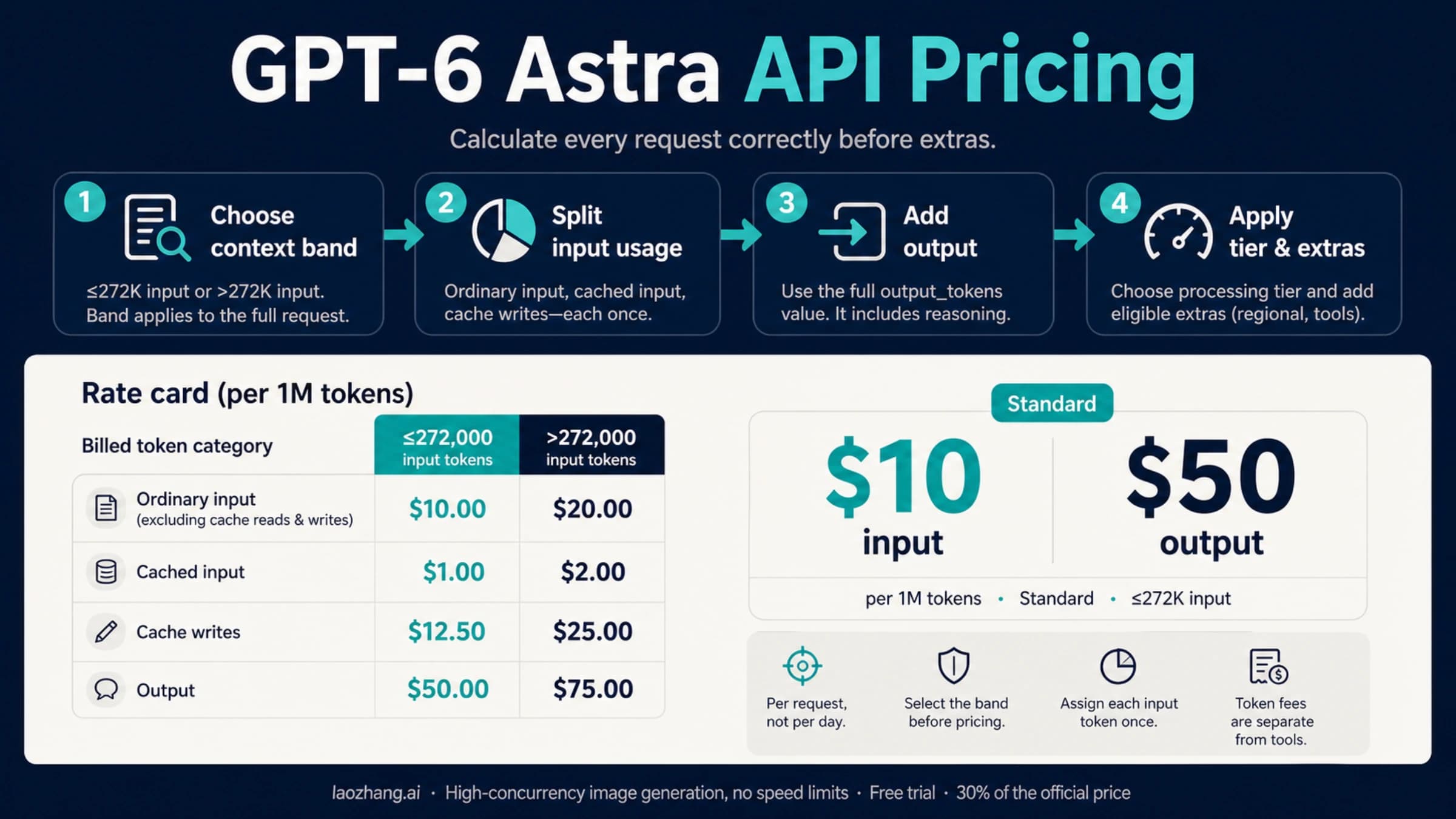
At standard direct-API list rates, the most useful starting comparison is this one. Prices are US dollars per million billed tokens; “fresh input” excludes cache reads. OpenAI's short-context row applies when the request has at most 272K input tokens. Anthropic's row is its standard uncached Claude API rate. Sources: OpenAI pricing, GPT-6 Sol model page, and Anthropic model overview.
| Direct API case | Fresh input | Cache read | Cache write | Output |
|---|---|---|---|---|
| GPT-6 Sol, Standard, input ≤272K | $2 | $0.20 | $2.50 | $10 |
| GPT-6 Sol, Standard, input >272K | $4 | $0.40 | $5 | $15 |
| Claude Opus 5.5, standard Claude API | $4 | $0.20 | $5 for a five-minute write | $20 |
OpenAI applies the long-context rates to the entire request once input exceeds 272K, rather than charging only the excess at the higher rate. Both models advertise roughly a million-token context window and 128K maximum output, but the context limit alone does not tell you the bill. Anthropic's long-input conditions, cache-write duration, tools and service tiers also need checking for a large or cache-heavy job. OpenAI Batch/Flex and Fast rates, regional processing and tool charges can likewise change the comparison. The linked price pages are the place to recheck the route you actually use.
For a deliberately simple example, suppose each model is billed for 100K fresh input tokens and 20K output tokens, with no cache, tools, taxes or tier adjustments. Sol's short-context Standard bill is 0.1 × $2 + 0.02 × $10 = $0.40; Opus's standard bill is 0.1 × $4 + 0.02 × $20 = $0.80. This is arithmetic on equal token counts, not an estimate of equal task outcomes. Different reasoning traces, output lengths, retries, cache behavior and reviewer time can overturn the apparent saving.
The useful denominator is cost per approved task: add model charges across attempts, tool charges and the human work needed to approve or repair the result, then divide by the number of tasks that pass your stated criteria. With identical token quantities, Opus costs twice as much per attempt in that short-context example. It needs either a large enough improvement in approval and repair effort or much lower billed usage to repay that premium. If approval quality is equal and all other charges are absent, its weighted billed token use would have to be less than half Sol's to be cheaper. That threshold is a calculation from list rates, not a measured property of either model.
What the public scores establish—and what they do not
Artificial Analysis evaluated both releases on its Intelligence Index v4.3.2. At max effort, it reports 58 index points and $5.98 per index task for Opus 5.5, using its default fallback, versus 48 points and $1.06 per index task for GPT-6 Sol. At medium effort, its reported pairs are 51/$1.34 and 40/$0.25, respectively. These are the evaluator's measurements on its weighted benchmark set, as reported on the Opus release page and Sol release page. Index points are not percentages of tasks passed, and index-task cost is not the price of completing your pull request.
The result is a useful reason to include Opus in a quality-sensitive trial and Sol in a budget-sensitive one. It does not prove a universal winner for coding agents. The evaluator's Sol analysis reports a Coding Agent Index result against GPT-5.6 Sol, its predecessor; that comparison is not an Opus 5.5 versus GPT-6 Sol coding-agent test. Similarly, Anthropic's launch table has an Opus 5.5 column and a GPT-5.6 Sol column. Reading that older Sol label as “GPT-6 Sol” creates a head-to-head claim the table never made. Vendor evaluations also vary in harness, effort and safeguards.
Run a trial you can actually act on
Take 15–30 recent tasks that represent the work you would delegate: a few straightforward bug fixes, a few changes spanning several files, and any knowledge-work outputs that require factual review. The exact sample size is a practical starting point, not a statistical guarantee. Include the tasks on which your current process fails or burns reviewer time; a set of only easy tasks may make both models look interchangeable.
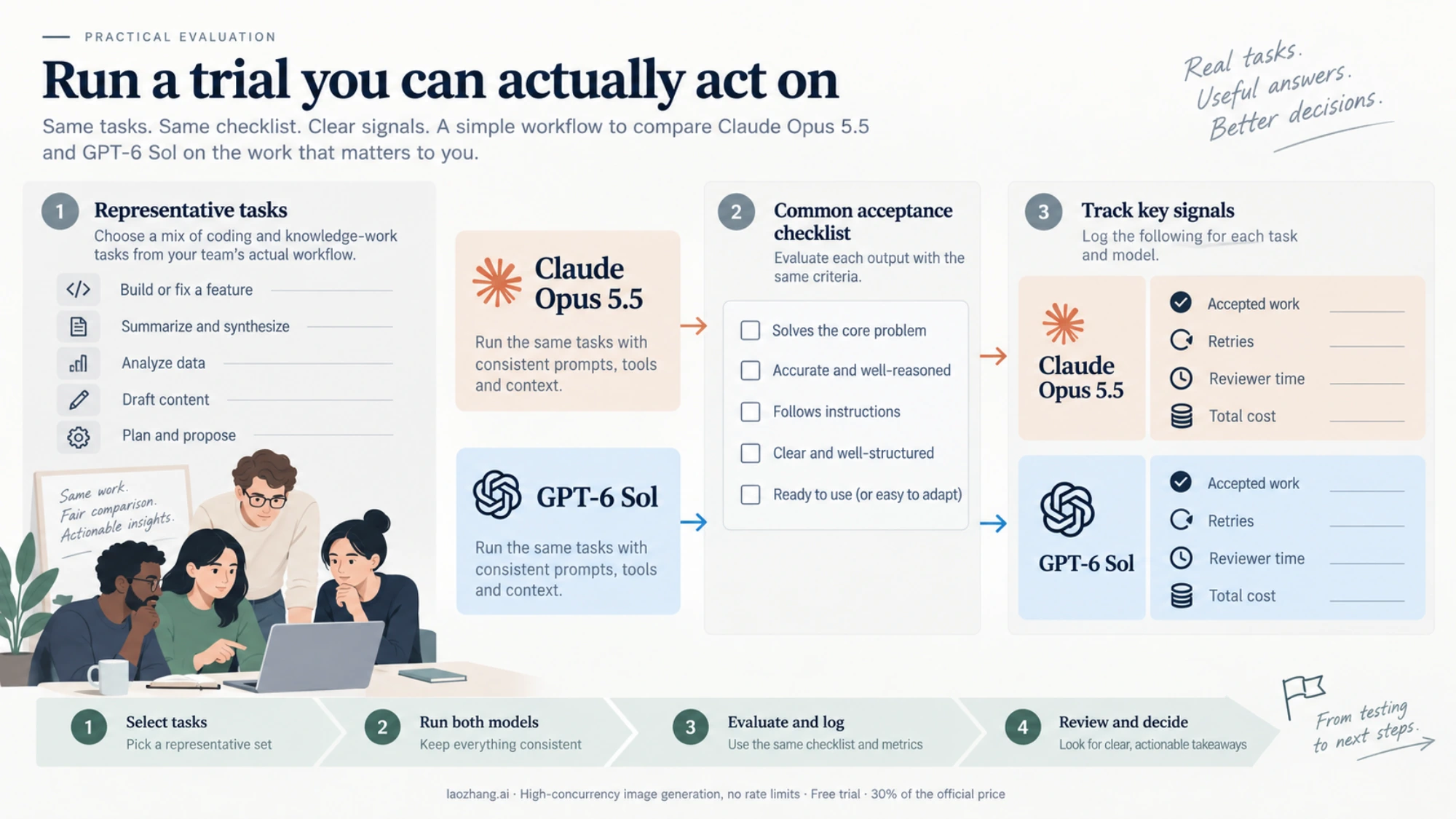
- Write acceptance rules before generating. For code, require the relevant tests, the requested behavior, and no unapproved changes. For a research memo, specify the required claims, source traceability and factual checks. Record the reasons for a rejection, not only a pass/fail mark.
- Hold the workflow steady. Use the same task description, repository snapshot, tool permissions, retry budget and reviewer instructions. Record the exact model ID, effort setting, cache policy, service tier and date. If you cannot match a setting across vendors, keep it visible as a difference.
- Count the full path to approval. Log input and output tokens, cache reads and writes, tool costs, elapsed time, retries, reviewer minutes and whether the final work was accepted. Stop a run that exceeds your normal time or budget limit; do not let an unlimited rescue loop hide poor first attempts.
- Compare by task type. Calculate total spend and reviewer time per accepted task for each bucket, and inspect the kinds of failures. A model that is cheaper overall but repeatedly misses your highest-risk requirement may still be the wrong default for that bucket.
If Sol clears your approval bar at lower total cost, use it as the default and reserve Opus for tasks whose observed failure pattern warrants escalation. If Opus produces enough additional approved work or saves enough repair time to cover its premium, route those tasks to Opus. If the sample is inconclusive, keep both available and add the missing task types before standardizing. That decision uses an acceptance test your team can reproduce; it does not depend on converting an index score into a promised success rate.