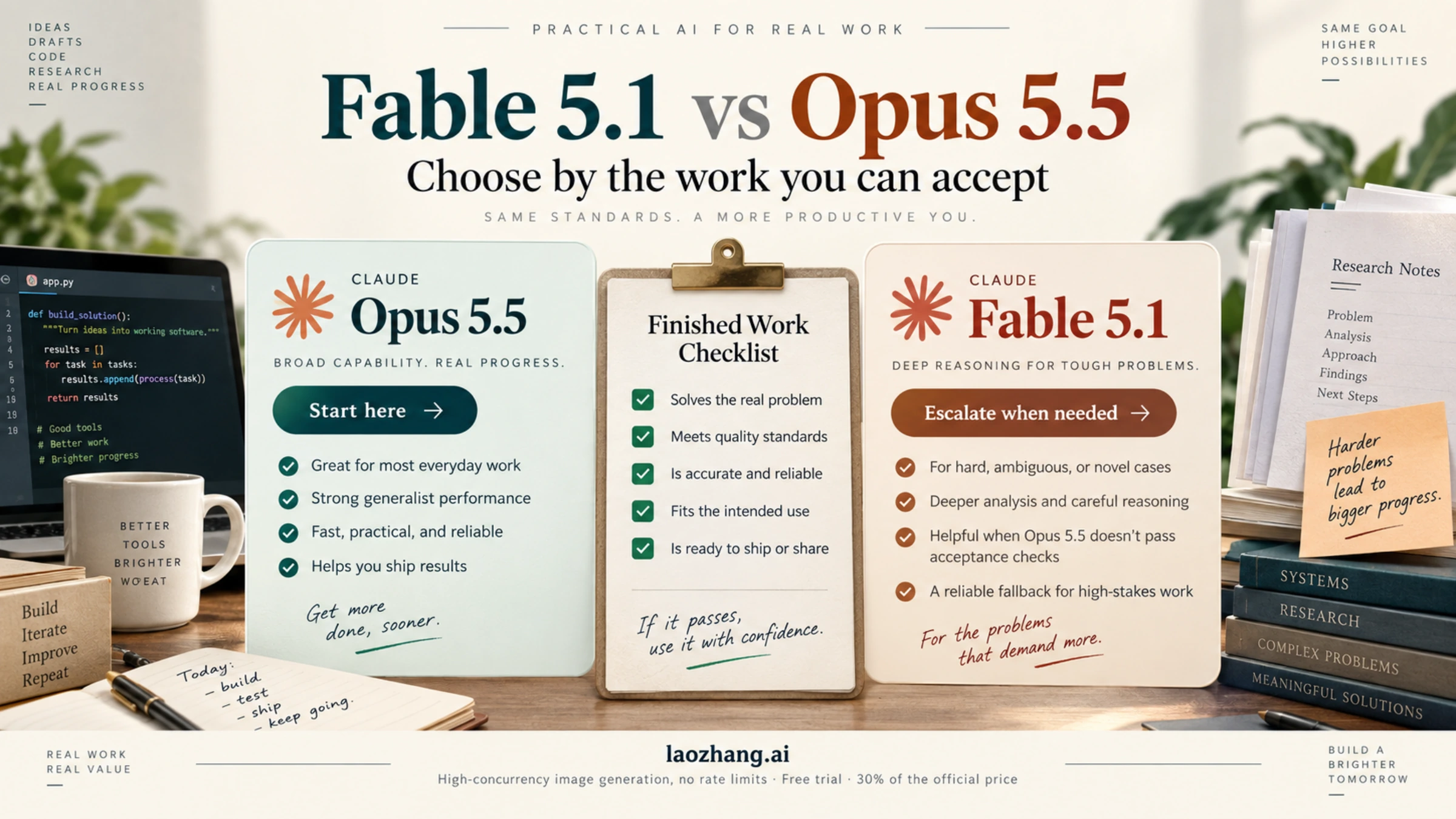
Start with Claude Opus 5.5 for most coding, research, and document work. Keep Fable 5.1 available for demanding tasks where Opus fails your acceptance criteria even at higher effort. That is consistent with Anthropic's current model selection guidance, which recommends trying Opus at xhigh or max before escalating to Fable for the hardest reasoning and long-running agent work.
The choice is less about which model deserves the word “best” and more about which one gets your work accepted with the least total expense. A cheaper answer that needs rewriting is expensive; so is paying a premium for an answer you would have accepted from either model. This comparison uses documentation and vendor-published results checked on September 23, 2026, rather than a hands-on benchmark of our own.
The practical choice, by task
| Your situation | Start here | What would change the choice? |
|---|---|---|
| Everyday feature development, bug fixes, and code review | Opus 5.5 | Fable repeatedly catches consequential failures that remain after tuning Opus |
| A large refactor or migration | Opus 5.5, with explicit regression checks | Opus loses essential constraints over the full job and Fable demonstrably preserves them |
| Research briefs, reports, spreadsheets, or presentations | Opus 5.5, with source and calculation checks | Fable produces materially more reliable work on your actual source set |
| Difficult reasoning with costly mistakes | Evaluate higher-effort Opus against Fable | Select the model that passes the required checks, even if its token bill is higher |
| An existing Fable agent that already works well | Keep it running while testing Opus separately | Move new work when Opus passes the same checks and lowers total cost |
These are starting recommendations, not measured win rates. For a migration, “done” might mean tests pass, public interfaces stay compatible, and a reviewer can explain the changes. For research, it might mean every material number is traceable, contradictory sources are addressed, and missing evidence is stated. Decide what acceptance means before comparing the prose or the bill.
A long job alone is not a reason to buy Fable. Both models are designed for demanding work; a short but subtle problem can be harder than a large, repetitive one.
What actually differs between the models?
The headline capacities are similar. Both accept text and images, return text, and provide a 1-million-token context window with a standard maximum output of 128,000 tokens. Both use always-on adaptive thinking. Opus 5.5 defaults to medium effort; Fable 5.1 defaults to high. Anthropic labels their comparative latency “Moderate” and “Slower,” respectively. See the Opus specifications and Fable specifications.
That means Fable's premium does not buy a larger standard context window. It also means a comparison with untouched defaults evaluates different effort settings. That is useful if you want the better out-of-the-box experience, but it does not isolate model capability at an identical computational budget. Even matching the effort label does not establish equal compute.
Record the exact model and effort in your evaluation. Otherwise, a saved setting can turn an apparent model difference into a configuration difference.
Do the benchmarks make Fable obsolete?
They make Opus a compelling first choice, but do not establish that Fable has no remaining use. In Anthropic's September 22 launch results, Opus leads Fable on these published measures:
| Vendor-published evaluation | Opus 5.5 | Fable 5.1 |
|---|---|---|
| Terminal-Bench 4.0, agentic terminal work | 66.4% | 55.8% |
| GDPval-AA v2.1, professional work | 1846 Elo | 1735 Elo |
Opus uses xhigh for Terminal-Bench and max for the GDPval result. The Terminal-Bench standard error for Opus is ±2.6 points. These release evaluations ran with production safeguards; specified interventions used fallback models. Anthropic also says the real-world difference between Opus and Fable is narrower than the benchmark scores suggest.
The launch includes a direct internal HAProxy C-to-Rust comparison: both rewrites passed nearly all regression tests, while Opus took 9.5 hours versus Fable's 12 and cost 51% less. That is one vendor-run experiment, not a promise about your repository. The separately advertised 40% typical task-cost reduction and greater-than-30% output-speed gain compare Opus 5.5 with Opus 5, not Fable 5.1. Source and evaluation notes.
For coding, treat these results as a reason to test Opus on a real change. For research and document work, use an equally concrete test: give both models the same source files and ask for the same deliverable. A polished report with an unsupported conclusion should fail regardless of its model name.
API pricing: the 60% saving has an important exception
At standard direct Claude API rates, Opus costs 60% less for uncached input, output, and cache writes. Cache reads are only 20% cheaper. All prices below are USD per million tokens, checked September 23, 2026; tool charges, taxes, geography, and provider-specific pricing are excluded. Anthropic pricing.
| Token category | Opus 5.5 | Fable 5.1 |
|---|---|---|
| Uncached input | $4 | $10 |
| Output | $20 | $50 |
| 5-minute cache write | $5 | $12.50 |
| 1-hour cache write | $8 | $20 |
| Cache read | $0.20 | $0.25 |
For an illustrative workload totaling 100,000 uncached input tokens, 900,000 cache-read tokens, and 100,000 output tokens across multiple calls:
- Opus:
0.1 × $4 + 0.9 × $0.20 + 0.1 × $20 = $2.58 - Fable:
0.1 × $10 + 0.9 × $0.25 + 0.1 × $50 = $6.225
That is about 58.6% lower for identical usage, assuming the cache already exists and excluding its creation cost. It is arithmetic, not an observed bill. One million cache-read tokens alone cost $0.20 versus $0.25; that component is not a complete answered task. Rate source.
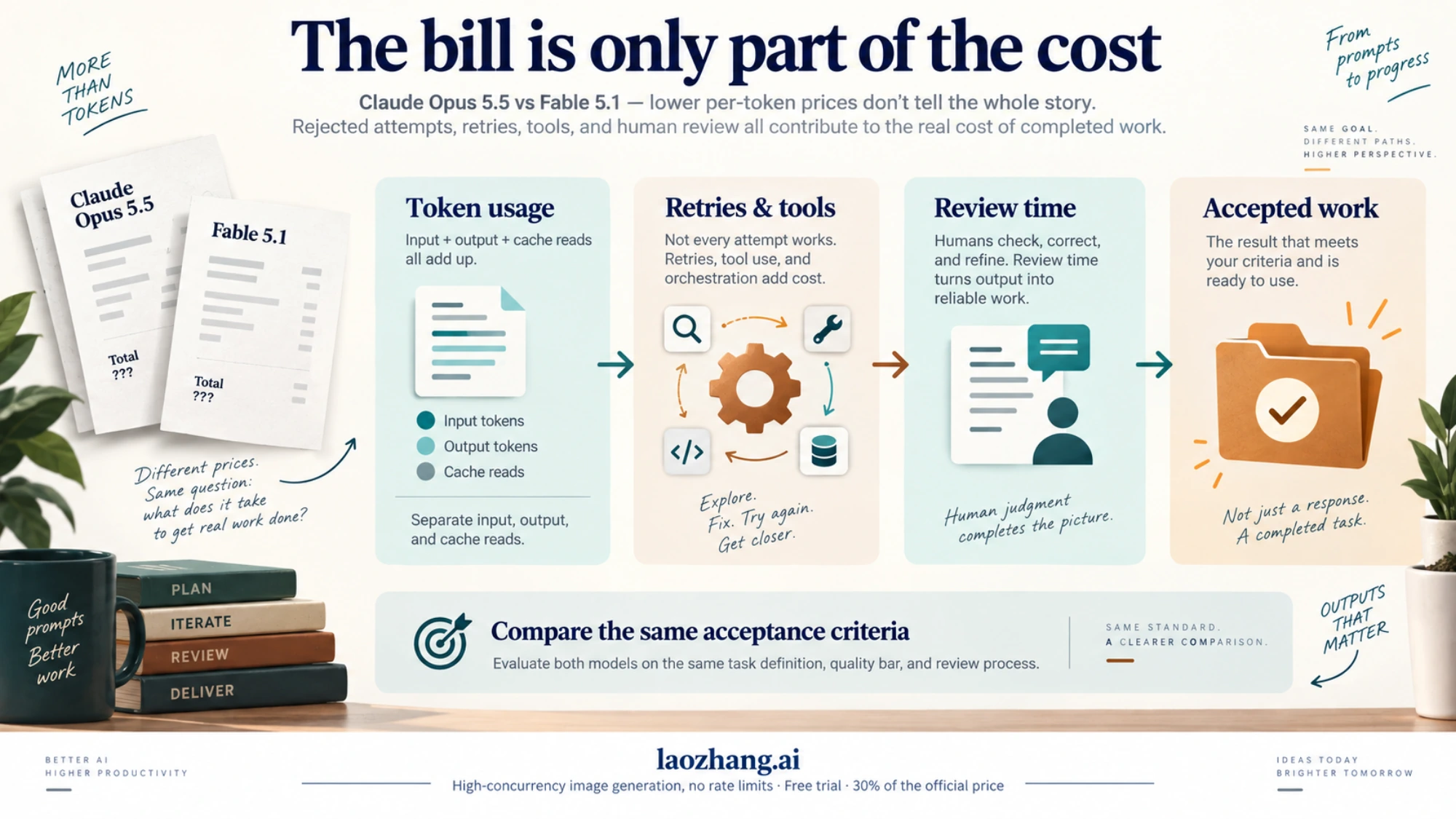
The actionable question is whether the models consume the same quantities to finish. Count rejected attempts, retries, tool costs, and review time. You can track:
cost per accepted task = total spend across all attempts / number of accepted tasks
Keep human review time alongside that number rather than hiding it inside an arbitrary token conversion. A lower API bill is valuable only if it does not push more work onto the person checking the result.
These API prices do not translate into a fixed number of Claude Pro or Max messages. If your decision is about a subscription, use the separate Opus 5.5 pricing and usage-limit guide. For detailed cache and billing scenarios, see Fable 5.1 API pricing.
When is Fable 5.1 worth paying for?
Pay for Fable when it fixes a failure that matters and that improvement is worth more than the extra cost. Anthropic's selection guide retains Fable as an escalation option for demanding reasoning and long-horizon work after higher-effort Opus falls short. It does not say every complex task will benefit.
A useful case is a recurring task with a specific weakness: an agent drops a dependency halfway through a migration, or a report reconciles most figures but misses an exception that changes the conclusion. Run that case against both models with the information and tools they actually need. If Fable consistently clears the missing requirement, route that kind of work to Fable while leaving routine tasks on Opus.
Conversely, do not infer value from a longer answer, more visible deliberation, or a more confident tone. If both outputs pass, compare completion time and cost. If neither passes, investigate the task instructions, missing information, and tool access before buying more reasoning. A model cannot verify a document it cannot retrieve.
For an established Fable workflow, reliability already demonstrated on your own work is evidence worth preserving. Keep it as the reference while testing Opus. You do not need to replace a functioning process on launch day, and you do not need to keep the premium model forever simply because it was previously the strongest option.
Switching models without confusing the comparison
Claude Code: choose the exact version
Opus 5.5 requires Claude Code 2.1.280 or later. With Claude Code installed, run claude update, then start a fresh session using one of these commands:
bashclaude --model claude-opus-5-5
bashclaude --model claude-fable-5-1
These examples use the Anthropic model IDs. Other providers can require their own deployment or model identifiers, and access depends on your account. Exact versions matter because aliases such as opus and fable can resolve differently by provider or gateway. Confirm the selected model in the session before comparing results. Claude Code model configuration.
Custom API agents: switching is not symmetric
On the Claude API, Fable 5.1 can read preserved thinking from Opus 5.5. The reverse does not hold: Opus 5.5 cannot read Fable's thinking blocks, and unsupported blocks are dropped without an error. This does not mean the entire text conversation is deleted, but it does mean the models are not continuing with identical reasoning state. Preserved-thinking documentation.
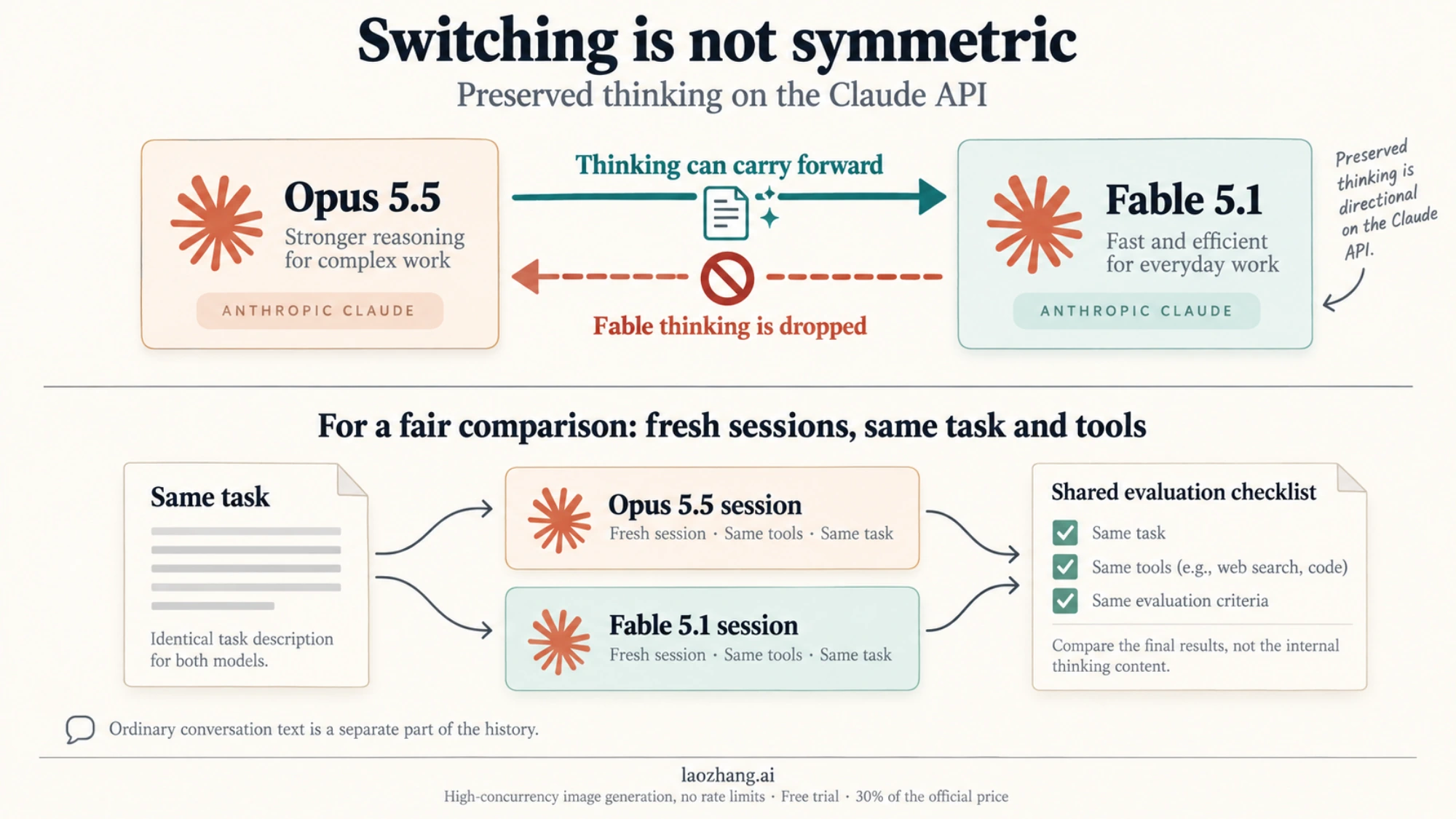
For a fair comparison, start separate sessions with the same task, files, permissions, and tool access. For a production handoff, make the required decisions and current state explicit in ordinary conversation content rather than relying only on private thinking. If your code edits earlier messages, system prompts, or tools while replaying thinking blocks, also check the documented prefix-binding rules. Claude Code and other managed Claude clients handle the request construction; ordinary users do not need to edit signed blocks themselves. Compatibility details.
Before moving a custom integration, also verify its request settings: both models reject forced tool_choice values of any or tool, and Opus 5.5 rejects the older computer_20251124 tool on the Claude API and Google Cloud. Those integration failures should not be mistaken for poor reasoning. Opus integration changes.
Make the decision on finished work
Take a representative job, write down its acceptance criteria, and run Opus 5.5 at its default effort in a clean session. If it fails, identify the failure before increasing effort; correct missing context or broken tools first. Then compare higher-effort Opus with Fable on the unresolved cases.
Record the accepted result, total cost, elapsed time, and corrections you had to make. Choose Opus when it meets the bar at lower total expense. Keep Fable for the task categories where its extra cost buys a demonstrated improvement. That gives you a useful model policy today without pretending a launch leaderboard can decide every future job.