Claude Sonnet 5.5 vs GPT-6.1 Sol: Same Price, 2–8x Cost per Task
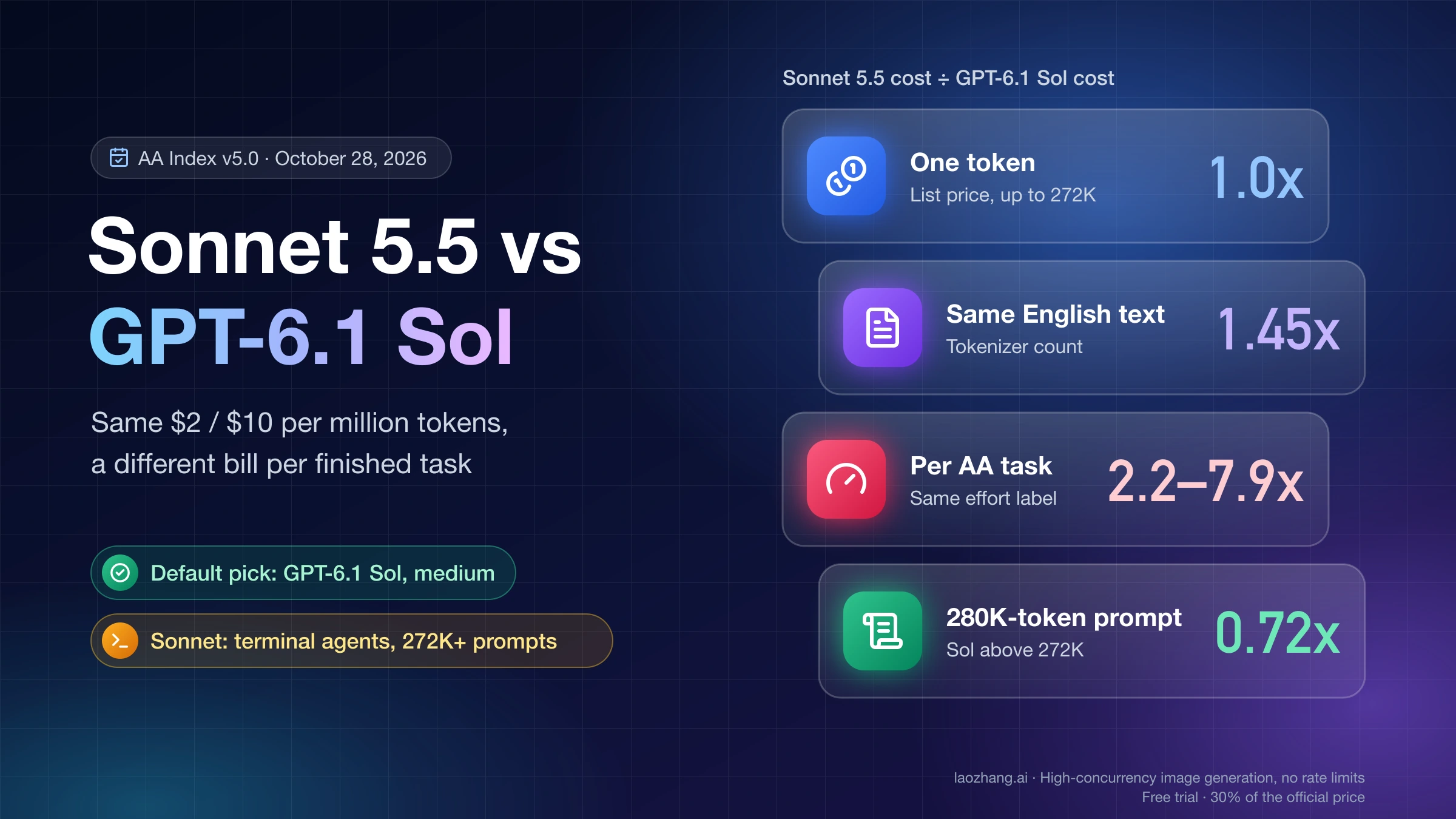
Same $2/$10 list price, but Sonnet 5.5 costs 2.2–7.9x GPT-6.1 Sol per AA task. Start on Sol; use Sonnet for terminal agents and prompts over 272K tokens.
On this page
As of October 28, 2026, start with GPT-6.1 Sol (gpt-6.1-sol) at its default medium effort for most API work, and route specific jobs to Claude Sonnet 5.5 (claude-sonnet-5-5). On Artificial Analysis's Intelligence Index v5.0, Sol scores higher than Sonnet at every effort level until max, where the two nearly meet at 54.5 and 54.2, and Sol costs less per benchmark task in every pairing. Sonnet is worth paying for in three places: terminal-heavy coding agents run at xhigh or max, agents that build file deliverables from many source documents, and prompts longer than 272,000 tokens, where Sol reprices the whole request and Sonnet doesn't.
The two list at the same $2 input and $10 output per million tokens, so the difference shows up in how many tokens each one spends. Sonnet counts more tokens for the same text, and on Artificial Analysis's tasks it costs 2.2 to 7.9 times as much as Sol at the same effort label, and 6.9 to 7.9 times as much when the scores are matched. If you move traffic to Sonnet, mark long repeated prefixes with cache_control, because Sol caches automatically and Sonnet doesn't. If you move to Sol, put function calling on the Responses API.
The measurements below were taken on October 28, 2026, unless another date is given: 12 single-turn tasks with hidden tests sent to both models through the LaoZhang gateway (Sonnet at high, Sol at default medium and at high), a token count of the same text in six languages and Python, and a cost recompute at list prices. Those runs measure cost, tokens and latency at near-equal pass rates, not which model is smarter. Direct vendor endpoints, the Responses API, tool calling, multi-turn agents, Sol at xhigh or max, and Sonnet at any effort other than high fall outside those runs, so every quality figure comes from Artificial Analysis.
Claude Sonnet 5.5 and GPT-6.1 Sol API prices as of October 28, 2026
For requests under 272,000 input tokens, Claude Sonnet 5.5 and GPT-6.1 Sol charge the same on every main column: input, output, cache reads and the short cache write. The table shows standard-tier USD prices per million tokens from Anthropic's Claude API pricing page and OpenAI's API pricing page.
| Per 1M tokens | Claude Sonnet 5.5 | GPT-6.1 Sol, up to 272K input | GPT-6.1 Sol, above 272K input |
|---|---|---|---|
| Input | $2.00 | $2.00 | $4.00 |
| Output | $10.00 | $10.00 | $15.00 |
| Cache read | $0.10 | $0.10 | $0.20 |
| Short cache write | $2.50 (5 minutes) | $2.50 (30 minutes) | $5.00 |
| Long cache write | $4.00 (1 hour) | $5.00 (12 hours, Responses API only) | $10.00 |
| Batch input / output | $1.00 / $5.00 | $1.00 / $5.00, same for Flex | $2.00 / $7.50 |
Two differences change real bills: the long-context step and how each side caches. The GPT-6.1 Sol model page says prompts above 272K input tokens "are priced at 2x input and cache rates and 1.5x output for the full request," while Anthropic includes the full 1M window at standard pricing for Sonnet 5.5. Sonnet's 128,000-token output cap matches Sol's, and Batch can raise Sonnet's to 300,000 with the output-300k-2026-03-24 beta header. Both vendors add a regional premium: 1.1x on all token categories for Anthropic's US-only inference, and 10% for OpenAI's data-residency processing.
Sol's cached input is no longer cheaper. It was half of Sonnet's until Anthropic cut Sonnet 5.5's cache read from $0.20 to $0.10 on October 7, 2026, so any cost figure that still assumes the $0.20 rate overstates Sol's advantage on cached workloads; Claude Sonnet 5.5 Cache Read Price Cut to $0.10: What You Save covers that change.
Same price, so why is Sonnet 5.5 called 30x more expensive?
None of the framings in the table below reaches 30x, and neither does any of Artificial Analysis's per-task ratios, which run from 2.2x to 7.9x. The figure comes from the title of a r/ClaudeAI thread, "Sonnet 5.5 30x more expensive than GPT 6.1 Sol on 3D tasks," and the thread's method isn't publicly readable. The ratio you get depends on what you hold equal, and each common framing gives a different number.
| What you hold equal | Sonnet 5.5 cost ÷ GPT-6.1 Sol cost | Where the number comes from |
|---|---|---|
| One token at list price, up to 272K | 1.0x | Anthropic and OpenAI pricing pages |
| The same English text as input | 1.45x | October 28 token count |
The same 12 single-turn tasks, Sonnet high vs Sol default | 1.52x | October 28 test |
The same 12 tasks, Sonnet high vs Sol high | 1.11x | October 28 test |
| AA benchmark tasks, same effort label | 2.2x to 7.9x | Artificial Analysis Intelligence Index v5.0 |
| AA tasks, each model at its API default | 4.6x | Same, Sonnet high vs Sol medium |
| AA tasks, matched scores near 50 and 54 | 6.9x and 7.9x | Same, Sonnet xhigh vs Sol high, both at max |
| One 280K-token document prompt | 0.72x | October 28 recompute |
Three things widen the gap from one token to one task. Sonnet's tokenizer counts more tokens for the same text. Sonnet also writes more: at max it averages 285,400 output tokens per AA task against Sol's 67,800. The largest effect is context re-reading. Of Sonnet's $10.02 per task at max, $7.17 is input-side cost, mostly cache reads ($4.88) and writes ($2.27), against $0.59 of input-side cost for Sol. Running the whole AA index at max took Sonnet 30.6 billion input tokens and Sol 1.92 billion, so on long agentic tasks Sonnet takes more turns and re-reads its context each time. Single tasks scatter around that average, and one that leans hard on long context re-reads can sit far above it.
Every effort level on AA Index v5.0: Sol leads until max
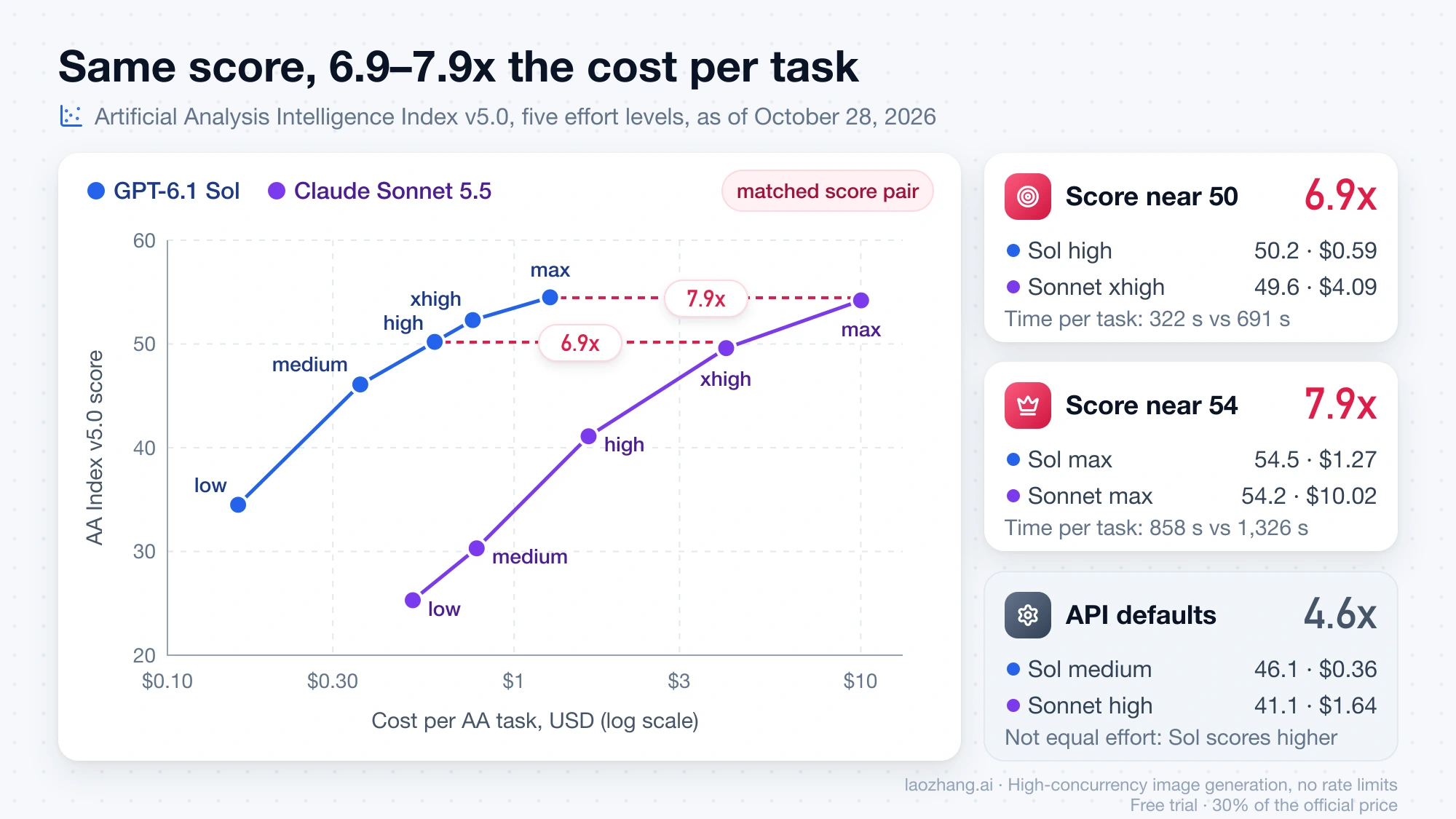
Sol scores higher than Sonnet at each effort label from low to xhigh, and at max the two are within half a point. The table uses unrounded figures from the Artificial Analysis comparison of Claude Sonnet 5.5 and GPT-6.1 Sol as of October 28, 2026; cost per task includes input, cache, reasoning and answer tokens, and time per task is AA's average.
| Effort | GPT-6.1 Sol score | Sol cost per task | Sol time per task | Sonnet 5.5 score | Sonnet cost per task | Sonnet time per task | Sonnet ÷ Sol cost |
|---|---|---|---|---|---|---|---|
low | 34.5 | $0.16 | 104 s | 25.3 | $0.51 | 121 s | 3.2x |
medium | 46.1 | $0.36 | 231 s | 30.3 | $0.78 | 178 s | 2.2x |
high | 50.2 | $0.59 | 322 s | 41.1 | $1.64 | 332 s | 2.8x |
xhigh | 52.3 | $0.76 | 436 s | 49.6 | $4.09 | 691 s | 5.4x |
max | 54.5 | $1.27 | 858 s | 54.2 | $10.02 | 1,326 s | 7.9x |
Comparing by label understates the gap, because Sonnet needs a higher setting to reach the same score. Sonnet xhigh (49.6) is the first level that matches Sol high (50.2), at 6.9 times the cost and more than twice the time per task (691 s against 322 s). At the top, Sonnet max (54.2) against Sol max (54.5) costs 7.9 times as much and takes 1,326 s against 858 s. "Default against default" isn't equal effort either: the API default is high for Sonnet (Claude Code and the Claude apps use medium) and medium for Sol, and at those settings Sol scores 46.1 against 41.1 while Sonnet costs 4.6 times as much per task.
If you've seen Sonnet ranked above Sol, that ranking is from Index v4.3.2, which Artificial Analysis replaced with v5.0 in October 2026. The new version added HLE-Diamond, FrontierCode 2.0 and Terminal-Bench-Science and dropped GDPval-AA, SciCode, AA-LCR and Humanity's Last Exam. Under v4.3.2 Sonnet max led 56 to 52; under v5.0 Sol max leads 54.5 to 54.2, so scores from the two versions can't be mixed.
Where Sonnet 5.5 beats Sol: terminal agents and file-heavy work
Sonnet's leads in AA Index v5.0 sit mostly at its top settings. It wins Terminal-Bench 4.0 at xhigh and max (57.1% and 63.6% against Sol's 54.0% and 56.1%), AutomationBench-AA and FrontierCode 2.0 at max, Terminal-Bench-Science at xhigh only (52.4% to 50.5%), and AA-Briefcase at every level. At low and medium Sol leads every evaluation except AA-Briefcase, and it keeps the lead on the knowledge and science evaluations at high and max. The table shows both models at high and max, as of October 28, 2026.
| Evaluation (what it tests) | Sol high | Sonnet high | Sol max | Sonnet max |
|---|---|---|---|---|
| Terminal-Bench 4.0 (software, sysadmin and data tasks in a terminal) | 51.5% | 43.9% | 56.1% | 63.6% |
| AA-Briefcase (multi-week knowledge-work projects with many source files, Elo) | 1,466 | 1,634 | 1,555 | 1,812 |
| AutomationBench-AA (SaaS workflows through REST API tools) | 64.5% | 59.4% | 64.9% | 71.8% |
| FrontierCode 2.0 (changes to real open-source repositories) | 36.7% | 25.7% | 40.6% | 41.7% |
| AA-Omniscience (factual reliability, penalizes wrong guesses) | 41.0 | 18.7 | 42.0 | 30.5 |
| CritPt v2 Hard (research-level physics) | 67.5% | 47.5% | 68.5% | 56.0% |
| GDP.pdf (answers grounded in long professional PDFs) | 32.0% | 25.2% | 31.0% | 25.8% |
For routing, Sonnet's strengths are long-running agents that act, either in a terminal or across SaaS tools, and agents that produce reports or analysis from a pile of input files. Its weakest area is knowledge reliability. On AA-Omniscience, which subtracts points for confident wrong answers, Sonnet scores 18.6 to 30.5 against Sol's 38.0 to 42.4. The two evaluations not in the table point the same way: on HLE-Diamond Sol scores 51.9% and 58.8% at high and max against Sonnet's 33.8% and 53.3%, and on Terminal-Bench-Science 46.2% and 58.1% against 34.3% and 53.3%, so knowledge-heavy Q&A, science and physics work belong on Sol. Repository code changes are close only at the top: on FrontierCode 2.0 Sol leads by 11 points at high, and Sonnet edges ahead by about one point at max at almost eight times the cost per task. A separate Artificial Analysis post from early October 2026 on its Coding Agent Index put Sonnet 5.5 max in Claude Code on top at 68 with the highest cost per task, $14.19, and GPT-6.1 Sol xhigh in Codex at 63 for $1.04.
October 28 test: Sol passed 12 of 12 at two-thirds of Sonnet's cost
On October 28, 2026, the same 12 prompts went to both models through the LaoZhang gateway. Sonnet ran through the Anthropic Messages format (/v1/messages) with thinking: {"type": "adaptive"} and output_config.effort: "high"; Sol ran through Chat Completions (/v1/chat/completions) once with no effort setting (its medium default) and once with reasoning_effort: "high". The tasks were small and well specified, with tests or exact answers written in advance: an expression evaluator, a CSV line parser, SemVer comparison, npm-style version ranges (36 tests), interval merging, a duration parser, a word counter, a pricing word problem, a digit-sum count, two questions about made-up Python standard-library functions, notes hidden inside a 6,723-word article, and a five-bullet summary of that article. Each ran once, with no system prompt and no tools, and cost is computed from the returned token usage at list price.
| Configuration | Passed | Cost at list price | Output tokens (of which reasoning) | Total call time | Median call |
|---|---|---|---|---|---|
Claude Sonnet 5.5, adaptive thinking, high | 11/12 | $0.1761 | 10,945 (not reported separately) | 101 s | 7.6 s |
GPT-6.1 Sol, default medium | 12/12 | $0.1157 | 6,162 (2,423) | 187 s | 14.0 s |
GPT-6.1 Sol, high | 12/12 | $0.1581 | 10,398 (6,311) | 442 s | 21.2 s |
Sonnet cost 1.52 times Sol's default and 1.11 times Sol high on the same work, and 1.83 times Sol's default once the two long-document tasks are left out. Its one miss was a format slip: the first bullet of the summary had 26 words against a 25-word limit, on a call where adaptive thinking produced no thinking block. All three configurations answered "does not exist" for both invented functions and passed all 36 version-range tests. Sonnet returned thinking blocks on 8 of 12 tasks; the thinking text is omitted by default but billed as output, so its reasoning length can't be split out.
Sol wrote its cache without being asked. Both long-document prompts, about 10,100 and 10,200 tokens, came back with cache_write_tokens of 10,103 and 10,195 even though the requests carried no cache settings, and at list price those tokens cost the $2.50 write rate instead of $2.00. The same document prompt sent again about 5.5 minutes later, with reasoning_effort: "high", wrote the cache a second time and read zero cached tokens. Why it missed (the different effort setting, gateway routing or something upstream) isn't visible from the response. Sonnet cached nothing, as expected without cache_control.
The token counts explain part of the cost gap. With minimal output and the instruction-only overhead subtracted, the first 6,000 characters of an English article came to 2,410 tokens on Sonnet and 1,664 on Sol (1.45x), and 6,000 characters of Python to 2,352 and 1,609 (1.46x). The full 6,723-word article was 15,335 tokens on Sonnet against 10,106 on Sol (1.52x). Across Chinese, Russian, Japanese, Korean and Spanish samples the ratio ran from 1.29x (Japanese) to 1.65x (Korean), and GPT-6 Luna returned exactly Sol's count on every sample. OpenAI doesn't name Sol's tokenizer, and the tiktoken library has no GPT-6 mapping yet, so use OpenAI's input-token-count endpoint for exact counts.
Set Sonnet's thinking and effort explicitly whenever you call it through a proxy. In an October 26 run through the same gateway, Sonnet requests that left out thinking and effort returned no thinking blocks on 9 of 9 tasks, although Anthropic documents adaptive thinking at high as the default when the field is omitted; with both set, thinking came back on 7 of 9 that day. The direct Anthropic API wasn't part of that run, so treat it as a reason to send the fields, not as a property of any one gateway.
Which is faster: Sonnet streams faster, Sol finishes agent tasks sooner
Sonnet generates text faster, but on long agentic tasks it usually finishes later because it writes and re-reads so much more. Artificial Analysis measures Sonnet's output speed at 109 to 140 tokens per second across effort levels against 59 to 81 for Sol, and Sonnet reaches its first answer token sooner at every level below max (11.1 s against 40.8 s at high). Per complete AA task the order flips: Sol high takes 322 s for a score of 50.2, while Sonnet needs xhigh and 691 s to get there.
For short single-turn calls, Sonnet's speed wins. In the October 28 test its median call took 7.6 s against 14.0 s for Sol's default and 21.2 s for Sol high, and it beat both Sol configurations on 11 of the 12 tasks. One Sol high call took 150.6 s to return 514 output tokens, an outlier that shows how much latency depends on the route and its load. OpenRouter reports its own median of 106 tokens per second for Sonnet against 29 for Sol as of October 13, 2026, measured on its own traffic and not comparable with AA's figures. If Sol is too slow for an interactive feature, GPT-6.1 Sol Slow in Codex or API? Causes and Tested Speed Fixes covers effort and tier changes before you switch models.
What your workload will cost: Sonnet wins only past 272K tokens
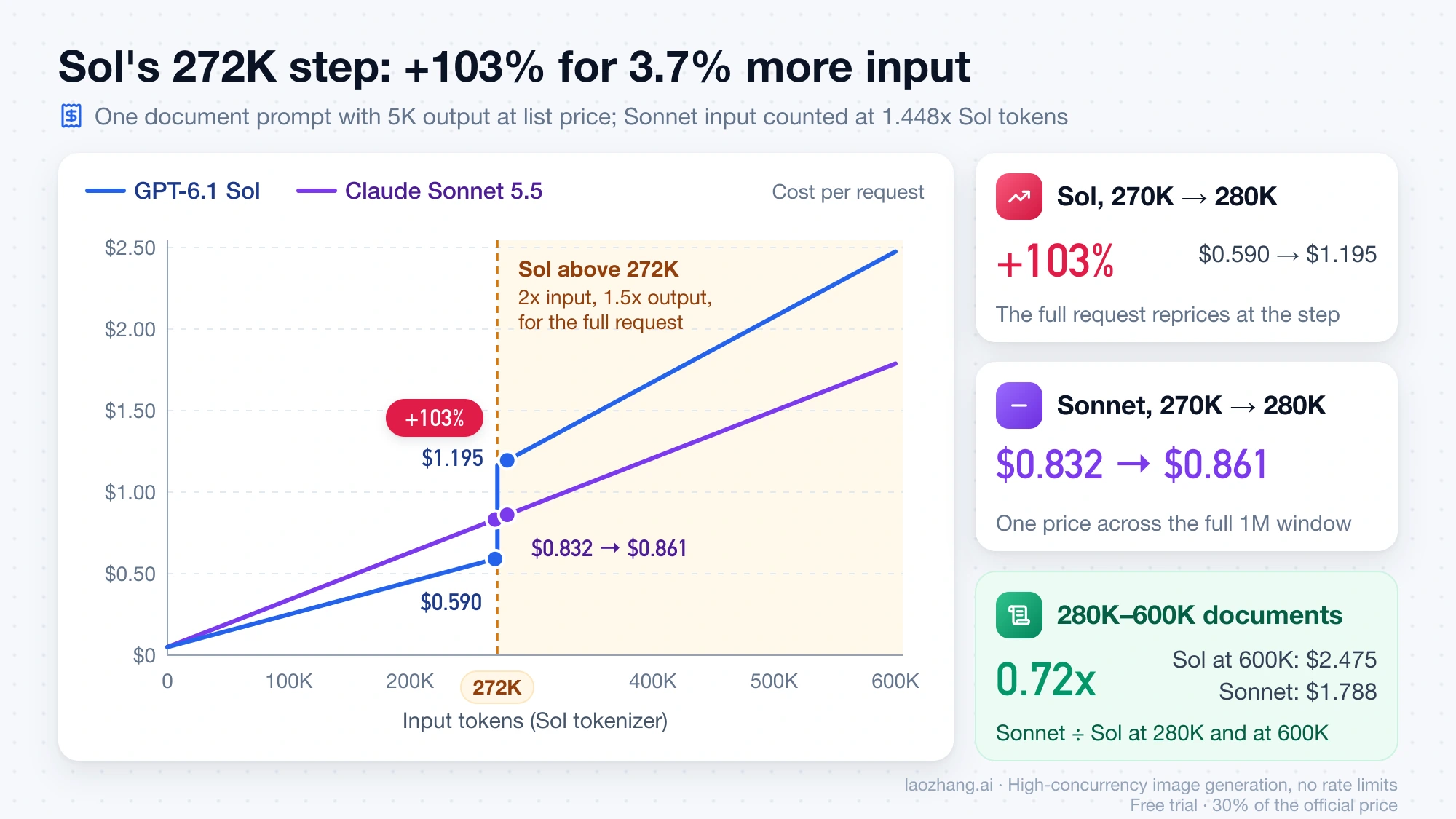
At list price, Sonnet costs about 1.2 to 1.4 times Sol for ordinary English workloads with the same output, drops to 0.72 times Sol once a prompt crosses 272,000 tokens, and costs 10.6 times as much in a cached agent loop where cache_control was forgotten. The table counts tokens in Sol's tokenizer and converts Sonnet's input with the measured English ratio of 1.448 (2,410 ÷ 1,664 tokens, the 1.45x above before rounding); output tokens are kept equal so only the price rules differ, though real output volume differs by model and effort.
| Workload (Sol tokens) | GPT-6.1 Sol | Claude Sonnet 5.5 | Sonnet ÷ Sol |
|---|---|---|---|
| Chat turn: 2K in, 500 out | $0.0090 | $0.0108 | 1.20x |
| Document: 250K in, 5K out | $0.550 | $0.774 | 1.41x |
| Document: 270K in, 5K out | $0.590 | $0.832 | 1.41x |
| Document: 280K in, 5K out (Sol above 272K) | $1.195 | $0.861 | 0.72x |
| Document: 600K in, 5K out | $2.475 | $1.788 | 0.72x |
| Agent loop: 50 turns, 100K cached prefix, 2K new + 1K out per turn | $1.44 | $1.86 | 1.29x |
Same loop, Sonnet without cache_control | $1.44 | $15.27 | 10.6x |
| Batch: 10,000 requests of 3K in + 1K out, 50% batch discount on both | $80.00 | $93.44 | 1.17x |
The formula behind each row is input tokens × input rate + cache reads × read rate + cache writes × write rate + output tokens × output rate, with Sonnet's input-side tokens multiplied by 1.448. The 280K row, for example, is 280,000 × $4 + 5,000 × $15 = $1.195 for Sol against 280,000 × 1.448 × $2 + 5,000 × $10 = $0.861 for Sonnet. In the loop rows, the first turn writes the 100K prefix and the other 49 read it, which assumes turns arrive within Sonnet's 5-minute and Sol's 30-minute cache lifetimes; the October 28 cache miss on Sol shows that assumption can fail. With a different language the ratio shifts with the tokenizer: Korean text (1.65x) puts the chat turn at 1.29x and the 280K document at 0.82x, and Japanese (1.29x) puts them at 1.13x and 0.65x.
Sol's 272K step is a cliff, not a surcharge on the extra tokens. Going from 270,000 to 280,000 input tokens raises the request from $0.590 to $1.195, a 103% increase for 3.7% more input, so the claim that adding 10K tokens to a 270K prompt doubles a Sol bill holds. Above the line, Sonnet's input is cheaper whenever its tokenizer ratio stays below 2, which every measured sample did, and its output is $10 against $15. If your documents sit just above 272K Sol tokens, trimming them below the line keeps Sol cheaper; if they run to several hundred thousand tokens, Sonnet is the cheaper reader, though Sol still leads GDP.pdf, AA's long-PDF evaluation.
Sonnet 5.5 or GPT-6.1 Sol: which to pick for each workload
Sol is the default pick, and Sonnet earns a route where its benchmark lead or its flat long-context price changes the outcome. The starting efforts below come from the AA scores and costs above and the October 28 measurements; confirm each on your own tasks before moving traffic.
| Workload | Start with | Why |
|---|---|---|
| Short chat, extraction, classification, single-turn code | Sol at medium | Cheaper in the October 28 test, and Sol medium outscores Sonnet high on AA |
| Knowledge-heavy Q&A, science, physics, research questions | Sol at high, or max for the hardest | Sol leads AA-Omniscience, HLE-Diamond, CritPt and Terminal-Bench-Science at high and max |
| Terminal and agentic coding where top score matters | Sonnet at xhigh or max, with Sol xhigh as the cheaper candidate | Sonnet leads Terminal-Bench 4.0 at those levels, at 5.4x and 7.9x Sol's cost per AA task |
| Agents that build reports or analysis from many files | Sonnet at high or above | Sonnet leads AA-Briefcase at every effort level |
| Documents above 272K Sol tokens | Sonnet at high, unless you can trim below 272K | Sonnet's flat rate beats Sol's full-request step at that size; Sol stays ahead on long-PDF answer quality |
| Long agent loops with a cached prefix | Either; on Sonnet only with cache_control | Same $0.10 cache read; without cache_control Sonnet re-reads the whole prefix at the full input rate |
| Latency-sensitive interactive turns | Sonnet at high, if its quality passes | Faster median call in the October 28 test (7.6 s against 14.0 s) and higher streaming speed |
| Overnight batch jobs | Sol on Batch or Flex | Same 50% discount, fewer tokens per text; Sonnet's batch came to 1.17x |
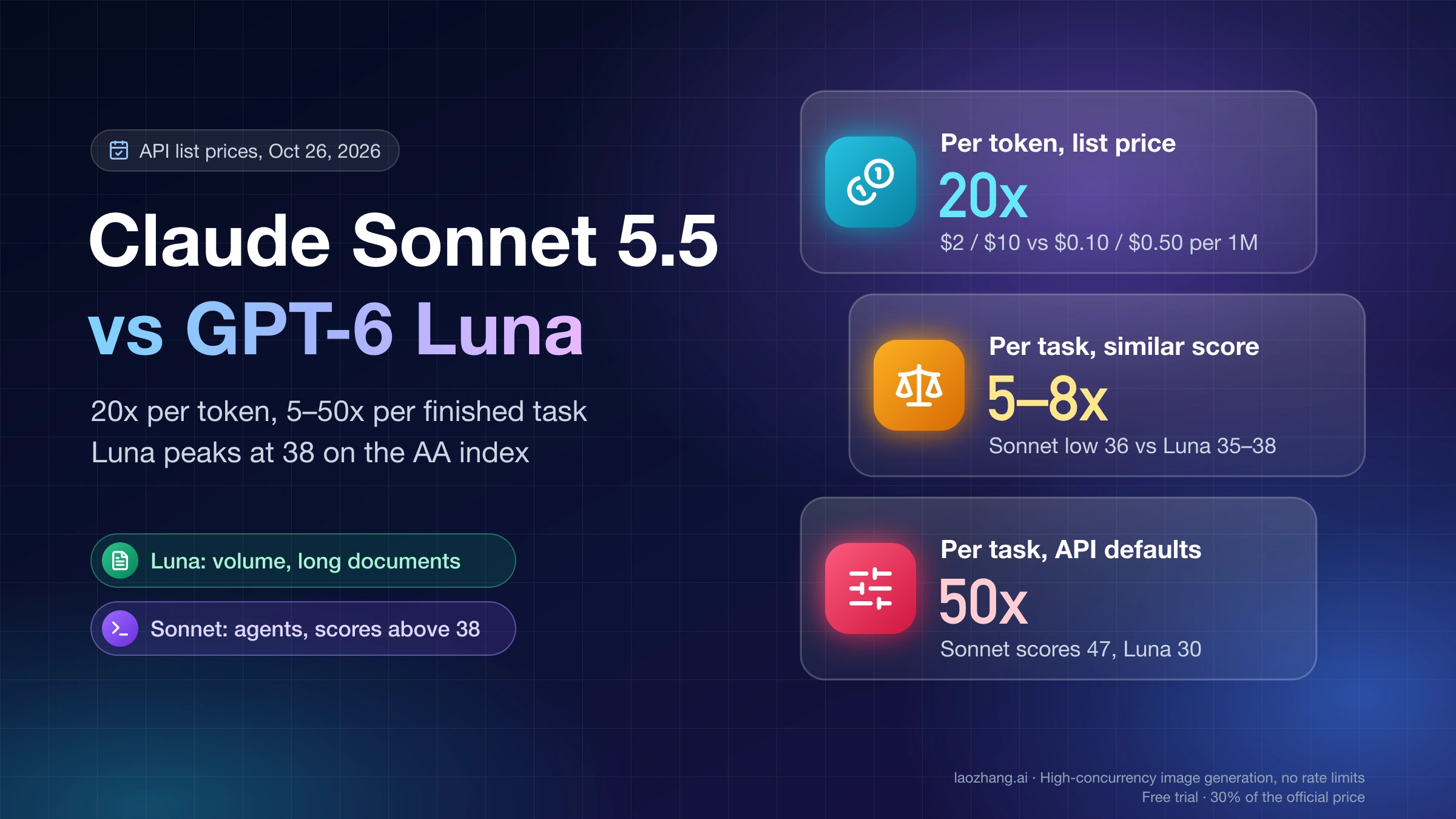
If you are deciding between tiers rather than vendors, GPT-6.1 Terra vs GPT-6.1 Sol: Half the Price, Not Always Cheaper covers OpenAI's cheaper option, and Claude Sonnet 5.5 vs GPT-6 Luna: 20x per Token, 5–50x per Task compares Sonnet with OpenAI's lowest-cost tier.
What breaks when you switch between Sonnet 5.5 and GPT-6.1 Sol
The parameters that fail on a switch are reasoning controls, tool calling and caching, not prompts. The table lists the differences from Anthropic's models overview, the GPT-6.1 Sol model page and OpenAI's prompt caching guide, as of October 28, 2026.
| What you send or rely on | Claude Sonnet 5.5 | GPT-6.1 Sol |
|---|---|---|
| Model ID | claude-sonnet-5-5 | gpt-6.1-sol |
| Effort setting and default | output_config.effort, low to max; API default high | reasoning.effort, low to max; default medium. Chat Completions' reasoning_effort accepted low to xhigh but not max in an October 25, 2026 test through the LaoZhang gateway |
| Turning reasoning down | thinking: {"type": "disabled"} is rejected; the lowest setting is between_tools | none and minimal aren't supported; the lowest is low |
| Tool calling | Messages API; forced tool_choice (any or a named tool) returns a 400 | Requires the Responses API; Chat Completions doesn't support function calling with Sol |
| Prompt caching | Opt-in with cache_control, 5-minute or 1-hour lifetime, 512-token minimum | On by default, 30-minute writes billed at 1.25x input; 12-hour option in the Responses API; 1,024-token minimum; explicit mode to opt out |
| Size limits | 1M context at one price, 128K output | 922,000 input, 128,000 output, price step above 272K |
| Speed tiers | No fast mode for Sonnet | Fast (2x) and Ultrafast (6x) |
Moving from Sonnet to Sol, the usual break is agent code built on Chat Completions: function calling has to move to the Responses API. Sol's Chat Completions route also rejected temperature: 0.2 in an October 5, 2026 test through the LaoZhang gateway with "Only the default (1) value is supported," so remove custom temperatures. If you relied on Sonnet's 1-hour cache, Sol's 12-hour write costs $5 per million tokens against Sonnet's $4 and only exists in the Responses API.
Moving from Sol to Sonnet, add cache_control to every long, stable prefix before anything else, because nothing is cached otherwise. Replace a "reasoning off" switch with between_tools, use tool_choice: {"type": "auto"} where you used to force a call, and send thinking and output_config.effort on every request when a proxy sits in between. Sonnet has no fast tier, so a feature built on Sol's Fast mode has to rely on Sonnet's normal streaming speed. LaoZhang lists both models at the vendors' list prices, including Sol's 272K step, but serves Sol only through Chat Completions, so Sol tool calling isn't available on that route. For the change from earlier models on each side, see GPT-6.1 Sol: Pricing, Access, and What Breaks When You Switch and Claude Sonnet 5.5 vs Sonnet 5: Cost by Effort and What Breaks.
How to test Sonnet 5.5 against GPT-6.1 Sol before moving traffic
The number to compare is cost per accepted task: total spend divided by the tasks that pass your checks. A trial of a few dozen real tasks is enough to see which side of the ratios above your workload falls on.
- Collect 20 to 50 real tasks from the traffic you plan to move, each with an automatic check or a written acceptance rule, and include your longest prompts.
- Count each prompt's tokens with OpenAI's input-token-count endpoint and Anthropic's
count_tokensendpoint, and flag any prompt above 272,000 Sol tokens, since those price differently. - Run Sonnet at
highand Sol atmediumandhigh, settingthinking, effort and caching explicitly on every request rather than relying on defaults. - Log input, cache-read, cache-write, output and reasoning tokens from each response, and price them at list rates, including Sol's automatic cache writes.
- Rerun only the failed tasks one effort level higher on each model, so you see what the last few points of quality cost.
- Route each task type to the model with the lower cost per accepted task, and re-check the routing when either vendor changes prices or AA updates its index.
Claude Sonnet 5.5 vs GPT-6.1 Sol: other questions
Claude Pro or ChatGPT Plus: which $20 plan gives more usage?
That is a subscription question, and API prices don't answer it, because Claude and ChatGPT plans meter usage with their own limits. Claude Code vs Codex Cost: Plans, Limits, and the Real API Bill compares the plans and their coding-agent limits.
Should I compare Opus 5.5 with GPT-6.1 Sol instead?
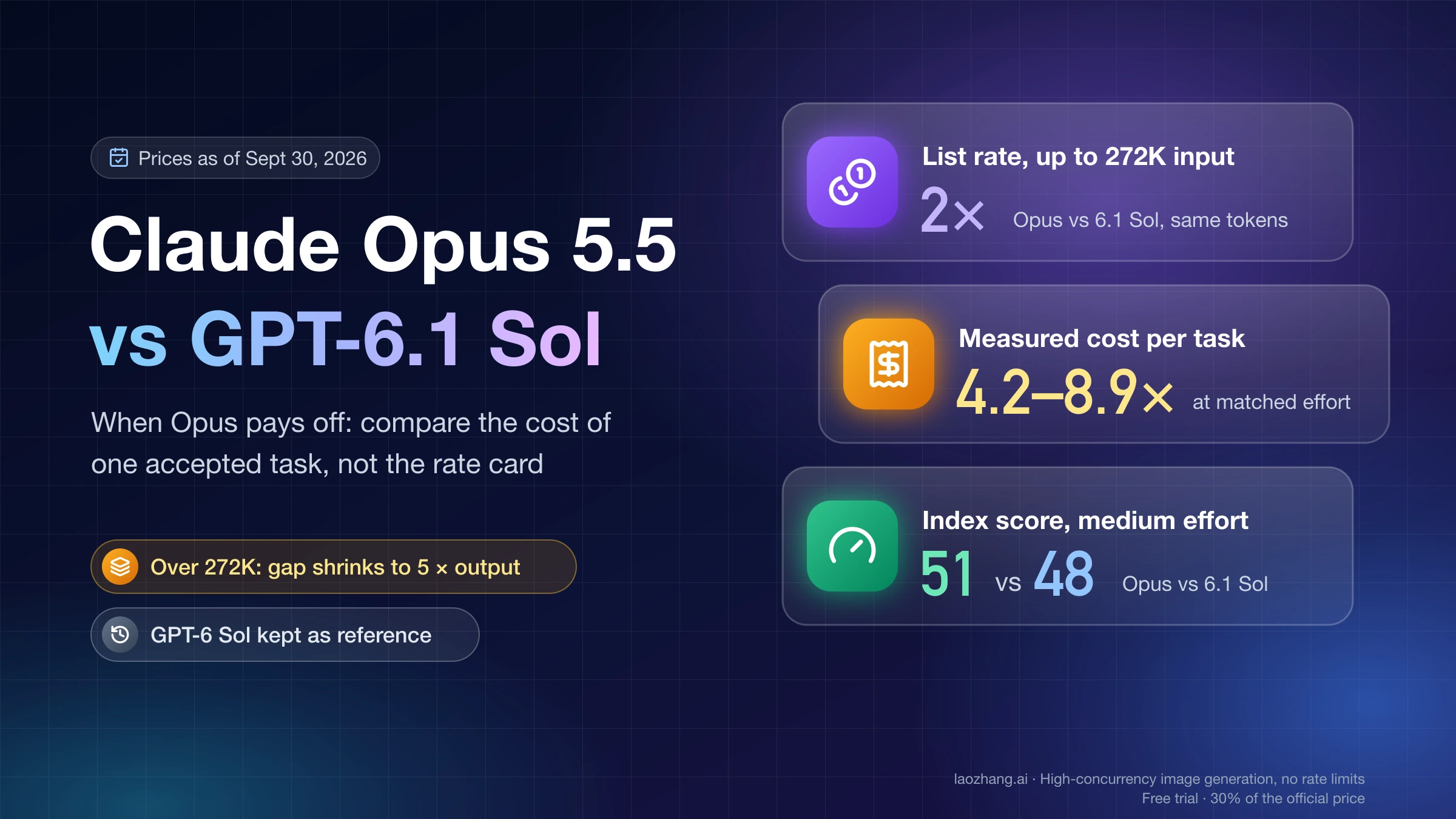
Compare Opus when Sonnet max still falls short on your hardest tasks; Anthropic's models overview suggests starting with Claude Opus 5.5 if you're unsure which Claude model to use. Claude Opus 5.5 vs GPT-6.1 Sol and GPT-6 Sol: When Opus Pays Off covers that step up.
Is there a GPT-6.1 Sol Pro?
No. As of October 28, 2026, OpenAI's pricing page lists gpt-6.1-sol with no Pro variant, so "GPT 6.1 Sol Pro" names no separate model; the Sol you can call is gpt-6.1-sol.
Sources6
External pages this guide links to, in the order they appear. Last updated Oct 28, 2026.
Sources6
External pages this guide links to, in the order they appear. Last updated Oct 28, 2026.
- 1.Anthropic's Claude API pricing pageplatform.claude.com/docs/en/about-claude/pricing
- 2.OpenAI's API pricing pagedevelopers.openai.com/api/docs/pricing
- 3.GPT-6.1 Sol model pagedevelopers.openai.com/api/docs/models/gpt-6.1-sol
- 4.Artificial Analysis comparison of Claude Sonnet 5.5 and GPT-6.1 Solartificialanalysis.ai/models/releases/comparisons/claude-sonnet-5-5-vs-gpt-6-1-sol
- 5.Anthropic's models overviewplatform.claude.com/docs/en/about-claude/models/overview
- 6.OpenAI's prompt caching guidedevelopers.openai.com/api/docs/guides/prompt-caching