ChatGPT Student Discount 2026: Complete Guide to Free & Discounted Access

A
22 min readChatGPT Guide

OpenAI does not offer an official ChatGPT student discount as of March 2026. However, students have at least 5 legitimate routes to access ChatGPT features at reduced cost or completely free—including ChatGPT Edu through universities, the budget-friendly Go plan at $8/month, the developer API route for as little as $3-5/month, and powerful free alternatives like Google Gemini Advanced (free for 1 year with student verification). This guide covers every option with honest pros, cons, and step-by-step instructions.

ChatGPT Student Discount 2026: Complete Guide to Free & Discounted Access

No, OpenAI does not offer an official ChatGPT student discount as of March 2026. The pricing remains identical for all users: Free ($0), Go ($8/month), Plus ($20/month), and Pro ($200/month). However, students are far from stuck paying full price. Between university institutional access, regional promotions, the developer API route, and genuinely powerful free alternatives, there are at least five legitimate ways to access ChatGPT-level AI capabilities without breaking a student budget. This guide covers every option honestly—no grey-market account sharing, no affiliate-driven recommendations, just practical routes that actually work.

TL;DR

OpenAI has no student discount for ChatGPT, but students have multiple legitimate alternatives. ChatGPT Edu gives free access through participating universities (460,000+ students at Cal State alone). The Go plan costs just $8/month—60% less than Plus. The developer API route can cost as little as $3-5/month for typical student usage. And free alternatives like Google Gemini Advanced (free for 1 year with SheerID student verification) and Microsoft Copilot (free GPT-4o access) collectively cover 95%+ of what ChatGPT Plus offers. The smartest student strategy: check your university for Edu access first, then layer free alternatives before considering any paid plan.

Does ChatGPT Offer a Student Discount? The Official Answer

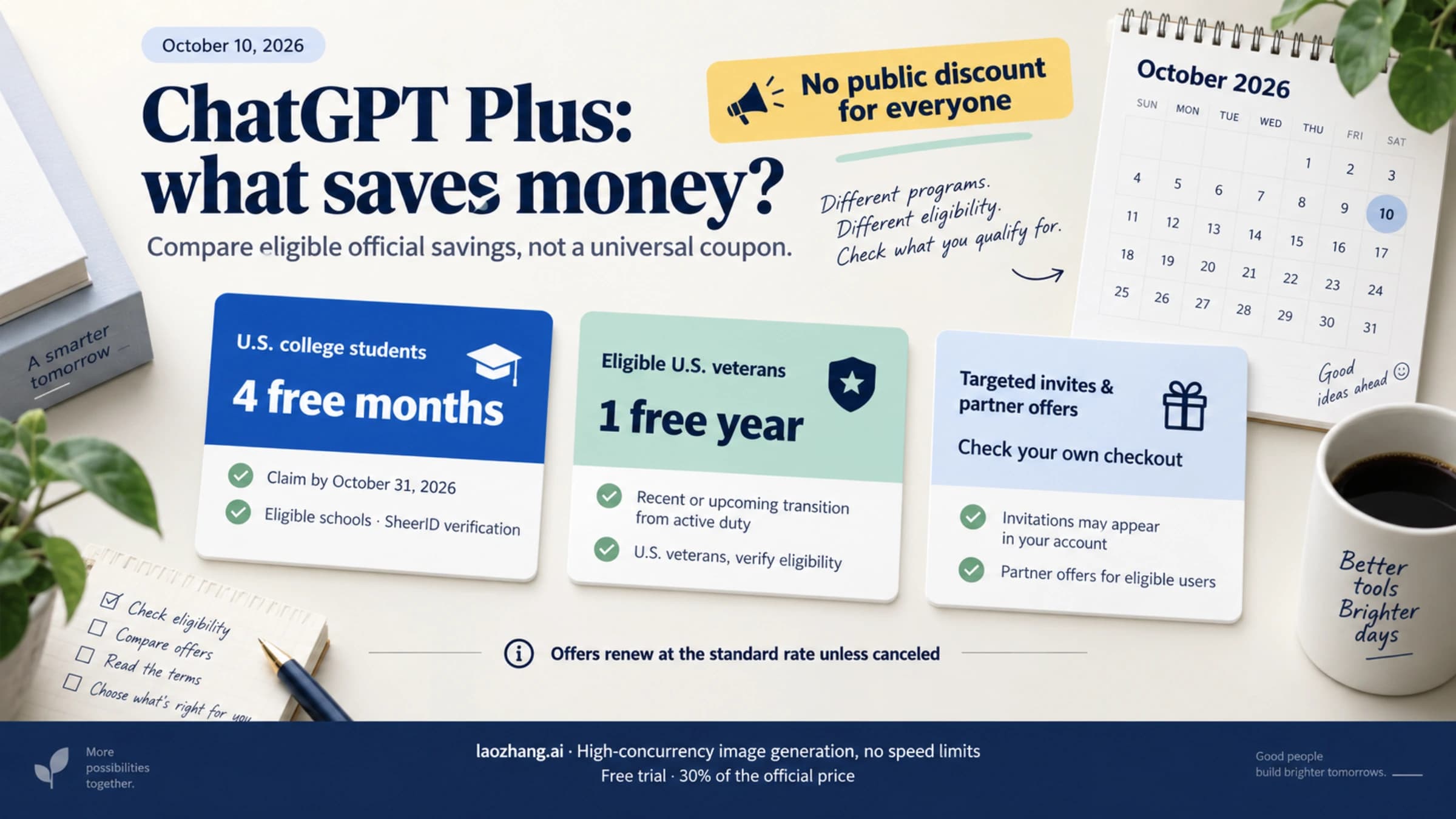
The short answer is no—and it is important to understand exactly why, because this affects how you should approach the alternatives. OpenAI, the company behind ChatGPT, does not currently offer any student pricing tier, educational discount code, or reduced-rate subscription for students. This is not a temporary gap or an oversight; it reflects OpenAI's current pricing strategy, which treats all individual consumers identically regardless of their educational status.

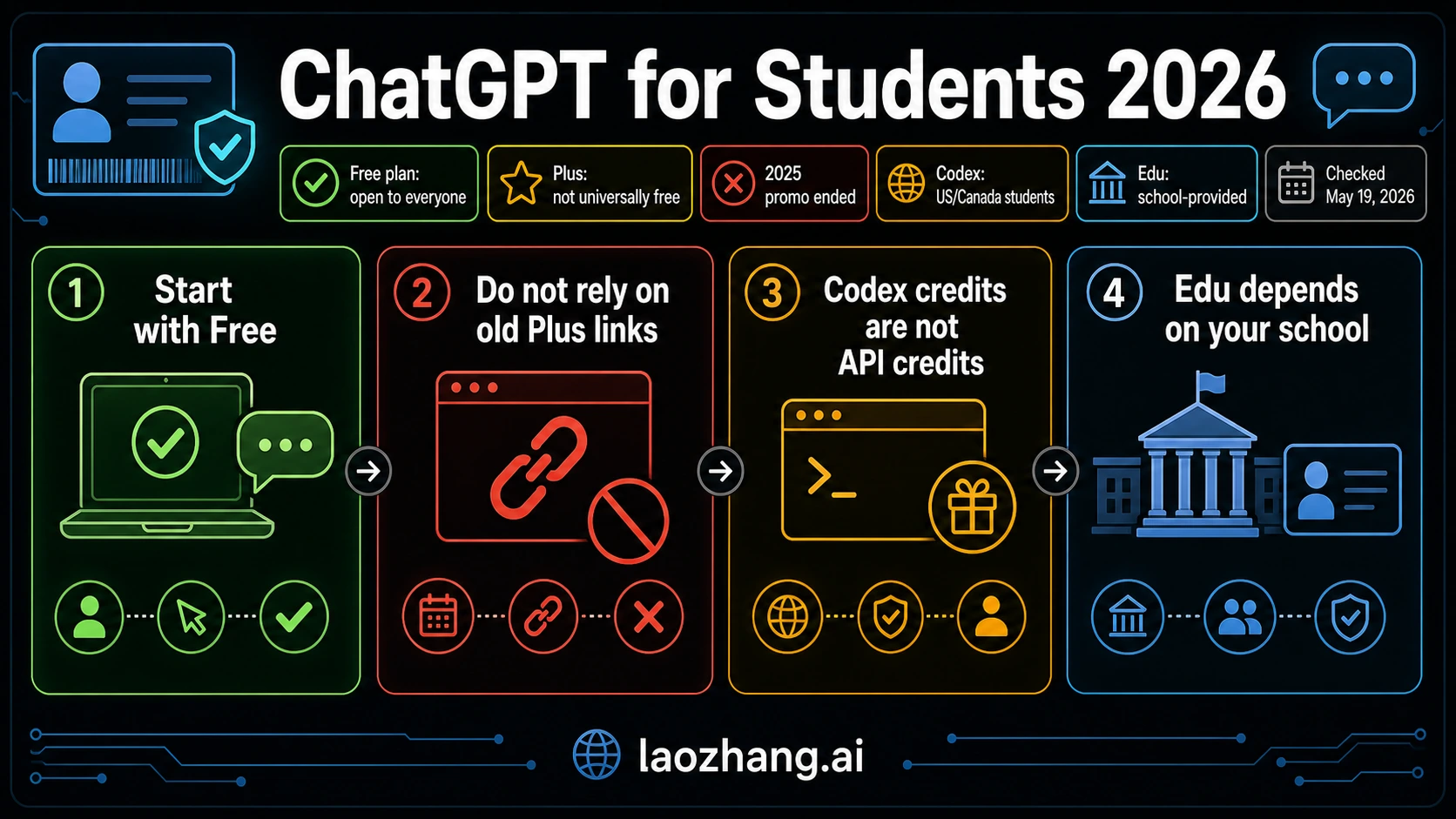
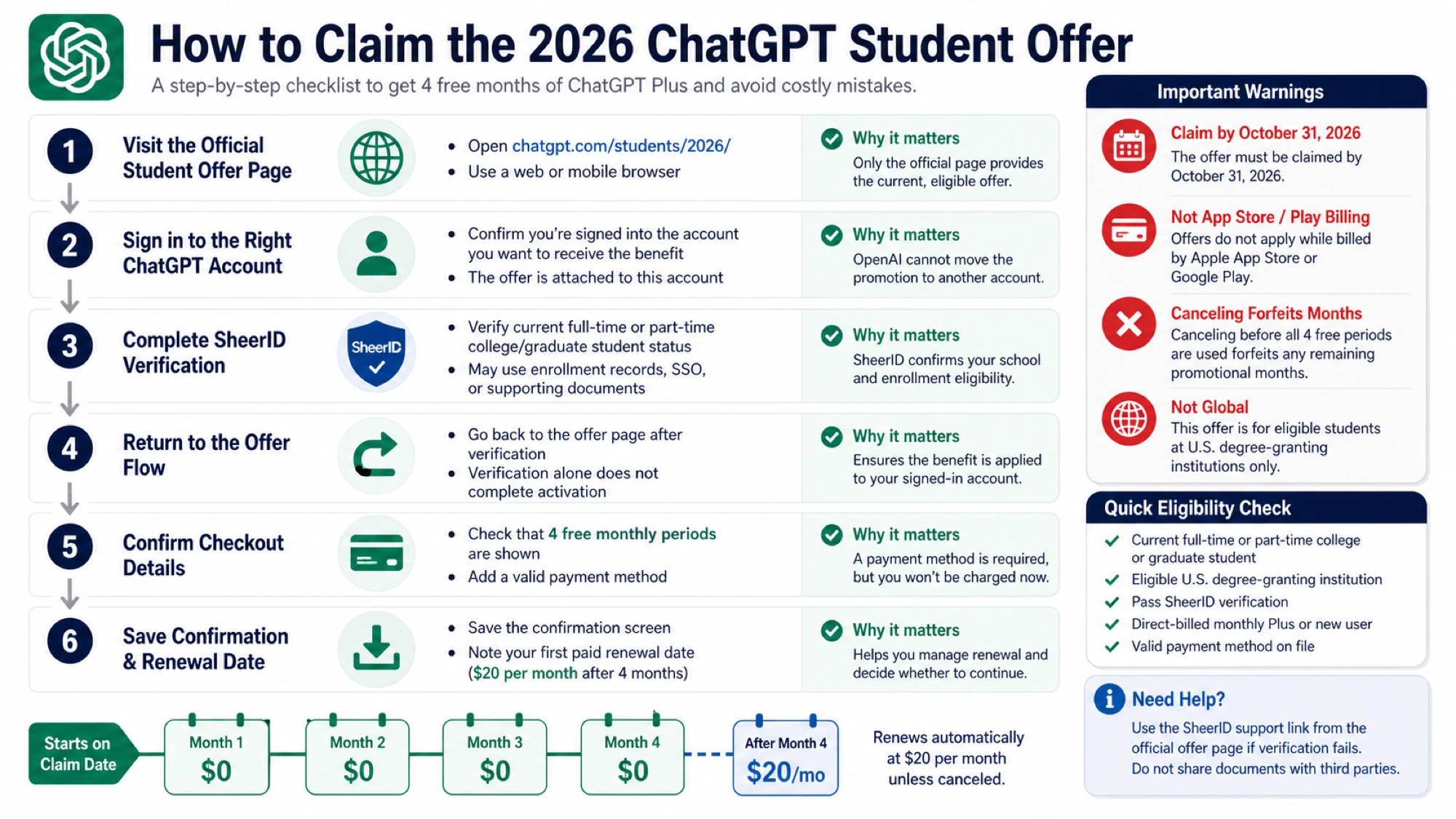
The confusion around student discounts partly stems from a limited-time promotion that OpenAI ran in early 2025. Between approximately March and May 2025, OpenAI offered two months of free ChatGPT Plus to university students in the United States and Canada. This program required verification through a .edu email address and was widely reported by technology news outlets including Mashable. However, this promotion ended on May 31, 2025, and as of March 2026, OpenAI has not announced any plans to revive it or create a permanent student discount program.

There are also two small regional programs that occasionally cause confusion. In Australia and Colombia, OpenAI offers a referral program where existing ChatGPT Plus subscribers can share a link that gives new users one month of free Plus access. This is not specifically a student discount—it is available to anyone—but it does represent a legitimate way to get a free month. Additionally, in India, OpenAI launched the ChatGPT Go plan with 12 months of free access starting November 2025, which benefits Indian students significantly.

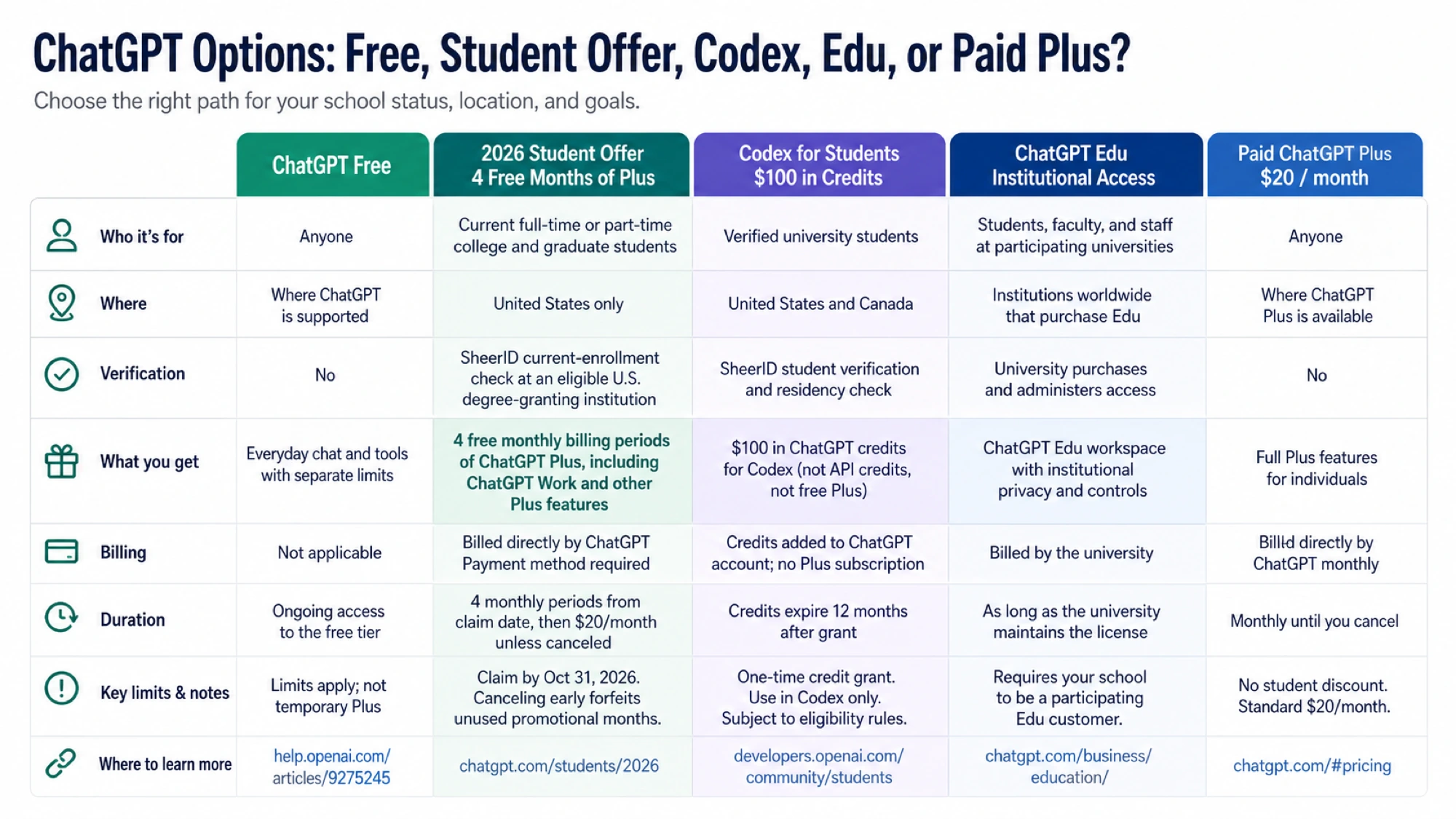
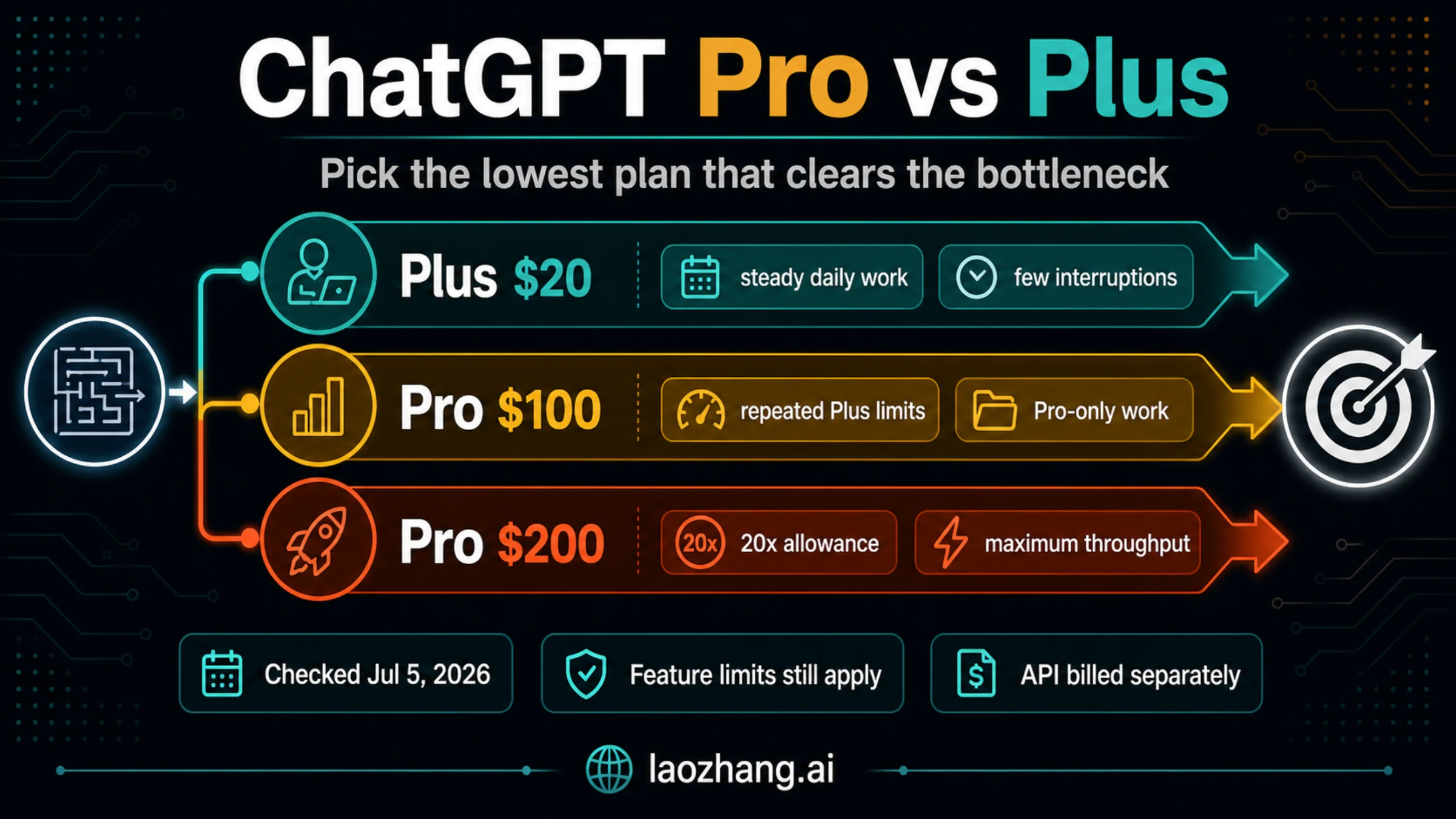
Here is the current pricing structure that applies equally to all users, including students, as verified from OpenAI's official pricing page in March 2026:

PlanMonthly PriceKey FeaturesBest For
Free$0GPT-5.2 Instant, basic chat, web search, file uploadsCasual use, light homework
Go$8Higher limits, priority accessRegular student use
Plus$20Full features, higher limits, DALL-E image generationHeavy daily use
Pro$200Unlimited access, research-grade modelsResearchers, professionals

If you are looking for a detailed comparison of ChatGPT plans and whether Plus is worth the upgrade, the difference between Go and Plus matters more than most articles acknowledge. For typical student workflows—writing assistance, research summaries, coding help—the Go plan at $8/month covers the vast majority of use cases. The jump to Plus at $20/month primarily benefits users who need image generation, voice mode, and significantly higher usage limits.

What ChatGPT's Free Plan Actually Offers Students

Before spending any money, it is worth understanding exactly how capable ChatGPT's free tier has become in 2026—because the gap between free and paid has narrowed considerably. Many students assume they need a paid plan for their academic work, but the free version now handles approximately 80% of common student tasks without any subscription at all.

The free plan runs on GPT-5.2 Instant, which is OpenAI's current base model as of March 2026. This is not a stripped-down or crippled version of the technology; it is a genuinely capable AI model that can write essays, explain complex concepts, debug code, analyze uploaded documents, search the web for current information, and interact with custom GPTs created by other users. The primary limitation is usage—you will hit rate limits faster than paid users, which means you may need to wait between conversations during peak hours.

For practical student scenarios, here is what the free plan handles well and where it falls short. Essay drafting and editing works excellently on the free tier, as these tasks require depth of reasoning rather than high request volumes. Research summaries work well too, especially with the built-in web search feature that can pull current information. Code debugging and explanation are fully supported. Math problem-solving, language translation, and study guide creation all work without limitations on quality—only on how many requests you can make per hour.

Where the free plan genuinely struggles is with sustained heavy usage. If you are writing a 20-page research paper in one sitting, making dozens of requests over several hours, you will likely hit the rate limit and need to wait. Image generation with DALL-E is also limited or unavailable on the free tier. And during peak usage times—typically weekday afternoons in US time zones—free users may experience slower response times or temporary capacity restrictions.

The strategic approach for budget-conscious students is to use the free plan as your daily driver and supplement with one of the alternatives discussed below when you hit limits. Many students find that combining ChatGPT Free with one or two of the free alternatives covered in this guide gives them more capability than a single paid subscription ever could. If you need help accessing ChatGPT from restricted networks at school, that is a separate issue with its own solutions.

5 Legitimate Ways to Get ChatGPT at Lower Cost

Five legitimate routes to save money on ChatGPT showing pricing and features for each option

Now that we have established what is available for free, let us walk through every legitimate way to access ChatGPT features at a discount or for free. Unlike many guides that recommend grey-area account sharing services, every option listed here is fully sanctioned by OpenAI or involves completely separate, legal AI products. The distinction matters because shared accounts violate OpenAI's terms of service and can result in permanent bans—losing all your conversation history and custom GPTs in the process.

The five routes are organized by a combination of savings potential and accessibility. The first route—optimizing the free plan—costs nothing and requires no action beyond what you are already doing. The second route, ChatGPT Go at $8/month, represents the best value for students who need more than free but cannot justify $20/month. The third route, ChatGPT Edu through your university, is potentially the highest-value option but depends on institutional availability. The fourth route targets technically inclined students who can use the API directly. And the fifth route involves switching to free alternatives that rival or exceed ChatGPT Plus in specific areas.

Route 1: Maximize the Free Plan. As discussed above, the free tier handles most student tasks. The key optimization technique is batching your requests—instead of asking ChatGPT 15 short questions throughout the day, combine related queries into fewer, more detailed prompts. You get better answers and use fewer of your limited daily requests. Setting up custom instructions also helps, as ChatGPT remembers your academic context (your field of study, writing style preferences, citation format) across conversations, reducing the need for repeated explanations.

Route 2: ChatGPT Go at $8/month. Launched in 2025, the Go plan sits between Free and Plus as a budget-friendly middle ground. At $8/month, it costs 60% less than Plus while offering meaningfully higher usage limits and priority access during peak times. For students in India, this plan is currently available free for 12 months (starting November 2025). The Go plan does not include DALL-E image generation or some of the most advanced features, but for the core text-based tasks that most students need—writing, research, coding—it delivers excellent value. If you are going to spend money on ChatGPT, Go should be your first consideration before Plus.

Route 3: ChatGPT Edu through your university. This is covered in detail in the next section, but in brief: if your university has purchased ChatGPT Edu, you get free access to GPT-4o-level capabilities with enterprise security, no personal payment required. This is the single best option for eligible students and is covered separately because it deserves a thorough explanation.

Route 4: Developer API access. Also covered in its own section below, the API route lets you pay only for what you use—typically $3-5/month for typical student usage patterns. This route requires some technical comfort but offers access to every model OpenAI makes.

Route 5: Free AI alternatives. Detailed in its own section, alternatives like Google Gemini Advanced (free for students for 1 year), Microsoft Copilot (free GPT-4o access), and Claude offer capabilities that match or exceed ChatGPT Plus in specific areas, all at zero cost.

For students who encounter payment issues when trying to subscribe, there are solutions available. For users without international credit cards, services like fastgptplus.com offer subscription assistance with local payment methods and quick activation, though this is mainly relevant for users in regions with payment restrictions.

ChatGPT Edu: Free Access Through Your University

ChatGPT Edu university access route with step-by-step guide and Cal State case study

ChatGPT Edu is arguably the most underreported option in this entire space, and it represents the single highest-value opportunity for students at participating universities. Unlike the consumer plans that require personal payment, ChatGPT Edu is an institutional product that universities purchase on behalf of their students and faculty. When your university has ChatGPT Edu, you get free access to GPT-4o-level capabilities through your school credentials—no credit card, no subscription management, no personal cost whatsoever.

The program's scale is already significant. California State University—the largest public university system in the United States—deployed ChatGPT Edu across all 23 of its campuses with a $17 million investment, providing free access to approximately 460,000 students (source: merlio.app, 2026). This is not a pilot program or a limited trial; it is a full institutional deployment. Other universities worldwide have followed similar paths, though the exact list of participating institutions is not publicly maintained by OpenAI. The program uses flexible pricing for institutions, meaning each university negotiates its own terms, which is why OpenAI does not advertise a fixed per-student price.

What makes ChatGPT Edu particularly valuable for students goes beyond just being free. The enterprise-grade data privacy protections mean that your conversations and uploaded documents are not used to train OpenAI's models—a meaningful distinction from the consumer version. Your data remains within your university's institutional boundary, which matters when you are uploading research data, draft papers, or proprietary course materials. The platform also supports custom GPTs configured by your professors for specific courses, creating tailored AI assistants for particular subjects.

To check whether your university offers ChatGPT Edu, start with the most direct approach: search Google for "[your university name] ChatGPT Edu" or "[your university name] AI tools for students." Many universities have dedicated pages explaining their AI tool offerings. If that does not yield results, contact your university's IT help desk or check your student technology portal. Some universities deploy ChatGPT Edu under different branding or as part of a broader AI initiative, so it may not always be immediately visible.

If your university does not currently offer ChatGPT Edu, consider advocating for it. Student government organizations, academic departments, and IT committees are the most effective channels. The argument is straightforward: at approximately $7-10 per student per year (based on institutional bulk pricing estimates), ChatGPT Edu costs less than many existing software licenses that universities already provide, and the educational value proposition is compelling given that 51% of teachers already use ChatGPT in their instruction (Walton Family Foundation survey, 2026). Faculty support is often the strongest lever, as departments frequently have discretionary technology budgets that can fund pilot programs.

The Developer Route: API Access on a Student Budget

This section is for students with some technical comfort—you do not need to be a computer science major, but you should be willing to work with a simple interface or script. The OpenAI API gives you access to every model OpenAI makes, including GPT-5.2, on a pure pay-per-use basis. There are no monthly subscriptions, no commitment periods, and no minimum charges. You pay only for the tokens (essentially, words) you actually process.

For typical student usage—let us say 30-50 conversations per week with moderate-length prompts and responses—your monthly API cost would typically fall between $3 and $8, depending on which model you use and how verbose your interactions are. That is significantly less than the $20/month Plus subscription, and you get access to more capable models with higher rate limits. The trade-off is that you do not get the polished ChatGPT interface; instead, you interact through the API, which means using a third-party client application, a simple Python script, or an API aggregation service.

For students who want API access without managing the technical setup themselves, services like laozhang.ai provide simplified API access with aggregated multi-model support. These services let you use multiple AI models through a single API key, often with competitive per-token pricing. This is particularly useful for students who want to compare responses from different models (GPT-5.2, Claude, Gemini) without managing separate accounts and billing for each.

GitHub Education Pack adds another dimension to this route. If you have a GitHub student account (free for verified students), you get access to GitHub Copilot and various AI-related credits. While GitHub Copilot is specifically designed for code, the credits and educational resources can offset some of your AI tool costs. The GitHub Student Developer Pack is available to students aged 13 and above who are enrolled in a degree-granting educational institution, verified through the GitHub Education program.

The API route is especially powerful for computer science and engineering students because the skills you develop—working with APIs, understanding token economics, building custom interfaces—are directly transferable to professional work. Many students who start using the API for cost savings end up building portfolio projects around it, turning a money-saving strategy into a career advantage.

Free AI Alternatives That Rival ChatGPT Plus

Feature comparison table of free AI alternatives versus ChatGPT Plus for students

The AI landscape in 2026 has matured to the point where free alternatives to ChatGPT are not just viable—they are genuinely excellent. Depending on your specific needs, one or more of these free tools might actually serve you better than a paid ChatGPT subscription. The key is understanding what each tool excels at, rather than treating them as inferior substitutes.

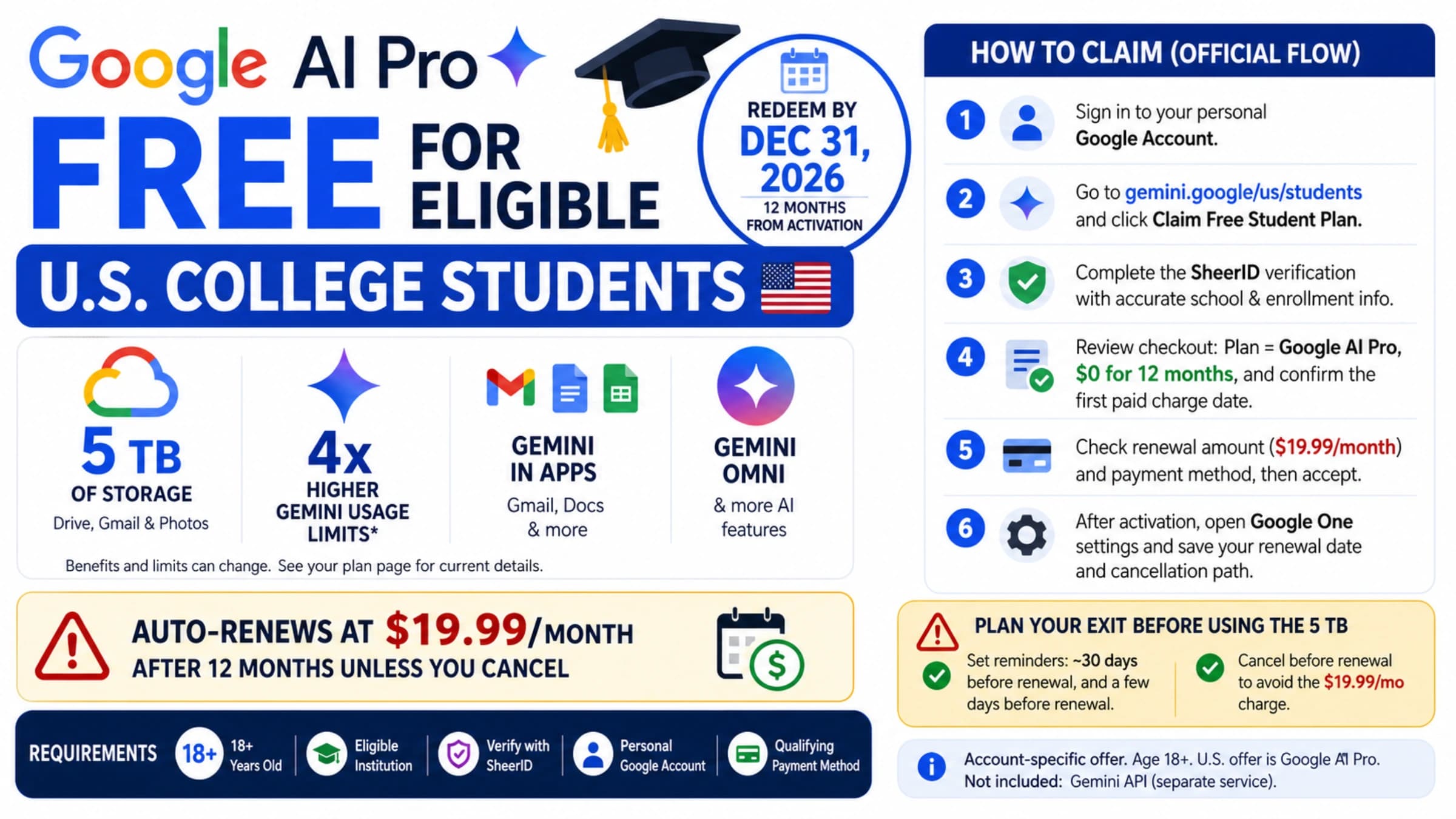
Google Gemini Advanced stands out as the single best free option for students in 2026. Through the SheerID student verification system, students worldwide can get one full year of Gemini Advanced completely free. This is not a trial; it is a full premium subscription to Google's most capable AI, which includes the Gemini 2.5 Pro model, integration with Google Workspace (Docs, Sheets, Gmail), 2TB of Google One storage, and other Google One AI Premium benefits. The verification process takes approximately two minutes—you enter your name, school email, and school name, and SheerID confirms your student status. If you are only going to take one action from this entire guide, this should be it. The combined value of Gemini Advanced plus Google One storage is approximately $240/year, and it is free with student verification.

Microsoft Copilot offers free access to GPT-4o—the same underlying model that powers much of ChatGPT Plus—through the Copilot interface at copilot.microsoft.com. For students already embedded in the Microsoft ecosystem (Word, PowerPoint, Excel), Copilot integrates naturally into your existing workflow. The free tier has moderate usage limits but handles typical daily student tasks without restriction. If your school provides Microsoft 365 Education, you may also have access to enhanced Copilot features at no additional cost.

Claude by Anthropic takes a different approach from ChatGPT, excelling in long-form writing assistance, nuanced analysis, and careful reasoning. Claude's free tier offers access to the Claude 3.5 Sonnet model with a generous context window, making it particularly strong for tasks like essay review, research paper analysis, and complex problem decomposition. Where ChatGPT often favors breadth and speed, Claude tends toward depth and careful consideration—a characteristic that many students find valuable for academic work. The usage limits on Claude's free tier are more restrictive than ChatGPT's, but for quality over quantity, it is hard to beat.

Perplexity AI occupies a unique niche as an AI-powered research engine. Unlike ChatGPT, which generates responses from its training data, Perplexity actively searches the web and provides cited sources for every claim. For students writing research papers, this citation-first approach is invaluable—you get AI-generated summaries backed by verifiable sources. The free tier includes five Pro searches per day (using the most capable models) plus unlimited standard searches, which is typically sufficient for daily academic research needs.

The strategic approach that maximizes student value is not choosing one tool but combining several. Use Gemini Advanced as your primary AI assistant (since it is free for a year), Claude for long-form writing and analysis tasks, Copilot for Microsoft Office integration, Perplexity for research with citations, and ChatGPT Free for anything that falls through the gaps. This multi-tool approach gives you access to four different frontier AI models, each with its own strengths, at a total cost of zero dollars.

Which Route Should You Choose? A Decision Framework

With five legitimate routes to explore, the natural question is: which one is right for you? Rather than offering a single recommendation, here is a framework based on the three factors that matter most for students—budget, technical comfort, and primary use case.

If your budget is exactly $0 and you want the simplest setup, start by claiming your free year of Gemini Advanced through SheerID verification. This single action gives you the most capable free AI access available to students. Supplement it with ChatGPT Free for variety, Claude Free for writing projects, and Perplexity for research. Check your university IT portal for ChatGPT Edu access. This combination costs nothing and covers virtually every student use case, from essay writing to code debugging to research summarization. For the vast majority of students, this is the optimal strategy.

If you can spend $8/month and want everything in one place, ChatGPT Go offers the best value-for-money in a single subscription. Combined with the free Gemini Advanced year and other free tools, you get a robust AI toolkit for minimal cost. The Go plan eliminates the frustration of hitting free-tier usage limits during intensive work sessions like exam preparation or research paper writing, while keeping costs at roughly the price of two coffee shop visits per month.

If you are technically inclined and want maximum flexibility, the API route through OpenAI or services like laozhang.ai gives you access to every model at cost-efficient per-token pricing. This is ideal for computer science students, data science students, or anyone who wants to build custom AI tools as portfolio projects. The learning curve is real but manageable, and the skills transfer directly to professional opportunities.

If you are at a university and want premium features for free, checking for ChatGPT Edu should be your absolute first step. If your university participates, this solves the problem entirely—you get enterprise-grade ChatGPT access at zero personal cost. If they do not participate yet, you have a genuine advocacy opportunity that could benefit thousands of fellow students.

Frequently Asked Questions

Do students get a discount for ChatGPT? No, OpenAI does not offer any official student discount, student pricing tier, or educational rate for ChatGPT as of March 2026. The pricing is identical for all individual users. However, students can access ChatGPT features through ChatGPT Edu (free via universities), the Go plan ($8/month), or free alternatives like Gemini Advanced.

Can I get ChatGPT for free as a student? Yes, through several routes. ChatGPT's free tier is available to everyone. If your university has ChatGPT Edu, you get enhanced access at no cost. And Google Gemini Advanced offers a full year free with SheerID student verification, providing comparable capabilities.

Is ChatGPT Plus worth it for students? For most students, no—especially when you consider the alternatives. The $20/month cost adds up to $240/year, and the Go plan at $8/month covers most student needs. The free alternatives discussed in this guide collectively match or exceed Plus features at zero cost.

What is ChatGPT Edu and how do I get it? ChatGPT Edu is OpenAI's institutional product for universities. It provides GPT-4o-level access with enterprise data privacy, funded by your university rather than individual students. Check your university's IT portal or search "[school name] ChatGPT Edu" to see if your institution participates.

Which free AI is best for students in 2026? Google Gemini Advanced with student verification offers the best overall value—one year of premium AI access completely free. For specific tasks, combine it with Claude (writing), Perplexity (research with citations), and Microsoft Copilot (Office integration).

Share:

laozhang.ai

One API, All AI Models

AI Image

Gemini 3 Pro Image

$0.05/img
80% OFF
AI Video

Sora 2 · Veo 3.1

$0.15/video
Async API
AI Chat

GPT · Claude · Gemini

200+ models
Official Price
Served 100K+ developers
|@laozhang_cn|Get $0.1