ChatGPT Plus Discount Guide 2026: What Still Works and the Cheapest Legitimate Paths
As of April 2, 2026, ChatGPT Plus does not have a standing public annual or universal discount. The real ways to pay less are targeted OpenAI promos or invite offers, a few narrow student or veteran exceptions, and ChatGPT Go at $8 per month if what you really need is a lower official bill rather than full Plus.
On this page
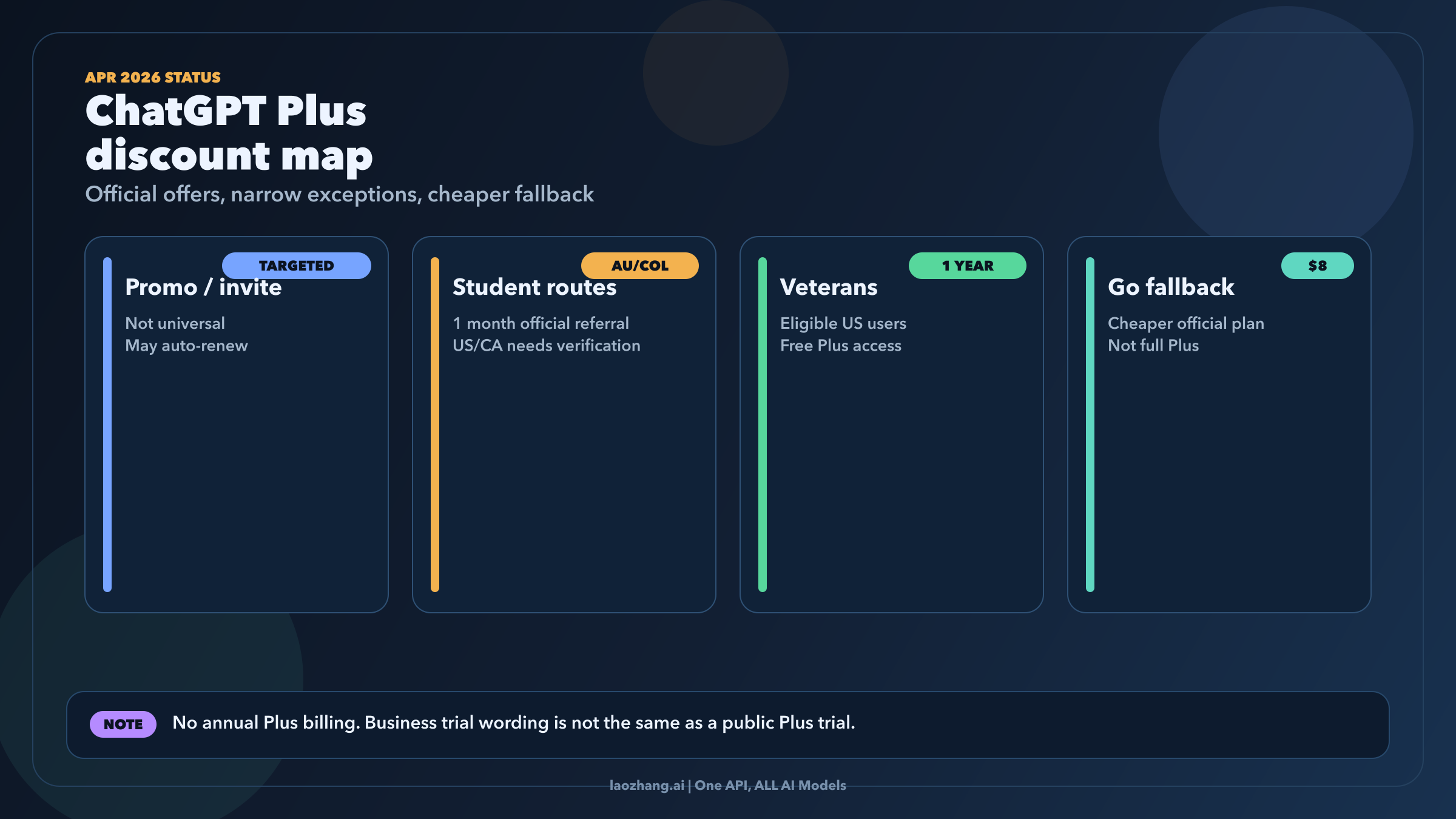
ChatGPT Plus can still cost less than full price in 2026, but most readers are being shown the wrong comparison. As of April 2, 2026, there is no standing public annual or universal ChatGPT Plus discount. The real savings routes are targeted OpenAI promos or invite offers, a few narrow exceptions such as the Australia and Colombia student referral program and the U.S. veteran offer, and ChatGPT Go at $8 per month if what you actually need is a lower official bill rather than full Plus.
That distinction matters because the cheapest sticker price on the web is not always the same product contract. A Business free-trial label is not a Plus trial. A shared account is not a normal discounted subscription. A recharge or reseller service may solve payment friction, but it is still not the same thing as OpenAI offering you cheaper Plus. If you sort those lanes correctly, the decision becomes much simpler.
Verification note: this guide was rechecked against OpenAI pricing, help-center, and blog pages on April 2, 2026. Where OpenAI's public surfaces do not line up cleanly, the article says so directly instead of flattening them into a confident yes.
TL;DR
If you only need the fast answer, here is the current map:
| Route | Status on April 2, 2026 | Best for | Main catch |
|---|---|---|---|
| Targeted OpenAI promo or invite | Real, but campaign-dependent | Readers who already received an offer | Not universal; some routes require a payment method and can auto-renew |
| Australia / Colombia student referral | Real, but narrow | Eligible-school new users in those countries | One month only; geography and school limits apply |
| US / Canada student surface | Use caution | Students who can verify a live claim flow on their own account | Help article is live, but the public chatgpt.com/students route currently redirects |
| U.S. veteran / servicemember offer | Real if eligible | Eligible U.S. servicemembers and veterans | Narrow eligibility window and verification required |
| ChatGPT Go | Best cheaper official fallback | Readers who mainly want a lower monthly bill | It is not discounted Plus; it is a lower tier |
The practical rule is straightforward. If you already have a real OpenAI-controlled offer, redeem it and watch the renewal date. If you clearly qualify for a documented exception, use that route. If neither is true and your real goal is simply to spend less each month, stop chasing coupon headlines and look at Free vs Go vs Plus vs Pro instead. And if the only "deal" you can find involves a shared account, a reseller code, or a murky recharge service, treat it as a different trust and policy question, not as an official ChatGPT Plus discount.
Is there a public ChatGPT Plus discount right now?
No, not in the way most people mean it. OpenAI's current Plus help page still describes ChatGPT Plus as a $20/month subscription, and OpenAI's current pricing help pages also say annual billing is not supported for Go, Plus, or Pro. That alone removes one of the most common false expectations on this topic: there is no official annual Plus plan that quietly lowers the monthly effective price, and there is no normal public "buy a year, save 20%" path hiding behind the current consumer flow.
The second thing to clear up is the pricing page itself. When readers see "Try for free" on chatgpt.com/pricing, they often assume OpenAI is quietly offering a Plus trial. The live pricing surface does not support that reading. The visible trial language belongs to Business, not to consumer Plus. That is a different product with a different purchase flow and a different intended user. If you are an individual comparing Plus prices, Business trial wording is background noise, not a consumer discount.
This is why the cleanest mental model is a route map rather than a coupon page. OpenAI does run promotions. OpenAI does run invite-based free trials. OpenAI also has a few narrow exception routes. But none of that adds up to one stable public discount that any reader can claim on demand. If you start from that reality, the rest of the article becomes a decision exercise instead of a scavenger hunt.
Every current official way to pay less for ChatGPT Plus
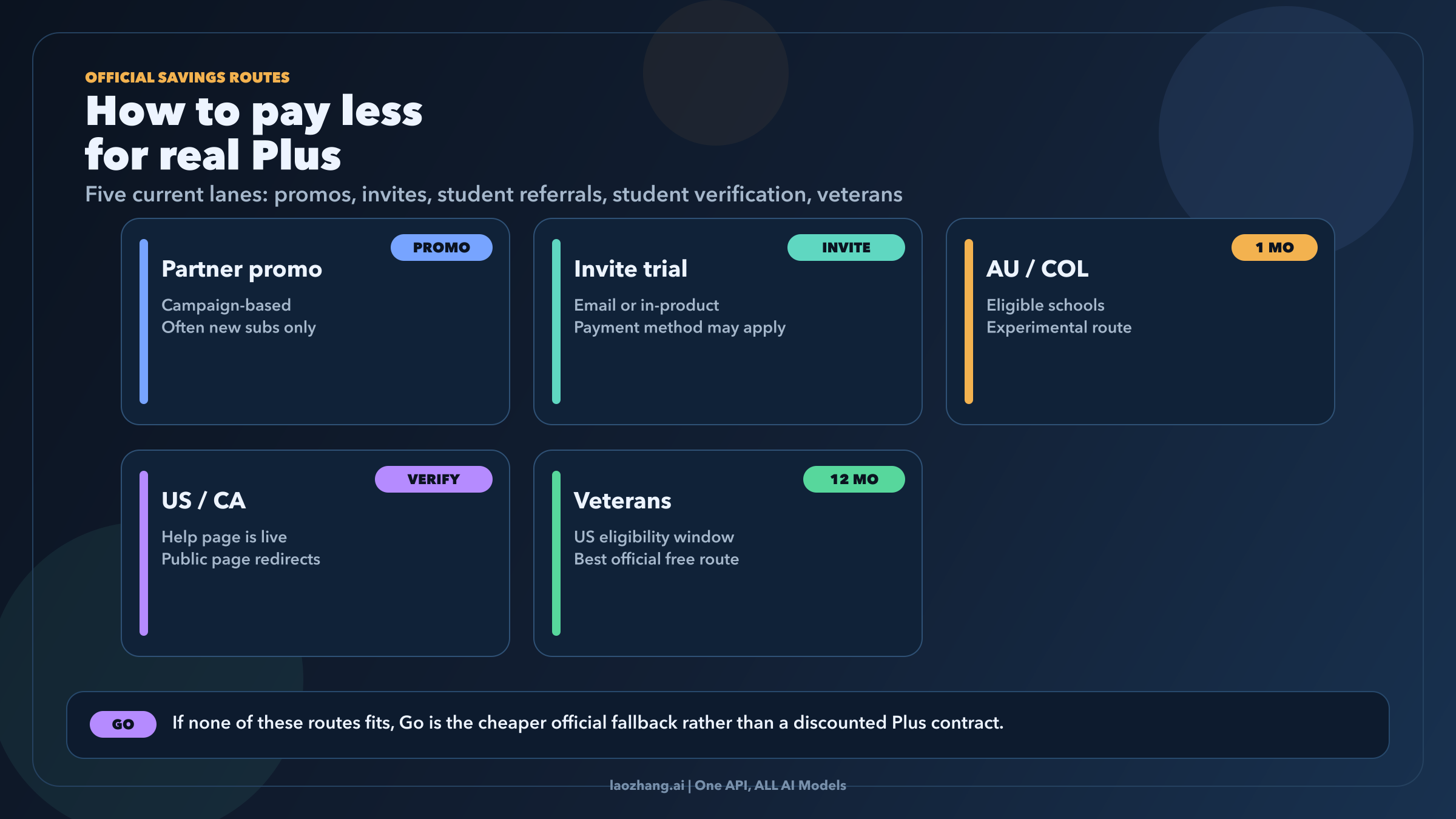
The official routes are real, but most of them are not broad. That is why weak articles feel contradictory on this topic. They are often describing pieces of the truth, but they blur targeted, narrow, and surface-conflicted routes into one easy headline. A better way to read the market is to separate each lane by who controls it, who qualifies, and how much uncertainty is left around it.
1. Targeted OpenAI promos and invite-based trials
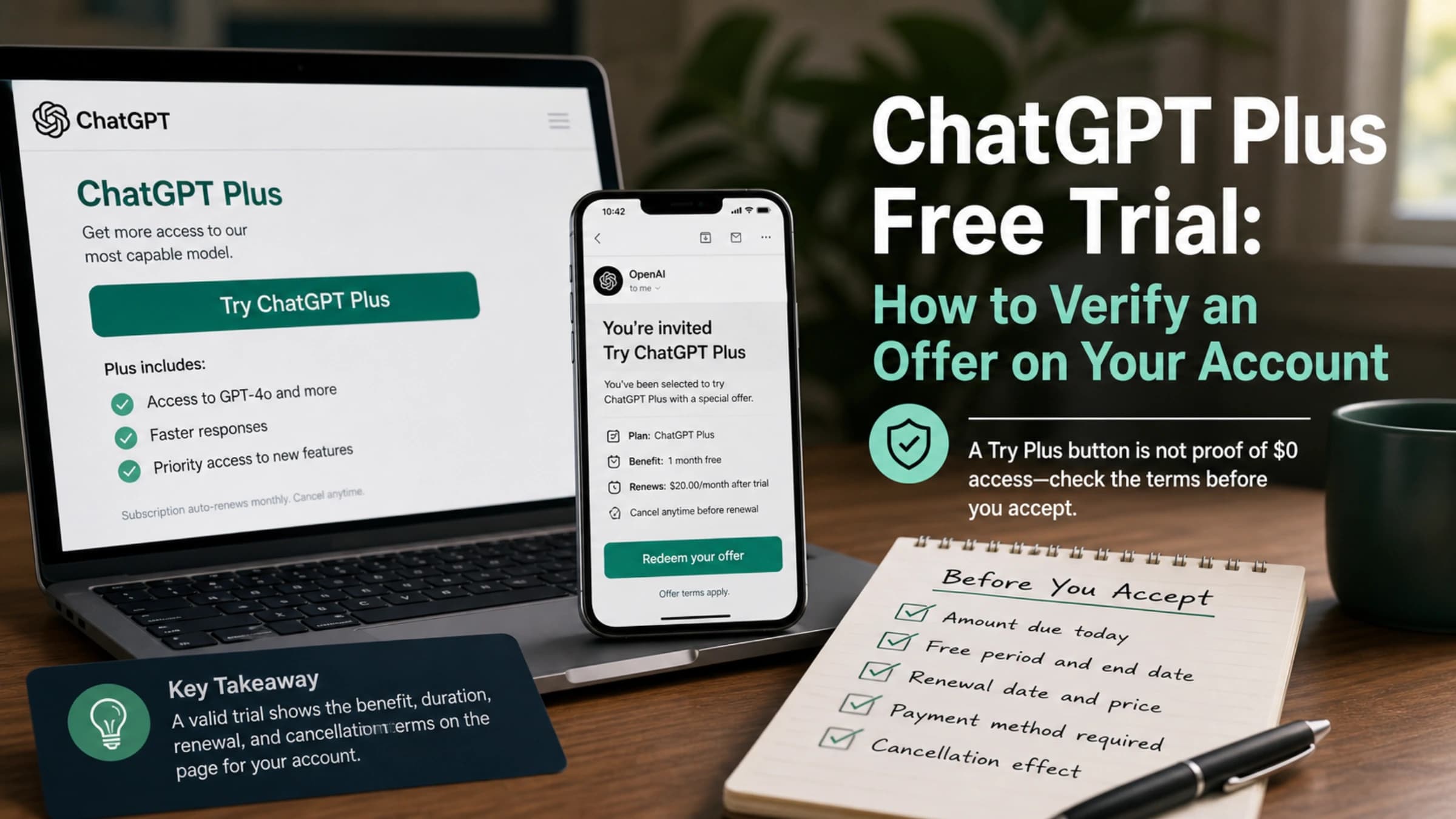
This is the most common real savings lane for ordinary consumer accounts, and also the least controllable one. OpenAI's promotions and referrals help page confirms that promo codes and partner offers exist, that some are only for new ChatGPT Plus subscribers, and that eligibility can depend on region or payment method. OpenAI's promotional-subscriptions and free-trial FAQ also confirms that invite-based trials exist, but not every user or region is included in every campaign.
That means the right way to talk about these offers is not "ChatGPT Plus is discounted right now." The honest version is "some accounts or campaigns have real Plus offers right now." Those are not the same statement. The public OpenAI help pages validate the lane, but they do not publish one neat matrix of every live targeted retention or partner offer by account state on April 2, 2026. So if you have already received an email, in-product banner, or official redemption flow, that is meaningful. If you have not, do not assume there is a hidden public page you simply have not found yet.
The operational details matter too. OpenAI says some promotions require a valid payment method, promotions can auto-renew into the standard Plus monthly rate, and promo codes are not reusable or stackable. In practice, that makes a targeted offer valuable but not casual. If you redeem one, treat the renewal date as part of the cost.
If your real question is not "How do I lower the price?" but "Can I get Plus free at all?", the more focused next read is ChatGPT Plus free trial, which tracks the zero-cost branch separately from the broader discount decision.
2. Australia and Colombia student referral program
This is one of the clearest narrow routes because OpenAI's help article is explicit about both the benefit and the limits. The current page describes an experimental student referral program in Australia and Colombia that gives eligible-school new users 1 month of ChatGPT Plus free. The wording matters: experimental, school-limited, geography-limited, and new-user oriented. That is a real official savings route, but it is not a general student discount for the whole market.
For readers in those countries who attend a listed school, this is a strong route because the public documentation still reads like a live access path rather than a stale news memory. For everyone else, it is useful mainly as proof of category. It shows that OpenAI still uses narrow exception programs even while there is no standing public Plus discount.
If your question is specifically about student pricing beyond these narrow programs, the better next read is ChatGPT student discounts and cheaper student access, because the broader student decision is usually about alternatives, not about waiting for a universal Plus coupon.
3. The US / Canada student page is still a surface-conflicted route
This is the lane that needs the most careful wording. OpenAI still hosts a help article for student discounts in the United States and Canada. That article describes a 2 months free offer and still instructs readers to use chatgpt.com/students. On its own, that sounds like a clean official route.
But the public logged-out chatgpt.com/students surface checked on April 2, 2026 currently redirects to a generic students use-cases page rather than an obvious public claim flow. Those two facts do not fit neatly together. The strongest defensible conclusion is not that the offer is definitely dead, and not that it is definitely live for anyone who clicks around long enough. The defensible conclusion is that the public documentation and the public surface are currently in tension.
That is why this lane belongs in the route map, but only with a warning label. If you are a student in the United States or Canada and you see a live official claim flow tied to your account or verification path, use the official route. But if all you have found is an older help article quoted by blogs, do not treat it as proof that two months of Plus are broadly available on demand right now.
4. Free year for eligible U.S. servicemembers and veterans
This is the most generous official route OpenAI publicly documents, and it deserves to be separated from the usual promo discussion because it is materially different in value. OpenAI's chatgpt-for-veterans page says eligible U.S. servicemembers and veterans within 12 months of retirement or separation can receive 1 year of ChatGPT Plus free. For anyone who qualifies, that is a better route than a short trial or a limited discount because it solves the access question for a full year.
The catch is narrowness, not credibility. This is not a public deal for everyone, and it should never be padded into a generic "many ways to get ChatGPT Plus cheap" list as if it were widely claimable. But for the people it is designed for, it is one of the strongest legitimate routes in the current market.
The broader lesson from all four lanes is the same: official savings routes still exist, but they are targeted, narrow, or both. The reader mistake is not failing to find a magical public coupon. It is assuming that targeted offers, narrow exception programs, and broad consumer pricing are all describing the same path.
The cheapest official fallback when no Plus discount applies
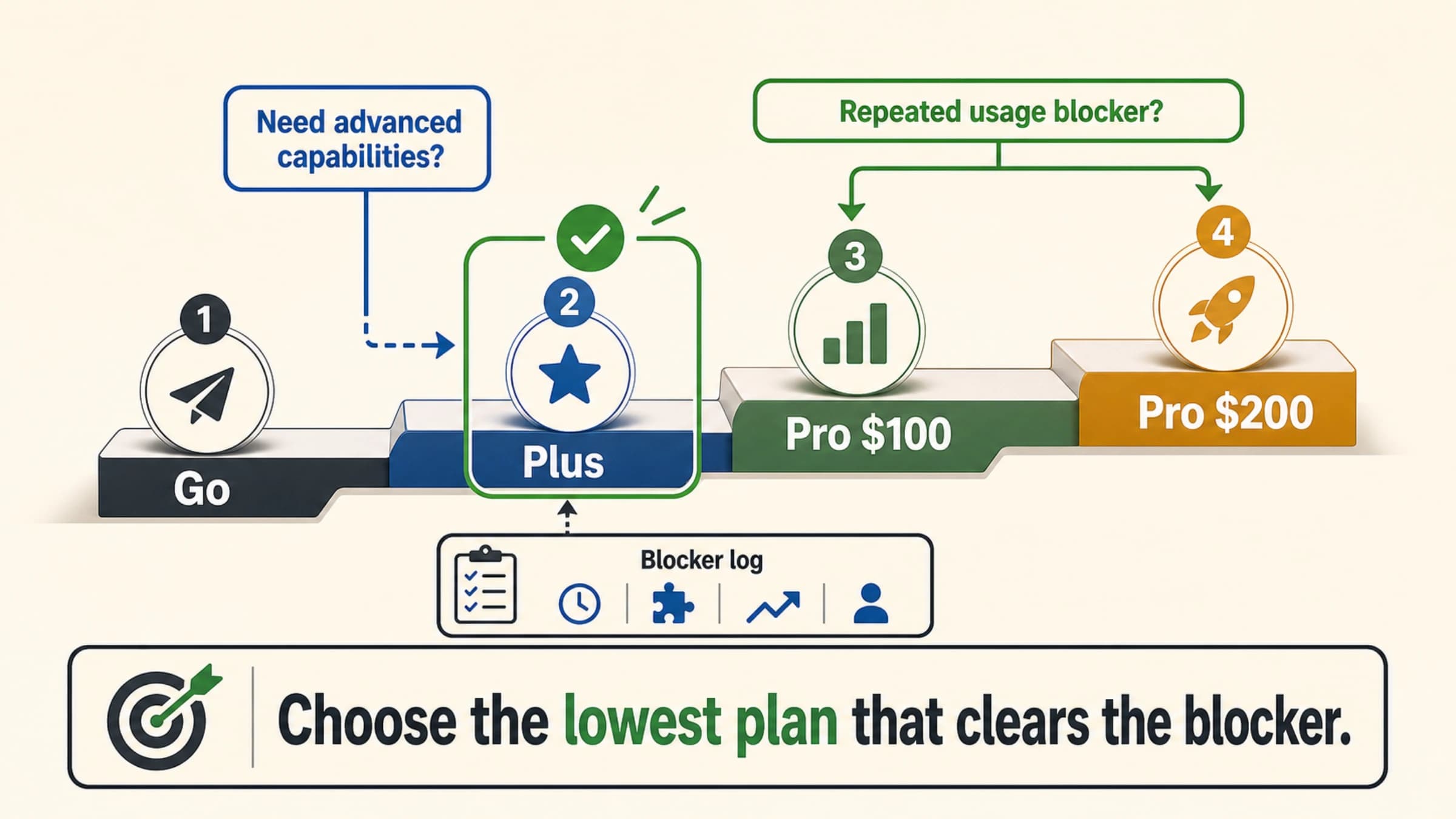
If your real goal is not "I must have full Plus at any cost," but "I want to spend less and still stay inside the official product ladder," then ChatGPT Go is usually the most important route in this whole article. OpenAI's January 16, 2026 Go announcement sets the current U.S. consumer ladder at Go $8/month, Plus $20/month, and Pro $200/month, and OpenAI's help documentation also makes clear that Go is a lower-cost paid tier rather than a temporary promotion.
That matters because many readers searching for a Plus discount are not actually solving for Plus. They are solving for a smaller bill. Once you say that out loud, the decision often changes. A targeted Plus promo is still better if you truly need full Plus and already have a real offer in front of you. But if no real offer applies and you mainly want a cheaper official subscription, Go is cleaner than continuing to chase half-documented discount stories.
What Go is not is a disguised Plus coupon. It is a different plan with a different place in the lineup. You should choose it when a lower monthly cost matters more than getting the exact Plus contract. You should not choose it because a blog implied it counts as discounted Plus. That sounds like a wording quibble, but it changes behavior: readers who think Go is "basically discounted Plus" often delay the real comparison they need to make, which is whether their workload actually needs Plus at all.
If you are doing light-to-regular writing, search, and everyday chat work, the cheaper official path may be enough. If you need the deeper paid capabilities that make Plus worth paying for in the first place, Go is probably the wrong substitution. That is why the more detailed decision guide is our plan comparison article, not this piece. This article is about how to pay less legitimately. The honest answer for many readers is that the legitimate cheaper branch is not Plus with a hidden discount. It is Go.
What is not the same thing as a ChatGPT Plus discount
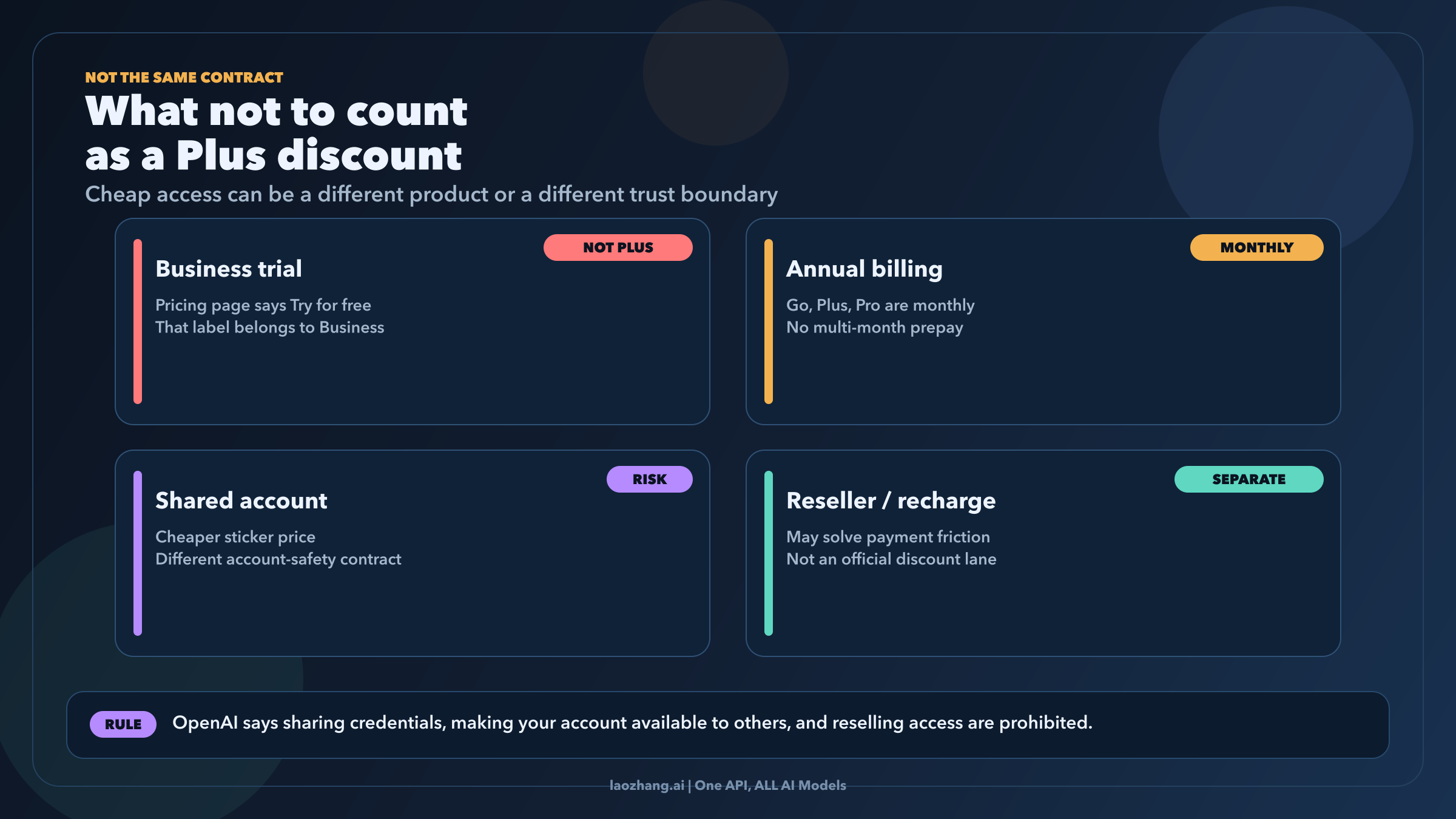
The web usually gets messy here because it sorts by price before it sorts by contract. Readers see a lower number and assume they are still looking at the same product. That assumption breaks down fast.
The first false equivalence is Business trial language. OpenAI's current pricing page visibly shows Try for free on Business, not on consumer Plus. If you are buying ChatGPT for yourself, that Business label is not a hidden Plus offer. It is a different plan. Using Business trial wording to imply that Plus has a public free-trial or discount path is simply mixing product surfaces.
The second false equivalence is annual-billing folklore. OpenAI's current help pages are explicit that Go, Plus, and Pro are billed monthly and do not support annual billing. So when a guide implies there is a secret yearly Plus plan, a multi-month prepay discount, or a coupon that only appears during annual checkout, it is describing a flow that the current official documentation does not support.
The third false equivalence is shared-account access. OpenAI's own help documentation says prohibited behavior includes sharing credentials, making the account available to other people, and reselling access. That does not mean every cheap-access listing on the internet is automatically a scam. It means a shared account is not just "Plus, but cheaper." It crosses a different account-safety and policy boundary. The price may be lower, but the contract is different.
The fourth false equivalence is reseller or recharge access. This is the easiest one to overstate, so it is worth being precise. Some readers are not really looking for a discount at all. They are dealing with payment friction: unsupported cards, local payment limits, or a region where direct checkout fails. A recharge or intermediary service can sometimes address that problem. But even if it does, it is still not the same thing as OpenAI offering you cheaper Plus. It is a separate payment and trust arrangement that should be evaluated as such. If that is your situation, the more useful next read is the ChatGPT Plus recharge reliability guide, not another coupon roundup.
The practical rule is simple: if the route changes who controls the account, who takes payment, or which Terms boundary you are operating inside, stop calling it a Plus discount. Call it what it is.
Which route fits which reader?
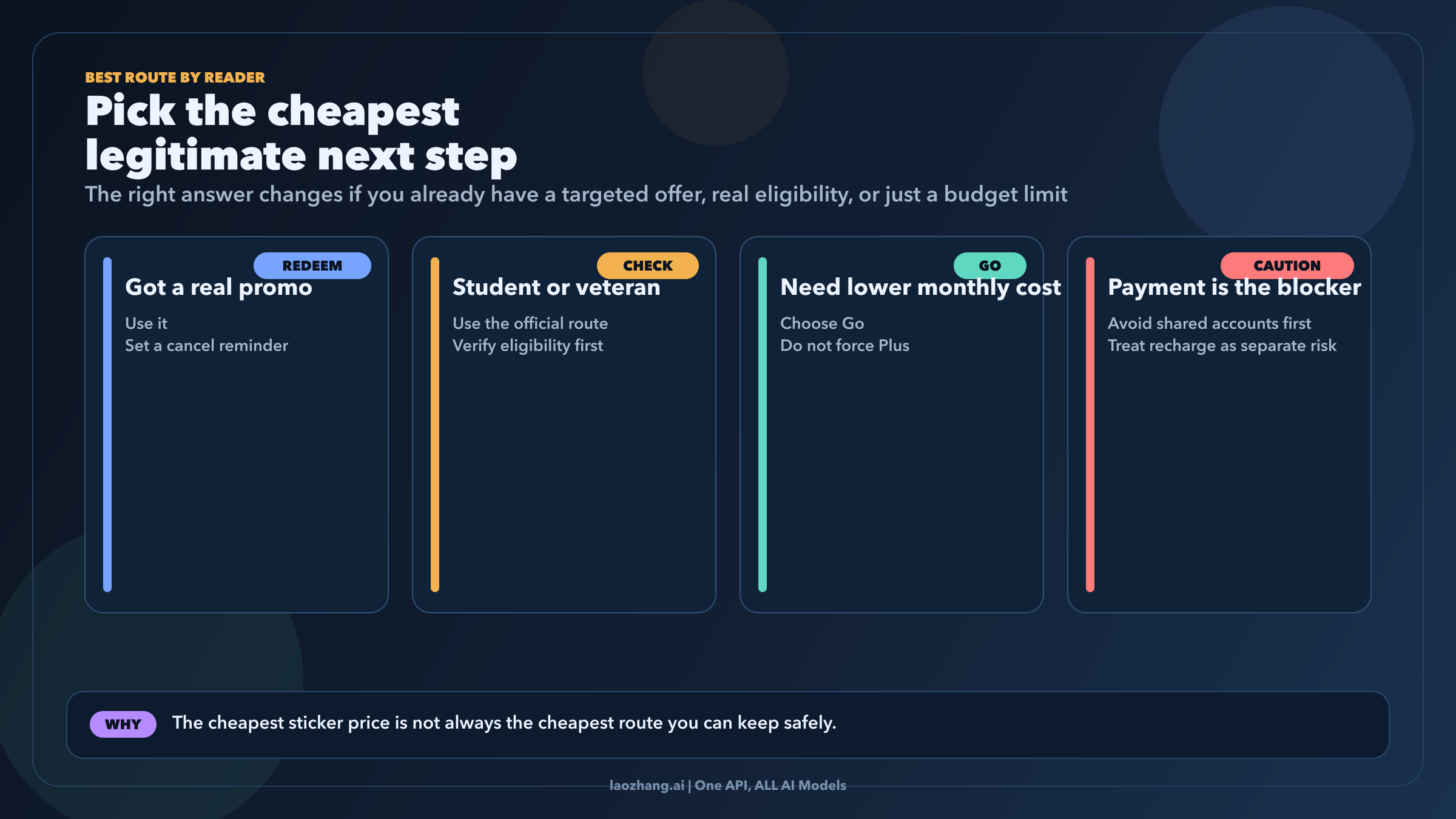
The best route depends less on what sounds cheap in a headline and more on what problem you are actually trying to solve.
If you already have a real OpenAI promo, invite, or partner code, redeem that route and treat it as time-limited. It is the cleanest way to lower your Plus cost because OpenAI is still controlling the subscription path. The catch is that you should expect campaign conditions, possible payment-method requirements, and ordinary renewal behavior after the promo ends. Put the end date on your calendar immediately.
If you clearly qualify for a documented exception such as the Australia / Colombia student program or the U.S. veteran offer, use the official exception rather than hunting for a broader discount. These routes are narrow, but that is exactly why they are worth using when you fit them. They are better grounded than rumor-driven coupon pages and more defensible than trying to reverse-engineer a campaign aimed at someone else.
If your real problem is the monthly bill, not the exact Plus contract, choose Go before you waste time chasing fragile discount stories. This is the branch many readers should have taken first. The cheapest legitimate official path is often a lower plan, not a hidden Plus code.
If your problem is payment friction, do not confuse that with a discount problem. A recharge or intermediary route may or may not be acceptable for your circumstances, but it should be evaluated for payment reliability and account safety, not celebrated as an official savings lane. And if the route requires credential sharing, the distinction is even sharper: you are no longer comparing ordinary subscriptions.
That scenario split is the real answer behind the keyword. There is no single cheapest ChatGPT Plus deal that fits everyone because the routes are solving different problems. One is a targeted discount. One is a narrow eligibility exception. One is a cheaper official plan. One is a workaround for payment or access friction. The moment you stop forcing them into one bucket, the right next step becomes obvious.
FAQ
Does ChatGPT Plus have an annual plan or annual discount?
No. As of April 2, 2026, OpenAI's help pages say annual billing is not supported for Go, Plus, or Pro. If you see an article implying there is a yearly Plus checkout flow with a lower effective monthly price, treat that claim as unverified.
Can ChatGPT Plus promo codes stack with other offers?
No, not normally. OpenAI's promotions help page says promo codes are not reusable or stackable. If you have a real offer, evaluate it on its own terms instead of assuming you can combine it with another campaign.
Do official ChatGPT Plus promos auto-renew?
Often, yes. OpenAI says some promotions and invite-based subscriptions can auto-renew to the standard monthly rate unless canceled before the promotional term ends. That is why the savings calculation should always include the renewal date.
Is the US / Canada student discount definitely live right now?
Not strongly enough to promise it as a public route. OpenAI still hosts the help article, but the public chatgpt.com/students route checked on April 2, 2026 redirects to a generic students page. Treat it as a verify-before-you-rely lane, not as a guaranteed public offer.
Is Business Try for free the same as a ChatGPT Plus trial?
No. The current pricing page shows that wording on Business, not on consumer Plus. It is a different plan and should not be read as proof of a general Plus trial.
Are reseller, recharge, or shared-account offers official ChatGPT Plus discounts?
No. At best, they are separate access or payment arrangements. At worst, they cross OpenAI's stated boundary against credential sharing or reselling access. Either way, they should not be treated as normal official Plus discounts.
What is the cheapest legitimate official option if no Plus discount applies to me?
Usually ChatGPT Go. If there is no real targeted Plus offer on your account and no narrow exception applies, Go is the cleaner official lower-cost branch at $8/month in the U.S., with localized pricing in some markets.