Claude Haiku 5.5 vs GPT-6 Luna: Same Price, 2.2x Cost per Task
Claude Haiku 5.5 and GPT-6 Luna share $0.10/$0.50 rates under 100K tokens, yet Haiku cost 2.2x more per task at default effort and reprices 5x above 100K.
On this page
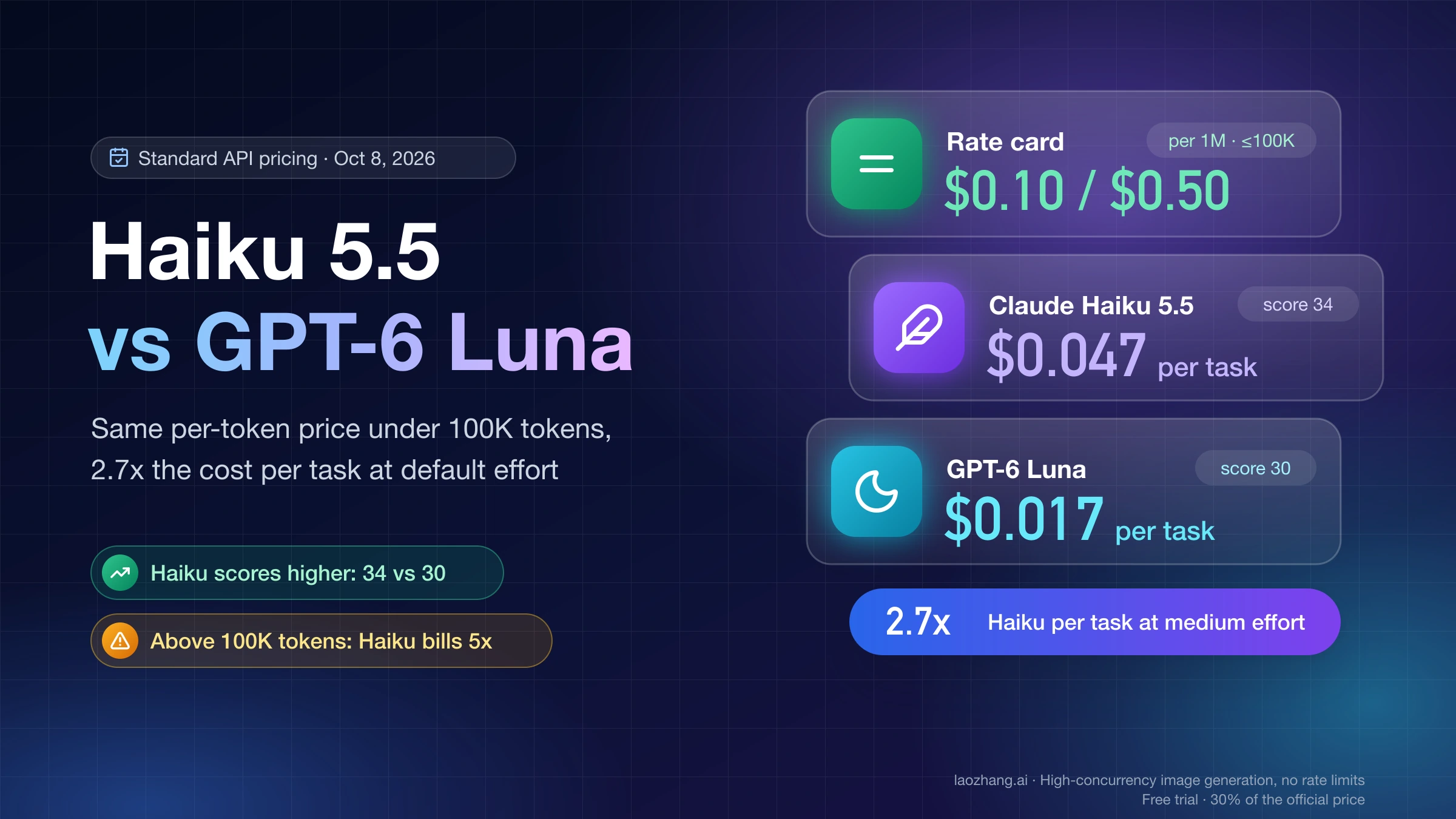
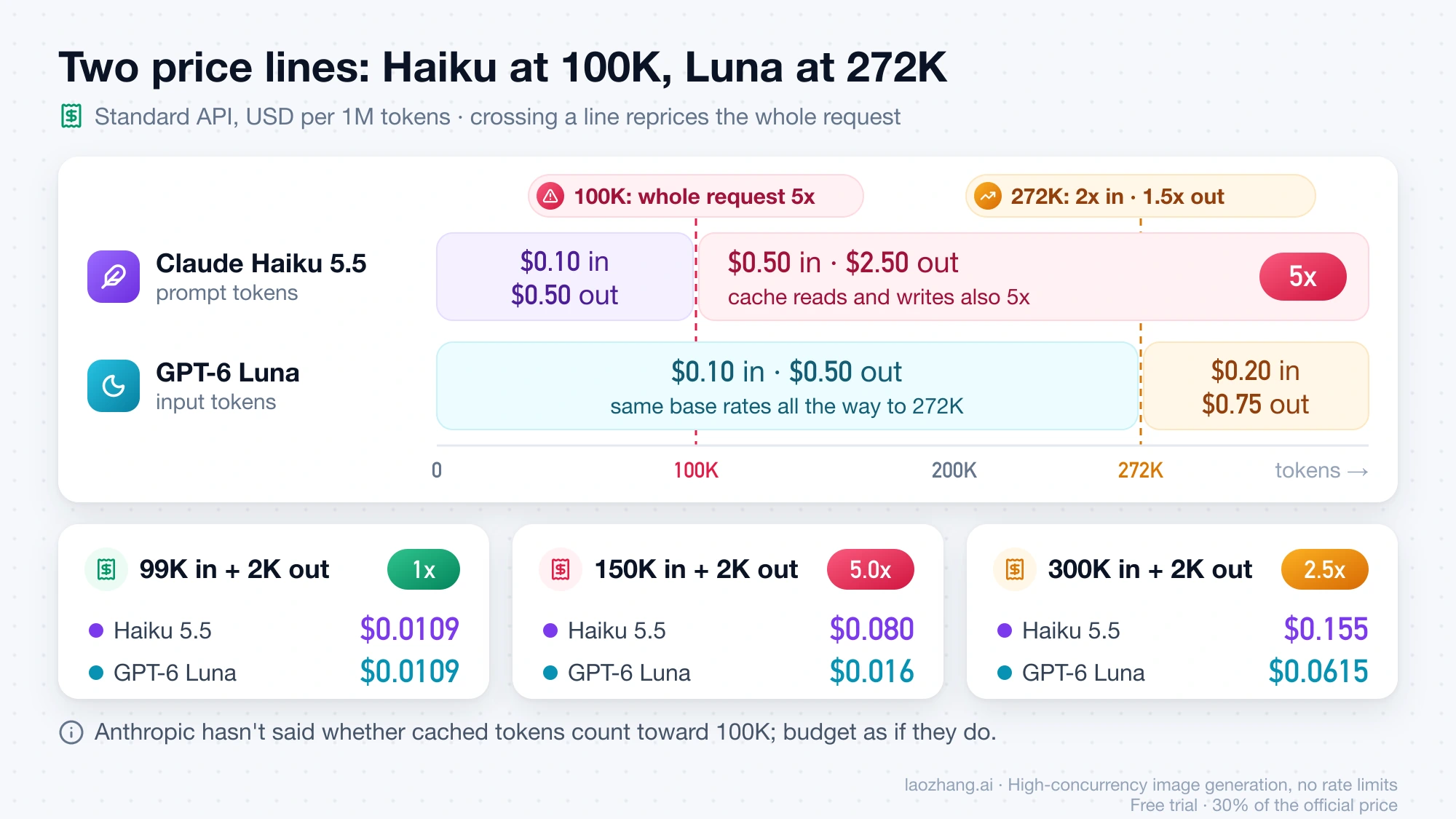
Claude Haiku 5.5, released on October 7, 2026, lists the same per-token rates as GPT-6 Luna for ordinary requests: $0.10 per million input tokens, $0.50 per million output tokens and $0.01 per million cached tokens. The parity ends at two different lines. Once a Haiku prompt passes 100,000 tokens, Anthropic bills the whole request at five times those rates. Luna keeps its base rates up to 272,000 input tokens and then charges 2x for input and 1.5x for output.
Equal rates don't produce equal bills. On Artificial Analysis' Intelligence Index v5.0, the nine-evaluation version that replaced v4.3.2 on October 27–28, 2026, Haiku 5.5 at the default medium effort cost $0.092 per task against Luna's $0.042, about 2.2 times as much, because it used more tokens. It also scored higher, 25 against 18. Compare the two at matched scores instead of matched effort settings and the gap mostly disappears: Haiku at medium (25) outscores Luna at xhigh (23) for 12% less per task and in about half the time, and the other close pairs differ by about 4% on cost. Every Haiku setting from high up scores above Luna's ceiling of 28.
The short answer: start with Luna for high-volume, short, cost-bound work and for any prompt between 100K and 272K tokens. Start with Haiku 5.5 where its higher pass rate, its computer-use results or its speed on long tasks saves more than the extra tokens cost. Prices below are USD per million tokens on each vendor's standard API tier, as of October 8, 2026.
Is Luna cheaper than Haiku? Same rates up to 100K, then Haiku jumps 5x
Per token, neither is cheaper as long as the prompt stays at or under 100,000 tokens. Above that line, Luna is cheaper on every billing column. Both vendors publish the rates on their pricing pages: Anthropic's Claude API pricing and OpenAI's API pricing.
| Per 1M tokens (USD) | Haiku 5.5, prompt up to 100K | Haiku 5.5, prompt over 100K | GPT-6 Luna, input up to 272K | GPT-6 Luna, input over 272K |
|---|---|---|---|---|
| Input | $0.10 | $0.50 | $0.10 | $0.20 |
| Cached input (cache read) | $0.01 | $0.05 | $0.01 | $0.02 |
| Cache write | $0.125 (5-minute), $0.20 (1-hour) | $0.625 (5-minute), $1 (1-hour) | $0.125 | $0.25 |
| Output, thinking included | $0.50 | $2.50 | $0.50 | $0.75 |
| Batch input / output | $0.05 / $0.25 | $0.25 / $1.25 | $0.05 / $0.25 (Batch or Flex) | $0.10 / $0.375 |
| Faster paid tier | None for Haiku 5.5 | None | Fast mode at 2x | Fast mode at 2x |
Three details in that table change real bills:
- Both thresholds reprice the whole request. OpenAI states it directly: prompts with more than 272K input tokens are billed at the higher rates "for the full request". Anthropic labels every Haiku 5.5 price column, output included, "for prompts over 100,000 tokens", so a 101K prompt does not pay the higher rate on just the last 1K.
- Cache hits don't keep Haiku under its threshold. Luna's threshold counts "input tokens". Anthropic's pricing page now says a Haiku 5.5 request's prompt length "counts all of its input tokens, including cache reads and cache writes." Each request is priced on its own: one over 100K pays the higher rates even when most of its prompt is a cache hit, and earlier requests keep the prices they were billed at.
- Output includes thinking. Haiku 5.5 thinks by default at
mediumeffort and Luna reasons by default atmedium. Those hidden tokens are billed as output on both, and they are one reason the per-task costs below differ so much.
OpenAI's Fast mode is what used to be called Priority processing; it was renamed on July 30, 2026. Anthropic's service tiers page lists Haiku 5.5 among the models without Priority Tier support, and Anthropic's Fast mode covers only its Opus models. If you need a paid lane for lower latency, only Luna has one.
Same price, 12x, 75% less: what each Haiku 5.5 cost claim measures
All three numbers circulating since launch can be true at once, because each one measures something different.
| Claim | What it actually compares | Does it describe your Haiku vs Luna bill? |
|---|---|---|
| "Haiku 5.5 matches Luna's price" | Per-token list rates for Haiku prompts up to 100K tokens | Yes, for the rate card. It says nothing about how many tokens each model uses. |
| "Haiku cost 12x more than Luna for the same task" | A single-prompt comparison posted on r/ClaudeAI (a voxel pagoda build). On Artificial Analysis' data, gaps that large appear only when Haiku runs at a higher effort than Luna | No. At the same effort setting, the measured gap is 2.2–8.6x. |
| "Haiku 5.5 costs 75% less" | Anthropic's estimate against Haiku 4.5, not against Luna | No. It tells Haiku 4.5 users what their bill may do after moving. |
The 12x figure is easy to reproduce by accident. In Artificial Analysis' launch-week data (index v4.3.2, October 8, 2026), Haiku 5.5 at max effort cost $0.2128 per task and Luna at medium $0.0175: 0.2128 ÷ 0.0175 ≈ 12.2. On the v5.0 index the same pairing is $0.4110 against $0.0422, about 9.7x, with Haiku producing about 226,000 output tokens per task against Luna's 19,800, roughly 11.4 times as many. Mismatched settings can go higher still: Haiku at medium against Luna at low is $0.0918 against $0.0051, about 18x. Run both models with their defaults or with the same effort level and the ratio falls to the range in the next section. A single prompt can land anywhere, so treat a one-off build as an anecdote rather than a rate.
The 75% figure comes from the Claude Haiku 5.5 announcement. Its footnote explains the blend: Haiku 5.5 is priced 90% below Haiku 4.5 for requests up to 100K tokens and 50% below it for longer requests, about 90% of Haiku 4.5 requests were in the shorter group, and the estimate already accounts for Haiku 5.5's newer tokenizer using more tokens for the same text. It is an average for Anthropic's previous traffic mix, not a per-request guarantee.
Cost per task by effort: Haiku 5.5 spends 2.2–8.6x more than Luna
Artificial Analysis' Haiku 5.5 vs GPT-6 Luna comparison runs both models through its Intelligence Index v5.0 (nine evaluations) at every effort level. Because the list rates are identical, the cost differences come almost entirely from token volume.
| Effort | Haiku 5.5 index score | Luna index score | Haiku 5.5 cost per task | Luna cost per task | Haiku ÷ Luna |
|---|---|---|---|---|---|
max | 36 | 28 | $0.4110 | $0.1520 | 2.7x |
xhigh | 34 | 23 | $0.2484 | $0.1041 | 2.4x |
high | 30 | 21 | $0.1586 | $0.0729 | 2.2x |
medium (default on both) | 25 | 18 | $0.0918 | $0.0422 | 2.2x |
low | 19 | 10 | $0.0438 | $0.0051 | 8.6x |
Luna without reasoning (none) | — | 9 | — | $0.07 | — |
Source: Artificial Analysis, as of October 28, 2026. Costs are Artificial Analysis' unrounded figures (its table rounds Haiku xhigh to $0.25 and Luna high to $0.07); for example 0.0918 ÷ 0.0422 = 2.18.
Three things in this table matter more than the headline ratio:
- Haiku uses more tokens of every kind. In the launch-week v4.3.2 run at
medium, Haiku 5.5 averaged 32,813 output tokens per task against Luna's 11,456. Output was not even the larger part of the bill there. About two thirds of each model's per-task cost was input, mostly cache reads and writes from multi-turn agent work: $0.0306 of Haiku's $0.0470, and $0.0117 of Luna's $0.0175. Haiku's longer runs re-read more context. - Luna's cheapest setting is
low, notnone. Without reasoning, Luna cost $0.07 per task against $0.0051 atlowwhile scoring lower (9 against 10). In the v4.3.2 run it also used more tokens per task atnone, input and output alike (3,758 output tokens against 2,087 atlow). Test both before assumingnoneis the budget option. - Haiku's figures assume short prompts. Artificial Analysis prices Haiku 5.5 at the up-to-100K rates for every task. If any of its tasks sent prompts above 100K tokens, Haiku's real cost on those tasks would be higher than listed.
Run the full v5.0 index once at max effort and the totals come to $339 for Haiku 5.5 against $136 for Luna. That 2.5x ratio is slightly lower than the 2.7x per-task ratio because the two runs logged different task counts. On v4.3.2 the totals were $330 and $122, with 435 million output tokens against 144 million.
Is GPT Luna better than Haiku? Haiku 5.5 leads on most scores, not all
On most published scores, Haiku 5.5 is the stronger model at the same effort level. On Artificial Analysis' v5.0 index it scores higher at every level, by 7 to 11 points. It is not ahead everywhere, and the vendor numbers come with conditions.
Anthropic's launch table, run by Anthropic, compares the two directly:
| Benchmark (Anthropic's launch table) | Haiku 5.5 | GPT-6 Luna |
|---|---|---|
| OSWorld 2.1, offline subset (computer use) | 72.4% | 48.9% |
| Terminal-Bench 4.0 (agentic coding) | 39.2% | 16.4% |
| FrontierCode 1.1, Main | 46.4% | 42.4% |
| Chartography, no tools (chart reasoning) | 46.4% | 29.1% |
| GDPval-AA v2.1 (knowledge work, Elo) | 1620 | 1437 |
| AA-Briefcase v1.1 | 1578 | 1336 |
The table does not say which effort level each model ran at, so read it as Anthropic's best-case comparison. Artificial Analysis' own runs point the same way with smaller margins in places: on Terminal-Bench 4.0 at max, it measured 32.8% for Haiku and 12.6% for Luna.
Where Luna leads or ties on Artificial Analysis' runs:
- AutomationBench-AA: Luna scores 53.2% at
maxagainst Haiku's 35.4%, and 47.8% against 33.7% athigh. Luna is ahead at every effort level exceptlow. - Strategy & Ops index: Luna at
maxscores 43 against Haiku's 39; in the v4.3.2 run it led at every level exceptlow. - Long-context reasoning (AA-LCR v1.1): Luna was slightly ahead at every level, 83.3% against 82.7% at
max. AA-LCR was part of the v4.3.2 index and is no longer in v5.0. - SciCode: the two stayed within about two points of each other, with the lead changing by effort level. SciCode has also left the index with v5.0.
A separate third-party run gives a narrower view. Kingy AI's 40-task Haiku 5.5 vs GPT-6 Luna test, published October 7, 2026, sent each task twice through the Claude Max and ChatGPT Pro command-line clients, with every input under 20,000 tokens. Haiku passed every strict check on 60 of 80 outputs (75.0%) and Luna on 51 of 80 (63.75%). Most of the gap came from calculations (8 of 10 against 4 of 10) and editing (8 of 10 against 5 of 10). Both models went 10 for 10 on JSON extraction, instruction following and code fixes. Median completion time through those clients was 6.83 seconds for Haiku and 2.92 seconds for Luna. The sample is small and the two clients wrap requests differently, so treat it as a signal about short, bounded tasks, not a ranking.
At matched scores, Luna costs at most 4% less and Haiku finishes sooner
Comparing effort settings by name flatters Luna, because Haiku at medium is doing harder work than Luna at medium. A fairer question is what each model costs to reach the same score. Pairing the closest scores on Artificial Analysis' v5.0 index:
| Score level | Haiku 5.5 setting and cost | Luna setting and cost | Cost difference per task | Time per task, Haiku vs Luna |
|---|---|---|---|---|
| About 18 | low, 18.6, $0.0438 | medium, 18.3, $0.0422 | Luna 4% cheaper | 98 s vs not published |
| About 24 | medium, 24.6, $0.0918 | xhigh, 23.3, $0.1041 | Haiku 12% cheaper and 1.3 points higher | 193 s vs 357 s |
| About 28–30 | high, 29.6, $0.1586 | max, 27.8, $0.1520 | Luna 4% cheaper but 1.8 points lower | 298 s vs 597 s |
| 34–36 | xhigh $0.25, max $0.4110 | Not reachable | — | — |
Cost difference = (higher cost − lower cost) ÷ higher cost; for the middle row, (0.1041 − 0.0918) ÷ 0.1041 = 11.8%.
This is the comparison that should drive a default. The 2.2x gap at equal settings almost vanishes at equal scores. At Haiku's default medium effort, Haiku beats the nearest Luna setting on score, cost and time. At the other two levels Luna saves about 4% per task, and at the top it does so with a slightly lower score. Haiku also finished each task in 46–50% less time at the two levels where both times are published, and it is the only one of the pair that reaches index scores above 28.
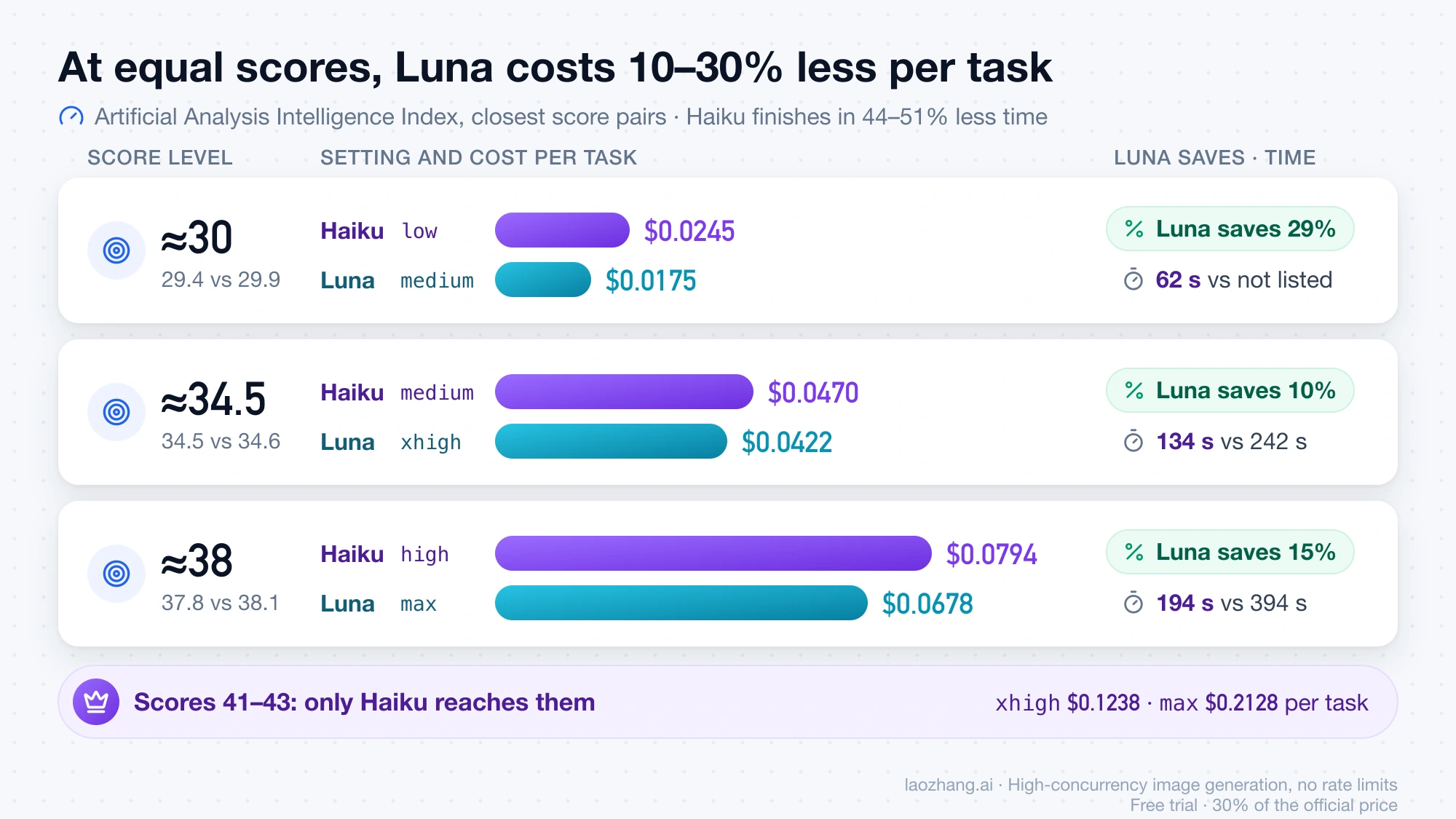
The chart shows Artificial Analysis v4.3.2 figures from October 8, 2026; the table above gives the v5.0 figures as of October 28, 2026.
Latency splits the other way for short calls. On the same page as of October 8, 2026, Luna's time to first token was 3.23 seconds at low and 0.87 seconds without reasoning, against 11.99 seconds for Haiku at low. For a chat reply or a one-shot classification, Luna answers sooner. For a multi-step task that runs for minutes, Haiku tends to finish first at the same quality.
Estimate your bill: worked Haiku 5.5 and GPT-6 Luna requests
Per-request cost on either model is:
(uncached input × input rate + cache reads × cache-read rate + cache writes × cache-write rate + output including thinking × output rate) ÷ 1,000,000
Use Haiku's over-100K rates for the whole request when the prompt exceeds 100,000 tokens, and Luna's over-272K rates when input exceeds 272,000 tokens. The examples below use standard-tier rates and leave caching out unless stated.
| Request | Claude Haiku 5.5 | GPT-6 Luna | Ratio |
|---|---|---|---|
| 10K input + 1K output | (10,000 × 0.10 + 1,000 × 0.50) ÷ 1M = $0.0015 | Same rates: $0.0015 | 1x |
| 99K input + 2K output | (99,000 × 0.10 + 2,000 × 0.50) ÷ 1M = $0.0109 | Same rates: $0.0109 | 1x |
| 150K input + 2K output | (150,000 × 0.50 + 2,000 × 2.50) ÷ 1M = $0.080 | (150,000 × 0.10 + 2,000 × 0.50) ÷ 1M = $0.016 | 5.0x |
| 300K input + 2K output | (300,000 × 0.50 + 2,000 × 2.50) ÷ 1M = $0.155 | (300,000 × 0.20 + 2,000 × 0.75) ÷ 1M = $0.0615 | 2.5x |
| 150K prompt: 140K cache reads + 10K new input + 2K output | (140,000 × 0.05 + 10,000 × 0.50 + 2,000 × 2.50) ÷ 1M = $0.017 (cache reads count toward 100K) | (140,000 × 0.01 + 10,000 × 0.10 + 2,000 × 0.50) ÷ 1M = $0.0034 | 5.0x |
Rates in the formulas are USD per million tokens.
The cached row is the one to watch in agent loops. Because cache reads count toward Haiku's 100K threshold, that request pays the over-100K rates on every token: $0.017, five times Luna's $0.0034, even though both read most of the prompt from cache. If your prompts sit near 100K, trimming history or tool output below the line keeps Haiku at its base rates.
A high-volume example shows how the base rates scale. One million classification requests, each with 2,000 input tokens and 300 output tokens:
- Either model, standard: (2,000 × 0.10 + 300 × 0.50) ÷ 1M = $0.00035 per request, or $350 per million requests.
- Either model, batch (Luna's Flex tier is the same price): $175.
- Claude Haiku 4.5, for comparison: (2,000 × 1 + 300 × 5) ÷ 1M = $0.0035 per request, or $3,500.
Thinking changes that picture fast. If each response adds 500 thinking tokens, output rises to 800 tokens and the standard cost becomes (2,000 × 0.10 + 800 × 0.50) ÷ 1M = $0.0006 per request, or $600 per million. That is why the effort setting matters more than the rate card for short tasks: set Luna to none or low and Haiku to low (or turn Haiku's thinking off), then measure real output tokens on a few hundred production requests before committing.
Two token-count caveats apply. Haiku 5.5 uses Anthropic's newer tokenizer, so the same text counts as roughly 30% more tokens than on Haiku 4.5; Anthropic says the exact increase depends on the content. Neither vendor publishes how its token counts compare with the other's, so count your own prompts on both models rather than assuming the same text is the same number of tokens.
Cost per accepted result: when Haiku's higher pass rate pays off
Token cost per attempt is only half the decision. What you actually pay for is a result you can use:
cost per accepted result = (model cost per attempt + other cost per attempt) ÷ acceptance rate
"Other cost" is whatever each attempt costs you outside the API bill: a human check, a retry in your pipeline, a failed downstream step.
Here is an illustration with assumed numbers. Take Artificial Analysis' default-effort costs on its v5.0 index ($0.0918 for Haiku, $0.0422 for Luna) and suppose your own evaluation shows Haiku accepted on 80% of attempts and Luna on 65%.
- No other cost per attempt: Haiku 0.0918 ÷ 0.80 = $0.115 per accepted result; Luna 0.0422 ÷ 0.65 = $0.065. Luna wins clearly.
- $0.25 of review per attempt: Haiku (0.0918 + 0.25) ÷ 0.80 = $0.427; Luna (0.0422 + 0.25) ÷ 0.65 = $0.450. Haiku wins.
- Break-even: 0.65 × (0.0918 + R) = 0.80 × (0.0422 + R) gives R ≈ $0.17 per attempt.
The rule that falls out: once each attempt costs you more in human or pipeline time than the break-even point (about $0.17 with these rates), a measurable gap in acceptance rate outweighs Haiku's higher token bill. When outputs flow straight into an automated system and failures are cheap to retry, Luna's lower cost per attempt wins. The acceptance rates in this example are assumptions. Measure yours on your own tasks at the effort level you plan to ship.
Which to trial first: Haiku 5.5 or GPT-6 Luna by workload
| Workload | Trial first | Why | Starting setting |
|---|---|---|---|
| Classification, tagging, routing, short extraction at high volume | GPT-6 Luna | Same rates, lowest cost per task at low, faster first token | Luna low or none; challenge with Haiku low |
| Prompts between 100K and 272K tokens | GPT-6 Luna | Haiku bills the whole request at 5x; Luna stays at base rates | Luna medium |
| Prompts above 272K tokens | GPT-6 Luna | 2.5x cheaper in the 300K example above | Luna medium |
| Business workflow automation | GPT-6 Luna | Leads Haiku on AutomationBench-AA at every effort except low | Luna medium or high |
| Computer use and browser use | Claude Haiku 5.5 | 72.4% vs 48.9% on Anthropic's OSWorld offline subset; new computer and browser toolsets | Haiku medium |
| Sub-agents in a Claude-based agent stack | Claude Haiku 5.5 | Anthropic positions it as a sub-agent for Opus 5.5 and Sonnet 5.5 on coding work | Haiku medium |
| Multi-step tasks where wall-clock time matters | Claude Haiku 5.5 | 46–50% less time per task at matched scores; at medium also cheaper than the closest Luna setting | Haiku medium or high |
| Quality above Luna's ceiling | Claude Haiku 5.5, or a larger model | Only Haiku reaches index scores above 28 (30 to 36) | Haiku xhigh, then compare with Sonnet 5.5 |
| Chat replies where first-token latency matters | GPT-6 Luna | 3.23 s at low vs 11.99 s for Haiku low (October 8, 2026) | Luna low |
Two cautions on that table. Anthropic itself says Sonnet 5.5 and Opus 5.5 remain the better choices for complex agentic coding of the kind Terminal-Bench measures, so treat Haiku's lead over Luna there as a ranking between small models, not a reason to downgrade a coding agent. And if you are still choosing within OpenAI's lineup, GPT-6 Sol vs Terra vs Luna vs Astra: Which Model Should You Use? covers when Luna is the right OpenAI model in the first place.
Routing between the two is often better than picking one. A practical split is to send short, cheap-to-retry requests to Luna, send computer-use steps and long agent sub-tasks to Haiku, and keep any request above 100K tokens off Haiku. If you only need Luna through an OpenAI-compatible endpoint, the laozhang.ai model list carries gpt-6-luna at the same $0.10/$0.50 rates with the same 272K tier. Its Claude models, paused for capacity earlier in October, returned on October 18, 2026, and as of October 28 the same list carries claude-haiku-5-5 at Anthropic's $0.10 input and $0.50 output rates.
Disclosure: laozhang.ai is our own service. Its prices are platform pricing, not an independent comparison.
Switching models: settings that cause 400 errors or change cost
Moving a prompt to Claude Haiku 5.5
Anthropic's Haiku 5.5 migration guide lists the breaking changes. The ones that hit code written for Haiku 4.5 or for OpenAI models:
- Model ID:
claude-haiku-5-5. It is a fixed ID with no date suffix and no separate alias. - Sampling parameters: remove
temperature,top_pandtop_k. Any non-default value returns a 400 error. - Assistant prefill: a final assistant turn returns a 400 error, even with thinking off. End
messageswith a user turn. - Thinking budget:
thinking: {"type": "enabled", "budget_tokens": N}returns a 400 error. Use adaptive thinking and setoutput_config.efforttolow,medium,high,xhighormax. - Thinking is on by default and counts toward
max_tokens. A smallmax_tokenscan stop the response after a thinking block and before any text. Thinking can be disabled only athigheffort or below. - Computer use: on the Claude API and Google Cloud, use the
computer_toolset_20260801toolset. The oldercomputer_20250124tool returns a 400 error. - Refusals: safety classifiers can end a response with
stop_reason: "refusal", and there is no server-side fallback. Handle it in code. - Token counts: recount prompts with the model set to
claude-haiku-5-5instead of reusing Haiku 4.5 counts, then revisitmax_tokensand cost estimates.
Moving a prompt to GPT-6 Luna
- Model ID:
gpt-6-luna. Don't confuse it withgpt-5.6-luna, which OpenAI still lists at $0.20 input and $1.20 output. - Effort levels:
reasoning.effortacceptsnone,low,medium(default),high,xhighandmax. Luna supportsnone; GPT-6.1 Sol does not. - Tool calling: in Chat Completions, Luna supports function calling only with
reasoning_effort: "none". Use the Responses API for reasoning with tools. - Sampling parameters: when effort is anything other than
none, removetemperature,top_pandtop_logprobs. - Tiers: Batch and Flex cost 50% of Standard; Fast mode costs 2x and isn't available with EU data residency for Luna. Regional processing adds 10%.
These details come from OpenAI's GPT-6 Luna model page and its latest-model migration guide.
Haiku 5.5 in Claude Code and Claude.ai, Luna in ChatGPT Free and Go
If you use the apps rather than the API, the small model you get changed this week on both sides.
- Claude.ai: Free, Pro, Max, Team and Enterprise users can select Haiku 5.5 on web, iOS and Android.
- Claude Code: the
haikualias resolves to Haiku 5.5 on the Anthropic API and needs Claude Code v2.1.293 or later; runclaude updateif you're behind. On Amazon Bedrock, Google Cloud, Microsoft Foundry and Claude Platform on AWS, the same alias still resolves to Haiku 4.5, according to Claude Code's model configuration docs. - ChatGPT Chat tab: OpenAI's October 7 announcement says GPT-6 in Chat is powered by GPT-6 Luna for Free and Go users, with the rollout to those tiers starting October 8, 2026, and by GPT-6 Sol for paid tiers. OpenAI describes both as "tuned for everyday conversation", and its safety page calls the Chat version "GPT-6 Luna (October)", so don't assume Chat behaves exactly like the API model.
- ChatGPT Work and Codex: OpenAI says the models there are not changing with this release. Luna is already available in Work and Codex, including for Free and Go users in the desktop app at standard speed, subject to rollout.
App plans bill by subscription rather than by token, so what you see in Claude.ai or ChatGPT says little about API cost. For that, use the per-task numbers above.
FAQ: Claude Haiku 5.5 vs GPT-6 Luna
Do cached tokens count toward Claude Haiku 5.5's 100K price threshold?
Yes. Anthropic's pricing page says a request's prompt length "counts all of its input tokens, including cache reads and cache writes." Each request is priced on its own: a request over 100,000 tokens pays the higher prices even when part of its prompt is a cache hit, and earlier requests keep the prices they were billed at. In a long agent session, every turn whose total input passes 100K is billed at the over-100K rates, so trim or compact history if you want those turns back on the base rates.
Should Haiku 4.5 users move to Haiku 5.5 or to GPT-6 Luna?
For prompts under 100K tokens, either move cuts list rates by 90%: the classification example above drops from $3,500 to $350 per million requests on both, before any difference in token counts. Haiku 5.5 keeps your code on the Claude API, but the migration still involves the 400-error changes listed above. Luna wins on cost per task at the same effort setting and on prompts above 100K. Anthropic lists Haiku 4.5's retirement as not sooner than October 15, 2026, so plan the test now.
Is GPT-6 better than Claude overall?
At the small-model tier, Haiku 5.5 outscores GPT-6 Luna on most published benchmarks while costing more per task, as shown above. At the flagship tier the trade-off is different; see Claude Opus 5.5 vs GPT-6.1 Sol and GPT-6 Sol: When Opus Pays Off.
Is Claude Haiku 5.5 faster than GPT-6 Luna?
It depends on the length of the job. Artificial Analysis measured higher output speed for Haiku at every effort level where both are published (175 tokens per second at medium and 241 at max as of October 28, 2026, against 116–124 for Luna) and shorter time per task at matched scores. Luna returns its first token much sooner on short requests: as of October 8, 2026, 3.23 seconds at low against 11.99 seconds for Haiku at low.
Sources9
External pages this guide links to, in the order they appear. Last updated Oct 28, 2026.
Sources9
External pages this guide links to, in the order they appear. Last updated Oct 28, 2026.
- 1.Anthropic's Claude API pricingplatform.claude.com/docs/en/about-claude/pricing
- 2.OpenAI's API pricingdevelopers.openai.com/api/docs/pricing
- 3.service tiers pageplatform.claude.com/docs/en/api/service-tiers
- 4.Claude Haiku 5.5 announcementanthropic.com/claude-haiku-5-5
- 5.Artificial Analysis' Haiku 5.5 vs GPT-6 Luna comparisonartificialanalysis.ai/models/releases/comparisons/claude-haiku-5-5-vs-gpt-6-luna
- 6.40-task Haiku 5.5 vs GPT-6 Luna testkingy.ai/blog/claude-haiku-5-5-vs-gpt-6-luna-benchmark
- 7.Haiku 5.5 migration guideplatform.claude.com/docs/en/models/haiku-5-5/migration-guide
- 8.OpenAI's GPT-6 Luna model pagedevelopers.openai.com/api/docs/models/gpt-6-luna
- 9.Claude Code's model configuration docscode.claude.com/docs/en/model-config