GPT-5.5 vs Claude Opus 4.7: API Costs and Which to Test First
Both APIs are available. GPT-5.5 is the first test for an existing Responses integration; Opus 4.7 has lower standard output rates and no long-input premium. Choose on accepted-task cost, not a universal coding ranking.
On this page
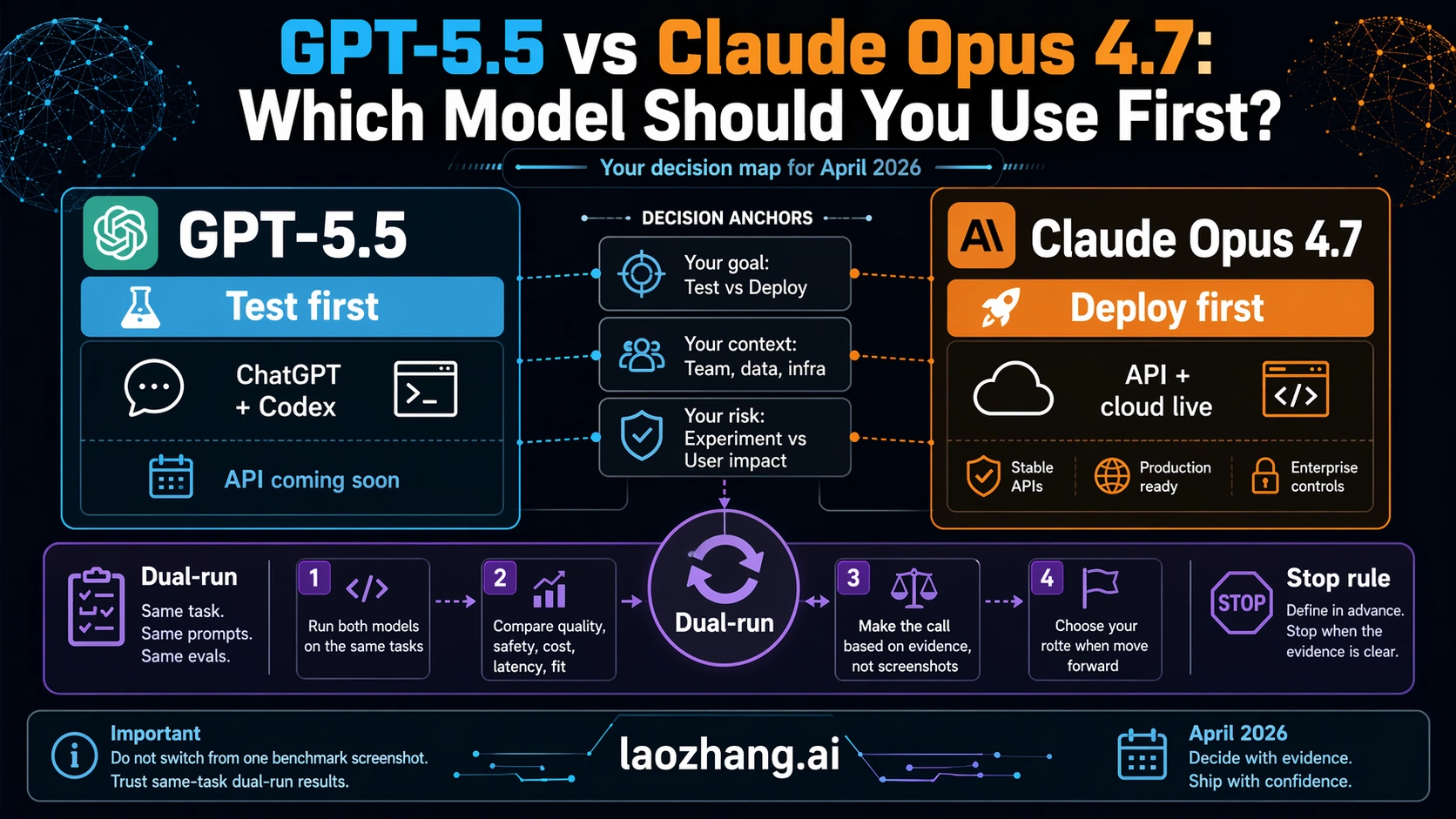
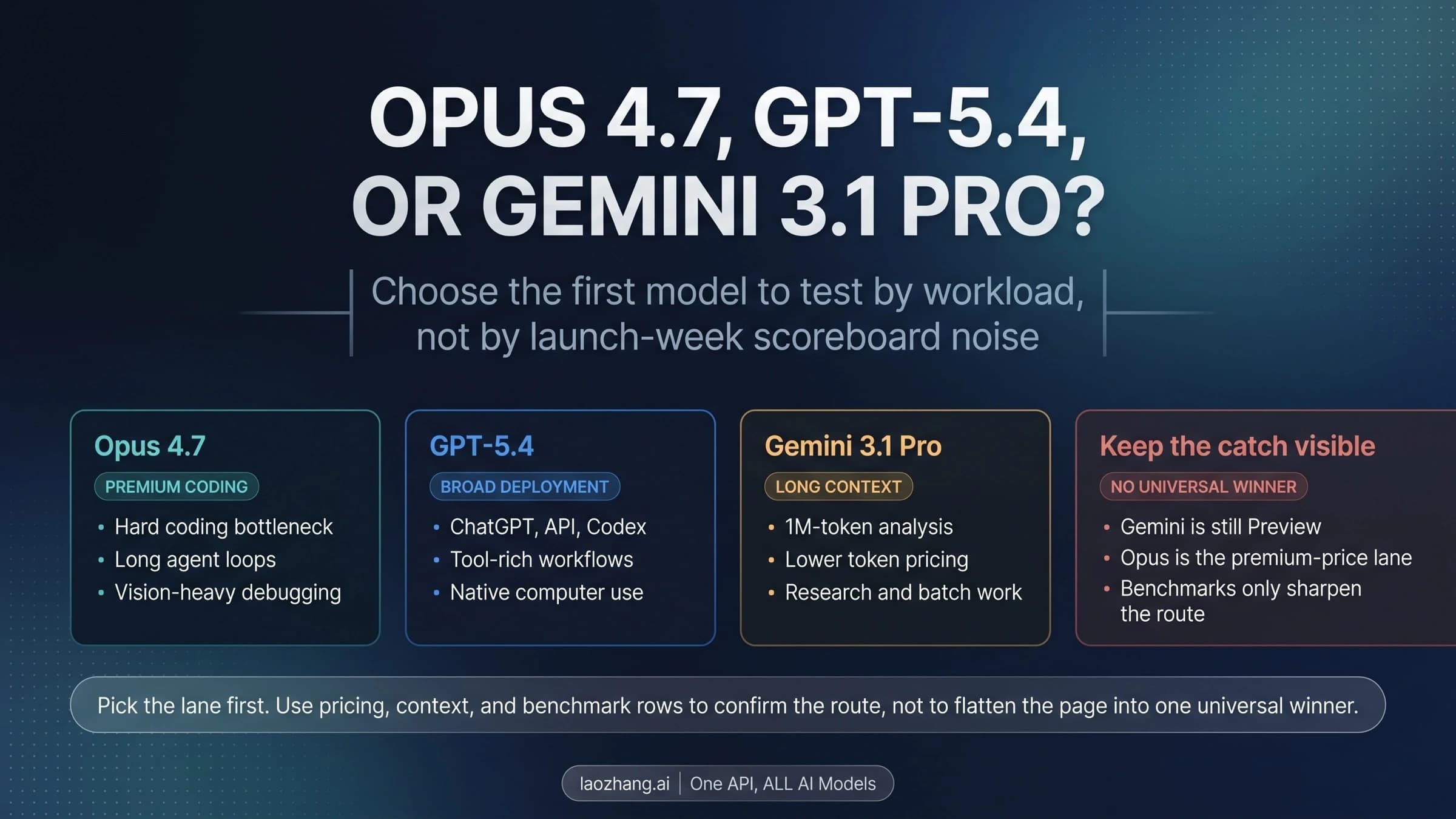
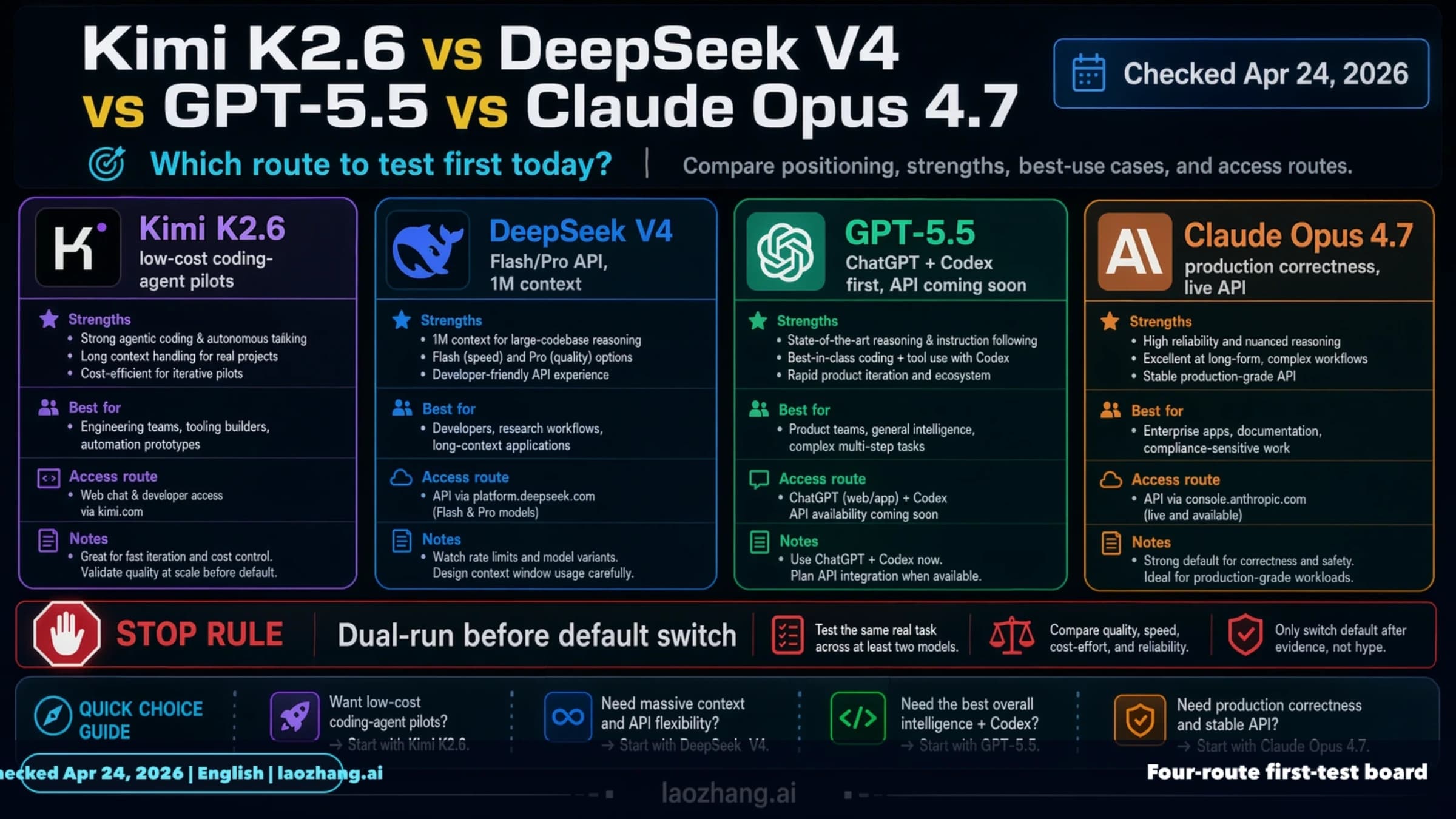
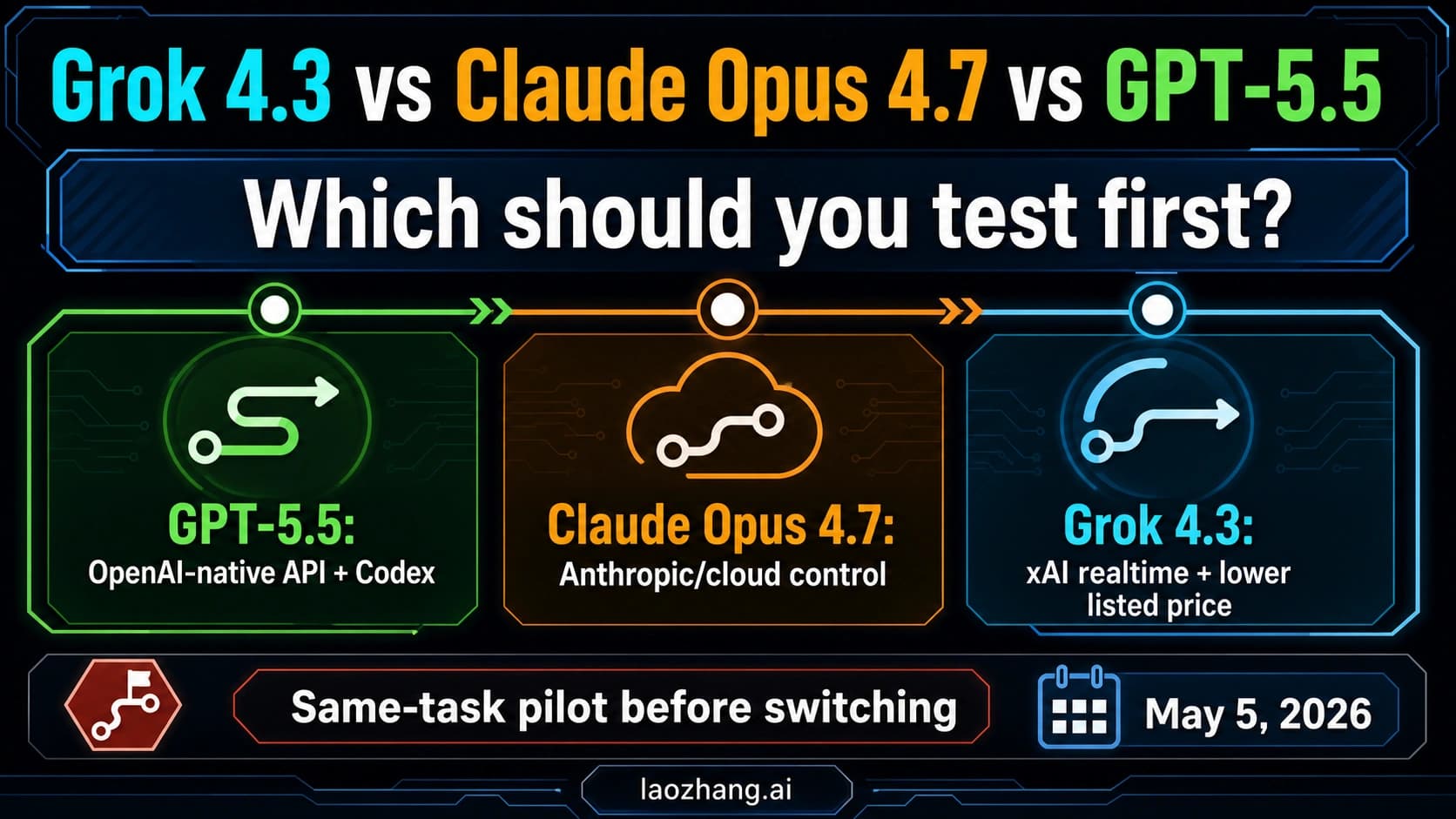
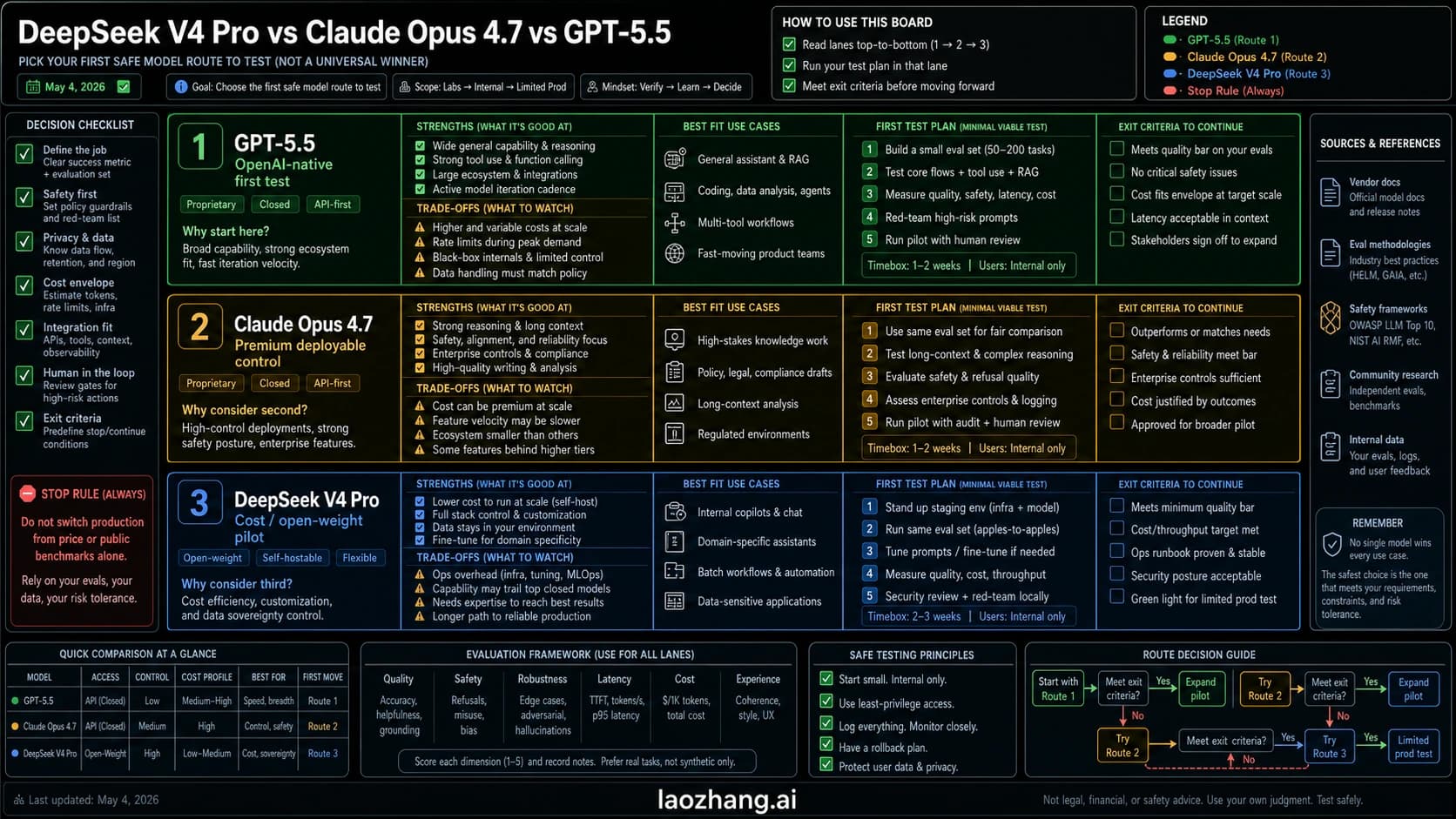
Start with GPT-5.5 if your application already uses OpenAI Responses; start with Claude Opus 4.7 if it already uses Claude Messages. For a new integration dominated by long inputs or substantial generated output, Opus 4.7 is the more economical first candidate at standard token rates. For coding agents, neither a token-price table nor a public leaderboard establishes which model will deliver more accepted patches in your repository.
Both models now have documented API access. The April launch-time advice to wait for GPT-5.5's API is obsolete. A separate change matters for people comparing ChatGPT or Codex with Claude Code: GPT-5.5 retires from ChatGPT, ChatGPT Work, and Codex on October 14, 2026, but that retirement does not apply to the OpenAI API. Do not build a new GPT-5.5 UI workflow around tomorrow's retired selection. See the GPT-5.5 API card and official retirement notice.
This comparison covers the exact API models gpt-5.5 and claude-opus-4-7, using documentation and published measurement data checked October 13, 2026. The cost examples are calculations under stated assumptions, not invoices or model tests.
Which model should you evaluate first?
The first useful choice is the model you can evaluate without changing everything around it. Keep your files, tool permissions, acceptance tests, and review process stable; adapt the request fields each provider actually supports.
| Your starting point | First candidate | Reason to start there | What would change the decision? |
|---|---|---|---|
| An existing OpenAI Responses application | GPT-5.5, initially at medium reasoning effort | You can preserve the existing integration while establishing a fresh prompt baseline. | Opus delivers more accepted results or lower total cost after accounting for the integration change. |
| An existing Claude Messages agent | Opus 4.7; explicitly enable adaptive thinking when needed | You can preserve your typed content blocks and tool loop. | GPT reduces failures, repeated calls, or review time enough to offset its rates and migration work. |
| A new long-document or output-heavy API workflow | Opus 4.7 as the cost baseline | Standard output costs $25 rather than $30 per million tokens, and its full 1M context uses standard rates. | GPT completes the task with fewer billed tokens or better acceptance, making the finished job cheaper. |
| A new coding agent without a provider commitment | Evaluate both against the same repository tasks | Current public evidence does not establish a general coding winner for this pair. | One consistently passes your tests with less intervention and lower cost per accepted patch. |
| GPT-5.5 in ChatGPT or Codex | Plan the UI replacement now | The October 14 retirement applies to those products. | An API integration is a separate decision and is excluded from this retirement. |
The price rationale comes from the OpenAI price list and Claude price list. The starting settings follow OpenAI's GPT-5.5 guidance and Anthropic's Opus 4.7 effort recommendations. These are evaluation starting points, not measured quality rankings.
API availability, model IDs, and context limits
GPT-5.5 supports Responses, Chat Completions, and Batch. OpenAI recommends Responses for reasoning, tools, and multi-turn workflows. Its published context window is 1,050,000 tokens, with a separate maximum output of 128,000 tokens. That does not mean you can fill the entire window with input and then add the maximum output: reserve space for generated reasoning and answers. See the model specifications and reasoning guide.
For reproducible evaluations, OpenAI lists the snapshot gpt-5.5-2026-04-23. Claude's native ID is claude-opus-4-7. Despite having no date suffix, it identifies a pinned snapshot; it is not an alias that silently advances to Opus 5.5. Anthropic fixes the weights and configuration for that ID, while serving infrastructure can still change. See Claude model IDs and versions.
The Opus 4.7 card lists a 1M context window, 128K standard maximum output, and text/image input with text output. GPT-5.5 also accepts text and images and produces text. Image-generation tools are separate capabilities; accepting an image does not make either text model a native image generator.
Opus 4.7 remains available, with Active (legacy) on its card and Active in the lifecycle table. Legacy means it no longer receives updates and may be deprecated later. The published retirement boundary is no sooner than April 16, 2027 on Anthropic-operated platforms, not a fixed shutdown appointment. Amazon Bedrock and Google Cloud can set different schedules. Use the current lifecycle table for the platform you deploy on.
Published availability is also distinct from your account's authorization and rate limits. GPT-5.5's card explicitly lists the Free API tier as unsupported. Generic quickstart examples about a free first call do not establish free access to this model.
Pricing: calculate the whole request, then the finished task
The following are direct-provider standard rates in USD per million tokens, checked October 13, 2026. They exclude tools, taxes, regional adjustments, retries, and subscription credits.
| Token category | GPT-5.5, input ≤272K | GPT-5.5, input >272K | Claude Opus 4.7, full 1M context |
|---|---|---|---|
| Uncached input | $5 | $10 | $5 |
| Cached input read | $0.50 | $1 | $0.50 |
| 5-minute cache write | No additional write charge | No additional write charge | $6.25 |
| 1-hour cache write | No additional write charge | No additional write charge | $10 |
| Generated output, including billed thinking | $30 | $45 | $25 |
OpenAI defines short input as ≤272K tokens and long input as >272K. Its GPT-5.5 card says the 2× input and 1.5× output rates apply to the full session for Standard, Batch, and Flex when that threshold is crossed. Anthropic includes Opus 4.7's full 1M context at standard rates, so an old assumption about a >200K Opus premium would overstate this model's cost. Sources: OpenAI pricing, GPT-5.5 pricing notes, and Claude pricing.
Two estimates that show when the difference matters
Assume a single request, standard processing, uncached input, and no regional or tool fees. Output below means all billed generated tokens, including thinking. Equal token counts are a calculation assumption, not a claim that the same text produces the same counts under both tokenizers.
| Hypothetical request | GPT-5.5 calculation | Opus 4.7 calculation |
|---|---|---|
| 60,000 input + 6,000 output tokens | 0.06 × $5 + 0.006 × $30 = $0.48 | 0.06 × $5 + 0.006 × $25 = $0.45 |
| 450,000 input + 20,000 output tokens | 0.45 × $10 + 0.02 × $45 = $5.40 | 0.45 × $5 + 0.02 × $25 = $2.75 |
For the smaller request, a three-cent rate advantage could easily disappear if Opus needs an extra attempt. In the long-input case, the pricing threshold creates a much larger difference before output quality enters the calculation. Use each provider's actual usage counts, rather than multiplying characters by one shared token estimate.
At the short-context output rates, $25 is 16.7% lower than $30; $30 is 20% higher than $25. “Opus is 20% cheaper” uses the wrong denominator. Neither percentage describes total task savings.
The metric that ultimately matters is:
Cost per accepted result =
  (all model calls + tools + retries + review/rework cost)
  / number of results that meet your acceptance criteria
Keep token-only cost and human time visible separately if you cannot assign a defensible dollar value to review. An inexpensive answer that needs rewriting is not an inexpensive completed task.
Cache, Batch, and region can change the estimate
GPT-5.5 caches eligible prefixes automatically, without explicit breakpoints or an added cache-write fee. A stable prompt_cache_key helps cache routing. The supported retention setting is "24h", but the documented lifetime is typically about 30 minutes and up to 24 hours, not guaranteed storage for a full day. Do not import the newer GPT-5.6 cache-write rules into GPT-5.5. See OpenAI's model-specific cache differences.
Opus 4.7 charges separately for writes and hits. For a repeated document, include the initial write and later reads before claiming a saving. A cache-enabled request is not proof of a hit; inspect reported usage.
For OpenAI Responses, cached tokens are included in usage.input_tokens: subtract usage.input_tokens_details.cached_tokens before charging the uncached portion. Reasoning tokens are already included in usage.output_tokens, so adding them again would double-count. Claude reports ordinary input, cache-read input, and cache-creation input as separate categories. Use the relevant write duration and rates. The field examples appear in OpenAI's reasoning guide and Claude's pricing documentation.
GPT-5.5 Batch and Flex short-context rates are $2.50 input, $0.25 cached input, and $15 output; their long-context rates are $5, $0.50, and $22.50. Opus 4.7 Batch discounts input and output by 50%, to $2.50 and $12.50. These processing options have different operating conditions, so do not assume the cheaper mode fits an interactive agent. GPT-5.5 Fast short-context rates are $12.50/$1.25/$75; Opus 4.7 does not support Fast mode. See the OpenAI modes and Claude feature pricing.
OpenAI charges a 10% uplift for GPT-5.5 regional processing. Anthropic charges 1.1× across token categories for Opus 4.7 with inference_geo: "us"; global is the standard-rate default. Partner-cloud pricing must be checked separately. A residency price option alone does not establish compliance for your application.
Coding and agentic work: useful controls, limited ranking evidence
For GPT-5.5, begin with reasoning.effort: "medium" and a concise statement of the required outcome. OpenAI recommends increasing to high or xhigh when evaluation shows a worthwhile gain. Its supported values also include low and none; max is not a GPT-5.5 effort value. Preserve the requirements that make a patch acceptable, without carrying over every instruction from an older prompt stack. See Using GPT-5.5.
For an Opus 4.7 coding agent, Anthropic recommends starting at xhigh, with enough generation space; its guidance suggests 64K max_tokens as a starting point at xhigh or max. The API effort default is high, and thinking defaults off. Enable thinking: {"type": "adaptive"} when you want adaptive thinking, and place effort under output_config. Older thinking.type: "enabled" plus budget_tokens requests are rejected by 4.7. The effort levels are behavioral controls, not fixed allocations of 5,000, 10,000, or 20,000 thinking tokens. See effort guidance and thinking configuration.
The providers' effort names do not specify equal compute. A comparison of GPT at high and Opus at max can be useful, but it is not a comparison of default settings or equal spending.
The Artificial Analysis comparison, read October 13, uses GPT-5.5 High versus Opus 4.7 Max. Its Intelligence Index v4.3.2 shows 37 versus 41, with the Opus score marked estimated, pending independent evaluation. Its current pair table has no Opus result for Terminal-Bench 4.0 or SciCode. Those gaps do not support a general coding winner.
That same comparison reports 88.2 versus 51.0 output tokens/second, yet its calculated 500-token end-to-end times are 36.20 versus 33.38 seconds. GPT decodes faster, while the waiting time changes the short-answer result. These setting-specific measurements are useful test hypotheses, not latency guarantees. Its blended $4.35/$3.85 prices use a 7:2:1 cache/input/output mix, not the ordinary input rate.
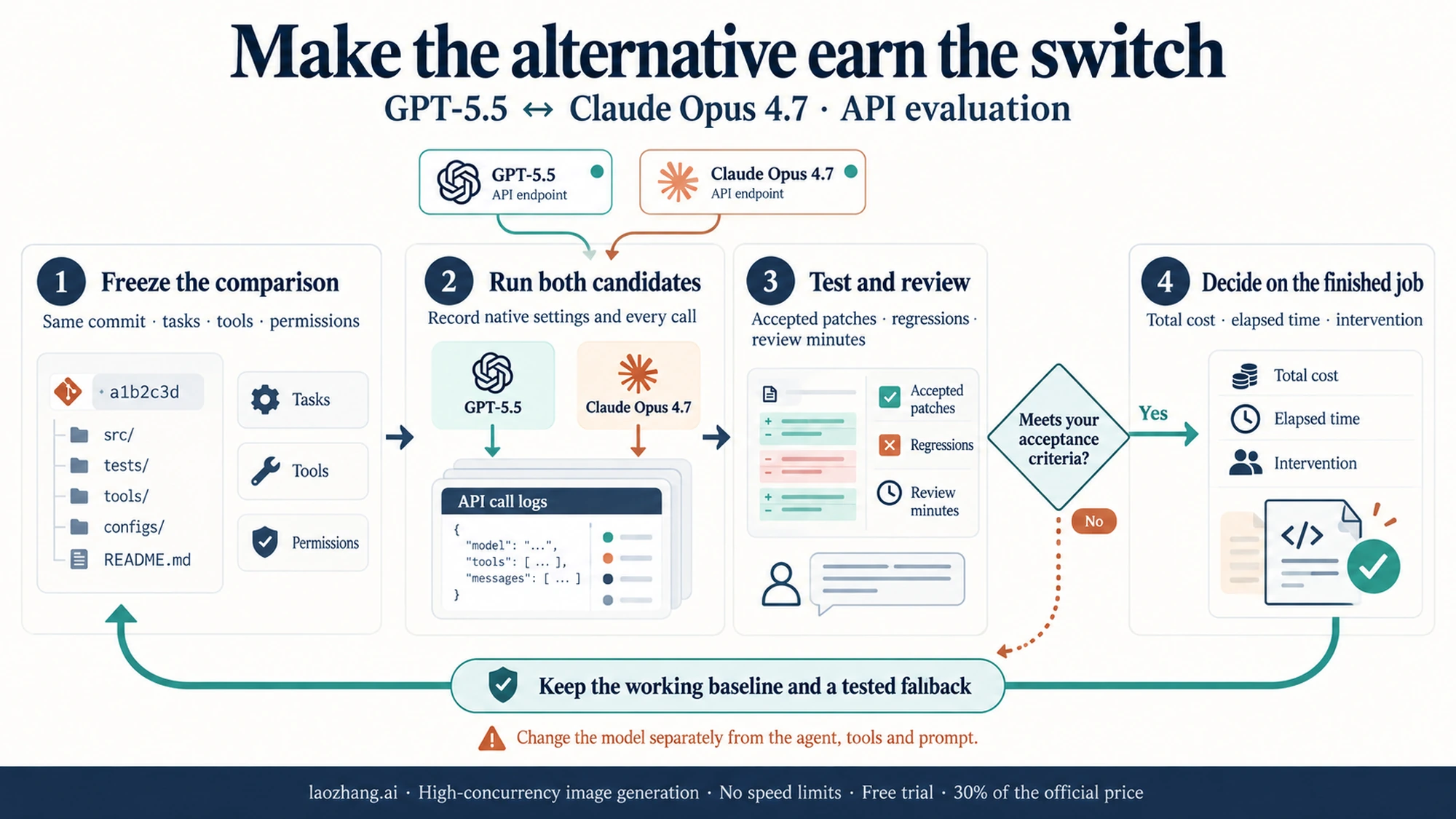
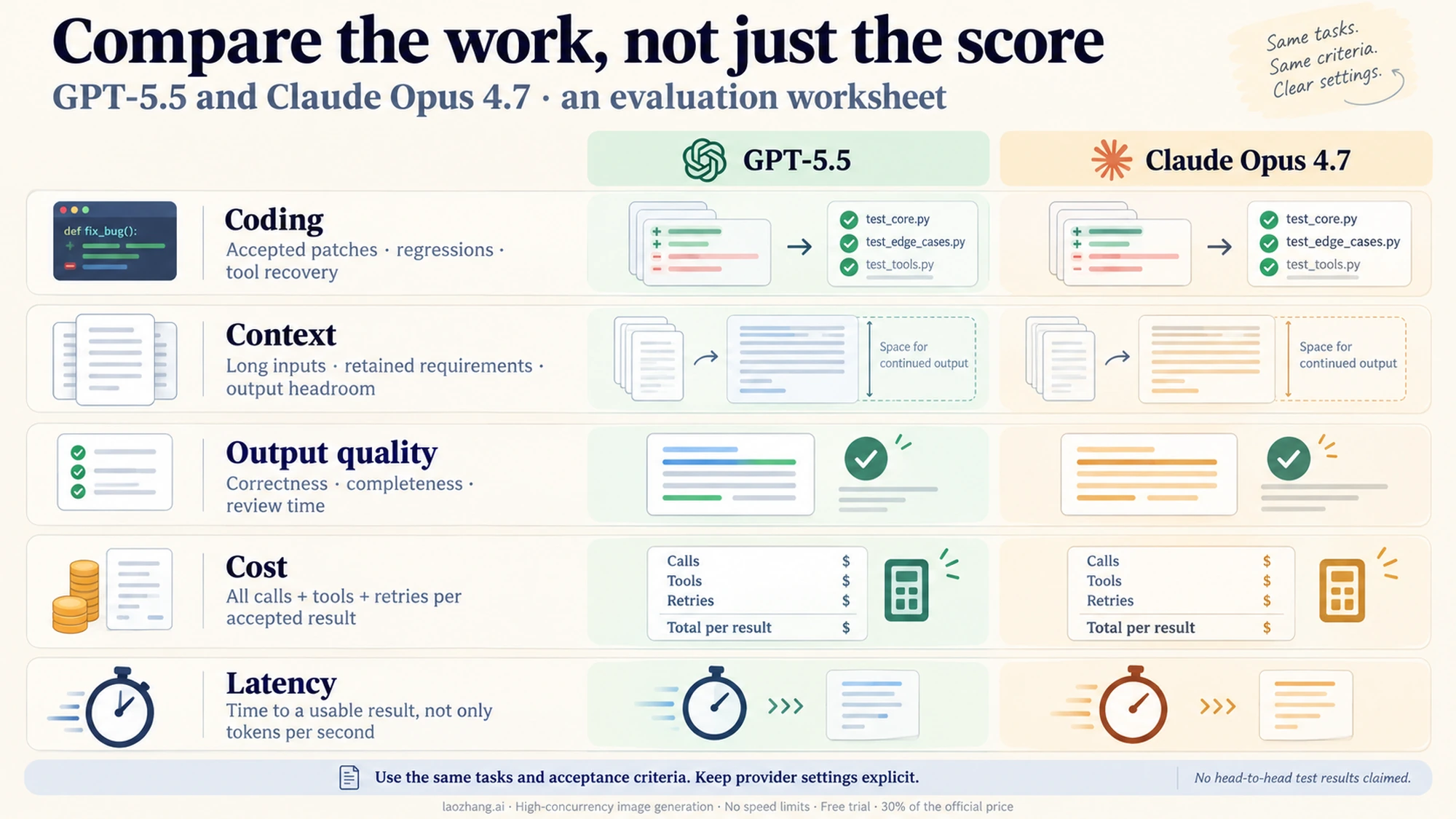
For your coding decision, evaluate both from the same repository commit on tasks whose failure you can recognize: a bug with a reproducing test, a change spanning modules, and a tool failure that requires recovery. Define the acceptable behavior before reading the patches. Count regressions and unauthorized changes as failures even when the requested feature works. Track accepted patches, review minutes, repeated calls, token categories, and elapsed time through the final usable result.
Keep provider-native settings explicit and compare both a practical starting configuration and the best configuration within your budget. If you change the agent software, tool set, prompt, and model together, the result measures the package rather than the model alone. A model-only API comparison cannot establish that Codex is better than Claude Code, or the reverse.
Task budgets help pacing, not invoice enforcement
Opus 4.7 supports the task-budgets-2026-03-13 beta with an output_config.task_budget spanning an agentic loop. Its minimum total is 20,000 tokens. The target includes thinking, tool calls, tool results, and output, but it is advisory and can be exceeded. The remaining countdown is not returned in response usage. It also does not apply to the Claude Code or Cowork interfaces. See Anthropic task budgets.
max_tokens is a hard generated-token limit for one Claude request, not a dollar limit across a multi-request agent. Similarly, OpenAI's max_output_tokens includes reasoning and visible output in one response. Either can leave you with a paid but unfinished answer. For an application spending ceiling, stop initiating new requests when your own cost, step, or time allowance is exhausted, and account for in-flight requests and tool charges.
Native API examples for the exact pair
These are documentation-based Python examples for a small, text-only review task. They have not been executed against either API. They do not attach a repository or run tools; an agent needs an additional tool loop and appropriate permissions.
Use a server-side Python environment with the official openai or anthropic package installed, respectively. The clients read OPENAI_API_KEY and ANTHROPIC_API_KEY from the environment. Your key must have access to the selected model and available API funding; a ChatGPT or Claude UI subscription alone is not that authorization. Follow the OpenAI quickstart or Claude quickstart for SDK setup. Never put the key into client-side code.
GPT-5.5 through Responses
from openai import OpenAI

client = OpenAI()
request = """Review this proposed CLI behavior:
An import command accepts a CSV file and writes records to a database.
It silently skips malformed rows and returns exit code 0.
Identify the failure users may miss, then propose acceptance tests.
Do not claim to have run tests or inspected a real repository."""

response = client.responses.create(
    model="gpt-5.5-2026-04-23",
    input=request,
    reasoning={"effort": "medium"},
    text={"verbosity": "low"},
    max_output_tokens=8192,
)

print("Model:", response.model)
print("Status:", response.status)
print("Usage:", response.usage)
if response.status != "completed":
    raise RuntimeError(
        f"Response unfinished: {response.incomplete_details}"
    )
if not response.output_text:
    raise RuntimeError("No final text returned")
print(response.output_text)
A completed status and nonempty answer establish only that a response arrived. Inspect whether it actually identifies the silent data-loss risk and proposes tests for malformed rows, partial imports, and the exit status. If the status is incomplete with reason max_output_tokens, the generated-token allowance ran out, potentially before visible text. Diagnose that result before raising the limit or retrying; reasoning already consumed may be billed. See OpenAI's output-budget behavior.
Claude Opus 4.7 through Messages
import anthropic

client = anthropic.Anthropic()
request = """Review this proposed CLI behavior:
An import command accepts a CSV file and writes records to a database.
It silently skips malformed rows and returns exit code 0.
Identify the failure users may miss, then propose acceptance tests.
Do not claim to have run tests or inspected a real repository."""

message = client.messages.create(
    model="claude-opus-4-7",
    max_tokens=8192,
    thinking={"type": "adaptive"},
    output_config={"effort": "high"},
    messages=[{"role": "user", "content": request}],
)

print("Model:", message.model)
print("Stop reason:", message.stop_reason)
print("Usage:", message.usage)
answer = "\n".join(
    block.text for block in message.content if block.type == "text"
)
if message.stop_reason != "end_turn":
    raise RuntimeError(f"Review unfinished: {message.stop_reason}")
if not answer:
    raise RuntimeError("No final text returned")
print(answer)
This small review uses high; the earlier xhigh recommendation concerns a coding agent doing substantial work. The code selects text blocks because thinking can precede the answer. If Claude stops at max_tokens, consider the thinking/output balance before treating partial text as a complete review. Leave deprecated temperature controls out of the 4.7 request. These behaviors are documented in the Claude API primer and thinking troubleshooting.
Changing only a model string in an OpenAI client does not create a native Claude Messages request. A gateway may adapt protocols, but verify its model identity, supported fields, tools, and billing contract separately before assuming these native examples carry over.
FAQ
Is GPT-5.5 still available through the API after October 14?
The October 14, 2026 retirement notice explicitly excludes the OpenAI API. It applies to ChatGPT, ChatGPT Work, and Codex on all plans. The API still has its own model access and lifecycle conditions. See the official notice.
Is Opus 4.7 cheaper than GPT-5.5?
At direct-provider standard rates, Opus 4.7 has lower output pricing: $25 versus $30 per million tokens for short-context GPT-5.5. GPT input over 272K uses $10 input and $45 output, while Opus 4.7 retains $5/$25 across its 1M context. Actual task cost also depends on token counts, caching, reasoning, repeated calls, and tools. Sources: OpenAI pricing and Claude pricing.
Which is better for enterprise AI agents or coding?
Choose the first evaluation from your existing integration and deployment requirements. Then compare accepted results under your own tool permissions, failure handling, review process, and cost limits. An estimated aggregate score or a faster decoding rate cannot establish enterprise reliability or a coding winner. This article does not report a head-to-head model test.
Does a Claude subscription include API credits?
Some now do, under specific conditions. The monthly API credits policy lists $100 for Max 5x and $200 for Max 20x. Team credits are $20 per Standard seat or $100 per Premium seat, pooled up to $500 monthly. Free, Pro, and Enterprise are ineligible for this offer.
Eligibility includes seven days on an active eligible plan, the required roles, and linking one Console organization under the credit terms. The balance expires each billing cycle and is separate from subscription usage limits. It covers eligible Claude Platform usage, not interactive Claude Code or partner clouds. Confirm your offer and balance before budgeting; it is not unlimited API usage.
Is GPT-5.5 Pro the same comparison at a higher effort setting?
No. gpt-5.5-pro is a separate model, supported through Responses and Batch. Standard short-context prices are $30 input and $180 output per million tokens, with no cached-input discount; long-context prices are $60/$270. Evaluate it separately only when the extra cost is justified by your acceptance results. See its model card and prices.
Claude Opus 5.5 is also a separate Anthropic model, not another spelling of GPT-5.5 or an automatic update to claude-opus-4-7.
What if the actual choice is Opus 4.6 versus 4.7?
That is a same-provider migration with different request compatibility and tokenization questions. Use the Opus 4.6-to-4.7 migration guide for that task. For this OpenAI-versus-Anthropic decision, preserve your working baseline until the alternative earns the switch on accepted results, total cost, and review time.
Sources19
External pages this guide links to, in the order they appear. Last updated Oct 13, 2026.
Sources19
External pages this guide links to, in the order they appear. Last updated Oct 13, 2026.
- 1.GPT-5.5 API carddevelopers.openai.com/api/docs/models/gpt-5.5
- 2.official retirement noticelearn.chatgpt.com/docs/models
- 3.OpenAI price listdevelopers.openai.com/api/docs/pricing
- 4.Claude price listplatform.claude.com/docs/en/about-claude/pricing
- 5.OpenAI's GPT-5.5 guidancedevelopers.openai.com/api/docs/guides/latest-model
- 6.Anthropic's Opus 4.7 effort recommendationsplatform.claude.com/docs/en/build-with-claude/effort
- 7.reasoning guidedevelopers.openai.com/api/docs/guides/reasoning
- 8.Claude model IDs and versionsplatform.claude.com/docs/en/about-claude/models/model-ids-and-versions
- 9.Opus 4.7 cardplatform.claude.com/docs/en/models/opus-4-7/overview
- 10.current lifecycle tableplatform.claude.com/docs/en/about-claude/model-deprecations
- 11.OpenAI's model-specific cache differencesdevelopers.openai.com/api/docs/guides/prompt-caching
- 12.thinking configurationplatform.claude.com/docs/en/build-with-claude/thinking-troubleshooting
- 13.Artificial Analysis comparisonartificialanalysis.ai/models/comparisons/gpt-5-5-high-vs-claude-opus-4-7
- 14.Anthropic task budgetsplatform.claude.com/docs/en/build-with-claude/task-budgets
- 15.OpenAI quickstartdevelopers.openai.com/api/docs/quickstart
- 16.Claude quickstartplatform.claude.com/docs/en/get-started
- 17.Claude API primerplatform.claude.com/docs/en/claude_api_primer
- 18.monthly API credits policysupport.claude.com/en/articles/17154008-monthly-api-credits-for-max-and-team-plans
- 19.model carddevelopers.openai.com/api/docs/models/gpt-5.5-pro