Gemini 4 Argon vs GPT-6 Astra: Which to Use Now and After Dec 1
GPT-6 Astra outscores Gemini 4 Argon 55 to 50 at the same high setting. Argon is cheaper at its default, but its API price doubles on December 1, 2026.
On this page
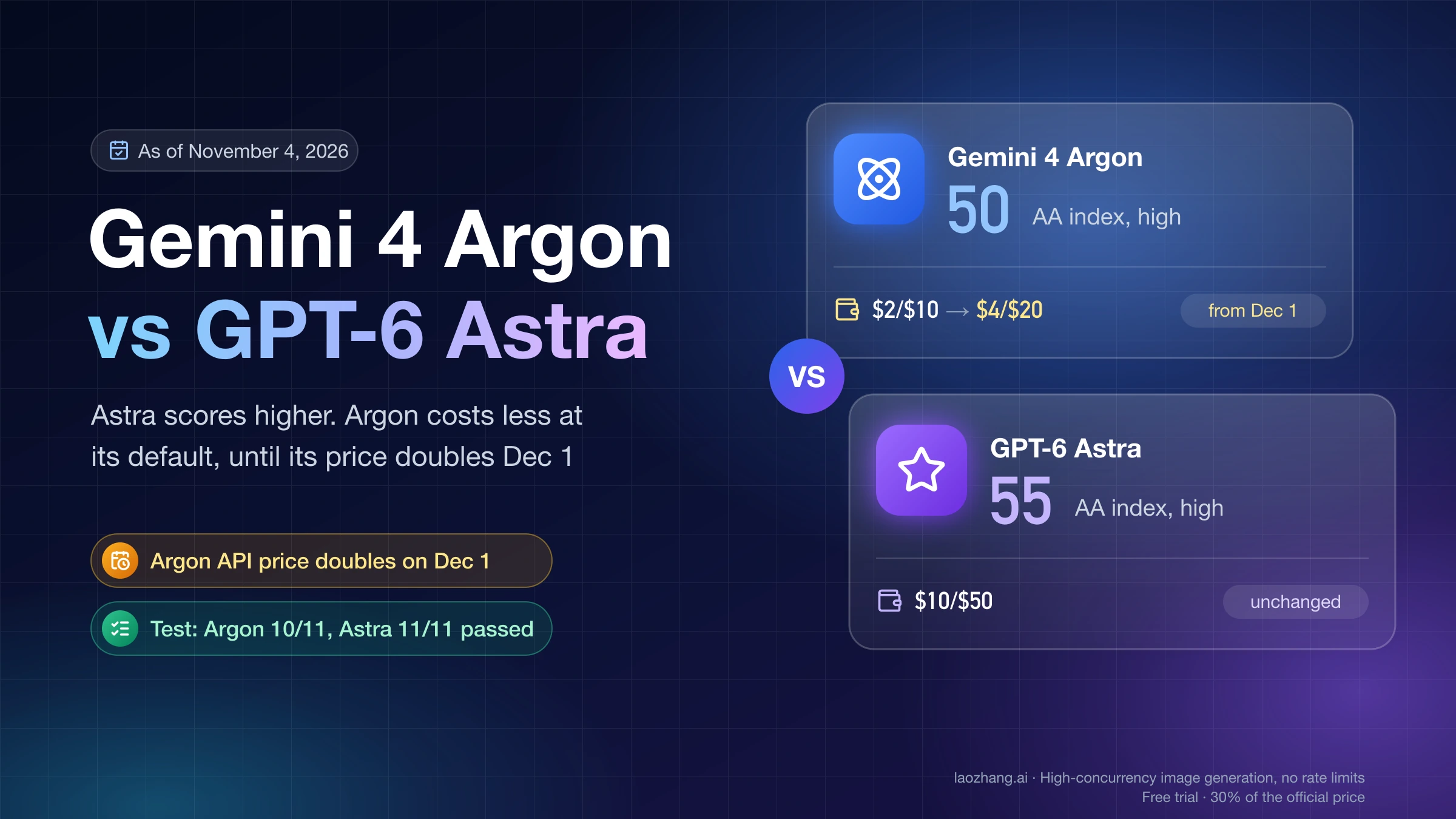
Use GPT-6 Astra (gpt-6-astra) when the answer has to be right the first time on hard, multi-step work, and use Gemini 4 Argon (gemini-4-argon) at its default thinking level for high-volume work that tests or a reviewer can check. As of November 4, 2026, the Artificial Analysis Intelligence Index v5.0.1 scores Astra 55 and Argon 50 at the same high setting, and Astra at medium (52) still beats Argon at high. Argon is not simply the weaker model, though: it leads AA's AutomationBench and Terminal-Bench 4.0 evaluations, and it ranks above Astra on the Vals Index.
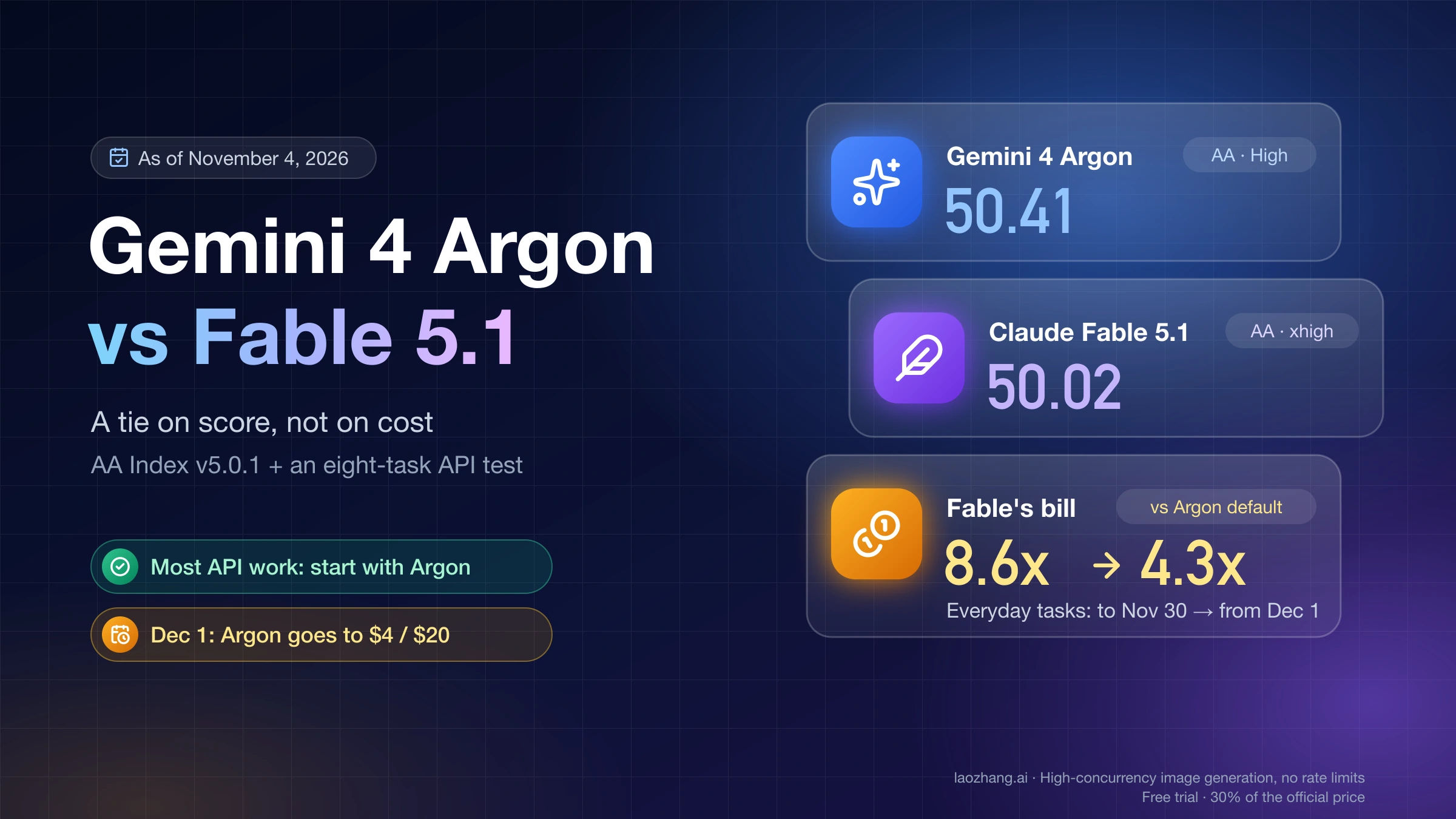
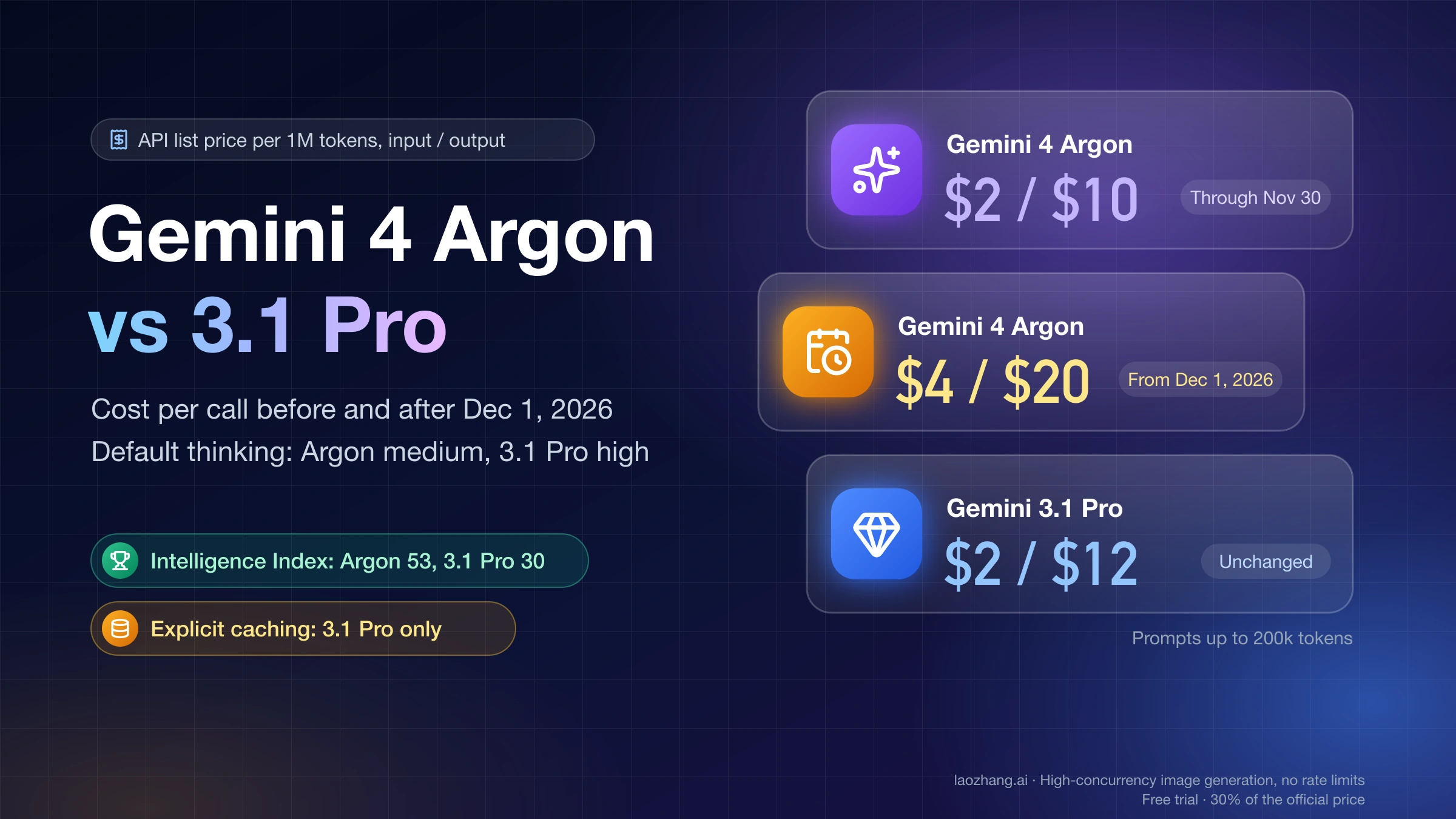
Price settles the rest, and Argon's price changes on December 1, 2026, when its API rate goes from $2 input and $10 output per million tokens to $4 and $20, while Astra stays at $10 and $50. In a same-prompt test on November 4 through the LaoZhang API, Argon at its default setting passed 10 of 11 graded answers against Astra's 11 of 11 for about a quarter of Astra's cost, and it stays at about half from December 1. At high, Argon wrote 4.2 times as many output tokens as Astra, so its lower rate barely helps now and Astra becomes the cheaper of the two from December 1. The often-quoted "Argon is the cheaper equal" was true on AA's October index at Argon's launch price, and neither condition holds today.
Disclosure: laozhang.ai is our own service. Its prices are platform pricing, not an independent comparison.
Two kinds of work change the pick. Prompts above 272,000 input tokens make Astra bill the whole request at long-context rates, while Argon keeps one price. Exact counting over long, noisy input is the other: Argon at its default answered a log question in 7 seconds with all five error counts 20–37% too low, while Astra was right at both settings. If your traffic is mostly one of those, read those sections first, and rerun 10–20 of your own prompts on both models before December 1.
Is Gemini 4 Argon better than GPT-6 Astra? Not on AA's index: 55 vs 50
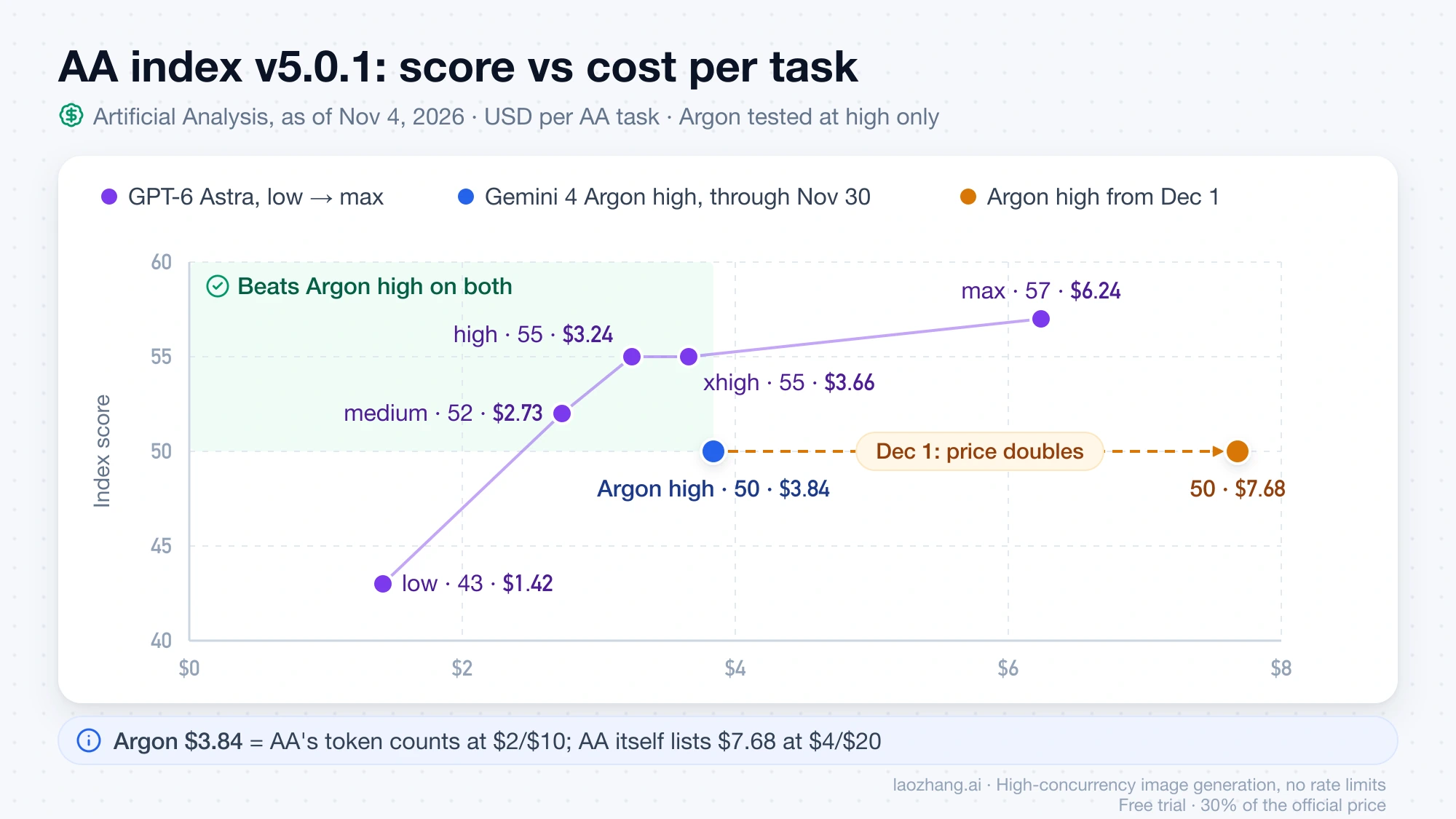
GPT-6 Astra scores higher than Gemini 4 Argon on Artificial Analysis' Intelligence Index v5.0.1 at every setting except its lowest, as of November 4, 2026. AA tests Argon only at high, where it scores 50; Astra scores 52 at medium, 55 at high and 57 at max, according to the Artificial Analysis comparison of Gemini 4 Argon and GPT-6 Astra. Only Astra at low (43) scores below Argon.
| Model and setting | AA index score | Cost per AA task through Nov 30 | Cost per AA task from Dec 1 | Time per AA task |
|---|---|---|---|---|
Gemini 4 Argon, high | 50 | $3.84 | $7.68 | 1,363 s |
GPT-6 Astra, low | 43 | $1.42 | $1.42 | 181 s |
GPT-6 Astra, medium | 52 | $2.73 | $2.73 | 352 s |
GPT-6 Astra, high | 55 | $3.24 | $3.24 | 404 s |
GPT-6 Astra, xhigh | 55 | $3.66 | $3.66 | 450 s |
GPT-6 Astra, max | 57 | $6.24 | $6.24 | 768 s |
AA already prices Argon at the December rate of $4/$20 and shows $7.68 per task on its Gemini 4 Argon model page. Every Argon token price is exactly half of that until November 30, so the same tokens cost about $3.84 per task today; that figure is arithmetic on AA's token counts, not a number AA publishes. On that basis Astra high costs 0.84 times Argon high now (16% less) and 0.42 times from December 1, and Astra medium is cheaper still while scoring 2 points more. Astra max costs 1.63 times Argon today and 0.81 times from December 1. An AA "task" is one of the index's long, multi-step evaluation tasks, not a typical API request, and Argon spends 116,000 output tokens on each one on average, 68,000 of them reasoning, against 52,000 for Astra at max. That is also why Argon takes 1,363 seconds per task, 3.4 times as long as Astra high.
The labels do not mean the same compute. Argon's thinking_level has low, medium and high, with medium as the API default, while Astra's reasoning_effort runs from low to max and OpenAI does not document its default. "Same setting" in this comparison means the same label, and it leaves out Argon's default, which is the setting most API calls use.
Where "tied at 53" and "Argon 40% cheaper" come from: AA's old index
The figures "tied at 53", "Argon about 40% cheaper per task" and "Astra costs 1.6x per task" come from AA's Intelligence Index v4.3.2, which AA replaced on October 27–28, 2026, and they assume Argon's $2/$10 launch price. On that version Argon high scored 53 for $1.99 per task, the same score as Astra at max, which cost $3.26, while Astra at high scored 51. The tie therefore set Argon's high against Astra's top setting, and the claim was accurate for its date.
Two things have changed since. AA moved to version 5.0 (now labeled 5.0.1), where Argon high scores 50 and Astra high 55, and it now prices Argon at $4/$20. Google's own price change follows on December 1. AA recalculated every model's score and cost when it changed versions, so a table that mixes 4.3.2 and 5.0.1 numbers compares nothing; check which version a source cites before you use its scores or cost per task.
Where Gemini 4 Argon leads and where GPT-6 Astra leads
Argon wins on workflow automation, AA's Terminal-Bench 4.0 and Vals' broad index, and Astra wins on the harder coding, science and document-reasoning evaluations. The independent numbers below come from AA v5.0.1 (both at high, as of November 4, 2026) and from the Vals Index, where Argon's figures are on Vals AI's Gemini 4 Argon model page and Astra's come from Kingy AI's retrieval of the Vals leaderboard.
| Evaluation | Gemini 4 Argon | GPT-6 Astra | Ahead |
|---|---|---|---|
| AutomationBench-AA | 77.5% | 66.6% | Argon |
| Terminal-Bench 4.0 (AA) | 57.1% | 54.0% | Argon |
| AA-Omniscience | 46 | 45 | Argon, by 1 |
| AA-Briefcase (Elo-style score) | 1484 | 1505 | Astra |
| FrontierCode 2.0 | 25.7% | 40.1% | Astra |
| GDP.pdf | 21.8% | 31.0% | Astra |
| HLE-Diamond | 56.7% | 59.3% | Astra |
| CritPt v2 Hard | 52.5% | 71.5% | Astra |
| Terminal-Bench-Science | 52.9% | 59.5% | Astra |
| Vals Index | 68.90% | 63.13% | Argon |
Vals is the one independent index that ranks Argon above Astra. As of September 30, 2026, its Argon run used high effort, priced Argon at $4/$20, and still put Argon's cost per test at $15.68; Astra's 63.13% at $18.46 per test is Kingy AI's reading of the same leaderboard, not a figure on the Argon page.
Google's Gemini 4 Argon launch post includes a 19-row table against GPT-6 Astra in which Argon leads 14, Astra 4, and one is tied. Its largest Argon leads are Harvey Legal Agent (19.6 vs 5.4), Vals Finance Agent v2 (65.4 vs 53.5), AutomationBench (51.3 vs 41.4) and GraphWalks at 256K–1M tokens (84.2 vs 71.8). Astra leads FrontierSWE v2, Terminal-bench 4.0, Terminal-Bench Science and OSWorld-2.0 offline. Google ran every row at its own settings, single attempts at the highest thinking level, and the LVBench row gave Gemini 1 frame per second against 800 frames for Astra, so read the table as vendor-reported. VentureBeat's reading of the same post also reports an indirect prompt-injection attack success rate of 0.7% for Argon against 8.5% for Astra in Gray Swan's testing, which matters if your agent reads untrusted pages or emails.
For coding, no source names one winner. Google's table puts Argon ahead on DeepSWE v1.1 (77.9 vs 74.1) and Astra ahead on FrontierSWE v2 (65.5 vs 55.0); on AA, Astra leads FrontierCode 2.0 by 14 points while Argon leads Terminal-Bench 4.0 by 3, even though Google's own table has Astra slightly ahead on that benchmark. On the small Python tasks with hidden tests described next, both models passed everything at high. A fair reading is that Astra is the safer pick for hard, open-ended code changes and Argon is competitive on terminal and automation work; whether Argon stays cheaper there depends on how high you have to set its thinking level.
Same-prompt test on November 4, 2026: equal passes, different bills
On November 4, 2026, the same 8 tasks went to both models through the LaoZhang API at two settings each: no effort parameter (Argon's default is medium; Astra's is undocumented) and high. The tasks were a word problem, three Python functions graded by hidden pytest suites, a 5-bullet summary of a 6,723-word English article, an expression parser (25 hidden tests), a CSV line parser (16 tests) and a digit-sum count; the last three ran twice, giving 11 graded answers per setting. Argon used Google's native generateContent endpoint without streaming, and Astra used streamed Chat Completions with no tools or system prompt. Costs are recomputed at list price from the token counts each API returned.
Disclosure: laozhang.ai is our own service. Its prices are platform pricing, not an independent comparison.
| Model and setting | Passed | Output tokens (thinking) | Cost of 11 answers through Nov 30 | From Dec 1 | Total time |
|---|---|---|---|---|---|
| Gemini 4 Argon, default | 10/11 | 6,782 (1,727) | $0.093 | $0.187 | 163 s |
Gemini 4 Argon, high | 11/11 | 39,514 (33,105) | $0.403 | $0.807 | 463 s |
| GPT-6 Astra, default | 11/11 | 5,342 (1,885) | $0.381 | $0.381 | 117 s |
GPT-6 Astra, high | 11/11 | 9,443 (5,982) | $0.586 | $0.586 | 215 s |
The one miss was Argon's default answer on the expression parser, which failed 1 of 25 hidden tests because " 1 + 2 " with extra spaces raised a ValueError; its second attempt passed. With pass rates this close, the result is about cost and time. At the default setting Astra cost 4.1 times as much as Argon now and will cost 2.0 times as much from December 1. At high, Argon produced 4.2 times Astra's output tokens, almost all of it thinking, so Astra cost only 1.45 times as much now and will cost 0.73 times Argon's bill from December 1. Argon high also took about twice as long in total; part of the time gap comes from comparing a non-streamed call with a streamed one, but the token counts do not depend on that.
AA's per-task numbers and this test agree on the December picture and disagree on today's. On AA's long agentic tasks Astra high is already cheaper than Argon high ($3.24 vs $3.84), while on these short single prompts Argon high stays cheaper until November 30 ($0.403 vs $0.586). Both show Astra high costing less than Argon high from December 1.
Exact counts over a 146 KB log: the task that split them
One extra task separated the two models. It gave each a 146 KB synthetic application log (1,500 lines, 326 of them ERROR lines, with WARN lines reusing the same error codes as distractors) and asked for the ERROR count of five codes, the number of distinct users hit by E503, and the request with the most retries. The correct answer was generated by the script that built the log and checked with grep before any call.
| Model and setting | Answers right | Time | Cost through Nov 30 | From Dec 1 |
|---|---|---|---|---|
| GPT-6 Astra, default | 2 of 2 | 46 s; 38 s with the file cached | $0.75; $0.21 cached | same |
GPT-6 Astra, high | 2 of 2 | 78 s; 72 s cached | $0.90; $0.34 cached | same |
| Gemini 4 Argon, default | 0 of 2 | about 7 s | $0.16 | $0.32 |
Gemini 4 Argon, high, streamed | 2 of 2 | 271 s and 402 s | $0.53–0.55 | $1.06–1.09 |
Gemini 4 Argon, high, not streamed | no answer | 247 s | $0.49 | $0.97 |
Argon at its default returned no thinking tokens on this prompt and answered fast and cheaply, but all five ERROR counts were 20–37% too low, for example 59 E503 errors instead of 94 and 59 E429 errors instead of 80. Its count of distinct E503 users was 46 instead of 78, 41% low, and only the max-retry request was right. At high it got everything right, but only after 37,205 and 53,426 thinking tokens. The non-streamed high call spent the entire 32,768-token output cap that Google applies to a single non-streaming call on thinking, stopped with finishReason: MAX_TOKENS, returned no text, and was still billed. If you send Argon long analysis jobs, stream the response and set maxOutputTokens (65,536 here) or you can hit the same wall.
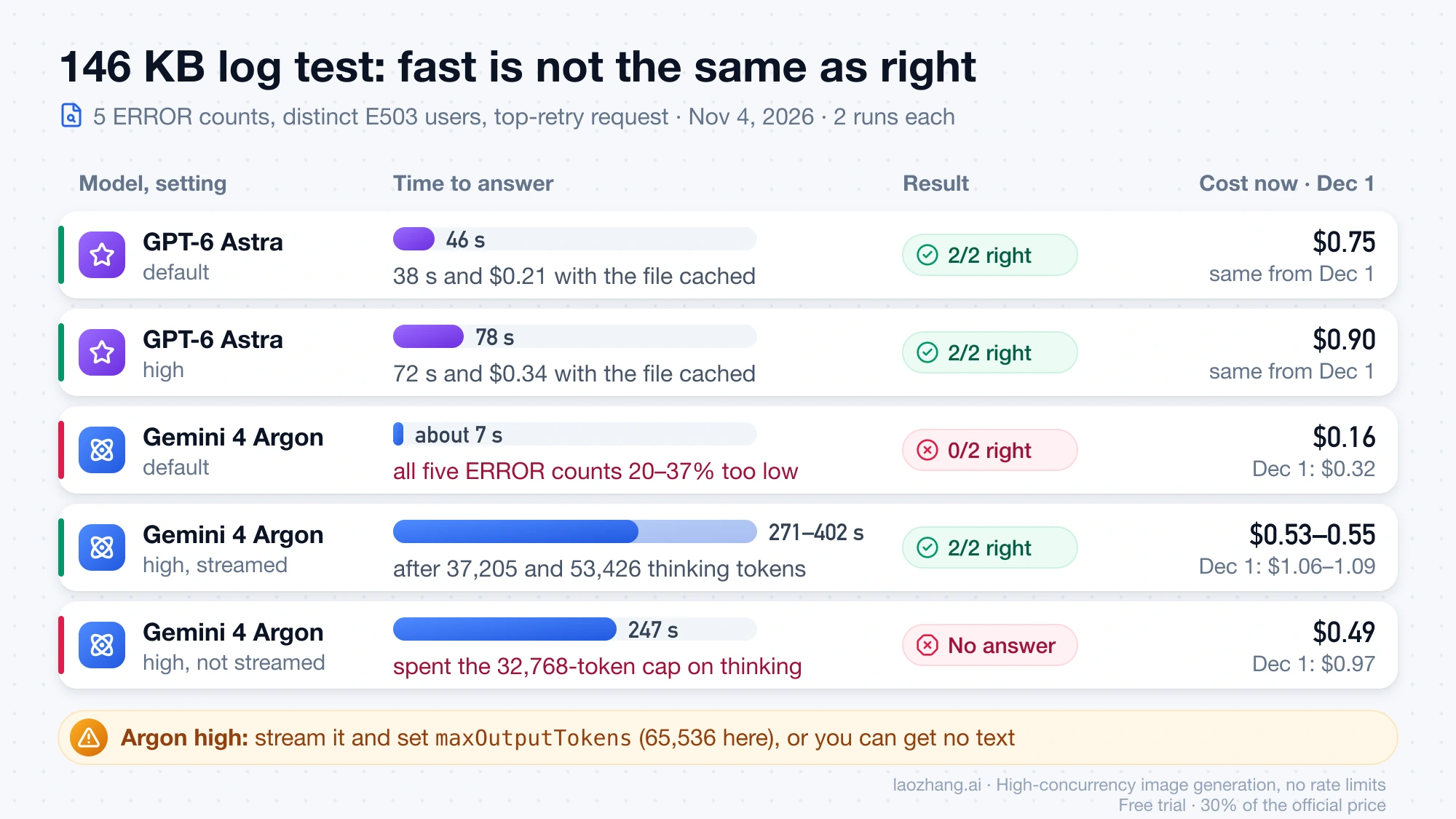
This is one task type with two samples per setting, so it does not rank the models. It does show that a fast, cheap answer from Argon's default setting can be confidently wrong on exact aggregation, and that the fix, high with streaming, costs more than Astra's default from December 1 and takes 6–10 times as long. The test ran on one gateway on one day with one or two samples per cell, so treat it as a template for your own check, not a verdict on quality.
Cost per request and per month: 5x per token now, 2.5x from Dec 1
Per token, Astra costs 5 times as much as Argon until November 30 and 2.5 times as much from December 1, on both input and output. Your real ratio then depends on three things: how many tokens each API counts for the same text, how much each model thinks, and how much of your input is served from cache.
| Price per 1M tokens (Standard) | Gemini 4 Argon through Nov 30 | Gemini 4 Argon from Dec 1 | GPT-6 Astra (up to 272K input) |
|---|---|---|---|
| Input | $2.00 | $4.00 | $10.00 |
| Output, including thinking | $10.00 | $20.00 | $50.00 |
| Cached input read | $0.10 | $0.20 | $1.00 |
| Cache write (30-minute default) | no charge | no charge | $12.50 |
These are the rates on Google's Gemini API pricing page and OpenAI's API pricing page as of November 4, 2026. Batch and Flex are half price on both. Argon has no free API tier, and Google bills every token, thinking included.
The cost of one request is input tokens × input price + output tokens × output price, where output includes thinking. In the November 4, 2026 test through the LaoZhang API, both APIs counted the same 137 tokens for one English prose passage, so English input simply costs 5 times as much on Astra now and 2.5 times from December 1; a 6,723-word article counted 1.10 times as many tokens on Argon. Other languages favor Argon: on the same passage Argon counted 0.67 times Astra's tokens in Japanese, 0.84 in Chinese and Korean, 0.91 in Russian and 0.95 in Spanish, so Japanese input costs about 7.5 times as much on Astra now and 3.7 times from December 1. Logs, IDs and key=value data go the other way: Argon counted 1.42 times as many tokens on the test log, which cuts Astra's input premium to about 3.5 times now and 1.8 times from December 1.
Disclosure: laozhang.ai is our own service. Its prices are platform pricing, not an independent comparison.
On short prompts output decides the bill, because both models charge 5 times more for output than for input and thinking counts as output. At high in the November 4 test, Argon's 4.2 times larger output erased most of its unit-price advantage. To scale that to a month, suppose your traffic looks like the 11-answer test set run 1,000 times, about 11,000 requests:
| Workload | Gemini 4 Argon through Nov 30 | Gemini 4 Argon from Dec 1 | GPT-6 Astra |
|---|---|---|---|
| 11,000 short requests, default setting | $93 | $187 | $381 |
11,000 short requests, high | $403 | $807 | $586 |
| One correct answer on the 146 KB log | $0.53–0.55 (high, streamed) | $1.06–1.09 | $0.75 default; $0.21 if cached |
Caching shifts these numbers differently on each side. Argon caches repeated prefixes implicitly, reads them at 5% of the input price, and charges nothing to write them; in the test, a repeated article read 9,056 of 11,110 tokens from cache and a repeated log 77,258 of 79,312, with no setting changed. OpenAI caches Astra prompts by default and bills the write at 1.25 times input for the 30-minute cache (2.5 times for the 12-hour cache in the Responses API), so a long prompt you send only once can cost about 25% more on its input; GPT-6 Astra API Pricing: $10/$50 per 1M Tokens, Caching Costs covers the opt-out. Through the LaoZhang API on November 4, Astra reported no cache-write tokens on any call even though the same gateway reported them on October 26, and a repeated 55,843-token log still read 55,840 tokens from cache at $1 instead of $10 per million. Check prompt_tokens_details.cache_write_tokens in your own Astra usage to see whether writes are reported and billed where you call it.
Long context and long outputs: Astra's 272K step, Argon's output caps
Above 272,000 input tokens, OpenAI bills the entire Astra request at long-context rates of $20 input and $75 output per million, double the input price and 1.5 times the output price. Argon has one price up to its full context. With the same 300,000 input and 10,000 output tokens on each, Astra costs $6.75 (0.3 × $20 + 0.01 × $75), while Argon costs $0.70 now (0.3 × $2 + 0.01 × $10) and $1.40 from December 1. For long-document work that crosses 272K, Argon stays far cheaper even after its price rise.
The limits differ too. Argon's 1,048,576 tokens are one budget shared by input and output, so a near-full prompt leaves little room for the answer, while Astra accepts up to 922,000 input tokens and 128,000 output tokens within a 1,050,000-token context. Argon's default synchronous output cap is 65,536 tokens and a single non-streamed call stops at 32,768, which is the wall the log test hit; Gemini 4 Argon API finish_reason: CONTINUATION and Empty Replies explains the long-output behavior. On the OpenAI side, function calling with Astra works only through the Responses API, so an agent built on Chat Completions has to move before it can call tools.
Which to use for each kind of work: Astra for hard, Argon for volume
Pick by the work, then by the date. The rule below combines AA v5.0.1 and Vals for quality, the November 4 test for cost and failure modes, and both price lists.
| Kind of work | Start with | Why |
|---|---|---|
| Hard multi-step agent work, research, science, PDF-heavy reasoning | GPT-6 Astra, medium or high | Higher AA score at lower cost per AA task; leads FrontierCode, CritPt, GDP.pdf |
| Large volumes of checkable tasks: code with tests, summaries, extraction | Gemini 4 Argon, default | 10/11 vs 11/11 in the test at about a quarter of Astra's cost now, half from Dec 1 |
| Exact counts and aggregation over long, noisy input | GPT-6 Astra, default | Right 2 of 2 at default and 2 of 2 at high, all under 80 s; Argon was right only at high, streamed, after 271–402 s |
| Workflow automation and terminal agents | Gemini 4 Argon trial against Astra | Argon leads AutomationBench-AA and Terminal-Bench 4.0 on AA; budget for slow high runs |
| Prompts above 272K input tokens | Gemini 4 Argon | Astra bills the whole request at $20/$75 |
Work that needs Argon at high after November 30 | GPT-6 Astra high instead | Cheaper per AA task and in the test from Dec 1, and 3.4 times faster per AA task |
If your inputs are mostly Japanese, Chinese or Korean text, Argon's lower token counts widen its price lead; if they are mostly logs or machine-generated data, they narrow it.
How to get Argon and Astra: API, chat apps, Codex, Antigravity
Both models are available through their vendors' paid APIs, and their app access sits behind different plans. The plan access below is as of October 27, 2026 for Google and October 26, 2026 for OpenAI:
| Where | Gemini 4 Argon | GPT-6 Astra |
|---|---|---|
| API | gemini-4-argon, paid tier only, no free tier | gpt-6-astra, billed per token for projects with access |
| Chat app | Gemini app and AI Mode with Google AI Pro ($19.99 a month in the US) or Ultra | Not on ChatGPT Free or Go, which get GPT-6 Luna; Chat access is reported for Pro, Business and Enterprise |
| Coding agent | Antigravity on paid Pro, Ultra and Enterprise | Codex and Work: about 5–45 Astra local messages per 5 hours on Plus and standard Business, no 5-hour limit on Pro |
A subscription does not include API usage on either side: enabling Astra in a ChatGPT workspace does not grant API access, and Google's AI Studio quota is separate from Gemini API billing. Google publishes no Argon prompt counts; Gemini 4 Argon Usage Limits: Pro vs Ultra, Resets, API Credits covers plan limits and the monthly developer credit. To confirm your OpenAI project can call Astra, follow GPT-6 Astra API Access: Check Your Project and Make a First Request.
How to test both on your own prompts before December 1
A small trial on your own traffic answers the cost question better than any index, because your input language, output length and pass bar decide the ratio. Run it before November 30 so you can price Argon at both rates from one set of token counts.
- Pick 10–20 real prompts whose answers you can check automatically: hidden tests for code, known totals for data, or a short rubric for summaries.
- Send each prompt to
gemini-4-argonwithout a thinking config and withthinkingLevel: "high", and togpt-6-astrawithoutreasoning_effortand withreasoning_effort: "high". Stream Argon'shighcalls and setmaxOutputTokensso thinking cannot use up the 32,768-token non-streaming cap. - Save the usage from every response. On Argon read
promptTokenCount,candidatesTokenCount,thoughtsTokenCountandcachedContentTokenCountinusageMetadata; on Astra readprompt_tokens,completion_tokens,completion_tokens_details.reasoning_tokensandprompt_tokens_details. - Grade every answer and count only accepted ones.
- Price Argon's tokens at $2/$10 and again at $4/$20, Astra's at $10/$50 with cached reads at $1 and any reported cache writes at $12.50, then divide each total by the number of accepted answers.
- Send the longest prompt twice within a few minutes to see how much each side reads from cache, and whether Astra reports a cache write.
Keep the cheapest setting that clears your bar for each kind of work; a single winner across all of them is rare.
Argon vs Astra: other questions
Is Astra the same as GPT-6? GPT-6 Astra is the top model in OpenAI's GPT-6 family, which also includes GPT-6.1 Sol, GPT-6.1 Terra and GPT-6 Luna, and as of November 4, 2026 there is no GPT-6.1 Astra. GPT-6 Sol vs Terra vs Luna vs Astra: Which Model Should You Use? explains which is which, and Is GPT-6 Free in ChatGPT? Yes, as GPT-6 Luna, Not Sol or Astra covers the free plan.
Is there a cheaper OpenAI model close to Astra? OpenAI positions GPT-6.1 Sol, at $2/$10 per million tokens, as near-Astra performance at a lower cost, and on AA v5.0.1 Sol at max scores 55 for $1.27 per task as of November 4, 2026. GPT-6.1 Sol vs GPT-6 Astra vs GPT-6 Sol: When Astra Is Worth It compares them.
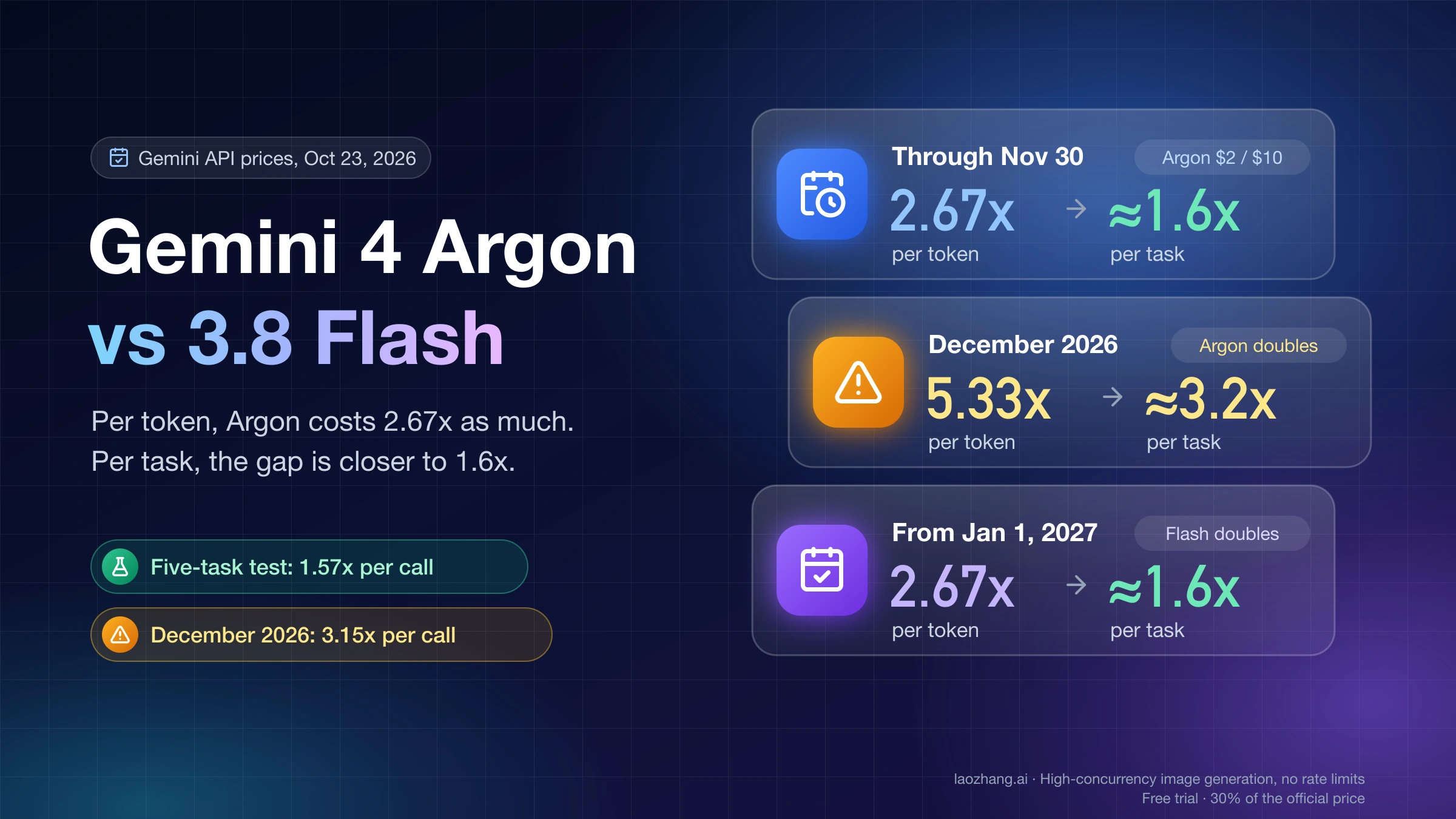
Is there a cheaper Google model than Argon? Google's cheaper step is Gemini 3.8 Flash; Gemini 4 Argon vs 3.8 Flash: Cost per Task and When to Switch has a same-prompt cost test.
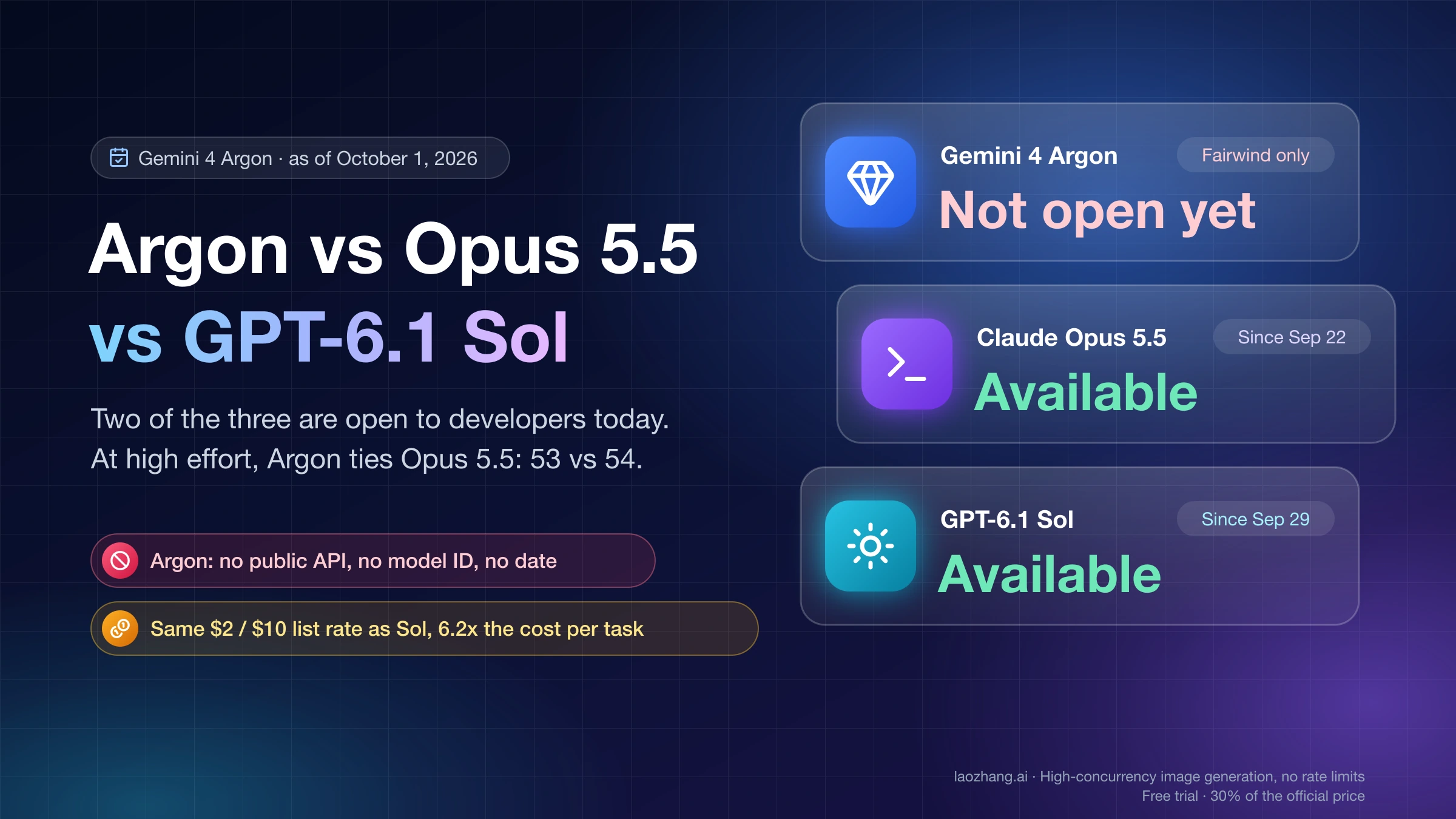
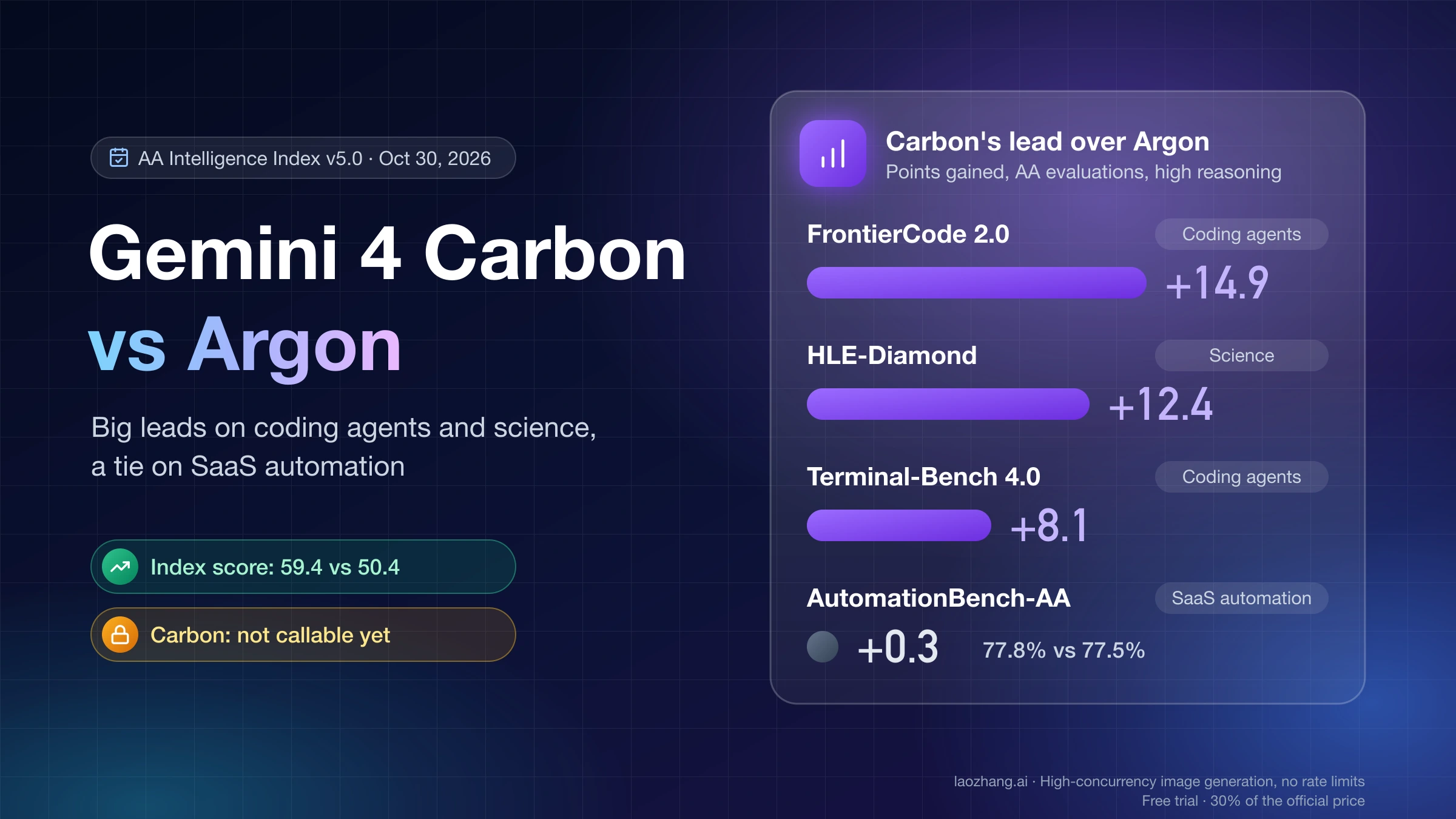
What about Gemini 4 Carbon? Google announced Gemini 4 Carbon on October 28, 2026 for its Fairwind cyber-defender program only, with no public API model ID or release date as of November 4. Gemini 4 Carbon vs Gemini 4 Argon: Slower Start, Faster Agents tracks what is known.
How does Argon compare with Claude Opus 5.5? Gemini 4 Argon vs Claude Opus 5.5 vs GPT-6.1 Sol: Cost and Access compares cost per task and access for that trio, including Argon's December 1 price.
Sources7
External pages this guide links to, in the order they appear. Last updated Nov 4, 2026.
Sources7
External pages this guide links to, in the order they appear. Last updated Nov 4, 2026.
- 1.Artificial Analysis comparison of Gemini 4 Argon and GPT-6 Astraartificialanalysis.ai/models/comparisons/gemini-4-argon-vs-gpt-6-astra
- 2.Gemini 4 Argon model pageartificialanalysis.ai/models/gemini-4-argon
- 3.thinking_levelai.google.dev/gemini-api/docs/thinking
- 4.Vals AI's Gemini 4 Argon model pagevals.ai/models/google_gemini-4-argon
- 5.Gemini 4 Argon launch postblog.google/innovation-and-ai/models-and-research/gemini-models/gemini-4-argon
- 6.Google's Gemini API pricing pageai.google.dev/gemini-api/docs/pricing
- 7.OpenAI's API pricing pagedevelopers.openai.com/api/docs/pricing