GPT-6 Astra vs Claude Fable 5.1: Choose by Workload
Astra and Fable share the same headline input and output rates, but cache pricing, long-context billing, access, and safeguards can reverse the cheaper or safer choice.
On this page
GPT-6 Astra and Claude Fable 5.1 are both premium models for difficult, multi-step work. Neither is the automatic winner. As of September 4, 2026, they even share the same standard API headline price—$10 per million input tokens and $50 per million output tokens—while differing sharply in cache cost, long-input billing, rollout status, tool contracts, and data handling.
That makes the first decision surprisingly concrete:
- Start with GPT-6 Astra when computer use, browser work, adjustable reasoning, or the OpenAI Responses tool stack is central—and the model is actually enabled for your account.
- Start with Claude Fable 5.1 when the job repeatedly reads a large stable prefix, regularly exceeds 272K input tokens, or already runs across the Claude and supported cloud ecosystems—and its retention and safeguard behavior fit the data.
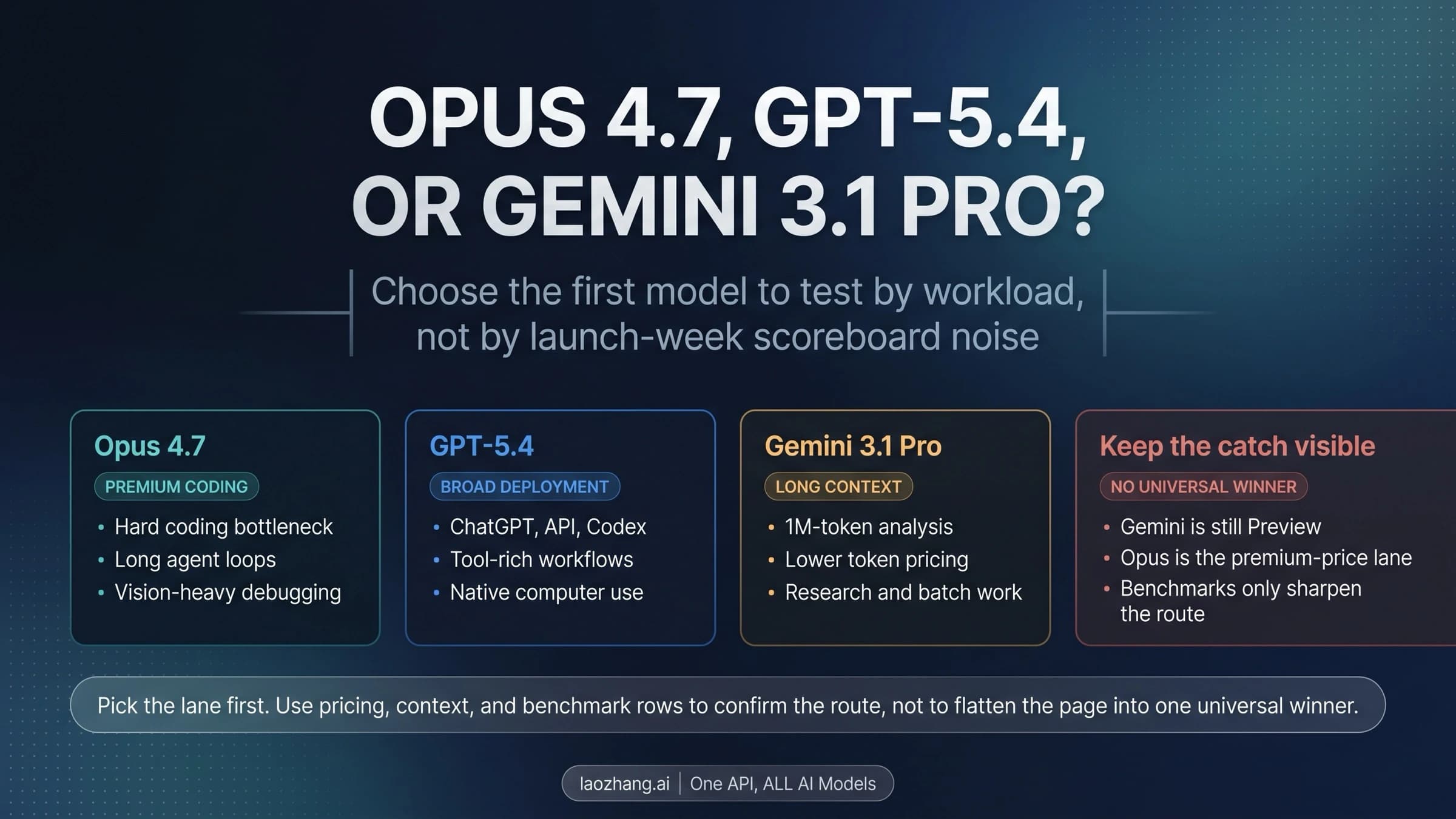
- Keep the incumbent when neither model has cleared a small test on your real task. Launch benchmarks are useful leads, not a migration approval.
For the newer names circulating in comparison posts, our Gemini 4, GPT-6, and Fable 5.2 comparison separates documented products from unresolved specifications and explains what can be evaluated today.
What is available now
OpenAI announced GPT-6 Astra on September 3 and identifies gpt-6-astra as the API model. Its launch is phased: selected organizations received it first, with API and paid ChatGPT access expanding over the following days. An API documentation page therefore does not prove that a particular project can call the model. Enterprise administrators may also need to enable access.
Anthropic released claude-fable-5-1 on September 1. Its model page lists it as Active and latest, with availability through the Claude API, Amazon Bedrock, Claude Platform on AWS, Google Cloud, and Microsoft Foundry. Product-plan access, cloud-region support, and API entitlement are still separate checks.
Before building an evaluation, make one minimal request through the route you intend to operate. Record the requested model, returned model, HTTP status, stop reason, usage fields, and any organization or region error. “Announced,” “visible in a picker,” “accepted by a gateway,” and “completed a valid response” are four different states.
The specifications that change a real decision
| Contract item | GPT-6 Astra | Claude Fable 5.1 | Why it matters |
|---|---|---|---|
| API model ID | gpt-6-astra | claude-fable-5-1 | Prevents testing an alias or older model by mistake |
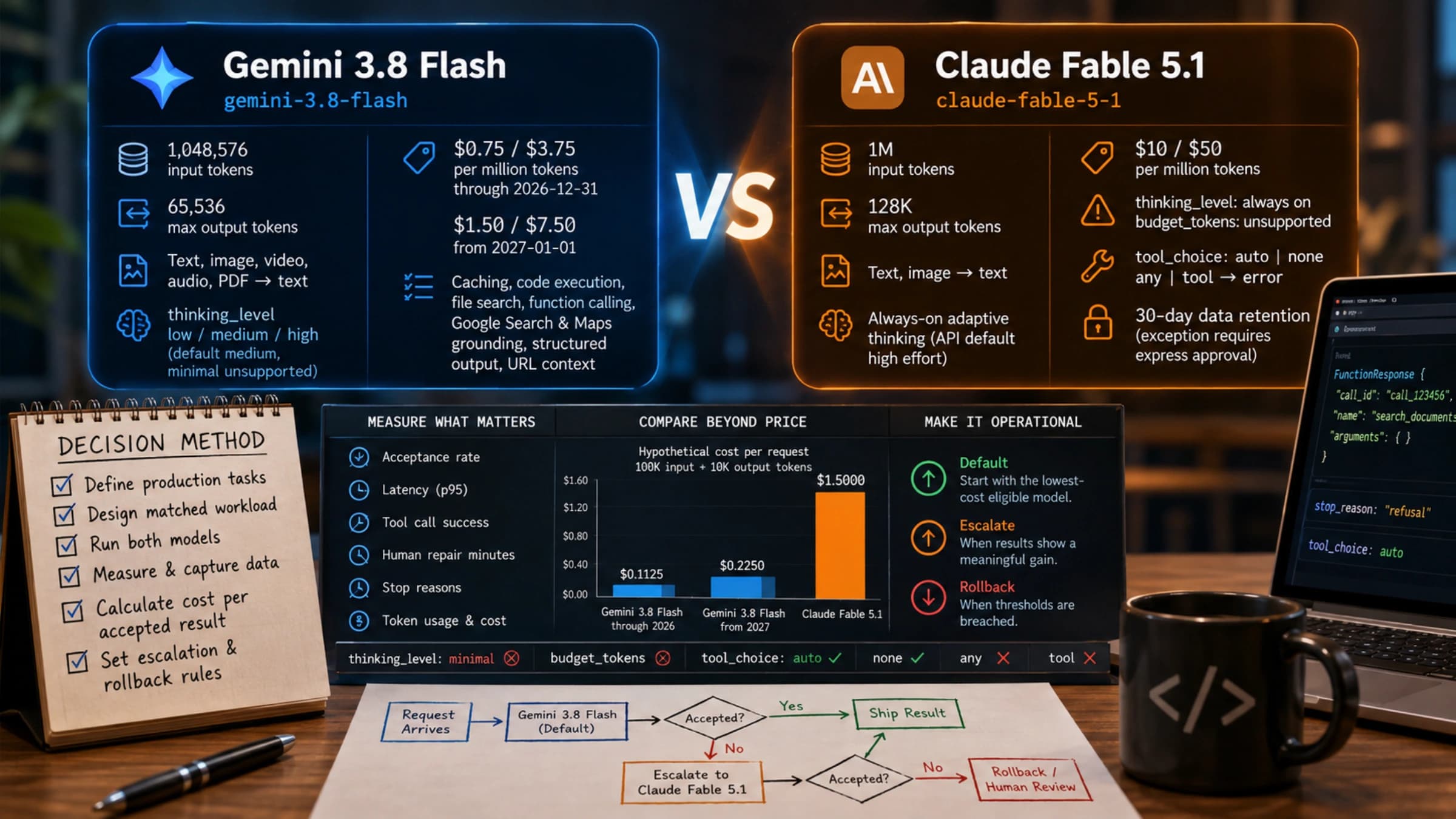
| Context window | 1,050,000 tokens | 1M tokens | Both can admit very large inputs; capacity is not retrieval quality |
| Maximum output | 128,000 tokens | 128K tokens | Similar ceiling, not a reason to request unnecessarily long answers |
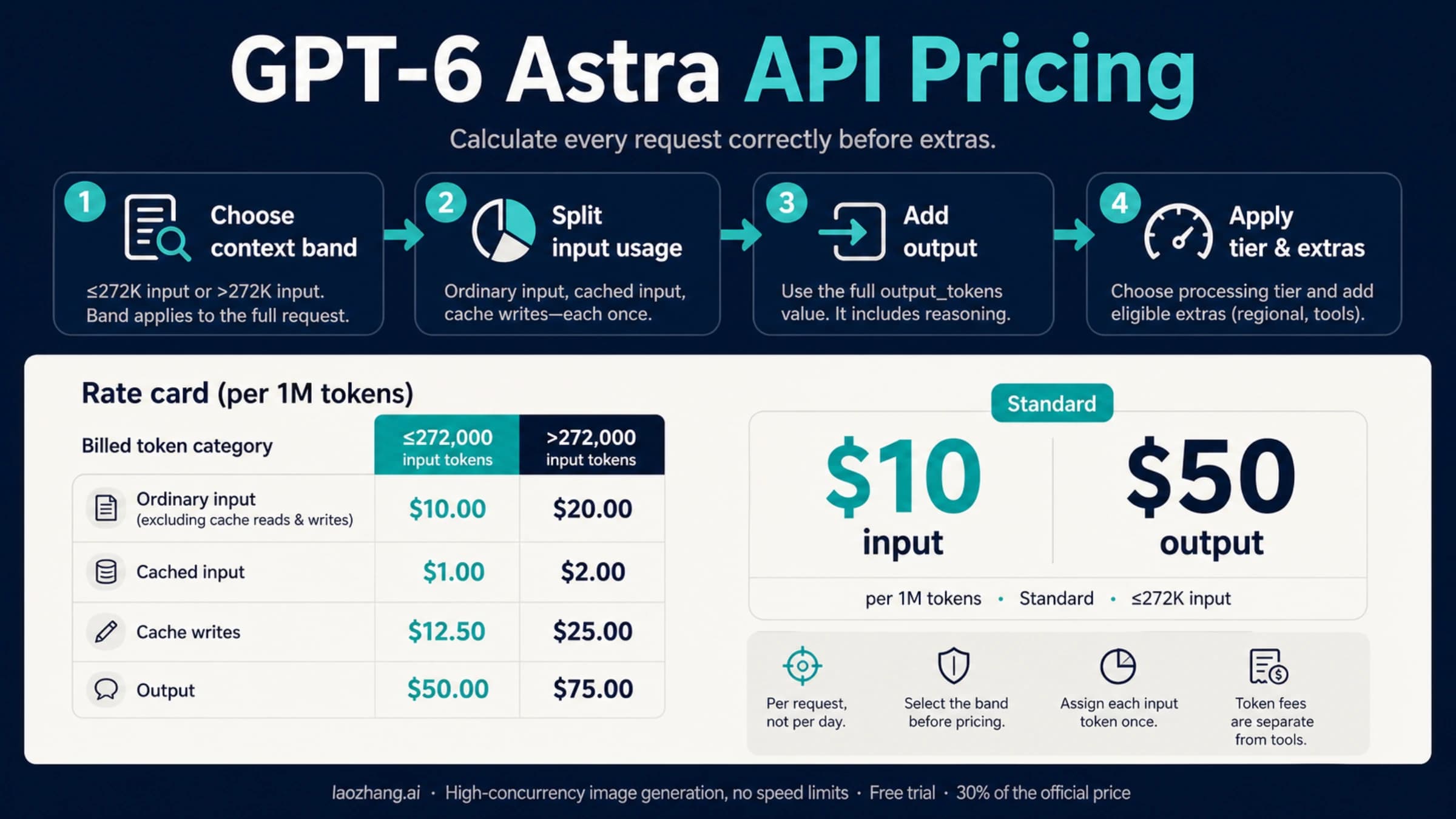
| Standard input | $10 / MTok | $10 / MTok | Same list rate below other pricing conditions |
| Standard output | $50 / MTok | $50 / MTok | Verbose retries can dominate the bill |
| Cache read | $1 / MTok | $0.25 / MTok | Fable is four times cheaper for a hit at listed direct-API rates |
| Cache write | $12.50 / MTok | $12.50 for 5m; $20 for 1h | TTL and reuse frequency determine whether caching pays |
| Long-input rule | Above 272K, whole request uses 2x input/cache and 1.5x output | 1M window remains at standard pricing | A nominally equal price can diverge abruptly |
The Astra figures come from the current OpenAI model contract. It also lists Batch and Flex at half the Standard rates and Fast processing at twice the applicable price. Those modes are not interchangeable: queueing, latency, tool charges, data residency, and service-level requirements can change eligibility as well as cost.
The Fable figures come from Anthropic's model pricing table and context-window guidance. Marketplace pricing or contractual discounts may differ. The providers also tokenize text differently, so do not copy one provider's token count into the other provider's budget sheet.
Two calculations expose the hidden difference
Assume, only for illustration, that both providers count the same tokens. A repeated agent turn reads 250K cached tokens, adds 10K new input tokens, and produces 5K output tokens:
- Astra:
0.25 × $1 + 0.01 × $10 + 0.005 × $50 = $0.60. - Fable:
0.25 × $0.25 + 0.01 × $10 + 0.005 × $50 = $0.4125.
This excludes the initial cache write. Fable's cheaper read becomes valuable only when the prefix is reusable; a constantly changing prompt can erase the advantage.
Now consider 300K uncached input tokens and 10K output tokens. Astra crosses its 272K threshold, so its full request costs 0.30 × $20 + 0.01 × $75 = $6.75. Fable remains at standard rates: 0.30 × $10 + 0.01 × $50 = $3.50.
Neither calculation is a quote. Add cache writes, tool fees, failed attempts, cloud markup, taxes, and the token counts observed from each actual API. More importantly, divide spend by usable work:
cost per accepted task = cost of every attempt / number of accepted results
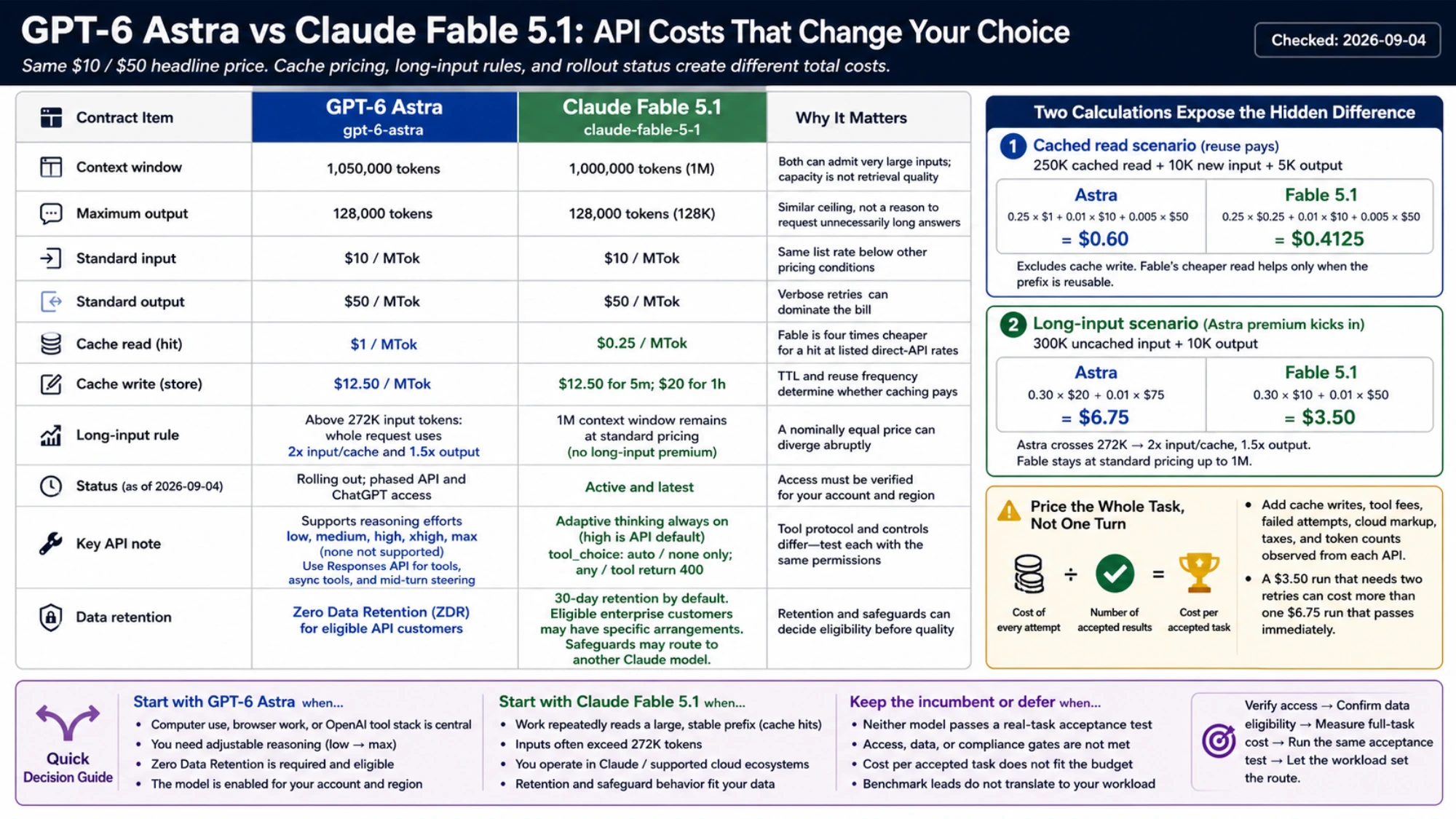
A $3.50 run that needs two retries costs more than one $6.75 run that passes immediately. Review time and rollback work belong beside the API bill even when they are not token charges.
The APIs ask you to build different agent loops
GPT-6 Astra supports reasoning efforts low, medium, high, xhigh, and max; none is not supported. OpenAI's Astra guidance recommends Responses for tool calling and documents async tools and mid-turn steering. Those features matter when a long job should continue independent work while one tool or one user answer is pending.
Claude Fable 5.1 uses adaptive thinking that is always on, with high as the documented API default. Anthropic's release notes say forced tool_choice values any and tool return a 400 error; auto and none remain available. Thinking blocks also have compatibility rules when an application changes earlier history or switches to an older model.
This is why matching a label such as “high” does not create a fair test. The model plus its native tool protocol is the product being selected. Give each route equivalent permissions and the same result requirements, then log the exact provider settings rather than pretending the controls are identical.
Security and retention can decide before quality does
OpenAI says Astra supports Zero Data Retention for eligible API customers. Eligibility must be verified for the project and endpoint in use; it is not implied by the model name.
Anthropic says Fable requires 30-day retention by default. Eligible enterprise customers can have specific arrangements, but the exception must be confirmed rather than assumed. Anthropic also documents safeguards that can route covered work to another Claude model. For API integrations, that makes the effective model and stop behavior part of the acceptance record.
If a repository, customer document, or regulated dataset cannot enter the documented retention path, Fable is ineligible for that workload regardless of its benchmark score. Conversely, an eligible route does not make the model accurate enough; it only permits the quality test to begin.
What the launch benchmarks do—and do not—show
OpenAI's launch page includes direct Astra and Fable rows. Under OpenAI's published setup, Astra scores 57.9% versus 55.8% on Terminal-Bench 4.0 and 41.4% versus 31.4% on AutomationBench. Fable leads on Humanity's Last Exam with tools, 65.0% versus 57.2%, and on the listed Artificial Analysis Intelligence Index, 65.7 versus 61.2.
The same page says results use the maximum at any effort and documents differences involving harnesses, safeguards, and fallback models. Anthropic's Fable announcement publishes another provider-run setup and explicitly discusses production safeguards. These numbers are not one neutral tournament, and the mixed leads are a warning against averaging unrelated tests into a “best model” score.
Use a benchmark to choose a task for your pilot. Do not use it to skip the pilot.
A pilot that can reject your favorite
Choose three expensive, recurring jobs instead of a bag of trivia. For example: one cross-file repair with tests, one large-document synthesis with citation checks, and one multi-application workflow with a recoverable failure. Run each from the same clean input at least enough times to expose obvious variance.
Before either model starts, lock these conditions:
- The repository commit or document snapshot and the exact task request.
- Equivalent tool permissions, network scope, time box, and human-help budget.
- A provider-appropriate reasoning setting and a maximum number of attempts.
- Acceptance checks that can fail: tests, required citations, numerical reconciliation, layout inspection, or a named business outcome.
- A fresh start for every run. Never give the second model the first model's patch, error discoveries, or reviewer feedback.
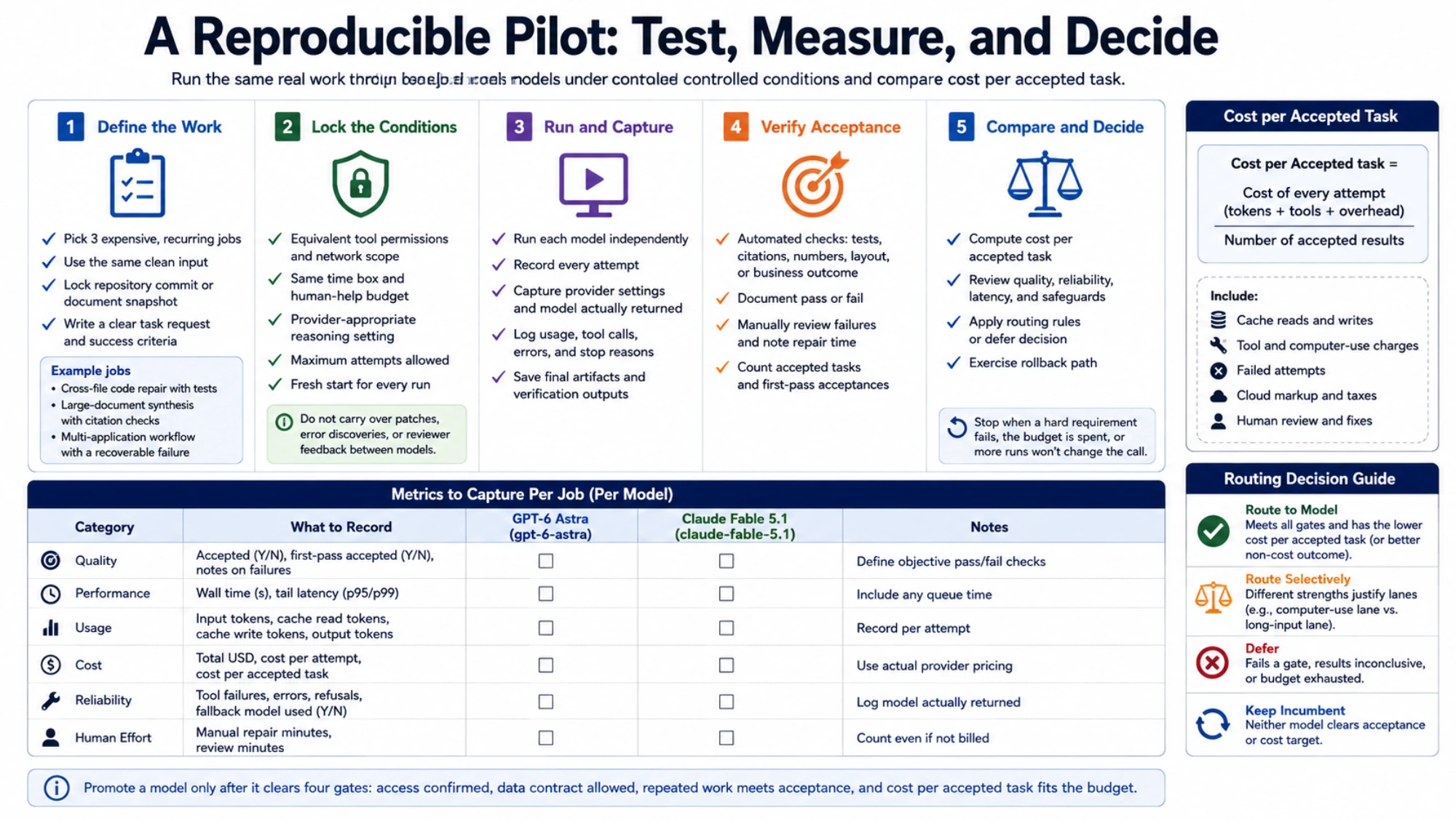
Capture accepted-task rate, first-pass acceptance, wall time, tail latency, input/cache/output usage, tool failures, refusals or fallback, manual repair minutes, and total spend. Treat a fallback completion as operationally useful but attribute it to the model that actually completed the task.
Stop when one candidate violates a hard requirement, when the predeclared budget is spent, or when more runs are unlikely to reverse a meaningful gap. Continuing until a preferred model finally wins is not evaluation.
Convert the result into a routing rule
A single default is not mandatory. Astra may earn the computer-use or OpenAI-native tool lane; Fable may earn the stable-prefix or very-long-input lane. Keep both only when the quality improvement exceeds the cost and complexity of two integrations.
Promote a model after it clears four gates: the account can call it, the data contract permits the task, repeated work meets acceptance criteria, and cost per accepted task fits the budget. Keep the current model or a tested fallback until rollback has been exercised.
If you are already migrating from Fable 5, the separate Claude Fable 5.1 migration and cache guide covers the model-specific API changes. For the cross-provider choice here, the durable answer is simpler: verify access, price the whole task, run the same acceptance test, and let the workload—not the launch-day winner headline—set the route.