GLM-5.3 vs GLM-5.3-Flash: Which One Should You Test First?
Start with GLM-5.3-Flash for multimodal or cost-sensitive work. Test GLM-5.3 alongside it for demanding text-only tasks, then choose by cost per accepted result.
On this page
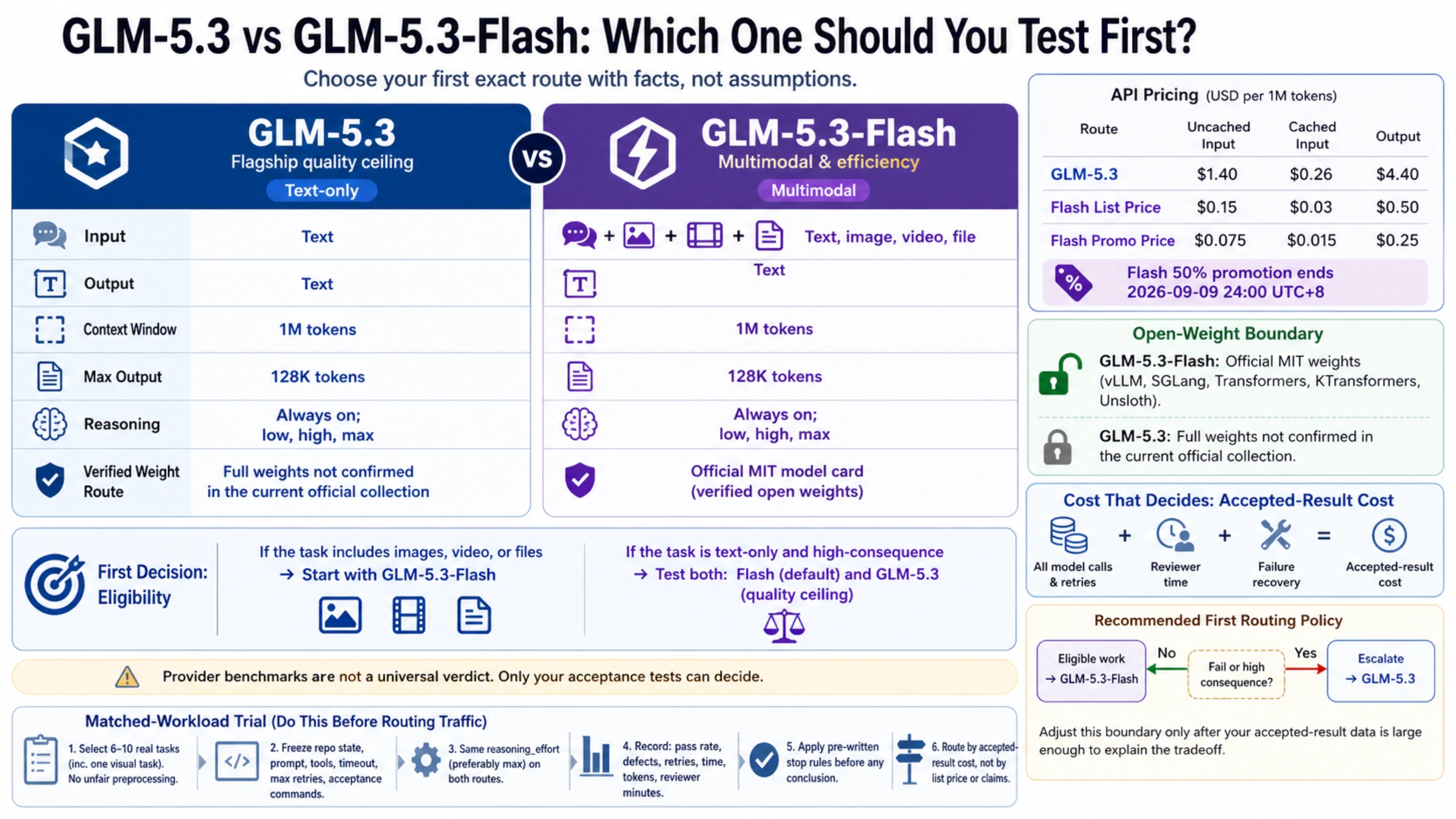
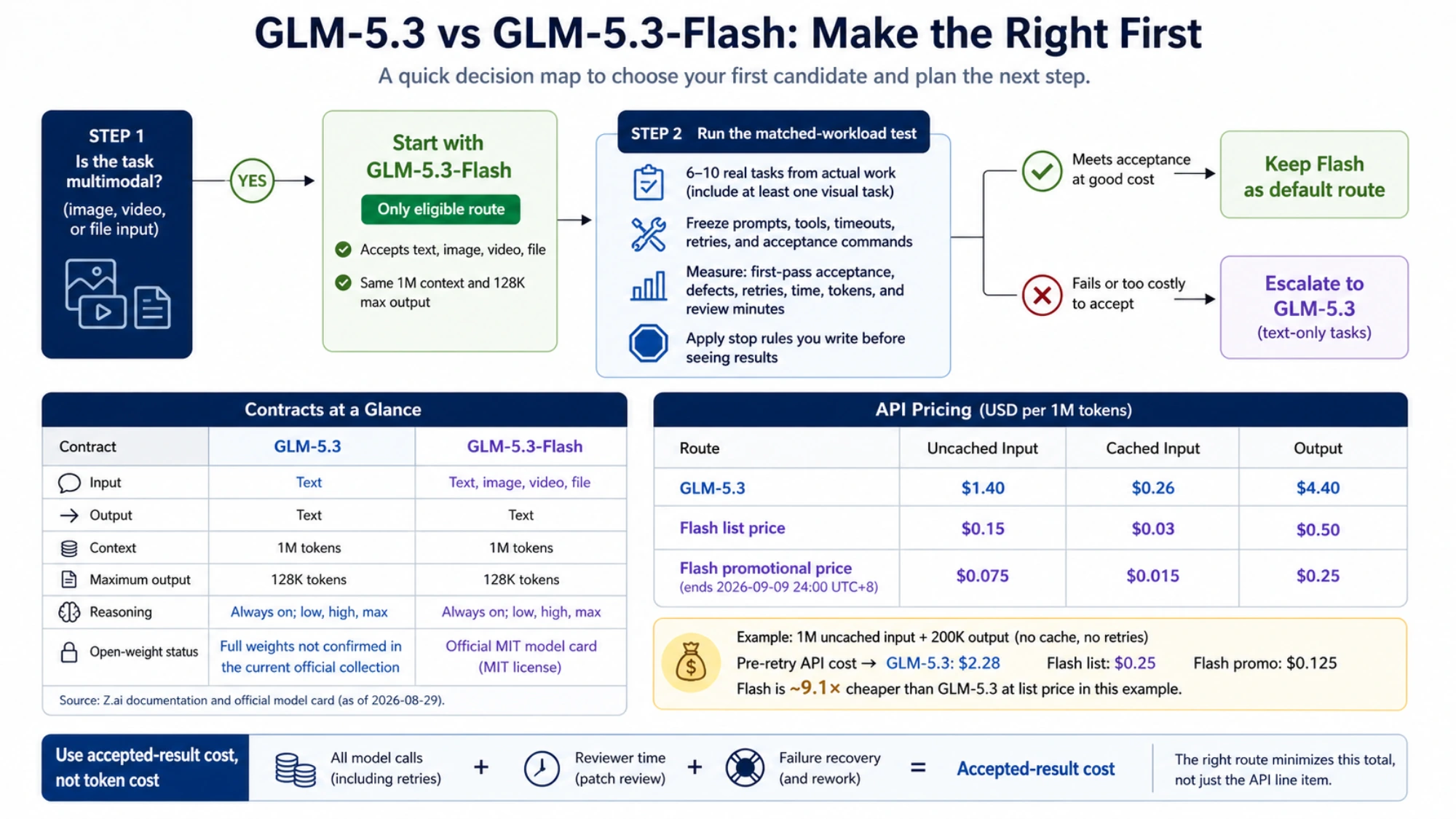
Use glm-5.3-flash as the first candidate when the task contains images, video, or files. The documented glm-5.3 input is text-only, so it cannot enter that comparison without preprocessing that changes the task. For text-only, high-consequence engineering, test both: Flash as the lower-cost candidate and GLM-5.3 for its stated focus on complex engineering.
That recommendation is a test order, not a claim that Flash wins every workload. Check supported inputs first, then use your own tests to decide which model meets your requirements.
Check which inputs each model supports
| Capability | glm-5.3 | glm-5.3-flash |
|---|---|---|
| Input | Text | Text, image, video, file |
| Output | Text | Text |
| Context | 1M tokens | 1M tokens |
| Maximum output | 128K tokens | 128K tokens |
| Reasoning | Always on; low, high, max | Always on; low, high, max |
| Published weights | Official 753B model card under the GLM-5.3 license | Official 321B MIT model card |
The GLM-5.3 documentation identifies it as Z.ai's flagship for complex software engineering and long-horizon agent work. It also says reasoning cannot be disabled. The GLM-5.3-Flash documentation gives its support for multimodal inputs and the exact API model code.
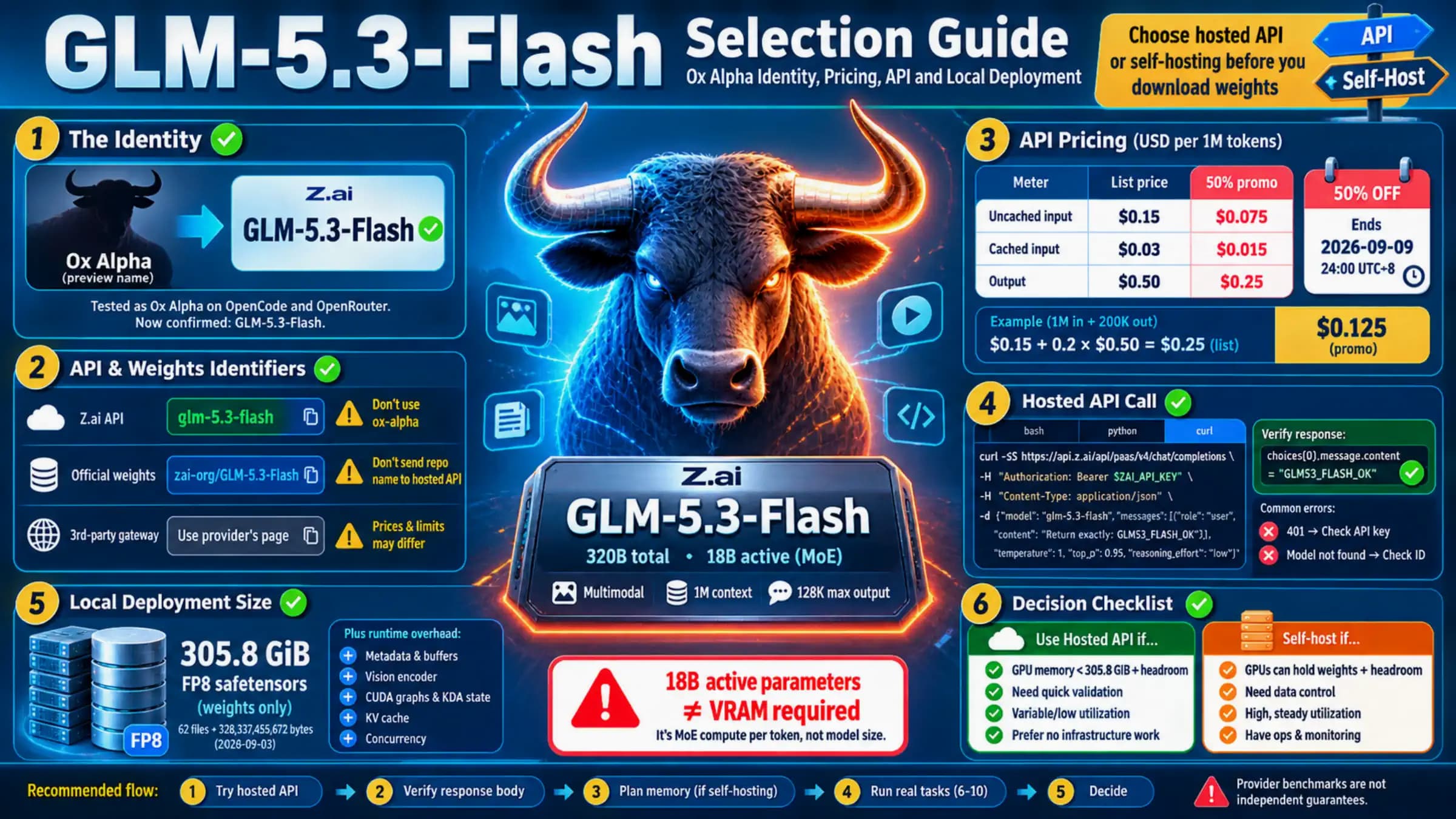
Z.ai publishes 320B total parameters and 18B active parameters for Flash. It reports about 3.01 times lower attention compute and 4.44 times lower KV cache than GLM-5.3. Those figures explain the efficiency design; they do not prove your latency, correctness, or review burden.
Budget with list price, not the launch discount
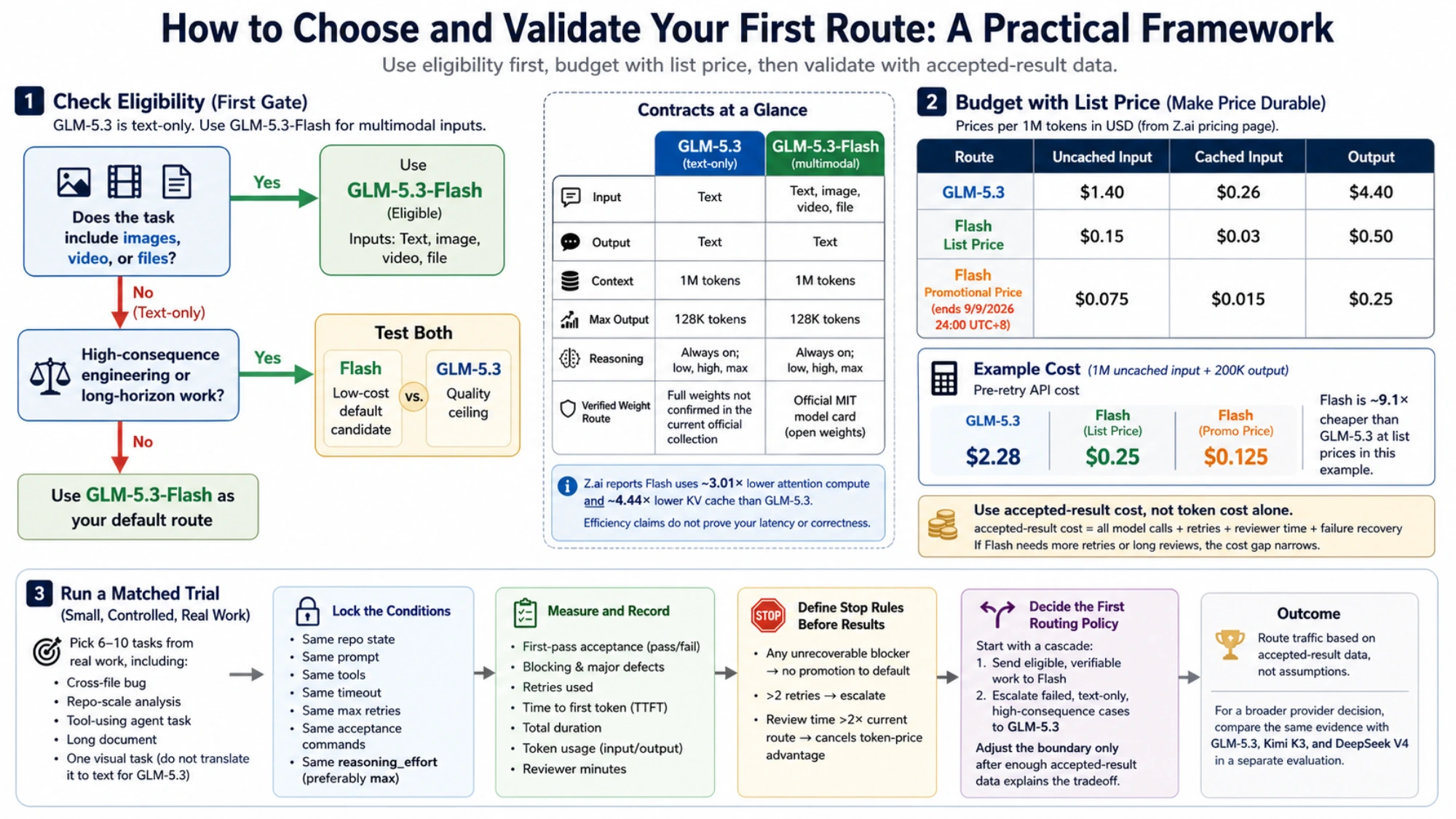
At the August 31, 2026 check, the Z.ai pricing page listed these USD prices per 1M tokens:
| Model and pricing option | Uncached input | Cached input | Output |
|---|---|---|---|
| GLM-5.3 | $1.40 | $0.26 | $4.40 |
| Flash list price | $0.15 | $0.03 | $0.50 |
| Flash promotional price | $0.075 | $0.015 | $0.25 |
At the August 31, 2026 pricing check, the 50% Flash promotion was scheduled to end on September 9 at 24:00 UTC+8. Use list prices for a long-term budget and check the live pricing page for any extension; the promotional row records the offer published at that time.
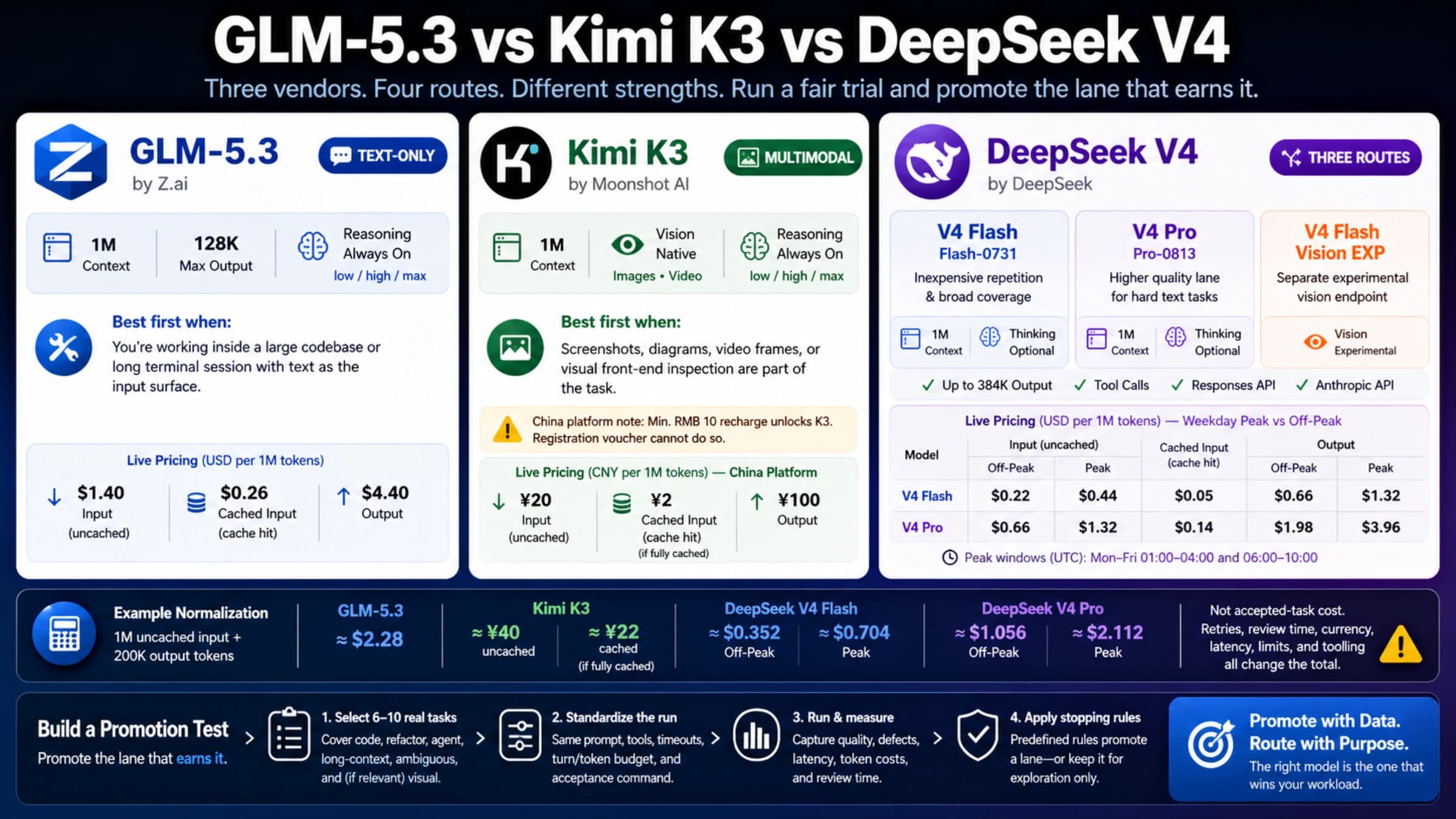
For a task with 1M uncached input tokens and 200K output tokens, the pre-retry API cost is about $2.28 on GLM-5.3, $0.25 at the Flash list price, or $0.125 during the promotion. Flash is therefore about 89% cheaper at list price for the token quantities in this example.
Include every billed attempt and convert human work to a monetary cost before comparing:
Cost per accepted result = (
  total API charges, including billed retries
  + review and recovery hours × hourly cost
  + other recovery costs
) / number of accepted results
Count retries only once in total API charges. If no result is accepted, report that failure rather than a zero cost per result.
If Flash needs three attempts and a lengthy patch review, the gap narrows. If both models pass once with similar review time, GLM-5.3 needs a meaningful reduction in defects or failure risk to justify its premium.
Budget separately for self-hosting
The official GLM-5.3-Flash model card provides 321B MIT-licensed weights and documents serving paths including vLLM, SGLang, Transformers, KTransformers, and Unsloth.
The official GLM-5.3 model card now also exposes 753B weights with vLLM, SGLang, Transformers, KTransformers, and Unsloth serving guidance. Its license is labeled GLM-5.3 rather than MIT. Deployment control therefore no longer selects Flash by itself; license fit, modality, model size, hardware capacity, throughput, monitoring, and upgrade cost all belong in the decision. Compare hosted API spend with the full infrastructure and engineering bill, not with hardware purchase price alone.
Run a small trial before choosing a default
Select 6–10 tasks from actual work: a cross-file bug, a repository-scale analysis, a tool-using agent task, a long document, and one visual task. Do not translate the visual task into text for GLM-5.3 and then call the conditions matched; include any preprocessing in the cost comparison.
For text tasks, freeze the repository state, prompt, tools, timeout, maximum retries, and acceptance commands. Use the same reasoning_effort, preferably max for the difficult set. Record first-pass acceptance, blocking and major defects, retries, time to first token, total duration, token usage, and reviewer minutes.
Write stop rules before seeing results. For example: one unrecoverable blocker prevents promotion to default; more than two retries triggers escalation; review time above twice your current setup cancels a token-price advantage.
A useful first routing policy is a cascade: send eligible, verifiable work to Flash; escalate failed, text-only, high-consequence cases to GLM-5.3. Change that boundary only after your accepted-result data is large enough to explain the tradeoff.
For a broader model comparison, use the same measurements with GLM-5.3, Kimi K3, and DeepSeek V4 rather than mixing a same-family test with a multi-vendor test.
Sources5
External pages this guide links to, in the order they appear. Last updated Aug 31, 2026.
Sources5
External pages this guide links to, in the order they appear. Last updated Aug 31, 2026.