GLM-5.3 vs Kimi K3 vs DeepSeek V4: Choose the Right First Test
Start with GLM-5.3 for text-only long-horizon engineering, Kimi K3 when vision belongs inside the model loop, and DeepSeek V4 Flash when cheap repeated coverage matters; use V4 Pro as the harder-task control.
On this page
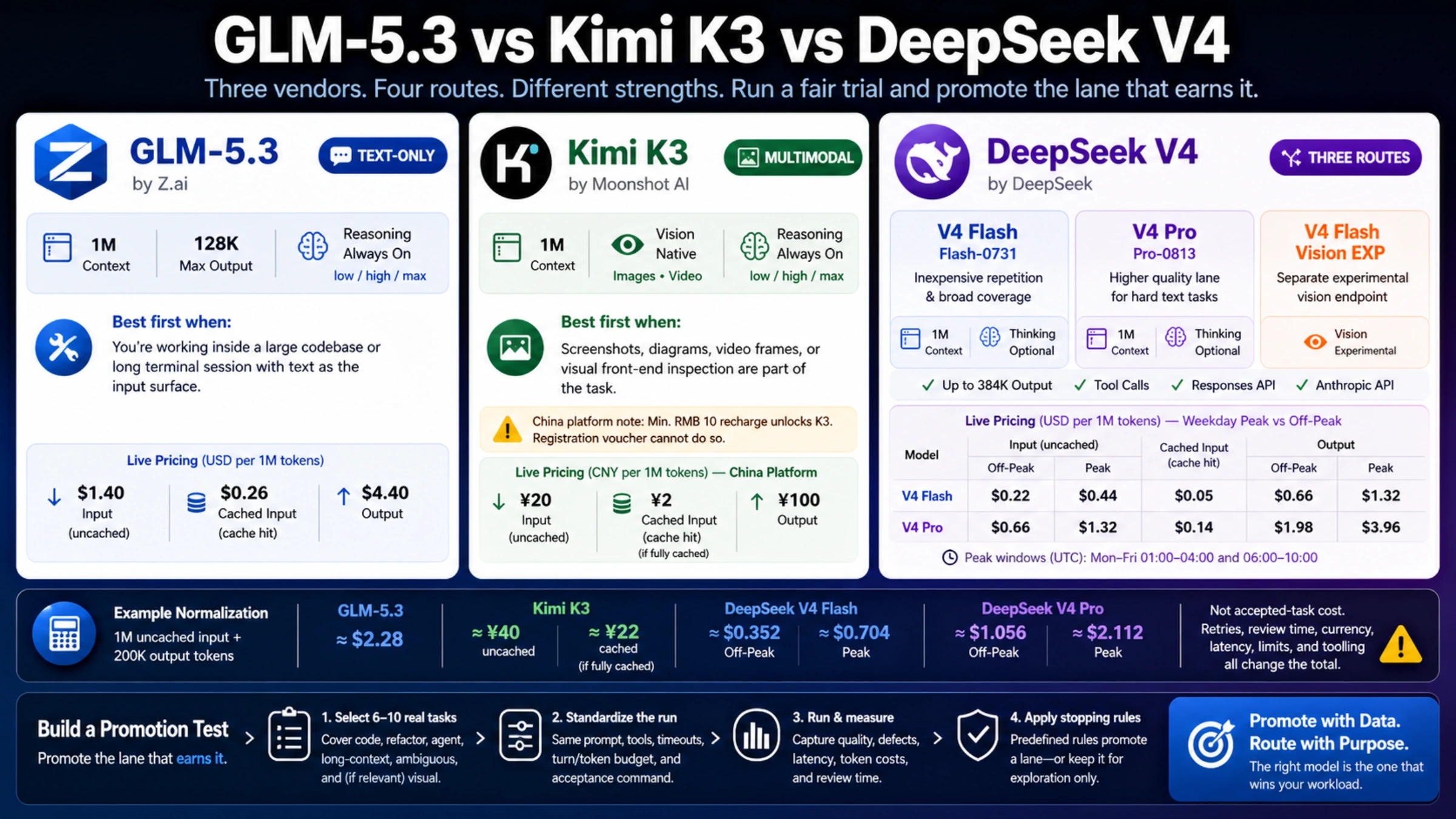
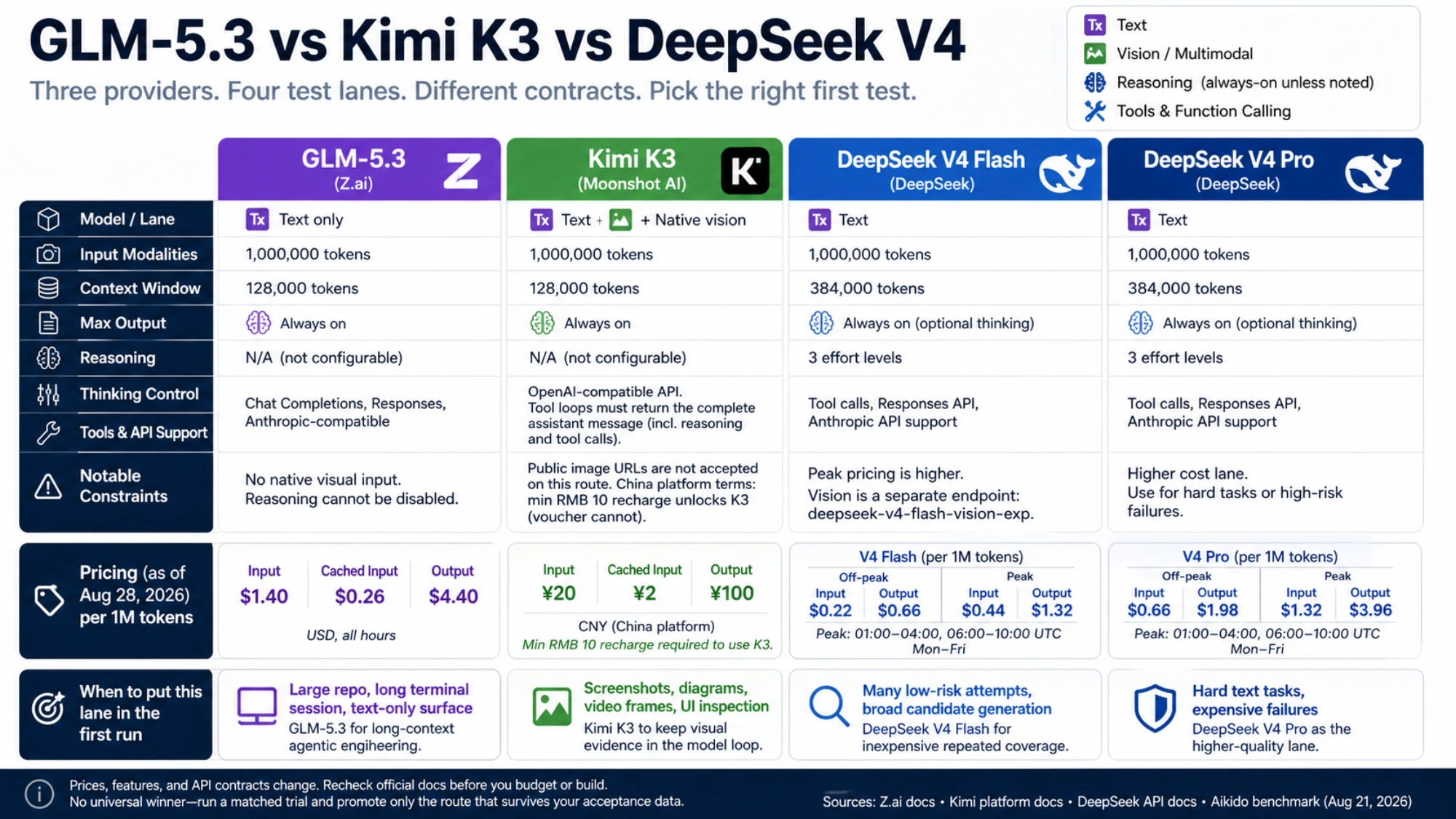
There is no honest one-line winner here. The useful shortlist is conditional: test GLM-5.3 first for text-only, long-horizon engineering; test Kimi K3 first when images or video are part of the task; test DeepSeek V4 Flash first for inexpensive repeated coverage, with V4 Pro as the higher-cost quality lane.
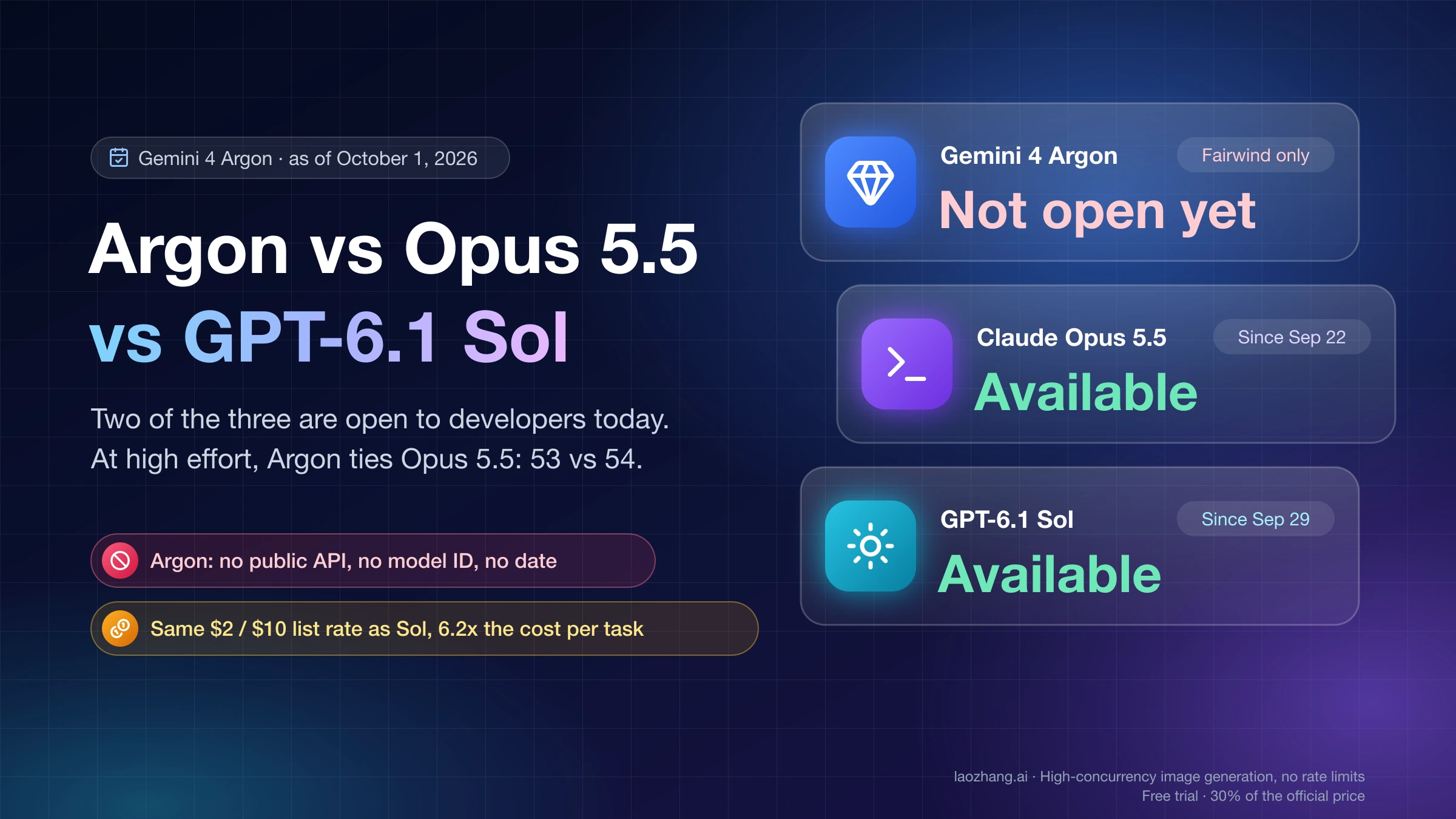
That recommendation is a starting order, not a default-model verdict. The three vendors expose different model contracts, and “DeepSeek V4” is itself a family. A fair decision begins by choosing the exact routes that will enter the test.
These are four test lanes, not three interchangeable models
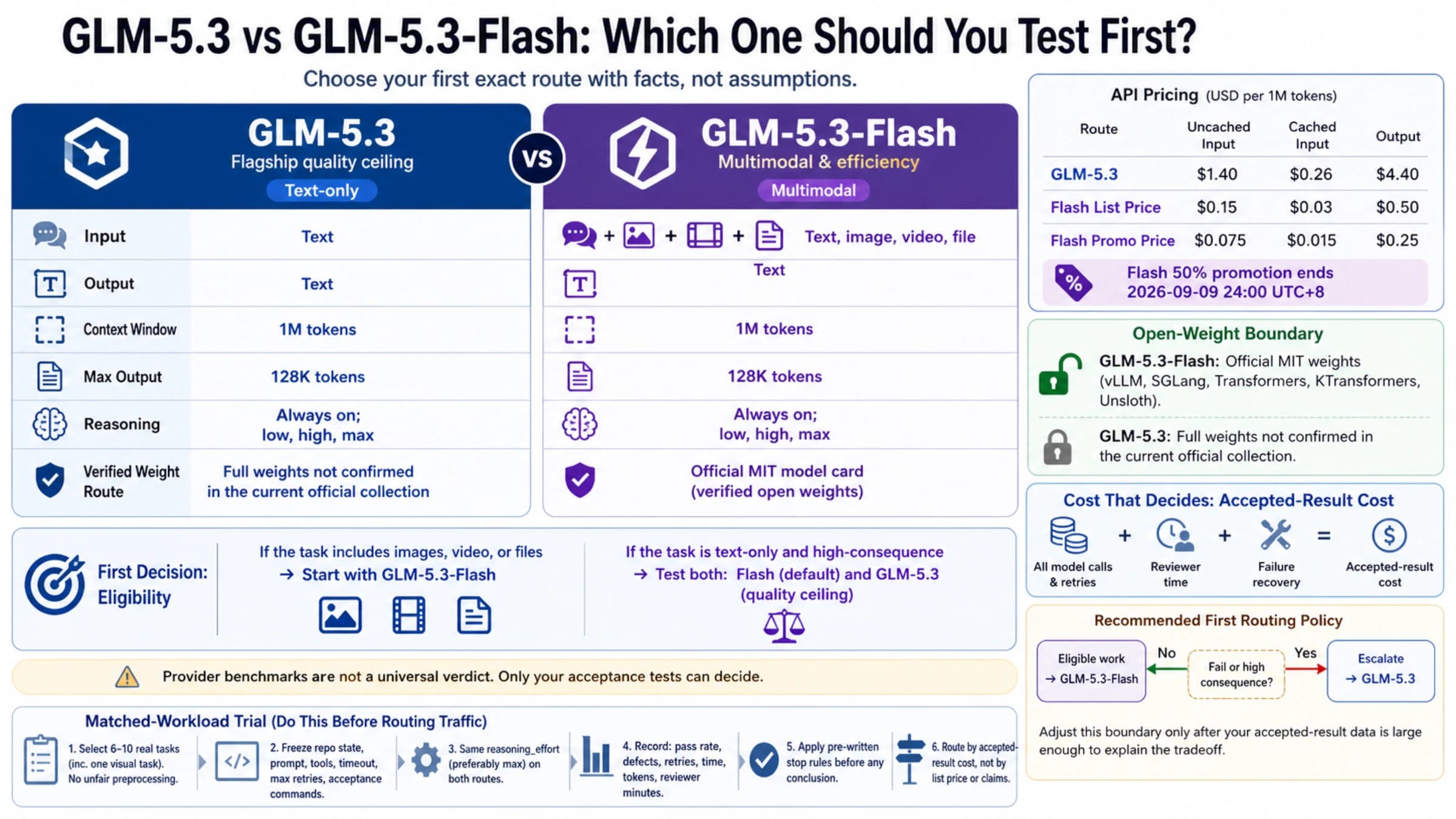
glm-5.3 is a text-input model with a 1-million-token context window and a maximum 128K-token output. Reasoning cannot be disabled; the caller selects low, high, or max. Z.ai documents Chat Completions-, Responses-, and Anthropic-compatible routes in the GLM-5.3 model guide.
kimi-k3 also has a 1M context window and always-on reasoning, but it accepts native visual input. Moonshot describes it as a 2.8T-total, 104B-active open-weight MoE model. Its API guide matters more than the parameter headline: tool loops must preserve and return the complete assistant message, including reasoning and tool calls, and public image URLs are not accepted on that route.
DeepSeek splits the decision. The current text routes are deepseek-v4-flash (Flash-0731) and deepseek-v4-pro (Pro-0813). Both list 1M context, up to 384K output, optional thinking, three effort levels, tool calls, Responses API and Anthropic API support. Vision is a separate experimental endpoint, deepseek-v4-flash-vision-exp. Those distinctions are visible in DeepSeek's current models and pricing table.
| If this is the constraint | Put this lane into the first run | Why it belongs there |
|---|---|---|
| A large repository and long terminal session, with text as the input surface | GLM-5.3 | Its current contract is built around long-context agentic engineering, without a vision-route ambiguity |
| Screenshot feedback, diagrams, video frames, or visual front-end inspection | Kimi K3 | Native multimodality keeps the visual evidence in the model loop |
| Many low-risk attempts or broad candidate generation | DeepSeek V4 Flash | The hosted token rates make repetition comparatively cheap |
| Hard text tasks where a failure is expensive | DeepSeek V4 Pro | It provides the stronger DeepSeek lane without pretending Flash and Pro are the same model |
Cost depends on cache state and clock time
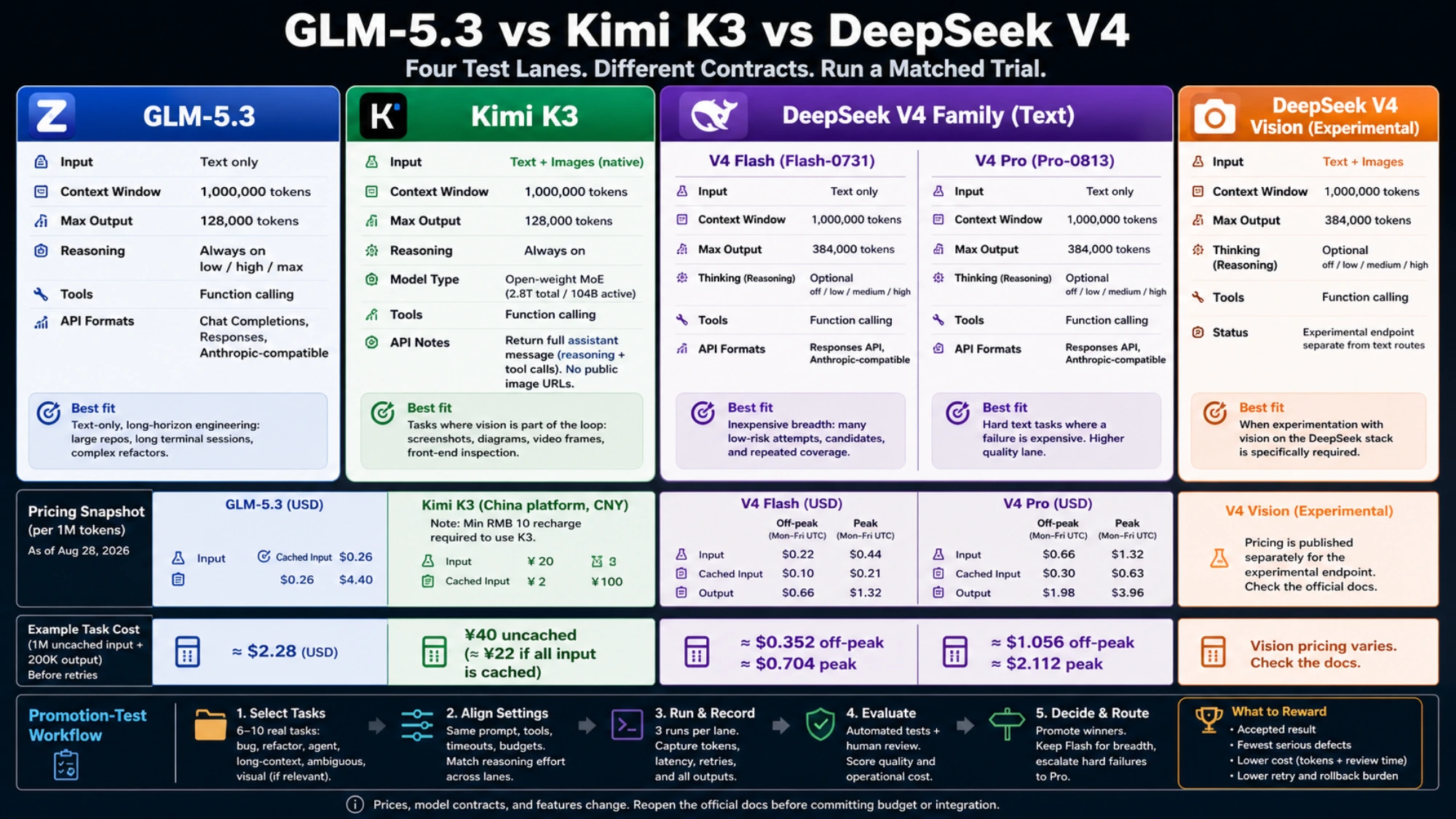
The live price rows do not share one currency or one billing shape. As checked on August 28, 2026, Z.ai lists GLM-5.3 at $1.40 input, $0.26 cached input, and $4.40 output per million tokens.
Kimi's China platform shows K3 at ¥20 input, ¥2 cached input, and ¥100 output per MTok. Its documentation also says a minimum RMB 10 recharge unlocks K3 and that the registration voucher cannot do so. Those are China-platform account conditions, not universal terms for every Kimi provider.
DeepSeek applies weekday peak and off-peak rates. V4 Flash costs $0.22 input and $0.66 output off peak, or $0.44 and $1.32 at peak, per million tokens. V4 Pro costs $0.66/$1.98 off peak and $1.32/$3.96 at peak. Cache-hit input is cheaper again. Peak windows are 01:00–04:00 and 06:00–10:00 UTC, Monday through Friday.
For a concrete normalization, take one task with 1M uncached input tokens and 200K output tokens, before retries:
- GLM-5.3: about $2.28;
- DeepSeek V4 Flash: about $0.352 off peak or $0.704 at peak;
- DeepSeek V4 Pro: about $1.056 off peak or $2.112 at peak;
- Kimi K3 on the China platform: ¥40 uncached, or about ¥22 if the entire input qualifies for the cached rate.
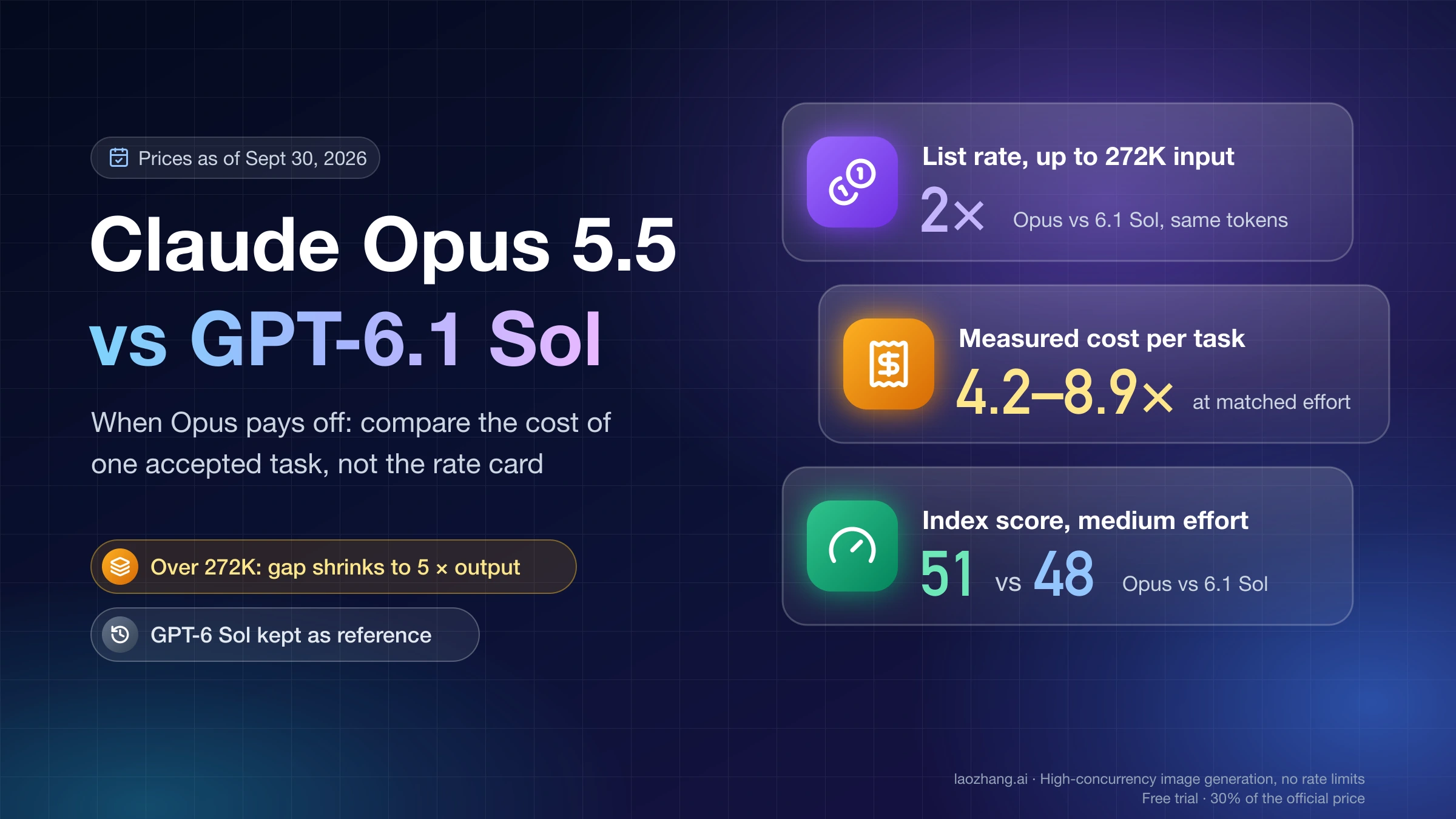
This is not accepted-task cost. A cheap run that needs three retries and forty minutes of review can lose to a higher token rate. Currency conversion also does not fix regional access, rate limits, latency, or provider-specific tooling. Reopen the official pages before committing a budget.
One independent result is useful precisely because it is narrow
Vendor launch tables are not a shared tournament. Their harnesses, tools, reasoning effort, token budgets, and datasets differ.
Aikido's August cyber benchmark offers a better example of how to compare: it froze 32 recently disclosed vulnerabilities, prompts, tools, and evaluation policy, then ran each model three times. In that vulnerability-discovery workload, DeepSeek V4 Pro-0813 achieved the highest pooled recall. Kimi K3 had the highest pooled precision among the tested open-weight models. GLM-5.3 combined strong recall and consistency.
The result does not settle front-end coding, visual understanding, document work, or your agent stack. It shows why the evaluation design matters. Repetition improved coverage, but aggressive exploration also created false leads. The operational question is not just “how many tasks did the model touch?” It is “how many acceptable results survived verification, and what did that cost?”
Build a promotion test, not a demo
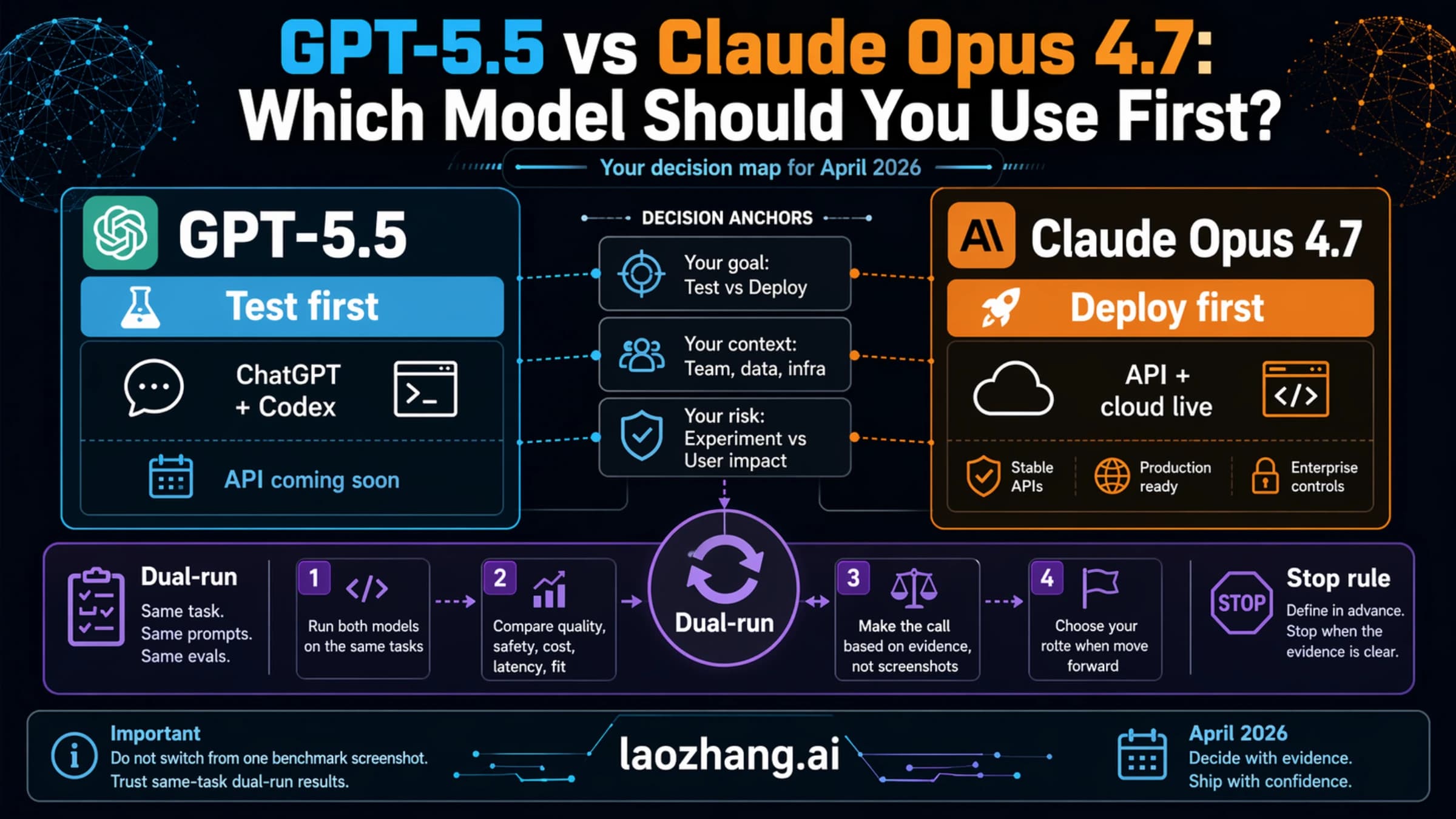
Choose six to ten tasks from actual work: a cross-file bug, a medium refactor, a tool-heavy agent job, a long-context analysis, an ambiguous request, and—if relevant—a visual front-end task. Freeze the repository or input snapshot. Give every eligible lane the same prompt, tools, timeout, turn/token budget, and acceptance command.
Align reasoning deliberately. GLM-5.3 and Kimi K3 always reason; DeepSeek can run with or without thinking. A comparison between Kimi at max and DeepSeek without thinking measures configurations, not model names. That can be useful, but label it as the production configuration you actually intend to buy.
Record more than pass/fail:
- accepted output and automated-test result;
- blocker, major, and minor defects;
- missing files, tool loops, format drift, and retries;
- first-token and end-to-end latency;
- uncached input, cached input, output, and retry charges;
- reviewer minutes and rollback difficulty.
Write the stopping rules before the run. One blocker can keep a candidate out of the default lane. Three retries for a routine task can limit it to cheap exploration. Review time above twice the current baseline can erase a token-price advantage.
A practical routing policy
Use GLM-5.3 as the text-only long-horizon challenger. Its strength hypothesis is sustained engineering work; its visible boundary is no native visual input and no non-reasoning mode.
Use Kimi K3 where vision and code or long-form knowledge work belong in one context. If self-hosting matters, evaluate its open weights and Kimi K3 License separately from hosted-API pricing and infrastructure cost.
Use DeepSeek V4 Flash to buy breadth: more low-risk attempts, candidates, and repeated search. Escalate failures or high-cost mistakes to V4 Pro. If batch jobs can move outside the weekday peak window, scheduling becomes part of model selection.
If your task is only the DeepSeek family migration—model IDs, retired aliases, and Flash-versus-Pro integration—use the narrower DeepSeek V4 API guide. For a cross-provider default, keep all three lanes in a small matched trial and promote only the route that survives your acceptance data.
Sources5
External pages this guide links to, in the order they appear. Last updated Aug 28, 2026.
Sources5
External pages this guide links to, in the order they appear. Last updated Aug 28, 2026.
- 1.GLM-5.3 model guidedocs.z.ai/guides/llm/glm-5.3
- 2.API guideplatform.kimi.com/docs/guide/kimi-k3-quickstart
- 3.current models and pricing tableapi-docs.deepseek.com/quick_start/pricing
- 4.Z.ai lists GLM-5.3docs.z.ai/guides/overview/pricing
- 5.Aikido's August cyber benchmarkaikido.dev/blog/ai-model-benchmarks-aug-21-2026