Qwen3.8 Flash-Next vs 27B: Which Model Should You Run Locally?
Start with Qwen3.8-27B when memory, a simpler serving setup, and Apache-2.0 matter most. Test Flash-Next if you can host its much larger weights and want to evaluate its reported advantages on coding and agent tasks.
On this page
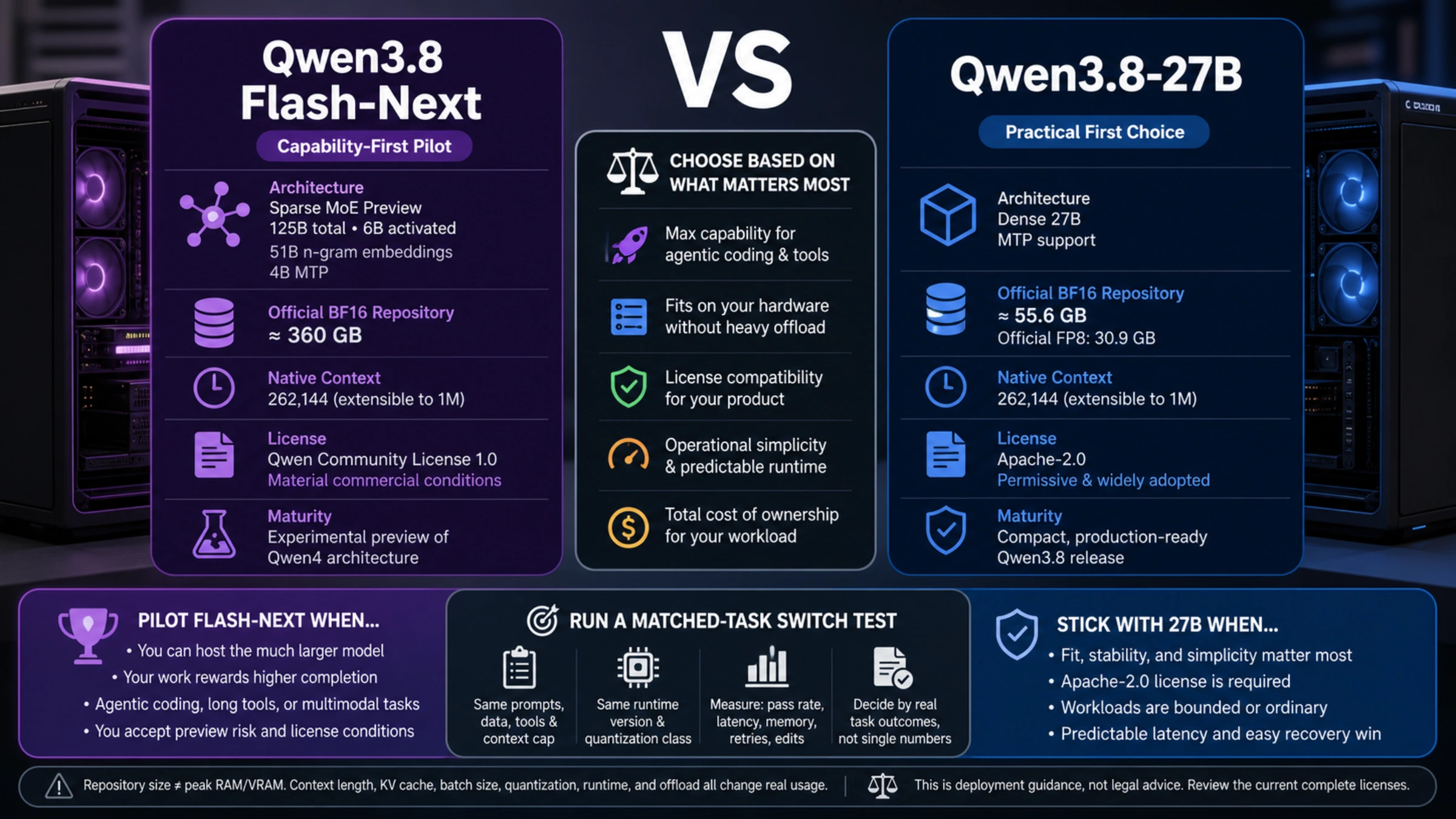
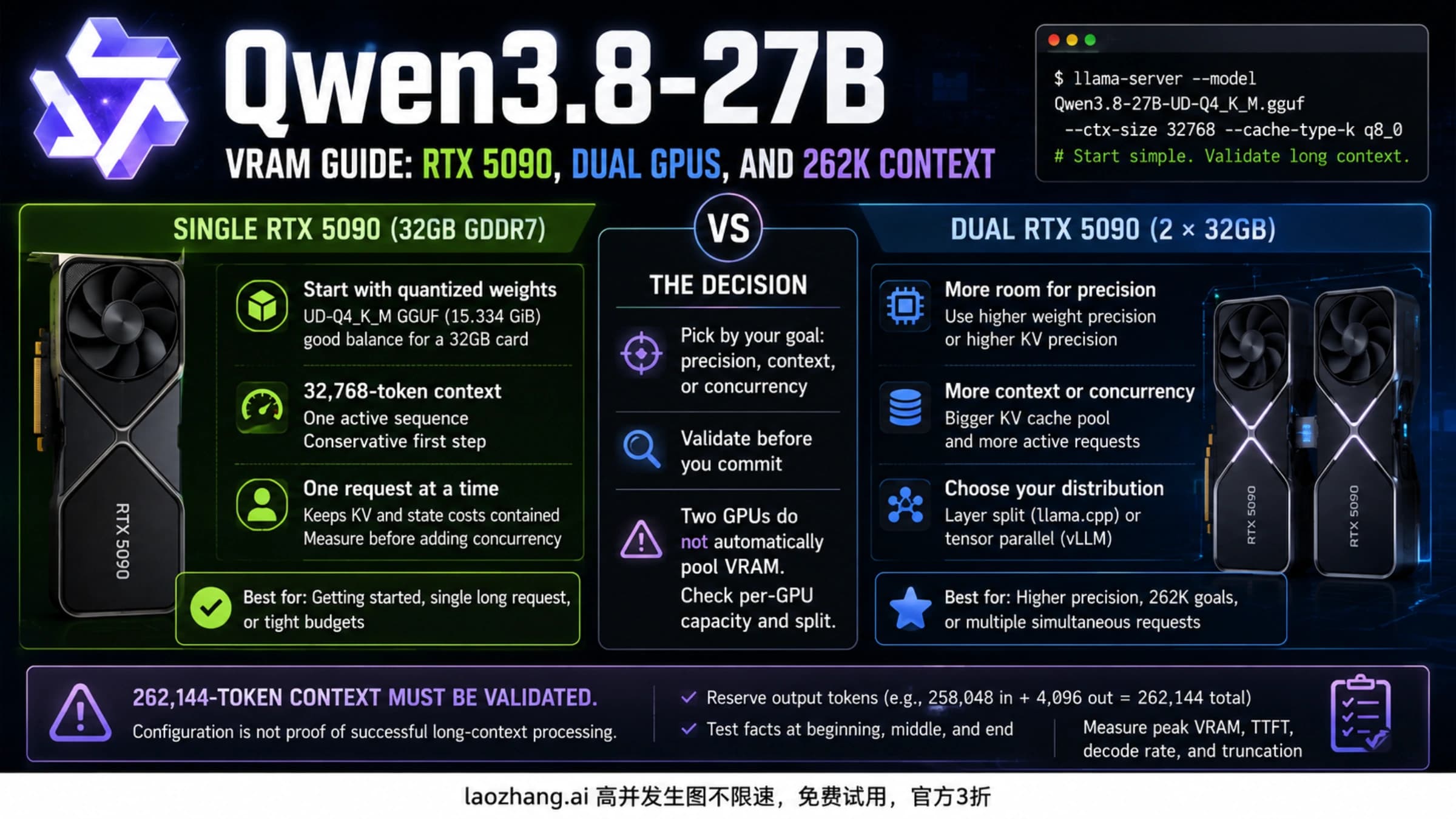
For most single-workstation deployments, Qwen3.8-27B is the safer first model. It is a 27B dense model, its official BF16 repository is about 55.6 GB, an official FP8 build is 30.9 GB, and the base repository is labeled Apache-2.0. It is the easier route when your priority is fitting the model, keeping the serving stack understandable, or shipping under a familiar permissive license.
Test Qwen3.8-Flash-Next when difficult tasks justify a larger deployment; it is not the small-memory option its name might suggest. Qwen describes it as a 125B sparse MoE with 6B activated per token, plus 51B of n-gram embeddings and 4B of multi-token-prediction parameters. Its official BF16 repository was about 360 GB at the checked revision. Qwen reports stronger results than 27B across most of its side-by-side coding, agent, and multimodal evaluations, but you must be able to host the much larger resident weight set and accept an experimental architecture and a different license.
The practical rule is simple: choose 27B when the model must fit cleanly and operate predictably; test Flash-Next when task completion is worth more than compact deployment and your system can hold or efficiently offload it. Do not switch defaults until both run the same work under the same constraints.
The Numbers That Actually Change the Choice
| Decision factor | Qwen3.8-Flash-Next | Qwen3.8-27B | Why it matters |
|---|---|---|---|
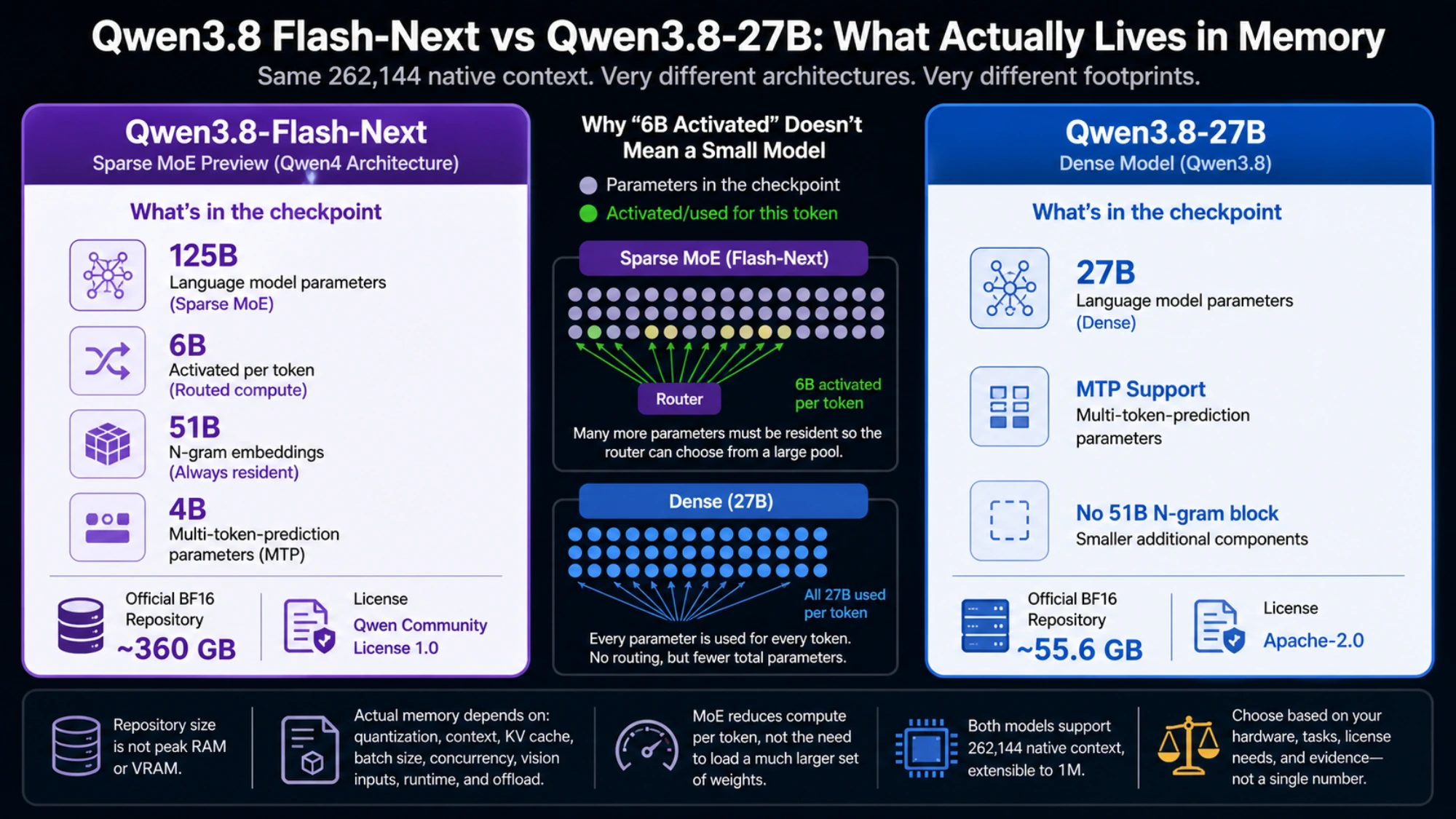
| Architecture | Sparse MoE preview, 125B language model with 6B activated | Dense 27B | Active compute and resident memory are different dimensions |
| Additional parameter blocks | 51B n-gram embeddings and 4B MTP | MTP support, no 51B n-gram block listed | “A6B” does not describe the download or total memory |
| Native context | 262,144 tokens | 262,144 tokens | Long context still consumes runtime memory |
| Official BF16 repository | About 360 GB at the checked Flash-Next revision | About 55.6 GB | Establishes the order-of-magnitude footprint before KV cache and runtime overhead |
| Official FP8 repository | Check the current exact release | 30.9 GB | Precision changes the fit; it also changes the stack being evaluated |
| License | Qwen Community License 1.0 | Apache-2.0 | License conditions can determine whether a commercial deployment is viable |
| Maturity | Experimental preview of a Qwen4 architecture | Compact dense Qwen3.8 release | Preview risk matters in production operations |
These rows come from the official Qwen3.8-Flash-Next model card, Qwen3.8-27B model card, and their repository listings. Repository size is not a promise about peak RAM or VRAM. Quantization, context, KV cache, batch size, concurrency, vision inputs, runtime implementation, and CPU offload all change the number you will see.
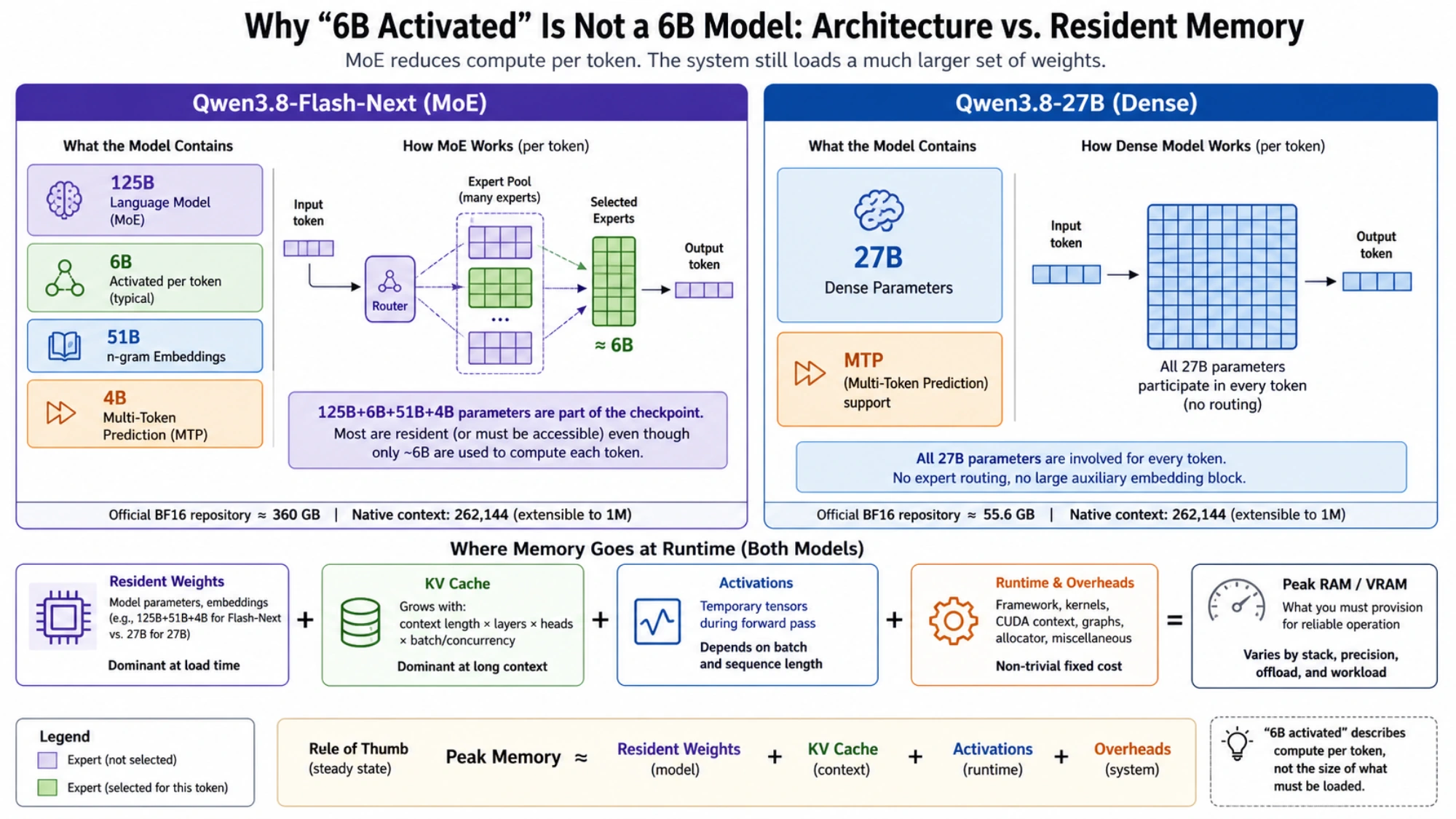
The most common mistake is reading “6B activated” as “a 6B model.” MoE routing can reduce the compute used for each token while the system still needs access to a much larger set of weights. Flash-Next also carries its large n-gram embedding block. That architecture may be compute-efficient on the right stack, but it does not turn the checkpoint into a small dense model.
What the Official Benchmarks Do and Do Not Prove
Qwen's own comparison table gives Flash-Next the higher score on most published rows. The largest practical-looking gaps include DeepSWE 1.1, where Qwen reports 58.7 versus 42.2, and JobBench, where it reports 55.7 versus 33.4. Other gaps are much smaller: SWE-bench Pro is 62.5 versus 61.7. Flash-Next also leads the listed multilingual software-engineering, tool-use, office-work, and several multimodal rows.
That is a strong reason to put Flash-Next into a pilot. It is not a reason to declare it universally better. The benchmark notes identify specific harnesses, temperatures, context windows, corrected tasks, in-house evaluations, and judge models. Some rows measure pass rate, some average scores, and some use the better of multiple harnesses. A model that leads a vendor table can still lose your repository task because of quantization, tool wrapper, prompt template, latency limits, or a failure mode the benchmark does not cover.
Treat the table as a hypothesis: Flash-Next should be tested first when agentic coding, professional workflows, long tool loops, or multimodal work are important. Treat your accepted task result as the decision.
When 27B Is the Better Model
Choose 27B first when one or more of these conditions are true:
- The model needs to fit on a single machine without aggressive offload.
- You want a dense architecture with fewer moving parts in the serving plan.
- Apache-2.0 is important for distribution, integration, or commercial review.
- Your workload is bounded enough that the official benchmark gap may not affect acceptance.
- Stable latency and easy recovery matter more than winning the hardest agent task.
- You already have a validated 27B quantization and would otherwise change model, precision, runtime, and prompt template at once.
This is not settling for a weak model. Qwen positions 27B as a native vision-language model for coding, professional work, research, and long-horizon agents. Its own results are competitive on many rows, and the small SWE-bench Pro gap is a reminder that “larger preview wins everything” is the wrong summary.
27B may also be more practical when your hardware budget forces Flash-Next into a heavily compressed or offloaded configuration while 27B can run at higher precision. Comparing a low-bit, memory-bound Flash-Next build with a comfortable 27B build is a comparison of two deployment stacks, not architecture alone.
When Flash-Next Earns the Extra Footprint
Pilot Flash-Next when your machine can host the chosen build and the work is expensive enough to reward better completion. Good candidate workloads include multi-file coding loops, long tool sequences, application recreation, multilingual software engineering, multimodal agents, and professional tasks where one missed constraint causes substantial rework.
The architecture is genuinely different. Qwen describes sparse attention, gated residual paths, a large n-gram embedding layer, and a tailored training recipe as an experimental preview of the foundation intended for Qwen4. That makes Flash-Next interesting for teams that want to evaluate where the family is going, not only where Qwen3.8 already is.
It also increases operational uncertainty. Runtime support may arrive at different speeds, throughput can vary sharply by framework, and community quantizations may make different tradeoffs. Use a recent vLLM, SGLang, TokenSpeed, llama.cpp, or another runtime only after confirming that its exact release supports the architecture and the media or reasoning controls you need.
The License Can Decide Before the Benchmark Does
The official Flash-Next repository uses Qwen Community License 1.0. It grants broad rights to use, modify, distribute, deploy, host, and fine-tune, but it also contains material conditions. Large commercial products above stated user or revenue thresholds have a model-name display requirement. Commercial “Model as a Service” and “AI Work Assistant” businesses, as the license defines them, must obtain a separate license from Qwen. Internal use has a stated exception when the model, outputs, and capabilities are not made available to third parties.
Qwen3.8-27B is labeled Apache-2.0 in its official repository. If your product is a hosted model endpoint, coding assistant, or office assistant, this difference deserves review before performance testing becomes an implementation commitment.
Check these licensing conditions before deployment. Read the current complete license and have the appropriate reviewer map it to your actual product, users, revenue, and distribution model.
Do Not Confuse Flash-Next with the Hosted Flash Model
Qwen/Qwen3.8-Flash-Next is the open-weight model discussed here. qwen3.8-flash is a hosted Qwen Cloud model based on Flash-Next with production features such as a default 1M context and built-in tools. It has provider pricing, rate limits, tool behavior, and service availability that do not belong to the self-hosted checkpoint.
If you want the capability direction but not the infrastructure, the hosted model is a separate alternative to evaluate. If you want control over weights, privacy, quantization, and serving, stay with the open-weight comparison. Do not copy hosted pricing or SLA assumptions into a local cost calculation.
Run a Matched-Task Switch Test
Pick six to ten tasks with observable acceptance. Include at least one task that should favor Flash-Next's claimed strengths and one ordinary task where 27B's operational simplicity should matter.
| Keep identical | Record for each model |
|---|---|
| Prompt, system rules, files, images, and tool permissions | Accepted or rejected outcome |
| Context cap and truncation policy | Missed constraints and unsupported claims |
| Runtime version and prompt template | Load failures, crashes, and recovery time |
| Quantization class where possible | Peak memory, time to first token, and completion time |
| Test command and human rubric | Test pass rate, reviewer edits, and retries |
Do not compare a short-context 27B run with a maximum-context Flash-Next run, or a polished community quantization with an unsupported preview build, and call the result a model verdict. Document the whole stack.
Keep 27B as the default if Flash-Next's extra accepted tasks do not compensate for memory pressure, slower recovery, license work, or reviewer time. Move Flash-Next forward if it consistently completes the expensive tasks with fewer retries and the infrastructure stays within budget. Keep both if the result is workload-specific: 27B for interactive daily work and Flash-Next for queued high-value jobs is a reasonable division of work.
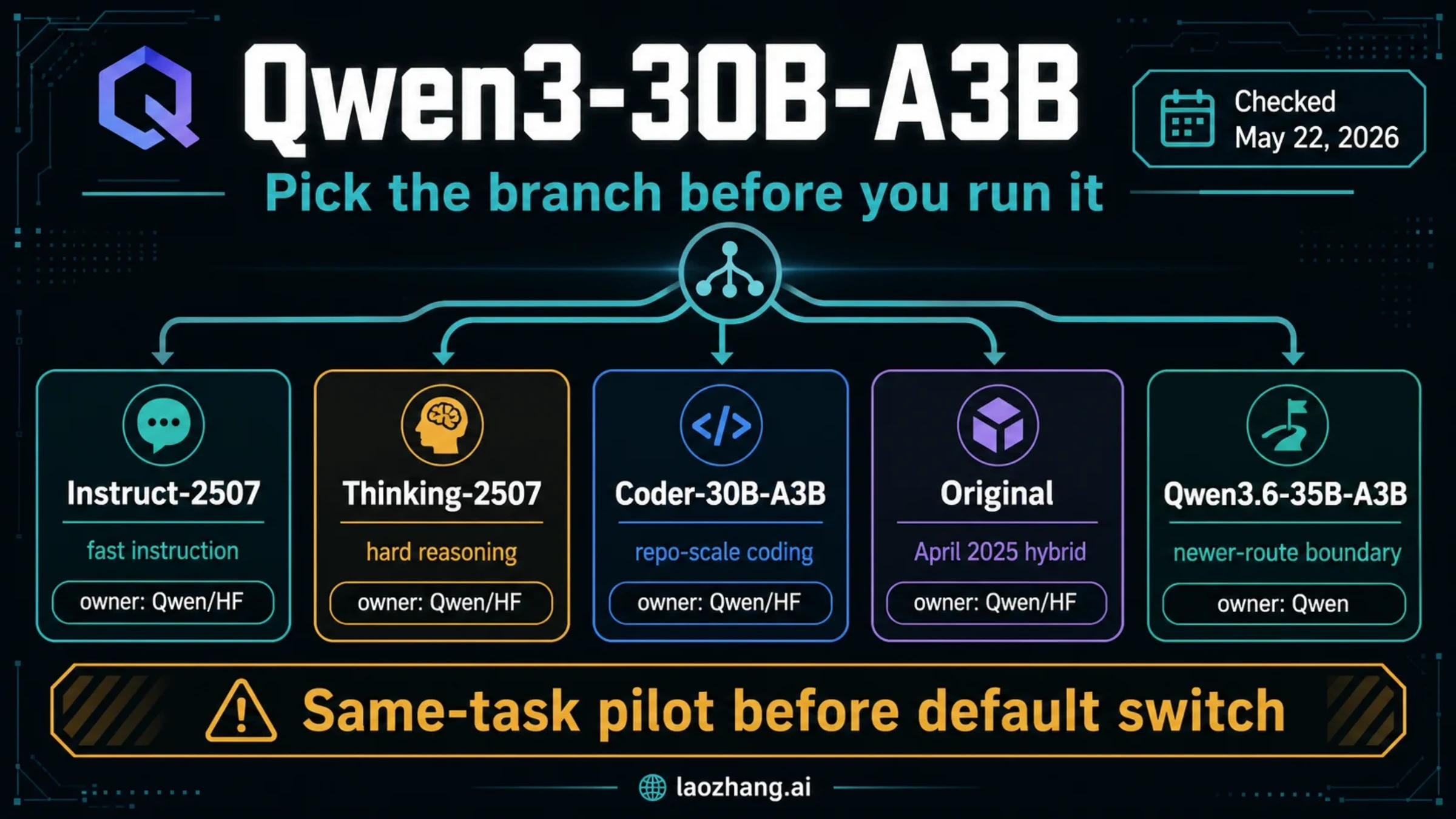
For a smaller Qwen model, use the Qwen3-30B-A3B local guide. If your machine has only 16 GB of VRAM, start with the 16 GB local coding LLM guide before assuming either full model fits.
Sources3
External pages this guide links to, in the order they appear. Last updated Sep 2, 2026.
Sources3
External pages this guide links to, in the order they appear. Last updated Sep 2, 2026.